Skip to content

Boning vs Silicone Elastic in Strapless Dresses: Which Support System Works Best?
Your trusted Women’s Apparel Development & Manufacturing Partner from China
- Jerry
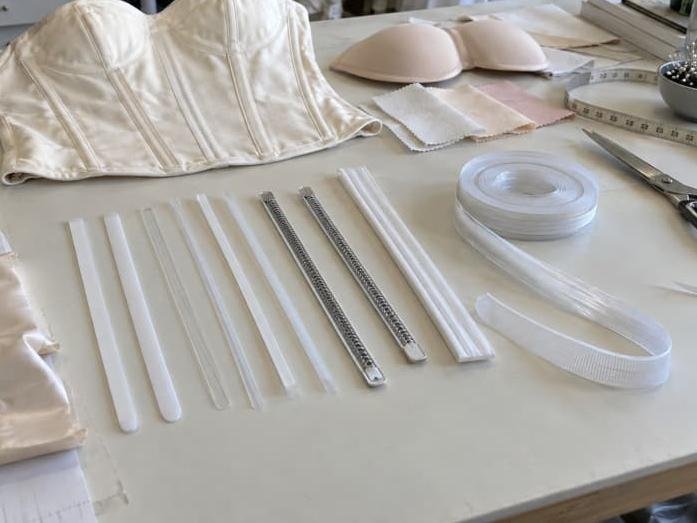
A strapless dress can look completely secure in a fitting-room mirror and become a very different garment after twenty minutes of walking, sitting, dancing, reaching, or simply breathing normally. The reason is easy to miss: keeping a strapless dress in place is not one job. The bodice has to maintain its vertical shape, stay close to the upper torso, manage bust volume, resist downward load from the skirt, and remain comfortable while the body moves. Boning and silicone elastic can both contribute to that result, but they solve different mechanical problems. When product teams treat them as interchangeable fixes, they often end up making a neckline tighter without making the dress more stable, or adding stiff reinforcement to a bodice whose real problem is pattern balance. The more useful approach is to look at the whole support system: pattern fit, fabric recovery, lining, cups, boning, grip elastic, waist anchoring, garment weight, and movement all have to work together.
Boning and silicone elastic are not direct substitutes in a strapless dress. Boning provides vertical structure and helps the bodice maintain its intended shape, while silicone elastic increases friction along the upper edge to reduce slipping. Lightweight stretch styles may rely mainly on fit, recovery, and grip, while structured, corset-inspired, or heavier dresses often perform better when boning and silicone elastic work together as part of a complete support system.
This distinction becomes very obvious during sampling. A dress may come back from fitting with the comment “top keeps falling down,” and the quickest reaction is often to tighten the elastic. Yet the actual cause may be an oversized underbust, too much neckline length, incorrect cup position, weak fabric recovery, or a skirt that is pulling the entire bodice downward. Experienced dress development is less about adding stronger components and more about identifying which force is causing the problem. Once that is understood, the support solution usually becomes much simpler—and the finished dress feels far more natural to wear.
What Do Boning and Silicone Elastic Do?
Boning mainly provides structure, vertical stability, and shape control, while silicone elastic mainly adds friction at the neckline to reduce downward movement. Neither component replaces correct fit. In well-developed strapless dresses, the pattern establishes body contact, boning helps the bodice resist collapse, and silicone grip helps the upper edge stay in position as the wearer moves through normal daily or occasion activities.
What Does Boning Control?
Boning acts like a lightweight framework inside the bodice. Its job is to help the garment keep the three-dimensional shape created by the pattern, seams, cups, lining, and supporting layers. This becomes particularly important around princess seams, side seams, center-front panels, and closure areas where the fabric is expected to remain vertically stable rather than fold or shorten as the wearer moves. A dress can technically stay on the body without enough boning and still look poorly developed because the waist collapses upward, the bust seam wrinkles, or the upper bodice begins folding below the neckline.
The amount of boning needed depends much more on silhouette and material than on the simple fact that a garment has no straps. A soft stretch tube mini may need none, while a satin midi with shaped cups can need several carefully positioned reinforced zones. A corset-inspired dress may need additional support because the vertical panel lines are part of the intended look. The goal is not maximum rigidity. Excessively stiff boning can fight curved seams, create visible ridges through satin, restrict sitting, or concentrate pressure at bone ends. Good development uses the least reinforcement necessary to preserve the intended shape consistently.
Bone length deserves the same attention as bone type. When a bone stops too far below the top edge, the unsupported section above it may buckle or flare away from the body. When it finishes too close to the edge, the bone end can create a visible pressure point. If the channel is much wider than the bone, the reinforcement may rotate instead of supporting the seam consistently. These details are why an effective production specification should identify individual bone positions and lengths rather than simply state “add boning to bodice.”
How Does Silicone Elastic Grip?
Silicone elastic works at the contact point between garment and wearer. It is usually positioned inside the upper edge so the silicone-coated area touches the skin and creates additional friction. This makes it harder for the neckline to migrate downward during walking, reaching, sitting, or dancing. It is particularly useful in styles where the overall fit is already correct but the upper edge needs more security against gradual movement.
The elastic base is just as important as the silicone itself. Two gripper elastics can appear nearly identical while behaving differently because their base material, recovery, thickness, silicone pattern, surface feel, and stretch resistance are different. One may recover quickly after repeated extension, while another gradually grows. A more aggressive silicone pattern may increase grip but also increase skin pressure or discomfort. For that reason, “silicone elastic” is not a sufficiently precise trim description for a repeatable commercial product.
A useful development record includes the elastic supplier reference, width, silicone layout, cut length, finished neckline measurement, overlap, placement, and stitch method. For example, a sample might use a 10 mm elastic successfully, but that does not make 10 mm a universal specification for strapless dresses. The performance comes from how that particular elastic interacts with the shell, lining, neckline shape, wearer, and application tension. Recording those details prevents later production teams from trying to recreate the result by feel.
Are They Designed for the Same Job?
Boning and silicone elastic influence the same overall goal—keeping a strapless dress stable—but they act in different ways. Boning resists deformation within the bodice. Silicone elastic resists movement at the skin-contact edge. Pattern fit determines whether the dress sits in the correct place to begin with, while cups, support layers, waist control, and seam shaping may carry additional loads that neither boning nor silicone should be expected to manage alone.
Support Element | Primary Role | Typical Area | Helps Control | Cannot Reliably Correct Alone |
Boning | Vertical structure | Princess seams, side seams, bodice panels | Folding, buckling, vertical collapse | Incorrect neckline circumference |
Silicone elastic | Surface grip | Inside neckline or upper edge | Slipping and edge migration | Weak internal structure |
Cups | Bust shaping | Bust area | Bust contour and positioning | Loose waist or ribcage |
Support lining | Tension distribution | Full or partial bodice | Local stretching and instability | Incorrect pattern balance |
Waist support | Load anchoring | Waist or ribcage | Downward garment load | Poor bust shaping |
Pattern fit | Body-to-garment balance | Whole bodice | Gaping, anchoring, proportion | Weak materials or construction |
Many disappointing samples result from strengthening the wrong element. A neckline that gaps because its pattern length is excessive does not become properly fitted simply because stronger silicone is installed. A bodice that collapses because the fabric and internal structure are too soft will not suddenly become stable when the top edge is tightened. The most reliable fitting process separates four questions—fit, structure, grip, and load distribution—before deciding which component actually needs to change.
Is Silicone Elastic a Substitute for Boning?
Silicone elastic may remove the need for boning in some lightweight stretch dresses, but it does not replace structural reinforcement when the bodice must hold a defined shape. A close-fitting tube dress can depend heavily on fabric recovery and neckline grip, while a corset, shaped satin bodice, or heavier occasion dress generally needs more internal structure to control vertical stability, bust shape, and downward load.

When Is Silicone Elastic Enough?
Silicone elastic works particularly well as the main added security in dresses that already receive substantial support from stretch fabric and close body contact. A lightweight tube mini, stretch jersey bodycon dress, or simple bandeau silhouette may not need a rigid internal framework because the shell itself follows the torso and creates continuous circumferential tension. In these styles, the grip elastic is improving an existing support system rather than trying to create one from nothing.
Fabric recovery is often more important than headline stretch percentage. Consider a 100 mm reference section of fabric that can comfortably extend to 130 mm. That represents approximately 30% extension. If it immediately returns to 101 mm after release, its behavior is quite different from another 30%-stretch fabric that settles at 105 mm. Both materials may be sold as having similar stretch, yet the second one is much more likely to grow around a strapless neckline during extended wear.
This kind of bench test should not be treated as a universal pass-or-fail standard. Its value is comparison. By using the same marked length, extension method, number of cycles, and recovery time on sample fabric, replacement fabric, and bulk fabric, product teams gain objective information rather than relying on comments such as “this fabric feels stretchier.” When the fabric does most of the support work, that information becomes particularly important because silicone grip cannot restore recovery that the shell or lining does not have.
When Is Boning Necessary?
Boning becomes more useful as the design asks the bodice to maintain a defined three-dimensional form independently of the wearer’s body. Sweetheart necklines, shaped cups, corset seams, structured satin, fitted woven fabrics, long torso panels, heavier skirts, deep neckline shapes, and embellished occasion dresses commonly increase this requirement. In those garments, the bodice has to do more than remain close to the body; it must preserve its own shape throughout wear.
Imagine two dresses with similar bust measurements. A lightweight stretch mini might weigh around 350 g, while a lined satin maxi with draping and decoration might approach 900 g or more depending on fabric, size, and construction. These are illustrative values rather than industry standards, but the difference shows the mechanical problem clearly. The heavier garment places far more continuous downward load on the bodice, so relying on neckline friction alone can concentrate too much pressure at the upper edge.
Boning can also improve visual stability even when a dress is not in danger of falling down. A poorly supported bodice may develop vertical collapse, waist shortening, seam waviness, or wrinkles around the bust during movement. A commercial strapless dress therefore needs to pass two tests at the same time: it should remain securely positioned, and it should continue to look like the approved silhouette after the wearer has moved around in it.
Can Either One Fix Poor Fit?
Neither boning nor silicone elastic can reliably correct a fundamentally incorrect pattern. Before changing trims, an experienced fitter checks upper-bust circumference, full-bust volume, underbust relationship, waist position, side-seam balance, neckline length, bust apex position, and torso length. A problem that looks like insufficient support may actually begin with one of these measurements being out of balance.
The symptoms provide useful clues. If the entire dress moves downward while the neckline remains close to the skin, the issue may involve insufficient anchoring, poor waist or underbust fit, or excessive garment weight. If the neckline opens away from the body without much vertical movement, the upper-edge shape or bust volume may be wrong. If the neckline feels painfully tight while the lower bodice continues to wrinkle, the dress may be using excessive top-edge tension to compensate for an unstable torso fit.
Adding stiffer boning to the wrong pattern can make the wearer feel the mistake more strongly because the garment now holds the incorrect shape with greater force. Increasing elastic tension may create deeper skin pressure while leaving the underlying geometry unchanged. The more efficient approach is to determine whether the failure is primarily geometric, structural, friction-related, or load-related, then correct the component that actually controls that problem.
Which Strapless Dresses Need One or Both?
Different strapless silhouettes need different support systems. Stretch tube dresses may rely primarily on fabric recovery and grip, while bodycon dresses can require selective reinforcement. Corset and bustier styles usually need a more deliberate internal framework, and heavier occasion dresses often perform best when boning, grip elastic, lining, cups, and waist-level load control share the work instead of relying on a single component.

What Works for Stretch Tube Dresses?
A stretch tube dress is one of the clearest examples of a strapless garment that can perform well with relatively simple construction. When the shell and lining have reliable recovery, the pattern uses sensible negative ease, and the finished garment is light, the whole bodice can participate in holding itself against the torso. Silicone elastic then acts as extra security along the upper edge rather than as the main force supporting the dress.
The common mistake is assuming that additional tightness always improves security. Too much negative ease can flatten the bust, pull side seams forward, distort prints, create horizontal drag lines, or cause the garment to migrate toward narrower areas of the torso. Over-tensioned grip elastic can also create rolling and visible skin indentation. These are not just cosmetic problems. They show that the garment is concentrating too much force in one area instead of distributing it across the body.
During development, finished garment measurements should be compared with upper-bust, full-bust, and waist measurements on the fit model. The sample then needs to be reviewed after movement rather than only when standing still. If the neckline stays in place but the side seam rotates forward by several centimeters, the support issue has not really been solved. A successful tube dress should remain secure while still looking relaxed and intentional on the body.
What Works for Bodycon Dresses?
Strapless bodycon dresses sit between soft tube styles and structured corset garments. Their shell fabrics can provide considerable compression, but compression alone does not guarantee bust control or neckline stability. Depending on the silhouette, the construction may combine power mesh, stable lining, shaped cups, side boning, seam reinforcement, silicone grip, and carefully controlled negative ease.
A useful development habit is to separate compression from support. A dress may feel very tight through the waist and hip while remaining loose at the upper bust. A bodycon midi can also create more downward drag than a mini made from the same fabric simply because there is more material below the bodice. When lining, draping, or embellishment is added, the load can change again even if the pattern itself has not changed.
Weighing each finished sample can reveal these changes quickly. If the first version weighs 420 g and the revised version reaches 680 g after lining and decoration are added, the support construction deserves another wear test. The increase does not automatically mean extra boning is required, but it tells the development team that the approved balance has changed. For fitted dresses, neckline movement, side-seam direction, wrinkles, and garment weight are often more informative when reviewed together than any one measurement by itself.
What Works for Corset Dresses?
Corset and bustier-inspired dresses benefit from a clear division of responsibilities inside the bodice. Boning manages vertical stability, cups shape and position the bust, seam lines create contour, support layers distribute tension, and silicone elastic can help the neckline maintain contact with the wearer. When these jobs are shared correctly, the garment can feel secure without needing excessive pressure at the upper edge.
One of the most common development shortcuts is tightening the neckline after a corset dress slips. This may improve the first few minutes of wear, but it forces the upper edge to carry a load that should be supported lower on the torso. Better results often come from improving underbust and waist anchoring so the ribcage carries more of the garment while the neckline is used mainly for final edge security.
Boning placement also needs to follow the actual panel geometry. A five-panel bodice and a nine-panel bodice may produce similar photographs but require very different reinforcement. Curved seams often perform better with a flexible bone, while straighter closure or center-back areas may tolerate firmer reinforcement. There is little value in using the strongest material everywhere. The best structure maintains the intended shape while remaining discreet, comfortable, and compatible with the shell fabric.
What Works for Heavy Occasion Dresses?
Heavy occasion dresses make load distribution especially important. Long satin skirts, double lining, dense rhinestones, sequins, layered mesh, metal trims, or large draped panels can increase the load acting on the bodice significantly. Once that happens, asking silicone elastic alone to hold the dress becomes inefficient because the force is concentrated at the top edge instead of being transferred through the ribcage or waist.
Dress Type | Illustrative Finished Weight* | Main Support Demand | Common Development Direction |
Stretch tube mini | 250–450 g | Grip and recovery | Fit + silicone elastic |
Strapless bodycon midi | 400–700 g | Compression + edge stability | Grip + selective reinforcement |
Corset mini or midi | 450–850 g | Shape + bust control | Boning + cups + grip |
Satin occasion midi | 550–900 g | Clean vertical structure | Boning + stable lining + grip |
Embellished maxi | 800–1,500+ g | Load distribution | Structured bodice + boning + grip + waist control |
These weight ranges are illustrative development examples, not universal industry standards. Actual weight varies considerably with garment size, fabric GSM, lining, embellishment density, skirt volume, and construction.
The useful number is often not the finished weight itself but the change between development stages. If a plain prototype becomes 40% heavier once production-intent lining and embellishment are added, the original wear-test result should not automatically be carried forward. A heavier version may need a different balance of waist support, boning, lining, or neckline grip even though the outer design appears unchanged.
How Do Fabric and Dress Weight Change the Choice?
Fabric can completely change how boning and silicone elastic behave. Stretch, recovery, weight, drape, thickness, friction, opacity, and lining compatibility determine how much support the material can provide by itself. A construction that performs well in compact stretch jersey may fail in slippery satin, while a lightweight prototype may need a different internal system after a longer skirt, second lining layer, or heavy embellishment is introduced.

How Does Stretch Affect Support?
Stretch should be evaluated in more than one direction because a strapless bodice experiences both horizontal and vertical forces. Crosswise stretch influences compression around the torso, while lengthwise stretch can contribute to vertical growth and neckline movement. Bias movement can also become important in woven satin, crepe, and mesh even when those fabrics are not promoted as stretch materials.
A simple development record can begin with a 100 mm marked section. If that section comfortably extends to 128 mm, the observed extension is 28%. After releasing the fabric, the team records the immediate recovery length and then measures again after a defined rest period. A result of 101 mm behaves very differently from a material that remains at 105 mm, especially after repeated cycles. The second fabric may gradually lose neckline control during wear even though its original stretch percentage looked attractive.
Shell and lining should also be considered together. A shell with around 30% extension over a lining with around 10% extension will not behave like two layers with equal stretch and recovery. The less extensible layer may take most of the load while the shell wrinkles or shifts over it. This is why strapless samples should eventually be tested in production-intent materials rather than assuming that a substitute fabric will reproduce the same support behavior.
How Does Dress Weight Affect Hold?
Every additional layer or decorative element below the bodice contributes to the load that the strapless support system must resist. Straps normally provide another route for carrying that weight, but a strapless dress has to transfer more of the load through the ribcage, waist, internal structure, and friction at the neckline.
Weighing development samples is an inexpensive way to see how styling changes affect the garment. A plain prototype might weigh 520 g, a lined version 690 g, and a decorated version 920 g. Those figures are only examples, but the comparison is useful because the final version now carries around 77% more mass than the first prototype. A fit decision made on the lightest version should therefore be confirmed again on the production-intent sample.
Weight distribution matters as well. A dense skirt attached close to the natural waist can behave differently from a soft bias skirt whose mass is distributed around the hip. A heavy draped front panel may rotate the bodice instead of simply pulling it downward. Product teams should therefore examine total weight together with side-seam movement, waist position, neckline migration, and the location of added decoration.
Which Fabrics Need More Structure?
Satin can be demanding because it often combines a smooth surface with a strong tendency to reveal internal construction. A bone that performs perfectly from a mechanical perspective may still be unacceptable if it creates a ridge through the face fabric. Underlining, channel position, seam allowance management, pressing, and the spacing between the shell and reinforcement can become just as important as the bone material itself.
Mesh creates a different challenge. Soft mesh can distort around boning channels, while stretch mesh lining may recover differently from the shell. Jersey can contribute useful compression when recovery is strong, but weaker knits may gradually grow during wear. Sequin and heavily embellished fabrics add weight and sometimes reduce stretch unevenly where decoration density changes. Even fabrics sold under the same category name can behave very differently once cut and sewn.
Before approving a support system, it is useful to record at least eight characteristics: fabric weight, crosswise stretch, lengthwise stretch, recovery, thickness, drape, opacity, and surface behavior. Duolan’s documented development framework similarly evaluates drape, structure, support, stretch, recovery, opacity, weight, and trim selection as connected product-development variables rather than isolated material decisions.
For brands developing several strapless styles across satin, jersey, mesh, bodycon, and occasionwear categories, one universal boning-and-elastic specification is rarely the most reliable approach. A small library of approved support constructions matched to specific fabric behaviors usually gives development teams better starting points while still allowing each new style to be fit-tested independently.
How Do Fit, Bust, and Size Affect Support?
Bust volume, ribcage circumference, torso length, neckline shape, waist position, and grading can change the performance of the same support construction. A strapless solution that works perfectly in the base sample size may perform differently at the ends of the size range. Reliable development therefore separates bust shaping, torso anchoring, neckline tension, structural support, and movement rather than treating all five issues as one general fit problem.

How Does Bust Fit Affect Hold?
Full-bust circumference alone does not tell a product developer whether a strapless dress will stay securely positioned. Two wearers can have the same full-bust measurement but very different upper-bust, underbust, ribcage, cup-volume, and torso-shape relationships. The same garment may anchor naturally on one body and rely almost entirely on neckline pressure on the other.
For structured styles, four horizontal levels are particularly useful during fitting: upper bust, full bust, underbust, and waist. These measurements help reveal where the garment is actually carrying its load. If the full-bust measurement looks correct but the underbust is too loose, the bodice can descend until the neckline starts doing work that should have been handled lower on the torso.
Cup position adds another layer. If a cup apex is 15 or 20 mm away from the intended position, the neckline can be pushed outward or the bust can appear flattened even if the overall circumference matches the specification. Those numbers are not universal tolerances; they simply illustrate how relatively small positional differences can influence the entire upper bodice. Fit comments should therefore be directional and measurable whenever possible. “Move cup apex 12 mm inward” gives a pattern maker something useful to act on; “bust looks wrong” does not.
How Tight Should the Neckline Be?
The neckline should be tight enough to maintain comfortable contact with the body but not so tight that it becomes the sole support system for the garment. When the upper edge creates deep skin indentation, flattens the bust, curls outward, pinches below the arm, or becomes uncomfortable after a short wear period, additional tension is unlikely to be the right answer.
A major production risk appears when elastic tension is communicated informally. Instructions such as “stretch slightly while sewing” can create different finished circumferences from one operator to another. A more repeatable method is to record the actual elastic cut length and finished neckline measurement from the approved sample.
For example, one style might use an 810 mm finished neckline circumference with a 775 mm elastic cut length, a defined overlap, and a specified application stitch. Those values belong only to that particular style, size, fabric, and elastic and should not be copied blindly into another product. Their value is that a production team can reproduce a known sample rather than interpret subjective tension instructions. If the supplier or elastic construction changes, the cut-length relationship should be tested again.
How Does Grading Change Support?
Strapless grading involves more than increasing circumference. Bust projection, cup capacity, upper-bust shape, torso length, bone length, neckline curve, garment weight, and waist relationship may change at different rates across the size range. A perfectly balanced base-size pattern can therefore become less secure in another size even when every graded measurement technically follows the rule.
A practical size review should include representative garments from different parts of the commercial range. For a moderate range, a lower size, the development size, and an upper size can reveal whether the support logic is scaling correctly. Extended-size programs often benefit from additional checkpoints rather than assuming that one linear grading formula will preserve the same fit experience.
At every review size, the same variables should be recorded: finished neckline circumference, bust and underbust relationship, cup placement, waist position, bone termination, elastic pressure, side-seam direction, movement after wear, and finished garment weight. The objective is not to keep bone lengths or elastic reduction identical across all sizes. The objective is to preserve the same visual and functional result on different bodies.
This is particularly important with corset and bustier dresses, where a seemingly small change in bust projection or torso length can alter how several components interact. Treating grading as part of support development rather than a final technical step reduces the risk of a product looking strong in campaign samples but receiving inconsistent fit feedback across the actual selling range.
How Does Movement Affect Fit?
A strapless dress that performs well only while the wearer stands still has not been fully tested. Breathing, sitting, raising the arms, twisting, reaching forward, and walking all change torso dimensions and redistribute tension around the bodice. Some failures appear immediately, while others develop slowly as the fabric warms, stretches, and settles.
A simple repeatable movement sequence provides much better development information than asking whether the dress “feels secure.” One internal test can include five arm raises, five forward reaches, five torso rotations, five sit-and-stand cycles, followed by several minutes of normal walking. The exact routine is less important than performing the same routine every time a sample is compared.
Before testing, mark or photograph the neckline position at center front and side seam. If Sample A moves downward by 18 mm and Sample B moves 6 mm under the same test, the team now has useful comparative evidence. Those values should not become universal acceptance limits because different brands and silhouettes have different requirements. Comfort should be reviewed at the same time. A sample that moves only 3 mm but creates severe underarm pressure may be a worse commercial solution than a comfortable sample with slightly more movement.
How Do You Prevent Support Failures in Production?
Support failures are reduced by converting the approved sample into measurable production information. Boning type and position, elastic specification and cut length, neckline measurement, cups, lining, fabric behavior, channel construction, stitch method, and critical tolerances should be locked before bulk production. Shape-sensitive strapless styles also benefit from first-piece verification because seemingly minor material or sewing changes can noticeably alter fit and stability.

What Should a Fit Sample Check?
A strapless fit sample should be reviewed as a functioning garment rather than as a photograph. Begin with overall silhouette: neckline height, bust shape, waist position, side-seam direction, center-front balance, and back height should all match the intended design. The next step is to look for signs that the bodice is compensating for poor balance through excessive tension or reinforcement.
Useful checkpoints include neckline gaping, bust apex alignment, underarm pressure, bone visibility, bone-end pressure, horizontal drag lines, diagonal wrinkles, waist migration, side-seam rotation, and back-neckline movement. Each observation should identify a location and direction of change. A comment such as “reduce left upper-bust neckline by 8 mm” is much easier to execute and verify than “make top fit better.”
The same sample should be photographed from front, side, and back before and after movement. Internal construction should also be documented because two dresses can look nearly identical outside while using different channel widths, bone lengths, elastic tension, cup positions, or lining arrangements. Those hidden details often explain why one sample performs well and another does not.
A production-ready sample is therefore more than a visually approved garment. It is a physical reference supported by enough dimensional and construction information that another operator or production line can recreate the same result without relying on memory.
How Do You Test Slipping and Gaping?
Slipping and gaping should be measured separately because they describe different failures. Slipping is vertical movement of the garment relative to the body. Gaping is loss of contact between the neckline and the wearer. A dress can slide downward without showing a large visible gap, and a neckline can gape while remaining at approximately the correct height.
A practical internal test uses several fixed reference points, such as center front, side front, side seam, and center back. Their positions are recorded before the movement sequence and measured again afterward. Gaping can be measured at the largest visible separation or documented with calibrated photographs taken from the same angle.
Checkpoint | What to Record | Example Development Record |
Center-front position | Before/after height | 0 mm → -7 mm |
Side-seam position | Before/after height | 0 mm → -5 mm |
Maximum neckline gap | Separation from body | 4 mm |
Side-seam rotation | Positional movement | 8 mm forward |
Bone pressure | Location + wearer rating | Left side, 2/5 |
Overall comfort | Wearer rating | 4/5 |
Wear period | Time before final review | 20 minutes |
Garment weight | Finished sample | 640 g |
These figures are examples of how development information can be recorded, not universal industry pass limits. Their value comes from consistency. If a revised sample reduces center-front movement from 7 mm to 3 mm without increasing pressure or distortion, the improvement is measurable rather than dependent on general impressions.
Which Details Must Be Locked Before Bulk?
Once a strapless sample is approved, instructions such as “same as sample” leave too much room for variation. The support system should be translated into a clear bill of materials, pattern information, and workmanship specification that can be understood by production teams who may not have participated in the original fitting.
For boning, the specification should record material, width, individual length, location, channel construction, upper and lower stopping points, end treatment, and supplier reference. For silicone elastic, it should include supplier reference, width, silicone configuration, cut length, overlap, placement, stitch method, and the finished neckline measurement achieved on the approved sample.
Bust structure should also be locked. Cup type, size grouping, cup position, lining, support layers, zipper or closure, and key bust measurements all influence the final result. Where a bodice contains several bones of different lengths, numbering them individually—B01, B02, B03, and so on—makes the production document much easier to follow.
The same principle is reflected in Duolan’s documented bulk-production process, where critical materials including fabric, lining, zippers, boning, straps, other trims, measurements, and workmanship requirements are intended to be confirmed before line production begins. This kind of control matters most on garments where several small deviations can combine into a visible fit failure.
What Causes Bulk Support Failures?
Bulk support failures often begin with several apparently minor changes rather than one obvious mistake. A replacement elastic may recover slightly more slowly. A bone with the same nominal width may bend more easily. The lining lot may stretch farther. An operator may apply greater elastic tension. A bone may be shortened by 10 mm because closing the upper edge becomes easier. Any one change may look harmless on a worktable, but the combined result can be very different on the body.
High-risk variables should therefore be compared directly with the approved sample. These normally include shell and lining stretch behavior, elastic supplier and lot, elastic cut length, bone material and dimensions, individual bone lengths, finished neckline measurement, cup placement, upper-bust and underbust measurements, critical channel widths, and finished garment weight.
First-piece or pilot checks become especially valuable for corset, bustier, bodycon, satin, mesh, embellished, and other shape-sensitive dresses. Duolan’s documented manufacturing workflow uses first-piece or small pilot verification for higher-risk structured products before full production is released, allowing fit and workmanship concerns to be identified before they are repeated across a larger quantity.
A first piece that already shows strong side-seam rotation, visible bone ridges, inconsistent neckline tension, or substantial downward movement should not be treated as something that will naturally improve once the line reaches full speed. The most reliable production mindset is to treat strapless support as a controlled system whose parts need to remain consistent together.
Conclusion
Boning and silicone elastic both contribute to a secure strapless dress, but comparing them as if one must replace the other oversimplifies the problem. Boning controls shape and vertical structure, while silicone elastic improves grip at the upper edge. Pattern fit determines where the dress sits on the body, and fabric recovery, cups, lining, waist anchoring, skirt weight, and grading determine how much work each support element has to perform. A lightweight stretch tube dress may need little more than accurate fit and well-tested neckline grip, while a structured corset, satin occasion dress, or embellished maxi may require several layers of support working together. For fashion brands developing these styles, the most productive discussion with a manufacturing partner starts before the first sample is sewn: define the silhouette, material behavior, size range, movement expectations, garment weight, and commercial construction target first. When those variables are developed as one system, the wearer should not notice the boning or silicone at all. She should simply put the dress on, move naturally, and trust that it will stay where it belongs.
Frequently Asked Questions
Does a strapless dress always need boning?
No. Lightweight stretch tube dresses and some simple bodycon styles can perform well without boning when the fabric has strong recovery, the pattern uses appropriate negative ease, and the neckline has sufficient grip. Boning becomes more important when the bodice needs to preserve a shaped silhouette, support cups, resist vertical collapse, or carry significant skirt weight. The decision should therefore be based on structure, material, garment weight, and fit rather than applying boning automatically to every strapless design.
Can silicone elastic stop a strapless dress from falling down?
Silicone elastic can significantly reduce slipping when the underlying fit is already correct because it increases friction between the upper edge and the skin. However, it cannot compensate reliably for an oversized neckline, loose underbust, incorrect bust shaping, poor fabric recovery, or a heavy skirt that pulls the whole garment downward. If a sample continues moving despite strong grip elastic, the next step should be diagnosing fit and load distribution rather than simply increasing elastic tension.
Is boning or silicone elastic better for a corset dress?
A corset-inspired dress usually benefits more from a combination of components than from choosing one. Boning is useful for preserving panel shape and vertical stability, while silicone elastic can improve neckline security. Cups, support lining, underbust shaping, waist fit, and closures may also contribute. A corset dress that relies only on silicone grip often feels excessively tight at the neckline, while a heavily boned dress with poor upper-edge fit can still gape or move during wear.
How tight should silicone elastic be in a strapless dress?
There is no universal reduction percentage that suits every style because elastic recovery, width, silicone pattern, fabric stretch, neckline shape, and garment size all affect the result. The most reliable method is to develop the correct tension on the actual sample, then record the elastic cut length and finished neckline circumference. Production should reproduce those measurements using the same approved elastic rather than relying on instructions such as “stretch slightly,” which can produce inconsistent results between operators.
How do you keep a strapless dress from slipping without making it too tight?
The key is to distribute support through the garment rather than concentrating all pressure at the neckline. Correct upper-bust, underbust, and waist fit should establish the basic position. Boning can stabilize the bodice, cups can control bust shape, and silicone elastic can provide final grip. On heavier dresses, internal waist support may help carry part of the load. A wear test should confirm that the dress stays secure during normal movement without strong skin indentation, neckline rolling, or underarm discomfort.
Why does a strapless dress fit well in the sample but slip in bulk production?
The problem often comes from small changes between the approved sample and production. Fabric or lining stretch may differ by lot, replacement elastic may recover differently, bone length or stiffness may change, operators may apply different elastic tension, or finished neckline measurements may drift. These variables can combine even when the garment looks similar on a hanger. Locking materials and support specifications before production and checking the first pieces against the approved sample greatly reduces this type of sample-to-bulk inconsistency.
Should strapless dresses be wear-tested before production?
Yes, especially for bodycon, corset, bustier, satin, embellished, and other fit-sensitive designs. Static fitting cannot show how the garment behaves when the wearer raises her arms, sits, walks, rotates the torso, or wears the dress for twenty minutes or longer. A repeatable movement test can record neckline migration in millimeters, side-seam rotation, gaping, pressure points, and comfort. This gives the development team measurable evidence before the style enters larger-scale production.
Share:
Our Services
Categories
Table of Contents
Here, developing fashion collections is more than manufacturing garments — it’s a collaborative process focused on transforming ideas into well-executed, market-ready products. From fabric sourcing and sample development to scalable production and delivery coordination, every stage is built to support quality, consistency, and efficient collection launches across global markets.