
How Do You Balance a Strapless Neckline for Fit, Support, and Production?
Your trusted Women’s Apparel Development & Manufacturing Partner from China
- Jerry
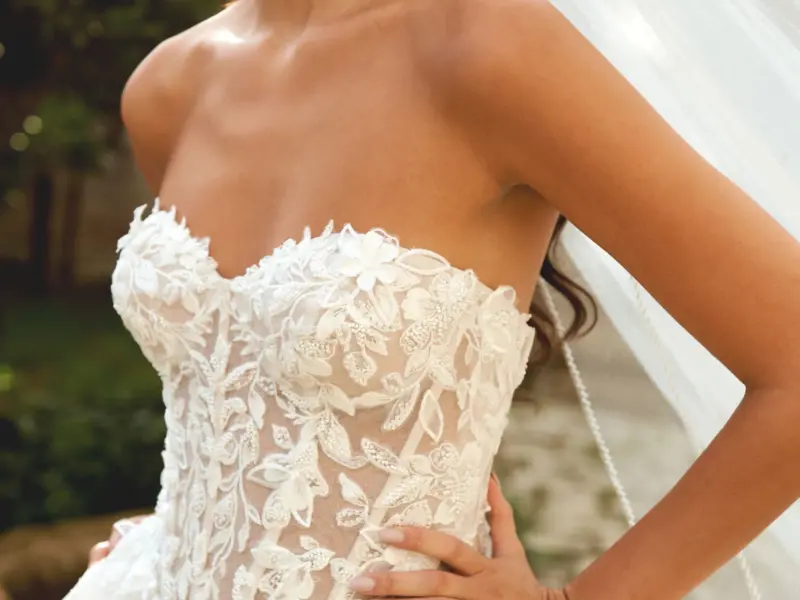
A strapless neckline often looks like one of the simplest parts of a dress. There are no straps to position, no sleeves to set, and sometimes only one clean line running across the upper body. In development, however, that clean appearance leaves very little room for error. The neckline has to sit close to the chest without flattening the bust, remain stable without feeling painfully tight, and preserve the designer’s intended shape while the wearer walks, sits, raises her arms, and moves naturally. Once the shoulder straps disappear, the upper bodice can no longer rely on the shoulders to carry garment weight or stabilize its position. Bust shaping, underbust fit, waist anchoring, fabric recovery, lining, cups, boning, seam balance, and neckline contour begin working as one system. That is why repeatedly shortening the top edge often improves one photograph while creating a new fit problem somewhere else.
A balanced strapless neckline follows the upper body smoothly, provides the intended bust coverage, and remains in its approved position during normal movement. It should not gape, roll outward, crush the bust, create obvious overflow, or force the wearer to keep pulling the dress upward. Reliable balance comes from coordinating neckline contour, bust volume, bodice tension, material behavior, and internal support rather than relying on one unusually tight edge.
A useful way to understand the problem is to imagine two samples hanging side by side in a fitting room. Both look nearly identical on the hanger, and both measure correctly on the specification sheet. One stays calm on the body for an entire fitting. The other begins to open at center front after the model sits down, then shifts sideways after several minutes of walking. The difference may be only a few millimeters of contour, a slightly shallow cup, a lining with weaker recovery, or support that is anchored in the wrong place. Those small details are where successful strapless development is usually won or lost.
What Does a Balanced Strapless Neckline Look Like?
A balanced strapless neckline should follow the upper torso smoothly, preserve the intended bust shape and coverage, and remain visually stable without obvious gaping, rolling, digging, or downward movement. The neckline should feel secure because the bodice, bust shaping, underbust fit, fabric, and support structure are working together, not because the top edge has simply been tightened around the body.
How Should the Neckline Sit on the Body?
The first thing to judge is contact rather than tightness. From center front through the upper bust and toward the side seam, the neckline should sit close enough to the body that there is no obvious space between skin and fabric, but it should not create a hard ridge, visible indentation, or compressed shape above the bust. On a straight neckline, the upper edge should remain calm and level according to the intended design. On a sweetheart neckline, both sides of the curve should frame the bust consistently without one side lifting, collapsing, or pulling farther toward the center. The back neckline should also remain at its intended height instead of climbing upward to compensate for a front bodice that is slipping down. A secure strapless dress usually looks visually relaxed. When the neckline appears to be gripping the wearer aggressively, the structure beneath it often needs another look.
During fittings, it is more useful to divide the neckline into zones than to describe the whole opening as “tight” or “loose.” Center front, left and right upper bust, side front, side neckline, and center back can behave differently even though they belong to the same continuous edge. A 6 mm gap concentrated near one side of the bust is not the same problem as 6 mm of excess distributed around the full neckline. Recording the location of a problem makes the next pattern adjustment much more precise and prevents the common cycle of tightening an entire bodice to correct one small local defect.
What Are the Signs of Poor Balance?
Gaping is the most obvious signal, but an unbalanced strapless neckline can fail in several less obvious ways. The bust may look flattened even though the neckline does not open. One cup may appear fuller than the other. The side seam may move toward the front because excessive tension is pulling the bodice around the body. The back can climb while the front slowly drops, or the wearer may need to pull the garment upward every few minutes even though the dress looked correct when she first put it on. These symptoms matter because they tell the pattern team where tension and volume are being distributed incorrectly.
A practical fitting review should therefore look beyond the upper edge itself. Bust projection, underbust position, waist location, side-seam balance, cup shape, lining behavior, and garment weight all need to be observed together. The table below is useful as a first diagnostic reference, but it should not be treated as an automatic correction chart. Similar symptoms can have different causes, so the surrounding fit still needs to be checked before the pattern is changed.
Fit symptom | What to check first | Useful fitting evidence |
Center-front gaping | Bust projection, apex position, local neckline length | Gap depth at center front in mm |
Side neckline gaping | Upper-bust contour, side height, panel shape | Left/right side-neckline height |
Bust flattening | Cup depth, front width, excessive negative ease | Bust shape plus circumference comparison |
Bust overflow | Cup capacity, coverage, neckline height | Neckline-to-apex distance |
Bodice slipping down | Underbust fit, waist anchoring, garment weight | Position before and after movement |
Neckline rolling outward | Fabric growth, lining, seam handling | Pattern edge vs. finished edge length |
Uneven neckline | Pattern balance, sewing accuracy, body asymmetry | Left/right height difference |
The most expensive fitting mistakes often begin with an understandable but incomplete comment such as “take 1 cm out of the top.” If the real problem is a shallow bust shape, that change may reduce room the wearer actually needs while leaving the original cause untouched. The next sample then becomes tighter but not better. Experienced dress development separates the visible symptom from the technical cause before deciding where that centimeter should really go.
How Do Fit and Visual Balance Differ?
Visual balance describes what the neckline contributes to the overall look of the dress. It includes center-front depth, shoulder exposure, bust framing, side height, symmetry, and the relationship between the neckline and the waist or skirt silhouette. Fit balance answers a different question: can that attractive line stay where the designer intended once the dress is worn? A neckline may be visually beautiful in a static front photograph but technically unstable during normal use. That distinction becomes especially important with deep sweetheart, low straight, curved, and highly sculpted strapless shapes.
A low sweetheart neckline, for example, may create exactly the dramatic proportion a brand wants for an occasion collection. Lowering the center front, however, also reduces coverage at a point where the bodice may already be managing considerable bust projection. Raising the side neckline can improve security, but too much height may change the intended silhouette. A higher straight neckline gives more continuous coverage, yet it can still stand away if its edge length does not follow the upper-bust contour correctly. There is no universally “balanced” strapless shape independent of the body and construction beneath it.
For commercial development, neckline approval works best as two separate decisions. First, confirm the design line: depth, curve, symmetry, coverage, and visual proportion. Then confirm the performance of that line after sitting, walking, turning, bending, and raising the arms. When both tests pass, the neckline is doing more than looking correct for a photograph. It is behaving like the same design throughout real wear.
What Causes a Strapless Neckline to Lose Balance?
A strapless neckline usually loses balance because several related variables no longer agree with one another. Excess edge length, incorrect bust projection, misplaced apex position, wrong bodice length, fabric growth, lining mismatch, seam distortion, or weak anchoring can all create similar symptoms. Tightening the upper edge may temporarily hide the problem, but a reliable correction begins by identifying which part of the system is actually out of balance.
Is Excess Neckline Length Always the Cause of Gaping?
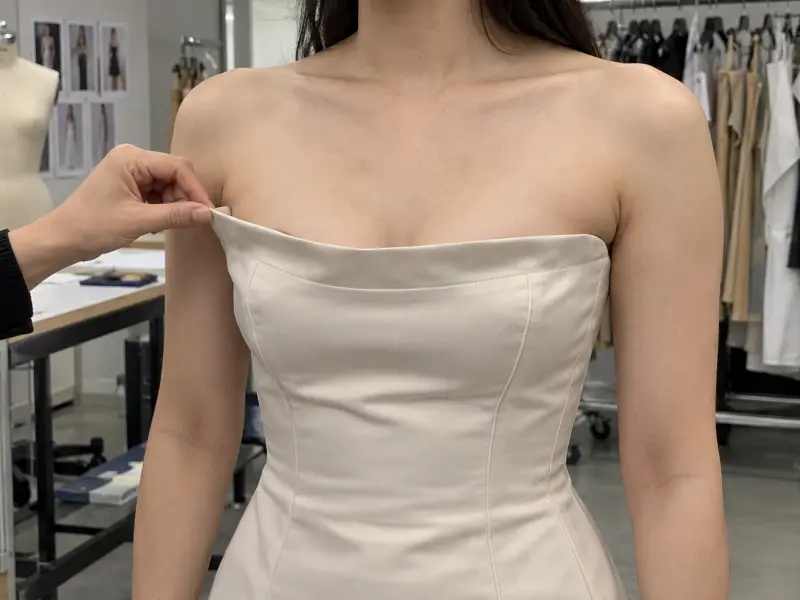
No. Excess neckline length is one common cause, but it is not the only one. A pattern can begin with the correct edge length and still produce a larger finished neckline after cutting, sewing, pressing, and repeated handling. This is particularly relevant where the neckline crosses areas with some bias direction, or when the fashion fabric is soft, loosely constructed, lightweight, or highly extensible. A stretch satin, delicate crepe, mesh, or fine jersey can behave very differently from a stable paper pattern once it has been handled several times during sampling.
One of the simplest checks is to compare three stages instead of measuring only the finished garment. Measure the neckline seam line on the approved pattern, the corresponding cut edge before assembly, and the finished neckline after sewing. If the pattern remains correct but the finished garment has gained length, reducing the paper pattern may create an unnecessarily tight next sample. In that case, stabilization, handling, construction order, pressing, or seam technique deserves more attention than the original pattern circumference.
Localized gaping should also be corrected locally whenever possible. If an 8 mm opening appears only over the upper bust, removing 8 mm around the complete neckline would be a very different adjustment. That local excess may need to be transferred into a dart, princess seam, or contour correction. The objective is not simply to make the opening smaller; it is to make the neckline correspond to the body while preserving the bust volume and design proportions that were already correct.
How Does Bust Volume Affect the Neckline?
Bust volume is one of the main reasons a strapless bodice can appear contradictory during fitting. The neckline seems loose, yet the bust feels tight. The wearer has enough overall circumference according to the specification, yet the cup looks compressed. These situations occur because circumference alone does not describe three-dimensional body shape. Two people can have the same full-bust measurement while having very different upper-bust measurements, ribcage widths, bust projection, breast root width, apex height, and apex spacing.
A front bodice therefore needs to be reviewed through several dimensions at once. Bust apex height tells the pattern maker where maximum projection should occur. Apex-to-apex distance controls horizontal placement. Cup or panel width indicates how much of the bust base is being accommodated. Projection or cup depth determines whether enough volume exists away from the body. Underbust circumference helps show whether the bodice is being anchored below the bust rather than forcing the upper edge to do all the work.
If the bust section is too shallow, the body pushes the front outward and can make the neckline appear to stand away. Tightening the neckline may then press the bust inward rather than solve the contour problem. If the bust section is too deep, empty volume can collapse above the bust and create a different type of gape. The most reliable corrections preserve the volume that is needed, remove only the volume that is not needed, and place both in the correct locations.
Do Pattern Length and Bodice Position Matter?
Vertical balance can influence the neckline just as strongly as horizontal circumference. A strapless bodice may have the correct upper-edge measurement but still sit badly because the entire garment is positioned too high, too low, or at an angle around the torso. If the front waist-to-neckline length is too short, the bust can pull the bodice upward and outward. If that length is too long, folds can develop below the bust while the upper section appears loose. A side seam that tilts can also make one neckline edge look higher even when the paper pattern is symmetrical.
Useful fitting measurements include center-front waist-to-neckline height, bust-apex height, underbust level, side-neckline height, side-seam length, and center-back height. These points reveal whether the apparent neckline problem belongs only to the upper edge or is part of a larger bodice-balance issue. When several of these positions move together, changing one local neckline curve is unlikely to be enough.
The weight below the bodice also matters. A lightweight fitting toile may stay in position, while the final version with a full satin skirt, layered mesh, dense embellishment, or several lining layers pulls the same bodice downward. For occasion and party dresses, final fit confirmation should therefore use a sample that represents the real garment weight as closely as practical. A strapless neckline cannot be evaluated completely without considering what the rest of the dress is asking it to support.
How Do You Balance the Neckline Pattern?
Balancing a strapless neckline pattern means shaping the upper edge around a three-dimensional torso while preserving enough room for the bust. Neckline contour, bust apex, dart or princess-seam intake, cup depth, side height, bodice length, and ease need to work together. The goal is close contact with the body without simply shrinking the complete upper circumference or creating excessive compression.
How Should the Upper Edge Be Shaped?
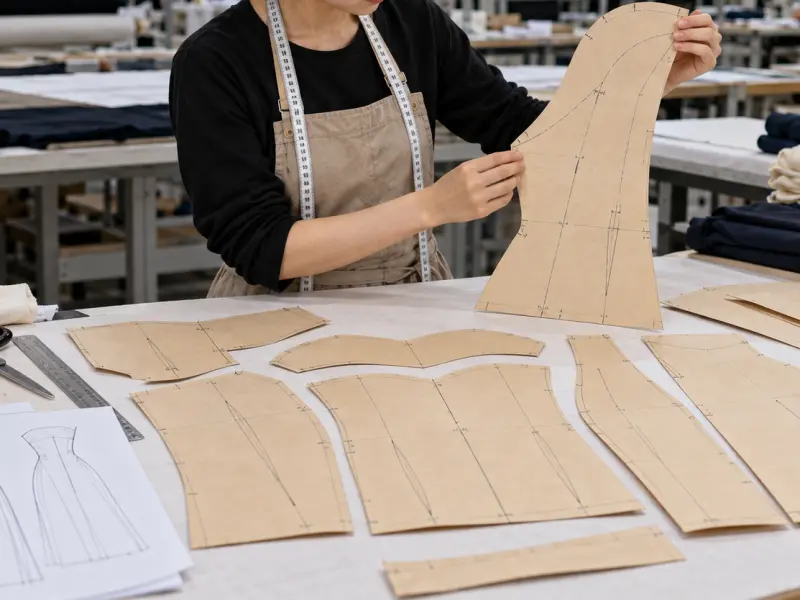
The upper edge of a strapless dress should be treated as a contour line rather than as the top of a conventional bodice that has simply had its shoulders removed. Once straps and shoulder seams disappear, the pattern has less structural help keeping the bodice in position. The upper edge generally needs closer control around the torso, but that control should follow the changing shape of the body rather than being applied as one uniform reduction.
A useful working method is to divide the neckline into four areas: center front, bust curve, side-front transition, and side/back neckline. Each area can respond differently during fitting. Center front may need enough contour to prevent lifting while still preserving the intended depth. The bust curve may require more projection beneath the edge rather than further shortening. The side-front section is a common place for localized gaping, while the back may require stability without excessive tightness.
When a fitting reveals a local problem, mark the amount directly on the sample before transferring it back to the pattern. A 5 mm wedge removed at the upper bust is not equivalent to a 5 mm reduction at center front or side seam. After the adjustment is transferred, the neckline should be re-trued so that seam lines remain smooth and adjoining pattern pieces still match correctly. This method takes slightly more thought than simply reducing circumference, but it usually saves time over several sample rounds because each correction has a clear purpose.
How Do You Balance the Bust Apex and Cup?
The bust apex is a key reference point because much of the front-bodice shaping is organized around it. If the apex is too high, the fullest part of the garment sits above the wearer’s actual projection and can leave emptiness beneath or around the neckline. If it is too low, the bust may push above the intended shape. Incorrect horizontal spacing produces a similar problem: the dress has volume, but the volume sits in the wrong place.
During sample development, it is useful to record apex height from a fixed horizontal reference such as the waist, apex-to-apex distance, cup or front-panel width, and neckline height above the apex. These measurements make fit comments more precise and become especially useful when a style moves into grading. Rather than saying that a larger size “looks lower,” the team can identify whether neckline height, apex position, or bust-volume progression is responsible.
Molded cups add another variable. A nominal cup size is not enough because two suppliers can produce cups with different widths, depths, heights, and root shapes under the same general size label. The cup used for bulk production should therefore be assessed as a physical component, not just a BOM description. Approving cup geometry and position before finalizing the neckline reduces the risk that a late component change alters the bust shape and forces another round of pattern work.
How Do Darts and Princess Seams Control Fit?
Darts and princess seams are not simply lines that make a fitted dress look tailored. They are the tools that turn a flat material into three-dimensional volume. In a strapless bodice, they also control how much fabric is available above the bust, at the bust apex, under the bust, and toward the waist. Adjusting these shaping lines can therefore improve neckline contact without removing the volume the wearer needs elsewhere.
When excess fabric appears just above the bust, part of that excess can often be redirected into an existing bust dart or absorbed through a princess seam. The upper edge becomes shorter locally while projection at the bust is maintained. Princess seams offer particularly useful control because different parts of the seam can be adjusted independently. The upper portion influences neckline contact, the curve around the apex controls projection, and the section below the bust controls underbust and waist shaping.
Changes of only a few millimeters in these areas can visibly alter a fitted bodice, especially in satin, firm woven fabrics, or styles with a clean uninterrupted front. It is also important to distinguish between straight and sweetheart necklines. A deeper sweetheart usually needs more careful control near center front because coverage is reduced at the middle, while a straight neckline may distribute coverage more evenly but still gape if the upper-bust contour has not been shaped accurately.
Which Support Structures Keep the Neckline Stable?
A strapless neckline remains stable when the garment’s weight and tension are distributed through the bodice instead of being resisted only by the top edge. Depending on the design, support may come from boning, cups, a stable lining or foundation, elastic, stay tape, underbust shaping, or a waist stay. The right combination depends on neckline depth, fabric behavior, garment weight, and the intended level of structure.
Do Strapless Dresses Always Need Boning?
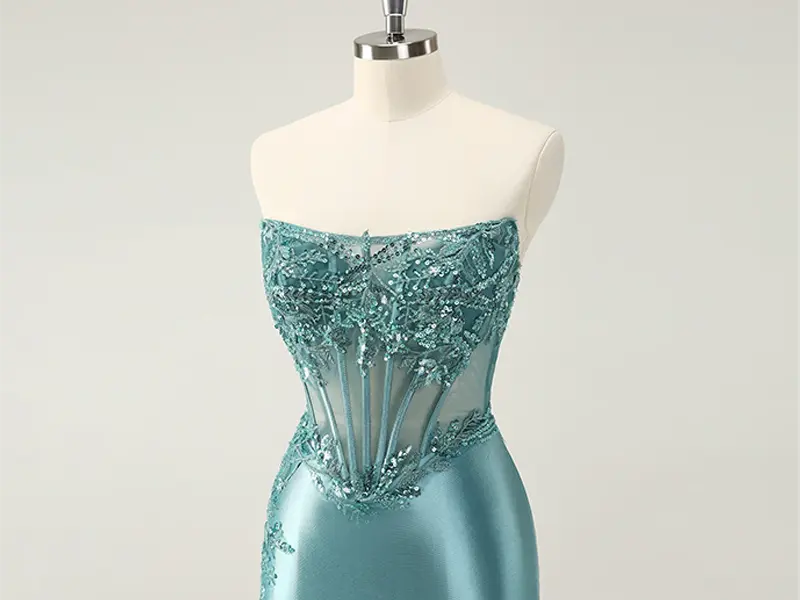
Not every strapless dress needs traditional boning. A lightweight stretch tube dress with strong fabric recovery may stay in place through controlled negative ease and elasticized edges. A structured woven party dress, a fitted satin style, or a corset-influenced occasion dress is a different engineering problem. Once the design requires a clearly shaped bust, smoother vertical torso line, lower neckline, heavier skirt, or stronger body contour, internal vertical support becomes much more useful.
Boning should be selected according to the job it needs to perform. It may help prevent a side panel from folding, keep a princess seam upright, stabilize center front, support a low neckline, or transfer part of the garment load toward a more secure area of the torso. What it cannot do is repair an inaccurate bust pattern. Adding more rigid material to a shallow cup or badly positioned apex can make the dress feel stronger while the original fit problem remains.
The amount and stiffness of boning also need restraint. A fashion dress is not automatically improved by turning it into a rigid corset. Excessive support can create visible ridges, discomfort, restricted movement, or an appearance that no longer matches the design concept. Flexible plastic boning, spiral steel, flat steel, and other support options all behave differently. Selection should follow fabric, seam construction, garment weight, fit target, and intended wearer experience rather than a rule that every strapless dress must contain a certain number of bones.
How Do Cups Affect Neckline Support?
Cups help create predictable bust shape, but their effect on neckline balance is often indirect. When a cup has suitable width, depth, height, and placement, the bust has a defined space to occupy. The outer neckline can then follow the upper body without trying to create bust shape through surface tension alone. When cup geometry is wrong, a neckline may be repeatedly altered even though the real mismatch sits several centimeters below it.
Four questions are especially useful during a cup fitting. Does the cup apex correspond to the intended bust apex? Does the cup width sit correctly around the bust root without pushing too far toward the side body? Is there enough depth without obvious empty space? Does the cup provide enough height for the planned neckline coverage? These questions should be answered on the body rather than from the component label.
The relationship between the cup and outer fabric matters as well. A firm molded cup under a soft stretch shell can create movement or rippling if the surface is not controlled. A shallow cup beneath a deeper outer panel can leave a hollow area. A wider replacement cup may push the side neckline outward even though its stated size is unchanged. For repeat orders, controlling the exact cup source and specification is therefore part of controlling fit, not merely part of purchasing.
What Does the Underbust Do?
The underbust is one of the most important anchoring areas in a strapless garment because it helps prevent the whole bodice from depending on the neckline for stability. If the garment can sit securely around the ribcage below the bust, the upper edge can remain close to the body without needing to grip aggressively. In more structured styles, the waist can provide another stable level where part of the garment’s weight is supported.
It helps to think of the bodice as having three functional zones. The upper edge manages contact and coverage. The bust and underbust manage shape and ribcage anchoring. The waist can help carry vertical load when the design allows it. When the underbust is too loose, the dress may gradually move downward and encourage the wearer to keep pulling it up. Tightening the neckline in response treats the symptom rather than restoring the missing anchor.
The opposite problem is also possible. An underbust that is too tight can push tissue upward, change bust projection, create overflow, and increase pressure at the neckline. Stability therefore comes from coordinated tension, not maximum tension. Some structured styles benefit from an internal waist stay, while lighter styles may rely on stable lining, elastic, or carefully placed support. The specific construction changes from dress to dress, but every successful strapless style needs a clear answer to one practical question: where is the garment actually being held on the body?
How Do Fabric and Fit Affect Neckline Balance?
Fabric can change neckline balance even when the paper pattern is identical. Stretch, recovery, weight, drape, thickness, and structural stability determine how far a material extends under tension and whether it returns to its original dimensions. A strapless pattern should therefore be fitted in the intended production fabric, or in a substitute with genuinely comparable behavior, before the neckline can be considered fully approved.
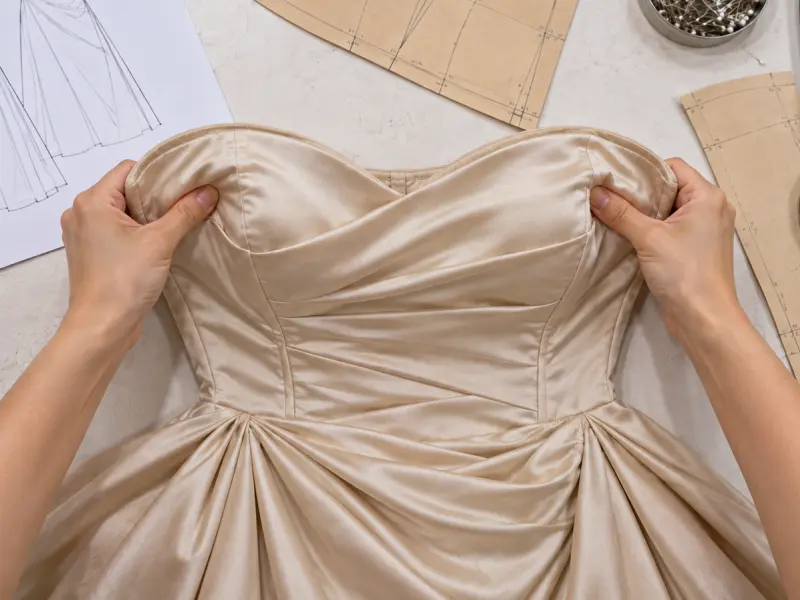
Which Fabric Properties Matter Most?
Stretch percentage is useful, but it does not tell the whole story. Recovery can be just as important because a strapless neckline remains under tension for much longer than a quick hand-stretch test. Two fabrics may both extend by 20 percent, yet one returns almost immediately while the other gradually grows during wear. The first may maintain neckline contact for several hours; the second may begin to feel secure and then become noticeably looser.
Direction also matters. A fabric with 20 percent stretch across the width and almost no stretch along the length behaves very differently from a material with significant stretch in both directions. Weight and drape add another layer. A soft lightweight fabric may follow the body beautifully but contribute little structural support, while a heavier fabric may create the shape the designer wants yet place more downward load on the bodice.
The following ranges are practical development categories rather than universal textile standards. Actual fabric behavior should always be measured and tested because fiber content, knitting or weaving structure, finishing, dyeing, and supplier variation can change performance.
Fabric behavior | Practical development range | Main neckline concern |
Stable woven | About 0–5% stretch | Requires accurate contour and movement allowance |
Low stretch | About 5–10% | Limited tolerance for pattern error |
Moderate stretch | About 10–25% | Balance contact against bust compression |
High stretch | Above about 25% | Recovery and long-wear growth become critical |
Heavy structured material | Weight varies by construction | Greater downward load on the bodice |
Soft drapey material | Low structural resistance | Edge distortion or loss of upper-body shape |
A useful internal test is not simply to record maximum stretch but to compare the relaxed dimension before stretching with the dimension after the fabric has been extended and allowed to recover. For a strapless application, a fabric that looks attractive but repeatedly grows under moderate tension may require stabilization, different ease, a stronger inner structure, or a different material choice altogether.
Does Stretch Fabric Need a Different Pattern?
In most cases, yes. Moving a pattern from stable satin to stretch satin, or from woven crepe to jersey, without reviewing ease can produce a dramatically different garment even when the materials look similar in a photograph. Stretch changes how circumference is distributed around the torso and can influence bust compression, neckline contact, side-seam position, waist tension, and the amount of support supplied by the outer fabric itself.
There is no single negative-ease percentage that works for every strapless fabric. A firm fabric with strong recovery can tolerate a different reduction from a soft fabric that extends easily and recovers slowly. If too much negative ease is used, the bust may flatten, the side seams may move, and the neckline can cut into the body. If too little is used, the garment may look correct during the first fitting but gradually drop as the fabric relaxes.
One practical approach is to record both body and garment measurements at the upper bust, full bust, underbust, and waist. The difference between those numbers shows where the garment is applying its tension. Those relationships can then be checked against what the wearer actually feels and what the team sees. Colorways deserve attention as well. Dyeing and finishing sometimes alter handfeel and stretch behavior, so a noticeably firmer or softer color should be measured rather than automatically assumed to behave exactly like the approved sample.
How Does Lining Change the Neckline?
Lining is often introduced as a comfort, coverage, or opacity layer, but in a strapless dress it can become part of the support system. A stable lining can limit unwanted stretch, hold boning channels, support cups, and help preserve the upper-edge shape. A stretch lining may provide more comfort and movement but contribute less structural control. Neither is automatically better; the choice depends on what the outer fabric and pattern need.
Problems commonly appear when shell and lining behave very differently without that difference being planned. If the inner layer is considerably more stable or shorter, a stretch outer fabric can ripple or appear baggy in places. If both layers have weak recovery, the neckline may grow together. A heavy internal foundation beneath delicate satin can create visible ridges or seam impressions, especially under strong studio lighting where otherwise small construction lines become obvious.
The two layers should therefore be reviewed as a pair for stretch direction, stretch percentage, recovery, weight, thickness, handfeel, and seam compatibility. When the outer fabric changes during development, the lining should be reconsidered rather than treated as a fixed component from the previous sample. A seemingly small fabric substitution can alter drape, bust support, neckline tension, and the way internal seams show through the finished dress.
For brands developing a strapless style through several sample rounds, this is also where a more integrated technical review can save time. Rather than changing pattern, cup, lining, and support in separate rounds, the development team can look at how those elements affect one another. When a persistent neckline problem is difficult to isolate, Duolan can review the style from this combined pattern, material, structure, and fit perspective before the project progresses toward bulk production.
How Do You Control Neckline Balance in Production?
Production control begins before bulk sewing starts. The approved neckline curve, bust shape, cup and support positions, shell fabric, lining, measurements, and critical workmanship points should be locked first. The style should then pass movement fitting, size-set review, first-piece verification, and inline inspection. Strapless fit is sensitive enough that small uncontrolled changes can become visible once a style moves across sizes, colorways, operators, or repeat orders.
How Should a Strapless Sample Be Fit-Tested?
A static front photograph is useful for reviewing proportion, but it is not enough to approve a strapless neckline. The wearer should perform movements that change torso length, shoulder position, and pressure around the bust so the team can see whether the garment returns to its intended position. A practical development sequence can include raising both arms, sitting and standing, bending forward moderately, rotating the torso in both directions, and walking naturally for several minutes.
These actions are not presented as a universal laboratory standard; they are consistent development checks that help make one sample round comparable with the next. A team may, for example, ask the wearer to rotate roughly 30–45 degrees in each direction or walk for 5–10 minutes before returning to the original fitting position. The exact numbers matter less than repeating the same procedure and observing the same reference points.
Before and after movement, check center-front neckline height, side-neckline position, center back, waist location, and whether the side seams have shifted. Note whether the garment returns naturally or requires manual adjustment. Comfort should be recorded as well. Pressure concentrated at the neckline, underbust, side seam, or waist can reveal that the dress is staying up through excessive compression rather than balanced support. A successful sample remains secure without constantly reminding the wearer that it is strapless.
How Do You Check Balance Across Sizes?
Approving only the base size is risky for a fitted strapless style because bust projection, torso width, apex spacing, neckline coverage, and underbust proportions do not always increase at exactly the same rate. A grade rule that works well for a loose dress can produce visible changes in a neckline where a few millimeters influence coverage and stability. The objective is therefore not simply to make every coordinate larger or smaller, but to preserve the same visual and functional relationship across the range.
At minimum, development teams commonly benefit from physically reviewing a smaller size, the base size, and a larger size. Wider size ranges may require additional checks, particularly where cup geometry or support strategy changes. Useful measurements include center-front neckline height, side-neckline height, bust-apex height, apex-to-apex distance, full bust, underbust, waist, cup position, and back-neckline height.
For highly visible fit points, some brands may work with sample-stage targets around ±0.5 cm, but this should be treated only as a practical reference rather than a universal industry tolerance. Bulk tolerances depend on fabric stretch, garment construction, size, measurement location, and the customer’s own specification. A highly elastic bodycon dress cannot always be controlled in exactly the same way as a structured woven bodice. The correct tolerances should be agreed in the tech pack and tested against the real garment rather than copied blindly from another style.
What Should Be Locked Before Bulk Production?
Once the fit is approved, the sample needs to be translated into production information that several teams can reproduce. “Follow the approved sample” is not enough for a structure-sensitive strapless dress because many of the features controlling the neckline are hidden. Cup source, cup position, boning type, boning length, channel location, lining construction, neckline finishing method, seam allowance, underbust treatment, and critical measurements all need to be understood before the line begins.
Production stage | Key control point | Practical evidence |
Pattern release | Neckline curve, bust shape, seam balance | Version-controlled approved pattern |
Material approval | Shell, lining, cups, boning, elastic | Approved BOM and physical references |
PP sample | Fit, movement, visual balance | Approved sample and comments |
First piece | Cup position, neckline height, workmanship | First-piece inspection record |
Inline QC | Measurements, symmetry, support placement | Recorded production checks |
Final QC | Appearance, consistency, finished fit points | Final measurement and visual review |
First-piece verification is particularly useful before a structured style moves into full quantity. One completed production garment can be compared with the approved sample for neckline height, bust projection, cup position, symmetry, support placement, seam appearance, and the behavior of the finished edge. If a problem appears here, correcting one piece is far easier than discovering the same issue after several hundred garments have passed through the line.
Inline control should also focus on variables that can drift during production. Repeated handling can stretch an unstable neckline edge. Slight changes in cup placement can alter coverage. Boning positioned several millimeters differently from the approved construction may affect how a side panel stands. Seam tension or pressing can change the appearance of satin and other smooth surfaces even when the measurements remain technically within tolerance. Production quality becomes more reliable when these points are defined in advance instead of being left to final visual inspection.
The same principle applies to repeat orders. The original approved sample, production pattern, material references, BOM, measurements, and construction notes should remain connected as one standard. If a cup supplier changes, a lining is substituted, or a fabric batch behaves differently, the team should consider whether that change can influence fit before assuming the repeat order will automatically match the first delivery. Strapless products reward disciplined record keeping because many of their most important fit variables are small, interconnected, and easy to overlook once the line is moving quickly.
Conclusion
A well-balanced strapless neckline is not created by making the top of a dress as tight as possible. It comes from controlling several relationships at the same time: the neckline must follow the upper torso, the bust needs the correct amount and position of volume, the underbust and waist need to provide appropriate anchoring, the fabric and lining must behave predictably, and internal support has to perform a clearly defined job. When those relationships are correct, the wearer rarely notices the engineering. She simply puts the dress on, moves comfortably, and the neckline stays where it was designed to sit.
For product teams, that is also the most useful way to approach recurring strapless fit problems. Instead of treating every gape, slip, or compressed bust as a separate sewing defect, trace the problem through pattern shape, material behavior, support, grading, and construction. Solving the system during sampling makes it easier to preserve the same result in multiple sizes, colorways, production lines, and repeat orders. A clean neckline may be only one line in the finished garment, but getting that line right is often evidence that the entire bodice underneath it has been developed properly.
Frequently Asked Questions
How tight should a strapless neckline be?
A strapless neckline should be snug enough to maintain contact with the body but not so tight that it flattens the bust, creates a visible ridge, restricts breathing, or causes discomfort after several minutes of wear. There is no useful universal circumference reduction because the correct tension depends on fabric stretch, recovery, bust shape, underbust anchoring, and internal support. The best fitting test is whether the dress stays stable during movement without the wearer repeatedly pulling it upward.
How do you stop a strapless neckline from gaping?
Start by identifying where the gap appears and whether the finished neckline has stretched beyond the pattern measurement. A local gap over the bust may require contouring through a dart or princess seam, while center-front gaping may point toward bust projection or apex placement. If the neckline became longer during sewing, stabilization or construction control may be the real solution. Reducing the entire upper circumference should usually come only after these more specific causes have been checked.
Does boning stop a strapless dress from falling down?
Boning can improve vertical stability and prevent a fitted bodice from collapsing, but it does not automatically stop a strapless dress from slipping. A stable garment usually combines correct bust shaping with underbust or waist anchoring, suitable fabric tension, and support placed where the design needs it. If the bodice is too loose around the ribcage or the bust pattern is incorrect, adding more boning may make the garment stiffer without solving the actual downward movement.
Is a sweetheart neckline harder to fit than a straight strapless neckline?
A sweetheart neckline is not automatically harder, but deeper curves often require more careful control around the bust and center front because coverage changes across the neckline. A straight neckline provides a more continuous upper edge, yet it can still gape if the upper-bust contour is too long or the bodice lacks support. The difficulty depends more on neckline depth, bust projection, fabric, pattern structure, and intended fit than on whether the upper edge is straight or sweetheart shaped.
Can the same strapless pattern be used with different fabrics?
The same base pattern may be a useful starting point, but a fabric change should trigger another fit review. Stable satin, stretch satin, jersey, mesh, and crepe can have very different stretch, recovery, drape, weight, and thickness. Those properties affect neckline tension, bust compression, side-seam position, and support requirements. Even when two fabrics look similar, the pattern ease, lining, stabilization, or internal construction may need adjustment before the new version is approved for production.
How should strapless neckline fit be checked across different sizes?
Do not rely only on the graded paper pattern. Review physical samples across representative points in the size range and compare center-front height, side-neckline height, apex position, bust volume, underbust fit, waist anchoring, and cup position. The objective is to preserve similar coverage and visual proportion rather than enlarging every dimension mechanically. Wider size ranges may need additional fittings where bust-volume progression or support requirements begin to change more noticeably.
What should be approved before a strapless dress enters bulk production?
Before bulk production, the team should lock the approved pattern, neckline curve, bust shape, shell fabric, lining, cup specification and position, boning or other support components, critical measurements, tolerances, and neckline construction method. A pre-production sample or first production piece should then be compared with the approved standard. This early verification is especially valuable for strapless styles because small changes in hidden components or edge handling can produce clearly visible fit differences in bulk.
Share:
Our Services
Categories
Table of Contents
Here, developing fashion collections is more than manufacturing garments — it’s a collaborative process focused on transforming ideas into well-executed, market-ready products. From fabric sourcing and sample development to scalable production and delivery coordination, every stage is built to support quality, consistency, and efficient collection launches across global markets.