Skip to content

Drop-Waist Mini vs Drop-Waist Midi Construction: What Changes in Pattern, Fit, and Skirt Balance?
Your trusted Women’s Apparel Development & Manufacturing Partner from China
- Jerry
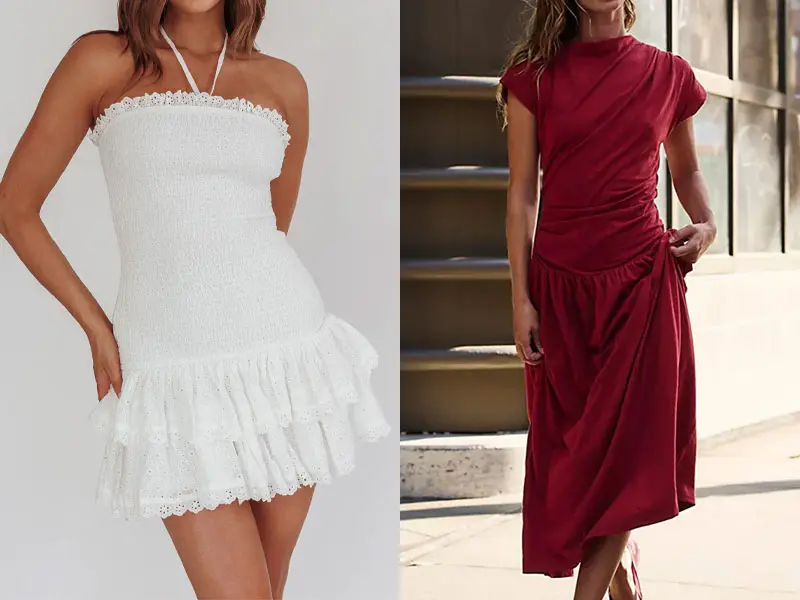
A drop-waist mini and a drop-waist midi can look like two lengths of the same dress, but treating them that way during development is one of the easiest ways to create avoidable fit and production problems. Once the waist seam moves below the natural waist, the fitted upper section, high-hip clearance, skirt release point, fabric weight, fullness, and hem all begin to influence one another. Add 25 or 30 centimeters of skirt length and the garment does not simply become longer; the extra fabric changes how the skirt hangs from the lowered seam, how much load the bodice carries, how folds develop, and how the dress behaves when the wearer walks or sits.
A drop-waist midi should therefore be reviewed as a different weight-and-proportion system, even when it starts from the same upper block as the mini. The neckline, armhole, bust shaping, zipper position, and basic drop-waist line may remain similar, but skirt volume, fabric consumption, lining, seam stability, hip clearance, hem behavior, and overall visual balance often need another round of checking before the pattern is considered production-ready.
The difference becomes obvious in sampling. A crisp mini can look lively with concentrated gathers and a relatively firm fabric, while the same skirt construction extended to midi length can suddenly feel bottom-heavy or bulky around the high hip. The reverse can happen too: a fluid midi may lose its intended movement when shortened. The useful question is not simply how many centimeters to add or remove, but what else changes when that length changes – and whether the pattern, fabric, and construction still work together after the hem moves.
What Changes from a Drop-Waist Mini to a Midi?
Moving from a drop-waist mini to a midi changes more than hem length. The longer skirt adds fabric area and weight, changes vertical proportion, spreads fullness over a greater distance, increases load on the lowered seam, and makes grain or balance problems easier to see. The upper block may remain similar, but the complete garment should be re-evaluated before approval.
Construction Point | Drop-Waist Mini | Drop-Waist Midi | Main Review |
Skirt depth | Shorter | Often 20-40 cm longer in comparable designs | Proportion and total weight |
Fabric area | Lower | Higher | Consumption and drape |
Fullness | More concentrated | Distributed over more length | Gather or pleat density |
Drop-seam load | Lower | Higher | Stability and stretching |
Movement | Quick and lively | Longer swing | Twist, drag, recovery |
Hem behavior | Fast response to movement | More visible imbalance | Grain and leveling |
Lining effect | Relatively limited | More influential | Weight, stride, static |
Pattern Changes
The safest way to create the midi is to begin with the approved mini block while treating the longer version as a fresh garment evaluation. Neckline, shoulder, armhole, sleeve, bust shaping, closure position, and much of the fitted upper section can often remain unchanged. What should not be assumed is that everything below the drop seam can simply be extended vertically. A change in skirt length alters the amount of fabric suspended from the same lowered seam, and that can affect the way the upper section settles on the body even when its pattern pieces have not changed.
A simple area calculation shows the scale of the change. Imagine a skirt with an effective width of 1.80 meters. At a finished depth of 45 centimeters, the rectangular area is about 0.81 square meters. At 75 centimeters, it is about 1.35 square meters – roughly 67% more skirt area before flare, seam allowances, lining, pleats, or ruffles are added. The calculation is only an illustration, not a universal pattern formula, but it explains why a midi can pull differently at the seam and expose balance problems that were barely noticeable in the mini.
Proportion Changes
Drop-waist dresses already lengthen the visual torso because the skirt begins below the natural waist. In a mini, that long upper section is contrasted by a short skirt, which can create a sharp, youthful proportion. In a midi, both the fitted torso and the skirt contribute long vertical lines. The seam can therefore appear lower or higher to the eye even when its measurement has not changed. Reviewing only the finished dress length misses this relationship, because the real visual result comes from how the upper and lower sections divide the whole garment.
A practical review uses three measurements together: shoulder to drop-waist seam, drop-waist seam to hem, and total shoulder-to-hem length. If the shoulder-to-seam measurement is 42 centimeters, it occupies a very different share of a dress with a 40-centimeter skirt than one with a 72-centimeter skirt. This is why experienced pattern teams photograph both versions on the body from the same camera height and distance. The goal is not to force identical numbers across both lengths, but to preserve the same design language and make each version feel deliberately proportioned.
Construction Changes
The most common construction differences appear at the skirt-to-bodice join, in the distribution of fullness, in the lining, and at the hem. A mini can tolerate concentrated gathers because the folds have less length in which to develop. When the same ratio is carried into a midi, those folds continue farther down the body and can make the skirt look heavier than intended. In structured fabrics, the added bulk can create a visible ridge around the high hip; in very soft fabrics, the extra weight may stretch the seam or alter the way the bodice hangs.
The hem also becomes a more sensitive diagnostic point. Short hems react quickly to leg movement, while longer hems reveal panel imbalance, grain distortion, and uneven stretching over a greater distance. With fluid satin, viscose, loosely woven materials, or bias-influenced panels, final hem leveling is often more reliable after the sample has had time to relax. The aim is not to over-engineer the midi with heavy reinforcement. It is to add only the stability the fabric needs, so the lowered seam stays level and the skirt falls cleanly without losing the softness or movement that gives the design its character.
How Should the Drop Waist Be Positioned?
The drop waist should be positioned from body landmarks and the intended silhouette, not from one fixed distance below the natural waist. High-hip clearance, full-hip transition, torso length, fabric stretch, and skirt release all matter. Mini and midi versions may share the same seam position, but each should be checked separately because changing the hem also changes how that seam is perceived.

Body Landmarks
The natural waist is only the starting reference. A successful drop-waist pattern also considers the high hip and full hip because the fitted upper section continues farther down the body than a conventional waist-seamed dress. If the seam sits too high, the silhouette can read as a standard low waist rather than a deliberate drop waist. If it sits too low, the bodice may begin gripping the fuller part of the hip, especially in a woven fabric with little stretch. A change of only 2 or 3 centimeters can noticeably alter where the skirt appears to release and how long the torso looks.
The seam itself becomes a useful fitting indicator once the sample is worn. After walking or sitting, it should remain reasonably level without climbing toward the waist or dropping unevenly at the back. If the front rises but the back remains low, the cause may be insufficient front hip clearance, front-to-back balance, or friction between the garment and the body. If the entire seam rides upward, the upper section may simply be too tight. Reading the seam as a functional line helps a team diagnose the pattern instead of treating it as a decorative horizontal line that only needs to look correct while the wearer stands still.
Mini and Midi Balance
Changing the hem does not automatically mean the drop waist must move, but it can change whether the original position still looks balanced. One useful development method is to test several temporary hem positions on the same fitted sample. Pinning the skirt at three depths – for example 42, 58, and 72 centimeters below the seam – can reveal how strongly the lower length changes the perceived torso proportion without altering the bodice. Photographs taken from a consistent camera height and distance make the comparison more objective than looking at samples from different angles.
Sometimes the midi benefits from moving the drop seam upward by 1 or 2 centimeters because the whole garment has become more vertically dominant. In another design, keeping the seam lower may be essential to preserve a strong elongated-torso look. Neither answer is automatically more correct. The decision should follow the style, fabric, body proportions, and intended market presentation. A small pattern difference between mini and midi is often a better production decision than forcing one seam position across both versions simply because a specification sheet would be easier to manage that way.
Size Range
Drop-waist placement becomes more sensitive during grading because body circumference and body length do not increase at exactly the same rate. A mechanical grade can accidentally push the lowered seam too far toward the full hip in larger sizes, while smaller sizes may end up with an upper section that feels compressed. The result can be horizontal drag lines, a seam that rides upward during walking, or a silhouette that no longer resembles the approved base size. Grading therefore needs to preserve relationships between bust, waist, high hip, full hip, and skirt release rather than simply scale every dimension in isolation.
A useful review compares both absolute measurements and proportions. Check shoulder-to-drop-seam length against total dress length, high-hip circumference against the finished bodice, and skirt attachment width against the intended fullness. The base size cannot prove that the silhouette survives the grade. For a fitted drop-waist style, evaluating the base size plus another meaningful size away from the base is a practical minimum for development, while broader size ranges or firm non-stretch fabrics may justify more physical fitting. The objective is consistent visual intent across sizes, not mathematically identical treatment of every measurement.
How Do Skirt Volume and Weight Differ?
A midi normally carries more fabric mass and gives folds more length to develop, so the same fullness ratio can look and behave very differently from a mini. Extra length can increase seam load, fabric consumption, swing, and the visibility of twisting or uneven drape. Fullness should therefore be chosen together with fabric weight and finished length, not copied automatically between versions.

Working Example | Typical Test Range | What the Test Reveals | Caution |
Lightweight gathered mini | 1.6:1-2.0:1 | Lift, seam bulk, gather definition | Not a universal standard |
Lightweight gathered midi | 1.4:1-1.8:1 | Fold depth, weight, drape | Confirm in actual fabric |
Structured mini | 1.3:1-1.6:1 | High-hip bulk and shape | Thickness matters |
Structured midi | 1.2:1-1.5:1 | Stiffness, weight, silhouette | May need lower fullness |
Area example: 1.8 m x 0.45 m | 0.81 m2 | Baseline short-skirt area | Excludes flare/allowances |
Area example: 1.8 m x 0.75 m | 1.35 m2 | About 67% more area | Excludes lining/trims |
Fullness Ratios
Gather ratio is a useful starting measurement because it converts a subjective word such as ‘full’ into something a pattern room can control. If a 70-centimeter drop-waist seam is joined to 126 centimeters of skirt edge, the ratio is 1.8:1. If the skirt edge is 140 centimeters, it becomes 2.0:1. The ratio alone, however, does not predict how bulky the seam will feel. A fine chiffon can compress softly at 2.0:1, while a firm poplin or structured satin at the same ratio may create a thick shelf around the high hip.
Length changes the visual result as well. A midi gives every fold more distance to develop, so a slightly lower ratio can still look rich and full. During sampling, a team might compare 1.6:1, 1.8:1, and 2.0:1 in the actual fabric rather than choosing a number from habit. Even a small change can affect appearance and consumption: reducing from 1.8:1 to 1.6:1 cuts gathered edge length by about 11% for the same attachment seam. That does not mean the lower ratio is always better; it simply gives the team a measurable way to balance silhouette, bulk, cost, and movement.
Added Weight
Length increases fabric weight in a straightforward way. Using the same simplified 1.80-meter effective width, a 45-centimeter skirt contains about 0.81 square meters of fabric, while a 75-centimeter skirt contains about 1.35 square meters. If the shell weighs 150 grams per square meter, the skirt portion rises from roughly 122 grams to 203 grams. Add a lining, deeper pleats, more flare, trims, or embellishment and the difference becomes larger. These numbers are examples rather than finished garment weights, but they show why the low-waist join deserves another review.
The critical point is not whether another 80 or 120 grams sounds heavy in isolation. It is where that mass is carried and how it behaves during movement. In a drop-waist dress, the skirt hangs from a seam around the lower torso or high hip, so the load can pull on a relatively narrow structural line. A soft shell may elongate at the seam, a zipper area may become wavy, or the back may settle lower than the front. When sequins, beads, tiers, or multiple layers are involved, weighing the finished mini and midi samples can provide a simple piece of evidence for deciding whether seam support or pattern balance needs to change.
Movement and Drape
A mini has a short movement radius, so its skirt reacts quickly to walking, turning, sitting, and airflow. A midi has a longer pendulum, which often produces slower and more fluid movement but also gives small distortions more distance to become visible. A panel that twists only slightly over 40 centimeters may show an obvious rotation over 75 centimeters. The same is true for a side seam that is only a little out of balance, or a lining that catches against the shell and pulls it off center.
Movement should therefore be reviewed after repeated actions, not from one static fitting. Ask the wearer to walk, sit, turn, and then stand naturally without manually resetting the skirt. Watch whether the center front returns to the center, whether the side seams settle vertically, and whether the drop-waist line remains level. If one side consistently hangs lower, trimming the hem immediately can hide the symptom while leaving the real problem untouched. Grain direction, panel length, seam tension, lining width, and front-to-back balance should be checked before the hem is corrected.
Which Fabrics Work for Mini and Midi Versions?
Many fabrics can work for both lengths, but the acceptable balance of weight, drape, stiffness, thickness, stretch, and recovery changes as the skirt becomes longer. A mini can use structure to create lift and shape, while a midi makes vertical drape and grain stability more visible. Fabric should be approved for the finished silhouette, not only because it worked in another length.

Mini Fabrics
A drop-waist mini can handle a broad range of fabric structures because the short skirt carries less mass and has less distance in which to twist or stretch. Firm cotton poplin, compact crepe, taffeta, faille, lightweight denim, structured satin, and stable woven blends can work well when the design needs shape. Softer georgette, chiffon, rayon blends, or fluid satin can create a lighter result when movement matters more than architectural volume. The decisive question is not the fabric name, but how that specific material behaves when it is gathered, pleated, lined, and attached at the lowered seam.
A small seam trial is one of the most efficient ways to avoid a poor full sample. Sew 25 or 30 centimeters of the planned drop-waist join using the intended fullness ratio, seam allowance, lining, and support. The test quickly shows whether the fabric compresses cleanly, whether the seam rolls, and whether the gathers become too thick. Fabric weight in grams per square meter is useful, but it should not be treated as a complete performance description. Two fabrics at 160 gsm may behave very differently if one is soft and compressible while the other is dense and springy. Mini hems should also be checked in motion because very light materials can flip upward while stiff ones can stand away from the legs.
Midi Fabrics
Midi length exposes drape, grain stability, relaxation, and recovery more clearly because the skirt has more distance to hang and move. Fluid crepe, satin, chiffon, georgette, soft jersey, and rayon-rich blends can create elegant vertical movement, but they can also reveal twisting or uneven growth when the cloth is unstable. Structured wovens can produce excellent architectural midis, yet fullness often needs tighter control so the skirt does not become too heavy or too bulky around the high hip. The correct material is therefore the one that produces predictable behavior in the intended construction, not the softest or heaviest option available.
A practical review looks at at least six characteristics together: weight, drape, thickness, stretch or mechanical give, recovery, and opacity. A 180 gsm satin may have enough weight to hang beautifully but still distort along long panels if its dimensional stability is weak. A lighter crepe can sometimes fall more evenly because its structure is more stable. Grain alignment also deserves more attention on midi panels, since a small cutting deviation becomes easier to see over a longer distance. When the material is fluid or bias-sensitive, letting the sample relax before final hem leveling gives the fabric a chance to show predictable length change before the hem is permanently finished.
Lining and Support
Lining changes more than opacity. It adds mass, changes friction, affects static, controls how the shell slides over the body, and can either support or restrict movement. A mini lining is relatively short, so its contribution to the overall load is modest. A full midi lining can influence the garment much more strongly. If it is too stiff, the shell may lose its natural fall; if it is too narrow, the wearer may feel restricted even when the outer skirt looks generous; if it is significantly heavier than the shell, it can pull the drop-waist seam downward.
Shell and lining should therefore be approved as a system. During fitting, use a normal walk, a long forward step, a seated position, and a full turn to see whether the layers move together. Support at the drop-waist seam should also be selected for the actual fabric. Fine satin, mesh, chiffon, and soft crepe can show even a small amount of excessive seam buildup in studio photography. The best construction is not the strongest-looking reinforcement; it is the lightest support that keeps the seam stable, preserves the intended drape, and remains visually clean through the shell.
How Should Fit and Movement Be Tested?
Fit testing should cover the whole drop-waist system: upper-body balance, high-hip clearance, seam level, skirt release, lining, and hem recovery. Mini and midi versions should be tested separately because their skirt mass and movement patterns differ. Standing fit alone is not enough; walking, sitting, turning, and standing again reveal riding, twisting, drag, and balance problems that static fitting can hide.

Development Check | Practical Test | What to Observe | Useful Record |
High-hip stability | 10 m walk + 30 sec sit | Riding, drag lines, seam shift | Before/after seam position |
Stride | 3 long steps | Lining restriction, shell pull | Side-seam movement |
Turning | 2 turns each direction | Twist, grain imbalance | Center-front recovery |
Stairs | 1 ascent and descent | Range of motion, hem interference | Video or notes |
Hem recovery | Stand naturally after movement | Uneven settling | Front/side/back photos |
Grade review | Base size + another key size | Silhouette and fullness consistency | Fit comments by size |
Hip Ease
High-hip ease is critical because the fitted upper section continues below the natural waist before releasing into the skirt. If the area is too tight, the dress can ride upward as the wearer walks, leaving horizontal wrinkles above the hip and changing both the seam position and the apparent skirt length. If it is too loose, the elongated fitted line can lose definition. There is no single ease allowance that works for every drop-waist dress, because a non-stretch satin, stretch woven, stable jersey, and soft knit all require different treatment.
A repeatable movement check is more informative than a generic ease number. Record the seam position while the wearer stands naturally, ask them to walk roughly 10 meters, sit normally for about 30 seconds, then stand again without pulling the dress back into place. Compare the seam position and the shape of the upper section before and after. If the seam rises and remains displaced, investigate high-hip restriction, fabric friction, lining, and front-to-back balance before changing the skirt. A garment can match its measurement chart and still ride if the measurements do not provide enough functional room for the actual fabric and body interaction.
Movement Tests
The mini and midi should not be expected to react the same way. A short skirt responds quickly to leg movement and is more likely to reveal coverage or lifting issues during sitting. A longer skirt puts more emphasis on swing, twist, stride, hem recovery, and interaction between shell and lining. Using the same simple movement routine on every sample makes comments more consistent and reduces vague feedback such as ‘the skirt feels a little heavy’ or ‘the side seam seems off.’ The routine does not need to be a formal laboratory standard to be useful; it simply needs to be repeatable.
After each movement sequence, allow the dress to settle naturally rather than smoothing it by hand. Check whether the side seams return to their original position, whether center front remains centered, whether the low-waist seam stays level, and whether the lining has shifted. Consistent rotation in one direction often points to grain alignment, asymmetric pattern lengths, uneven seam tension, or lining drag rather than a general fit issue. A problem that appears only in the midi can be especially revealing because the extra length amplifies small distortions that the mini may have hidden.
Grading
Grading requires more judgment than adding standard increments to every measurement. As the drop-waist circumference becomes larger, maintaining the same fullness ratio also increases the absolute amount of fabric gathered or pleated into the seam. If a seam grows from 72 to 84 centimeters, a 1.8:1 ratio increases the skirt attachment edge from about 129.6 to 151.2 centimeters. The ratio is mathematically identical, but the larger size now carries more than 21 centimeters of additional gathered edge. Whether that looks right should be confirmed rather than assumed.
Vertical grading needs the same care. The drop-waist seam should continue to relate correctly to the high hip instead of drifting lower simply because a generic grade rule adds length. For wider commercial size ranges, reviewing only the base size leaves too much uncertainty. A sensible development process checks the base size plus at least one size that meaningfully challenges the pattern, and fitted non-stretch dresses may justify more physical fitting. The goal is not to make every ratio identical on paper; it is to preserve contour, comfort, seam position, and the intended silhouette when the garment is actually worn.
How Do You Develop Both Lengths for Production?
Mini and midi versions can share one design foundation, but each should be approved as a complete product when length changes weight, volume, lining, movement, or visual balance. Production is more reliable when each version has its own pattern identification, finished measurements, skirt specifications, construction notes, and quality checkpoints instead of being treated as an informal hem-length variation during development.

Sample Strategy
Separate samples are not necessary for every small length adjustment, but the need increases as construction differences grow. If a skirt changes from 43 to 48 centimeters while fabric, fullness, lining, and hem construction remain identical, a controlled length review may be enough. If it changes from 43 to 72 centimeters, the longer version introduces far more fabric area, a different movement pattern, and usually a longer lining. Add pleats, tiers, godets, ruffles, or a fabric change and the case for a separate physical sample becomes much stronger because several variables are now changing at the same time.
The sample should also have a clear purpose. One round may be intended to confirm silhouette, another to confirm fit, and a final pre-production sample to lock construction details. Treating every sample as if it must answer every question can create unnecessary revisions because the team has not agreed on what is actually being evaluated. A disciplined development process locks the design basis, fit priority, fabric direction, and sample purpose before cutting. For brands comparing both lengths, this is especially useful because it separates a genuine mini-to-midi construction issue from unrelated styling changes that may have been introduced during the same round.
Approval Points
Before production, the approved dress should be translated into measurable and observable control points rather than a general instruction that it ‘looks right.’ For a drop-waist mini or midi, the list normally includes drop-waist depth, high-hip measurement, front and back balance, skirt attachment circumference, gather or pleat specification, finished length, lining length, zipper behavior, seam reinforcement, and hem level. Movement should also be part of approval, because a sample that looks balanced while standing can still ride or twist after a few minutes of normal wear.
The more of these points that can be measured, photographed, diagrammed, or written into a specification, the less production depends on memory. If the gather ratio is 1.6:1, control it through pattern length, notches, or a documented measurement instead of asking an operator to make it ‘even.’ If center-front finished length is 112 centimeters, put that number in the measurement chart rather than writing ‘midi length.’ Front, side, and back photographs of the approved sample also help, because measurements control dimensions while visual references communicate the intended fall, seam position, and overall character of the garment.
Bulk Consistency
Mini and midi versions should have separate pattern or style references whenever their construction differs. Informal instructions such as ‘use the mini and add 30 centimeters’ create unnecessary risk because the skirt panel, lining, hem allowance, notches, and measurement chart may all need their own approved values. Before cutting starts, the production team should be working from the actual approved version rather than recreating the midi from memory. Quality checks can then focus on the areas most likely to drift: grain direction, cut-panel length, drop-waist seam measurement, fullness distribution, side-seam balance, lining position, zipper installation, and finished hem level.
For brands developing both lengths within one collection, consistency does not mean making the garments mechanically identical. It means preserving the same design language while giving each length the construction it needs. Duolan’s development approach connects fabric behavior, fit priorities, sample review, and production-readiness rather than treating them as isolated steps, which is particularly useful when a style family includes multiple lengths. When the mini feels intentionally short and energetic and the midi feels intentionally longer, balanced, and controlled, the development has successfully translated one idea into two different garments instead of simply moving the hem.
Conclusion
A successful drop-waist mini and midi should look related without being engineered as if they are the same garment. The upper block may share a common foundation, but the longer skirt changes fabric area, weight, movement, visual proportion, and the forces acting on the lowered seam. That is why reliable development checks the seam position, high-hip ease, fullness, lining, grain, hem behavior, and grading again after the length changes. The extra work is usually small compared with the cost of discovering a sagging seam, bulky high hip, twisted midi skirt, or unstable grade after bulk cutting has already started. For product teams building both lengths into one collection, the most useful mindset is simple: preserve the design idea, but let each length earn the construction it needs.
Frequently Asked Questions
Is a drop-waist midi just a longer version of a drop-waist mini?
Not necessarily. The same upper block can often be used as the starting point, but a midi adds more fabric area, weight, and movement below the lowered seam. That can change fullness, seam load, lining behavior, drape, and even the way the upper section settles on the body. If the length change is substantial, the midi should be fitted and reviewed as a complete garment rather than approved only by extending the mini hem on the pattern.
Where should the drop waist sit on a dress?
A drop waist normally sits below the natural waist and around the lower torso or high-hip area, but there is no single correct distance for every style or body. The seam should be positioned by looking at natural waist, high hip, full hip, torso length, fabric stretch, and where the skirt is intended to release. A seam that is only 2 or 3 centimeters higher or lower can noticeably change the silhouette, so physical fitting is more reliable than using one fixed measurement across all designs.
Should a drop-waist mini and midi use the same gathering ratio?
They can, but they do not have to. A longer skirt gives gathers more distance to develop, so a midi may look equally full with a slightly lower ratio than the mini. Fabric thickness and compressibility also matter: a 2.0:1 ratio in chiffon can sit softly, while the same ratio in structured satin can create unwanted bulk at the high hip. Testing two or three ratios in the actual fabric is more useful than applying one standard number to every length.
Which fabrics work best for a drop-waist midi dress?
There is no single best fabric because the correct choice depends on the intended silhouette. Fluid crepe, satin, chiffon, georgette, soft jersey, and rayon blends can produce elegant vertical movement, while structured wovens can create a more architectural midi. The important properties are weight, drape, thickness, stretch, recovery, opacity, and grain stability. Longer skirts make twisting and uneven relaxation easier to see, so the fabric should be tested in the actual skirt construction rather than approved only from a swatch.
Do mini and midi versions need separate samples?
A separate sample is most valuable when the length change also affects fabric area, fullness, lining, pleats, panel shape, hem construction, or seam loading. A small five-centimeter length adjustment may be checked through a controlled review, but moving from a short mini to a substantially longer midi usually deserves a physical sample because the garment will move and hang differently. The purpose of each sample should also be clear, whether it is confirming silhouette, fit, or final production construction.
How can a drop-waist midi be prevented from sagging at the seam?
Start by identifying the real cause rather than simply adding heavy reinforcement. Excess skirt weight, an unstable shell fabric, concentrated gathers, uneven front-to-back balance, or a lining that pulls downward can all contribute to sagging. The solution may involve redistributing fullness, using a lighter lining, improving seam construction, adding carefully selected stay support, or adjusting the pattern balance. The best support is usually the minimum needed to keep the seam level without creating a visible ridge through the fabric.
How should a drop-waist dress be graded across sizes?
Grading should preserve the relationship between bust, waist, high hip, full hip, drop-seam position, and skirt volume rather than applying the same length and circumference rules mechanically. As the attachment seam becomes larger, the same fullness ratio also adds more absolute skirt fabric, which can change the visual result. Reviewing the base size plus at least one meaningful size away from it helps reveal whether the seam has drifted too low, the hip has become restrictive, or the skirt has gained more volume than the original silhouette intended.
Share:
Our Services
Categories
Table of Contents
Here, developing fashion collections is more than manufacturing garments — it’s a collaborative process focused on transforming ideas into well-executed, market-ready products. From fabric sourcing and sample development to scalable production and delivery coordination, every stage is built to support quality, consistency, and efficient collection launches across global markets.