 Skip to content
EU Apparel Compliance Solutions for Fashion Brands
Compliance-ready womenswear development and manufacturing built around approved materials, controlled samples, documented production, testing coordination and EU market requirements.
- 16 owned womenswear factories and 20+ coordinated satellite factories operated through brand-specific development, production and quality requirements.
- 300 sewing lines and 50+ quick-response lines support multi-style seasonal programs, repeat orders and controlled capacity allocation.
- SMETA 2-Pillar audit record, structured quality checkpoints and cooperation with client-appointed laboratories and inspection companies.
- 15,000-35,000 sample development units can be handled monthly across the manufacturing group, supporting 3,000-8,000 style development workflows.
- Stable monthly production capacity of approximately 6.5 million garments, with complex styles routed according to material, workmanship and documentation risk.
Duolan helps fashion brands translate confirmed EU market requirements into material files, samples, labels, production controls, inspection evidence and shipment records. Legal interpretation, market registration and independent test decisions remain with the brand, its EU economic operator, compliance adviser and accredited laboratories.
A Manufacturing Partner Inside Your EU Compliance System
Brand Compliance Direction
Independent Verification
Manufacturing Execution
Built for Complex Fashion Programs Entering Europe

Global Fashion Brands

Buying and Sourcing Teams

Compliance and Product Teams
Core EU Apparel Compliance Areas to Control
EU apparel compliance is not one certificate. Product safety, chemical restrictions, fibre information, approved claims, traceable records and market-specific obligations must be translated into measurable development and production controls.
| Compliance area | Brand or market responsibility | Manufacturing evidence needed | Duolan support |
|---|---|---|---|
| General product safety | Confirm applicable product safety duties, economic operator responsibilities and market release criteria. | Risk review, approved construction, QC records, traceable product and packing information. | Manufacturing risk controls, sample-to-bulk consistency and inspection evidence. |
| REACH and chemical restrictions | Define RSL, test scope, restricted substances and acceptance limits for each product risk. | Supplier declarations, representative samples, material identity and laboratory reports. | Material review, sample preparation, test coordination and change control. |
| Textile fibre labelling | Approve legal fibre names, percentages, language and market-specific information. | Confirmed composition, BOM, label artwork and product-label consistency. | Execute approved labels and verify garment, hangtag, barcode and packing alignment. |
| ESPR and DPP readiness | Prepare for product-specific ecodesign and digital product data requirements as delegated rules develop. | Structured material, supplier, product, production and repair or end-of-life data where required. | Provide manufacturing data fields and evidence for the brand platform; no claim of complete DPP compliance before final rules apply. |
| Textile EPR and circularity | Assess producer status, registrations, reporting and fees in relevant Member States. | Product weight, fibre data, packaging details and other requested product information. | Supply manufacturing and packing data; registrations and reporting remain with the responsible producer. |
| CE marking scope | Confirm whether specialised legislation applies to the product. | Technical evidence only where a product category requires CE marking. | Ordinary fashion apparel is not treated as CE-marked clothing; specialised products require separate review. |
Manufacturing Risks That Create Compliance Gaps
Unverified Fibre Data
High-Risk Chemical Inputs
Material Changes After Testing
Unsupported Product Claims
Label and Packing Mismatch
Incomplete Evidence Files
Start With a Clear Compliance Development Brief
Build the Compliance Input Pack Before Development
- Core inputs: target EU countries, product category, intended user group, tech pack, size specification, brand RSL, test protocol, label manual, packing manual, inspection standard and required sustainability evidence.
- Product-specific inputs: fibre direction, lining, stretch requirement, print or coating, metal components, embellishment method, skin-contact materials, functional finishes and any claim planned for retail communication.
- Commercial inputs: number of styles, order quantity, launch date, delivery model, nominated laboratory, nominated inspection company and internal approval owners.
- Missing information is recorded as pending. Production does not silently fill a legal, testing or claim-related gap with a factory assumption.

Separate Confirmed, Pending and Conditional Requirements
- Confirmed items can enter the development plan immediately, such as an approved test protocol or label template.
- Pending items receive an owner and deadline, such as final fibre composition, target-country language, laboratory selection or care instruction approval.
- Conditional items are triggered by product risk. A metal trim may require additional testing; a coating change may require re-evaluation; a new supplier may require updated declarations.
- Sample timing is quoted after fabric availability, construction complexity, testing needs and approval stages are reviewed. A clear path is more reliable than a single generic sampling promise.
Plan Compliance at Collection Scale
- Programs containing 10-30 styles and 20,000-80,000 total units need risk tiers rather than identical treatment for every SKU.
- Low-risk styles can follow the standard approval path. Medium-risk styles receive additional material or workmanship checks. High-risk styles, including complex embellishment, coating, metal hardware or multi-layer constructions, receive earlier sample review and targeted testing.
- The program calendar links material approval, first sample, revisions, PP confirmation, testing, bulk release, inline inspection, final inspection and shipment. Shared dependencies are grouped so one late fabric or label decision does not block the entire collection.
Turn Requirements Into a Controlled Production Plan
Every important requirement needs an owner, a control stage, evidence and a release point. The production plan remains usable because teams can see what is approved, what is pending and what blocks the next step.
| Requirement | Primary owner | Control stage | Evidence | Release point |
|---|---|---|---|---|
| Fibre composition | Brand + Duolan + material supplier | Material approval | BOM, supplier data, test report when required | Before label artwork |
| RSL and chemical testing | Brand + laboratory + Duolan | Material or product risk stage | Test request, representative sample, report | Before bulk use or shipment, as defined |
| Certificate or claim evidence | Brand + supplier + Duolan | Material selection | Valid certificate, scope check, material match | Before claim approval |
| Label and barcode data | Brand + Duolan | PP sample | Approved artwork and information checklist | Before bulk printing |
| Construction and workmanship | Duolan + brand product team | Sample and PP review | Approved sample, comments, workmanship standard | Before production |
| Final product and packing | Duolan + appointed inspector | Final inspection | Inspection record, label and packing checks | Before shipment release |
Compliance Risks Change With Dress Construction

Satin Dresses

Mesh and Lace

Bodycon and Stretch

Corset and Bustier

Sequin and Embellished
Sequins, beads, stones, pearls and metal decorations create detachment, sharpness, abrasion, coating and needle-control risks. Duolan reviews attachment density, stitch path, backing, lining protection and repair standards. Final inspection includes missing decoration, loose threads, exposed sharp points and consistency across the approved pattern.

Printed and Coated

Velvet and Pile

Fashion Sets
Control Fabric, Trims and Finishes Before Bulk
Verify the Final Fabric, Not Only the Quotation
- Material identity: supplier, article number, fibre composition, width, weight or construction, colour, finish and intended garment component are recorded in the BOM.
- Performance relevance: stretch, recovery, opacity, drape, shrinkage, colourfastness, seam behaviour and dimensional stability are considered according to the dress structure and brand protocol.
- Incoming control: fabric inspection, shade review, GSM or weight checks where relevant, colour assessment and cutting preparation are carried out before bulk sewing.
- The manufacturing group operates approximately 1,100-2,000 fabric inspection, spreading and cutting units, including inspection machines, weight measurement equipment, colour light boxes, automatic spreaders and cutting systems. Equipment supports control; approved standards and trained decisions determine release.
Review Trims as Independent Materials
- Zippers, snaps, sliders, hooks, eyelets, chains, elastics, lace, labels, heat transfers, adhesives, sequins and decorative stones are reviewed by actual use and skin contact.
- Supplier declarations and certificates are checked against the selected component rather than stored as general supplier marketing documents.
- Where a brand protocol requires testing for nickel release, restricted substances, coating chemistry, colourfastness, attachment or mechanical performance, representative components are prepared and identified correctly.
- Trim substitutions are controlled because a visually similar part can use a different plating, resin, adhesive or backing and may invalidate earlier evidence.
Treat Special Processes as Material Changes
- Printing, embroidery, washing, dyeing, coating, pleating, bonding, transfer application and embellishment can alter the final product risk.
- Duolan works with established special-process resources, including 2-3 commonly used partner facilities in major process categories such as printing, dyeing, embroidery and washing.
- Process parameters, artwork, colour, placement, curing or bonding route and approved hand feel are confirmed before bulk.
- When a process formula, supplier or application changes, the affected style returns to technical review. Earlier evidence is not assumed to cover a materially different final product.

Use Certificates and Claims With Exact Scope
Check Certificate Scope
Match the Actual Material
Control Every Change
Lock Compliance at Sample and PP Stages
Tech Pack Review
Material Confirmation
First Sample
Fit and Revision
PP Confirmation
The PP sample locks approved fabric, colour, lining, trims, workmanship, measurements, labels and packing presentation.
Open test or document items remain visible on the release list. Bulk printing, cutting or sewing starts only after the required approvals are recorded for the program.
Bulk Release
Production timing is confirmed after materials and approvals are ready. Reference bulk cycles are 15-20 days for simple styles, 20-30 days for regular styles and 30-45 days for complex styles. Multi-style programs may use phased release so approved styles move forward without bypassing controls on styles still under review.
Execute Labels and Product Information Without Drift
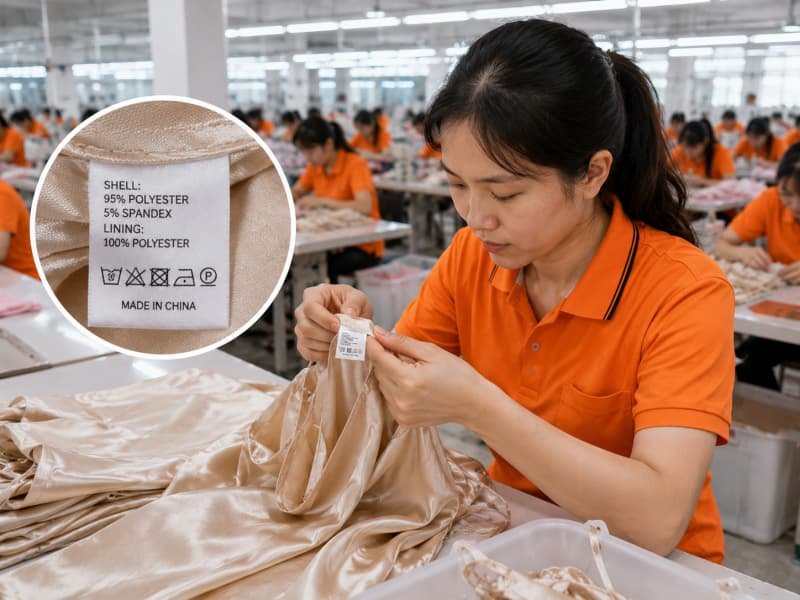
Fibre Composition

Care and Size Data

Market and Brand Details

Barcodes and Packing
Quality Control From Fabric Receipt to Shipment

Incoming Fabric Check

Pre-Production Meeting

First-Piece Confirmation

Inline Measurement Control

Workmanship Inspection
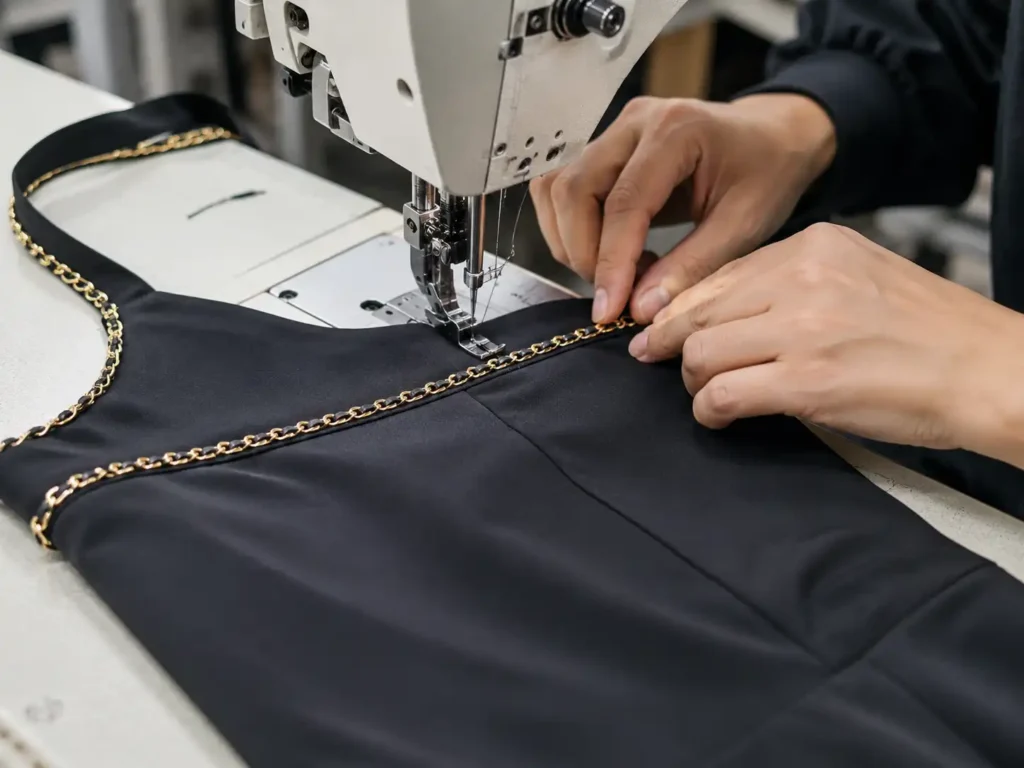
Trim and Needle Control
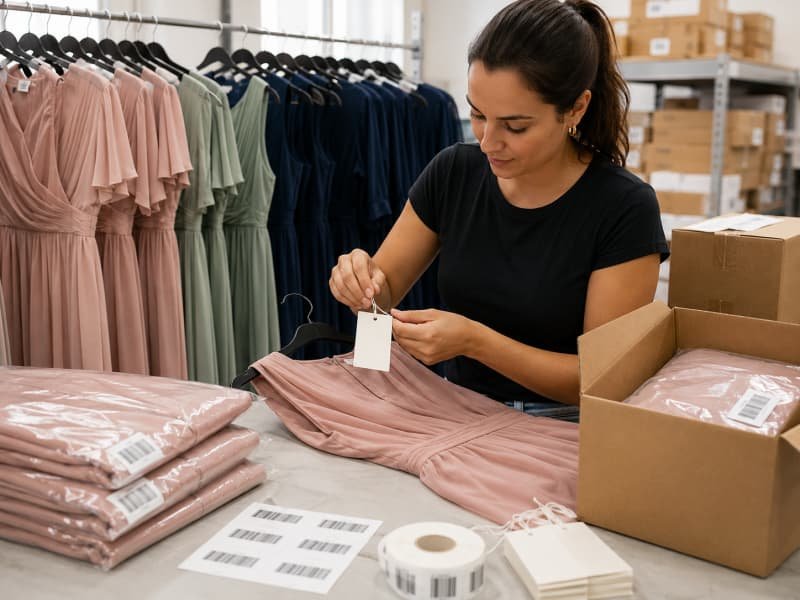
Label and Barcode Check

Final Packing Review
Coordinate Independent Testing and Inspection Properly
Prepare the Correct Sample and Documentation
- Confirm the brand test protocol, product category, target market, sample quantity, colour or size coverage and required components.
- Identify the sample against the production material and style BOM. A laboratory should know which fabric, lining, trim, print, coating or finished garment is being tested.
- Provide approved labels, supplier documents and relevant product information without editing or interpreting the laboratory result.
- Testing timing is connected to development and bulk release. High-risk materials are tested early enough to allow correction; shipment-stage testing is used only where the brand protocol requires it.
Support an Independent Factory Inspection
- Provide inspection access, order files, approved samples, size specifications, packing instructions and available quantities.
- Support random sample selection and product identification without directing the inspector toward preferred goods.
- Prepare measurement areas, lighting, barcode tools, carton access and responsible staff so the inspection can proceed efficiently.
- The inspector applies the brand or inspection-company standard. Duolan does not promise a pass result; Duolan prepares the production and evidence for a fair, complete assessment.
Close Failures With Corrective Evidence
- Affected materials or goods are isolated, and the finding is linked to the relevant style, batch and process.
- Root cause is reviewed across supplier input, pattern, sewing method, process parameter, label file or packing execution.
- Correction, rework or replacement is documented. Re-testing or re-inspection is arranged when required by the brand or independent provider.
- The corrected standard is added to the project record and repeat-order instructions, reducing the chance that the same failure returns in a later production run.

Build Traceable Manufacturing Evidence by Style
Approved BOM
Supplier Evidence
Sample History
Batch Records
Production lot, fabric lot, colour group, size distribution, line allocation and change records help connect bulk garments to the approved product version.
Multi-factory programs use the same released standard and project-level controls.
QC Evidence
Inline findings, measurement checks, workmanship records, label checks, corrective actions and final inspection files are stored by style and production stage.
Photographs support the written record where brand policy permits.
Shipment Pack
Packing lists, carton details, inspection status, laboratory references, approved artwork and shipment documents can be consolidated for brand review. Duolan can supply structured manufacturing data for traceability, DPP preparation or EPR data requests, while platform operation and legal reporting remain with the responsible brand organisation.
Manufacturing Scale With Brand-Level Control
30+ Years Development
16 Owned Factories
20+ Satellite Factories
300 Sewing Lines
50+ Response Lines
Audit and Capacity
A 22-Style EU Compliance Execution Program
Program Scope and Risk Map
- Program profile: a US occasionwear brand prepared 22 styles and 58,600 garments for EU distribution across satin, mesh, stretch, corset, embellished and fashion-set categories.
- Input files included a brand RSL, testing protocol, fibre and label guide, packing manual, inspection checklist and product data fields.
- Nine styles were classified as high risk because of metal trims, coated components, sequins, bonded details or multi-layer construction. Eight were medium risk and five followed the standard path.
- The project was divided into six approval groups so shared fabrics, labels and test dependencies could be controlled without delaying every style.
Development and Production Controls
- Material references were connected to style BOMs before label data was released. Supplier evidence was checked for scope and validity, and missing records were placed on the open-item list.
- High-risk materials and components were prepared for two coordinated third-party testing rounds. Changes to a coated trim and a lining blend were held until evidence and label data were updated.
- PP approval locked construction, measurements, labels and packing. Production was released in three controlled lots rather than forcing all styles into one start date.
- Inline QC focused on seam appearance, stretch recovery, support construction, embellishment security, label accuracy and component matching according to the risk map.
Evidence Pack and Program Outcome
- The project file contained 22 released BOMs, 22 PP approval records, material and supplier documents, laboratory references, label artwork, QC evidence and final packing confirmations.
- Label information was aligned with the final material version before bulk printing. Styles with changed components were reviewed again instead of relying on earlier evidence.
- The brand received one consolidated manufacturing evidence pack organised by style and production lot for internal compliance and sourcing review.
- The outcome reflects controlled execution, not a legal guarantee: product decisions, market obligations and final compliance approval remained with the brand and its appointed specialists.

EU Apparel Compliance Frequently Asked Questions

Submit Your EU Compliance Manufacturing Requirements
Send the product and compliance information already used by your organisation. Duolan will review the manufacturing scope, identify missing inputs and prepare a development path covering materials, samples, testing coordination, labels, production controls, inspection preparation and evidence files. For multi-style programs, include the collection calendar and indicate which requirements apply across all styles and which are product-specific. The first review is intended to clarify feasibility and responsibilities before sampling or bulk commitments are made.
- Company name, website, target EU countries and responsible project contacts
- Tech packs, reference samples or collection brief, including 10-30 style programs where applicable
- Estimated quantities, colour and size distribution, launch date and required delivery model
- Brand RSL, laboratory test protocol, compliance manual and third-party inspection standard
- Fibre, label, care, barcode, packaging and market-information requirements
- Organic, recycled or other material claims and the evidence standard required by your organisation
- DPP, traceability, retailer onboarding or textile EPR data fields requested from the manufacturer
Recommended form fields: Name, Company, Website, Email, Tel/WhatsApp, Target EU Markets, Product Category, Number of Styles, Estimated Quantity, Required Delivery Date, Message and File Upload.


