Skip to content

Halter Dress Manufacturing
Dress-focused development, sampling and scalable production for halter mini, midi, maxi, party, occasion and resort collections.
- 7 control areas guide halter development: neck strap, neckline, bust, side coverage, back opening, lining and functional trims.
- Front, side and back fit reviews are used to assess proportion, coverage and stability before a style moves toward production approval.
- Bulk production references are 15-20 days for simple styles, 20-30 days for regular styles and 30-45 days for complex styles after approvals and material readiness.
What Brands Should Expect From Halter Dress Manufacturing
Halter Product Depth
Fit Engineering
Fabric Matching
Controlled Sampling
Bulk Consistency
Brand-Level Coordination
Established fashion programs often involve several styles, colorways, fit comments, packaging requirements and launch dates moving at the same time. Duolan organizes development and production around project stages, responsibility points and confirmation records. The aim is to keep product teams clear on what is approved, what remains open and what can affect the next milestone. Manufacturing support therefore extends beyond factory output into sample communication, material locking, production readiness, QC and shipment coordination.
Halter Dress Styles Built Around Different Fit Demands
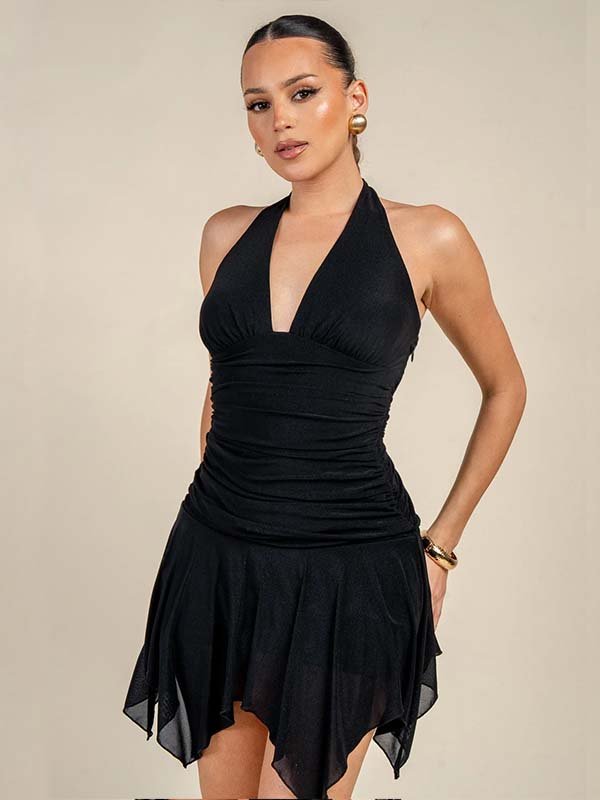
Halter Mini Dresses
- Development focus: strap angle, bust security, armhole shape and mini-length balance.
- Common fabrics: stretch jersey, crepe, satin, mesh combinations and structured woven blends.
- Production risk: neckline drop, side-bust exposure, hem rise and left-right strap variation can become obvious in bulk.

Halter Midi Dresses
Midi halters move the visual focus from a short hemline to upper-body proportion and fabric fall. A clean neckline can look refined only when the torso length, waist placement and skirt drape remain controlled through front, side and back views. Fitted and fluid versions need different pattern logic.
- Development focus: neckline-to-waist proportion, body length, hip release and back balance.
- Common fabrics: crepe, satin, stretch woven, jersey and soft woven blends.
- Production risk: excess drag from the skirt can increase neck pressure when fabric weight and pattern balance are not reviewed together.
A midi program also benefits from checking sitting and walking positions because a stable standing fit can change when the longer skirt adds drag through the waist and torso.

Halter Maxi Dresses
- Development focus: neck-load distribution, skirt sweep, body length, lining length and back opening stability.
- Common fabrics: chiffon, viscose blends, lightweight crepe, satin and printed polyester blends.
- Production risk: heavy hems, uneven stretch and inconsistent skirt length can change neckline position across sizes.

Bodycon Halter Dresses
- Development focus: bust containment, side coverage, waist contour, hip balance and neckline recovery.
- Common fabrics: medium-weight jersey, double-layer jersey, stretch crepe and stretch satin.
- Production risk: thin or weak-recovery fabrics can create armhole gape, neckline growth and visible body-line inconsistency.

Backless Halter Dresses
- Development focus: back depth, side seam position, waist anchoring, neck comfort and lining coverage.
- Common closures: tie back, hook closure, elastic back, lace-up or concealed zip depending on silhouette.
- Production risk: over-deep back shapes can create front lift, side gaping or unstable bust coverage.

Cut-Out Halter Dresses
Cut-outs add visual impact but remove supporting fabric, so placement has to be checked against stretch direction, seam lines and movement.
A cut-out near the side bust, underbust or waist can change both garment stability and grading behavior as sizes increase.
- Development focus: cut-out position, edge recovery, lining strategy, seam reinforcement and movement safety.
- Common fabrics: stretch jersey, mesh combinations, compact knits and structured stretch woven fabrics.
- Production risk: small placement shifts can create visibly different exposure from piece to piece or size to size.
Graded cut-out positions also need representative size review because the same opening can become visually larger or shift closer to the bust as body dimensions change.

Hardware Halter Dresses
- Development focus: hardware load, strap width, reinforcement, plating consistency and skin contact.
- Suitable directions: ring-front minis, adjustable neck straps, resort hardware details and polished occasion styles.
- Production risk: weak reinforcement, plating variation and hardware weight can affect comfort and durability.

Occasion Halter Dresses
Occasion halters need a controlled balance between exposure and security. Satin, drape, lace, mesh or embellishment may create the visual statement, but neckline support, lining coverage and clean inside finishing decide whether the garment feels premium during extended wear.
- Development focus: bust shaping, lining, visual proportion, drape placement and refined closures.
- Suitable programs: cocktail, wedding guest, social-event, graduation and evening edits.
- Production risk: surface-sensitive fabrics and decorative weight can magnify puckering, pressure points and fit inconsistency.
For event-led programs, photo-ready appearance and production-ready construction should be reviewed separately when surface finish, drape or embellishment makes the garment especially sensitive to handling.
Engineering Neck Load, Bust Security and Back Stability
Neck Load and Strap Geometry
- Strap width and finished thickness against the weight of the bodice and skirt.
- Strap angle from neckline to neck, including whether the edge pulls outward or inward.
- Closure location and seam bulk at the back neck.
- Neckline height after the strap carries normal garment load.
- Comfort during standing, walking, arm movement and longer wear.
Bust Coverage and Side Security
- Front neckline height and the amount of center-front exposure.
- Bust point placement relative to the intended size standard.
- Side-bust coverage and armhole line from front and side views.
- Underbust anchoring where the design uses a seam, elastic or internal panel.
- Lining coverage in sheer, light or low-cut areas.
- Cup, power-mesh or internal-support compatibility where required.
Back Structure and Wearing Balance
Open backs are often the strongest visual feature of a halter dress, but every reduction in back coverage changes how the front is stabilized. A high-back halter can use more fabric area to balance tension. A low-back or fully open-back style has fewer support points, increasing the importance of side seam position, waist anchoring, closure design and neck load. Tie-back, elastic-back, lace-up and zip-back constructions each create different behavior. Duolan reviews back shape together with the front neckline rather than treating the back as a separate design feature. A lower back can pull the front upward if the side seams are too tight, while a loose back can reduce bust security and create armhole gape. Fabric stretch direction also matters: a stable woven back behaves very differently from a soft jersey or mesh panel. Development review covers:
- Back opening depth and width in relation to side seam position.
- Waist or underbust anchoring where the garment needs an additional support point.
- Tie length, elastic tension, zip placement or lace-up range.
- Lining and seam finishing around exposed edges.
- Symmetry from left to right through the back opening and strap connection.
- Movement stability when the wearer turns, sits or raises the arms.
A successful halter fit maintains the intended exposed-back proportion without forcing the neck to carry unnecessary load. Once the balance is approved, measurement points and construction details are recorded for grading, PP approval and bulk inspection so the same relationship can be reproduced beyond the original sample size.

Halter Fit and Production Risk Matrix
Halter issues are often connected: a small strap, pattern or material change can alter coverage somewhere else. The matrix below turns common fitting symptoms into production checkpoints that can be reviewed during development, PP approval and bulk inspection.
| Risk Area | What Appears on Garment | Common Cause | Development and Production Control |
|---|---|---|---|
| Neck pressure | Strap digs in or feels heavy | Strap too narrow, skirt too heavy, poor load sharing | Review strap width, angle, garment weight and alternate anchoring points |
| Front neckline drop | Neckline sits lower than approved | Strap growth, fabric stretch, incorrect body length | Lock strap finished length, fabric recovery and neckline POM |
| Side-bust exposure | Excess opening near armhole | Armhole shape, bust volume mismatch, weak side support | Correct side pattern, bust point, lining and grading |
| Armhole gaping | Edge stands away from body | Excess edge length or unstable stretch | Rebalance armhole curve, edge finish and elastic tension where used |
| Back instability | Back opening shifts during movement | Back too loose, weak waist anchor, poor closure setup | Review side seam, back width, closure range and waist support |
| Strap twisting | Strap turns or rolls | Narrow construction, seam bulk, unstable fabric | Control grain, finished width, seam position and pressing |
| Hardware discomfort | Ring or slider rubs skin | Oversized part, sharp edge, poor placement | Confirm hardware size, edge finish, reinforcement and wear position |
| Size-to-size drift | Larger sizes expose more or sit differently | Mechanical grading without fit review | Grade critical POMs separately and review representative graded sizes |
Fabrics That Change Halter Fit and Garment Behavior

Satin Halter Dresses
- Review: weight, drape, shine, slip, opacity and seam marking.
- Fit effect: little stretch means neckline and bust shape rely more heavily on precise pattern balance.
- Production control: needle choice, seam smoothness, pressing, lining compatibility, handling marks and packing protection.

Stretch Jersey Halters
Stretch jersey can support fitted halter silhouettes through controlled negative ease, but stretch percentage alone does not define performance. Recovery determines whether the neckline and armhole return after wear. Weight and coverage affect confidence, especially through the bust and side body.
- Review: GSM, stretch direction, recovery, opacity, shrinkage and surface stability.
- Fit effect: weak recovery can lower the neckline, increase armhole gape and reduce bust containment.
- Production control: edge stabilization, seam elasticity, double-layer decisions, grain direction and measurement in relaxed condition.
For bodycon halters, Duolan links fabric stretch to pattern reduction and size grading rather than applying one fixed fit block across different jerseys.

Mesh Halter Dresses
- Review: transparency, mesh recovery, handfeel, stretch direction and abrasion against skin.
- Fit effect: unsupported mesh may grow at neckline or back edges under tension.
- Production control: lining coverage, seam choice, edge stabilization, panel matching and print or embellishment placement.

Chiffon Halter Dresses
Chiffon suits fluid resort and occasion halters, especially gathered necklines, tie-neck designs and layered maxis. Its light hand creates movement, but the fabric offers limited structural support and can distort along biased or curved edges.
A stable internal layer may be needed to keep the neckline where the design intends.
- Review: drape, transparency, snag sensitivity, grain stability and lining relationship.
- Fit effect: gathers can redistribute fullness and alter center-front height if neckline length is not controlled.
- Production control: fine seams, clean binding, gathering ratio, lining length, hem balance and pressing temperature.
Chiffon halters benefit from clear sample comments on both appearance and security because a visually soft neckline can still need hidden structural control.

Crepe Halter Dresses
Crepe offers a useful balance between fluidity and structure for cocktail, occasion and polished contemporary halters.
Depending on construction and composition, crepe can hold a clean neckline better than very slippery satin while still providing enough drape for body-skimming shapes.
- Review: weight, surface texture, stretch where present, recovery, drape and crease behavior.
- Fit effect: medium structure can help side coverage and back stability without making the garment rigid.
- Production control: seam puckering, pressing, edge finishing, shrinkage and shade consistency.
Crepe is often a strong option when the design needs cleaner fit control than chiffon but less shine than satin, especially for commercial occasion programs.

Lace and Embellished Halters
Lace, sequins, beads and decorative surfaces can shift halter engineering because added weight changes load and rough surfaces may contact the neck, armhole or side body. Pattern placement also matters where motifs must remain symmetrical around a central neckline or open back.
- Review: motif position, total decoration weight, edge comfort, stretch, backing and lining.
- Fit effect: dense embellishment may pull the neckline down or reduce stretch expected from the base fabric.
- Production control: reinforcement, motif matching, seam allowance clearance, handfeel at skin-contact zones and final weight checks.
Decorative halters should be sampled with representative embellishment density before bulk approval so the fit is not approved on a lighter development version.
Functional Trims That Keep Halter Dresses Secure

Neck Ties
- Lock finished tie width and length.
- Reinforce tie entry points.
- Check knot bulk and skin comfort.
- Confirm symmetry after pressing and final inspection.

Hooks and Closures
- Select size against strap width.
- Cover or position hard edges cleanly.
- Reinforce the attachment area.
- Check opening security under normal wear tension.

Sliders and D-Rings
- Confirm internal opening against strap width.
- Review plating and edge smoothness.
- Test sliding resistance and hold.
- Inspect left-right position and strap symmetry in bulk.

Internal Elastic
Elastic can support underbust, back or edge stability without changing the external design. Tension must be set carefully; excessive tension can distort the neckline or create visible gathering, while weak tension may provide little support.
- Specify width, stretch and recovery.
- Define finished measurement after attachment.
- Check tension against the sample fabric.
- Keep elastic hidden from external view where required.
Elastic settings should be recorded as finished measurements or controlled ratios so production teams can reproduce support consistently instead of stretching by feel during sewing.

Cups and Power Mesh
- Match cup position to the approved bust point.
- Use power mesh where controlled stretch is needed.
- Secure internal layers at stable seam locations.
- Review comfort, opacity and movement before approval.

Zippers and Reinforcement
A concealed zipper can stabilize waist or side entry on structured halters, while reinforcement tape, stay stitching or local backing can protect high-tension areas. Clean function matters as much as invisible appearance.
- Keep zipper top secure and smooth.
- Reinforce neck, ring and back connection points.
- Check opening stress before full production.
- Inspect seam distortion around reinforced zones.
Reinforcement should be scaled to the fabric. A stable crepe and a delicate satin may need different backing choices even when the external halter shape and closure position are identical.
Pattern, Fit and Grading Built for Halter Stability
Translating Brand Fit Into Pattern Geometry
- Neckline shape and finished neckline length.
- Bust point and dart, seam or gathering position.
- Side-bust and armhole curve.
- Front and back body length.
- Waist or underbust anchoring points.
- Back opening width and depth.
- Strap construction and attachment position.
- Lining pattern alignment with the outer shell.
Critical Measurements and Tolerance Control
- Defined POM name and measurement route.
- Base-size approved measurement.
- Tolerance by criticality.
- Notes for adjustable hardware or stretch condition.
- Fit-comment reference where a value changed.
- PP and inline measurement checkpoints.
Grading Without Losing Coverage
Mechanical grading can create unexpected exposure in halter styles because the body does not grow evenly in every direction. Larger sizes may need more bust volume and side coverage without simply enlarging the neckline opening. Smaller sizes may require reduced strap or armhole dimensions while keeping the same visual proportion. Back depth and underbust placement can also shift differently from standard torso increments. Duolan reviews grading around the brand’s size specification and approved fit logic. Where a halter style is highly exposed or structured, representative graded sizes can be checked rather than assuming the base-size shape will scale perfectly. The goal is to preserve the design language – neckline proportion, back exposure, waist placement and overall silhouette – while adapting coverage and support to each size. Key grading considerations include:
- Bust and underbust growth versus neckline width.
- Side-bust height and armhole curve.
- Strap length increments.
- Front and back body-length growth.
- Back opening width and depth.
- Waist and hip relationship on fitted bodies.
- Skirt length and sweep on midi or maxi versions.
Fit comments from graded samples can be returned to the pattern and spec before full production. The approved size system then supports measurement inspection, reorder consistency and later extensions built from the same halter fit direction.

Halter Sample Development From Brief to Production Readiness
Development Review Before Cutting the First Sample
For a halter style, the early review commonly covers neckline depth, strap construction, bust shape, side coverage, back opening, waist anchoring, lining, closure, hardware and intended fabric. A fluid resort halter may need emphasis on drape, tie behavior and maxi balance. A party mini may require tighter attention to bust security, body contour, hardware and short-length movement. An embellished occasion style may need weight and skin-contact review before the outer pattern is finalized.
The sample plan can define:
- Sample purpose: proto, fit, photo, salesman or PP.
- Material basis and any temporary substitutions.
- Critical measurements to confirm first.
- Construction details requiring trial or mock-up.
- Fit risks requiring mannequin or live review.
- Open points requiring brand confirmation.
- Items that could affect later bulk costing or timing.
Fit Review, Comments and Pattern Correction
Movement review can include standing, walking, sitting, turning and raising the arms. Those positions reveal neck pressure, side-bust exposure, armhole gaping, back movement and hem behavior that may not appear in a static fitting. Photo review also matters for occasion and party styles because strong lighting can expose transparency, wrinkling or neckline imbalance that looks less obvious in person.
Comments are converted into actions such as:
- Pattern correction at neckline, armhole, side seam or back opening.
- Strap length or angle adjustment.
- Bust-point, dart or seam-position correction.
- Lining or internal-support change.
- Fabric recommendation where fit symptoms originate from material behavior.
- Measurement-spec update.
- Workmanship or edge-finish revision.
PP Approval and the Handover to Bulk
A visually approved sample is not automatically a production-ready standard. Before bulk, Duolan aligns the elements that production teams need to reproduce: material, fit, measurement, construction, trims, color, labels, packaging and QC checkpoints. A PP sample or confirmed production basis provides the reference for the transition.
Halter-specific approval should lock:
- Finished strap length, width and attachment.
- Neckline position and bust coverage.
- Side-bust and armhole shape.
- Back opening and closure behavior.
- Lining placement and internal support.
- Hardware type, finish and reinforcement.
- Critical POMs and tolerance.
- Seam, binding, gathering or edge-finish requirements.
Where the style carries higher structural or workmanship risk, first-piece or pilot verification can be used before releasing the full run. Such checks are particularly useful for open-back, hardware, embellished or highly fitted halters where a small construction shift can alter wearing stability.
The handover also confirms packaging and handling where surface-sensitive materials are involved. Satin may need crease and abrasion protection; embellished styles may need additional protection against snagging or pressure. Production readiness therefore covers the complete garment standard, not only the sewing operation.

Workmanship Details That Separate Clean Halter Production

Neckline Binding
Binding must follow the neckline without stretching it open, shrinking it tight or creating visible waves. Satin, jersey, mesh and chiffon require different handling because each reacts differently to tension and pressing.
- Control binding width and feed.
- Stabilize curved or stretchy edges where needed.
- Keep join points clean and low-bulk.
- Check neckline shape after pressing, hanging and fitting.
Bulk operators should work from an approved finished width and neckline shape. A few millimeters of extra feed can change both appearance and fit, especially on low or curved halter necklines.

Strap Attachment
Strap joins carry repeated tension and are visible at close range.
Reinforcement should be strong enough for wear while remaining clean enough for an exposed neckline.
- Secure load-bearing seams with appropriate back-tack or reinforcement.
- Avoid excessive seam bulk near the neck.
- Match left-right strap position precisely.
- Inspect finished length before and after attachment.
Where a strap joins hardware or a narrow neckline point, reinforcement should be checked from both sides so security is achieved without a visible lump, puckering or stiff patch.

Armhole and Side Edge
A halter armhole often becomes a side-bust edge, making finish quality directly linked to coverage.
Wavy edges or uneven tension can alter the apparent fit even when the pattern is correct.
- Control edge length against the approved pattern.
- Use lining, facing, binding or elastic according to design.
- Check for gaping in front and side views.
- Keep seam allowances flat and comfortable against skin.
Side-edge finish should also be checked after movement because an edge that appears flat on the table can stand away from the body once the neck strap carries tension.

Lining Fixation
Lining should support coverage without dropping below exposed edges, twisting inside the garment or pulling the outer shell. Fixing points must allow movement where the design needs drape.
- Align neckline, armhole and back-opening coverage.
- Secure lining at stable seams rather than random hand tacks.
- Check light colors and sheer fabrics under strong light.
- Confirm lining length and movement before PP approval.
For open-back or low-side styles, internal layers should remain invisible through the complete wearing range. Front, side and back checks help confirm coverage without adding unnecessary bulk.
A well-fixed lining should support the garment quietly: no rolling at the neckline, no visible edge at the back and no pulling that changes the outer silhouette.

Back Closure Finish
Tie backs, hooks, elastic backs, zippers and lace-up constructions all need clean internal finishing because the back is a focal point on many halter dresses.
Closure placement must not create pressure or distortion.
- Reinforce high-tension connection points.
- Keep hooks and zipper tops smooth against skin.
- Check tie or lace-up symmetry.
- Inspect back shape during movement, not only on a hanger.
Final inspection should compare closure position against the approved sample because a small shift in hooks, elastic or zipper height can change back tension and the front neckline simultaneously.
For tie or lace-up backs, finished lengths and exit positions should be controlled so the wearer receives a usable adjustment range without excess bulk or uneven ends.

Gather and Drape Control
Gathering and drape can soften a halter neckline or create a strong party silhouette, but uncontrolled fullness changes bust position and side coverage.
Bulk pieces need repeatable ratios and placement.
- Define gather zones and finished lengths.
- Mark critical drape or twist positions.
- Check mirrored details for symmetry where required.
- Compare first-piece appearance to the approved sample before full release.
For repeated production, gather ratios, notch positions and fold directions should be marked clearly enough for different operators to reproduce the approved visual balance without relying on styling by hand.
Pressing and hanging checks can help confirm that the approved folds remain stable after handling rather than disappearing or shifting before the garment reaches packing.
Halter Quality Control Built Around Product-Specific Risks
Fit and Measurement Checks
- PP sample and approved measurement record.
- Inline measurement sheets for critical POMs.
- Left-right symmetry checks.
- Representative size checks after grading.
- Corrective action records where a measurement trends outside tolerance.
Construction and Functional Security
- Strap attachment and stitch security.
- Hardware placement, finish and edge condition.
- Tie length and symmetry.
- Closure operation and reinforcement.
- Armhole and neckline edge stability.
- Lining fixation and internal-support position.
- Seam integrity in high-tension areas.
Visual, Material and Final Presentation
Halter dresses often depend on clean visual lines, making material and finishing consistency highly visible. Satin needs attention to shine, seam marks, scratches and pressing. Mesh and chiffon need transparency and edge review. Jersey needs recovery and shape retention. Embellished fabrics need placement, missing components, snagging and skin-contact checks.
Final review also considers whether the garment presents correctly after packing. Hardware can scratch delicate surfaces when not separated. Long tie straps can tangle or distort if packed without control.Final checkpoints can include:
- Shade and surface consistency within approved standards.
- Drape and silhouette against the reference sample.
- Transparency and lining coverage where relevant.
- Pressing and seam appearance.
- Label, barcode and packaging accuracy.
- Folding method and protection for delicate surfaces or hardware.
Quality control therefore protects both fit performance and the visual result the brand expects to receive at warehouse, showroom or launch preparation.
Packing checks are linked to the final garment rather than treated as a separate logistics task. Long neck ties may need controlled folding, metal rings may need isolation from delicate satin, and embellished surfaces may need tissue or protective layers to avoid snagging.

Locking Halter Standards Before Bulk Production Starts
Material and Fit Approval
The production basis should make clear:
- Approved shell and lining reference.
- Color or lab-dip approval where applicable.
- Stretch or recovery requirements for fitted materials.
- Base-size fit status and critical POMs.
- Tolerance for high-sensitivity measurements.
- Approved hardware or closure reference.
Material references should be traceable to the actual bulk source whenever possible. If a sample uses a substitute fabric, the difference in weight, stretch, finish or handfeel is recorded so fit approval is not interpreted as approval of an unavailable material. For halter products, even modest changes in fabric recovery can alter neckline position and armhole behavior, so any late material switch deserves a targeted fit review before full release.
The approval record should identify the latest physical and digital reference clearly, including sample version and date where internal systems require it. Clear version control prevents an earlier strap length, back opening or lining setup from being used after later fit corrections have already been accepted.
Construction and Visual Approval
Construction approval describes how the garment is built, while visual approval confirms how the finished dress is expected to look. A halter can meet measurement values and still appear wrong if gathering is placed differently, bindings become wider, hardware rotates, or the back opening loses symmetry. Workmanship references therefore belong beside size specifications.
Approval can cover:
- Neckline binding or facing method.
- Strap construction and reinforcement.
- Gather, twist, drape or cut-out placement.
- Lining attachment and internal support.
- Back closure and hardware orientation.
- Seam and hem finish.
- Pressing standard and garment presentation.
Photo references, approved samples and detail close-ups make the standard easier to execute than text alone. Clear visual and technical references reduce interpretation as production moves across operators and inspection stages.
Where several colors or surface finishes are ordered, approval also checks whether the construction remains visually consistent across them. Dark shades can hide seam impressions that become obvious on ivory satin; printed or embellished versions may need different placement references around the neckline. The production file should therefore define which visual details are universal and which require color- or material-specific references.
For details controlled mainly by appearance, the approval reference should still be measurable where possible.
Production Readiness and First-Piece Release
Before bulk release, Duolan reviews whether the project has the information and materials needed to execute consistently. The order is broken down by style, color, size, quantity, complexity and timing. Higher-risk halters can be routed through first-piece or pilot verification before a full run is released.
Readiness review can confirm:
- Approved sample or PP basis.
- BOM and material availability.
- Critical workmanship points.
- Size and quantity breakdown.
- QC checkpoints and inspection method.
- Labels, barcodes and packing requirements.
- Delivery window and production path.
A first-piece check is especially useful for open-back, hardware, highly fitted or embellished halters because a small setup error can propagate quickly in volume. Release follows only after key measurements, construction and appearance are aligned with the approved standard.
Production readiness also includes a decision on monitoring intensity. A straightforward crepe halter with stable materials may follow standard inline checks, while a low-back ring-detail satin style may require earlier first-piece review and more frequent control of strap, hardware and back measurements. Risk-based control concentrates attention where a deviation would have the strongest effect on wear, appearance or later rework cost.

Manufacturing Capacity Organized Around Halter Project Complexity
Core Factory Control
Satellite Capacity Support
Specialized Process Network
Halter collections may combine printing, embroidery, washing, pleating, embellishment or other surface processes. Duolan works with established supporting resources in South China’s textile and apparel cluster, including multiple regular partners across printing, dip-dye, embroidery and washing.
Process trials, strike-offs or first-piece checks can be integrated where a special finish affects drape, stretch, surface quality or bulk repeatability. For halter styles, any process that changes weight, stretch or surface stiffness is reviewed as part of garment engineering because the final process can change neckline tension, drape and comfort after the fit has already been approved.
Extending One Halter Fit Direction Into a Collection

Mini to Midi
Moving a halter from mini to midi changes more than skirt length. Added fabric weight can increase neck load, while the waist-to-hem proportion changes the overall visual balance.
- Recheck body and skirt balance.
- Review lining and slit needs.
- Confirm total garment weight.
- Preserve the approved neckline and bust relationship.
If the original mini uses a fitted or highly exposed upper body, the extension should keep its halter identity while rechecking whether the longer skirt changes tension through the waist, neck and back.

Midi to Maxi
- Recheck strap comfort under added weight.
- Balance hem sweep with movement.
- Control finished length across sizes.
- Review shipping and crease protection for long garments.

Backless Extension
A core halter can be developed into a deeper back or more open version, but the existing fit cannot simply be cut away.
Support must be redistributed through side seams, waist or closure systems.
- Define new back depth and width.
- Recheck side-bust coverage.
- Select tie, elastic, lace-up or zip support.
- Review movement stability before approval.
Where a deeper back is added to a proven style, the new version should be treated as a structural revision with its own fit approval rather than a simple cut-away design change.

Fabric Family Extension
A successful shape can move from crepe to satin, jersey, mesh overlay or chiffon, yet each material can change fit and workmanship.
Pattern reuse should begin from the approved block, followed by material-specific correction.
- Compare drape, stretch and support.
- Recheck neckline and armhole behavior.
- Adjust seam and edge construction.
- Confirm new bulk material risks.
A fabric extension is strongest when the original silhouette is treated as a starting block, while neckline, strap, lining and seam decisions are recalibrated for the new material behavior.

Party and Occasion Edit
- Build a clear hero and commercial mix.
- Coordinate color and material families.
- Share compatible trims where appropriate.
- Separate photo-focused complexity from repeatable core styles.

Halter Tops and Sets
The same neckline language can extend into halter tops, skirt sets or two-piece programs. Cropped proportions, waist exposure and separate bottom grading create new fit questions, so the top pattern still needs dedicated review.
- Preserve neckline identity.
- Rebalance cropped body length.
- Coordinate top and bottom size logic.
- Align colors, fabrics, labels and packing across the set.
Set development should also confirm how the upper halter finishes at the waist and how the separate bottom sits beneath it, avoiding unwanted gaps, overlap or proportion changes across sizes.
Planning Halter Development Around the Launch Calendar
Timing works best when development is planned backward from the required launch or warehouse date. The schedule below separates design confirmation, samples, production and logistics so high-risk halter details are resolved before they become bulk delays.
| Stage | Main Halter Decisions | Timing Reference |
|---|---|---|
| Design and feasibility review | Neckline, strap, bust, back opening, fabric, trims, target size range | Confirm before sample cutting |
| First sample and fit review | Front/side/back fit, neck comfort, coverage, movement, material behavior | Timing set by complexity and material readiness |
| Revision and photo readiness | Pattern corrections, visual details, color, photo-sample priorities | Complete before campaign or lookbook deadline |
| PP and material locking | Size spec, BOM, fabric, lining, hardware, workmanship, labels, packing | Complete before bulk release |
| Bulk production | Simple styles 15-20 days; regular styles 20-30 days; complex styles 30-45 days | After approvals and material readiness |
| Inspection and packing | Measurement, workmanship, visual check, labels, barcode, packing | Before shipment release |
| Logistics | Express 3-7 days; air 5-8 days; sea 20-35 days | Select against launch window and cost plan |
From Halter Fit Correction to 31,200-Piece Production
A recent anonymous-style project example reflects the scale and decision path common in Duolan’s established fashion programs: multiple halter-led styles, several fabric behaviors and a launch calendar that required fit decisions to remain consistent from development into bulk.
Project Scope and Development Challenge
- Neck pressure on the heavier satin and maxi versions.
- Side-bust exposure on lower armholes.
- Front neckline height changing when strap tension changed.
- Back openings becoming unstable during movement.
- Hardware rotation on the ring-detail styles.
- Different grading behavior between stretch and non-stretch fabric families.
Sampling, Fit Review and Production Locking
- Critical POMs for strap, neckline, bust, armhole and back opening.
- Approved fabric and lining references by style group.
- Hardware size, finish, orientation and attachment method.
- Neckline, binding and back-edge workmanship.
- Size-grading notes where exposure needed extra control.
- Packing methods for satin and hardware styles.
Bulk Outcome and Reorder Readiness
The 31,200-piece order was allocated by construction complexity rather than distributed only by quantity. Fitted stretch styles, woven occasion styles and hardware versions followed production paths suited to their material and workmanship requirements. Inline QC focused on the POMs most likely to alter halter fit, with additional visual checks on strap symmetry, back opening, lining and hardware position.
The production result was not defined only by shipment completion. More importantly, the first order left a reusable technical basis for future halter development:
- Approved fit references by structural family.
- Working measurement and tolerance logic for critical halter POMs.
- Material notes covering recovery, drape and support behavior.
- Hardware and reinforcement standards for ring-detail styles.
- Workmanship references for binding, lining and back closures.
- QC checkpoints that could be repeated on later color and style extensions.
The capsule moved from a set of visually related designs into a production system with repeatable standards. Future color additions, length changes and related halter styles could begin from an established fit and construction history rather than restarting development from zero.
Client identity, labels and unreleased design details are withheld for confidentiality.

Evidence Behind Halter Development and Bulk Production

Pattern Review Evidence
- Suggested caption: Halter neckline and side-coverage review before revised sample cutting.
- Useful proof: marked pattern, measurement notes, sample issue photo and corrected pattern piece.

Front Side Back Fit
Use one approved or development sample in front, side and back views. Halter structure cannot be judged from the front alone because side-bust coverage and back stability often reveal the real fit risk.
- Suggested caption: Three-view review for neckline height, side coverage and back balance.
- Useful proof: mannequin, live fitting or consistent studio fit photographs.
Keep camera angle, garment adjustment and base size consistent across the three views so differences in neckline, side coverage or back balance can be compared without visual noise from styling changes.

Fabric and Garment Pairing
Place swatches or fabric cards beside the halter sample built from the same material.
The visual should demonstrate how drape, stretch, opacity or surface finish affects the final silhouette.
- Suggested caption: Fabric behavior checked against halter support and drape requirements.
- Useful proof: shell fabric, lining, stretch note, color card and finished sample.
Where several material options were tested, show the rejected and approved direction side by side.The comparison demonstrates why drape, support or opacity led to a different garment decision.

Construction Close-Ups
Photograph the places where halter quality is won or lost: binding, strap attachment, lining, armhole edge, ring reinforcement, hooks, zipper top and back closure.
Close-ups should show finish and function clearly.
- Suggested caption: Reinforced strap connection and clean internal neckline finishing.
- Useful proof: exterior and interior views of the same construction point.
Use scale and lighting that reveal stitch quality, seam thickness and reinforcement clearly. Exterior beauty shots alone cannot prove how a high-tension halter connection is built internally.

Sample Revision Evidence
A before-and-after sample comparison communicates more than a polished final photo. Show the original issue, the comment, the technical correction and the revised result where confidentiality allows.
- Suggested caption: Fit comment translated into strap, armhole and pattern correction.
- Useful proof: issue mark-up, revision summary, revised sample and updated spec point.
Where confidentiality permits, pair each visual change with one short technical note such as strap shortened, armhole reshaped or back width reduced, making the development sequence easy to understand.

QC and Production Evidence
Include PP reference, first-piece review, inline measurement, hardware or seam checks, final inspection and packing confirmation. Each image should identify the production decision it supports.
- Suggested caption: Inline critical-POM check against the approved halter production basis.
- Useful proof: QC sheet, measurement photo, line check, packing approval and shipment preparation.
Production images are strongest when tied to a defined checkpoint: critical POM measurement, first-piece release, hardware security, packing approval or another decision that protects the approved halter standard.
Supplier Qualification for Established Halter Dress Programs
Manufacturing Foundation
Audit and Standards Support
Cross-Border Project Coordination
Development and production communication can be handled through email, WhatsApp, WeChat, voice, video and online meetings. English communication covers tech packs, fit comments, sampling, quotations, lead time, revisions, production updates and shipment coordination. Factory visits can also be arranged for qualified projects, including sample-room, production-line and process review where appropriate to the stage of cooperation. For multi-style programs, staged updates can keep sample comments, pending approvals and production changes visible to the relevant brand team, reducing the risk of old instructions being carried into later versions.
Halter Dress Manufacturing Frequently Asked Questions
Yes. Reference images can be reviewed together with target fabric, intended fit, size information and commercial direction. A tech pack gives more detail, but an image can still start an initial feasibility review. Duolan identifies neckline, strap, bust, side coverage, back opening, lining and construction points before confirming the sample path.
Yes. Existing tech packs, BOMs, size charts and construction notes can be used as the primary development basis. Where measurements or construction details conflict with fabric behavior or halter fit, the team can flag the issue before sampling and propose a review point rather than changing the specification without discussion.
Common directions include satin, crepe, stretch jersey, chiffon, mesh, lace and selected embellished fabrics. The best choice depends on support, drape, stretch, opacity, weight, skin feel and the intended back opening. Fabric is reviewed against the garment result rather than chosen only by category name.
Neck pressure is reviewed through strap width, angle, length, garment weight, bodice support and available anchoring points. A heavy maxi, open-back satin dress and fitted jersey mini do not carry load in the same way. Sample fitting is used to rebalance the structure instead of simply loosening the strap.
Side coverage is managed through bust point, armhole curve, side seam, strap angle, lining and fabric recovery. Live fitting and side-view photography help identify gaping or exposure. Grading also receives separate attention because coverage can change unevenly as bust volume increases across sizes.
Yes. Backless, ring-detail, tie-neck, adjustable, cut-out and other fashion-led halter constructions can be evaluated. Production planning includes reinforcement, hardware position, back stability, side coverage, lining and skin-contact details where the design creates additional load or exposure.
Programs can use first development samples, fit or revision samples, photo-ready samples, salesman samples and PP samples depending on the project. Sample purpose is confirmed first because a photo sample and a production-basis sample may require different levels of fit, material and technical locking.
Reference production cycles are 15-20 days for simple styles, 20-30 days for regular styles and 30-45 days for complex styles after approvals and material readiness. Halter construction, special processes, fabric availability, order quantity and required inspection can change the final schedule.
The production basis locks material, critical measurements, strap and neckline construction, lining, hardware, workmanship, labels and packing. Higher-risk styles can receive first-piece or pilot verification. Inline measurement and workmanship checks then compare bulk output against the approved PP or production reference.
Yes. An approved halter direction can be extended into mini, midi, maxi, backless, fabric variations, halter tops or coordinated sets. Each extension is rechecked where length, weight, stretch, exposure or construction changes the original support system rather than assuming one pattern can be reused unchanged.

Send Your Halter Dress Program for Development Review
Share the information already available for your halter program. Duolan can review the product direction, fabric and trim basis, fit-sensitive areas, sample stage and production requirements before confirming the next development path. A complete tech pack is useful, but a well-defined reference image, existing garment, size chart or construction brief can also support an initial review. For production-ready programs, approved samples, BOMs and quantity breakdowns allow a more accurate evaluation of manufacturing, QC and delivery planning.
The first review focuses on the points most likely to affect the garment result: strap geometry, neckline height, bust and side coverage, back opening, lining, hardware, fabric behavior and the required fit standard. Where information is incomplete, the team can identify which items need confirmation before sampling or formal production quotation. Where a sample is already approved, the review can move directly toward material readiness, critical measurements, construction references, inspection requirements and delivery planning. Clear project information helps the team respond with a defined development or production path rather than a generic price response.
Please include where available:
- Halter style or collection direction.
- Tech pack, reference images or existing sample photos.
- Target fabric, lining and hardware direction.
- Base size, size range and measurement standard.
- Style, color, size and quantity breakdown.
- Required sample stage or current approval status.
- Target warehouse, campaign or launch date.
- Label, barcode, packing and inspection requirements.