Skip to content

Lightweight Embellishment Engineering Solutions
Garment-level engineering for embellished fashion dresses requiring visual impact, controlled weight, stable fit, comfortable wear, and repeatable bulk production.
Duolan develops embellishment around garment behavior rather than decoration count.
- 6 engineering variables: visual effect, element weight, density, placement, fabric response, and production repeatability.
- 5 critical load areas: neckline, straps, bust, waist and hip, and hem.
- 4 validation gates: material trial, placement trial, garment sample, and PP production standard.
- The objective is clear: preserve sparkle, texture, movement, fit, and comfort without carrying unnecessary decorative load.
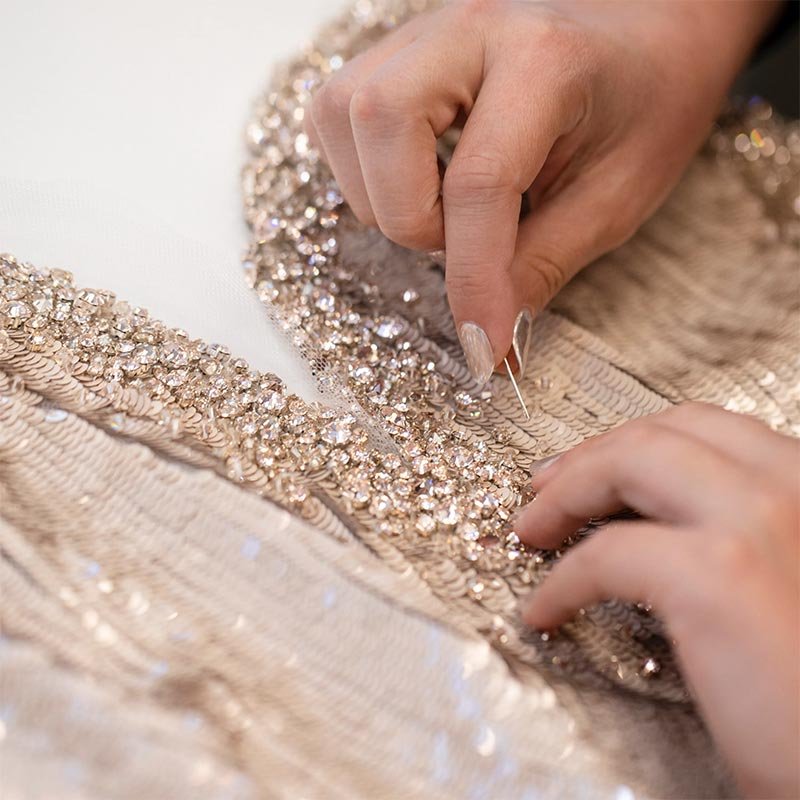
When Embellishment Starts Changing the Dress Instead of Enhancing It
Weight Changes Behavior
Decorative weight does not remain isolated on the surface.
Added load can pull a neckline lower, increase tension on narrow straps, flatten a soft drape, change skirt movement, or make a fitted panel recover more slowly after wear.
A heavily decorated hem may also change how a mini, midi, or maxi dress falls when walking.
Engineering review therefore considers:
- Where added weight is concentrated.
- Which garment areas carry the load.
- Whether the original silhouette remains balanced.
- How the dress behaves on a body rather than on a hanger.
- Whether the same result can remain stable across the intended size range.
Fabric Fights Decoration
Lightweight fabrics often create their commercial value through softness, transparency, stretch, movement, or fluid drape. Dense embellishment can work against those properties. Stretch mesh may become locally rigid. Fine satin can show puckering around attachment points. Chiffon may distort under concentrated beadwork. Lightweight jersey can lose clean recovery when a decorative area becomes too dense.
Fabric and embellishment therefore need to be reviewed as one material system.
Key questions include:
- Can the base fabric carry the planned load?
- Does decoration interfere with stretch or drape?
- Is backing required?
- Will lining improve comfort without creating excessive thickness?
Samples Hide Bulk Risk
A skilled sample maker can often make one complex dress look convincing through hand adjustment, careful placement, and extra working time.
Bulk production has a different requirement: the result must be defined well enough for repeated cutting, embellishment, sewing, inspection, and packing.
A development sample therefore needs more than visual approval. Production teams need clear references for:
- Decorative position and orientation.
- Coverage and density.
- Base material and lining.
- Attachment method.
- Critical edges and seam clearance.
- Interior finishing.
- PP appearance standard.
- Inspection points.
Six Decisions Behind Lightweight Embellishment Engineering for Fashion Dresses
Lightweight embellishment is not controlled by a single material specification. Duolan reviews the intended visual result together with decorative load, fabric response, body position, comfort, and production repeatability before a development direction is treated as commercially workable.
| Engineering Dimension | What We Review | What Needs to Be Locked |
|---|---|---|
| Visual Impact | Shine, texture, dimension, focal areas, photography effect | Which visual elements carry the design identity |
| Decorative Load | Element size, material type, density, coverage, accumulated garment load | Where weight is necessary and where it can be reduced |
| Fabric Response | Drape, stretch, recovery, transparency, stability, surface sensitivity | Base fabric, backing, lining, seam and edge strategy |
| Body & Fit Effect | Neckline, straps, bust, waist, hip, hem, movement | Load distribution and fit-sensitive placement |
| Wearing Comfort | Skin contact, friction, reverse-side finish, interior bulk, lining coverage | Comfort protection at high-contact areas |
| Bulk Repeatability | Placement, attachment, direction, PP reference, inspection points | A production standard that can be copied consistently |
Dress Categories Where Decorative Weight Requires More Engineering Control
Lightweight engineering matters most when decoration meets delicate fabric, fitted construction, narrow support points, or movement-sensitive silhouettes. Duolan applies different control priorities according to dress category rather than using one embellishment formula for every fashion product.

Party and Going-Out
- Concentrating shine in visually valuable areas.
- Keeping underarm and side-seam areas wearable.
- Protecting mini-dress movement.
- Controlling heavy hem effects.
- Reviewing reverse-side finishing.
- Making sure fitted sections still recover after movement.

Occasion Dresses
- Localized bead or crystal placement.
- Softer transition from embellished to clean areas.
- Stable drape through the skirt.
- Clean neckline and armhole comfort.
- Refined lining beneath decorative areas.
- Controlled garment weight across longer lengths.

Fitted and Bodycon
Stretch-driven silhouettes react strongly to decorative density. A dense rigid area can interrupt stretch, change recovery, produce rippling, or create an uneven body contour even when the original fabric performs well.
Duolan reviews:
- Stretch before and after decoration.
- Density around bust, waist, and hip.
- Side-seam behavior.
- Placement across curved body areas.
- Lining interaction.
- Grading across multiple sizes.
Decoration should move with a fitted garment wherever the design requires movement. When a decorative area needs greater rigidity, surrounding construction must be planned around the change rather than left to production adjustment.

Mesh and Sheer
- Mesh stretch and recovery.
- Concentrated pull around bead or crystal groups.
- Backing visibility.
- Lining color and coverage.
- Stitch visibility.
- Distortion around motifs.
- Clean edges at transparent zones.

Halter and Strapless
Halter, strapless, backless, and narrow-strap dresses have fewer areas available to support garment load. Decorative weight can therefore become a fit issue rather than only a surface issue.
Development review focuses on:
- Neck and shoulder pressure.
- Strap connection strength.
- Bust stability.
- Top-edge position.
- Back closure balance.
- Decorative load near support points.
- Movement during standing, sitting, and walking.
A visually impressive bodice cannot rely on narrow support points carrying more load than the structure can comfortably manage.

Resort Evening Dresses
Resort-evening and destination-occasion styles often depend on light movement, fluid fabric, open backs, halter lines, or long skirts.
Useful approaches include:
- Focal embellishment rather than continuous coverage.
- Lighter decorative transitions.
- Controlled placement at neckline or waist.
- Open areas that preserve movement.
- Soft lining choices.
- Reduced load through long skirt sections.
The decorative treatment should enrich the evening impression while allowing the garment to remain light enough for travel, movement, and warm-weather wear.
Engineering Sequins, Beads, Crystals and Embroidery Around Garment Behavior
Different decorative techniques create different mechanical effects on fabric. Duolan reviews element type, density, attachment, backing, lining, position, seam interaction, and total garment behavior before selecting a development route for embellished fashion dresses.
Sequins, Beads and Crystals Need Different Load Decisions
Sequins can create wide visual coverage without relying on the same point-load pattern as heavy beads or crystal clusters, yet sequin construction introduces its own risks. Direction, base fabric, sequin diameter, overlap, seam allowance, cutting loss, edge treatment, lining, and rubbing zones all affect the finished garment. Dense sequin surfaces can also make a stretch fabric noticeably less flexible.
Duolan reviews sequin direction and density before cutting. Seam areas need enough control for clean assembly rather than allowing excessive layers to build inside side seams, zippers, necklines, or armholes. Skin-contact edges require special attention because a visually clean exterior may still create an uncomfortable interior.
Beads, pearls, and crystal elements need a different review. Element size and individual weight matter, but distribution matters just as much. A concentrated crystal group at a neckline can pull the front down. Dense pearl work on a narrow strap can add both pressure and structural load. Heavy beadwork across a hem can alter skirt swing. Decorative clusters around a fitted hip can resist stretch and change contour.
Development therefore looks at:
- Element size and material.
- Local density.
- Total coverage.
- Attachment points.
- Fabric strength beneath the decoration.
- Body position.
- Back-side finish.
- Lining or support requirement.
- Handling during bulk production.
A lighter result does not automatically mean fewer decorative elements. Smaller elements, adjusted spacing, selective coverage, or different placement can often protect the main visual signal while lowering load in areas with limited commercial value.
Embroidery, Appliqué and Mixed Media Need Controlled Structure
Embroidery brings color, surface texture, motif definition, and premium visual detail, but thread density and backing can change a soft fabric into a stiff panel. Lightweight engineering therefore starts with the relationship between motif construction and base material.
On mesh, a dense embroidery area may distort the open structure or create a strong contrast between rigid and flexible zones. On satin, needle penetration and local tension can affect surface smoothness. On stretch materials, motif design must account for movement or intentionally define where stretch should be restricted.
Duolan reviews motif scale, stitch density, backing, edge condition, placement, and final garment position before deciding how embroidery should enter the sample.
Appliqué requires another balance. A second material layer adds local thickness even when the added fabric itself feels light. Layer shape, edge treatment, attachment path, seam overlap, and lining determine whether appliqué looks integrated or appears bulky.
Mixed-media designs require the most disciplined sequence. Combining embroidery, sequins, pearls, crystals, appliqué, or metallic elements can create a strong signature look, but every additional process affects handling, production order, inspection, and repair risk.
Engineering decisions may include:
- Which visual technique should dominate.
- Which effects can be reduced or substituted.
- Whether techniques can share one support layer.
- Where decoration must stop before seam assembly.
- Which process occurs before or after garment construction.
- How the reverse side will be protected.
- How the PP sample will define the approved appearance.
The objective is not maximum decoration.
Matching Lightweight Embellishment Methods to Different Fashion Dress Fabrics
Base fabric determines how decorative load is absorbed, displayed, and moved. Duolan compares fabric behavior with embellishment density, attachment method, lining, and silhouette before confirming a route for sampling or production.
| Base Fabric | Main Embellishment Risk | Engineering Focus |
|---|---|---|
| Stretch Mesh | Local distortion, reduced recovery, visible backing | Stretch compatibility, density spacing, lining, transparent-area finish |
| Tulle | Pulling, tearing, excess local weight | Motif distribution, light support, layered construction, edge control |
| Chiffon / Organza | Puckering, sagging, concentrated load | Local reinforcement, lighter elements, controlled placement |
| Stretch Jersey | Restricted stretch, rippling, contour change | Flexible placement, recovery check, seam and body-zone balance |
| Satin | Needle marks, puckering, surface drag | Attachment choice, local tension, lining, pressing protection |
| Lace | Motif conflict, uneven support, bulky layering | Placement alignment, motif use, backing, lining and seam planning |
| Crepe / Woven | Drape change, local stiffness, seam imbalance | Weight distribution, silhouette effect, attachment and bulk repeatability |
Placement and Density Control Where Lightweight Engineering Becomes Visible
Decorative weight cannot be evaluated only as a total number. Location changes how the garment carries load. Duolan plans placement around body position, structural support, fabric response, visual hierarchy, and movement before coverage is treated as final.
Design the Load Around the Body, Not the Artwork
A flat artwork can look perfectly balanced while producing an unbalanced garment. The reason is simple: a dress is worn on a three-dimensional, moving body. Decorative elements placed at the front neckline, shoulder, bust, waist, hip, or hem interact with gravity and garment construction in different ways.
At the neckline, concentrated crystals or beads may pull the front edge downward. A few millimeters of position change can affect coverage on a low neckline. On narrow straps, added weight can increase pressure and change strap extension. Halter designs are especially sensitive because the neck area carries load directly.
Around the bust, decoration must work with curvature, support, cup construction, lining, and seam position. Dense flat motifs can bridge over curved areas instead of following the intended shape. At the waist, bulky decoration can interrupt a clean fitted line or create pressure where several internal layers already meet.
Hip placement is particularly sensitive on bodycon and stretch dresses. A rigid decorative panel may restrict movement or create tension lines around the side seam. At the hem, repeated beads, crystals, fringe, or dense sequins change swing and may make a lightweight skirt behave like a heavier construction.
Duolan therefore evaluates placement through:
- Body position and curvature.
- Support available beneath the area.
- Fabric stretch direction.
- Seam and zipper location.
- Lining construction.
- Movement requirement.
- Skin contact.
- Expected visual focal point.
Decorative artwork becomes production-ready only when its placement works on the garment, not merely on the screen.

Use Density Zones to Preserve Impact Without Excess Coverage
Full, uniform decoration is not always the strongest visual solution. Many fashion dresses benefit from controlled density zones where the most important area receives stronger treatment while secondary areas gradually open up.
A three-zone approach can be useful during development:
High-Impact Zone: The focal area carries the strongest decoration. It may be a neckline, corset panel, waist motif, asymmetric shoulder, hip accent, or concentrated skirt detail. Visual value is protected here because the area communicates the design immediately.
Transition Zone: Density becomes lighter as the decoration moves away from the focal point. Spacing, element size, motif scale, or embroidery density can be adjusted gradually. A transition prevents the design from looking abruptly unfinished while reducing unnecessary load.
Open or Lightweight Zone: Areas needing movement, stretch, comfort, or clean drape remain lightly decorated or unembellished. Side seams, underarms, narrow straps, lower stretch zones, or long skirt areas may benefit from more freedom.
A density plan also helps production. Instead of relying on subjective instructions such as “make the top heavier and the bottom lighter,” approved placement can be documented through reference samples, motif maps, photographs, measurements, or controlled artwork.Different sizes require review as well. Simply scaling decorative artwork proportionally may place motifs too close to seams or change the visual balance. Placement needs to remain visually consistent while respecting altered body dimensions and construction lines.
The most effective lightweight solution is often not “use fewer decorations everywhere.” Better engineering decides where decoration creates the greatest visual return and where additional coverage adds weight without adding enough product value.

Keep the Decorative Impact While Removing Unnecessary Garment Load
Protect Hero Zones
A neckline, corset panel, asymmetric shoulder, waist motif, or focused crystal cluster may carry most of the design identity. Those areas should not be simplified automatically.
Engineering priorities include:
- Identify the first visual focal point.
- Protect shine, texture, or dimension where it matters.
- Review support beneath concentrated decoration.
- Keep high-impact areas away from unstable edges where possible.
- Define an approved sample reference before bulk.
Weight reduction should begin in areas with lower visual return, not at the expense of the detail that makes the style recognizable.
Reduce Low-Value Coverage
- Dense coverage at hidden side areas.
- Decoration extending unnecessarily into seam allowances.
- Heavy lower-skirt coverage where movement is more valuable.
- Repeated elements near areas already visually dominated by another detail.
- Decoration beneath overlapping garment layers.
Substitute Weight Drivers
- Smaller beads or crystals.
- Lighter element materials.
- More open motif spacing.
- Embroidery with reduced density.
- Printed or dimensional effects replacing selected solid components.
- Appliqué replacing areas of dense hand decoration.
- One dominant process replacing several overlapping processes.
Recheck Garment Balance
Every decorative reduction or substitution changes more than weight. A revised sample needs to be checked again for visual balance, drape, fit, movement, lining behavior, and surface quality.
Duolan reviews:
- Front, side, and back appearance.
- Neckline and strap position.
- Bust and waist balance.
- Hip stretch where relevant.
- Skirt fall and hem movement.
- Interior finish.
- Camera appearance under normal lighting.
- Consistency against the approved reference.
Optimization is complete only when the finished garment looks intentional rather than visibly “reduced.”
Fit Engineering for Dresses Carrying Decorative Weight and Surface Structure
Embellishment changes how a dress sits on the body. Duolan evaluates load, fabric behavior, pattern balance, support, lining, and movement together so decorative areas strengthen the design rather than pulling the silhouette away from its approved fit.

Control Neckline, Bust, Straps and Upper-Body Load Together
Upper-body areas are especially sensitive because small fit changes are highly visible and often affect wearing security. A neckline decorated with crystals, beads, pearls, sequins, or embroidery may behave differently from the same neckline in clean fabric.
For strapless dresses, increased decorative weight across the bodice can place more demand on internal support. Cup position, top-edge stability, lining, boning, grip, back construction, and closure need to work together. Adding a heavy surface treatment after fit is already approved can change the balance.
Halter dresses require another approach. Decorative weight near the front neckline may transfer directly toward the neck strap. A visually impressive front panel can become uncomfortable when worn for several hours if load distribution is not reviewed during sampling.
Narrow shoulder straps also need control. The issue is not only whether the strap is strong enough. Strap extension, attachment position, neckline height, armhole balance, and pressure all affect the final fit.
Development checks may include:
- Bust position before and after decoration.
- Neckline height.
- Cup and lining relationship.
- Strap length and angle.
- Load around strap connection points.
- Back closure stability.
- Movement while raising arms or turning.
- Pressure during extended wear.
Decoration should therefore be introduced early enough for fit comments to reflect the real garment construction rather than a cleaner temporary sample.

Protect Waist, Hip, Skirt Fall and Movement Across Sizes
Decorative load below the bust can change a fitted silhouette just as strongly as upper-body decoration. At the waist, dense beadwork, layered appliqué, or heavy embroidery may increase local thickness. A waistline designed to look sharp can become visually bulky if decorative layers, seam allowances, lining, and internal construction meet at the same point.
Bodycon dresses require close attention through the hip. Stretch fabrics depend on controlled extension and recovery. A rigid embellished panel may create a different stretch rate from the surrounding fabric, producing horizontal tension, side-seam movement, or uneven recovery after sitting.
Skirt areas introduce gravity and movement. Dense decoration through a long skirt can pull the garment downward, alter drape, and change the relationship between outer layer and lining. Heavy hems may produce attractive swing in some designs but unwanted dragging in others.
Duolan reviews:
- Waist thickness and contour.
- Hip stretch and recovery.
- Side-seam balance.
- Lining tension.
- Slit position and reinforcement.
- Skirt fall.
- Hem movement.
- Length after the garment hangs naturally.
Size grading also needs decorative review. A motif that looks centered on the sample size may move too close to a seam on larger or smaller sizes. Decorative coverage, body proportions, support, and stretch requirements are therefore checked against the intended size range rather than treated as artwork-only decisions.
Comfort Engineering Behind Lightweight Embellished Party and Occasion Dresses
A dress can meet visual approval and still fail during wear. Duolan reviews skin contact, interior thickness, lining coverage, pressure points, abrasive edges, mobility, and garment weight so decorative value does not come at the expense of comfort.
Protect High-Contact Areas From Friction, Sharp Edges and Bulk
The most important comfort areas are often not visible in front-facing product images. Underarms, necklines, armholes, side seams, inner thighs, waist seams, zipper areas, and narrow straps repeatedly contact skin during movement.
Sequins positioned too close to an armhole can rub with every step. Bead attachment threads or backing can feel rough against bare skin. Crystal settings, metallic elements, or poorly finished appliqué edges may become irritating around a low neckline. Multiple seam layers can also create uncomfortable thickness even when each material is individually soft.
Duolan reviews high-contact areas during sample development rather than waiting for final inspection.Typical checks include:
- Decorative edge distance from skin-sensitive positions.
- Reverse-side thread and attachment finish.
- Exposed backing.
- Seam allowance thickness.
- Zipper-area buildup.
- Underarm rubbing.
- Strap pressure.
- Lining coverage.
- Loose or sharp decorative components.
A movement review is useful for party and occasion dresses because static fit alone will not expose every issue. Sitting, walking, raising arms, turning, and normal body friction reveal problems that a mannequin cannot reproduce.
A visually dense design may therefore use clean zones around selected contact points. The reduction is often almost invisible from normal viewing distance but can materially improve wearing comfort.

Engineer Lining as Part of the Embellishment System
Lining is not simply added after decoration. In embellished dresses, lining can protect the body, stabilize transparent fabrics, support decorative load, hide backing, improve color depth, and keep internal construction clean.The challenge is controlling lining without adding unnecessary weight or restricting the outer fabric.
A lightweight stretch-mesh dress may need a lining with enough recovery to move with the shell. A non-stretch lining beneath stretch embellishment can create tension even when the outer materials are correct. A delicate satin style may need a smooth lining that protects attachment points without pulling against the outer layer. A beaded bodice may require targeted support rather than a uniformly heavy internal construction.
Duolan evaluates:
- Lining composition and weight.
- Stretch compatibility.
- Coverage.
- Attachment position.
- Color beneath sheer fabric.
- Friction between layers.
- Hem relationship.
- Interior seam finish.
- Support needed beneath concentrated embellishment.
Some areas may require full lining, while others work better with partial support, clean backing, or layered mesh. The decision depends on garment structure and wearing position.
Good lining should solve a problem without creating another one. The finished dress should feel controlled inside, preserve the intended outer drape, and avoid the heavy, overbuilt sensation commonly associated with poorly engineered embellished garments.

Six Validation Stages Before Lightweight Embellishment Reaches Bulk Production
Visual Brief Review
The review covers:
- Product category and wearing occasion.
- Hero decorative effect.
- Base fabric direction.
- Silhouette.
- Size range.
- Target quantity.
- Launch timing.
- Known weight or comfort concerns.
Material Element Trial
Duolan may review:
- Element size and weight.
- Color and shine.
- Base-fabric response.
- Attachment appearance.
- Back-side finish.
- Local stiffness.
- Stretch response where relevant.
- Potential skin-contact risk.
Density Placement Trial
Review points include:
- Focal-area intensity.
- Transition between dense and clean zones.
- Distance from seams.
- Distance from armholes and necklines.
- Motif direction.
- Alignment with pattern pieces.
- Approximate local load.
- Repeatability of the proposed layout.
First Garment Review
The first complete embellished garment reveals interactions unavailable from swatches. Gravity, drape, lining, fit, seam construction, closures, and decorative load begin working together.
Duolan reviews:
- Front, side, and back appearance.
- Neckline and strap behavior.
- Bust and waist balance.
- Hip recovery.
- Skirt movement.
- Interior finish.
- Decorative edge quality.
- Overall garment feel.
The first garment may confirm the direction or identify areas where density, placement, material, lining, or pattern needs refinement before further approval.
Fit Movement Review
Fit is checked with the real decorative construction wherever possible. A clean shell can fit correctly while the finished embellished version behaves differently.
Movement review may include:
- Walking.
- Sitting.
- Turning.
- Raising arms.
- Bending.
- Checking strap and neckline position.
- Reviewing underarm friction.
- Observing skirt swing.
- Checking stretch recovery.
Comments are converted into defined technical actions rather than general statements such as “make it lighter” or “improve comfort.”
PP Standard Lock
The PP stage turns the approved garment into a manufacturing reference. Decorative appearance cannot remain dependent on memory or verbal instruction.
The locked standard may include:
- Approved fabric and trims.
- Embellishment element specification.
- Placement reference.
- Density or motif reference.
- Workmanship notes.
- Interior finish.
- Critical measurements.
- Approved lining.
- Packing requirement.
- QC checkpoints.
Production begins from a defined reference so line teams and quality teams can judge bulk pieces against the same approved result.
Workmanship Details That Keep Embellished Dresses Clean and Wearable

Sequin Construction
Sequin garments require control before, during, and after sewing. Direction and density are checked against pattern pieces, while seam areas need enough clearance for clean assembly. Excessive sequin layers around zippers, armholes, necklines, and side seams can create thickness, broken needles, rough edges, and uncomfortable contact.
Key workmanship points include:
- Sequin direction.
- Seam clearance.
- Edge cleaning.
- Zipper treatment.
- Lining protection.
- Missing or loose sequin review.
- Underarm and neckline comfort.
- Packing protection.
The approved sample should define not only sparkle but also how the garment is constructed underneath the surface.

Bead Crystal Attachment
- Attachment method.
- Local fabric support.
- Reverse-side condition.
- Element spacing.
- Concentrated load.
- Loose-component risk.
- Edge distance.
- Contact with zippers or seams.
- Skin-facing protection.

Embroidery Appliqué Finish
- Flatness around motif edges.
- No unnecessary puckering.
- Clean reverse side.
- Controlled backing.
- Symmetry where required.
- Alignment with seams and body lines.
- Surface protection during pressing.
- Stable appearance after garment assembly.

Mixed Media Assembly
- Which process comes first.
- Which areas need seam clearance.
- Whether processes share backing.
- Total local thickness.
- Visual hierarchy.
- Handling between operations.
- Repair access.
- Final interior finish.
- Quality checkpoints after each major process.
Testing the Fabric, Decoration and Finished Garment Before Bulk Release
Garment Weight Check
Finished garment weight can be compared across development versions when weight reduction is one of the project goals. The number is interpreted together with silhouette, length, fabric, size, and decoration distribution rather than used as a universal pass/fail limit.
Review may compare:
- Original sample.
- Revised density version.
- Alternative element version.
- PP sample.
The useful question is not whether one gram value is “light.” The useful question is whether a change produces a meaningful improvement in wearing balance while preserving the intended visual effect.
Fabric GSM Check
Base-fabric weight affects support, drape, opacity, lining needs, and how well the material carries decoration.GSM review helps confirm whether the production fabric remains close to the approved direction.
For lightweight embellished dresses, Duolan also considers:
- Hand feel.
- Stretch.
- Recovery.
- Transparency.
- Surface condition.
- Drape.
Fabric weight is therefore one part of a broader material-control decision rather than a stand-alone quality number.
Stretch Recovery Review
Stretch mesh, jersey, and fitted fabrics should be evaluated before and after decorative application where stretch remains important to the garment.
Review focuses on:
- How far the decorated area needs to move.
- Whether the base returns toward its original shape.
- Local stiffness around motifs.
- Transition between decorated and clean zones.
- Seam behavior.
- Fit impact on bust, waist, and hip.
A decorative area does not need identical stretch to clean fabric in every design.
Attachment Strength Review
Review priority is given to:
- Straps.
- Necklines.
- Waist details.
- High-friction areas.
- Hanging decorative components.
- Metal or dimensional trims.
Surface Abrasion Review
Decorated surfaces experience friction against other parts of the garment, lining, packaging, furniture, and the wearer’s body. A visually stable sample can still show damage after repeated rubbing.
Review may focus on:
- Sequin surface loss.
- Crystal or bead contact.
- Metallic finish scratching.
- Fabric abrasion beneath decoration.
- Color transfer where relevant.
- Damage caused by adjacent garments during packing.
Testing intensity should match the material, product position, and brand standard rather than rely on a single universal method for every embellished style.
Opacity Lining Review
Sheer and light-colored fabrics need opacity assessment together with embellishment and lining. Decoration can create uneven visual coverage or draw attention to areas where backing becomes visible.
Duolan reviews:
- Fabric alone.
- Fabric under stretch.
- Fabric with lining.
- Embellished area against lining.
- Body-sensitive coverage.
- Color interaction under normal lighting.
Mesh, chiffon, lace, and light satin often require different lining strategies. A lining solution should protect wearing confidence and internal workmanship without making the finished dress unnecessarily heavy.
Locking Lightweight Embellishment Standards From Approved Sample to Bulk
Bulk consistency depends on converting visual approval into production references. Duolan aligns materials, decorative placement, workmanship, measurements, lining, PP appearance, inspection points, and packing requirements before a complex embellished style is released for volume production.
Turn the Approved Garment Into a Production Standard
A visually approved sample contains many decisions that may never appear in a simple measurement chart. Decorative density, motif position, seam clearance, lining coverage, reverse-side finish, edge comfort, and surface balance need to be transferred into production language.
Duolan can align the approved garment with:
Fabric and Trim Reference: The production material direction, color, hand feel, stretch, lining, embellishment elements, and relevant supporting trims are confirmed.
Placement Reference: Critical motifs or focal embellishment areas are defined through artwork, measurements, photographs, pattern-piece references, or the approved physical sample.
Workmanship Notes: Construction-sensitive details such as sequin seam clearance, bead attachment, backing, lining protection, edge finish, zipper treatment, and interior comfort areas are recorded.
Measurement Standard: Bust, waist, hip, body length, strap, neckline, slit, and other fit-critical measurements remain connected to the actual decorated garment.
PP Sample: The pre-production sample becomes a key physical reference for appearance, construction, and manufacturing readiness.
QC Points: Inspection teams know which decorative details carry the greatest visual, comfort, fit, and durability risk.
The purpose is to prevent a common problem: development teams approving one visual standard while production teams reproduce a different interpretation.

Control Changes Before They Become Thousands of Garments
Production materials and methods can introduce variation even after a strong sample is approved. Fabric batches may behave differently. Decorative elements may arrive with slight surface differences. A process can become slower than expected at volume. A seam may be harder to execute consistently than it was in the sample room.
Duolan’s bulk-readiness approach is designed to identify those gaps before full release.
For higher-risk embellished styles, review may include:
- Material and trim confirmation.
- PP comparison.
- First-piece verification.
- Pilot or limited process trial.
- Critical workmanship check.
- Fit-sensitive review.
- Decorative placement check.
- Interior comfort check.
- Packing protection.
Changes discovered at this stage are documented rather than handled informally on the production floor.
A style may be visually approved but still require a production adjustment. For example, a small reduction near a side seam can improve sewing consistency without changing the front view. A backing method may need refinement to avoid interior bulk. A decorative edge may need to stop earlier near an armhole.
Sample-to-bulk control protects the original design by deciding which details are fixed and which production refinements can be made without changing the approved product identity.

Quality Checkpoints for Lightweight Embellishment During Bulk Dress Production
Placement Consistency
- Center-front position.
- Bust motif height.
- Waist placement.
- Left/right symmetry.
- Distance from neckline.
- Hem motif level.
- Size-specific placement.
Density and Direction
- Gaps.
- Unexpected heavy areas.
- Direction changes.
- Uneven transition.
- Missing decorative sections.
- Local overcrowding.
Attachment Security
- Loose beads.
- Missing sequins.
- Unstable pearls.
- Lifted appliqué edges.
- Loose embroidery threads.
- Dimensional trims at stress areas.
- Reinforcement around hanging elements.
Interior Comfort
QC should inspect the inside of an embellished dress, not only the front surface. A clean exterior may hide rough thread ends, exposed backing, hard trim edges, bulky seam allowances, or inadequate lining coverage. Review points include:
- Neckline.
- Armhole.
- Side seam.
- Waist.
- Zipper.
- Hem edge.
The inspection team checks whether the approved comfort treatment has been repeated consistently across production rather than assuming lining automatically solves every interior issue.
Garment Balance
A decorated garment can meet flat measurements and still hang incorrectly. QC therefore observes the finished dress as a garment.
Review may include:
- Neckline level.
- Strap position.
- Front/back balance.
- Side-seam direction.
- Waist alignment.
- Hip contour.
- Skirt fall.
- Hem balance.
- Lining position.
For selected styles, hanging or mannequin review can reveal load-related distortion more effectively than flat inspection alone.
Packing Condition
Surface-sensitive garments can be damaged after sewing is complete. Packing QC therefore checks whether folding, protective layers, hanging, bag size, and carton pressure are appropriate for the decorative construction. Risks include:
- Sequin snagging.
- Crystal scratching.
- Bead pressure marks.
- Metallic surface abrasion.
- Motif crushing.
- Fabric imprint.
- Entanglement between garments.
Packing is treated as the final production operation because delivery condition directly affects how the product reaches a warehouse, showroom, studio, or fulfillment center.
Packing Methods That Protect Lightweight Decorative Surfaces During Delivery
Prevent Surface Contact
- Protective tissue or separator where appropriate.
- Controlled folding position.
- Avoiding direct crystal-to-fabric pressure.
- Separating snag-sensitive surfaces.
- Suitable individual bag dimensions.
- Keeping sharp or dimensional details away from delicate satin or mesh.
Control Folding Pressure
- Location of decorative concentration.
- Fabric crease sensitivity.
- Garment length.
- Lining.
- Hanger versus folded packing requirement.
- Carton loading.
Check Delivery Condition
- Missing components.
- Snagging.
- Surface marks.
- Fold pressure.
- Interior protection.
- Correct size and style identification.
- Hangtag and barcode requirements.
- Carton condition.
An Embellished Occasionwear Program Built Around Controlled Decorative Load
An anonymized program illustrates how lightweight embellishment decisions can be integrated into a multi-style commercial order. The project combined high-impact party looks with more refined occasion pieces, requiring different decoration levels under one coordinated development and production plan.
Eighteen Styles and 42,600 Pieces With Three Decoration Families
The program covered 18 styles and 42,600 pieces, combining fitted minis, occasion midis, mesh-led party dresses, and selected longer silhouettes. Decorative direction included three main families: sequin surfaces, crystal-and-pearl accents, and embroidered mesh details.
The commercial challenge was not simply executing the original artwork. Several hero styles needed strong photography impact, while the broader line still had to remain wearable and suitable for repeat production.
Early review identified three recurring risks.
Concentrated Bodice Load:
Several fitted and strap-focused styles carried too much decoration around the upper body. The front visual worked on a flat sketch, but weight concentration risked affecting neckline balance and wearing comfort.
Stretch Interruption:
Selected mesh and fitted panels relied on stretch and recovery. Dense embellishment created rigid zones that changed how the garment followed the body.
Excess Coverage:
Some artwork used high decorative density across areas with limited visual importance. The extra coverage increased garment load and production complexity without adding enough value to the main camera view.
Instead of applying one reduction rule across all 18 styles, the collection was separated by visual role. Hero pieces retained stronger decorative concentration. Commercial styles used more controlled placement and open transition zones. Mesh and fitted styles received additional stretch and body-position review.
The development plan used two major sample review rounds, followed by PP confirmation for production-sensitive details. Density, positioning, lining, interior finish, and seam-clearance comments were handled together instead of being reviewed by separate teams in isolation.

Density, Placement and Construction Were Locked Before Production Release
Engineering changes focused on preserving the visible identity of each style rather than simply removing decorative elements.
For selected bodices, the strongest crystal or pearl areas remained near the visual focal point while density reduced toward side seams and high-movement areas. Narrow strap zones were kept cleaner where additional decoration did not justify the load.
On stretch mesh styles, embellishment spacing was adjusted around body-contour areas. The objective was to preserve more fabric movement through waist and hip zones while retaining stronger visual treatment around selected upper-body details.
Sequin styles received specific seam and edge treatment. Decoration near zippers, underarms, necklines, and selected seam allowances was reviewed so sewing did not create avoidable internal thickness. Lining and reverse-side comfort were assessed along with exterior sparkle.
Before bulk release, production references covered:
- Approved decorative elements.
- Placement direction.
- Density appearance.
- Key clean zones.
- Fabric and lining.
- Fit-sensitive measurements.
- Seam and edge workmanship.
- PP visual standard.
- QC checkpoints.
- Packing protection.
The 42,600-piece program then moved through coordinated bulk production with the approved decorative logic treated as part of the garment standard rather than an optional finishing instruction.
The case demonstrates the commercial value of lightweight engineering: strong embellished styles do not need to become visually weak. Better results come from protecting high-value decorative areas while controlling load where extra complexity does not improve the finished product.

Manufacturing Resources Behind Complex Embellished Fashion Dress Production Programs

Development Capacity
The manufacturing system supporting Duolan includes dedicated product, fabric, pattern, sample, craft-development, sourcing, production coordination, and quality functions.
For embellished fashion programs, the relevant advantage is cross-functional coordination. Pattern teams can review fit implications while fabric teams evaluate material behavior and process teams review embellishment feasibility. Sample development then creates a physical standard before production engineering takes over.
The wider system is designed to run multiple development projects in parallel, which is important for seasonal collections containing numerous styles rather than single isolated garments.

Production Scale
The supporting manufacturing system includes approximately 300 garment sewing lines together with 50+ flexible and fast-response lines. Stable manufacturing capacity across the wider system is approximately 6.5 million pieces per month, with higher peak capacity available through coordinated production resources. Production timing still depends on style complexity, material readiness, approval speed, and order structure. Reference bulk cycles are approximately:
- 15–20 days: simpler styles.
- 20–30 days: regular styles.
- 30–45 days: complex styles.
Highly embellished dresses are planned according to actual process complexity rather than assigned an unrealistic universal lead time.

Special Process Network

Quality and Compliance
Frequently Asked Questions About Lightweight Embellishment Engineering

Send Your Embellished Dress Project for Engineering Review
A strong development start requires more than a photograph and a unit-price request. Send Duolan the information already available for your embellished dress program, and our team can review how the visual direction interacts with fabric behavior, decorative load, placement, fit, lining, workmanship, production sequence, and bulk requirements.
Useful project information includes:
- Tech pack, sketch, reference image, or original sample.
- Dress category and intended wearing occasion.
- Base fabric or fabric direction.
- Sequin, bead, pearl, crystal, embroidery, appliqué, or mixed-media direction.
- Artwork or target placement.
- Size range.
- Expected order quantity.
- Target market and launch timing.
- Required testing or inspection standards.
- Known concerns involving weight, stretch, drape, comfort, attachment, or previous production experience.
Duolan will use the information to identify development priorities, suitable sample steps, major construction risks, and the points that should be confirmed before a style moves toward PP and bulk production.