Skip to content
Pattern Development from Tech Pack
From technical flats and measurement specifications to fit-approved patterns and bulk production standards, Duolan develops fashion dress patterns around fabric behavior, body balance, construction logic and the intended market fit.
- 300-400 pattern and sample development specialists across the manufacturing group
- 3,000-8,000 styles supported through development and sampling workflows each month
- 15,000-35,000 sample development capacity per month across the group
- 16 owned womenswear factories available for direct sample-to-bulk transition
- Dress-focused experience covering corset, bodycon, satin, mesh, backless and embellished styles
What Pattern Development from a Tech Pack Means

Technical Review

Pattern Architecture

Sample Validation

Pattern Correction

Size Grading
Grading begins after the base pattern is approved. Grade rules are established around the product category, target market, size range and brand fit. Bust point movement, neckline growth, strap position, waist level, hip shaping, length and internal support cannot be enlarged by one uniform rule. Representative sizes are reviewed to protect proportion and wearing security across the range.

Production Lock
A production-ready pattern is linked to the approved sample, measurement chart, grade rules, fabric and trim standards, construction notes and quality checkpoints. Version control prevents obsolete files from entering the cutting room. The final pattern becomes part of a production standard that can support first bulk, repeat orders and future style extensions without rebuilding the development logic from zero.
Built for Fashion Product and Technical Teams
Established Fashion Brands
Product and Technical Teams
Buying and Sourcing Teams
What We Review Before Pattern Work Begins
A clean technical review prevents avoidable sampling rounds. Duolan compares the design, measurements, materials and construction route before the first pattern is released, then records open decisions for confirmation.
| Review Area | Duolan Review Focus | Risk When Unclear |
|---|---|---|
| Technical flats | Front, back, side and detail views; seam and panel relationships | Missing panels, incorrect seam placement or wrong construction interpretation |
| Base size | Sample size, target body reference and finished-garment basis | Pattern starts from the wrong body and ease assumption |
| POM definitions | Measurement location, method and landmark | Conflicting sample measurements and approval disputes |
| Size specification | Finished garment versus body measurements; linked dimensions | Incorrect ease, balance or grade foundation |
| Fabric information | Composition, weight, stretch, recovery, drape and shrinkage | Silhouette, support and finished dimensions change after cutting or wear |
| Construction notes | Seams, lining, closure, support, boning, cups and edge finishes | Pattern cannot be assembled or does not hold the intended shape |
| Fit direction | Fitted, relaxed, structured, compression or negative ease | Measurements may pass while the garment still fits incorrectly |
| Trims and components | Zippers, elastic, cups, boning, straps and hardware | Component size or stiffness changes pattern geometry |
| Tolerances | Measurement acceptance ranges and critical points | QC cannot distinguish acceptable variation from a fit defect |
| Open decisions | Missing, conflicting or undecided instructions | Repeated revisions, delayed approval and uncontrolled assumptions |
From Tech Pack to a Production-Ready Pattern
Review the Development Basis Before Drawing
Technical flats are compared with the POM chart and construction notes. When a neckline depth conflicts with a bust point position, or a waist measurement conflicts with a corset panel layout, the conflict is raised before drafting. Open questions are grouped by priority: fit-critical, structure-critical, material-critical and production-critical. Brand blocks or previous approved garments can be reviewed when available, giving the pattern team a reliable fit reference rather than relying on generic assumptions.
The output of the first phase is a confirmed pattern brief: base size, fit priority, material direction, key POMs, construction route and unresolved items requiring approval. Sampling timing is quoted after the review because style complexity, material readiness and the number of fit gates have a direct effect on the calendar.
Build the Base Pattern Around Fabric and Structure
Pattern pieces include the information required for accurate cutting and assembly: grain direction, notches, balance marks, drill points where needed, panel identity and seam relationships. Seam allowance and production markings are confirmed according to the agreed scope. Internal layers are not treated as an afterthought. Lining, interfacing, cups, power mesh, boning channels and elastic can require separate patterns or modified dimensions to prevent rolling, twisting, exposure or tension imbalance.
The first pattern is checked against the measurement architecture before sample cutting. Lengths that must sew together are walked and matched. Curves, seam transitions and panel junctions are reviewed. High-risk areas such as neckline edges, armholes, zipper seams, side seams, slit openings and hem balance are inspected before fabric is committed.
Validate the Pattern Through Fit and Sample Evidence
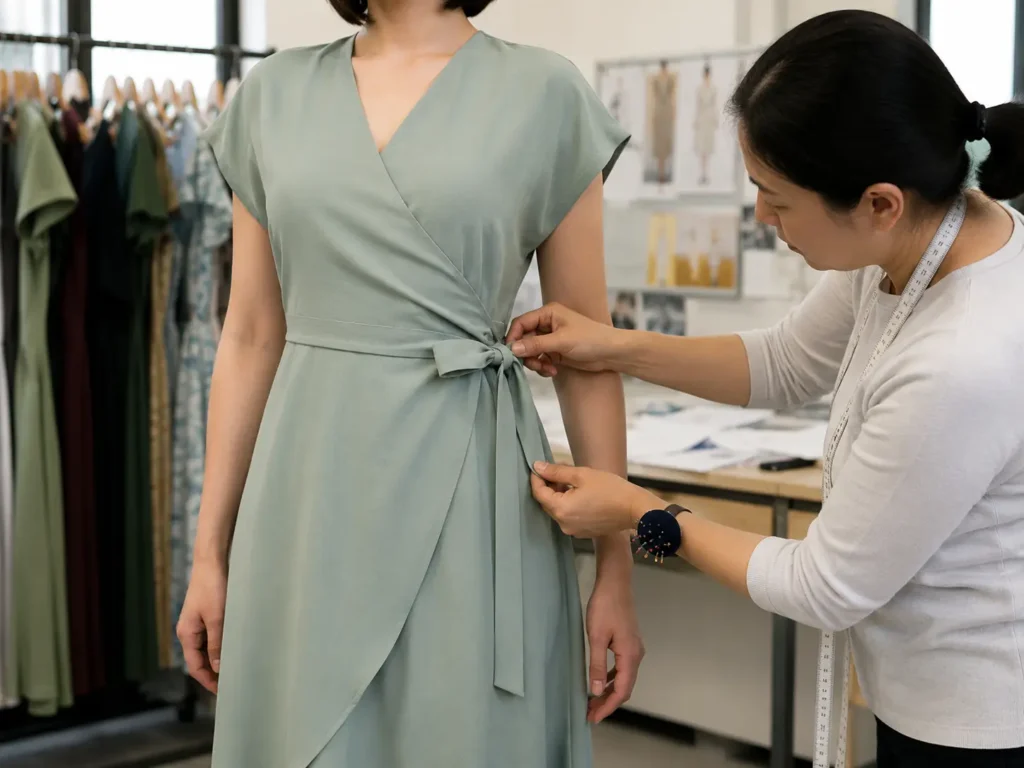
Fit review covers static measurements and movement. Bust support, waist level, hip shaping, shoulder or strap stability, neckline security, arm movement, sitting comfort, walking clearance, slit control and hem level are checked according to the style. Comments are converted into measurable actions, such as reducing total waist by a defined amount, relocating the bust point, changing a panel curve, adding support, adjusting lining tension or altering the grain route.
Every approved action returns to the pattern and related records. The revised sample is cut from the updated version, not altered from an obsolete set. A revision summary identifies what changed, why it changed and which sample proves the result.
Grade, Approve and Lock the Production Standard
Formal grading starts after the base size reaches an approved fit and construction direction. Grade rules reflect body growth, style proportion and internal structure. The team reviews how the neckline, bust point, waist, hip, strap, armhole, slit, hem and support components move across sizes. Complex styles may require different growth behavior in separate zones rather than a uniform increment.
Representative size-set samples confirm whether the graded range maintains coverage, support, proportion and movement. Any change made during size-set review returns to the grade rule or base pattern with a version record. PP approval then aligns the final pattern, measurement chart, BOM, fabric and trim standards, workmanship details and packing requirements.
Production files are locked before cutting.
The current pattern version is identified clearly, superseded files are removed from active use and critical POMs are transferred to first-piece, inline and final inspection. The result is not only an approved sample; it is a controlled system capable of being reproduced across production lines, later colorways and repeat orders.
Measurement Architecture Behind Dress Pattern Development

Bust and Underbust
Waist Position

Hip and Seat

Neckline and Armhole
Neckline depth, width and curve interact with shoulder or strap placement, bust support, lining and edge construction. Armholes must provide coverage and movement without gaping. Backless and halter styles require tension to travel through the correct points. Small curve changes can have a large effect on fit, especially in satin, mesh and stretch fabrics where edge behavior is visible.

Length and Hem

Ease and Movement
Ease is selected by product function, fabric and brand fit. Positive ease allows room; negative ease creates controlled stretch and contour. Recovery determines whether the garment returns to shape after wear. Sitting, walking, raising the arms and entering the garment are considered alongside flat measurements. A pattern can meet every POM and still fail if movement and fabric response were not engineered together.
Fabric Behavior Changes Pattern Decisions
A size chart cannot be transferred unchanged across unrelated materials. Stretch, recovery, drape, weight, grain, shrinkage and surface structure influence ease, seam position, lining, support and the final silhouette.
| Fabric Direction | Pattern Decision | Main Risk | Development Control |
|---|---|---|---|
| Stretch jersey | Negative ease, stretch direction and recovery allowance | Over-compression, looseness after wear or hem ride-up | Stretch and recovery review with fit testing |
| Ponte and structured knit | Controlled ease, seam shaping and panel distribution | Heavy silhouette, restricted movement or bulky seams | Weight-specific pattern and seam route |
| Satin | Grain, drape, seam stress and zipper balance | Puckering, seam grin, zipper waves and uneven hem | Pattern walking, seam trial and controlled pressing route |
| Bias-cut woven | Grain angle, relaxation and body balance | Twisting, length growth and side-seam drift | Relaxation period and balance correction before final hem |
| Stretch mesh | Stretch ratio, coverage and lining relationship | Distortion, exposure or unstable neckline edges | Layer compatibility and edge stabilization |
| Lace | Motif placement, seam position and edge use | Broken motifs, unbalanced panels and visible joins | Placement planning before final pattern release |
| Sequin fabric | Surface thickness, seam allowance and clearance | Bulk, abrasion, broken embellishment and uneven seams | Controlled seam path, clearance zones and lining protection |
| Woven crepe | Drape, shrinkage and movement ease | Tightness after finishing or loss of intended fall | Material testing and fabric-specific ease review |
Pattern Engineering for Complex Fashion Dresses

Corset and Bustier Dresses

Bodycon Stretch Dresses

Satin and Slip Dresses

Mesh and Sheer Dresses

Halter and Backless Dresses

Sequin and Embellished Dresses
Turning Fit Comments into Pattern Corrections
Diagnose the Source Before Changing the Pattern
Visible symptoms can have several causes. A gaping neckline may come from an overlong edge, insufficient bust shaping, elastic recovery, lining tension, sewing stretch or missing stabilization. A twisted side seam can come from pattern balance, grain direction, uneven stretch or cutting. Waist wrinkles may result from incorrect suppression, torso length, hip balance or zipper tension.
The review team first checks the sample against the current pattern version and measurement chart. Flat measurements, seam alignment, grain, material behavior and construction are examined before an action is assigned. Findings are classified as pattern, fabric, construction or workmanship. Several causes can be corrected together when the problem crosses categories.
Comments such as “make it tighter” or “the bust looks wrong” are converted into clearer instructions. A useful action may read: reduce total waist by 2 cm while maintaining hip measurement, blend the change through front and back panel seams, and retain zipper length. A bust action may include moving the apex, increasing cup depth, changing neckline length and adjusting the lining pattern. Measurable instructions reduce interpretation gaps between technical, pattern and sample teams.
Update Every Connected Record
A pattern correction is incomplete when the sample is altered but the source files remain unchanged. Duolan updates the relevant pattern pieces, POM chart, construction note and revision record. Connected dimensions are checked so one change does not create a new imbalance. Reducing side-seam length may affect the underarm, waist level, hip notch and hem; moving a bust point may affect darts, cup position, neckline and internal support.
Each sample round receives a version reference. The revision summary records the observed issue, agreed action, affected files and verification method. Superseded patterns are removed from active sample use. When a comment is not adopted, the reason is documented, such as material limitation, structural conflict or a trade-off with movement and coverage.
The revised sample is made from the updated pattern. Temporary pins, hand tacks or local alterations can demonstrate direction during review, but approval comes from a repeat sample or controlled correction using the documented method. The approach prevents a visually improved sample from becoming impossible to reproduce in production.
Verify the Result Against Fit and Commercial Use
A corrected sample must solve the original issue without damaging another part of the garment. Review returns to the agreed fit priorities: silhouette, support, coverage, movement, comfort and visual proportion. Critical measurements are checked, then the garment is assessed on the intended body or fit form. Movement tests reflect the use case, including sitting, walking, raising the arms or entering through a fitted opening.
For multi-style programs, common comments are consolidated so approved fit direction can be applied consistently. A neckline solution or waist balance developed on one style may inform related silhouettes, but only after material and construction differences are considered. Brand blocks and confirmed rules become more valuable with each approved style because future development can begin from evidence rather than a generic base.
The final output is a corrected pattern supported by a sample, updated measurements and an approval record. Production teams can then reproduce the decision rather than trying to interpret a photo or email comment after bulk cutting has started.

Every Sample Must Answer a Defined Question
Prototype Sample
First Sample
Fit Sample
Revised Sample
PP Sample
Golden Sample
Pattern Grading and Size Range Validation
A correct base size is only the starting point. Duolan develops grade rules around body growth, style proportion, material response and internal structure, then checks representative sizes before the range is released.
Approve the Base Pattern
Build Controlled Grade Rules
Validate Representative Sizes
Pattern Deliverables and Approval Records
Pattern Set
Measurements and Grading
Revision and Approval Record
Access and Transfer Terms
From Approved Pattern to Controlled Bulk Production

Align Production Files

Seal PP and First-Piece Standards

Match Capacity to Complexity
Protecting Tech Packs and Pattern Assets
Tech Pack Protection
Technical files are used for the agreed review, pattern, sample, production and quality activities. Unreleased flats, measurements, artwork, material direction and sample photographs are not intended for unrelated marketing or other brand projects. Access can be limited by project role. Sensitive documents may be marked confidential, and an NDA can be reviewed before the brand sends the complete development package.
Pattern Asset Protection
Brand blocks, fit standards, grade rules, corrected patterns and development history are treated as project assets. They are not reused for unrelated programs without authorization. Repeat-order access is controlled through style and version records. File delivery, archive period, future transfer and permitted production use are confirmed in writing so both sides understand how the pattern may be used after approval.
Pattern Room and Development Resources
650-1,200 Development Systems
110-200 Material Specialists
130-200 Process Engineers
300 Sewing Lines
50+ Flexible Lines
6.5 Million Monthly Capacity
From Tech Pack Conflict to Approved Production Pattern
Program Scope and Technical Risks
A U.S. fast-fashion dress program included 18 styles and a planned total of 46,800 garments across sizes XS-XL. The range contained six corset or bustier dresses, five stretch bodycon styles, four satin occasion dresses and three mesh or embellished styles. Four material groups and multiple lining or support constructions had to move through development together.
The initial review identified 27 open technical decisions. Eleven involved POM conflicts or unclear measurement methods. Six styles did not fully define internal support, lining boundaries or closure construction. Four styles used material descriptions that did not provide enough stretch, recovery or weight information for a reliable pattern decision. The project team grouped every issue into measurement, pattern, material or construction categories and closed the fit-critical points before releasing the first patterns.
Instead of creating 18 unrelated bases, the pattern room organized the program into four fit families. Shared logic was used where silhouette and material allowed, while corset, bias satin and stretch mesh styles retained separate pattern rules. The structure reduced duplicated work without forcing unrelated garments onto one generic block.

Sample Review and Pattern Correction
First samples were reviewed against the agreed fit priorities for each family. Corset styles focused on cup position, upper-edge security, waist balance and boning route. Bodycon styles were checked for negative ease, recovery, transparency and hem ride-up. Satin styles were assessed for neckline control, zipper balance, grain and hem fall. Mesh styles were reviewed for coverage, lining tension and edge stability.
The program used two controlled revision rounds. Several regular styles closed after the first correction, while complex structures moved through the second round. Comments were consolidated by issue rather than by email sequence. Pattern changes, measurement updates and construction actions were recorded together. One recurring neckline issue was traced to a combination of pattern length and lining tension; changing only the neckline pattern would not have solved the problem. Another bodycon issue required both negative-ease correction and a higher-recovery lining.
Before grading, every base-size pattern was matched to its approved sample and revision log. Representative sizes were then reviewed for bust point, waist level, hip shaping, strap position, coverage and internal support. Size-set comments were returned to the grade rules before PP release.
Bulk Handover and Order Control
After PP approval, each style received a locked pattern version, measurement chart, BOM, construction record and critical QC points. The 46,800-piece program was staged by complexity rather than released as one undifferentiated batch. Regular styles followed the 20-30 day production reference; complex corset, mesh and embellished styles were planned within the 30-45 day reference after material readiness and PP approval.
First-piece checks focused on the fit-critical areas identified during development. Inline measurement checks used the same POM definitions agreed during pattern review. Approved material and lining relationships were protected, and substitutions required technical confirmation before use. The method allowed the collection to retain a consistent fit direction while different style families moved through separate production routes.
The value of the program came from disciplined conversion: technical questions were closed before pattern release, sample comments returned to controlled source files, grading followed approved bases, and bulk teams received a complete production standard rather than a garment photo and scattered comments.
Pattern Development Frequently Asked Questions

Submit Your Tech Pack for Pattern Review
Send the development package for a structured review before pattern work begins. Duolan will evaluate the technical basis, fit-critical measurements, material direction, construction risks, sample purpose, grading requirement and route into production. A clear submission allows the pattern room to identify open questions early and prepare a development plan aligned with the collection calendar.
Please include:
- Company and brand information
- Product category and number of styles
- Tech pack, technical flats or approved reference garment details
- Base size, target size range and market
- Fabric composition, weight, stretch, recovery or preferred material direction
- Intended sample type and fit priorities
- Estimated quantity by style or program
- Target approval, launch and delivery dates
- Pattern file, ownership, grading or transfer requirements
- Confidentiality or NDA instructions
Form fields: Name, Company / Brand, Work Email, Tel / WhatsApp, Country / Market, Product Category, Number of Styles, Target Quantity, Base Size, Size Range, Fabric Direction, Target Launch Date, Message, Upload Tech Pack, Upload Reference Files.