 Skip to content
What Private Label Options Are Available for Custom Dresses?
Your trusted Women’s Apparel Development & Manufacturing Partner from China
- Jerry
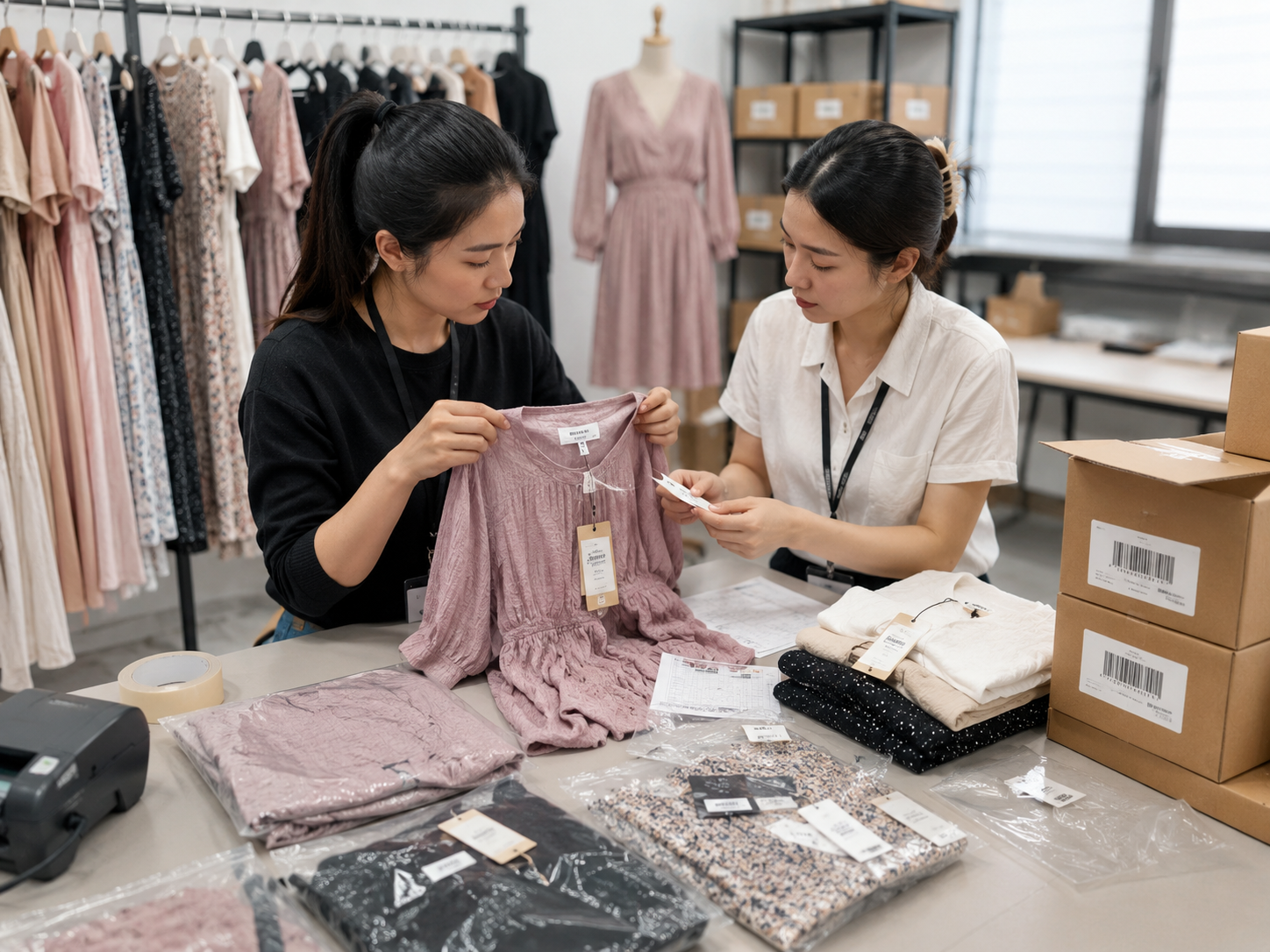
Private label dress manufacturing is often described as a simple branding exercise: choose a style, sew in a label, and place an order. In practice, the decision reaches much further. It determines who develops the design, how much control the brand retains, whether the silhouette is exclusive, how fabric and fit are approved, and whether the finished dress can be repeated consistently across different sizes, colors, and production runs. A fast-looking route can become expensive when those decisions are left undefined.
Private label options for custom dresses range from relabeling manufacturer-developed styles to semi-custom modification, ODM collection development, and full OEM production from a brand’s tech pack or original sample. The right model depends on design control, exclusivity, development speed, technical input, target price, and the ability to repeat the approved dress accurately in bulk.
The cheapest or fastest option is not automatically the safest commercial choice. A proven factory style may help a brand reach the market quickly, while an original corset, mesh, satin, or bodycon dress may require careful pattern engineering and several approval stages. Problems usually begin when a brand chooses one model but expects the benefits of another. Imagine approving a beautiful satin sample, then discovering during production that the bulk fabric hangs differently, the concealed zipper creates rippling, and the lining changes the skirt’s movement. The label was never the difficult part. The real work was controlling everything behind it – and that is where a private label program either becomes a repeatable business asset or an expensive one-season experiment.
What Does Private Label Mean for Custom Dresses?
Private label custom dresses are garments developed or manufactured for one brand and sold under that brand’s identity. The arrangement can range from relabeling an existing factory style to creating an original dress from a tech pack, sample, sketch, or collection brief. The actual scope depends on design ownership, fit control, fabric selection, branding, exclusivity, and production agreements.
Private Label, White Label, OEM, and ODM
These terms are often mixed together, but they describe different levels of product development. White-label production usually starts with an existing garment that the manufacturer already offers. The brand selects an available color, adds its own labels, and may choose basic packaging, while the underlying pattern and construction remain largely unchanged. The same design may also be supplied to other customers.
Private label is broader. A brand may use an existing pattern as a starting point but change the fabric, color, length, neckline, sleeve, lining, trims, fit, labels, and packaging. Some projects remain close to a factory-developed style; others involve a completely original product. OEM normally means the brand supplies the main product direction through a tech pack, measurement chart, original sample, artwork, or detailed drawings. ODM gives the manufacturer a larger role in proposing silhouettes, materials, seasonal concepts, and coordinated styles.
The terminology matters less than the actual agreement. Two suppliers may both advertise private label services while offering very different levels of customization. A buying team should ask what can be changed, which parts remain standard, whether the final pattern is exclusive, and who is responsible for correcting technical conflicts between the design and the selected material.
Design Ownership and Exclusivity
Design ownership should be discussed before sampling, especially when a project includes original patterns, engineered prints, embroidery layouts, or recognizable construction. A brand may own its sketches and artwork while the factory retains ownership of an existing base pattern. In full OEM development, the client may expect the new pattern and grading to remain exclusive. In an ODM arrangement, the supplier may allow customization while continuing to use the core design for other customers.
- Is the final silhouette exclusive to the brand, or can a similar pattern be supplied elsewhere?
- Who owns the pattern, grading, artwork, embroidery file, and approved sample after development fees are paid?
- Can the brand transfer the final files to another supplier?
- Does exclusivity depend on order volume, territory, annual commitments, or a fixed period?
- How are reference garments, tech packs, and confidential files stored and protected?
Exclusivity is rarely automatic. It needs to be stated in writing and separated from general manufacturing knowledge. A brand can own its specific design while the factory continues using standard construction methods, pattern-making techniques, and sewing expertise developed over many years.
What the Brand Can Control
A serious private label program controls much more than the neck label. Visible choices include silhouette, color, print, length, neckline, sleeves, back design, and decorative details. Less visible decisions often have a greater effect on quality: fabric weight, stretch and recovery, lining structure, seam type, zipper specification, cup shape, boning layout, elastic tension, and measurement tolerances.
- Visual control: silhouette, proportion, color, print, length, and embellishment.
- Technical control: pattern measurements, grading, seams, support, and tolerances.
- Material control: outer fabric, lining, trims, colors, and approved substitutes.
- Brand control: main labels, care labels, hangtags, barcodes, and packaging.
- Commercial control: target cost, launch timing, order allocation, and replenishment planning.
Private label can also include a proprietary fit standard. This is particularly important for bodycon, corset, halter, backless, and fitted occasion dresses, where a small difference in bust position, waist placement, or body length can noticeably change the wearing effect. Vague instructions such as ‘make it more premium’ or ‘make the waist tighter’ should be converted into approved measurements, physical samples, material specifications, or construction notes.
Commercial Implications
Greater customization normally increases development work, decision-making, and technical risk. It does not always increase the unit price dramatically, but it requires more control before production. A proven style may need only a color and branding approval. A completely original corset, draped satin, cut-out, or embellished dress may require several sample rounds because fit, support, material behavior, grading, and workmanship all need to be tested.
Material suppliers can create additional constraints. Custom-dyed fabric, exclusive prints, molded cups, branded hardware, and special embellishments may each have minimum quantities that differ from the garment factory’s minimum. Brands should separate three questions: what can technically be customized, what can be customized within the target price, and what can be customized at the planned quantity and delivery date. A private label option is commercially suitable only when all three answers align.

Which Private Label Model Fits Your Brand?
The right private label model depends on the brand’s design resources, launch schedule, required exclusivity, target price, order plan, and technical capability. Factory-developed styles prioritize speed, semi-custom programs balance efficiency and differentiation, ODM provides development support, and full OEM offers the highest level of control for original products and proprietary fit.
Factory-Developed Options
Factory-developed dresses are useful when a brand wants to enter a category quickly or expand an existing collection without building every style from zero. The strongest options are not random catalogue items; they are patterns that have already been sampled, fitted, produced, and corrected. A proven fitted midi, ruched mini, satin maxi, mesh party dress, or halter silhouette may reduce technical uncertainty because the manufacturer already understands its construction and production sequence.
Brands can often change the fabric color, print, dress length, straps, sleeve shape, neckline, back opening, lining, trim, labels, and packaging. The base pattern makes material consumption and labor easier to estimate, but it also creates limits. A style developed for a junior fast-fashion customer may have a shorter body length, lower coverage, or stronger compression than a premium occasionwear brand expects.
Before selecting a factory-developed option, review the base size, fit intention, fabric category, previous production history, structural limits, and exclusivity. If the project changes the fabric type, bust structure, silhouette, and fit block, developing a new pattern may be clearer and faster than repeatedly modifying an unsuitable base.
Semi-Custom and ODM
Semi-custom development begins with a proven pattern or construction platform and changes selected elements to create a more distinctive result. A fitted mini dress might retain its basic body block but receive a new neckline, asymmetric draping, revised skirt length, custom color, and branded packaging. This route works well when the original fit suits the target customer and the launch calendar cannot absorb a long development cycle.
ODM goes further by involving the manufacturer in product planning. The brand may provide a mood board, target customer, retail range, selling occasion, collection theme, and preferred categories. The development team then proposes silhouettes, fabrics, trims, and coordinated styles. This is useful for buying teams that understand their market but need stronger technical or product-development support.
The most effective ODM projects still have clear brand boundaries. The client should define the intended customer, visual language, fit direction, price position, and launch timing. The manufacturer contributes construction knowledge, fabric judgment, sourcing, pattern development, and production experience. Neither side should outsource its core responsibility to the other.
Full-Custom OEM
Full-custom OEM is suitable when a dress needs an original silhouette, proprietary fit, signature construction, exclusive artwork, or a complex combination of materials and techniques. The starting point may be a complete tech pack, original sample, front and back flats, measurement specifications, grading rules, fabric swatches, print files, or a structured design brief.
This model is commonly used for structured bodycon dresses, corset and bustier styles, asymmetric designs, engineered prints, mixed mesh panels, cut-outs, complex draping, and high-detail occasionwear. Full customization gives the brand greater control, but it creates more decisions. A drawing may communicate appearance without explaining how the bust is supported, how the wearer enters the garment, or how the design should be graded.
Fabric selection cannot be separated from the pattern. A style developed in stretch jersey cannot simply be transferred into rigid satin. A draped design that works in lightweight crepe may become heavy in velvet. A sequin surface may require changes to seam allowance, needle selection, lining, and finishing. Full OEM succeeds when design, pattern, material, and production teams solve those issues together.
Model Comparison
The planning ranges below are common industry references, not guaranteed timelines. Fabric availability, style complexity, custom components, comment speed, and approval requirements can shorten or extend the process.
Model | Typical starting point | Design control | Common sample rounds | Indicative development time | Best suited to |
White label | Existing finished product | Low | 0-1 | 1-3 weeks | Fast category extension |
Semi-custom | Proven factory pattern | Medium | 1-2 | 2-5 weeks | Seasonal updates and commercial collections |
ODM | Manufacturer concepts plus brand brief | Medium to high | 2-3 | 3-7 weeks | Brands needing design and technical support |
Full OEM | Tech pack, sketch, or original sample | High | 2-4 | 4-10 weeks | Original dresses and proprietary fit |
Co-development | Shared collection brief | High | 2-4 for key styles | Project-dependent | Multi-style seasonal programs |
A brand should not automatically choose the most customized option. The right model protects the features that customers notice and value while remaining realistic for the launch date, target cost, quantity, and internal approval capacity. A mixed collection can also use more than one route: a new signature corset style may require full OEM, while coordinated commercial dresses can use proven patterns with controlled modifications.

What Can You Customize in a Dress?
A private label dress can be customized through its silhouette, measurements, fabric, color, print, lining, internal support, closures, trims, embellishments, labels, and packaging. Practical limits are determined by material availability, supplier minimums, product safety, construction feasibility, target price, order volume, testing requirements, and the ability to repeat the approved result in bulk.
Product and Silhouette
Customization should begin with the product’s purpose. A party mini, office midi, vacation maxi, wedding guest dress, graduation style, and formal occasion dress solve different customer needs even when they share similar fabrics. The brief should identify both the selling category and the technical silhouette. ‘Party dress’ is a market category; ‘fitted asymmetric mini with side ruching and a low back’ is a development description.
- Length: mini, short, midi, long, or maxi.
- Occasion: party, cocktail, wedding guest, graduation, homecoming, resort, going-out, office, or daywear.
- Silhouette: bodycon, A-line, skater, babydoll, drop waist, corset, bustier, halter, one-shoulder, or backless.
- Detail: ruched, draped, pleated, ruffled, cut-out, slit, two-piece, or layered.
Proportion often matters more than decoration. A 1-2 cm change in waist position, bust length, neckline depth, or skirt opening can alter how a fitted dress sits on the body. The brand should also define the intended wearing effect: should the dress compress, skim, drape, support, or move freely? Pattern engineers cannot deliver the correct fit without understanding that objective.
Fabric, Fit, and Construction
Fabric selection controls the final appearance, fit, comfort, and production stability. The same pattern can look completely different in satin, stretch crepe, velvet, mesh, jersey, chiffon, or sequin fabric. Useful material data includes composition, weight, width, stretch direction, stretch percentage, recovery, shrinkage, opacity, hand feel, and surface finish.
Construction must respond to the material. Lightweight satin may need seam stabilization to reduce waviness. Stretch mesh can require double layering and controlled sewing tension. Velvet needs pile-direction management. Sequins may need to be removed from seam allowances before sewing. Internal support can include full or partial lining, cups, boning, power mesh, under-bust elastic, waist stays, silicone grip, fusible support, or adjustable straps.
The relationship between outer fabric and lining deserves particular attention. A rigid lining inside a stretch dress can restrict movement. A heavy lining can change the drape of a light skirt. A lining that is too short can pull the outer layer upward. Fit should therefore be reviewed in motion, not only on a mannequin: the wearer needs to sit, walk, raise the arms, and enter or leave the garment without damaging seams or closures.
Branding and Packaging
Brand customization continues from the inside neckline to the shipping carton. Main labels may be woven, printed, heat transferred, or directly printed. Care labels require confirmed fiber content, care instructions, country-of-origin information, and market-specific wording. Hangtags may include the collection name, SKU, barcode, price, care guidance, or sustainability information.
- Logo artwork in a usable vector format.
- Label dimensions, material, fold type, color, placement, and sewing method.
- Care-label wording, fiber content, size naming, and destination-market information.
- Barcode, price-ticket, and SKU structure.
- Polybag size, tissue, protective inserts, folding method, carton assortment, and carton markings.
Packaging should protect the garment as well as present the brand. Satin can crease, velvet can pressure-mark, sequins can snag, and structured cups can collapse. Barcode or SKU errors can also create warehouse problems even when the garment itself is correct. Labels and packaging should therefore be included in the approval process rather than handled as last-minute accessories.
Hidden Cost and Risk
Some changes look minor on a sketch but have a large effect on cost, lead time, or production stability. The table below shows why the visual request and the manufacturing requirement should be reviewed together.
Customization area | Data to confirm | Common production risk | Likely commercial effect |
Custom-dyed fabric | Pantone reference, composition, weight, quantity | Shade variation between lots | Dye minimum and added lead time |
Engineered print | Artwork scale, placement, repeat, panel size | Misalignment at seams | Higher cutting waste |
Corset structure | Cup size, boning layout, lining, closure | Poor bust balance or discomfort | More sampling and labor |
Sequin or beadwork | Density, pattern, attachment method | Loss, snagging, uneven placement | Higher material and inspection cost |
Cut-outs | Position, edge finish, stretch support | Gaping or distortion | Pattern and fit revisions |
Bias-cut satin | Grain direction, fabric width, hanging time | Twisting, growth, uneven hem | Higher fabric use and longer finishing |
Custom hardware | Size, finish, logo, testing | Delay or color inconsistency | Tooling or supplier minimum |
Multi-layer mesh | Stretch, opacity, recovery, layer direction | Layer shifting and size variation | More cutting and sewing time |
The best cost control happens before sampling. Removing essential support after the first sample can damage the fit. A better approach is to identify which features create customer value and simplify details that add complexity without improving the final appearance, comfort, or brand recognition.

What Do Brands Need Before Dress Development?
Before development begins, a brand should define the design reference, target customer, fit direction, size range, fabric preference, color plan, branding, quantity, target price, destination market, and delivery date. A complete tech pack is ideal, but an experienced dress manufacturer can also begin from an original sample, sketch, reference image, or structured collection brief.
Technical Brief
A technical brief gives design, pattern, sourcing, costing, sampling, and production teams a consistent understanding of the product. It does not need to look complicated, but it should answer the questions that affect fit and manufacturing. A complete tech pack normally includes front and back flats, detail sketches, base-size measurements, construction notes, a bill of materials, artwork, color references, labels, and packaging requirements.
Complex dresses benefit from internal construction views. The outside drawing of a corset dress does not show the cups, boning, lining, waist support, or closure. Without that information, the pattern room must make assumptions. The brief should also identify priority features. A brand may care most about a narrow-waist effect, a clean neckline, or a specific skirt movement. When priorities are clear, the manufacturer can protect them while adjusting lower-value details for production.
A detailed tech pack can still be wrong. Measurements may conflict with the drawing, a proposed seam may not suit the fabric, or a rigid woven specification may have been copied into a stretch garment. The manufacturer should review the files and return questions rather than follow every line without technical judgment. Version control is equally important: each revised measurement chart, artwork file, and comment sheet should carry a clear date or revision number.
Measurements and Fit
The manufacturer needs more than a general size chart. It needs to know how every measurement is taken, which size is the base size, what fit standard the brand expects, and which measurements are most critical. Common points for fitted dresses include high bust, full bust, under bust, waist, high hip, full hip, shoulder width, across front and back, front and back body length, armhole depth, dress length, and slit or opening height.
Measurement method matters. A waist measured flat is not the same as waist circumference. A stretch garment measured relaxed can differ from the same garment measured under light tension. Brands should define a tolerance strategy rather than applying one number to every point. A 1 cm difference in a loose skirt sweep may be acceptable, while the same difference at the bust, waist, or body length can visibly affect a fitted style.
Fit comments should be specific and measurable. ‘The bust looks wrong’ does not tell the pattern maker whether the cup is too small, the apex is too high, the neckline is gaping, or the under-bust seam is misplaced. A consistent fit model also reduces contradictory feedback. For wider size ranges, selected sizes should be physically checked instead of relying only on mathematical grading from one base size.
Commercial Inputs
A dress cannot be engineered properly without understanding its commercial role. The manufacturer should know whether the style is a test product, a core repeat item, a seasonal statement piece, or part of a multi-style collection. These categories influence material commitments, construction choices, replenishment planning, and the amount of development worth investing in.
- Target retail price and target factory cost.
- Forecast quantity by style, color, and size.
- Launch market, launch date, sample deadline, and bulk delivery window.
- Reorder expectations and whether the style is a test, core, or seasonal item.
- Required labeling, testing, compliance, packaging, and inspection.
Target price should be discussed before development becomes too advanced. A dress with double lining, molded cups, custom hardware, hand-applied rhinestones, and complex draping may not fit an entry-level price position. Order quantity also affects fabric dyeing, printing, trim tooling, and production planning. The brand should decide which features are non-negotiable and which can be adjusted to protect price and timing.
Development Readiness
A project can start with incomplete information, but every missing decision must eventually be resolved. The earlier these questions are answered, the less likely the brand is to pay for avoidable sample rounds or lose time waiting for approvals.
Item | Minimum information | Better information | Why it matters |
Design | Sketch or clear reference image | Complete flats and detail views | Reduces visual interpretation |
Fit | Basic size chart | Brand measurement specification and fit sample | Protects consistency |
Fabric | Fabric type or reference | Composition, weight, stretch, color, finish | Supports correct pattern development |
Construction | General appearance | Seam, lining, cup, boning, and closure details | Prevents hidden assumptions |
Color | Color name | Pantone or approved physical standard | Improves shade control |
Quantity | Total estimated order | Quantity by style, color, and size | Supports sourcing and costing |
Price | General expectation | Target cost range and priority features | Guides realistic engineering |
Branding | Logo | Vector artwork, dimensions, placement, wording | Avoids label delays |
Timing | Desired launch month | Sample and bulk approval calendar | Enables capacity planning |
Market | Country or region | Testing, labeling, and compliance requirements | Prevents late changes |
A well-prepared inquiry does not need to contain every final detail, but it should make the project’s priorities visible. That allows the development team to distinguish between decisions that can remain open during the first prototype and decisions that must be fixed before fabric sourcing, pattern development, or costing begins.
How Does Sampling Become Bulk Production?
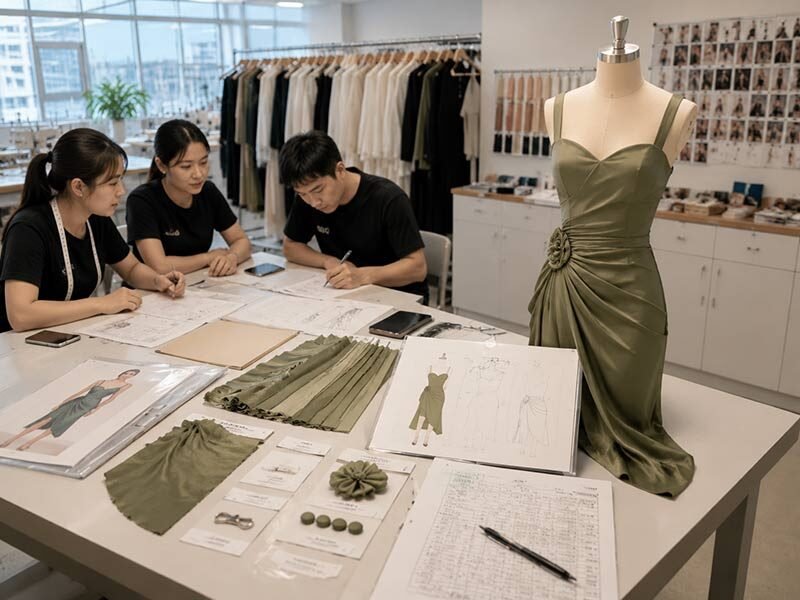
Sampling becomes bulk production through documented approvals. The design, pattern, fit, fabric, trims, color, workmanship, labels, packaging, and inspection standard must be confirmed before full production. A visually attractive sample is only the beginning; the factory must convert it into instructions that can be repeated across operators, sizes, material lots, and future orders.
Sampling Stages
Not every dress needs every sample stage, but each sample should have a defined purpose. A simple update to a proven style may move quickly. A corset dress with custom fabric, cups, boning, and embellishment may need several rounds because fit, support, and materials interact.
Sample stage | Main purpose | Common planning range | Key approval points |
Development prototype | Test design and construction | 7-21 days | Shape, feasibility, general appearance |
Fit sample | Correct balance and measurements | 7-14 days after comments | Bust, waist, hip, length, mobility |
Revised sample | Confirm corrections | 7-14 days | Comment accuracy and remaining risks |
Size-set sample | Review grading | 7-21 days | Fit across selected sizes |
Sales or photo sample | Support marketing or internal sales | Project-dependent | Visual finish and correct color |
Pre-production sample | Confirm bulk standard | 7-21 days after materials arrive | Production fabric, trims, workmanship |
Sealed sample | Final physical reference | After approval | Standard for production and inspection |
These ranges vary with material availability, complexity, factory workload, and the speed of client comments. A fit sample in substitute fabric can help correct measurements but may not accurately show drape or support. A photo sample can be visually finished yet still use temporary internal construction. Approvals should therefore state exactly what has been accepted.
Comments should be consolidated into one document. ‘Make the waist better’ is open to interpretation. ‘Reduce the half-waist by 1 cm, remove 0.5 cm excess at the back waist, and preserve the hip measurement’ is actionable. Photographs, measurement records, and marked-up sketches make feedback easier to follow and reduce contradictory revisions from design, merchandising, and management teams.
Approvals Before Bulk
Bulk production should begin only after a production-readiness review confirms the final pattern, approved measurements, grading, tolerances, production fabric, colors, trims, workmanship, labels, packaging, and inspection criteria. Production fabric should be checked for width, weight, stretch, recovery, shrinkage, shade, opacity, surface condition, and lot consistency where relevant.
- Final pattern and approved measurement specification.
- Production fabric, lining, cups, boning, zippers, elastic, and trims.
- Approved color standard, print strike-off, or embellishment layout.
- Construction, stitch, seam, pressing, and workmanship requirements.
- Labels, folding method, individual packaging, carton assortment, and markings.
- Pre-production or sealed sample and the agreed inspection standard.
A pre-production meeting is especially useful for high-risk styles. For a mesh bodycon dress, the team may review stretch direction, layer alignment, tension, measurement method, and recovery. For satin, the focus may be seam puckering, pressing, zipper application, and handling marks. Multi-style collections need an additional control layer so that shared fabrics, colors, trims, labels, and delivery dates are tracked across the whole program.
Bulk Consistency
Bulk production introduces variables that do not appear in the sample room. More fabric is handled, several operators complete different steps, machines run for longer periods, and production pressure increases. Consistency depends on controlling the process from incoming materials to final packing.
- Incoming fabric and trim inspection, shade grouping, shrinkage, and relaxation.
- Pattern, marker, cutting, bundle numbering, and first-piece approval.
- Inline measurement checks and workmanship checkpoints at high-risk operations.
- End-line review, final inspection, needle detection where required, and packaging verification.
Dress-specific risks need targeted controls. Satin can pucker or show pressing marks. Mesh layers can shift. Stretch fabrics can grow when handled under tension. Boning can twist or press against the body. Linings can appear below the hem. Sequins can loosen, snag, or become trapped in seams. Quality teams should focus on critical-to-fit and critical-to-appearance points rather than treating every measurement as equally important.
According to Duolan’s company records, the supporting manufacturing group operates 300 sewing lines, more than 50 rapid-response and flexible lines, 16 self-operated fashion factories, and over 20 long-term satellite facilities. Reported stable monthly capacity is approximately 6.5 million garments, with higher peak capacity. These are group-level figures; actual project scheduling depends on style complexity, material readiness, approval status, and line allocation.
Repeat Orders and Scale
Repeat orders should not be treated as automatic copies of the first order. Fabrics may come from a new production lot, trims may be remade, and a different line may be assigned. Before repeating a style, the team should review previous inspection results, customer complaints, fit comments, material changes, shade continuity, pattern revisions, packaging updates, quantity, and delivery requirements.
Scaling from a test order to a much larger quantity also requires capacity planning. A method that works for a few hundred pieces may not be efficient or stable for tens of thousands. The factory may need templates, specialized machines, additional quality checkpoints, or a different line layout. The objective is not simply to increase output; it is to preserve fit, appearance, workmanship, and packaging accuracy while volume grows.
A capable manufacturer should be able to explain how the approved sample is transferred into production instructions, how repeat-order information is stored, and how successful styles will be scheduled when demand increases. That continuity is what turns a sample into a commercial product rather than a one-off garment.

How Do You Choose a Private Label Dress Manufacturer?
Choose a private label dress manufacturer by evaluating dress specialization, pattern and fit capability, fabric knowledge, sampling discipline, quality systems, communication, compliance, capacity, and repeat-order support. A suitable supplier should explain how it will control your specific dress rather than relying on general claims about experience, low prices, or factory size.
Dress Specialization
A factory that produces garments is not automatically a strong dress manufacturer. Dresses place unusual demands on proportion, body balance, fabric behavior, internal support, and visual finish. A supplier experienced mainly in loose casual clothing may not have the same ability to handle fitted satin, corsetry, bodycon stretch, asymmetric draping, layered mesh, or complex backless construction.
- Comparable development samples and construction close-ups.
- Pattern-room, fit, grading, and size-set capability.
- Experience with the intended fabrics and internal support structures.
- Production photographs, inspection records, and repeat-order examples.
- A clear explanation of risks specific to the proposed dress.
The supplier’s questions are revealing. A dress-focused team should ask about stretch percentage, desired compression, bust support, bra compatibility, opacity, skirt movement, and target fit. A generic supplier may ask only for quantity, color, and price. Specialization does not mean producing only one silhouette; it means understanding which controls matter for different dress categories and materials.
Quality and Compliance
Quality management should be evaluated through both formal systems and product knowledge. Audits and inspection procedures can show that a supplier has organized controls, but they do not prove that the team understands how to prevent satin seam puckering, stretch growth, bias-cut twisting, lining imbalance, or gaping at a cut-out neckline.
Ask the manufacturer to explain its quality plan for one difficult style. The answer should cover incoming materials, cutting, first-piece approval, inline checks, measurement control, workmanship, final inspection, and packing. It should also explain how failed inspections are corrected, whether third-party inspection can be arranged, how barcode and label data are verified, and how lessons from complaints are applied to repeat orders.
Duolan’s company documentation states that its core manufacturing system has completed SMETA and SMETA 2-Pillar audits and can work with customer requirements connected to frameworks such as BSCI, ISO 9001, AATCC, ASTM, OEKO-TEX, EN, China GB, and GOTS where relevant. Exact certification, test scope, and product compliance should always be confirmed for the specific fabric, trim, destination market, and order.
Capacity and Project Management
Large capacity is useful only when the right technical resources are available. A supplier may have many sewing lines but limited pattern, sample, or product-development capacity. Another may produce excellent samples but struggle with multi-style bulk orders. Brands should assess the complete development-to-delivery system: pattern, sampling, sourcing, costing, planning, quality, shipping, and repeat-order control.
Ask who manages the project during development and who takes responsibility during production. Information can be lost when fit comments, costing decisions, and material approvals move between separate teams. For multi-style orders, the supplier should have a method for tracking each style’s fabric, trims, sample status, approvals, production date, inspection, and shipment.
Duolan’s group-level records describe a development organization covering trend research, design, fabric and trim development, pattern making, sample production, process engineering, costing, order coordination, and quality support. Reported capacity includes approximately 15,000-35,000 sample pieces or development iterations per month and support for roughly 3,000-8,000 style-development and sampling workflows. Actual capacity reserved for a project still depends on complexity, timing, materials, and confirmed production plans.
Questions Before Ordering
Before placing a sample or bulk order, ask questions that reveal how the manufacturer actually works. Begin with product experience, then examine materials, fit, production, commercial terms, communication, and protection.
- Which dress categories, structures, and fabrics are your strongest?
- Can you work from a tech pack, original sample, sketch, or reference image?
- How do you review fabric behavior, fit, grading, and production feasibility?
- What is the process from first sample to pre-production approval and bulk inspection?
- What are the garment, fabric, trim, print, or hardware minimums?
- Which factors change the sample fee, unit cost, and production timeline?
- Who will manage comments, approvals, bulk production, and problem escalation?
- How are design files, patterns, artwork, and confidential information protected?
- How will repeat orders and sudden replenishment be handled?
A useful supplier conversation should leave the brand with a clearer understanding of the product, not only a unit price. The manufacturer should identify risks, explain trade-offs, and show how the dress will move from design intent to stable production. Price matters, but a low price cannot recover a missed launch, an unstable fit, or a bulk order that no longer resembles the approved sample.
Start Your Custom Dress Program With Duolan Apparel
Private label success is built long before a brand label is sewn into the neckline. It begins with choosing the correct development model, defining the product clearly, matching fabric to silhouette, engineering the fit, controlling approvals, and preparing the dress for repeatable bulk production.
Duolan Apparel works with established fashion brands, product teams, buying teams, sourcing offices, and design-led labels developing fashion dresses, party dresses, occasion dresses, fitted styles, vacation dresses, and coordinated collections. Development can begin from a tech pack, original sample, reference image, sketch, fabric idea, or collection brief. The team can review product feasibility, identify fit and material risks, and recommend a practical route for sampling and production.
For a focused project review, prepare the following information:
- Dress sketches, tech packs, original samples, or reference images.
- Target categories, number of styles, size range, and measurement chart.
- Fabric, color, trim, embellishment, branding, and packaging direction.
- Estimated quantity by style and color, target price range, and reorder plan.
- Sample deadline, bulk delivery date, destination market, and testing requirements.
Share:
Our Services
Categories
Table of Contents
Here, developing fashion collections is more than manufacturing garments — it’s a collaborative process focused on transforming ideas into well-executed, market-ready products. From fabric sourcing and sample development to scalable production and delivery coordination, every stage is built to support quality, consistency, and efficient collection launches across global markets.

