Skip to content
Quality & Compliance Solutions for Brand QA Teams
Convert brand quality standards into controlled development, production, inspection, and delivery across complex fashion dress programs.
- 30+ years of fashion dress development and manufacturing experience behind the Duolan production system.
- 16 owned factories, 20+ long-term satellite factories, 300 sewing lines, and 50+ flexible lines for multi-style programs.
- 750-1,200 development specialists across design, fabric, trim, pattern, sample, process, and project coordination functions.
- 140-180 professionals supporting quality coordination, order data, complaint handling, rework, replenishment, and system control.
- SMETA audit completed, including SMETA 2-Pillar audit and an established social audit record.
- Stable monthly capacity of approximately 6.5 million garments, with higher output available for planned seasonal peaks.
What Brand QA Teams Need From Manufacturing Partners
Standard Interpretation
Early Risk Screening
Sample-Bulk Continuity
Traceable Quality Evidence
Third-Party Coordination
Fast Issue Escalation
A useful quality system reports risk before a shipment is finished. When an issue appears, the responsible team should know the affected style, color, size range, quantity, process stage, immediate containment action, decision owner, and required closure evidence. Duolan uses structured internal coordination so pattern, sourcing, production, and quality personnel can respond without relying on scattered messages or informal instructions.
Where Apparel Quality Systems Commonly Break Down
Mixed Approval Status
A comment such as “sample approved” may hide unresolved fit, color, lining, trim, or workmanship points. Production then starts with different assumptions across teams.
- Separate fit, visual, material, and PP approval status.
- List open points with a named decision owner.
- Confirm whether the sample is a development reference or a production basis.
- Prevent partial approval from becoming an accidental bulk release.
Material Drift
- Record approved material direction before bulk booking.
- Review roll and lot variation where appearance is sensitive.
- Reconfirm any replacement affecting construction or compliance.
- Keep fabric, lining, trim, and decoration approvals connected.
Fit And Size Drift
- Identify critical points of measure before line start.
- Check trends during production rather than waiting for final measurement.
- Review grading and size-dependent construction risks.
- Escalate repeated movement before the full quantity is completed.
Late Defect Discovery
Final inspection cannot economically repair every process failure. Seam puckering, weak stress points, incorrect boning, misplaced embellishment, shade mixing, and label errors become more expensive after assembly.
- Place controls near the operation creating the risk.
- Use first-off or trial verification for high-risk construction.
- Isolate affected work promptly.
- Confirm corrective action before the same defect spreads across lines.
Version Control Gaps
- Apply clear dates or revision numbers to approved documents.
- Link revised measurements to the correct sample version.
- Remove superseded instructions from active production use.
- Record material and construction changes in the working BOM or control brief.
Packing And Label Errors
- Check labels and packing references before final packing.
- Verify style, color, size, barcode, and carton relationships.
- Control mixed-size and split-shipment requirements.
- Hold shipment release until product and packing status agree.
How Duolan Fits Into Your Quality System
Clear responsibilities prevent duplicated checks and missing decisions. Duolan operates as the manufacturing execution partner, translating approved standards into materials, samples, production controls, corrective actions, packing checks, and shipment readiness.
| Partner | Primary Responsibility | Independent Decision Role | Duolan Coordination |
|---|---|---|---|
| Brand QA Team | Sets quality manuals, tolerances, defect rules, approval gates, and release authority | Approves brand standards and exceptions | Receives requirements, highlights ambiguity, and follows approved decisions |
| Garment Technologists | Reviews fit, measurements, construction, grading, and workmanship | Approves technical direction | Provides samples, measurement records, revision summaries, and production feedback |
| Testing Laboratory | Performs independent physical or chemical testing | Issues laboratory reports within its accredited scope | Prepares samples, tracks timing, follows findings, and coordinates corrective action |
| Inspection Company | Performs independent inline or final inspection | Issues inspection reports under the agreed sampling plan | Arranges access, documents order status, supports inspection, and closes factory actions |
| Audit Body | Reviews social, environmental, or management-system requirements | Issues independent audit findings | Prepares records, supports site access, and implements approved improvement actions |
| Duolan | Executes approved requirements throughout development and manufacturing | Controls internal production release and factory action | Manages materials, samples, lines, inspections, records, packing, and delivery readiness |
Turning Brand Standards Into Production Controls
Reviewing Technical Requirements Before Development Starts
- Style sketch, reference sample, or approved visual direction.
- Measurement chart, grade rule, tolerance, and critical points of measure.
- BOM details for shell fabric, lining, interfacing, boning, cups, zippers, elastics, hooks, trims, and decorations.
- Seam, hem, edge finish, stitch type, reinforcement, and pressing requirements.
- Artwork scale, repeat, placement, embroidery, print, sequin, bead, or rhinestone details.
- Care label, fiber content, country-of-origin, hangtag, barcode, and packing instructions.
- Brand-specific testing, inspection, social compliance, or documentation requirements.
Building A Critical Control Plan For Each Style
Not every operation deserves the same inspection frequency. Critical controls are chosen according to product risk, commercial impact, and the stage where a defect can still be corrected efficiently.
A fitted stretch dress may place priority on negative ease, hip measurement, waist recovery, side-seam balance, and zipper waviness. A structured corset style may prioritize cup symmetry, boning position, bust support, closure strength, and neckline stability. A style control plan may identify:
- Critical measurements and acceptable tolerance.
- Appearance points visible on body, hanger, or e-commerce photography.
- Fabric direction, nap, print placement, stripe matching, or panel orientation.
- Stress points requiring reinforcement or pull verification.
- Operations requiring first-off review before line release.
- Special processes requiring separate approval before assembly.
- Size-dependent risks where grading changes construction behavior.
- Packing or label details linked to a retailer or warehouse requirement.
Controls are then assigned to development, material approval, cutting, first-off, inline, final, or packing stages.
A problem should be checked where it originates, not only after the garment reaches final inspection. Clear ownership also reduces repeated checking of low-risk details while high-risk operations remain unattended.
Maintaining Version And Approval Discipline
Production consistency depends on one active version of the truth. Duolan organizes working files so revised comments, new measurements, material substitutions, and approval status can be traced to the correct sample and order. The objective is not paperwork for its own sake; the objective is preventing an outdated instruction from reaching cutting, sewing, special processing, or packing. Version discipline includes:
- Visible revision dates or numbers on active tech packs and measurement charts.
- A comment response showing how each approved change was interpreted.
- Separation of confirmed points from pending decisions.
- Updated BOM references when fabric, lining, trim, or decoration changes.
- Archived superseded files kept away from active line use.
- Production-readiness confirmation before allocation to factory or line.
- Controlled communication when a late change affects cost, timing, testing, or finished appearance.
For multi-style programs, approval discipline becomes even more important. Orders often contain 10-30 styles, several colors, multiple size ranges, and different construction risks.

Material Quality Control Before Bulk Production
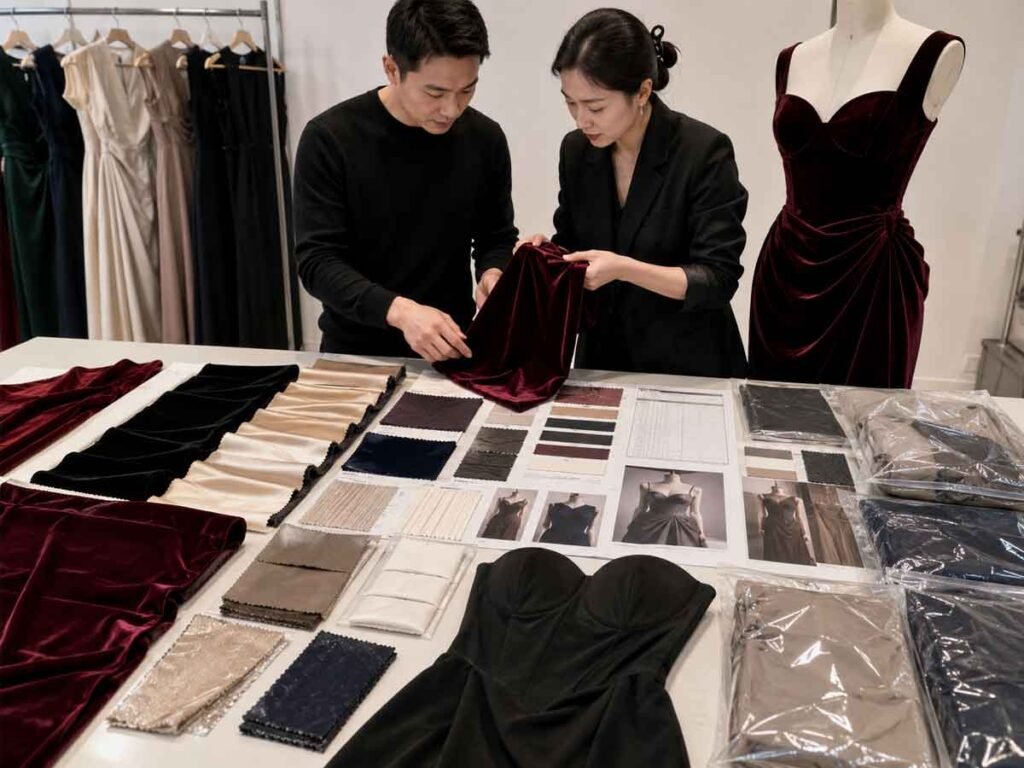
Fabric Performance Review For Intended Silhouette
The same textile can perform well in a loose day dress and fail in a fitted, bias-cut, gathered, or heavily embellished silhouette. Technical review may include:
- Fabric weight and thickness in relation to drape, opacity, support, and seam bulk.
- Stretch percentage, direction, recovery, and expected negative ease for fitted garments.
- Shrinkage or relaxation behavior affecting pattern dimensions and finished measurements.
- Surface sensitivity to needles,abrasion, snagging, or handling marks.
- Seam slippage, tearing, bursting, or stitch damage risk around high-stress areas.
- Colorfastness, pilling, dimensional stability, and other performance requirements specified by the brand.
- Transparency under lighting and the effect of lining color, weight, and construction.
The broader manufacturing system includes approximately 1,100-2,000 sets of fabric inspection, spreading, cutting, weight checking, shade review, needle detection, and related preparation equipment. Relevant tools include fabric inspection machines, GSM equipment, light boxes, automatic spreading systems, and automatic cutting systems.

Shade, Roll, And Lot Discipline
Color approval has several layers. A lab dip may match the target under a light box while bulk fabric later shows roll-to-roll variation, side-to-center shade, surface luster differences, or inconsistent dye penetration.
Satin, velvet, mesh, and fabrics with pile or directional shine require especially careful visual handling. Duolan can organize shade and lot controls around the style risk:
- Lab dip or strike-off approval linked to the correct color reference.
- Bulk lot confirmation before cutting when color sensitivity is high.
- Roll inspection and shade grouping for visible panel consistency.
- Directional cutting rules for nap, luster, or one-way surface effects.
- Lot separation where mixed cutting could create panel mismatch.
- Reapproval when replacement yardage or a new dye lot enters production.
Shade management also affects lining, mesh, thread, elastic, zipper tape, and decorations. A shell color may appear correct while a lining or trim shifts the overall tone.
Material boards and approved component references help QA teams review the complete garment rather than isolated parts.

Lining, Trim, And Structural Compatibility
Linings and trims influence fit, appearance, comfort, strength, and test performance. A lining with insufficient stretch can restrict a bodycon dress even when the shell fabric meets specification. Heavy zipper tape can distort a delicate satin seam.
Boning may support a corset bodice but create pressure points if channel placement and edge finishing are poorly controlled. Compatibility review covers:
- Stretch and recovery balance between shell, lining, elastic, and binding.
- Shrinkage compatibility to reduce twisting or bubbling after care.
- Zipper type, tape weight, slider performance, and seam interaction.
- Cup shape, interfacing, boning, underbust support, hook-and-eye, and closure strength.
- Thread, needle, stitch density, and seam finish suited to the fabric structure.
- Metal, plastic, adhesive, and decorative components subject to brand or market requirements.
- Skin-contact comfort around sequins, beads, rhinestones, mesh edges, and internal support pieces.
Material substitutions require controlled review. A visually similar trim may alter weight, stretch, nickel exposure, colorfastness, attachment strength, or packing performance. Substitution should therefore be recorded, assessed, and approved before bulk use.

Special Process Material Control
Print, embroidery, sequin, bead, rhinestone, washing, dip-dye, and bonded decoration processes add several material interfaces. Duolan works with 2-3 mature long-term partners in each major special-process direction, including printing, embroidery, washing, and dip-dye. Partner availability supports flexibility, while project quality still depends on approved artwork, process trials, attachment methods, and bulk consistency controls. Important controls include:
- Artwork scale, placement, repeat, orientation, and color separation.
- Strike-off or process sample approval before bulk execution.
- Embroidery backing, thread behavior, puckering risk, and edge cleanliness.
- Sequin or bead density, attachment security, repair method, and skin comfort.
- Rhinestone adhesive, curing conditions, heat sensitivity, and pull resistance.
- Print hand feel, cracking, migration, shade, and interaction with stretch fabric.
- Wash or dye effect consistency across lots and garment panels.
- Protection during sewing, pressing, packing, and transport.
Special processing should not be treated as decoration added at the end. Process choices affect pattern allowance, seam position, cutting yield, pressing sequence, inspection method, packing, and delivery timing. Early coordination reduces damage and visual inconsistency during bulk production.
From Sample Approval To Bulk Readiness
Defining Sample Purpose And Approval Status
A first proto, fit sample, revised sample, salesman sample, and pre-production sample serve different decisions. A visually appealing sample may still need measurement correction, while a technically correct fit sample may not represent the final fabric, color, trim, or finishing standard. Duolan can support several development stages:
- First proto for silhouette, construction, and feasibility review.
- Fit sample for measurement, balance, support, and movement.
- Revised sample for confirmed comment implementation.
- Salesman or presentation sample for range review and market preparation.
- Pre-production sample for bulk reference and manufacturing alignment.
Sampling schedules are issued after feasibility, material availability, special-process timing, and sample purpose are reviewed rather than promising one fixed lead time for every dress category. Duolan’s broader development network includes approximately 750-1,200 specialists and a monthly sample capacity of 15,000-35,000 pieces or development iterations. The system can support around 3,000-8,000 style-development and sampling flows per month. Capacity is used to run multiple programs in parallel, while each style still requires a defined approval path.
Running A Bulk Readiness Review
Sample approval does not automatically mean bulk production can start. Duolan runs a structured readiness review before fabric cutting and line allocation. The review identifies the order purpose, sample status, material status, workmanship points, packing requirements, remaining decisions, and production route.
Bulk readiness normally confirms:
- Whether the order is a launch, repeat, replenishment, or scale-up program.
- Which sample version forms the production basis.
- Fabric, lining, trims, color, measurements, and workmanship points.
- Approved special-process references and placement standards.
- Testing, inspection, audit, or documentation requirements.
- Packaging, labels, barcodes, size ratios, and carton rules.
- Need for first-off review, trial production, or additional risk verification.
- Single-factory, multi-line, or multi-factory production route.
The brand team can receive a concise Bulk Start Confirmation or Production Readiness Note rather than an informal “production can start” message. A clear handover protects sample knowledge and reduces the risk of bulk teams rebuilding the style from incomplete information.
Controlling Fit, Measurement, And Grading
Fit quality depends on the relationship among body measurements, ease, fabric behavior, structure, and construction. Measurement charts alone cannot explain every issue. A garment may meet flat measurements yet show poor bust balance, waist position, side-seam movement, skirt fall, neckline gaping, or uneven hem when worn. Fit review for fashion dresses may address:
- Bust point, cup shape, underbust, neckline, armhole, and strap position.
- Waist placement, contour, negative ease, and elastic recovery.
- Hip measurement, seat balance, side-seam direction, and skirt sweep.
- Front and back length balance on fitted or bias-cut silhouettes.
- Zipper behavior, opening length, closure pressure, and seam waviness.
- Lining influence on stretch, support, transparency, and movement.
- Grading behavior from the smallest through the largest approved size.
Critical points of measure are separated from secondary measurements so line teams know where variation carries the greatest fit risk. When fabric changes, pattern and grade assumptions may also need review. Mechanical copying of a pattern from one fabric to another often produces a garment that matches the chart but fails on body.

Quality Risks Across High-Complexity Dress Categories

Satin Dresses
- Confirm grain or bias direction before cutting.
- Match needle, thread, stitch length, and seam allowance to fabric weight.
- Control handling and pressing temperatures.
- Check side seams, darts, zippers, hems, and panel smoothness under light.
- Verify lining does not pull or distort the shell.

Mesh Dresses
- Review stretch direction and recovery for each layer.
- Define modesty and lining coverage zones.
- Check seam reinforcement without creating bulky edges.
- Control gathering ratio, panel alignment, and decorative placement.
- Inspect snagging, holes, needle damage, and raw-edge stability.

Sequin Dresses
- Approve sequin density, orientation, color, and placement.
- Clear seam allowances where construction requires it.
- Define repair methods for missing or broken decorations.
- Protect skin-contact zones with suitable lining or facing.
- Inspect attachment, comfort, surface loss, and packing pressure.

Bodycon Dresses
- Confirm stretch percentage and direction before pattern approval.
- Define critical measurements and tolerance by size.
- Check side-seam balance, waist position, hip recovery, and hem level.
- Review lining or shaping support for restriction and comfort.
- Monitor measurement trends during production, not only at final inspection.

Corset Dresses
- Confirm cup dimensions and left-right symmetry.
- Check boning channels, ends, placement, and comfort.
- Reinforce stress points around closures and waist seams.
- Review support across the approved size range.
- Validate first-off construction before line volume increases.

Printed Embellished Dresses
- Lock artwork scale, repeat, orientation, and placement reference.
- Approve strike-offs or process samples before bulk.
- Check attachment, color, density, migration, and surface damage.
- Protect decorated panels during cutting, sewing, pressing, and packing.
- Record accepted visual tolerance for handmade or semi-manual effects.
Production Planning Around Product Risk
Breaking Orders Into Manageable Production Units
- Regular construction with stable materials and established methods.
- Complex fit or structure requiring stronger technical control.
- Fast-response styles linked to a launch or replenishment deadline.
- High-risk special-process styles involving print, embroidery, sequin, wash, or bonded decoration.
- Repeat styles with approved references but possible new color or fabric risk.
- Scale-up styles requiring added lines, factories, or process capacity.
Matching Styles To Lines And Factories
Duolan’s manufacturing structure includes 16 owned factories, 20+ long-term satellite factories, around 300 sewing lines, and 50+ flexible lines. Capacity alone does not guarantee quality. Strong allocation depends on matching the product to the right technical and production environment.
Allocation decisions consider:
- Historical experience with the silhouette, fabric, and process.
- Need for pattern, sample, or technical support close to production.
- Line capability for stretch, satin, corsetry, mesh, or decoration work.
- Special-process location and transport between process stages.
- Order volume, color count, size ratio, and delivery sequence.
- Need for single-factory control or carefully managed multi-factory scaling.
- Risk of visual variation when the same style runs on several lines.
Core, complex, or high-risk styles can remain under closer owned-factory control. Satellite capacity supports planned expansion, replenishment, and multi-style programs when standards, active files, first-off references, and reporting routines remain unified. Production allocation should protect repeatability rather than simply fill available lines.
First-Off And Trial Validation Before Full Release
High-risk production should earn line release through evidence. First-off garments or controlled trial quantities allow teams to verify measurements, construction sequence, pressing, decoration, seam appearance, support, and packing before a large quantity accumulates.First-off review may include:
- Critical measurements against the active chart and tolerance.
- Fit-sensitive construction, including cup, waist, hip, neckline, straps, and closures.
- Fabric handling, seam smoothness, stitch security, and pressing result.
- Print, embroidery, sequin, bead, or rhinestone placement and appearance.
- Label placement, care content, barcode relationship, and folding method.
- Confirmation that line instructions match the approved PP reference.
A failed first-off result should trigger correction, retraining, pattern adjustment, material review, or process change before volume increases. Trial validation is especially valuable when a style moves to a new line, a new fabric lot, a new color, or a scaled production route.

Inline Quality Control With Active Escalation
Controlling Critical Operations Near The Source
- Bust cups, boning, neckline, and closure construction on corset dresses.
- Zipper insertion and seam smoothness on satin or fitted dresses.
- Stretch seam security and elastic recovery on bodycon styles.
- Gathering ratio and layer alignment on mesh or tiered dresses.
- Embellishment placement, seam clearance, and repair quality on sequin garments.
- Hems, slits, side-seam balance, and length consistency on long dresses.
Monitoring Measurement And Appearance Trends
- Repeated movement at bust, waist, hip, garment length, or strap length.
- Stretch growth or recovery change during sewing and pressing.
- Left-right asymmetry, twisting, side-seam drift, or uneven hem.
- Visual changes in drape, transparency, gathering, or decoration density.
- Differences between first-off, inline, and later production output.
Containing And Escalating Quality Issues
- Style, color, size, line, process, and time detected.
- Defect description and available photo evidence.
- Quantity potentially affected and current production stage.
- Immediate containment action.
- Suspected root cause and technical assessment.
- Decision needed from Duolan, the brand team, or a third party.
- Impact on timing, material, cost, testing, or finished appearance.
- Verification required before restart.
Closing Corrective Action With Evidence
Corrective action should prevent recurrence, not only repair finished pieces. Duolan can organize closure around immediate containment, root-cause review, process correction, responsible ownership, verification, and status tracking.
Closure may include:
- Updated work instruction or operation sequence.
- Pattern, template, gauge, folder, or machine-setting adjustment.
- Replacement or reapproval of material or trim.
- Operator retraining and first-off recheck.
- Increased inspection frequency until the process stabilizes.
- Reinspection of affected quantities.
- Photo, measurement, or sample evidence confirming improvement.
- Final decision on repair, replacement, downgrade, or exception approval.
For brand-appointed inspection plans, internal corrective action can be linked to third-party findings. Duolan supports inspection access and factory closure actions, while the independent inspector retains authority over its own report and release recommendation.
Quality Checkpoints From Fabric To Shipment
A controlled production path uses staged release points rather than one final quality decision. The matrix below shows how risk, evidence, and release conditions can be organized around a fashion dress program.
| Stage | Main Risk | Core Checks | QA Evidence | Release Condition |
|---|---|---|---|---|
| Requirement Review | Conflicting or incomplete instructions | Tech pack, measurements, BOM, construction, labels, testing, packing | Requirement Summary | Critical requirements and open decisions are visible |
| Material Approval | Fabric or trim unsuitable for silhouette or compliance | Weight, stretch, recovery, shade, shrinkage, transparency, compatibility | Material Approval Record | Approved materials are linked to the correct style and color |
| Sample Review | Fit, appearance, or construction not ready for bulk | Fit, measurements, balance, structure, workmanship, visual result | Sample Comment Log | Approval status and remaining revisions are separated |
| Bulk Readiness | Sample knowledge lost during handover | PP basis, fabric, lining, trims, color, measurements, workmanship, packing | Production Readiness Note | Production reference and open risks are confirmed |
| Cutting | Shade mixing, direction errors, inaccurate cutting | Lot separation, nap direction, numbering, panel matching, cutting accuracy | Cutting Control Record | Cut components meet active material and pattern rules |
| First-Off | Line method differs from approved reference | Critical measurements, fit-sensitive operations, seam appearance, placement | First-Off Review | Approved correction or release before volume increases |
| Inline Production | Measurement drift or repeated workmanship defects | Critical operations, trend measurements, visual consistency, containment | Inline Quality Record | Process remains stable or corrective action is closed |
| Special Process | Artwork, color, density, attachment, or finish variation | Strike-off reference, placement, adhesion, surface condition, repair | Process Approval Record | Bulk effect matches approved process reference |
| Final Inspection | Finished garment defects or incomplete repair | Measurements, appearance, workmanship, symmetry, cleanliness, safety checks | Final Quality Summary | Results meet agreed internal or third-party criteria |
| Packing And Shipment | Wrong labels, barcodes, assortment, marks, or documents | Labels, tags, barcodes, folding, polybags, ratios, cartons, shipment files | Final Packing Status | Product, packing, and shipment requirements are released |
Final Quality Packing And Delivery Verification
Verifying Finished Garment Quality
- Critical and selected secondary measurements across the size range.
- Front-back balance, side seams, hem level, neckline, straps, cups, and closures.
- Stitch security, seam appearance, edge finishing, reinforcement, and loose threads.
- Shade, surface marks, pressing quality, snagging, holes, stains, or damage.
- Print, embroidery, sequin, bead, rhinestone, and other decoration consistency.
- Zippers, hooks, buttons, elastics, ties, sliders, and functional openings.
- Needle detection or relevant safety checks when required by the project.
Controlling Labels Barcodes And Packing Details
- Main label, size label, care label, fiber content, and country-of-origin information.
- Hangtag, price ticket, security label, sticker, and promotional insert.
- Style, color, size, SKU, UPC, EAN, or other barcode relationships.
- Folding method, tissue, hanger, polybag, warning statement, and sealing.
- Size ratio, solid-size or mixed-size packing, and carton assortment.
- Carton dimensions, weight, carton mark, destination, and split-shipment identification.
Releasing Shipment Against Agreed Status
Shipment release should show whether the order is ready, conditionally ready, or held for closure. A Final Quality and Packing Status Summary can bring together internal inspection, third-party inspection status, unresolved deviations, packing completion, quantity, documentation, and shipping readiness.Release review may confirm:
- Inspection result and closure of critical or repeated issues.
- Approved exception status where a deviation requires brand acceptance.
- Packed quantity by style, color, size, and shipment batch.
- Label, barcode, packing, carton, and mark completion.
- Required laboratory, audit, or inspection records available for the program.
- Packing list, commercial documents, and appointed forwarder instructions.
- Split-shipment sequence or multi-destination allocation.
Duolan supports express, air, sea, FOB, CIF, DDP, split shipment, appointed forwarder, overseas warehouse, and multi-location delivery arrangements according to the agreed project structure. Delivery coordination is linked to production and release status rather than treated as a separate administrative step.

Testing And Compliance Coordination For Brand Programs
Physical Performance Testing
Chemical Requirements
Product Information Control
Social Compliance Readiness
Third-Party Inspection
Client-Specific Standards
Documentation Your QA Team Can Actually Review
Requirement Summary
Sample Comment Log
Material Approval Record
Production Readiness Note
Quality Issue Record
Final Delivery Summary
Manufacturing Resources Behind Quality Execution

16 Owned Factories
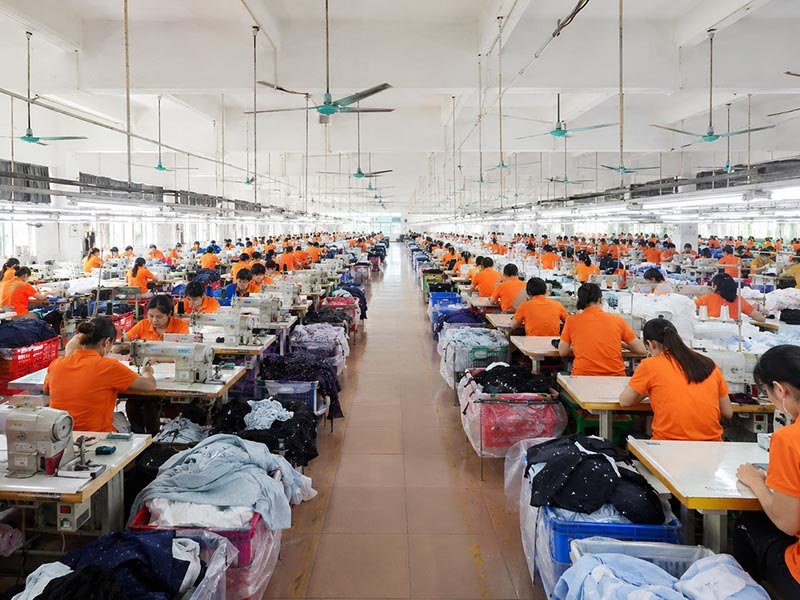
20+ Satellite Factories

300 Sewing Lines

50+ Flexible Lines

750-1,200 Developers

140-180 Quality Support
Quality Control Cases From Development To Delivery
18-Style Fitted Dress Launch
A US fashion brand prepared an 18-style fitted and occasion dress launch totaling 42,600 garments across five colors and sizes XXS-XL. The range combined stretch jersey, power mesh, lining, molded cups, boning, zippers, and fitted woven panels. Main risks involved negative ease, bust support, waist and hip measurement drift, mesh transparency, lining restriction, zipper waviness, and consistency across several lines.
Duolan organized the program into three risk groups rather than one production block. Corset and cup-structured styles remained under closer owned-factory control; stable stretch styles moved to approved flexible lines; woven fitted styles received separate first-off checks. Critical points of measure were identified by category, and PP references were linked to the active measurement charts and material records.
During first-off review, two styles showed waist recovery movement after pressing and one cup style showed left-right shape variation. Affected operations were held, pressing settings and component handling were adjusted, and first-off garments were repeated before line release. Inline measurement checks then focused on bust, waist, hip, garment length, strap length, and zipper area. Final verification included size-range measurements, visual fit points, labeling, barcode relationships, and mixed-size carton ratios.
The program moved through a 30-day controlled production window after bulk readiness approval. Shipment release followed closure of first-off actions, internal final review, packing verification, and the brand’s appointed inspection process.

24-Style Party Dress Program
A multi-market fashion label placed a 24-style party and occasion program totaling 68,400 garments in six color groups and sizes XS-XL. Products included satin mini dresses, stretch mesh styles, sequin dresses, rhinestone details, embroidered panels, and lined corset silhouettes. Visual consistency and surface protection were as important as measurements because several styles were intended for e-commerce launch photography and coordinated campaign delivery.
Material control began with shell, lining, zipper, elastic, cup, boning, sequin, bead, and rhinestone approvals. Special-process samples were reviewed for artwork placement, decoration density, color, attachment, skin-contact comfort, seam clearance, and repair method. Satin styles received directional cutting and seam-puckering controls, while mesh styles used separate transparency and layer-alignment references.
Production was divided across owned facilities and selected long-term process partners. Three styles required trial quantities before full release because decoration and construction interacted at the side seams and neckline. One rhinestone process was reworked after early attachment review, and a satin color lot was separated before cutting due to visible luster variation. Those actions occurred before large quantities entered assembly.
The program ran through a 38-day production and finishing window, including special processing, inline review, final appearance checks, barcode and hangtag verification, and protective packing for decorated garments. Final release followed completion of internal closure records and third-party inspection coordination.
Quality And Compliance Frequently Asked Questions

Share Your Quality Requirements With Our Team
Send the information your QA and technical teams already use, and Duolan will review how the standards can be carried into development, bulk readiness, production control, third-party coordination, packing, and shipment release. A complete file set helps the team identify risk early and propose the correct technical route, approval gates, production path, inspection focus, and documentation level.
Useful project information includes:
- Brand quality manual, tech pack, measurement chart, grade rules, and BOM.
- Reference sample, approved photos, fit comments, or current problem report.
- Fabric, lining, trim, artwork, print, embroidery, or decoration requirements.
- Target market, physical or chemical testing protocol, and nominated laboratory.
- Inspection method, defect classification, AQL plan, or nominated inspection company.
- Label, barcode, packing, carton, warehouse, and delivery instructions.
- Style count, color count, size range, estimated order quantity, and target launch date.
- Current quality concern, repeated supplier failure, or sample-to-bulk risk needing review.