Skip to content

Resort & Vacation Dress Manufacturing Solutions
Dress-focused development and manufacturing for fashion brands building seasonal resort, vacation, holiday, and destination collections across global markets.
- Multi-style resort programs: Brand projects commonly involve 10–30 styles and 20,000–80,000 pieces per order, requiring coordinated development across silhouettes, colors, fabrics, approval stages, and launch priorities.
- Flexible production routing: 50+ quick-response and flexible production lines support launch orders, repeat demand, and scale-up planning across a larger multi-factory manufacturing network.
- Special-process coordination: Long-term manufacturing resources include 2–3 regularly used partner facilities in key process areas such as printing, dip dyeing, embroidery, and washing.
Built for Established Resort and Vacation Fashion Programs
Established Fashion Brands
Product and Design Teams
Design and product teams may begin with a complete tech pack, an edited reference board, an original garment, fabric swatches, artwork, or a partially developed collection. Duolan helps translate those inputs into development decisions: which silhouettes require early pattern work, where fabric behavior can change the intended shape, which details need construction testing, and which styles should be prioritized for first sampling. Fit, drape, coverage, visual balance, and production feasibility are reviewed before development becomes expensive or difficult to reverse.
Sourcing and Supply Teams
Sourcing teams need visibility beyond sample appearance. Supplier assessment commonly includes manufacturing structure, production routing, quality checkpoints, audit readiness, branded packing, shipment coordination, and capacity for repeat orders. Duolan connects development records with bulk execution so approved fabrics, measurements, workmanship points, labels, and packing instructions do not disappear after sample approval. Manufacturing resources can then be allocated according to style complexity, process requirements, volume, and target delivery window rather than treating every resort dress as the same production job.
Build a Resort Collection Around a Clear Commercial Structure
Build Around Real Resort Selling Moments
Resort and vacation dressing covers several distinct wearing occasions, and each occasion places different demands on the garment. A lightweight daytime dress needs comfortable movement, manageable transparency, and an easy silhouette, while a resort dinner dress may require cleaner drape, stronger shape, more controlled exposure, and a finish that reads well under evening lighting. Destination events add another layer because garments must photograph well while remaining comfortable during walking, sitting, dining, and travel. A collection can therefore be structured around summer launch, vacation drop, holiday edit, beach-to-dinner dressing, resort evening, destination occasion, or travel capsule rather than beginning with unrelated sketches. Product development becomes clearer when each style has a role.
- Day-focused pieces need ease, movement, coverage, and travel-friendly handling.
- Beach-to-dinner styles need enough refinement to move beyond daytime use.
- Resort-evening dresses rely more heavily on drape, fit balance, neckline stability, and finish.
- Destination occasion styles may combine resort color or print direction with stronger occasionwear construction.
- Travel capsules benefit from coordinated color, repeatable fit blocks, and silhouettes that can be extended across several styles.
Duolan reviews the collection around where each dress is expected to sell and how it will be worn. The aim is not to redesign a brand’s creative direction. The aim is to identify whether material, pattern, construction, and production decisions support the intended selling occasion before sampling begins.
Balance Hero Styles and Commercial Volume
A resort collection needs visual impact, but filling every style with difficult construction, unique materials, or heavy development requirements can create unnecessary cost and schedule pressure. A more controlled assortment normally combines several roles: campaign-driving hero dresses, reliable commercial silhouettes, easier vacation pieces, print-led styles, occasion crossover pieces, and repeat-friendly shapes.
Hero styles may carry stronger cut-outs, asymmetric construction, dramatic print placement, complex halter shaping, or distinctive volume. Commercial styles can share fabric families, fit blocks, color stories, or construction methods. The relationship reduces development fragmentation while giving the collection enough visual variation for campaign, ecommerce, and merchandising use.
Duolan can separate styles by development risk before sampling. A familiar slip or wrap silhouette may move quickly once fabric behavior is confirmed. A low-back halter with limited coverage may require earlier pattern and fit testing. A large printed maxi may need artwork scale and skirt movement checked before final cutting decisions. A heavily gathered lightweight dress may need consumption and seam stability reviewed before price and production planning become reliable.
A well-built collection therefore does not mean making every design simpler. It means concentrating complexity where it creates visible product value and keeping repeatable standards where consistency matters more. Such separation also makes sampling priority, material sourcing, costing, PP approval, and production scheduling easier to manage across 10, 20, or more styles.
Connect Silhouette, Fabric and Color
Silhouette cannot be developed separately from fabric. The same sketch can behave very differently when produced in a fluid satin, a lightweight woven construction, a crepe with more body, or a semi-transparent mesh layer. Weight changes movement. Stretch changes fit. Surface finish changes visual perception. Opacity changes lining decisions. Print scale changes how the body and skirt proportions appear.
For resort programs, Duolan reviews material direction against the intended garment result rather than choosing fabric from appearance alone. A printed maxi needs enough movement to create a long, fluid silhouette without collapsing around the body. A bias-influenced slip needs controlled drape and seam handling. A fitted halter requires enough stability around the bust and back. A cut-out style needs edges that remain clean while the garment moves. A layered dress requires the outer fabric and lining to work together rather than pulling against each other.
Color planning also affects collection structure. Main colors, commercial neutrals, seasonal accents, and print grounds should work across the assortment without creating unnecessary material fragmentation. Where several styles share related fabrics or trim families, approvals can be coordinated more efficiently. Where a hero print is unique, artwork, scale, repeat, cutting position, and bulk color consistency deserve a separate development route.
Plan Development Back From Launch
A resort collection has little commercial value if campaign samples, production, inspection, or shipment miss the selling window. Development therefore needs to be connected to the intended launch date from the beginning.
Duolan starts by identifying which styles carry the greatest timing risk. Print development may require artwork review before sample fabric can be prepared. Special trims may need longer sourcing. Halter, backless, cut-out, or structured styles may need an additional fit round. Photo samples may be required before production approval is complete. Large multi-style programs may also need different production routes rather than one common release date.
A working sequence may move through collection direction → material and print review → first sample → fit or visual revision → photo sample where required → PP approval → material locking → bulk production → inline control → final inspection → packing → shipment. The sequence changes according to complexity, but the decision points remain visible.
Brand approvals also need timing discipline. Delayed artwork, late color confirmation, changing measurements, or unresolved PP comments can compress production without changing the final launch date. Duolan therefore treats approval timing as part of the manufacturing schedule, not as an administrative detail.
Core Resort and Vacation Dress Directions for Brand Collections
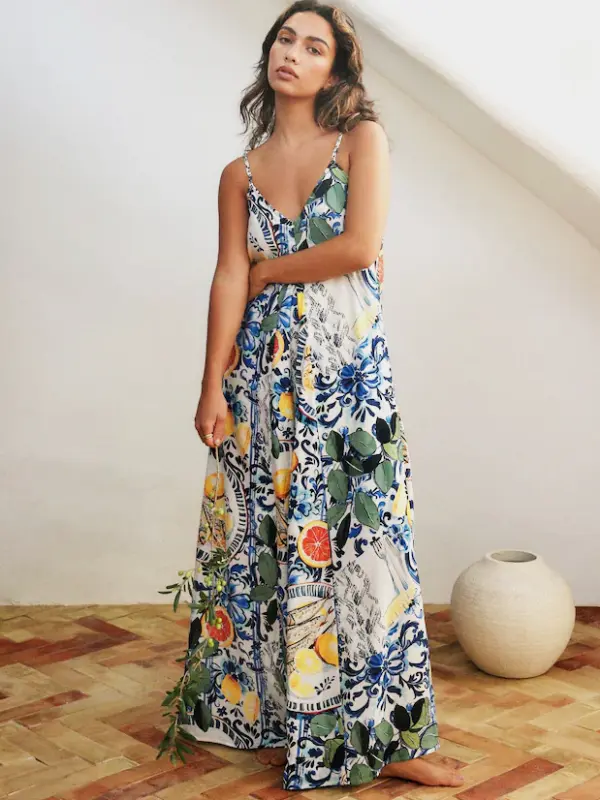
Printed Maxi Dresses
Print scale should be reviewed against body length and skirt volume. Placement near the bust, waist seam, center front, side seam, and hem can alter visual balance. Lightweight materials also require attention to opacity, lining, seam puckering, and skirt fall.
- Review artwork scale on garment proportions.
- Check repeat behavior across major seams.
- Confirm lining without flattening movement.
- Control hem shape and finished length.
- Compare sample print color with bulk production reference.

Halter Vacation Dresses
Development should consider how the garment performs while standing, walking, sitting, and turning rather than evaluating only a front photograph. Fabric stretch and recovery also influence the amount of support available.
- Check neck strap width, angle, and length.
- Review bust coverage and underarm security.
- Balance open-back shape with garment stability.
- Confirm left-right symmetry in bulk.
- Grade neckline and strap relationships rather than enlarging measurements mechanically.

Backless Resort Dresses
A development sample should therefore be reviewed from front, side, and back. Fabric weight and stretch can determine whether the dress stays close to the body or falls away during movement. Tie backs, elastic sections, lace-up details, concealed closures, or internal support may be selected according to the design.
- Define the lowest stable back position.
- Check side coverage and underarm exposure.
- Review closure strength and tension.
- Keep lining from showing around the opening.
- Record critical back measurements for grading and QC.

Slip and Cowl Dresses
Slip and cowl dresses rely on proportion, fabric behavior, neckline balance, and clean finishing. A small change in drape can alter the entire front appearance, while poor seam handling can make a refined resort dress look inexpensive.
Strap position, cowl depth, bust ease, side-seam direction, back height, and hem movement should be assessed together.
Where fabric has limited stretch, enough wearing ease is needed without losing the narrow silhouette.
- Match fabric drape to the intended neckline.
- Control strap length and attachment position.
- Check bust coverage during movement.
- Review seam tension and pressing marks.
- Confirm hem balance after the garment hangs naturally.

Wrap Resort Dresses
Wrap dresses appear straightforward, yet overlap depth, waist placement, tie position, skirt opening, and neckline stability determine whether the garment feels secure. A wrap style designed for travel or resort dining must stay controlled while the wearer walks, sits, or moves outdoors.
Fabric should provide enough drape for a flattering overlap without creating excessive bulk at the waist.
Printed versions also require attention to how artwork breaks across overlapping panels.
- Set sufficient front overlap.
- Review neckline opening under movement.
- Position ties without distorting the waist.
- Check skirt exposure when walking or sitting.
- Control print direction across wrap panels and hems.

Cut-Out Vacation Dresses
Development should start by defining which areas carry load and which areas can safely open. A cut-out that looks accurate on a flat sample can stretch, gape, twist, or expose more than intended after fitting.
- Check opening position against body landmarks.
- Stabilize edges without creating stiffness.
- Review elastic or binding recovery where needed.
- Balance waist and bust support around open areas.
- Measure critical openings for production consistency.

Ruched Lightweight Dresses
The development team should define the finished ruched area rather than relying only on the amount of fabric fed into a seam. Drawstrings, elastic channels, fixed gathering, and asymmetric ruching each require a different production standard.
- Define finished ruched length and density.
- Control left-right or front-back balance.
- Check drawstring function and reinforcement.
- Review seam strength under gathered tension.
- Keep bulk gathering consistent with the approved sample.

Tiered Fluid Dresses
Tiered dresses are useful for relaxed resort ranges because volume and movement can be created without heavy internal structure. Poor proportion, however, can make the garment feel oversized, uneven, or difficult to photograph.
Each tier affects fabric consumption, finished length, seam weight, print direction, and overall silhouette.
Large printed styles also need careful panel planning so strong motifs do not create accidental visual breaks.
- Set tier depth according to total dress length.
- Control gathering ratio between panels.
- Review side-seam and hem balance.
- Check print direction before cutting.
- Confirm finished length after hanging and pressing.
Match Resort Dresses to Real Wearing and Selling Occasions
Different resort occasions call for different product decisions. A dress for daytime travel does not need the same support, opacity, finish, or visual intensity as a destination dinner or social-event style. The matrix helps connect selling occasion with development priorities.
| Resort / Vacation Occasion | Strong Product Directions | Fabric & Visual Priority | Fit / Construction Priority | Main Development Risk |
|---|---|---|---|---|
| Resort Day | Wrap, tiered, relaxed midi | Light movement, controlled opacity | Ease and secure neckline | Excess transparency or uncontrolled volume |
| Beach-to-Dinner | Halter, printed maxi, cut-out | Strong color, fluid drape | Coverage plus evening-ready shape | Style feels too casual or unstable |
| Resort Dinner | Slip, cowl, fitted maxi | Refined surface and clean drape | Bust, waist and neckline balance | Seam marks, fit imbalance, poor finish |
| Vacation Party | Ruched, backless, asymmetric | Visual impact and movement | Body security during movement | Openings stretch or ruching becomes inconsistent |
| Destination Event | Maxi, halter, polished fitted dress | Elevated finish and photographability | Fit, coverage and sitting comfort | Strong visual sample but weak wearability |
| Travel Capsule | Wrap, slip, midi, coordinated styles | Repeatable palette and versatile fabric | Consistent fit blocks | Too many one-off materials and production routes |
Fabric Decisions Shape Every Resort Dress Before Cutting
Drape, Weight and Garment Movement
- Weight and body: how strongly the fabric holds or collapses around the silhouette.
- Drape: how folds develop around the bust, waist, hip, and skirt.
- Stretch and recovery: whether fitted areas return to shape after wear.
- Surface: whether sheen, texture, or print behaves correctly under photography.
- Cutting behavior: whether fabric shifts, twists, frays, or requires additional handling.
- Pressing response: whether heat or pressure leaves unwanted marks.
Opacity, Lining and Wearing Comfort
- outer-fabric opacity in relaxed and stretched states;
- lining shade against the main color;
- lining length around slits and cut-outs;
- seam visibility through light surfaces;
- internal attachment points that prevent twisting;
- friction between outer fabric and lining;
- comfort around necklines, armholes, straps, and exposed backs.
Bulk Stability and Travel Finish
A fabric can pass sample review and still create problems when production volume increases. Shade variation, handfeel changes, shrinkage, width differences, print response, surface marking, or different finishing behavior can alter the garment after approval.
Before bulk release, production-critical material details should be recorded and checked. Depending on the style, records may cover composition, weight direction, color, stretch, shrinkage requirement, approved handfeel, print reference, lining, trim compatibility, and supplier or lot information. When color is critical, approval references should remain connected to the bulk lot rather than relying on visual memory.
Travel handling also matters for resort products. Satin-like surfaces may show pressure marks. Lightweight dresses can arrive heavily creased if folded without considering fabric behavior. Structured necklines can deform in unsuitable packing. Decorative pieces can catch against neighboring garments. Finishing and packing therefore form part of material control.
Duolan’s material network is supported by established fabric, trim, accessory, and special-process resources around the South China apparel supply base. The value lies in coordination: materials can be reviewed alongside pattern, print, workmanship, quantity, schedule, and production requirements rather than being sourced independently from the garment.

Control Print and Color Before Resort Dresses Reach Bulk
Review Artwork Scale Before Sampling
A print viewed on a screen does not show how the artwork will behave across a full dress. Motif size can visually shorten or lengthen the body, compete with necklines, disappear into gathering, or become overwhelming across a large skirt.
Duolan reviews artwork in relation to garment proportions before final sample direction is locked. A large floral or abstract motif may need a different scale for a mini dress than for a floor-length maxi. A border element needs to correspond with finished hem placement. A strong central motif can become distorted by ruching, darts, princess seams, wrap overlaps, or cut-outs.
Important checks include:
- motif scale against sample size and finished length;
- artwork orientation across front and back panels;
- interaction with bust, waist, and hip construction;
- visibility after gathering or pleating;
- position near slits and cut-outs;
- expected appearance across graded sizes.
For multi-style programs, print planning can also determine which silhouettes belong together. One print may work across a maxi, halter midi, and matching piece while requiring different placement logic for each garment.
The objective is to move from a flat artwork approval to a garment-aware print decision. Earlier review reduces the chance of reaching a finished sample only to discover that the pattern scale, visual center, or seam interruption does not support the intended collection.
Manage Repeat Placement and Cutting
Once artwork direction is approved, production still needs rules for how print enters the garment. Repeat size, panel width, seam location, directional motifs, and cutting yield can affect both appearance and cost.
Placement prints require more controlled cutting because a defined motif must land in a defined area. All-over repeats allow greater flexibility, yet prominent motifs can still create obvious mismatches at center fronts, side seams, waist joins, or wrap panels. Dresses with tiered skirts introduce additional decisions because each tier may show a different section of the artwork.
Duolan coordinates print and garment development through long-term special-process resources, including regularly used printing partners. Print execution is reviewed alongside the pattern rather than being treated as an isolated textile process.
Production controls may include:
- approved printed swatch or strike-off reference;
- artwork direction markers;
- panel placement guidance;
- repeat and scale confirmation;
- cutting reference for high-visibility areas;
- seam matching priorities where commercially justified;
- first-piece visual check before full release.
Not every seam needs perfect motif matching; doing so can sharply increase material consumption and cutting time. The right standard depends on garment price position, artwork character, and where misalignment would be visually unacceptable.
Lock Colorways for Bulk Consistency
Colorways often multiply quickly in resort programs. A successful silhouette may launch in several solids, two print grounds, or seasonal extensions, while matching pieces need to stay visually connected.
Color decisions should be linked to the actual material and process. The same color can appear different across smooth, textured, transparent, matte, or high-shine fabrics. Lining can also change perceived depth in light colors. Printed grounds and solid companion styles need enough visual consistency to work together in campaign and merchandising environments.
Duolan can coordinate color cards, lab-dip direction where required, printed references, main-fabric and lining relationships, and approved production standards according to the program. For bulk, color checks should distinguish expected material variation from changes large enough to affect the collection.
A strong control path may include:
- approved digital artwork and physical print reference;
- approved main color direction;
- lining and trim color relationship;
- bulk-lot visual review;
- first-piece comparison against approved sample;
- final inspection under consistent viewing conditions.
Color locking becomes especially important for repeat orders. Retaining approved material, artwork, color, BOM, and sample records creates a stronger reference when a successful resort dress returns in the same color or is extended into a later seasonal drop.

Engineer Fit, Coverage and Movement Into Resort Silhouettes
Balance Halter Load and Bust Support
- neck strap length and attachment;
- pressure distribution around the back neck;
- bust-point position and cup coverage;
- underarm height;
- side seam direction;
- back opening and closure stability;
- lining or internal support;
- symmetry between left and right sides.
Stabilize Backless and Cut-Out Areas
- opening dimensions against body landmarks;
- edge recovery after fitting;
- coverage during walking and sitting;
- support around bust and waist;
- zipper or fastening position;
- lining visibility;
- seam tension near open sections;
- appearance after repeated dressing movement.
Control Slits, Hemlines and Full-Body Movement
Resort dresses are often photographed while walking, turning, or moving outdoors, making lower-body balance part of product performance. Slits, wrap openings, tiered hems, asymmetric hems, and long fluid skirts can all behave differently once the wearer moves.
A slit must be evaluated for height, overlap, seam strength, sitting exposure, and distortion around the hip. A maxi hem needs enough clearance for the intended footwear and market fit while preserving the designer’s proportion. A tiered or gathered hem should move evenly without one side dropping lower after hanging.
Duolan connects fit comments with pattern and measurement standards. Key POMs may include bust, waist, hip, body length, strap length, slit height, hem opening, and other style-specific measurements. Tolerance priorities should be defined according to risk: a small difference in an internal seam may have little visible effect, while a similar difference at a halter strap, slit, or cut-out can change wearability.
Fabric behavior remains part of the decision. Fluid or bias-influenced materials may settle after sewing and pressing. Lightweight fabric can react to lining tension. Gathered panels may shift final length.
Final fit assessment should therefore include more than static measurements. The garment should be reviewed for silhouette balance, movement, coverage, side-seam direction, hem level, and stability before PP or bulk standards are released.

Start Resort Development From the Information Already Available
Different brand teams enter development at different stages. Duolan can review a complete technical package, a visual direction, or an existing garment and determine which decisions must be clarified before pattern work, material sourcing, sampling, costing, or bulk planning begins.
Tech-Pack OEM Review
Reference-Led ODM Development
Original Sample Improvement
Sampling Stages That Keep Resort Development Decision-Ready
A sample should answer a defined development question. Duolan separates visual, fit, revision, photography, and production approval stages so comments can be handled in the correct order and the final approved standard can move into bulk preparation.
| Sample Stage | Primary Decision | Main Review Points | Release Condition |
|---|---|---|---|
| First Sample | Is the development direction correct? | Silhouette, fabric behavior, main proportion, construction direction | Core concept is strong enough for further refinement |
| Fit Sample | Does the garment fit the target body and size standard? | Bust, waist, hip, straps, neckline, back, length, movement | Fit corrections are documented and approved |
| Revised Sample | Were comments translated correctly? | Pattern changes, fabric/detail changes, visual preferences | Required corrections are verified |
| Photo / Salesman Sample | Is the garment visually ready for presentation? | Finish, styling appearance, color, drape, campaign details | Visual standard meets brand presentation needs |
| PP Sample | Is the garment ready to become a production reference? | Final material, measurements, workmanship, labels, packing basis | Production-critical details are locked for bulk |
Workmanship Controls Behind Clean Resort and Vacation Dresses
Lightweight construction exposes sewing problems quickly. Duolan reviews workmanship according to fabric behavior, visual position, wearing stress, production repeatability, and inspection needs so a clean sample can be translated into a stable bulk standard.

Print Execution
- Best for: maxi, wrap, halter and seasonal hero styles.
- Main risk: scale or placement changes the intended proportion.
- Control focus: artwork reference, cutting direction, seam interruption, color consistency.
- QC focus: visible placement, shade, print defects and finished-garment balance.

Lightweight Seam Control
Fine or fluid fabrics can show puckering, seam impression, needle damage, tension imbalance, and pressing marks more easily than heavier constructions. A seam that is technically secure can still reduce the perceived quality of a dress if it pulls or ripples.
Machine setup, thread, needle choice, seam allowance, feeding, pressing, and operator handling need to suit the material.
- Best for: slip, cowl, lightweight maxi and fluid midi dresses.
- Main risk: puckered seams or distorted panels.
- Control focus: stitch tension, feeding, seam direction and pressing.
- QC focus: smoothness, symmetry, seam strength and surface condition.

Ruched Construction
Ruching creates shape and adjustability but introduces several variables: gathering density, finished length, elastic recovery, drawstring strength, left-right balance, and seam tension.
Production instructions should define the finished result, not simply the amount of fabric gathered.
- Best for: fitted vacation, asymmetric and body-conscious resort styles.
- Main risk: inconsistent length or visual density across units.
- Control focus: fixed gathering zones, elastic specification, drawstring position.
- QC focus: symmetry, finished measurement, recovery and functional adjustment.

Pleating and Volume
Pleating and controlled volume can add movement without relying on heavy structure. Fabric response to heat, finishing, packing, and wear must be considered before bulk.
Pleat depth, direction, repeat, skirt volume, and join points should be clear enough for inspection.
- Best for: fluid skirts, resort midis, maxis and statement panels.
- Main risk: uneven pleats or volume changing after finishing.
- Control focus: pleat specification, process stability, panel alignment.
- QC focus: spacing, symmetry, finished length and recovery after packing.

Binding and Edge Finish
Necklines, armholes, cut-outs, open backs, and lightweight hems often depend on narrow edge finishes. Poor binding can twist, stretch, ripple, or make an opening larger than the approved sample. The edge method should match fabric stretch and the amount of load around the opening.
- Best for: halter, backless, cut-out and slip silhouettes.
- Main risk: stretched openings and visible waviness.
- Control focus: binding width, tension, stretch ratio and join position.
- QC focus: smoothness, recovery, symmetry and finished opening measurement.

Embroidery and Decoration
- Best for: destination, holiday and elevated resort styles.
- Main risk: decoration changes drape or creates discomfort.
- Control focus: placement, density, backing and seam interaction.
- QC focus: attachment security, appearance, inside comfort and batch consistency.
Lock Materials and Standards Before Resort Bulk Production Starts
Lock What Controls the Garment Appearance
- main fabric and approved color direction;
- lining construction and shade;
- print artwork, scale, repeat, and approved reference;
- zipper, elastic, ties, buttons, or other closures;
- decorative materials;
- strap and binding construction;
- finished measurement priorities;
- workmanship details;
- labels, hangtags, barcode requirements, and packing materials.
Turn Sample Choices Into a Usable BOM
A BOM turns product decisions into procurement and manufacturing information. For resort programs with several fabrics, prints, linings, trims, labels, and packing requirements, the document helps keep one style from drifting as it moves between development, sourcing, production, inspection, and reorder.
Duolan’s BOM logic can record the main fabric, lining, construction trims, decorative elements, labels, and packaging as separate production items. Color, supplier reference, usage direction, and approval status can be added according to the project.
For example, a printed maxi program may require the main fabric, print reference, lining, zipper, thread direction, care label, main label, hangtag, barcode sticker, individual bag, and carton marking to be coordinated under the same style. A halter dress may add neck ties, elastic, internal support, or specific lining construction. A matching resort group may share materials while using different consumption and trim rules.
BOM control improves more than purchasing. It gives costing a clearer basis, helps QC identify approved materials, reduces confusion during PP review, and preserves information for future repeat orders.
Where materials are still under evaluation, options can remain identified as pending rather than being treated as final. Where an alternative is approved, the production record should reflect the approved replacement.
A usable BOM therefore supports four decisions at once: what to purchase, what to manufacture, what to inspect, and what to repeat later.
Verify the First Production Basis
After material and specification locking, high-risk styles should still be verified before the full production run is released. Duolan can use first-piece confirmation or a controlled pilot stage where fit, structure, workmanship, and finishing sensitivity justify the extra checkpoint.
The review is especially relevant for resort styles involving halter load, low backs, cut-outs, complex ruching, large print placement, delicate surfaces, layered transparency, or construction methods that are difficult to correct after volume sewing begins.
First-piece review can compare:
- production material against the approved reference;
- finished measurements against critical POMs;
- strap, neckline, back, and cut-out positions;
- seam appearance on lightweight fabric;
- print direction or visual placement;
- gathering or pleating consistency;
- lining coverage;
- finishing and pressing;
- label or trim application.
A problem discovered at first-piece stage is usually easier to isolate than the same problem repeated across hundreds or thousands of units. Correction can return to pattern, machine setup, operator instruction, material handling, or workmanship standard before the full line continues.

Structured Manufacturing for Multi-Style Resort Dress Programs
Order Breakdown
Bulk orders are separated by style, color, size, quantity, complexity, and required process before line allocation. Duolan’s manufacturing structure includes 16 self-operated womenswear factories and more than 20 long-term satellite factories, allowing core projects, repeat demand, specialist processes, and additional volume to be allocated differently. Approved samples, BOMs, measurements, workmanship, packing, and QC references remain the common basis across the program.
Production Routing
First-Piece Verification
Multi-Style Coordination
Repeat Production
Capacity Flexibility
Duolan’s manufacturing base includes 50+ quick-response and flexible production lines alongside larger-scale capacity. The structure supports launch orders, repeat production, multi-style scheduling, and scale-up when selected styles perform strongly. Capacity planning is still tied to material readiness, style complexity, approval timing, and required delivery window; available sewing lines alone do not determine a realistic production date.
Resort Dress Quality Control Begins Before Final Inspection
Fabric, Print and Material Checkpoints
- incoming fabric review;
- approved color or print reference;
- cutting direction;
- first-piece visual comparison;
- lot or shade awareness;
- defect identification;
- finished-garment appearance under consistent viewing conditions.
Fit, Construction and Measurement Checkpoints
- neckline lies cleanly against the body;
- straps remain even and securely attached;
- side seams hang in the intended direction;
- open-back and cut-out edges recover correctly;
- ruching stays consistent;
- lining does not twist or show unexpectedly;
- hems remain balanced;
- seams on lightweight fabric stay smooth;
- closures work without distorting the garment.
Final Appearance, Packing and Reorder Control
Final inspection confirms whether the finished order reflects the standards created earlier in development and production. The process should not become a late attempt to repair decisions that were never defined. Final garment review can cover appearance, measurement, seam quality, symmetry, print or color, pressing, loose threads, closures, lining, decorative details, labels, size identification, and packing. Resort garments with sensitive surfaces or fluid construction also need careful folding and handling so a correct garment does not arrive with avoidable pressure marks, crushed volume, or distorted straps. Packing checks can include:
- correct style, color, and size;
- main label and care label;
- hangtag;
- barcode or SKU information;
- individual packing method;
- protective material where required;
- carton quantity;
- carton marking;
- packing list consistency.
Inspection records also have value after shipment. When a repeat order is placed, the previous pattern, BOM, measurements, workmanship, QC findings, and packing instructions create a stronger starting point. If a problem occurred in an earlier batch, the corrective point can be carried into the next production release. Quality consistency therefore depends on memory being converted into records.

Plan Resort Development Back From the Intended Launch Date
Collection Direction
Material Development
Sampling and Revision
PP and Readiness
Bulk Production
Shipping Buffer
Delivery planning should protect the launch window after production. Typical transit references include 3–7 days by express, 5–8 days by air, and 20–35 days by sea. FOB, CIF, DDP, split shipments, or nominated freight arrangements can be coordinated according to project requirements and destination.
Cost and MOQ Follow the Real Resort Product Structure
Resort dress pricing becomes clearer when material, print, construction, quantity, colorways, finishing, and packing are defined. Duolan evaluates commercial feasibility around the actual production standard rather than using one headline MOQ or an early unit price that ignores unresolved development decisions.

Fabric Economics

Print Requirements

Construction Complexity

Colorways and Quantity

Labels and Packaging

Approval Readiness
Private Label Resort Dresses Prepared for Retail Delivery
Branding should be integrated into production planning rather than attached after garments are finished. Duolan coordinates labels, product identification, packing, and carton requirements so resort collections can move from manufacturing into warehouse, ecommerce, showroom, or retail operations with fewer last-stage changes.
Main Labels
Care and Size Labels
Hangtags
Barcode and SKU
Individual Packing
Carton and Warehouse Marking
Supplier Evaluation Support for Established International Fashion Brands
Audit Foundation
Standards Coordination
Different markets and brand manuals can require different material, testing, labeling, quality, or documentation standards. Duolan can coordinate requirements related to BSCI, ISO 9001, AATCC, ASTM, OEKO-TEX®, EN, China GB, GOTS, or other brand-specific standards where applicable to the project. Coordination does not mean every material or order automatically carries every certification; required evidence depends on the nominated material, supplier, test scope, market, and brand requirement.
Inspection and Documentation
Third-party inspection, brand QC, packing manuals, labeling instructions, RSL requirements, vendor forms, shipment documents, and warehouse requirements can be incorporated into project planning. Production teams can work from approved samples, BOMs, measurements, QC priorities, and packing instructions while sourcing teams receive the relevant manufacturing and shipment records needed for supplier management.








Anonymous Resort Program: 18 Styles From Development to Delivery
Program Scope and Development Challenge
A North American resort program was structured around 18 styles and 42,600 total pieces, within the normal range of multi-style brand orders managed by Duolan. The assortment covered printed maxis, halter midis, backless styles, fluid slips, ruched dresses, and several easier commercial silhouettes. The range used 5 coordinated color families, with selected print-led styles carrying stronger campaign value and solid styles providing repeatable commercial volume. The approved size structure ran from XS to XL.
The development challenge was not one difficult garment. The challenge was keeping the 18 styles visually related while preventing every style from creating a different material, fit, and production route.Styles were separated into development groups:
- print-led maxis requiring artwork scale and skirt-movement review;
- halter and backless dresses requiring fit and coverage review;
- fluid slip styles requiring fabric and seam-finish control;
- ruched styles requiring finished gathering standards;
- lower-risk commercial silhouettes using more repeatable construction.
The collection direction was reviewed before all styles were released into sampling at once. Higher-risk styles were prioritized first so fabric, print, neckline, coverage, and fit decisions could influence later developments.
The project structure also allowed common material and color decisions to be reused where suitable without forcing one construction standard onto every silhouette. The result was a clearer collection architecture before bulk costing and line planning began.
Sampling, Print and Fit Decisions
- main fabric and lining direction;
- approved print references;
- key color standards;
- critical measurements;
- workmanship points;
- closures and trims;
- labels and packing requirements.
Bulk Execution and Delivery Result
The 18-style order created 31 style-color combinations across the approved size range. Production routing was based on complexity rather than releasing every style through the same line sequence.Print-sensitive and fit-sensitive styles received stronger first-piece attention. Lower-risk commercial silhouettes moved through standard production once materials, measurements, and workmanship references were confirmed. Inline checks focused on style-specific risks instead of relying on one generic dress inspection.
For printed pieces, visual checks compared artwork direction, color, and garment balance. Halter and backless styles were measured around critical straps, openings, bust, waist, and length. Ruched styles were checked for finished gathering consistency. Fluid styles received additional attention around seam smoothness, pressing, and hem balance.Final QC also covered labels, hangtags, barcode information, individual packing, carton quantities, and carton marks before shipment preparation.
The program reached bulk delivery with 42,600 pieces controlled against the approved sample, BOM, measurements, workmanship, and packing references established during development. Project records were retained to provide a clearer foundation for repeat colors, selected style reorders, and later seasonal extensions.
The strongest result was not a single perfect sample. The value came from converting 18 different designs into a structured collection in which development decisions could survive the transition into production.

See the Evidence Behind Resort Dress Development and Production
Manufacturing claims should be visible in the work. Development records, material references, patterns, samples, production details, QC checks, packing, and shipment preparation give sourcing teams a clearer basis for evaluating how Duolan manages a resort program.
Development Review
Fabric and Print
Pattern and Sample
Workmanship Process
Quality Control
Packing and Delivery
Resort Dress Manufacturing Frequently Asked Questions

Share Your Resort and Vacation Dress Program
Send the information already available for your upcoming resort, vacation, holiday, or destination collection. A complete technical package is useful, but development can also begin from reference images, an original sample, fabric direction, artwork, or a structured collection brief. Duolan will review the product direction, material requirements, fit and construction sensitivity, sample route, production basis, and delivery priorities before recommending the next step.
For a more accurate review, include:
- Product type or planned style list
- Tech pack, sketch, reference images, or sample photos
- Target fabric or required fabric behavior
- Print artwork or color direction
- Target quantity and colorways
- Size range and measurement standard
- Required sample purpose
- Main label, care label, hangtag, barcode, and packing needs
- Quality, testing, inspection, or compliance requirements
- Target launch or required delivery date
Design files, technical information, and unreleased product materials should be shared only for project evaluation and manufacturing communication. The more clearly the program is defined, the more accurately development, costing, production routing, and timing can be reviewed.