Skip to content

Shirt Dress Manufacturing
Woven shirt dress development for fashion brands needing precise collars, clean plackets, controlled fit, reliable sampling, and scalable bulk production.
- 4 critical construction zones reviewed before bulk: collar and stand, front placket, button line, and cuff/yoke structure. Each zone affects symmetry, pressing, wearability, and repeat production.
- 6 core woven fabric directions covered: cotton poplin, cotton blends, linen blends, lyocell, viscose, and structured twill or lightweight denim, with fabric behavior reviewed against silhouette and finishing.
- 3 development gates kept distinct: first sample, fit/revision approval, and PP readiness, so shirt details and dress fit are locked before production release.
Shirt Dress Means More Than a Long Shirt
A women’s shirt dress combines tailored shirt construction with dress proportion, movement, and fit. Clear product definition matters before development because collar engineering, front opening, fabric behavior, and body balance differ sharply from dress shirts and knit T-shirt dresses.
| Product Type | Construction Base | Main Fit Logic | Duolan Development Scope |
| Women’s Shirt Dress | Woven dress with shirt-derived details | Bust, waist, hip, length, sleeve movement, skirt fall | Core focus: pattern, collar, placket, buttons, cuffs, fabric, fit, sampling, bulk |
| Dress Shirt | Tailored shirt body | Neck, shoulder, chest, sleeve, shirt length | Not the product focus of the program |
| T-Shirt Dress | Knit or jersey dress | Stretch, recovery, shoulder balance, body length | Developed under knit-dress logic rather than woven shirt construction |
Built for Established Fashion Product Teams
Shirt dress programs work best when development decisions, approval standards, and launch requirements are already defined. Duolan supports organized fashion programs where fit, fabric, trim, production consistency, and repeat-order readiness matter as much as the first sample.
Fashion Brands
Product Development Teams
Sourcing Offices
Shirt Dress Styles Developed for Commercial Collections
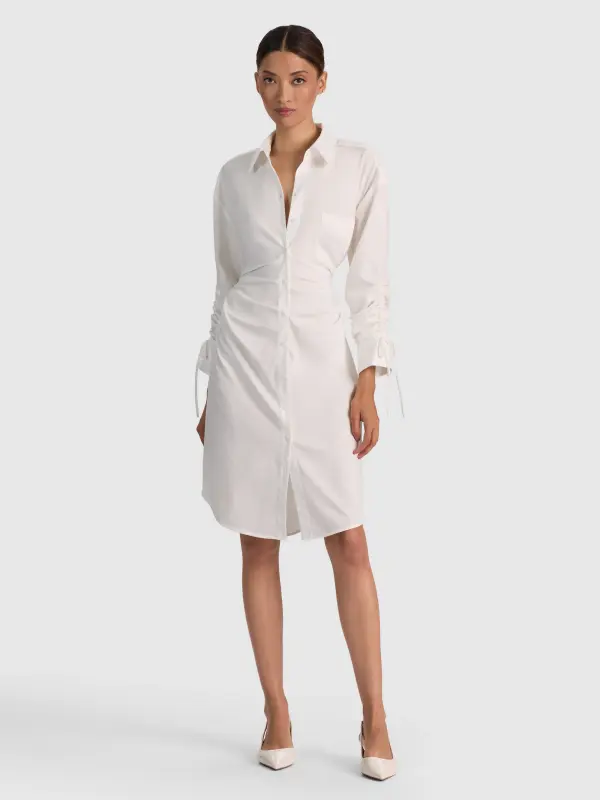
Classic Button-Front

Belted Midi
A belted midi adds another fit system around the waist. Waist position, belt width, belt length, belt-loop placement, pocket level, and skirt volume all influence how the silhouette reads on the body. A belt placed too high can shorten the upper body; too low can make the garment feel heavy. The front placket must remain straight after the waist is cinched, and the skirt needs enough movement to avoid pulling at the hip. Fabric drape is selected according to the intended result, from crisp city styling to softer contemporary or resort dressing.

Utility Shirt Dress
Utility shirt dresses rely on visible construction accuracy. Patch pockets, flap pockets, shoulder tabs, sleeve tabs, topstitching, metal or resin buttons, waist tabs, and belt details create multiple reference points exposing placement errors quickly. Twill, cotton canvas blends, lightweight denim, and compact cottons can support the utility look, but added thickness around plackets, cuffs, and pockets must remain manageable. Production files need clear placement measurements and stitch specifications before bulk cutting begins.

Relaxed Resort

Tailored City

Denim and Twill

Printed and Striped

Longline Maxi
A longline maxi shirt dress extends every small balance issue over a larger garment. Front placket straightness, side-seam hang, waist position, sleeve proportion, skirt sweep, slit height, and hem level become more visible with length. Lightweight woven fabric can create elegant movement, but excessive shrinkage or grain distortion may change the finished length and make the front opening pull off line. Development checks walking ease, sitting comfort, belt interaction, and lower-body volume. The objective is a long silhouette moving cleanly without turning the shirt structure into a rigid vertical column.
Woven Fabrics Selected Around Shirt Dress Structure
Fabric choice changes collar behavior, placket stability, waist shaping, pressing, shrinkage, opacity, and skirt movement. Duolan reviews fabric by garment result and production risk rather than selecting material from fiber name alone.

Cotton Poplin and Blends

Linen and Linen Blends

Lyocell and Tencel Direction

Viscose and Rayon

Chambray and Light Denim

Twill and Structured Woven
Collar, Placket, Button and Cuff Engineering

Collar and Collar Stand Built for Shape, Comfort, and Symmetry
A collar is one of the first areas people notice because it frames the face and sets the garment’s level of formality. Development starts with collar style, point length, stand height, neck circumference, roll, edge shape, seam allowance, and the relationship between collar and neckline. A pointed collar, band collar, camp collar, or oversized fashion collar cannot share one internal construction formula.
Interlining selection: Support is matched to fabric weight and desired handfeel. Crisp poplin may accept a firmer support than soft lyocell or linen blend. Excessive stiffness can create a board-like collar; insufficient support can cause collapse, bubbling, or curling. Fusing behavior is reviewed against surface sensitivity and pressing conditions.
Symmetry and edge control: Left and right collar points need matched length and angle. Seam bulk is reduced at corners so the points turn cleanly. Topstitch distance, if used, is fixed before bulk because small variation is easy to see on a structured neckline.
Neck comfort and balance: A visually sharp collar still needs a clean neckline curve. Stand height, closure position, back-neck shape, and shoulder balance affect whether the collar sits flat or pulls away from the body. Fit review checks the collar while standing and moving rather than judging it only on a hanger.
Bulk reference: Approved collar shape, interlining, stitch position, pressing result, and key measurements are recorded in the production file. The objective is a collar designed to look consistent across sizes and production lots without becoming harder, softer, wider, or more uneven than the approved sample.

Front Placket Engineered to Stay Straight on the Body
The front placket carries visual, structural, and fit pressure at the same time. A slight twist can make an otherwise clean shirt dress look poorly cut, while excessive tension around the bust or waist can create gaping even when the garment measures within specification. Development therefore treats the placket as part of the pattern and fabric system rather than a decorative strip.
Width and grain direction: Finished width, fold construction, seam allowance, grain alignment, and extension are set according to design. Grain distortion or unstable fabric can make the placket torque after sewing, pressing, or washing. Stripe and check programs need additional alignment rules along center front.
Interlining and support: Support is selected according to fabric. The goal is enough body for a clean button line without making the front edge noticeably stiffer than the dress body. Buttonhole zones and stress areas may need reinforcement, especially on soft cloth or heavier buttons.
Sewing tension and pressing: Stitch tension, feed balance, topstitching, folding, and pressing sequence influence whether the placket lies flat. A straight placket on the cutting table can still wave after sewing if the layers feed unevenly. Pressing must set the edge without glazing, scorching, or crushing textured fabric.
Fit relationship: Bust apex, waist shaping, and hip ease determine how much load reaches the front opening. If the body block is too tight, adding stronger buttons does not solve the root problem. Fit correction comes first; closure refinement follows.

Buttons and Buttonholes Designed Around Real Wearing Pressure
Buttons define the rhythm of a shirt dress and control how securely the front body closes. Button diameter, thickness, material, finish, spacing, shank, buttonhole size, and reinforcement all affect appearance and wear. A branded button is only valuable when the closure system works reliably.
Spacing by body zone: Uniform mathematical spacing can fail on women’s fit because the bust area often carries more opening pressure than the upper chest or lower skirt. Development checks whether the bust level needs a different spacing solution, an internal security snap, or pattern correction. Waist placement also matters when the style is belted or shaped.
Buttonhole engineering: Buttonhole length must suit button thickness and shape. Direction is selected according to garment construction and stress. Dense stitching on a light fabric can distort the placket, while weak stitching can fray or stretch during repeated wear. Stabilization around the buttonhole helps maintain shape.
Attachment strength: Buttons at bust, waist, cuff, and utility-pocket positions can experience different loads. Thread build, reinforcement, and back support are selected accordingly. Decorative buttons with excessive weight for the base cloth may require a different backing solution.
Bulk consistency: Button supplier, color, finish, diameter, hole or shank construction, spacing, and placement are locked in the BOM. Replacement decisions are reviewed before use because a small trim change can alter both appearance and function across a large production run.

Cuffs, Yokes and Pockets Controlled as Visible Reference Points
Cuffs, yokes, and pockets look secondary beside the collar and front opening, yet they create strong visual reference lines. Uneven pocket height, a twisted cuff, or a yoke pulling backward can make the entire garment feel unbalanced. Their construction also changes according to sleeve shape, fabric thickness, and styling direction.
Cuff proportion: Finished width, overlap, button position, pleat or gather amount, sleeve opening, and interlining are balanced together. A narrow tailored cuff needs a different support level from a soft resort roll-up sleeve. Sleeve tabs need enough strength to hold position without distorting the sleeve.
Yoke balance: Back and shoulder yokes influence shoulder structure, garment hang, and visual proportion. Stripes or checks may be turned on the bias or cross grain for design effect, but the cutting decision must be deliberate and recorded.
Pocket placement: Chest, patch, utility, and side-seam pockets are positioned against bust, waist, and hip lines. Placement is measured from defined reference points so every size follows a controlled rule. Heavy pockets on soft cloth may need reduced layers or reinforcement to prevent sagging.
Topstitch and pressing: Visible topstitching needs fixed distance, thread choice, and stitch density. Pressing shapes seams without flattening texture or creating shine. Approved close-up references help the production team judge visual finish rather than relying only on written notes.
Where Shirt Engineering Meets Women’s Dress Fit
Bust Balance and Front Opening Security
Bust fit is the most important difference between a women’s shirt dress and a conventional long shirt. The front opening passes directly over a three-dimensional body area, so button spacing, bust ease, dart or princess shaping, shoulder balance, and fabric stability all influence whether the placket remains closed and straight.
Bust apex and shaping: Pattern shaping must place volume where the body needs it. If bust volume sits too high, low, or too far toward the side seam, the front can pull diagonally even when the total chest measurement appears correct. Darts, side shaping, princess seams, or controlled ease are selected according to style.
Gaping diagnosis: Gaping is not treated as a button problem first. The team checks bust width, front length, button position, fabric give, armhole balance, waist suppression, and movement. A security snap can support a design, but it should not hide a fundamentally tight pattern.
Wear test: Fit is reviewed with normal movement such as reaching, sitting, and walking. A front opening looking smooth on a stationary mannequin may separate when the wearer moves. Relevant comments are converted into pattern and specification changes before approval.
Full-size logic: Bust pressure changes across a size range. Button placement and front balance are checked against grading rules so the design does not work only in the sample size. The result should protect both visual finish and wearing confidence across the intended market range.
Waist, Hip and Skirt Fall Controlled as One Silhouette
The lower body determines whether a shirt dress feels like a true dress or an oversized shirt. Waist location, hip ease, side-seam shape, skirt sweep, belt position, slit height, and hem line need to support the intended silhouette.
Waist position: A shaped waist, elastic waist, drawstring, or self belt changes how fabric is distributed around the body. Belt loops are placed after the intended waist level is confirmed, not added as a generic trim position. If the belt pulls the front body backward or makes the placket bow, pattern balance needs correction.
Hip movement: A straight shirt dress needs sufficient hip and stride room even when the visual direction is narrow. Side slits, back pleats, skirt sweep, or added ease can provide movement. Too much ease can weaken a tailored line; too little can force the front placket open below the waist.
Skirt fall: Grain, fabric drape, pocket weight, seam balance, and waist shaping affect how the skirt hangs. A soft viscose version behaves differently from a compact twill version. Fit comments therefore describe both measurements and visual behavior.
Hem balance: Mini, midi, and maxi proportions are checked front, side, and back. A level hem on a flat pattern does not always remain level on the body because bust projection, posture, and fabric behavior change vertical balance.
Shoulder, Sleeve and Armhole Movement Without Losing Shape
Shirt dresses often carry structured details through the shoulder and sleeve while the dress body still needs all-day movement. Shoulder width, shoulder slope, armhole shape, sleeve cap, bicep width, cuff opening, and back width work together. A sleeve problem is rarely solved by changing one measurement in isolation.
Shoulder balance: If the shoulder seam sits too far forward or backward, the collar and yoke can also shift. Shoulder slope must match the intended fit block and fabric structure. Oversized styles still need a deliberate dropped-shoulder position rather than uncontrolled extra width.
Armhole and sleeve: A high armhole can create a sharper look but may restrict movement if sleeve shape is not balanced. A low armhole adds ease but can make the body look bulky. Bicep width, sleeve-head ease, underarm seam, and cuff circumference are reviewed together.
Movement check: Reaching forward, lifting the arm, and bending the elbow reveal tension missed by a static fitting. Back yoke width and pleat design may add movement without enlarging the entire garment.
Size consistency: Sleeve length and cuff position are graded alongside shoulder and body length. The objective is stable proportion across the size range, not merely larger circumference values.

Pattern, Specification and Grading Built for Repeatability
Pattern Development Starts from Brand Fit Direction
Pattern work begins with the intended silhouette rather than a generic dress block. A tailored city shirt dress, relaxed resort maxi, belted midi, and utility mini need different relationships between shoulder, bust, waist, hip, sleeve, front length, and skirt volume. Reference garments and tech packs are useful, but the pattern still needs technical interpretation.
Base structure: Neckline, collar stand, shoulder, armhole, bust point, front opening, side seam, back yoke, sleeve, cuff, waist level, hip line, pocket position, hem, and slit are mapped as connected areas. Changing one zone can alter another. A deeper armhole can affect sleeve mobility; added waist suppression can increase front-opening tension.
Fabric adaptation: The same pattern cannot be transferred blindly from crisp poplin to fluid lyocell or thicker twill. Drape, thickness, shrinkage, stretch, and pressing behavior may require ease or seam adjustments. Interlining also changes the behavior of collar and placket pieces.
Fit comments into pattern: Comments such as “front pulls at bust,” “waist sits too high,” “sleeve twists,” or “skirt kicks forward” are translated into measurable corrections. The pattern file records the corrected route so the next sample does not rely on memory.
Approval discipline: Once fit direction is approved, pattern versions are controlled. Production should not begin from a visually similar but technically different pattern. Version discipline protects repeat orders and later color extensions.
Critical Measurements Turn Fit Comments into Production Standards
A size chart gives numbers, but a production-ready specification also defines where and how those numbers are measured. Shirt dresses need additional attention because shirt details and dress proportions share the same garment. Critical points should reflect both fit and visual alignment.
Upper-body points: Neck circumference, shoulder width, chest, bust position, front width, back width, armhole, bicep, sleeve length, cuff opening, and collar or stand dimensions are defined according to the style. A collar measurement needs a consistent measurement method, not only a target number.
Body and length points: Waist, hip, front body length, back body length, dress length, skirt sweep, slit height, belt position, pocket position, and hem opening are linked to fit and proportion. For belted styles, the actual waist position matters as much as waist circumference.
Construction points: Placket width, button spacing, button-to-edge distance, pocket dimensions, yoke depth, cuff width, and topstitch distance may also be recorded where visual consistency is important. A few millimeters of variation can be highly visible around a button line or collar edge even when body fit remains acceptable.
QC connection: The same measurement method used during approval should be used during inline and final inspection. Consistent measurement language prevents sample-room and production teams from interpreting the same specification differently.
Grading Preserves Proportion Across the Full Size Range
Grading is not simple enlargement. A shirt dress needs size growth preserving collar proportion, shoulder line, bust room, waist position, hip balance, button rhythm, sleeve length, pocket location, and garment length. A style looking controlled in the base size can lose its visual identity when vertical and horizontal growth are applied mechanically.
Bust-waist-hip relationship: Growth must reflect the brand’s fit model and target market. Fitted shirt dresses may need more carefully distributed growth than relaxed straight styles. The front opening must remain secure as bust and hip measurements increase.
Vertical balance: Collar depth, bust level, waist level, pocket position, belt loop position, skirt length, slit height, and button placement need coordinated vertical rules. Increasing body circumference without adjusting vertical landmarks can make larger sizes look visually compressed.
Button line: Button count and spacing may remain constant, change selectively, or require repositioning depending on total length and body growth. The bust closure area receives special attention because stress increases differently from the lower skirt opening.
Size review: A representative size range such as XS-XL is checked against the intended grading rule, with fit and measurement review focused on high-risk points rather than assuming every size will behave like the sample size.

Shrinkage, Pressing and Shape Stability Before Bulk
Woven shirt dresses can change after sewing, pressing, washing, or finishing. Dimensional control focuses on the areas most likely to alter appearance: front opening, collar, sleeve, waist position, and total dress length.

Shrinkage Control

Pressing Stability

Packing Recovery
A shirt dress can leave the finishing area in good condition and arrive looking distorted if folding and compression are not suited to the fabric and construction. Collar protection, placket alignment, belt placement, button closure, fold position, tissue or support where required, and carton pressure affect recovery. Fluid fabrics need different handling from compact poplin or twill. Packing review considers how quickly the garment returns to presentation condition after unpacking and whether collars, cuffs, pressed edges, and long hems retain the intended shape through shipment.
Shirt Dress Manufacturing Risk Control Matrix
A reliable production plan identifies visible and fit-sensitive risks before bulk. The matrix below links common shirt dress failures to their likely cause, the development action used to control them, and the production checkpoint used to prevent repeat defects.
| Risk | Likely Cause | Development Control | Bulk Check |
|---|---|---|---|
| Bust gaping | Insufficient bust room, poor button spacing, front-length imbalance | Fit correction, bust-level button review, movement check | First-piece fit and inline front-opening check |
| Twisted placket | Grain distortion, uneven feed, shrinkage, poor pressing | Grain review, placket construction trial, fabric conditioning | Cutting check, sewing check, pressing review |
| Collapsed collar | Weak or mismatched interlining | Support trial by fabric and collar shape | Interlining verification and collar symmetry check |
| Uneven button line | Placement drift or inaccurate marking | Approved spacing and center-front specification | Placement template and inline measurement |
| Pocket drift | Weak reference points or grading error | Pocket position measured from defined landmarks | Cutting mark and final placement check |
| Stripe/check mismatch | Marker and cutting alignment not defined | Matching points agreed before cutting | Marker review and cut-part inspection |
| Length change | Fabric shrinkage or finishing variation | Shrinkage review and measurement planning | Bulk fabric review and finished measurement |
| Uneven hem or skirt twist | Grain, pattern balance, seam feed, shrinkage | Fit and grain review on sample | First piece, inline hang check, final inspection |
Sampling Built Around Four Approval Gates
Feasibility Review Before the First Sample Starts
A useful first sample begins before fabric is cut. Duolan reviews the design file, reference garment or images, intended fabric, collar type, front-opening construction, buttons, cuffs, pockets, waist treatment, expected size range, and launch stage. The aim is to identify conflicting requirements before they become sample problems.
Fabric and structure: A fluid material paired with a sharp tailored collar may need a specific interlining route. Heavy utility buttons on a lightweight viscose body may need a different reinforcement or trim. Stripes and checks can add cutting and matching requirements affecting fabric consumption and development time.
Fit direction: The team clarifies whether the style is relaxed, straight, fitted, waisted, oversized, or belted. Bust security, shoulder line, sleeve movement, hip ease, and total length are flagged according to silhouette.
Information gaps: Missing details are listed rather than guessed. Button diameter, pocket height, collar stand, finish, wash, color reference, size spec, or packaging information may need confirmation. Development can still begin where appropriate, but assumptions are recorded so later comments are not confused with errors.
Calendar: Sample timing is reviewed against fabric availability, custom trims, print or wash requirements, and approval stages. A standard poplin shirt dress with available trims follows a different path from an engineered stripe, custom wash, or special-button program.
First Sample Establishes Construction and Proportion
The first sample is expected to become a decision-making garment, not a rough sewing demonstration. Pattern, fabric direction, collar shape, placket behavior, button rhythm, pocket position, sleeve shape, waist line, skirt fall, and overall proportion are assessed together.
Construction accuracy: The team checks whether collar and cuff support match the approved visual direction, whether the front placket lies flat, and whether visible topstitching is clean enough to judge. Temporary sample substitutions are recorded when final trims are not yet available.
Fit review: Bust, shoulder, waist, hip, sleeve movement, body length, and hem balance are reviewed. Problems are described by cause where possible. For example, a front gap at the bust may come from insufficient front length, wrong dart volume, button placement, or a combination of factors.
Visual review: Pocket scale, belt width, collar proportion, button size, stripe direction, and skirt volume are checked against brand intent. A technically wearable garment can still be visually wrong if those proportions drift.
Decision output: The first-sample review produces a clear revision list. Corrections are separated into pattern, measurement, material, construction, trim, and visual categories so the next sample progresses instead of restarting the discussion.
Fit and Revision Convert Comments into Controlled Changes
Revision quality depends on how comments are translated. Duolan does not treat comments as isolated instructions when one correction could affect several areas. A request to “take in the waist,” for example, can influence side-seam shape, front-placket tension, belt length, pocket position, and skirt fall.
Pattern corrections: Fit comments are returned to the pattern rather than fixed only through temporary sewing changes. Version control keeps the corrected pattern aligned with the latest sample.
Material changes: If fabric weight, shrinkage, drape, or support is causing the problem, the material route is reviewed. A pattern should not be repeatedly altered to compensate for an unsuitable cloth if the material itself is the real source of instability.
Closure and trim changes: Button spacing, button diameter, security snaps, cuff closure, belt hardware, or pocket reinforcement can be revised where function requires it. The specification and BOM are updated together.
Approval focus: Each revision round has a defined purpose. Fit, silhouette, construction, fabric, and detail comments are separated so decision-making remains clear. A second sample should resolve known issues rather than introduce undocumented substitutions.
PP Readiness Locks the Standard Used by Production
The PP stage is the bridge between development and manufacturing. A shirt dress should not move into bulk only because the silhouette “looks approved.” The production team needs a locked reference for material, measurements, collar construction, placket, buttons, workmanship, labels, and packing.
Fit and measurement: Approved measurements, grading basis, and critical tolerances are confirmed. High-risk points include bust, shoulder, sleeve, waist, hip, dress length, front opening, collar, cuff, pocket placement, and slit height where used.
Material and trim: Main fabric, interlining, buttons, thread, labels, packaging, and any wash or finish are identified by approved specification or supplier reference. Substitutions require review before use.
Workmanship: Stitch type, topstitch distance, seam finish, pocket construction, buttonhole appearance, collar edge, cuff shape, pressing standard, and hem finish are reflected in the approved reference.
Production release: Once the PP basis is ready, bulk planning can allocate lines, establish first-piece checks, and set inline inspection points. The approved sample becomes a manufacturing standard instead of a showroom sample disconnected from the production floor.
PP and Bulk Readiness Before Production Release
Material Lock
Fit and Construction Lock
Production File Lock
Production teams need more than photos. The file set can include approved sample reference, pattern version, measurement specification, BOM, workmanship notes, color standard, trim details, label and packing instructions, and QC checkpoints. A clean file set reduces verbal handover and protects the approved development logic. Reorder files can later reuse the same records, with material availability and shade reviewed again before a repeat run.
Production Engineering for Visible Shirt Dress Details

Cutting and Pattern Alignment

Collar Assembly

Placket Sewing

Button and Buttonhole Placement

Pocket, Cuff and Belt Details

Final Pressing and Presentation
Pressing brings several operations into one final visual standard. Collar roll, placket edge, cuff shape, pocket flap, sleeve seam, waist shaping, side seam, and hem are assessed together. Surface shine, over-pressing, creases, and seam impressions are controlled according to fabric. Belts and ties are prepared to the same presentation standard. Final appearance is reviewed in a natural hanging state so the garment reflects how it will be photographed, displayed, and unpacked rather than how it looks only on the pressing table.
Shirt Dress QC from Fabric to Packed Garment
Fabric Inspection
Cutting Check
First-Piece Check
Inline Inspection
Measurement Check
Final and Packing Check
Final inspection combines garment appearance, measurement, workmanship, labels, size ratio, packing, and shipment readiness. Collar and front presentation, loose threads, stains, button security, pressing, hem balance, labels, hangtags, barcode or packing instructions are checked against the approved requirement before goods leave the production system.
Manufacturing Capacity for Multi-Style Shirt Dress Programs
16 Owned Womenswear Factories
Sixteen owned womenswear production factories form the core manufacturing base. Core styles, development-sensitive programs, PP-to-bulk transitions, and projects requiring tighter control can be assigned within the owned system.
The value lies in control of standards, accountability, and continuity rather than factory count alone.
20+ Satellite Factories
300 Sewing Lines
50+ Flexible Lines
More than 50 quick-response and flexible production lines support launch planning, repeat-order response, and programs needing controlled flexibility alongside larger manufacturing volume.
The operating goal is not speed at any cost; material readiness, approved standards, and quality checkpoints remain part of production release.
6.5 Million Stable Monthly Capacity
15,000-35,000 Monthly Sample Developments
The broader development system handles approximately 15,000-35,000 sample styles or sample units per month across group operations. For shirt dress projects, scale is useful only when development records remain clear. First sample, revision, PP reference, material approval, and bulk handover are managed as separate technical stages to protect accuracy while several projects run in parallel.
Compliance and Testing Aligned with Brand Requirements
Compliance is handled as part of the manufacturing workflow. Requirements vary by market, material, product claim, inspection plan, and brand manual, so Duolan separates existing audit records from standards or tests coordinated for a specific program.

SMETA Audit Record

Product and Material Standards

Inspection and Shipment Documentation
Third-party inspection support, QC records, material specifications, care-label requirements, packing instructions, barcode details, shipment documents, and testing coordination can be incorporated according to the brand manual. Early alignment is preferable because labels, material documents, packing, and testing can affect development and production decisions long before final inspection.








Project Stage, MOQ and Production Lead Time Logic
Development and Launch Stage
MOQ is reviewed against fabric minimums, custom buttons or trims, color quantity, size breakdown, print or wash requirements, and the intended launch stage.
Duolan does not position shirt dress manufacturing around a universal low threshold. The objective is a workable production route for a real collection, with development and launch quantities structured so materials, quality, and later scaling remain commercially coherent.
Bulk Production Timing
Repeat and Scale-Up Programs
Repeat production starts from stored pattern, BOM, fit, color, workmanship, QC, and packing records rather than rebuilding the style from zero. Material availability and dye-lot color still need fresh review, especially for cotton, linen, viscose, lyocell, denim, and seasonal trims. Capacity is planned against the new quantity and delivery window so a successful shirt dress can move from launch order into replenishment or larger seasonal volume without losing the approved product standard.
Anonymous Shirt Dress Program from Development to Bulk
Project Brief and Development Architecture
The collection combined classic button-front, belted midi, relaxed resort, utility, and printed shirt dress directions. The challenge was not producing sixteen unrelated garments; the brand wanted a coherent family with consistent fit language while allowing different fabric behaviors and style details. Five woven material families were used across the program: cotton poplin or cotton-rich blend, linen blend, lyocell-type fabric, printed viscose, and lightweight twill.
Fit architecture: A shared fit direction was established for shoulder balance, bust ease, waist position, and grading language. Individual styles then adjusted silhouette: tailored bodies used more controlled waist shaping, resort styles carried softer volume, and utility designs allowed room for pocket and belt structure. Five sizes from XS through XL followed one approved grading framework with style-specific checks at bust closure, sleeve, waist, and total length.
Construction architecture: Collar and stand proportions were grouped into several approved directions rather than allowing every style to develop independently. Placket widths, button families, cuff treatments, and pocket reference rules were also organized so the range felt related. Printed and striped styles received added cutting instructions around center front and pocket placement.
Material architecture: Interlining was tested by fabric family because the support needed for poplin did not suit lyocell or soft viscose. Button weight and reinforcement were also reviewed against fabric. The program therefore used shared design language without forcing identical internal construction across all sixteen styles.
Sampling Corrections Focused on Fit and Front-Body Control
The first sample stage exposed several issues common to shirt dresses: front opening pressure near the bust on a fitted midi, collar collapse on a soft fabric, pocket position reading too low after grading, and placket waviness on one lightweight printed cloth. Each issue was separated by root cause before revision.
Bust opening: The fitted midi initially showed tension between two buttons during movement. Review found a combination of front-body balance and button position rather than weak closure strength. The pattern was corrected to improve bust distribution, and the button line was adjusted around the high-pressure zone. The next fitting was checked while standing, reaching, and sitting instead of relying only on static appearance.
Collar support: The lyocell direction looked too soft against the brand’s intended clean neckline. A lighter but more stable interlining route was tested rather than using the firmer support from the poplin styles. The goal was shape retention without making the collar noticeably rigid compared with the fluid body.
Pocket grading: One utility style showed a pocket appearing visually low in the larger sample. The placement rule was changed from a simple proportional shift to a reference tied more closely to bust and waist landmarks. The corrected rule was carried into the size specification.
Placket behavior: Printed viscose showed slight waviness after sewing and pressing. Construction sequence, support, handling, and pressing were adjusted before approval. A fabric-only explanation was rejected because the defect needed a controllable production response.
Bulk Release Used Shared Standards with Style-Specific Checkpoints
After the third sample stage, the program moved into bulk readiness with approved pattern versions, material references, trim specifications, workmanship notes, packing requirements, and style-specific QC points. The 38,400-piece order was not treated as one production block because fabric and construction risks differed across the sixteen styles.
Production grouping: Crisp cotton and cotton-blend styles were grouped around collar, placket, button, and pressing consistency. Fluid lyocell and viscose styles carried added checks for front-edge stability, seam handling, and hem balance. Utility twill styles included pocket placement, topstitching, belt-loop position, and thicker-layer handling. Printed programs included cutting direction and center-front visual control.
First-piece review: Key styles received first-piece comparison against the approved reference before full release. Checks covered collar shape, placket straightness, bust closure, pocket level, cuff symmetry, critical measurements, button line, and pressing result.
Inline control: Repeated defects were tracked by operation rather than left for final sorting. Measurement and visual checks were concentrated at high-risk zones defined during sampling. The same fit and construction language used in development therefore remained visible during production.
Range consistency: Although the sixteen styles used five fabric families and twenty-seven style-color combinations, the collection maintained one recognizable fit and finishing standard. The result was not achieved by making every garment identical; it came from separating shared brand standards from style-specific engineering requirements before bulk.

Evidence to Review Before Starting a Shirt Dress Program
Shirt Dress Samples
Construction Close-Ups
Fabric and Trim Boards
Pattern and Sample Records
Production and QC Records
Packing and Shipment Readiness
Shirt Dress Manufacturing Frequently Asked Questions
Cotton poplin, cotton blends, linen blends, lyocell-type fabrics, viscose, chambray, lightweight denim, and twill are common directions. Selection depends on silhouette, collar structure, drape, opacity, wrinkle behavior, shrinkage, pressing, season, and target price position. A crisp tailored style and a fluid resort style should not share the same fabric logic.
Bust gaping is reviewed through pattern balance, front length, bust volume, armhole and shoulder fit, fabric behavior, and button placement. Stronger buttons alone rarely solve the root cause. Fit testing includes normal movement, and the correction is returned to the pattern and specification before the style is approved for bulk.
Placket control begins with grain direction, pattern accuracy, construction method, support, stitch-feed balance, sewing tension, shrinkage, and pressing. Stripe or check styles add alignment rules. Production checks compare width, straightness, button line, and visual hang against the approved sample before defects spread across a full run.
Many structured shirt dress collars use interlining, but support level depends on fabric and design. Crisp poplin, soft lyocell, linen blend, and lightweight viscose need different solutions. The goal is enough structure to hold the collar and placket cleanly without making the supported areas feel disconnected from the dress body.
Yes. Development can follow an existing size specification, base size, fit block, grading rule, and fitting comments. The team still reviews measurement method, fabric behavior, critical points, and construction because identical numbers can fit differently when material weight, drape, stretch, or internal support changes.
Sampling is managed through separate approval gates rather than one generic sample event. A common route covers feasibility review, first sample, fit and revision, and PP readiness. Timing is confirmed after fabric availability, custom trims, print or wash requirements, construction complexity, and required approval stages are reviewed.
Reference manufacturing timing is approximately 15-20 days for simpler styles, 20-30 days for regular styles, and 30-45 days for complex styles after required approvals and material readiness. Final scheduling depends on quantity, fabric, trims, colorways, size split, wash or print, packing, and delivery window.
MOQ is evaluated from fabric minimums, colorways, size split, button or trim minimums, print or wash requirements, construction, and production stage. Duolan does not position manufacturing around one universal low threshold. The goal is a commercially workable launch, bulk, repeat, or scale-up route preserving material and production stability.
Yes, when the matching requirement is defined before cutting. Center-front, pocket, yoke, collar, cuff, belt, and side-seam areas can carry different alignment priorities. Required matching points affect marker planning, fabric yield, cutting control, cost, and production time, so expectations should be agreed during development.
Approved pattern version, PP reference, size specification, grading basis, main fabric, interlining, buttons, thread, color standard, workmanship details, labels, packing instructions, and QC checkpoints should be aligned. Any pending substitution or unresolved fit point should be identified before full production release.

Send Your Shirt Dress Project for Technical Review
Share the development file you already have, whether it is a tech pack, reference garment, marked-up images, fabric direction, or an approved sample requiring production review. Duolan will assess the shirt dress as a complete product: collar and placket construction, button system, women’s fit, pattern and grading, woven fabric behavior, sampling path, bulk readiness, QC requirements, and production planning. The first response should help clarify the next technical step rather than return a generic quotation before the product scope is understood.
Please include, where available:
- Shirt dress style or reference images
- Tech pack and current measurement specification
- Target fabric, composition, weight, print, stripe, check, wash, or finish direction
- Collar, placket, button, cuff, pocket, belt, and closure details
- Size range and grading rules
- Quantity by style, color, and size
- Target launch or delivery window
- Label, packing, testing, inspection, or compliance requirements