Skip to content

When fashion brands prepare a seasonal collection, the manufacturing partner becomes the single most influential factor determining whether the entire launch succeeds or collapses under timing and quality pressure. A dress is not just a garment in this context—it is a time-sensitive commercial product tied to marketing calendars, influencer campaigns, retail drops, and seasonal consumer demand curves. A delay of even two weeks can shift an entire collection from “high demand window” to “discount cycle,” directly impacting margins and brand positioning.
In practice, many brands underestimate how early manufacturing risks appear. The most damaging failures rarely happen during bulk production—they start much earlier, in sampling misalignment, unclear fabric logic, weak communication structures, and inconsistent interpretation of design intent. These issues silently accumulate until the first production batch exposes them at scale.
Red flags in dress manufacturer selection include unclear sampling systems, weak fabric and fit understanding, inconsistent production quality, poor communication structure, and inability to scale from sample to bulk. These issues directly impact seasonal collection success, causing delays, quality deviation, and commercial loss in fast-moving fashion cycles.
What makes this topic critical is that seasonal collections operate under compression: limited time, high SKU variety, and strict launch windows. One weak manufacturing decision can disrupt an entire seasonal strategy. Many brand founders only discover this after losing a launch opportunity or receiving inconsistent bulk production results.
There is a real-world pattern behind these failures. A London-based contemporary brand once shared that their Spring collection lost nearly 30% of projected revenue because sample approval took too long, forcing production into off-peak delivery. Another US-based label had to cancel three SKUs entirely due to fabric inconsistency between sample and bulk production. These are not isolated incidents—they reflect structural weaknesses in manufacturer selection.
Understanding red flags is therefore not just a procurement task. It is a strategic capability that protects brand identity, financial stability, and seasonal market relevance. Let’s break down what truly matters when evaluating dress manufacturers for seasonal collections.
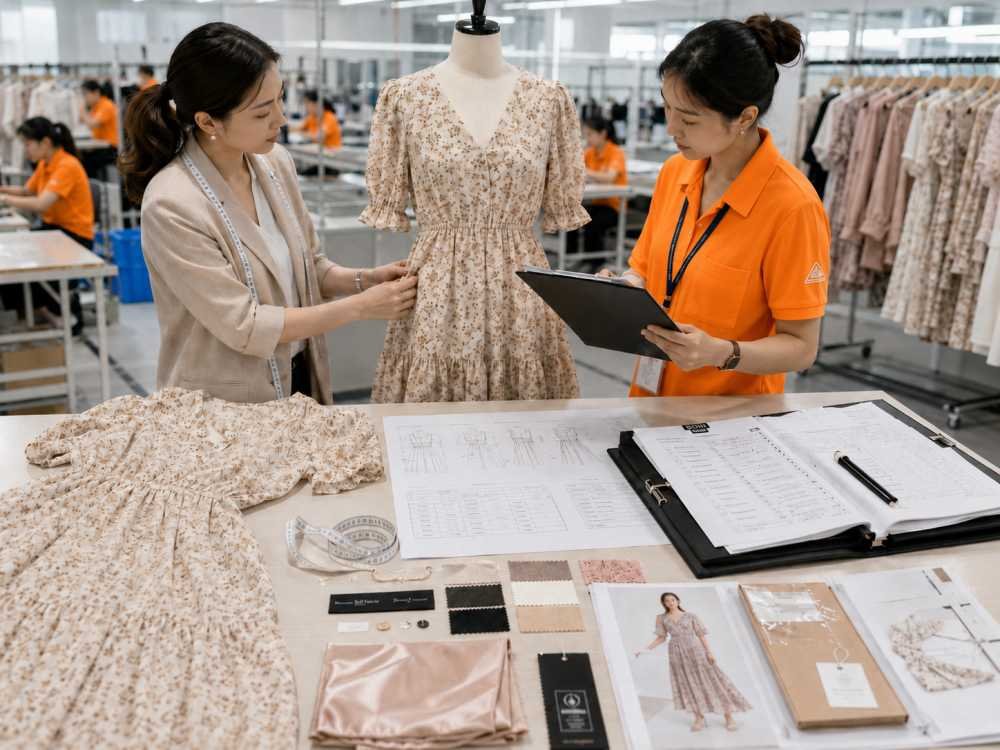
What Are the Real Risks When Choosing a Dress Manufacturer for Seasonal Collections?
Seasonal dress manufacturing risks include missed delivery windows, unstable sampling outcomes, fabric and fit inconsistency, weak production coordination, and lack of scalable capacity. These risks directly affect sell-through speed, collection coherence, and overall seasonal revenue performance in fashion brands.
Seasonal dress production is fundamentally different from standard apparel sourcing because it operates under a fixed commercial calendar. Spring, summer, autumn, and holiday collections are not flexible—they are tied to marketing campaigns, retail drops, influencer schedules, and consumer demand peaks. When manufacturing execution fails, the impact is immediate and measurable: lost launch windows, reduced visibility, and forced markdowns.
Below is a more practical breakdown of real production risks that appear in seasonal dress manufacturing, based on actual industry execution patterns rather than theoretical assumptions.
Why do delays and sampling errors directly impact seasonal revenue cycles?
In seasonal fashion, timing is not operational—it is commercial value.
A dress collection is usually planned 3–6 months ahead of launch, but market relevance is compressed into a very short selling window (often 4–10 weeks). If sampling or production is delayed by even 7–14 days, the collection may enter the market after peak demand has already passed.
Real industry scenarios show:
- A 10–15 day delay in sample approval can push production into peak factory congestion periods, increasing lead time by 20–30%
- A 2–3 week bulk delay can shift a full seasonal drop into discount cycles (often reducing gross margin by 15–40%)
- Late delivery often forces brands to reduce SKU exposure in marketing campaigns, lowering overall campaign ROI
Sampling errors amplify this problem further. When the first sample does not accurately reflect final design intent, brands often go through 2–4 revision cycles instead of 1–2. Each cycle adds 5–10 days depending on complexity. For fitted dresses, such as bodycon, corset, or structured occasionwear, revisions tend to increase due to fit sensitivity and fabric behavior mismatch.
The real risk is not just delay—it is misalignment between product readiness and market timing, which directly breaks seasonal profitability logic.
What are the most common hidden risks in dress manufacturing partnerships?
Most manufacturing failures do not appear at the quotation stage—they appear during execution. The following risks are the most common across seasonal dress production projects:
1. Fabric behavior mismatch (high-impact risk)
Many dresses rely on drape, stretch, and recovery behavior. A fabric that looks correct in swatch form may behave differently in structured garments.
Typical failure patterns:
- Satin losing structure in seam-heavy designs
- Mesh becoming too transparent under lighting
- Knit fabrics overstretching in fitted silhouettes
This leads to re-sampling or full redesign in 25–35% of early-stage projects when fabric validation is weak.
2. Weak silhouette translation from design to sample
A reference image or tech pack does not guarantee correct interpretation. Common gaps include:
- Incorrect waist placement in fitted dresses
- Misaligned bust shaping in corset styles
- Poor hem balance in asymmetric designs
These issues are especially frequent in occasion dresses and partywear, where visual proportion defines market acceptance.
3. Lack of structured sampling system
Many factories operate without a clear sampling framework:
- No separation between proto sample / fit sample / production sample
- No documented revision logic
- No controlled feedback loops
As a result, each revision becomes a “restart” rather than an iteration. This typically increases development time by 30–50%.
4. Production instability between sample and bulk
Even when samples are approved, bulk production may diverge due to:
- Different operators handling sample vs bulk
- Fabric batch variation
- Lack of standardized workmanship instructions
In dress manufacturing, this often leads to:
- Fit deviation (waist, hip, bust shift)
- Drape inconsistency across sizes
- Trim and embellishment variation
5. Communication fragmentation across teams
Seasonal collections require synchronized execution between design, sourcing, sampling, and production. Weak manufacturers often suffer from:
- Missing revision history
- Unclear responsibility ownership
- Delayed feedback loops between departments
This creates “information lag,” where decisions are made on outdated sample versions.
Risk Summary Table
| Risk Area | Typical Impact | Real Outcome in Production |
|---|---|---|
| Sampling delays | +7–21 days | Missed seasonal launch window |
| Fabric mismatch | 15–30% rework rate | Sample redo or redesign |
| Fit inconsistency | High return risk | Bulk rejection or alteration |
| Weak coordination | 20–40% timeline inefficiency | Delayed approvals |
| Production deviation | Batch inconsistency | Brand quality inconsistency |
Strategic View: Why These Risks Compound in Seasonal Collections
Seasonal dress production is not linear—it is cumulative.
A small sampling delay leads to rushed bulk decisions. Rushed decisions increase fabric risk. Fabric risk leads to production inconsistency. Production inconsistency leads to rework, which again compresses time.
This creates a risk cascade effect, where one weak stage amplifies all downstream stages.
Brands that rely heavily on fashion timing—especially in partywear, occasionwear, and resort collections—are most exposed to this cascade because their revenue depends on precise launch synchronization.
Practical Insight from Manufacturing Reality
In structured manufacturing systems like Duolan Apparel’s dress production framework, risk is typically reduced through:
- Pre-sample feasibility checks (before cutting first sample)
- Fabric behavior validation aligned with silhouette type
- Controlled revision tracking instead of open-ended sampling loops
- Sample-to-bulk continuity planning before production starts
This type of structured approach is designed specifically to prevent the “silent failure points” that often appear in seasonal collections.

What Red Flags Indicate a Weak Dress Manufacturer?
Weak dress manufacturers often reveal structural issues such as unclear specialization, inconsistent sampling results, limited fabric and fit understanding, vague production timelines, and lack of scalable systems. These red flags directly indicate higher risk of delays, quality instability, and poor seasonal collection execution, especially in fashion-sensitive categories like dresses.
In seasonal dress manufacturing, weak suppliers rarely fail in an obvious way at the beginning. Instead, risk signals appear gradually through communication patterns, sampling behavior, and production structure. These early indicators are often ignored because initial pricing or sample enthusiasm can mask deeper operational weaknesses.
A weak manufacturer is not defined only by lack of equipment or size. In many cases, the real issue is the absence of structured systems—no clear sampling logic, no consistent fabric control, no repeatable production standards, and no reliable communication flow between development and production teams.
When seasonal collections are involved, these weaknesses multiply. A small inconsistency in sampling can escalate into missed seasonal deadlines. A vague answer in production planning can lead to batch inconsistency. A lack of fabric understanding can completely distort a dress silhouette.
Below are the most critical red flags that appear repeatedly in real seasonal dress development projects.
Is the factory unable to clearly define its dress specialization?
One of the earliest warning signals appears when a manufacturer cannot clearly define its core strengths.
Weak manufacturers often describe themselves as:
- “We can do all types of garments”
- “We produce everything from T-shirts to dresses”
- “We are general clothing factory”
On the surface, this seems flexible. In reality, it indicates lack of specialization in dress engineering.
For seasonal dress collections, specialization matters because different dress categories require very different technical knowledge:
- Bodycon dresses require precise contour and stretch control
- Satin dresses require drape stability and seam balance
- Corset and structured dresses require internal support engineering
- Mesh and sheer dresses require opacity and layering control
When a factory cannot clearly explain which dress types it handles best, it usually means:
- No focused pattern development system exists
- No dedicated dress category team is in place
- No accumulated production learning curve for specific silhouettes
In real sourcing cases, brands often discover that such factories produce “acceptable samples” but fail when complexity increases. This becomes visible in the second or third revision cycle, when issues repeat instead of improving.
Do inconsistent samples indicate weak development capability?
Sampling inconsistency is one of the strongest red flags in dress manufacturing.
A structured manufacturer typically shows progressive improvement across samples:
- First sample: structural alignment
- Second sample: fit refinement
- Final sample: production readiness
Weak manufacturers show the opposite pattern:
- Each sample feels like a restart
- Previous corrections are lost or ignored
- Fit or silhouette changes unpredictably
Typical warning signs include:
- Waist position shifting between samples
- Uneven hem adjustments without logical pattern correction
- Fabric behavior changing without explanation
- Fit improvements in one area causing new distortions elsewhere
In seasonal dress production, this is particularly dangerous because:
- Each extra revision adds 5–10 days
- 2–3 unnecessary cycles can delay production by 2–4 weeks
- Missed timing often moves collection into discount season
A simple internal benchmark used by many brands:
- Reliable supplier → 1–2 revision cycles for standard dresses
- Weak supplier → 3–5+ cycles with unclear improvement logic
Consistency is not about perfection—it is about predictable improvement per revision cycle.
Why is lack of fabric and silhouette understanding a major warning sign?
Fabric is one of the most underestimated risk areas in dress manufacturing. Weak manufacturers often treat fabric as a sourcing item rather than a structural design element.
This creates serious production issues:
1. Drape mismatch
- Satin loses structure in fitted designs
- Chiffon fails to hold silhouette in layered styles
- Knit fabrics overstretch in bodycon dresses
2. Fit instability
- Stretch ratio not aligned with pattern design
- Recovery issues in waist and hip areas
- Distortion after sewing and washing processes
3. Visual inconsistency
- Same design looks different across samples
- Lighting changes reveal transparency issues
- Embellishment weight affects garment balance
In professional dress manufacturing, fabric selection directly determines:
- 30–50% of final silhouette performance
- 20–40% of production stability
- Return rate risk in retail environments
A weak manufacturer typically cannot clearly explain:
- Why a fabric works for a specific dress silhouette
- What alternatives can replace unstable materials
- How fabric behavior affects fit and structure
When fabric logic is missing, sampling becomes trial-and-error instead of engineering.
Are unclear lead times and vague production schedules a risk factor?
Yes, unclear timing is one of the most practical and costly red flags in seasonal dress production.
Weak manufacturers often respond with:
- “Depends on fabric”
- “We will check later”
- “Around 20–40 days”
These responses indicate lack of internal production planning system.
In structured seasonal production, lead times are broken into clear stages:
| Stage | Standard Timeline (Reference) | Purpose |
|---|---|---|
| Sampling (first round) | 5–10 days | Structure validation |
| Fit revision | 5–7 days | Adjustment phase |
| Final sample | 3–7 days | Production readiness |
| Bulk production | 15–45 days | Seasonal execution |
Weak manufacturers fail to separate these stages, which leads to:
- Uncontrolled revision cycles
- Production bottlenecks
- Missed seasonal deadlines
A key risk indicator is when a factory cannot explain:
- What affects lead time variability
- How complexity changes delivery time
- How multiple styles are scheduled in parallel
In seasonal collections, unclear timing is not just operational risk—it directly impacts sales execution windows.
Does the manufacturer avoid discussing production limitations or risks?
Another subtle but important red flag is when a manufacturer always responds with “yes” without explaining constraints.
Weak suppliers tend to avoid:
- Discussing production bottlenecks
- Explaining complexity limitations
- Highlighting risky design elements
Instead, they agree to everything in order to win the order.
This becomes problematic later when:
- Complex designs exceed production capability
- Hidden limitations appear during bulk production
- Delivery commitments cannot be maintained
In contrast, structured manufacturers proactively communicate:
- Which designs require additional validation
- Where production risks may occur
- How to adjust design for better manufacturability
A useful internal benchmark:
- Strong supplier → identifies risk before production
- Weak supplier → identifies risk only after failure occurs
In seasonal dress manufacturing, transparency is not a weakness—it is a reliability indicator.

How Does a Professional Dress Manufacturer Handle Seasonal Collection Development?
Professional dress manufacturers manage seasonal collection development through structured workflows that connect trend interpretation, fabric engineering, sampling control, fit validation, and scalable production planning. This ensures design intent is translated into production-ready garments with consistent quality, controlled timelines, and reduced revision cycles across the entire seasonal cycle.
Seasonal collection development is not a single production step—it is a controlled system that links design intention with commercial execution. In professional dress manufacturing environments, especially those handling occasionwear, partywear, and fashion-led collections, every stage is designed to reduce uncertainty and stabilize outcomes.
Unlike basic garment production, seasonal dress development requires synchronization between creative direction, technical execution, and production scalability. A professional manufacturer does not wait for complete instructions before acting. Instead, the system is designed to validate, refine, and structure the product before bulk production begins.
Below is how a structured manufacturer typically handles seasonal collection development in real operational terms.
How should trend-driven dress development be structured?
Seasonal dress collections begin with trend interpretation, but professional manufacturers do not treat trends as design inspiration alone. Trends are converted into structured product logic that can be manufactured reliably.
A structured approach usually includes:
- Identifying 3–5 dominant silhouette directions per season (e.g. bodycon, A-line, corset, slip dress, structured mini)
- Translating trend references into manufacturable construction logic
- Filtering design ideas based on fabric feasibility and production stability
- Mapping each style into commercial categories (party, occasion, resort, formal, daily going-out)
For example, a satin slip dress trend is not just a visual reference. It is analyzed in terms of:
- Fabric weight and drape stability
- Seam behavior under bias cut
- Lining requirements for opacity control
- Bust and strap reinforcement needs
In structured systems, approximately 30–40% of trend concepts are adjusted before sampling begins to reduce production risk later. This early filtering step is one of the biggest differences between professional and weak manufacturing systems.
What is the correct sample-to-bulk workflow for seasonal collections?
In professional dress manufacturing, sampling is not a trial-and-error stage. It follows a controlled pathway designed to reduce revision cycles and stabilize production readiness.
A typical structured workflow includes:
1. Pre-sampling validation
Before the first sample is cut:
- Fabric suitability check (drape, stretch, recovery)
- Silhouette feasibility review
- Risk identification for fit-sensitive areas (bust, waist, hip balance)
- Confirmation of construction complexity
This step alone can reduce sampling revisions by 20–35%.
2. Proto sample stage
Focus is not visual perfection but structure validation:
- Basic silhouette confirmation
- Initial fit balance
- Construction logic testing
3. Fit sample stage
This stage focuses on real body behavior:
- Waist positioning accuracy
- Bust support and contour shaping
- Skirt drape and movement behavior
- Adjustments for stretch or rigid fabrics
Typically, 70% of fit issues are resolved at this stage in a well-managed system.
4. Production sample (PP sample)
This is the final validation before bulk:
- Fabric final confirmation
- Trim and embellishment locking
- Stitching consistency check
- Measurement tolerance finalization
This structured sequence prevents the most common industry problem: treating all samples as identical iterations instead of stage-specific validations.
How do advanced manufacturers reduce sampling iterations?
Sampling inefficiency is one of the biggest hidden cost drivers in seasonal collections. Professional manufacturers reduce iterations not by speeding up production, but by improving decision accuracy at each stage.
Key methods include:
1. Early risk filtering
Instead of discovering problems during sampling, risks are identified before production starts:
- Fabric mismatch risk
- Structural instability in fitted dresses
- Complexity overload in embellishment-heavy designs
2. Clear revision categorization
Instead of open-ended comments, revisions are categorized into:
- Fit corrections
- Fabric adjustments
- Visual refinement
- Production feasibility adjustments
This reduces confusion and prevents repeated mistakes across cycles.
3. Controlled feedback loops
Each revision is tracked, documented, and compared with previous versions. This prevents regression errors where old issues reappear in later samples.
In structured environments, these methods typically reduce total sampling rounds from 3–5 cycles down to 1–2 cycles for standard dresses and 2–3 cycles for complex occasionwear.
What systems ensure consistency between sample and bulk production?
Consistency between sample and bulk is one of the most critical success factors in seasonal dress manufacturing. Without it, even a perfect sample loses commercial value.
Professional manufacturers rely on several control mechanisms:
1. Standardized pattern control system
- Single source of pattern authority
- Controlled grading rules across sizes
- Locked pattern versions before bulk approval
2. Fabric batch control
- Pre-approved fabric specifications
- Lab dip confirmation before production
- Batch consistency checks for dye and weight variation
3. Production instruction documentation
Every approved sample is translated into a production control document that includes:
- Stitching instructions
- Seam type definitions
- Tolerance ranges
- Construction sequence logic
4. Multi-stage QC checkpoints
Instead of final inspection only:
- Inline inspection during production
- Mid-line measurement checks
- Final garment verification
5. Sample-to-bulk alignment review
Before bulk starts, a structured review ensures:
- All materials match approved sample
- All measurements are locked
- All construction details are confirmed
This system reduces bulk deviation risks significantly. In structured environments, production inconsistency rates can be reduced by 30–60% compared to non-systemized factories.

How Do Sampling Errors Become Red Flags in Dress Manufacturing?
Sampling errors in dress manufacturing often signal deeper structural problems such as weak pattern control, poor fabric understanding, and lack of systematic revision processes. These issues do not stay at the sampling stage—they directly escalate into bulk production inconsistency, delayed seasonal launches, and increased commercial risk for fashion dress collections.
In seasonal dress manufacturing, sampling is not a “trial stage”—it is the foundation of production accuracy. When sampling errors appear repeatedly, they are rarely isolated mistakes. Instead, they indicate structural weaknesses in how a manufacturer interprets design intent, handles fabric behavior, and manages revision logic.
For fashion dresses—especially bodycon, corset, satin, mesh, and occasionwear styles—sampling precision determines whether the product can even enter production safely. A small deviation in waist positioning or fabric tension at the sampling stage can multiply into large-scale inconsistency during bulk manufacturing.
Below is a breakdown of how sampling errors evolve into serious red flags in real production environments.
Why do first samples often fail in fit or silhouette accuracy?
The first sample is expected to validate structure, not perfection. However, weak manufacturers often treat it as a final product attempt rather than a controlled prototype.
Common failure patterns include:
- Waistline shifting by 1–3 cm from intended position
- Bust shaping not aligned with design proportion
- Hip balance misaligned in fitted dresses
- Hemline falling incorrectly due to fabric miscalculation
In structured development systems, the first sample should achieve 70–80% structural accuracy. When accuracy drops below this threshold, it usually indicates:
- Weak pattern foundation
- Lack of silhouette engineering understanding
- Poor translation from tech pack or reference image
In seasonal collections, this creates a cascading effect. A weak first sample often leads to:
- 2–3 additional revision rounds
- 10–20 extra days in development cycle
- Delayed confirmation for bulk production scheduling
Over time, this directly compresses the selling window of the collection.
What causes repeated revision cycles in dress development?
Repeated revisions are one of the clearest red flags in sampling systems.
In professional manufacturing environments, revisions should show directional improvement. However, weak systems often produce circular revision patterns where issues repeat or shift unpredictably.
Typical causes include:
1. Lack of structured feedback interpretation
Comments from brands are not categorized properly:
- Fit corrections mixed with design preferences
- Fabric issues not separated from construction issues
- Visual adjustments treated as structural changes
This leads to confusion in execution.
2. Absence of version control logic
Without structured tracking:
- Previous corrections are not preserved
- Old mistakes reappear in new samples
- Each revision becomes independent rather than progressive
3. Weak technical alignment between teams
When pattern makers, sample makers, and merchandisers are not aligned:
- Instructions are interpreted differently
- Adjustments are partially applied
- Final sample deviates from intended direction
In real production data patterns, weak manufacturers often show:
- 3–5 revision cycles for standard dresses
- 5–8 cycles for complex silhouettes
- No clear convergence point in sampling progression
A stable system should typically resolve most dress styles within 1–3 controlled cycles depending on complexity.
How does fabric mismatch impact final garment performance?
Fabric mismatch is one of the most underestimated causes of sampling failure in dress manufacturing.
A design may appear correct on paper, but fabric behavior determines whether it can actually exist in physical form. When fabric selection is incorrect or poorly matched, multiple performance issues appear:
1. Structural collapse or distortion
- Satin losing shape in structured bodice designs
- Knit fabrics overstretching in fitted silhouettes
- Mesh collapsing under layered construction
2. Drape inconsistency
- Skirt not falling evenly
- Uneven weight distribution in asymmetrical dresses
- Movement behavior not matching design intent
3. Transparency and layering issues
- Lining not sufficient for light fabrics
- Sheer areas becoming too exposed under lighting conditions
4. Fit instability after sewing
- Waist compression changes after stitching
- Seam tension affecting garment balance
- Fabric recovery failing after wear simulation
In structured manufacturing environments, fabric selection is treated as a technical decision, not a sourcing step. Poor fabric matching at sampling stage often leads to:
- Full sample redo
- Delayed production approval
- Increased material waste (10–25% in failed iterations)
Why is weak pattern control a major production risk?
Pattern control is the technical backbone of dress manufacturing. When it is weak, every stage after sampling becomes unstable.
Weak pattern control typically appears as:
- Inconsistent grading between sizes
- Unstable waist-to-hip ratio across revisions
- Lack of symmetry in structured dresses
- Poor alignment between bodice and skirt segments
In fitted and occasion dresses, pattern accuracy directly affects:
- Body contour balance
- Visual proportion
- Movement behavior
A key issue is that weak manufacturers often rely on manual adjustment without systematic pattern logic. This results in:
- “Fixing one issue creates another issue” cycles
- No stable baseline for bulk production
- Frequent mismatch between sample and production units
In contrast, structured systems maintain:
- Locked pattern versions after each stage
- Controlled grading rules
- Documented adjustment history
Without this, sampling errors almost always reappear in bulk production.
Can sampling errors predict bulk production failure?
Yes, sampling errors are one of the most reliable early indicators of bulk production risk.
In real production environments, the following correlation is commonly observed:
| Sampling Issue | Bulk Production Outcome Risk |
|---|---|
| Inconsistent fit across samples | High size deviation in bulk |
| Fabric mismatch | Visual inconsistency across batches |
| Repeated revision cycles | Delayed production + unstable output |
| Unclear pattern control | Size grading errors in bulk |
When sampling lacks structure, bulk production typically inherits the same instability but at scale. This is especially critical in seasonal dress collections where:
- Production windows are fixed
- Retail launch dates cannot shift
- Inventory timing directly impacts revenue
A weak sampling system does not stay small—it amplifies into full-scale production risk.
How do structured systems prevent sampling errors from scaling into production issues?
Professional dress manufacturers use controlled systems to prevent sampling errors from propagating into bulk production.
Key control mechanisms include:
1. Stage-based sampling validation
- Proto sample → structure check
- Fit sample → body performance check
- PP sample → production readiness lock
2. Fabric behavior testing before final approval
- Stretch and recovery check
- Drape simulation on body form
- Transparency assessment under lighting
3. Controlled revision documentation
Each change is:
- Recorded
- Categorized
- Compared against previous version
- Verified before next stage
4. Sample-to-bulk locking process
Before production starts:
- Final pattern version is locked
- Fabric batch is confirmed
- Construction details are fixed
- Tolerance ranges are defined
This prevents sampling errors from silently entering bulk production and ensures that approved samples remain consistent throughout the entire manufacturing cycle.
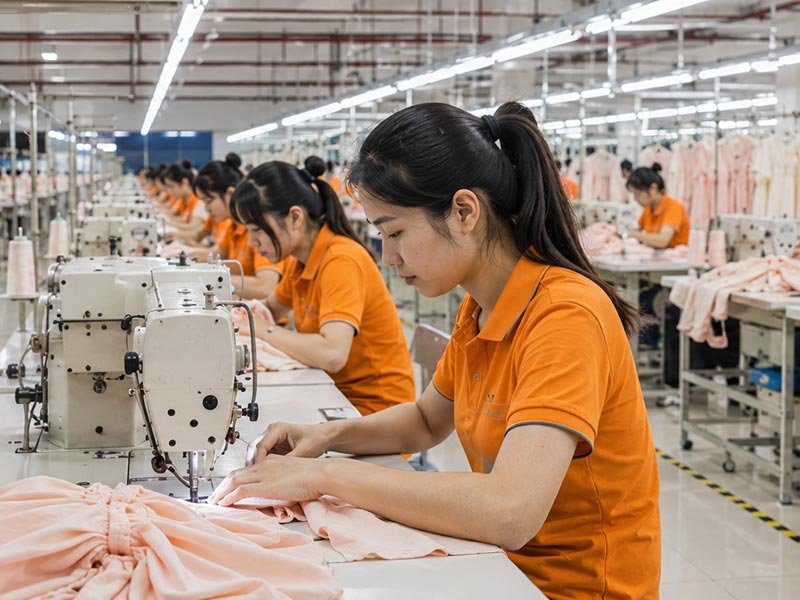
What Makes a Manufacturer Reliable for Seasonal Dress Collections?
A reliable dress manufacturer for seasonal collections is defined by consistent sample-to-bulk accuracy, structured production systems, scalable capacity, stable quality control, and predictable delivery timelines. Reliability is not based on size alone, but on the ability to maintain fabric consistency, fit accuracy, and production discipline across multiple styles within strict seasonal deadlines.
Reliability in seasonal dress manufacturing is not about isolated strengths such as fast sampling or large factory size. It is about system stability under pressure. Seasonal collections operate within strict timelines, multiple style variations, and high sensitivity to design accuracy. A reliable manufacturer must perform consistently across all these variables, not just in controlled sample conditions.
In real production environments, reliability becomes visible only when pressure increases: multiple styles running in parallel, fabric variations across batches, tight shipping deadlines, and repeated revision cycles. Many manufacturers perform well in low-pressure sampling stages but fail during scaled production. This gap is where reliability is truly tested.
A strong manufacturing system behaves predictably. A weak system behaves reactively. The difference between the two directly determines whether a seasonal collection arrives on time, maintains visual consistency, and meets commercial expectations.
Below are the key structural elements that define reliability in seasonal dress manufacturing.
How does production consistency define reliability?
Production consistency is the most visible indicator of manufacturing reliability. In seasonal dress collections, consistency means that every unit produced matches the approved sample in fit, silhouette, and fabric behavior.
Reliable manufacturers maintain:
- Stable pattern control across all sizes
- Repeatable stitching standards across production lines
- Controlled fabric handling across different batches
- Uniform finishing and ironing standards
In practical production environments, reliable factories typically maintain:
- Less than 3–5% deviation rate between sample and bulk measurements
- Fabric consistency variation within tightly controlled tolerance ranges
- Repeat order accuracy above 90% similarity to original sample
Weak systems often show the opposite:
- Batch-to-batch variation in waist and hip measurements
- Inconsistent drape in dresses using the same fabric
- Visible differences in finishing quality across production runs
For seasonal collections, even small inconsistencies multiply across hundreds or thousands of units, leading to customer returns, brand inconsistency, and reduced retail performance.
Why is scalable capacity critical for seasonal collections?
Seasonal collections are not linear production tasks. They require flexible scaling depending on market response. A reliable manufacturer must be able to handle three stages of volume change:
- Sample stage – small, controlled production
- Test order stage – limited commercial validation
- Bulk and repeat stage – full-scale production expansion
A key requirement is the ability to move smoothly between these stages without structural breakdown.
Reliable manufacturers typically maintain:
- Multi-line production systems (not single-line dependency)
- Dedicated sample and bulk separation
- Flexible scheduling for multiple styles simultaneously
- Backup capacity for peak seasonal demand
In real operational terms:
- A stable factory can increase production volume by 30–60% during peak season without quality degradation
- Multi-style handling capability often ranges from 20–100+ styles in parallel depending on system maturity
Weak manufacturers often fail when volume increases:
- Lead times extend unpredictably
- Quality becomes inconsistent under pressure
- Priority conflicts between different styles cause delays
Scalability is not about size—it is about controlled expansion under seasonal pressure.
How do structured QC systems ensure reliability?
Quality control in dress manufacturing is not a final step—it is a continuous system. Reliable manufacturers integrate QC checkpoints at multiple stages of production.
A structured QC system typically includes:
1. Pre-production checks
- Fabric inspection before cutting
- Color and texture confirmation against approved sample
- Measurement tolerance locking
2. Inline production checks
- Stitching accuracy monitoring during assembly
- Real-time correction of fit deviations
- Early detection of structural issues
3. Mid-line inspection
- Verification of partially completed garments
- Random sampling for measurement accuracy
- Early identification of batch inconsistencies
4. Final inspection
- Full garment review for finishing quality
- Trim, lining, and accessory validation
- Packaging verification
In structured systems, QC coverage typically reaches:
- 100% inspection for critical dress styles (bodycon, corset, fitted dresses)
- Random sampling rates of 10–30% for standard styles
- Zero-tolerance control for key measurement points (waist, bust, hip)
Weak manufacturers often rely only on final inspection, which allows defects to accumulate during production rather than being corrected early.
Why does sample-to-bulk continuity determine reliability?
One of the most important indicators of reliability is whether the approved sample can be reproduced at scale without deviation.
Reliable manufacturers ensure continuity through:
- Locked pattern versions after sample approval
- Fixed fabric specifications and approved suppliers
- Documented construction processes for each style
- Standardized workmanship instructions for production lines
Without these controls, production becomes interpretative rather than systematic.
Common failure patterns in weak systems include:
- Sample made in controlled conditions, bulk produced under different execution standards
- Fabric substitution without proper validation
- Loss of fit precision when scaling sizes
- Variation in stitching quality between lines
In seasonal dress collections, this disconnect leads to:
- Visual inconsistency across retail inventory
- Brand quality perception issues
- Increased return rates in e-commerce channels
Reliable systems treat sample approval as a locked reference point, not a flexible guideline.
How does communication structure impact reliability?
Reliability is not only technical—it is operational. Communication structure plays a critical role in maintaining consistency across seasonal projects.
Reliable manufacturers implement:
- Structured sample feedback documentation
- Clear revision tracking systems
- Defined responsibility for each stage (sampling, production, QC, logistics)
- Regular progress updates tied to production milestones
In practice, this means:
- Clients do not need to repeatedly request updates
- Revision history is transparent and traceable
- Production decisions are based on documented confirmation rather than informal messages
Weak systems often show:
- Fragmented communication across departments
- Lost or misunderstood revision instructions
- Lack of clear ownership for project issues
- Delayed responses during critical production stages
In seasonal collections, communication delays of even 48–72 hours can disrupt entire production schedules due to tight launch timelines.
What role does operational predictability play in reliability?
Operational predictability is the final layer of manufacturing reliability. It refers to the ability to forecast outcomes accurately across sampling, production, and delivery.
Reliable manufacturers typically demonstrate:
- Stable lead times across seasons
- Predictable revision cycles (1–3 rounds for most styles)
- Consistent output quality regardless of order volume
- Clear escalation handling for production risks
Predictability allows brands to:
- Plan seasonal launches with confidence
- Align marketing campaigns with production timelines
- Reduce buffer inventory requirements
- Improve sell-through planning accuracy
Weak manufacturers often operate reactively:
- Timelines change during production
- Quality varies depending on workload
- Delivery estimates shift frequently
In seasonal fashion, unpredictability is more damaging than minor inefficiencies, because it directly affects market timing.

Ready to Start Your Seasonal Dress Collection with Duolan Apparel?
If you are planning a seasonal dress collection and need a manufacturing partner capable of handling sampling precision, fabric development, and scalable production, Duolan Apparel supports end-to-end custom dress manufacturing for global fashion brands.
From initial concept interpretation to final bulk production, the focus is on reducing sampling risk, improving consistency, and ensuring seasonal delivery alignment with your brand calendar.
Whether you are developing party dresses, occasionwear, resort collections, or multi-style seasonal drops, Duolan Apparel provides structured development systems designed to support both creative direction and commercial execution.
Start your next collection with a manufacturing partner that understands both design intent and production reality.