Skip to content
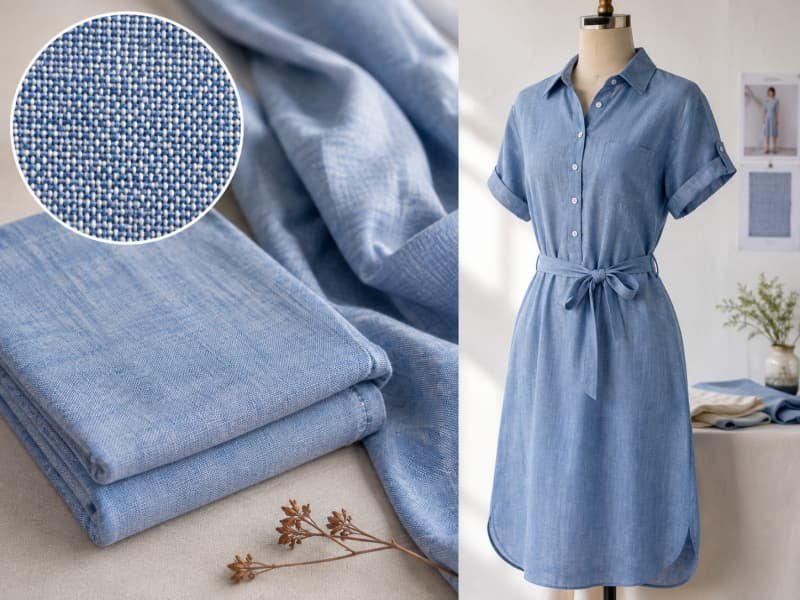
Chambray is one of those fabrics that many people recognize before they know its name. It often appears in pale-blue shirts, easy summer dresses, lightweight jumpsuits, and casual skirts that carry the visual character of denim without the same weight or stiffness. That resemblance is useful, but it also creates confusion. A garment may look denim-inspired in a product image while behaving very differently once it is cut, sewn, washed, packed, and worn. For shoppers, the difference affects comfort and care. For designers and product teams, it affects fit, construction, quality control, and whether a style can be reproduced consistently in bulk production.
Chambray is a lightweight to medium-weight woven fabric, usually made from cotton and built with a plain weave. Traditional blue chambray combines colored warp yarns with white or pale weft yarns, creating a softly blended surface. Unlike denim, it normally has no diagonal twill rib, so it tends to feel smoother, lighter, more breathable, and easier to use in warm-weather garments.
The useful question is not simply whether chambray is good or bad. It is whether a specific chambray has the right weight, density, drape, opacity, shrinkage, and surface finish for the intended garment. Imagine two nearly identical blue dresses hanging on the same rail: one feels cool, soft, and easy, while the other feels rigid, bulky, or unexpectedly transparent. From several feet away they may look alike. The real difference begins inside the yarns, the weave, and the decisions made before the first pattern piece is cut.
What Is Chambray Fabric?
Chambray is a lightweight to medium-weight plain-weave fabric, most often made from cotton. Traditional versions use colored warp yarns and white or pale weft yarns, producing a softly mottled, two-tone appearance. Its balanced weave gives it a smoother face and lighter hand than denim, making it especially useful for shirts, dresses, skirts, jumpsuits, and warm-weather separates.
Fiber and Yarn Structure
Most commercial chambray is made from 100% cotton because cotton provides the familiar dry hand, breathability, moisture absorption, dye acceptance, and washability associated with the fabric. The term chambray, however, describes the fabric construction and visual effect more than one mandatory fiber composition. Cotton-polyester, cotton-lyocell, cotton-linen, and cotton-elastane blends are also available, each changing the way the material drapes, wrinkles, stretches, dries, and recovers after wear.
A cotton-rich quality usually feels natural and becomes softer through washing, but it may also crease and shrink more than a stable synthetic blend. Polyester can improve dimensional stability and crease recovery, while lyocell can add fluidity and a smoother surface. Linen creates a drier, more textured character. A small elastane percentage can support fitted styles, but stretch chambray must be evaluated for recovery, seam movement, and growth because a fabric that stretches easily but does not return to shape can develop bagging at elbows, knees, hips, or seat areas.
Yarn quality is just as important as fiber content. Combed cotton normally produces a cleaner, smoother surface with fewer projecting fibers, while carded yarn can feel more rustic and may fuzz more quickly. Slub yarn creates deliberate thick-and-thin variation, giving the cloth a casual, handcrafted appearance, but the effect should be controlled across bulk rolls. For product development, composition, yarn count, yarn twist, fabric density, finishing, and intended care must be reviewed together. A label that simply says ‘100% cotton chambray’ does not tell the full performance story.
Plain-Weave Construction
Chambray is normally woven in a simple one-over, one-under structure. Each weft yarn alternates over and under the warp yarns, producing an even surface with many regular intersections. This is the main technical reason chambray looks flatter than denim. Denim is usually woven in a twill pattern that creates visible diagonal ribs, while chambray distributes the colored and pale yarns more evenly across the face and reverse of the cloth.
Plain weave is simple in theory, but a lightweight plain-weave fabric can still be demanding in production. Fine chambray may fray along cut edges, develop seam puckering when thread tension is too high, or show needle holes if the needle size is unsuitable. Looser qualities may suffer seam slippage around armholes, hips, zippers, and pocket openings. Dense qualities may sew cleanly but feel too crisp for gathered silhouettes. Trial sewing should therefore cover stitch density, needle point, thread size, pressing temperature, fusible compatibility, and the way seams look after washing.
Grain stability also deserves attention. Bowing or skew in the fabric can create twisted side seams, uneven hems, or sleeves that rotate after laundering. These problems are not always obvious in a small swatch. A full-width cutting or development length allows the team to inspect the straight grain, selvage behavior, shade across the width, and natural hang of the cloth. Plain weave gives chambray its recognizable smoothness, but consistent results still depend on disciplined inspection and garment-specific engineering.
Color and Surface
Classic blue chambray is usually yarn-dyed, with blue warp yarns crossing white or pale weft yarns. The eye blends the two systems into a soft blue field with subtle white variation. This gives the fabric more visual depth than a uniformly piece-dyed cloth. The final shade is influenced not only by the blue yarn itself but also by the proportion, thickness, and visibility of the lighter yarn, so color should be approved in the woven construction rather than from an isolated thread or digital screen reference.
Chambray is not limited to traditional blue. Mills can produce black, grey, green, pink, red, beige, brown, striped, checked, melange, and slubbed versions. A brand can also specify washed, enzyme-finished, brushed, peach-finished, or softened surfaces. Each treatment changes more than appearance. Heavy softening can improve comfort but reduce body, make collars collapse, or increase seam distortion. Enzyme washing can clean the surface and create a more relaxed hand, while garment washing can introduce controlled fading and a lived-in character.
The reverse side of chambray is often relatively similar to the face because plain weave exposes both yarn systems evenly, although darker or heavier warp yarns can still create a visible difference. Surface quality should be reviewed before and after care testing. A cloth that looks refined when freshly finished may fuzz, lose body, or change shade after several wash cycles. For commercial garments, the preferred surface is the one that remains attractive through normal use, not merely the one that feels impressive on the first swatch presentation.
Typical Specifications
There is no universal chambray weight because the fabric is made for many different products, from fine blouses to firm overshirts. Finished GSM is a useful starting point, but it does not predict drape or stiffness by itself. A compact 140 GSM quality may feel firmer than a softly washed 170 GSM cloth, and a fabric with lyocell may hang more fluidly than a cotton quality of similar weight. Density, yarn size, finish, and composition must be considered alongside the number on the specification sheet.
The practical approach is to identify a likely weight range, request enough fabric for a full sample, and then evaluate the garment after sewing, pressing, washing, and wearing. The team should observe opacity, seam behavior, collar and placket support, gathering bulk, hem balance, and whether the fabric returns to shape after movement. These checks reveal whether the material supports the intended silhouette far more accurately than a small hand swatch.
| Chambray Type | Typical Weight | Common Uses | Main Development Risk |
| Very light | 80-110 GSM | Blouses, loose summer tops, lightweight overlays | Transparency and seam slippage |
| Lightweight | 110-140 GSM | Shirts, sundresses, tiered dresses | Wrinkling and weak placket support |
| Midweight | 140-180 GSM | Shirt dresses, skirts, jumpsuits | Gather bulk and slower drying |
| Firm midweight | 180-220 GSM | Utility dresses and structured skirts | Stiff hand and reduced airflow |
| Heavy chambray | 220 GSM and above | Overshirts, light jackets, workwear | May behave closer to lightweight denim |
Is Chambray the Same as Denim?
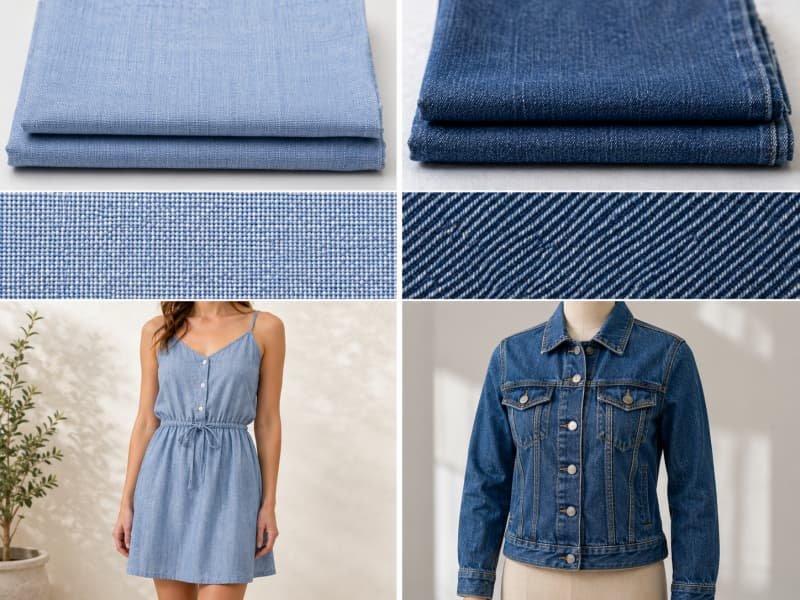
Chambray and denim are not the same fabric. Both may combine colored warp yarns with white weft yarns, which explains their similar blue appearance, but chambray normally uses a plain weave while denim uses a twill weave. Chambray is generally smoother, lighter, and more breathable; denim is usually denser, more abrasion-resistant, and better suited to structured garments.
Weave Difference
The clearest distinction is visible under close inspection. Chambray follows a balanced one-over, one-under pattern, so its surface appears flat and evenly mixed. Denim normally uses a twill arrangement, often with several warp yarns passing over one weft yarn before the pattern shifts. This produces the diagonal lines that people associate with jeans. The structure changes how the fabric reflects light, wears at stress points, and distributes colored and white yarns across the face.
Denim often has a stronger contrast between front and back. Colored warp yarns dominate the face, while pale weft yarns appear more clearly on the reverse. Chambray generally looks more balanced on both sides, although the exact effect depends on yarn size and density. This is more than a visual detail. The face and reverse influence seam finishes, rolled sleeves, turned cuffs, pocket flaps, and any design where the inside may be visible.
The difference should be stated accurately in product descriptions because online shoppers often use the word denim for any blue woven garment. A customer expecting jeans-like body and durability may be surprised by a soft, shirt-like chambray, while someone seeking a light summer dress may avoid a product wrongly described as denim. Clear naming, close-up photography, weight information, and care guidance help set the right expectation and reduce avoidable returns.
Weight and Comfort
Chambray is usually lighter than conventional denim, but the categories overlap. Fine chambray may begin near shirting weights, while firm chambray can approach lightweight denim. Traditional jeans denim is often much heavier, although modern mills also produce soft, low-weight denim for shirts and dresses. The fabric name should therefore be supported by finished GSM, hand-feel references, and a physical sample rather than treated as a guarantee of thickness.
Lower weight normally improves warm-weather comfort because the garment carries less bulk and allows more movement of air, yet comfort also depends on weave density, fiber content, finishing, fit, and lining. A relaxed, unlined chambray shirt dress can feel cool in summer, while a fitted chambray dress with a full polyester lining, heavy fusible, and several internal layers may feel unexpectedly warm. The product should be judged as a complete system rather than by shell fabric alone.
The same principle applies to mobility. Chambray often bends and folds more easily than rigid denim, which makes it comfortable for sleeves, gathered skirts, and loose jumpsuits. Non-stretch chambray still has limited give, however. Close-fitting garments need enough pattern ease, suitable seam placement, or a controlled stretch component. Assuming that a lightweight fabric will automatically feel comfortable can lead to pulling at the bust, back, seat, or armhole even when the cloth itself feels soft.
Strength and Wear
Denim is generally more abrasion-resistant because twill construction can pack yarns densely and spreads wear along diagonal ribs. This is one reason denim remains the standard for jeans, work jackets, and garments exposed to repeated friction. Chambray can still be durable enough for daily shirts, dresses, skirts, uniforms, and light trousers when its yarn quality, density, weight, and construction are appropriate for the product.
The risk appears when a light shirt quality is used in a high-stress silhouette. A close-fitting mini dress places load around side seams, hips, zipper ends, and seat areas. A jumpsuit adds stress at the crotch, back rise, knees, and pockets. A fabric that performs well in a loose blouse may open at the seams or distort in these garments. Seam slippage, tensile strength, tearing strength, and wash performance should be considered in relation to the actual fit and use.
Garment engineering can improve performance but cannot completely rescue an unsuitable cloth. Reinforcement at pocket corners, zipper bases, buttonholes, and vents can reduce local stress. Correct seam allowance, stitch density, and thread selection also matter. The most reliable approach is to test the fabric and construction together, then assess the sample during movement and after laundering. Durability is the result of material, pattern, sewing, and care working as one system.
When to Substitute
Chambray can replace denim when a design needs a lighter, softer interpretation of the denim look. It works particularly well for summer dresses, shirts, loose jumpsuits, casual skirts, and coordinated sets. The substitution is less successful when the style depends on rigid shape, heavy abrasion resistance, pronounced fading, thick topstitching, or traditional five-pocket jeans construction. In those cases, lightweight denim may deliver the expected character more accurately.
Changing from denim to chambray often requires pattern and construction adjustments. Chambray may need lighter topstitch thread, different interfacing, narrower seam finishes, and extra stabilization at closures or pockets. A waistband designed for denim may collapse in soft chambray, while a gathered seam developed for chambray may become bulky in denim. Fabric substitution should therefore be treated as a product redevelopment decision rather than a simple material swap.
| Feature | Chambray | Denim |
| Typical weave | Plain weave | Twill weave |
| Surface texture | Flat and smooth | Visible diagonal rib |
| Typical weight | Light to medium | Medium to heavy |
| Drape | Soft to moderately crisp | Firmer and more structured |
| Warm-weather comfort | Usually higher | Depends strongly on weight |
| Abrasion resistance | Moderate to good | Usually higher |
| Common uses | Shirts, dresses, skirts, summer separates | Jeans, jackets, skirts, structured dresses |
| Fading character | Softer and more even | Stronger at seams and stress points |
What Are Chambray’s Main Properties?
Chambray is valued for its breathability, relatively light weight, smooth surface, soft-to-crisp hand, and subtle two-tone appearance. Cotton qualities can wrinkle, shrink, and fade, while very lightweight cloth may become transparent or move at stressed seams. Real performance depends on composition, GSM, yarn density, dye method, finishing, pattern ease, lining, and care instructions.

Breathability and Moisture
Cotton chambray is generally comfortable in warm weather because cotton absorbs moisture and lightweight woven constructions allow air to move between yarns. This makes the fabric suitable for summer shirts, sundresses, loose trousers, and vacation styles. Breathability is not fixed, however. A dense compact weave can feel less open than a lighter construction, while a resin finish, coating, or heavy softener may change the way the surface feels against the skin.
Fiber blends alter moisture behavior. Polyester may speed drying and improve crease recovery but can feel less absorbent, depending on the blend and finish. Lyocell often adds softness and moisture management, though it may also increase fluidity and reduce crisp structure. Linen can improve a cool, dry sensation but brings more visible creasing. The best composition depends on whether the garment needs airy comfort, sharp tailoring, easy care, or a particular visual character.
Garment construction can either preserve or cancel the fabric’s comfort. A breathable shell paired with a dense synthetic lining may feel warm. Large facings, padded cups, thick fusibles, heavy embroidery, or multiple gathered layers add insulation and weight. Opacity also competes with airflow: opening the weave may improve ventilation but reveal underwear or internal construction. Partial lining, light pocketing, skin-tone internal components, and well-planned coverage can provide a better balance than simply choosing a heavier shell.
Softness and Drape
Chambray can feel crisp, dry, smooth, brushed, or fluid, depending on cotton quality, yarn size, density, and finishing. A traditional shirt chambray often begins with a clean, slightly crisp hand and becomes softer through washing. Enzyme treatment can remove loose surface fibers, mechanical softening can relax the cloth, and lyocell blending can increase fluidity. These treatments should support the garment rather than chase softness as an isolated selling point.
Drape determines how the fabric falls from the body. A soft chambray can create attractive gathers and gentle skirt movement, while a firmer quality can hold patch pockets, utility details, collars, and A-line shapes. The same material is unlikely to be ideal for every silhouette. A cloth that feels luxurious in a loose tiered dress may collapse around a structured placket, and a firm utility quality may create heavy, bulky gathers in a voluminous skirt.
A larger cutting gives a more accurate impression than a small swatch. The fabric should be hung, folded, gathered, pressed, and placed over a body form. The team can then observe whether the skirt falls evenly, whether side seams remain straight, how the hem moves, and whether the cloth clings after washing. Over-softening should be avoided because it can reduce shape retention, increase seam distortion, and make collars or pocket edges look tired before the customer has worn the garment.
Wrinkling and Shrinkage
Cotton chambray normally wrinkles because cotton has limited natural crease recovery. The effect is often most visible in lightweight, pale, solid-colored fabrics with large flat panels. Some customers accept soft wrinkles as part of a relaxed summer or workwear-inspired look, while officewear and polished retail programs may require better recovery. Fiber blending, easy-care finishing, print, texture, and silhouette can all make wrinkles less noticeable or easier to manage.
Shrinkage is a more technical concern because it can change fit, balance, and construction placement. Untreated cotton may move in both length and width when washed and dried, while preshrunk qualities should be more stable. The acceptable result depends on the brand’s standards and garment type. A loose blouse may tolerate moderate movement, but a fitted dress can become too tight, too short, or incorrectly positioned at the bust, waist, hip, sleeve, and pocket after the same percentage change.
Testing should use the intended consumer care method before final pattern approval. Lengthwise and widthwise changes need to be recorded separately. Predictable shrinkage can be allowed for in the pattern, but irregular movement, twisting, or lot-to-lot inconsistency cannot be solved by adding a simple percentage. The development team should also examine fusible, lining, thread, and trim because different components may shrink at different rates, causing bubbling, puckering, or distorted openings even when the shell fabric remains within tolerance.
Colorfastness and Opacity
Blue chambray may fade gradually, especially when it uses indigo-style dyeing or a wash designed to create a lived-in appearance. Controlled fading can be attractive, but uncontrolled shade loss or transfer creates complaints. Dark qualities should be checked for dry and wet rubbing because blue color can transfer to light bags, upholstery, underwear, shoes, or neighboring garments. Wet crocking is commonly the more demanding condition and deserves careful review for dark fashion colors.
Shade consistency is equally important in bulk production. Yarn-dyed fabrics can vary between lots and sometimes between rolls. Shade grouping helps keep the panels of one garment visually consistent. Cutting mixed shades into a dress can create obvious differences between front, back, sleeves, pockets, or belt pieces, especially under retail lighting. The production team should also consider coordinated sets, where a top and bottom sold together need to match closely even when cut at different times.
Opacity should be checked on the body or over standardized light and dark backings. A fabric that appears substantial on the roll may show pocket bags, facings, underwear, or seam allowances when stretched across the bust or hips. Pale colors and close-fitting patterns increase the risk. Solutions include denser fabric, partial lining, a separate slip, matched internal colors, controlled negative ease, and double layers only where needed. Transparency is not simply a fabric flaw; it is a product-development decision involving color, fit, pattern, and internal construction.
| Property | Practical Check | Common Risk | Product Response |
| Finished weight | Confirm GSM after finishing | Wrong drape or structure | Match the range to the silhouette |
| Shrinkage | Wash to the intended care method | Size, length, and pocket movement | Finalize pattern after stable results |
| Color rubbing | Check dry and wet crocking | Transfer to light surfaces | Improve fixation or provide care warning |
| Opacity | Review over contrasting backings and on-body | Visible underwear and internals | Use lining or a denser construction |
| Seam slippage | Test likely stress areas | Opening around hips or armholes | Change fabric, ease, or seam design |
| Skew and bow | Measure across full width | Twisted seams and uneven hems | Control or reject affected rolls |
| Wrinkle recovery | Conduct wear and packing trials | Poor appearance after sitting | Adjust blend, finish, or silhouette |
Which Garments Use Chambray?
Chambray is widely used for shirts, blouses, dresses, skirts, shorts, jumpsuits, light trousers, children’s wear, and casual separates. Lightweight qualities suit relaxed, gathered, and warm-weather styles, while firmer midweight fabrics support shirt dresses, utility silhouettes, structured skirts, pockets, collars, and topstitched details. The best application depends on weight, drape, opacity, seam strength, and finish.

Dresses and Skirts
Chambray is especially effective in dresses that combine ease, utility, and feminine shape. Shirt dresses are a natural match because the fabric can support collars, cuffs, plackets, pockets, belts, and topstitching without the bulk of standard denim. Softer qualities work well for tiered dresses, babydoll shapes, sundresses, wrap dresses, and relaxed midis. Firmer qualities can hold utility minis, A-line skirts, button-front styles, and clean waist details.
The main challenge is matching the cloth to the silhouette. Very light chambray can create soft movement but may become transparent, distort around buttonholes, or lack support for heavy pockets. Firm chambray can produce a polished shirt dress but create excessive thickness at gathered waists, ruffles, or multiple skirt tiers. The development sample should be reviewed for seam bulk, collar and placket balance, pocket pull, hem movement, and the way the garment looks after washing rather than only when freshly pressed.
Close-fitting skirts and dresses require additional caution. Plain-weave cloth may show seam strain or slippage if it lacks density, recovery, or sufficient pattern ease. Pale blue shades can also reveal internal construction when stretched across the hips. Partial lining, suitable seam placement, controlled fit, and reinforcement at zipper ends or vents can improve performance. The goal is not to make chambray behave like power stretch fabric, but to design within its natural strengths while protecting areas exposed to repeated movement.
Shirts and Tops
Shirts are perhaps the most familiar chambray product because the fabric combines a clean woven appearance with comfort and easy layering. Fine qualities suit relaxed blouses, oversized shirts, cropped tops, puff sleeves, and soft button-front designs. Midweight cloth works better for utility shirts, overshirts, and styles with larger patch pockets. The selected hand should coordinate with the intended collar shape, sleeve volume, and whether the garment is meant to be tucked, tied, or worn open.
Collars, cuffs, and front plackets need careful stabilization. A soft fabric can collapse when the fusible is too light, while a stiff fusible creates a board-like contrast and may bubble after laundering. The correct result comes from testing the shell, interfacing, pressing conditions, and wash method together. Buttonholes also reveal quality quickly. Fine chambray can pucker if thread tension is excessive, and plackets can ripple when the fusible and shell shrink differently.
Topstitching should suit the scale of the cloth. Heavy denim thread can overpower fine chambray, create tension problems, and make seam areas rigid. Standard construction thread or a moderate decorative thread usually gives a cleaner result. Designers can still use contrast stitching, metal buttons, or utility details, but the components should reinforce the light character of the material rather than make it imitate heavy denim. A well-balanced chambray shirt looks simple because the technical choices remain unobtrusive.
Jumpsuits and Separates
Chambray also works well in jumpsuits, rompers, shorts, coordinated sets, and relaxed trousers. These products benefit from its casual appearance and lower weight, but they place more stress on the material than a shirt. Jumpsuits concentrate movement at the seat, crotch, back rise, knees, waist, and pockets. A very light quality may feel comfortable yet fail under repeated load unless the style includes generous ease and carefully reinforced construction.
Non-stretch chambray has limited mechanical give, so the pattern should provide enough mobility rather than relying on the fabric to stretch. Close-fitting jumpsuits can pull at the shoulders, armholes, back, or rise even when the cloth feels soft in the hand. A small elastane percentage may help, but the stretch should be matched by reliable recovery. Excessive growth can produce bagging at the knee and seat, particularly after sitting or several hours of wear.
Coordinated sets are commercially useful because a cropped shirt, skirt, or short can deliver a denim-inspired look for warm weather. Shade control becomes more important when pieces are designed to be worn together. Fabric from different lots may appear acceptable when sold separately but noticeably mismatched as a set. Relaxed trousers also require opacity and seam-strength checks, especially in pale colors. Pocket bags, zipper tape, and inner facings should be selected so they do not show through or create dark shadows on the shell.
Match Weight to Style
Weight ranges offer a practical starting point, but they should be treated as guides rather than rules. A 130 GSM fabric with a dry compact finish may support a shirt collar better than a fluid 150 GSM lyocell blend. A softly washed 180 GSM cloth may gather more easily than an untreated 160 GSM quality. The team should compare hand, drape, density, and surface alongside GSM, then make a full sample before approving the fabric for production.
During sample review, observe how the skirt falls from the waist, whether gathers look soft or bulky, whether side seams remain straight, and whether the hem flips after washing. Check whether collars and cuffs hold their shape, pockets pull the shell, and the fabric clings to the body in motion. These practical observations turn a technical specification into a judgment about the customer’s real wearing experience.
| Garment | Suggested Weight | Preferred Hand | Key Risk |
| Soft blouse | 80-120 GSM | Light and fluid | Transparency and placket instability |
| Casual shirt | 100-150 GSM | Soft to moderately crisp | Collar collapse and seam puckering |
| Tiered dress | 100-150 GSM | Soft with controlled drape | Excess bulk at gathers |
| Shirt dress | 120-180 GSM | Balanced body and softness | Buttonhole and pocket distortion |
| Utility mini dress | 150-210 GSM | Firm but wearable | Stiffness and seam buildup |
| Relaxed jumpsuit | 140-200 GSM | Stable with some drape | Seat and crotch stress |
| A-line skirt | 160-220 GSM | Structured | Waistband and hem distortion |
| Overshirt | 180-240 GSM | Firm and durable | Reduced comfort in hot weather |
How Do You Choose and Care for Chambray?
Choose chambray by matching composition, finished weight, density, drape, opacity, shrinkage, colorfastness, and surface finish to the intended garment. Do not approve it by color alone. Most cotton chambray performs well with cool washing, mild detergent, and low-temperature drying, but final care instructions should be based on tested garment performance, including lining, trims, interfacing, and decoration.

Selecting the Right Quality
Fabric selection should begin with the garment brief rather than the swatch rack. A good-looking blue sample is not enough. The brief should define the intended silhouette, composition, finished GSM, width, stretch and recovery when relevant, desired hand, opacity, shrinkage target, color standard, surface finish, wash effect, quantity, target cost, launch date, and care expectations. These details allow the sourcing and technical teams to compare qualities on the basis of product performance instead of appearance alone.
A shirt dress, tiered dress, and fitted mini dress require different chambray even when the collection uses the same blue mood. The shirt dress needs placket and collar support. The tiered dress needs soft drape without heavy seam buildup. The fitted dress needs opacity, seam strength, stable recovery, and enough density to resist slippage. Approving one fabric for every style may simplify purchasing but can weaken fit and quality across the range.
Full-width cuttings and development yardage are more useful than small swatches. A small piece may hide bowing, skew, shade variation, or stiffness across the width. A complete sample reveals how the cloth responds to cutting, sewing, pressing, movement, and laundering. Alternative qualities should be compared side by side. The lowest initial fabric price can become expensive when it requires extra lining, reinforcement, additional sampling, or corrective work. A stable fabric that supports the design often creates the stronger commercial result.
Quality Checks Before Cutting
Bulk fabric inspection should happen before cutting begins. Visual review includes shade, usable width, stains, holes, broken yarns, contamination, unintended slubs, weaving streaks, bowing, skew, and surface inconsistency. Rolls should be grouped by shade when variation is visible so that the panels of one garment remain consistent. This is especially important for dresses with many pieces and for coordinated sets that may be cut at different times.
Performance checks should reflect the actual garment. Common tests include finished GSM, dimensional change, dry and wet rubbing, wash colorfastness, seam slippage, seam strength, tearing strength, surface pilling, opacity, skew, pressing response, and fusible compatibility. A loose blouse does not need the same risk profile as a close-fitting jumpsuit. Testing becomes more useful when the technical team identifies likely failure points in the specific style instead of applying a generic checklist without context.
Trial cutting and sewing can reveal problems that a laboratory report does not show. Needle holes, seam puckering, thread breakage, edge fraying, poor topstitch definition, or adhesive bubbling may appear only on the production line or after a wash. Shrinkage results should be available before the final pattern is approved, and the test should follow the intended care label. Different components must also be reviewed together because shell, lining, fusible, thread, and trims may shrink or react at different rates.
Washing, Drying, Pressing
Many cotton chambray garments can be machine washed in cool or cold water with similar colors, but the tested care label remains the authority. Mild detergent and a moderate cycle reduce unnecessary color loss and mechanical stress. Dark blue qualities may release some color during early washes, depending on dye method and finishing. The customer should not be given generic instructions until the complete garment, including lining, elastic, embroidery, print, buttons, zippers, and fusible components, has been evaluated.
High heat is a common cause of unexpected shrinkage, hard creasing, and accelerated fading. Line drying or low-temperature tumble drying is often safer when testing permits it. Removing the garment while slightly damp can make wrinkles easier to release. Factory garment washing should not be confused with consumer care: it is a controlled finishing process used to create a specific shade and hand, but the garment must still survive repeated home laundering without twisting, bubbling, seam distortion, trim damage, or unacceptable measurement change.
Cotton chambray can usually be pressed with moderate heat and steam, while blended qualities may require lower temperatures. Production pressing needs particular care because excessive pressure can flatten texture, create shine, mark seam allowances, or leave pocket and facing impressions. Packing also affects final presentation. Compressing a lightweight dress into a small bag or tightly filled carton can create hard creases that remain visible at retail. A well-developed care and packing method protects the product from factory finishing through the customer’s wardrobe.
Custom Chambray Development
A successful chambray garment begins before bulk cutting. The fabric must support the silhouette, the pattern must account for drape and dimensional change, and the construction must remain stable after washing. Color, lining, opacity, pocketing, buttons, topstitching, reinforcement, and finishing should be reviewed as one connected product system. This is especially important for fashion dresses, shirt dresses, summer sets, skirts, and jumpsuits where a small material mistake can change the entire visual character of the style.
Duolan Apparel supports fashion brands with fabric sourcing, material comparison, color development, pattern engineering, sample making, fit correction, workmanship review, and the transition from an approved sample to repeatable production. The team’s women’s dress experience is particularly useful when chambray must be adapted to a specific silhouette rather than used as a generic shirting fabric. Product teams can begin with a tech pack, reference images, an original sample, a fabric idea, or a broader collection direction.
A productive inquiry should include the target garment, desired composition and weight, color or wash reference, fit direction, size range, lining and opacity expectations, estimated quantity by style and color, required delivery window, target market, and any testing or packaging standards. Sharing these details early allows the development team to identify likely risks, compare fabric routes, and prepare a clearer sampling plan.