Skip to content
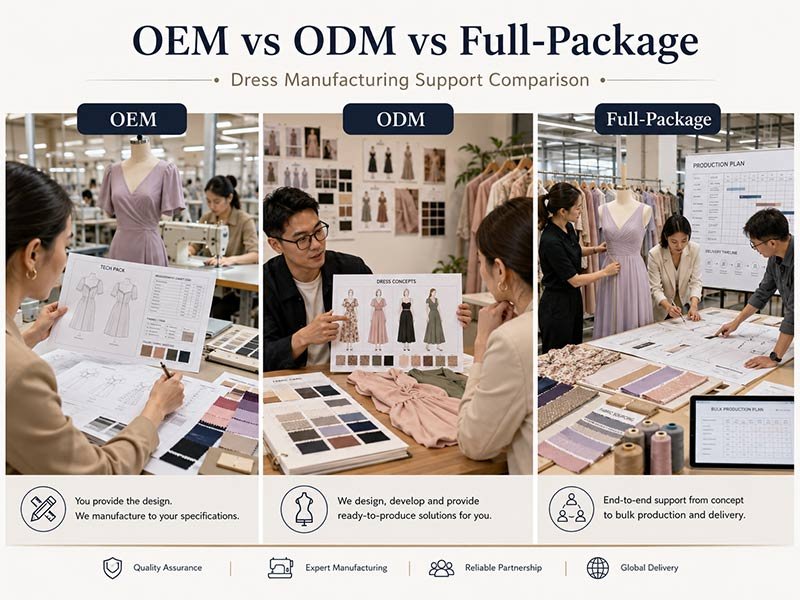
The fashion industry does not fail because ideas are weak—it fails because production systems are misunderstood. Many brands enter manufacturing with strong design concepts but unclear expectations of how OEM, ODM, and full-package support actually shape cost, speed, creative control, and final product quality. The reality is that the manufacturing model you choose will directly define whether your dress collection becomes a scalable business or a series of inconsistent sampling experiments.
OEM (Original Equipment Manufacturing) gives brands control but demands technical readiness. ODM (Original Design Manufacturing) offers faster development but limits creative ownership. Full-package manufacturing, on the other hand, integrates design interpretation, fabric sourcing, sampling, and bulk production into one structured system. Each model solves a different stage of brand maturity, and selecting the wrong one often leads to misaligned samples, delayed launches, and unnecessary production risk.
OEM, ODM, and full-package dress manufacturing differ in how design responsibility, sampling control, and production execution are distributed. OEM requires brand-provided tech packs, ODM includes factory-driven design adaptation, while full-package support covers end-to-end development from concept to bulk production. Choosing the right model depends on brand maturity, design readiness, budget flexibility, and required speed to market.
Imagine a brand preparing its first viral dress collection. The designs are strong, the marketing is ready—but the factory model is wrong. The result is not just delay; it is lost seasonality, lost revenue, and lost momentum. That is why understanding these manufacturing structures is not optional—it is strategic survival.

What Are OEM, ODM, and Full-Package Dress Manufacturing Models?
OEM in dress manufacturing
OEM (Original Equipment Manufacturing) in dress production is a structure where the brand carries full responsibility for design direction, technical development, and product definition, while the factory focuses on execution. In practical dress development, this means the brand must provide a complete tech pack, including measurement charts, fabric selection, construction details, stitching requirements, and trim specifications.
In production scenarios, OEM works best when the brand already has a strong internal product team. Established fashion labels often use OEM when they need strict control over silhouette, fit consistency, and fabric behavior across seasonal collections. The factory does not interpret design intent; it executes strictly according to specifications.
In dress categories such as bodycon, satin evening dresses, or structured corset styles, OEM requires highly precise input because even small gaps in documentation can lead to sampling deviations. Missing details in waist shaping, lining structure, or stretch ratio often result in repeated sampling rounds and cost increases.
Key operational characteristics:
- Brand provides full technical package and complete design direction
- Factory executes sampling and bulk production strictly according to instructions
- Material sourcing is usually brand-controlled or pre-approved
- High dependency on technical accuracy and completeness from the brand
- Suitable for established brands with strong technical teams
OEM gives maximum creative control, but it also requires strong technical maturity. Without it, sampling cycles become longer, especially in complex dress categories where fabric behavior and structure are critical.
ODM in fashion production
ODM (Original Design Manufacturing) shifts part of the design and development responsibility to the factory. Instead of relying entirely on brand-provided specifications, the manufacturer contributes design suggestions, fabric options, and construction adjustments based on trends and production feasibility.
In dress manufacturing, ODM is often used by brands that want faster market entry without building a full internal design system. Factories may provide pre-developed silhouettes, fabric libraries, or modified versions of existing styles. The brand selects and adjusts from these options to form final products.
This model is widely used in categories such as party dresses, vacation dresses, and occasionwear, where speed and trend response matter more than full design ownership. However, ODM introduces interpretation layers. Final designs are influenced by factory development logic, which can reduce uniqueness if not managed carefully.
Key operational characteristics:
- Factory provides design base, silhouettes, or trend-driven proposals
- Brand selects and adapts from available development options
- Faster sampling cycle due to reduced starting complexity
- Lower requirement for technical documentation from brand side
- Suitable for early-stage or trend-driven fashion brands
ODM improves speed and lowers entry barriers, but brand identity depends heavily on how well the factory understands aesthetic direction and market positioning.
Full-package manufacturing support
Full-package manufacturing integrates the entire development chain into one system: design interpretation, fabric sourcing, pattern development, sampling, production planning, and bulk manufacturing. Instead of separating responsibilities, the process becomes a continuous workflow.
In dress production, this model is especially effective for brands managing seasonal drops or multi-style collections. When developing coordinated lines of mini, midi, and maxi dresses across different occasions, full-package systems help maintain consistency in silhouette, fabric logic, and quality standards.
Factories do not wait for complete technical input. They actively translate ideas into production-ready garments, including fabric suggestions, fit refinement, construction optimization, and pre-sampling risk evaluation.
Key operational characteristics:
- Integrated management of design, sourcing, sampling, and production
- Factory participates in product development decisions
- Reduced communication loss across stages
- Strong focus on sample-to-bulk consistency
- Suitable for scaling brands and multi-style collections
This model requires a highly structured manufacturing system with coordinated development, pattern, sourcing, and production teams working in sync.

How Do OEM, ODM, and Full-Package Models Differ in Dress Development?
OEM, ODM, and full-package manufacturing differ in how design input, sampling responsibility, fabric sourcing, and production control are distributed during dress development. OEM relies on brand-led technical execution, ODM introduces factory-led design adaptation, while full-package manufacturing integrates all stages into one coordinated system. These differences directly impact sampling accuracy, development speed, cost structure, and bulk production stability in dress manufacturing projects.
Who controls design direction in each model?
In dress development, control over design direction determines how predictable or flexible the final product becomes. OEM places full control on the brand side, ODM shifts partial creative input to the factory, and full-package manufacturing blends both into a shared development flow. The level of control directly influences sample accuracy, revision cycles, and product identity consistency across collections.
OEM requires a complete design system from the brand. Every detail, from silhouette balance to stitch density, must be clearly defined before sampling begins. ODM reduces this pressure by allowing factories to propose silhouettes and fabric combinations based on production experience and trend data. Full-package systems go further by allowing factories to actively refine design logic during development, especially when translating sketches or reference images into production-ready garments.
Key differences in workflow:
- OEM: brand defines design structure and visual direction in full detail
- ODM: factory suggests design base, brand selects and refines final direction
- Full-package: factory and brand jointly shape design during development cycle
- OEM depends heavily on internal design maturity
- ODM depends heavily on factory trend interpretation capability
- Full-package depends on integrated communication and development system
In dress categories such as corset dresses, satin bodycon, or structured eveningwear, even small differences in design control can significantly affect fit balance and fabric behavior in production.
How does sampling process differ across OEM, ODM, and full-package?
Sampling is where manufacturing models show their most practical differences. OEM sampling follows strict execution logic, ODM sampling is guided by factory interpretation, and full-package sampling is an iterative development cycle combining both structure and refinement.
In OEM, sampling starts only after full technical input is provided. If measurements or fabric specifications are incomplete, factories proceed literally, often resulting in multiple revision rounds. ODM sampling starts from pre-developed templates, which reduces initial errors but limits customization depth. Full-package sampling begins with concept interpretation, where factories actively translate design intent into structured garments and adjust based on fitting feedback.
Key sampling differences:
- OEM: sampling strictly follows tech pack with minimal interpretation
- ODM: sampling built on existing silhouettes with modification flexibility
- Full-package: sampling includes continuous refinement from concept stage
- OEM often requires more revision cycles due to documentation sensitivity
- ODM reduces early-stage friction but limits structural originality
- Full-package reduces revision loops through integrated feedback systems
In practical dress production, full-package systems often reduce sampling rounds from multiple iterations to fewer controlled adjustments because fabric selection, pattern correction, and construction decisions are handled in one workflow instead of fragmented steps.
What is the difference in fabric sourcing responsibility?
Fabric sourcing directly affects dress quality, cost stability, and production risk. OEM keeps sourcing responsibility primarily on the brand, ODM shares sourcing influence between both sides, while full-package manufacturing places sourcing inside the factory system.
In OEM, brands typically define fabric composition, GSM, stretch ratio, and supplier selection. Factories execute according to approved materials. ODM introduces factory suggestions based on available fabric libraries and cost-performance options. Full-package systems manage sourcing internally, selecting fabrics that match both design intent and production feasibility.
Key sourcing differences:
- OEM: brand selects and approves all fabrics before production
- ODM: factory proposes fabric options based on trend and availability
- Full-package: factory manages sourcing aligned with design and production needs
- OEM ensures high control but increases sourcing workload
- ODM improves speed but may introduce material variation risk
- Full-package balances cost, performance, and production stability
In dress categories like satin eveningwear or stretch bodycon dresses, fabric behavior such as drape, recovery, and opacity must align with construction logic. Full-package systems reduce mismatch risk by aligning fabric selection directly with pattern development and sampling.
How is tech pack usage different across models?
Tech pack usage defines how structured or flexible the development process becomes. OEM relies heavily on detailed tech packs, ODM uses simplified or reference-based inputs, and full-package systems may build or refine tech packs internally during development.
In OEM, tech packs are the core communication tool. Every measurement, stitch type, and construction detail must be documented. ODM reduces reliance on technical documentation by using visual references and factory-developed templates. Full-package manufacturing often converts sketches or inspiration images into structured technical documentation as part of the development process.
Key differences in tech pack usage:
- OEM: requires complete and precise technical documentation
- ODM: partial tech pack supported by factory templates and references
- Full-package: tech pack may be created or refined by factory team
- OEM depends on documentation accuracy for production success
- ODM reduces technical burden but increases interpretation reliance
- Full-package ensures technical alignment through internal systemization
In dress manufacturing, incomplete tech packs under OEM often lead to repeated sampling. Full-package systems reduce this risk by converting design intent into production logic before sampling begins, improving consistency between sample and bulk output.
Which model reduces production risk most effectively?
Production risk in dress manufacturing appears in sampling accuracy, bulk consistency, and scaling stability. OEM places most risk on the brand due to technical dependency, ODM distributes risk between brand and factory, while full-package manufacturing internalizes most development risks within the factory system.
OEM risk emerges when technical details are incomplete or misinterpreted. ODM risk appears when design direction is loosely controlled or overly dependent on factory interpretation. Full-package systems reduce risk by integrating decision-making across fabric, pattern, and production stages, allowing early detection of feasibility issues.
Key risk differences:
- OEM: high risk from incomplete or inaccurate technical input
- ODM: medium risk due to shared interpretation and design influence
- Full-package: lower risk due to integrated development control
- OEM risk increases with complex dress structures
- ODM risk increases with brand–factory misalignment
- Full-package reduces risk through system-based validation before sampling
In structured dress categories such as corset, satin, and mesh designs, full-package systems typically achieve more stable sample-to-bulk consistency because fabric behavior, construction logic, and production feasibility are evaluated together rather than separately.

Which Manufacturing Model Is Best for Different Types of Fashion Brands?
Different fashion brands require different manufacturing structures depending on their design capability, development speed, and production scale. OEM suits brands with strong internal technical teams and strict product control. ODM supports early-stage or trend-driven brands needing faster market entry. Full-package manufacturing fits scaling brands that require integrated development, stable sampling, and multi-style collection execution. Choosing the right model directly affects cost efficiency, sampling success rate, and long-term production stability.
Which model suits startup dress brands?
Startup fashion brands usually operate with limited technical teams, incomplete tech packs, and high dependence on external development support. In this stage, speed and flexibility matter more than strict technical control. ODM or light full-package support becomes the most practical structure because it reduces development barriers and shortens sampling cycles.
ODM allows startups to access ready-made silhouettes, fabric options, and trend-based design direction without building internal pattern or sourcing systems. Full-package support goes further by helping transform visual ideas into structured garments, including fabric recommendation, pattern development, and sampling coordination.
Key suitability factors for startup brands:
- Limited or no internal technical design team
- Fast launch requirement for first collection validation
- Need for factory-supported design interpretation
- Lower tolerance for repeated sampling cost
- Focus on market testing before scaling production
ODM reduces entry complexity, while full-package systems reduce development dependency on fragmented suppliers. In early-stage dress categories such as basic bodycon, casual dresses, or simple partywear, both models help stabilize first-season development outcomes and reduce design-to-production gaps.
Which model fits fast fashion or DTC brands?
Fast fashion and DTC brands operate under high SKU turnover, seasonal pressure, and frequent collection updates. Their main requirement is speed combined with consistent quality across multiple styles. Full-package manufacturing becomes the most efficient structure because it reduces communication delays and integrates development steps.
In these brands, design teams often work on multiple drops simultaneously. OEM can slow down production due to heavy documentation requirements, while ODM may limit design uniqueness across collections. Full-package systems allow parallel development of multiple dress styles with centralized coordination of fabric sourcing, sampling, and production planning.
Key suitability factors for fast fashion and DTC brands:
- High frequency of new style releases per season
- Need for multi-SKU coordination in short timelines
- Requirement for consistent fit across repeated styles
- Strong emphasis on sample-to-bulk accuracy
- Need for scalable production without repeated rework
Full-package manufacturing supports structured pipeline execution, especially for categories like mini dresses, party dresses, and seasonal trend collections. It reduces fragmentation between design, sampling, and bulk production, allowing faster market response while maintaining production consistency.
Which model is better for established global fashion brands?
Established fashion brands usually operate with mature design teams, defined technical standards, and strict brand identity systems. OEM becomes the most suitable model because it ensures full control over design execution and production accuracy. These brands already possess detailed tech packs and standardized measurement systems, which align with OEM requirements.
In many cases, these brands also integrate advanced full-package systems for expansion categories or new product lines. However, OEM remains core for maintaining consistency across global collections and suppliers.
Key suitability factors for established brands:
- Strong internal design and technical development teams
- Strict control over fit, fabric, and construction standards
- Requirement for cross-season and cross-market consistency
- Established sourcing and compliance systems
- Need for precise execution across multiple factories
OEM ensures that production aligns exactly with brand specifications, especially in structured dress categories where fit precision is critical. Full-package systems may still be used for innovation or capsule collections, but OEM remains the foundation for core product lines due to its strict execution framework.
When should brands choose full-package manufacturing?
Full-package manufacturing is most effective for brands that are moving beyond single-product development into structured collection building. This includes brands scaling from small batches to multi-style seasonal lines, or those expanding from simple designs into more complex dress categories requiring coordinated development.
This model is especially useful when internal teams cannot manage full technical workflows across fabric sourcing, pattern making, and production planning. Instead of splitting responsibilities across multiple suppliers, full-package systems centralize the entire process into one development structure.
Key suitability factors for full-package manufacturing:
- Multi-style dress collections across one season
- Need for integrated fabric, pattern, and sampling coordination
- Limited internal technical execution capacity
- Focus on improving sample-to-bulk consistency
- Requirement for scalable production systems
Full-package systems are particularly effective in structured categories such as corset dresses, satin occasionwear, mesh designs, and fashion-forward party dresses. These categories require close alignment between fabric behavior and construction logic, which benefits from integrated decision-making during development.
What mistakes do brands make when choosing the wrong model?
Selecting an unsuitable manufacturing model is one of the main reasons for sampling delays, cost escalation, and inconsistent production outcomes in dress manufacturing. Most issues come from misalignment between brand capability and factory structure rather than production capacity itself.
A common mistake is early-stage brands selecting OEM without sufficient technical documentation. This leads to repeated sampling cycles because factories execute exactly what is provided, even if incomplete. Another frequent issue is established brands using ODM for core collections, resulting in reduced design control and inconsistent brand identity.
Key mistakes observed in model selection:
- Startups choosing OEM without complete tech packs
- Established brands using ODM for core product lines
- Over-reliance on factory interpretation without clear direction
- Underestimating importance of fabric and fit alignment
- Mixing multiple models without clear development structure
These mistakes often lead to unstable sample results, increased revision rounds, and delayed seasonal launches. The most stable approach is aligning manufacturing models with internal capability rather than product ambition. Brands that match structure with capability achieve faster sampling cycles, more consistent bulk production, and stronger long-term scalability in dress manufacturing.
What Risks Should Brands Consider When Choosing OEM vs ODM vs Full-Package?
OEM, ODM, and full-package manufacturing models carry different types of production risks across sampling, fabric behavior, communication flow, and bulk scalability. OEM concentrates risk on technical documentation accuracy, ODM introduces interpretation and design consistency risks, while full-package shifts risk toward factory capability and system stability. Understanding these risk structures helps fashion brands reduce sampling failure, improve production stability, and avoid costly development delays.
What are the risks of OEM in dress manufacturing?
OEM risk is mainly driven by documentation precision and technical dependency. Since the factory executes strictly based on tech packs, any missing or unclear detail directly impacts sampling accuracy and bulk production consistency.
In dress categories such as satin dresses, corset silhouettes, or fitted bodycon styles, small technical gaps often escalate into repeated sampling rounds. Issues like missing stretch ratios, unclear lining structure, or incomplete measurement logic can create visible fit distortion in production.
Key OEM risk factors:
- Incomplete or inaccurate tech pack specifications
- High dependency on internal technical design capability
- Multiple sampling iterations due to execution-only workflow
- Fabric mismatch caused by unclear material definition
- Cost escalation from repeated corrections and re-sampling
OEM works well only when documentation quality is highly structured. Without strong technical input, even capable factories will produce inconsistent outcomes because interpretation is not part of the OEM workflow.
What are the risks of ODM in fashion production?
ODM introduces a different risk structure centered around interpretation and creative alignment. Since factories contribute design direction, the final product is influenced by factory development logic, not only brand vision.
In dress production, this becomes visible in silhouette adjustments, fabric substitutions, or construction simplifications. While ODM improves speed, it can reduce design uniqueness if factory design libraries are overused or not aligned with brand positioning.
Key ODM risk factors:
- Reduced design ownership and originality dilution
- Inconsistent brand identity across multiple collections
- Over-reliance on factory design interpretation quality
- Fabric or silhouette deviation from original intent
- Limited control over fine construction details
ODM risk is not technical execution failure but alignment drift. When factory and brand interpretation diverge, final garments may perform well in production but fail to reflect intended design direction.
What are the risks in full-package manufacturing?
Full-package manufacturing reduces fragmentation but introduces system dependency risk. Since one factory manages design interpretation, sourcing, sampling, and production, overall performance depends heavily on internal capability and coordination structure.
In dress manufacturing, especially for multi-style collections like mini, midi, and evening dresses, weak coordination between pattern, sourcing, and production teams can lead to timeline pressure or inconsistent quality across styles.
Key full-package risk factors:
- Over-dependence on factory internal capability and organization
- Risk of weak coordination across design, sourcing, and production teams
- Quality inconsistency if internal systems are not standardized
- Limited visibility into intermediate development decisions
- Performance variation across complex multi-style collections
While full-package reduces external communication risk, it shifts responsibility inward. If the factory lacks structured development systems, risk becomes concentrated inside the production workflow rather than distributed across stages.
How does risk distribution differ across OEM, ODM, and full-package?
Risk distribution determines who absorbs production failure costs, delays, and sampling iterations. Each manufacturing model assigns responsibility differently, which directly impacts project stability and financial exposure.
In OEM, most risk sits on the brand side because technical input defines production accuracy. In ODM, risk is shared between brand and factory due to co-developed design direction. In full-package systems, risk is primarily managed within the factory, but depends heavily on internal system strength.
Key risk distribution differences:
- OEM: brand carries technical and documentation risk
- ODM: shared risk between brand direction and factory interpretation
- Full-package: factory manages integrated development risk internally
- OEM risk increases with complexity of dress construction
- ODM risk increases with design ambiguity
- Full-package risk increases with system coordination complexity
In dress manufacturing, risk distribution directly affects cost predictability. The more fragmented the model, the higher the chance of repeated sampling and revision cycles.
Start Your Custom Dress Manufacturing Project with Duolan Apparel
Fashion brands succeed not by choosing the cheapest or fastest factory, but by choosing the right manufacturing structure aligned with their growth stage. Whether you need OEM precision, ODM speed, or full-package integration, the key is working with a partner that understands dress development at both technical and commercial levels.
Duolan Apparel supports global fashion brands across OEM, ODM, and full-package dress manufacturing systems, specializing in occasion dresses, party dresses, bodycon styles, satin collections, and trend-driven womenswear development.
If you are preparing your next collection, launching a new dress line, or scaling your current fashion brand, you can submit your tech pack, reference images, or concept ideas to begin a structured development process with our team.
👉 Contact Duolan Apparel to start your custom fashion dress development today.