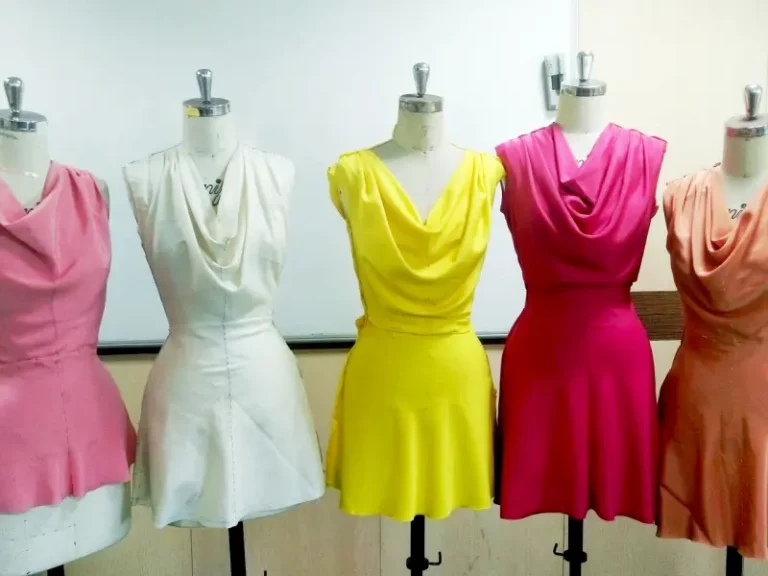
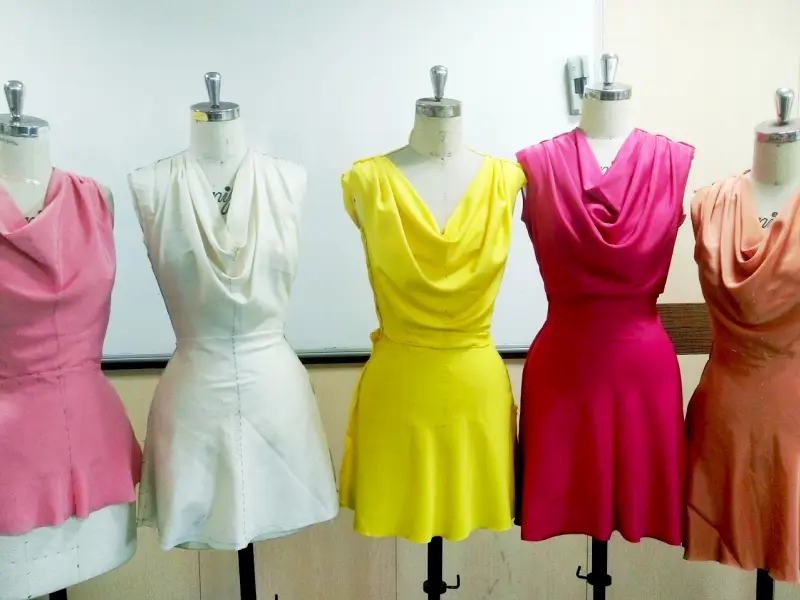
A cowl neckline can look soft, effortless and almost liquid in one fabric, then appear bulky, shallow or awkward in another even when the pattern has barely changed. That difference is not simply a matter of sewing quality. A cowl is one of the clearest examples of a garment feature whose final shape is created jointly by the pattern and the fabric. Once the extra neckline volume is released between the shoulder points, gravity begins to determine where the fabric settles, while weight, thickness, bending softness, stretch, grain direction and surface finish decide what kind of folds can actually form.
Fabric drape changes a cowl neck by controlling how far the neckline falls, how many folds appear, how rounded or structured those folds look, how closely the fabric follows the bust, and how stable the opening remains during movement. Soft, fluid fabrics generally create deeper and smoother folds, while firmer fabrics tend to form broader, more projected folds and may require a different pattern balance to achieve the intended shape.
This is why two dresses made from the same drawing can feel like completely different designs once they reach the fitting room. A development team may approve a beautiful satin reference, change to another satin with a similar shine and color, and then discover that the cowl no longer sits at the same depth. The pattern may still be technically correct; the material has changed the three-dimensional result. Understanding that relationship early makes cowl development far more predictable and reduces the risk of repeatedly correcting the pattern for a problem that actually began with the fabric.
What Makes Fabric Drape Change a Cowl Neck?
Fabric drape changes a cowl neck because the neckline contains unsupported fabric that must bend and settle between fixed points. Weight provides downward force, softness determines how easily folds curve, thickness affects fold bulk, and stretch changes how tension moves across the neckline. Recovery, surface finish and internal construction also influence whether the cowl keeps its intended shape after fitting, movement and wear.
Drape, Weight and Softness
A conventional neckline is usually controlled by a defined seam or edge that follows a fairly predictable path around the body. A cowl works differently because part of the neckline is deliberately released from that fixed geometry. The pattern provides surplus material, but the final position of that material is not fully established until the garment is placed vertically and gravity begins to act on it. For this reason, a cowl cannot be judged accurately from a flat pattern alone.
Fabric weight is one of the obvious influences, but it is often misunderstood. Greater weight increases the downward force on the cowl, yet a heavier material does not automatically create better drape. A relatively heavy fabric with low bending stiffness can produce deep, elegant folds, while a much lighter but crisp fabric may resist curving and stand away from the body. Weight tells only part of the story; bending behavior and thickness determine what the fabric does with that weight.
Thickness becomes especially important when the pattern contains substantial neckline volume. A thin charmeuse can place several folds within a relatively small area because each layer occupies little space. A thicker material may use the same amount of pattern fullness to create only two large folds because every fold requires more physical room. Adding even more volume to compensate can make the neckline bulkier instead of more fluid.
For this reason, experienced product teams evaluate the fabric while it is hanging rather than relying only on a fabric card. They watch whether the material forms narrow rounded folds, wide curved folds, sharp ridges or an outward projection. They also observe whether the lowest point stops moving quickly or continues to lengthen after the material has been suspended. These simple visual checks often reveal more about cowl suitability than fabric weight alone.
Stretch and Recovery
Stretch changes how tension is distributed across the neckline. In a woven cowl, much of the movement may come from bias orientation, while a knitted fabric can stretch through its loop structure even when it is not cut on true bias. That extra movement can help the cowl follow the upper body smoothly, but it can also make the final neckline position more difficult to predict when the fabric has weak recovery.
Two jersey fabrics might both stretch by 30% or 40% during a simple test, yet behave very differently after the tension is released. A fabric with strong recovery moves back close to its original dimension, while one with weaker recovery may remain slightly extended. When a cowl is deep, its own suspended weight keeps applying low-level tension to the neckline, so weak recovery can gradually lower the center front during hanging or wear.
The first sample should therefore not be judged immediately after sewing. A neckline can appear correct during the first fitting and then settle lower several hours later. This is especially relevant for viscose-rich jerseys, soft rib structures and lightweight stretch fabrics that are designed for high mobility. Measuring the neckline before and after a controlled resting period can reveal whether the change is small enough to accept or whether the pattern needs to compensate for growth.
Fabric development should consequently consider drape, stretch and recovery as connected properties. The material-development framework used for fashion dresses at Duolan similarly treats drape, structure, support, stretch, skin feel and opacity as related decisions, while pattern adjustments are considered when material behavior changes.
Surface Finish and Layering
Surface finish changes the visual impact of the folds even when the underlying geometry is similar. Glossy satin makes every ridge and valley more obvious because light reflects differently across the curved surface. A small difference in fold position that is barely noticeable in matte crepe may become very visible in pale satin under studio lighting. This is one reason satin cowls can look exceptionally elegant when balanced correctly but unforgiving when the two sides do not fall evenly.
Internal layers can change the behavior again. A soft shell fabric may suddenly feel rigid at the top edge when it is combined with a substantial facing, thick seam allowance or heavy lining. A lining cut shorter than the shell can restrict the cowl and pull it upward, while an overly loose facing can roll toward the outside and appear between the folds. Even shoulder seam construction matters because several layers converging at the anchor point can create a stiff hinge exactly where the cowl needs to begin falling.
The most reliable way to understand cowl behavior is therefore to look at the whole construction rather than the shell fabric in isolation. Grain direction, neckline volume, lining, facing, shoulder anchoring, seam bulk and pressing all contribute to the finished result. A beautiful fabric can still produce an unsuccessful neckline if one of these supporting elements prevents it from behaving naturally.
Which Fabrics Create Different Cowl Effects?
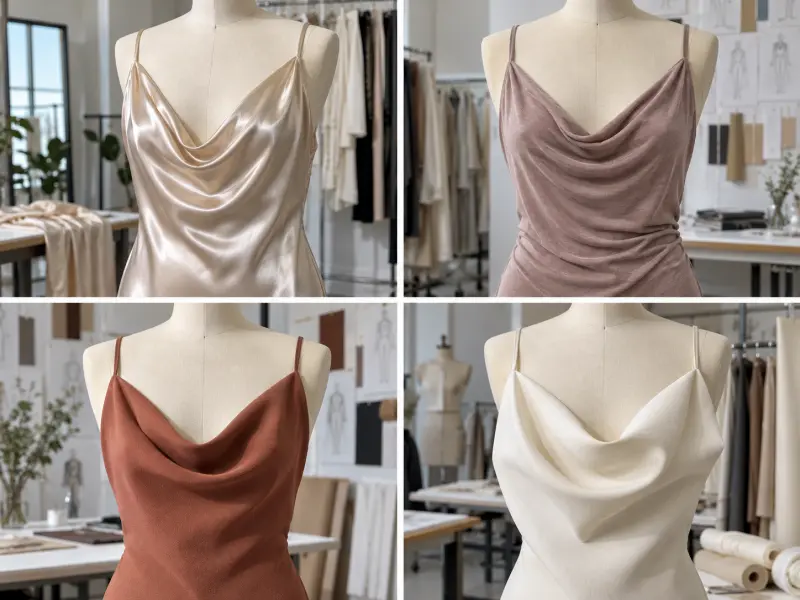
Different fabrics create different cowl effects because they combine weight, softness, thickness and elasticity in different proportions. Charmeuse and fluid satin usually create narrow, flowing folds; viscose jersey produces softer body-following drape; medium crepe gives more controlled definition; and structured materials create broader, more architectural shapes. The best choice depends on the intended silhouette rather than on a single definition of “good drape.”
Satin and Charmeuse
Charmeuse is closely associated with cowl neck dresses because its relatively thin construction and fluid handle allow surplus fabric to collapse into smooth curves. When sufficient neckline volume is present, the fabric can form several close folds without building excessive thickness near the center front. Its surface also highlights those folds, which helps create the liquid appearance often seen in evening, occasion and slip-inspired dresses.
Satin, however, should not be treated as one uniform category. Satin refers primarily to a weave structure, and fabrics sold under that name can vary considerably in fiber, weight, density, finish and stiffness. A lightweight satin around the lower end of common dress weights may behave much like charmeuse, while a heavier duchess-style satin can hold broad sculptural folds and resist falling close to the body. Both are satin, but they can require very different cowl patterns.
The reflective surface also raises the standard of execution. Slight grain distortion, uneven shoulder tension, puckering or differences between the left and right fold positions become more visible because the highlights do not match. This is particularly important for styles intended for ecommerce photography, event dressing or studio campaigns, where the neckline may be photographed under strong directional lighting.
For development teams, the practical lesson is simple: selecting satin from an online image or small swatch is not enough. A larger piece should be suspended and compared with the intended neckline shape. The fabric may match the reference visually when flat but behave very differently once 20 or 30 centimeters of unsupported material is allowed to fall.
Jersey and Viscose
Jersey cowls often look softer and more relaxed because knitted construction already provides flexibility in multiple directions. Viscose jersey can follow the bust closely and form rounded folds without depending on the same true-bias orientation commonly used for woven fabrics. This makes it suitable for dresses and tops where comfort, movement and a body-following silhouette are more important than a sharply controlled neckline.
The main issue is dimensional stability. Lightweight stretch jersey may continue to lengthen under the suspended weight of the cowl. A neckline that looks appropriate immediately after construction can become noticeably lower after hanging overnight, and this effect may become more pronounced in larger sizes or deeper cowl designs because more material is pulling on the upper edge.
Fabric density and recovery therefore need to be considered together. A very light jersey may create more folds and a softer appearance but provide less control. A slightly heavier knit may create fewer folds while keeping the neckline closer to its approved position. Neither result is automatically better; the decision depends on whether the style is intended to feel loose and fluid or more polished and secure.
Crepe and Structured Fabrics
Crepe is useful when a design needs visible drape without the highly liquid behavior of charmeuse. Many dress crepes combine enough flexibility for rounded folds with slightly greater body, allowing individual folds to remain more defined. This can make the neckline look controlled rather than flowing continuously, which may suit contemporary occasion dresses where the cowl needs to look elegant but not overly lingerie-inspired.
Structured fabrics sit at the other end of the spectrum. Taffeta, mikado, brocade and firm poplin resist small-radius bending and are more likely to produce large folds, obvious ridges or outward projection. These fabrics can create excellent sculptural cowls when that effect is intentional, but they should not be expected to reproduce the appearance of a light bias-cut satin without pattern changes.
The ranges below are practical sourcing references rather than universal rules because yarn, weave, finishing and fiber can cause two fabrics at the same weight to behave very differently.
| Fabric Type | Approx. Common Weight | Typical Cowl Character | Main Risk |
| Light charmeuse | 60–100 gsm | Deep, narrow, liquid folds | Excessive drop or shifting |
| Light satin | 80–140 gsm | Smooth, reflective folds | Visible asymmetry |
| Viscose jersey | 140–220 gsm | Soft, body-following drape | Stretch growth |
| Medium crepe | 110–190 gsm | Controlled rounded folds | Reduced visual depth |
| Taffeta | 100–180 gsm | Broad, crisp folds | Projection from the chest |
| Duchess-style satin | 180–300+ gsm | Large sculptural folds | Bulk at shoulders and facing |
Weight should therefore be used as a screening tool rather than a final answer. Two fabrics at 130 gsm may produce noticeably different results because one has a softer finish or greater diagonal mobility. The garment test remains the most useful evidence of whether a candidate material can produce the required cowl.
How Does Bias Grain Change Cowl Drape?
Bias grain allows woven fabric to deform diagonally, which usually gives a cowl softer and more rounded folds than the same fabric placed on straight grain. At approximately 45 degrees to the warp and weft, the yarn structure can shear more freely, helping the neckline respond to gravity. Accurate grain placement is important because inconsistent bias angles can cause different stretching and visible asymmetry.

Why Bias Feels Softer
Woven fabric is built from warp and weft yarns crossing approximately at right angles. Along those primary directions, the cloth is relatively stable because tension travels directly along the yarns. When the fabric is rotated toward a diagonal orientation, the yarns can change their angle slightly relative to one another, allowing the whole fabric structure to distort without requiring large amounts of yarn stretch.
That diagonal shear is what makes many woven fabrics feel softer and more flexible on bias. When used for a cowl, it allows the neckline volume to move toward center front while the shoulder areas rotate naturally around the body. The folds can therefore appear more rounded and less rigid than they would if the same piece were cut along the straight grain.
Bias does not override every other material characteristic. A tightly constructed or heavily coated fabric can remain relatively stiff even at 45 degrees. The benefit is strongest when the underlying material already has enough softness and thickness control to form curved folds. Bias should therefore be treated as one part of the fabric-pattern relationship, not as a guaranteed method for turning any woven fabric into a fluid cowl.
Grain Accuracy and Asymmetry
Bias cutting introduces additional sensitivity because small differences in grain orientation can change the way each side stretches. If one half of the front sits closer to true bias than the other, that side may lengthen more after sewing and hanging. The paper pattern can remain perfectly symmetrical while the finished garment gradually develops a lower fold on one side.
This problem is sometimes misdiagnosed as inaccurate sewing because the imbalance only becomes visible after the garment has been suspended. Immediately after assembly, the neckline may look acceptable. Several hours later, the fabric has continued to settle and the center of the cowl begins to move toward the side with greater growth.
For this reason, woven bias cowls benefit from controlled handling during spreading, cutting, bundling and sewing. Long bias edges should not be stretched unnecessarily, and both sides should be positioned consistently relative to the grain. A settling period before final evaluation can also prevent premature corrections. An overnight rest is commonly practical in sampling, although the appropriate duration depends on the fabric and construction rather than on a universal rule.
Knits Versus Wovens
Knitted fabrics do not always need to be cut on true bias because their looped structure already provides mechanical stretch and dimensional movement. A soft viscose jersey can often form an attractive cowl on its conventional grain direction because the fabric has enough flexibility to redistribute itself over the upper body without relying on diagonal shear.
Cutting a highly elastic knit on bias can sometimes create too much instability. The neckline may become difficult to control, particularly when the fabric also has weak recovery. Stable knits may benefit from grain experiments, but the decision should be based on the actual fabric rather than copied automatically from woven cowl construction.
The distinction is useful during development. With woven fabrics, grain direction is often one of the primary tools used to increase fluidity. With knits, stretch percentage, recovery, weight and directional stability usually deserve attention first. Treating the two categories in the same way can create unnecessary corrections during sampling.
How Do Drape and Pattern Shape Control Cowl Depth?
Cowl depth is controlled by both pattern volume and fabric behavior. The pattern determines how much surplus material is available between the shoulder anchors, while the fabric determines how that material settles. Increasing neckline volume can create a deeper or fuller cowl, but a heavy fluid fabric may still hang lower than a crisp lightweight fabric cut from the same pattern.
Pattern Volume and Fold Count
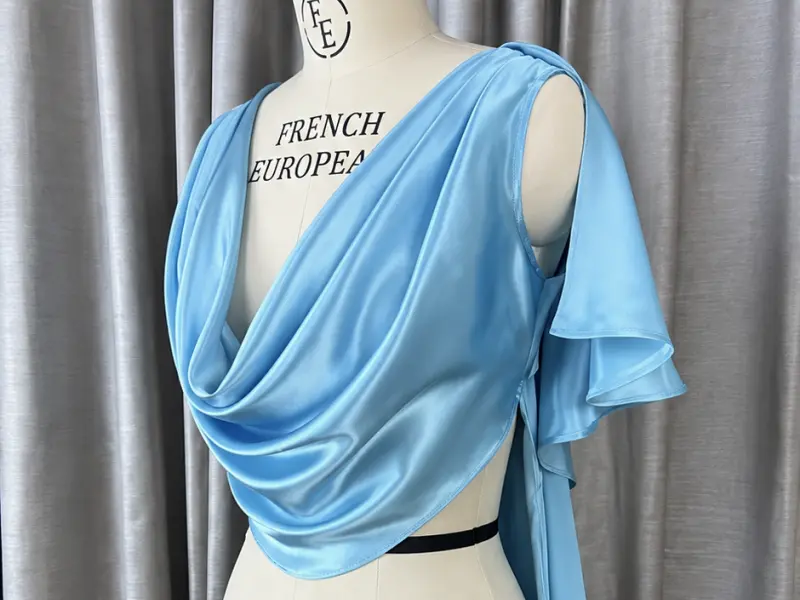
A cowl requires additional fabric beyond the basic neckline. Pattern makers can introduce this fullness through slash-and-spread techniques, dart manipulation, neckline extension or related drafting methods. As more material is released, the neckline gains the potential to form deeper or more numerous folds.
The relationship is not linear. Adding 50% more volume does not guarantee 50% more visible folds because the fabric determines how that volume organizes itself. A thin, supple material may divide extra fullness into several narrow curves, while a firmer cloth may combine the same amount of fabric into two broad folds. A thick material may use much of the additional fullness simply to build physical bulk.
This distinction matters when sample comments use general language such as “make the cowl deeper.” That request could refer to several different outcomes. The team may want the center-front opening to sit lower, the neckline to contain more fabric, the folds to become larger or the drape to move closer to the bust. Each objective can require a different adjustment, even though all of them might initially be described as increasing cowl depth.
Clear sample comments therefore separate neckline position from fold volume. Instead of asking only for a deeper cowl, the team can define the desired center-front drop while also describing whether the number and scale of the folds should remain unchanged.
Shoulder Anchors
The shoulder points act as suspension anchors for the entire neckline. Moving them changes how the same amount of fabric is distributed. Narrower spacing concentrates the volume into a smaller area and can push more folds toward center front. Wider spacing spreads the fullness across the chest and may make the cowl appear shallower even though the amount of fabric has not changed.
The type of shoulder construction also affects stability. A conventional sleeveless bodice has relatively firm shoulder seams, while a narrow-strap dress gives the cowl less support. Halter, backless and one-shoulder styles introduce additional directions of tension, which means a cowl pattern that works on a standard bodice may not behave the same way when transferred to a more open silhouette.
This becomes important in fast-moving development programs where a successful detail is adapted across several related styles. Copying the same neckline extension onto different shoulder structures can save drafting time initially but may create additional fitting rounds later. The cowl should be re-evaluated whenever the support geometry changes.
Fabric Weight and Worn Depth
The neckline depth shown on a flat pattern is not the same as the depth seen on a person. Once the garment is worn, gravity pulls material downward, body curvature pushes parts of the fabric outward, bias movement redistributes the fullness, and stretch may alter the upper edge. These forces create the final worn depth.
A heavier but fluid fabric can therefore produce a lower center-front point than a lighter fabric cut from the same pattern. A crisp fabric may do the opposite by holding more volume higher on the chest. This is why measurement on a fit model or dress form provides more useful approval information than estimating the final drop solely from CAD.
| Development Variable | Likely Effect as It Increases | Useful Check |
| Neckline volume | More material available for folds | Total neckline length |
| Fabric weight | Greater downward pull | Center-front drop |
| Fabric softness | Smaller, smoother fold radius | Fold shape and count |
| Shoulder span | Wider distribution of volume | Anchor-to-anchor width |
| Stretch | Greater movement under tension | Neckline growth |
| Facing weight | More support but possible stiffness | Upper-edge projection |
Product development becomes more efficient when these variables are recorded before major revisions. Duolan’s documented sampling process similarly calls for teams to clarify fabric direction, fit priority and sample purpose, then identify whether the main development objective is drape accuracy, fit accuracy, visual styling or construction testing.
How Does Fabric Drape Affect Fit and Coverage?
Fabric drape affects fit and coverage by changing where the neckline sits relative to the bust and how much it moves during wear. Very fluid fabric can lower the center front and increase exposure, while firmer fabric may bridge between the shoulders and stand away from the body. Stretch, recovery, lining, facing and shoulder support also influence whether the neckline remains controlled after movement.
Gaping and Exposure
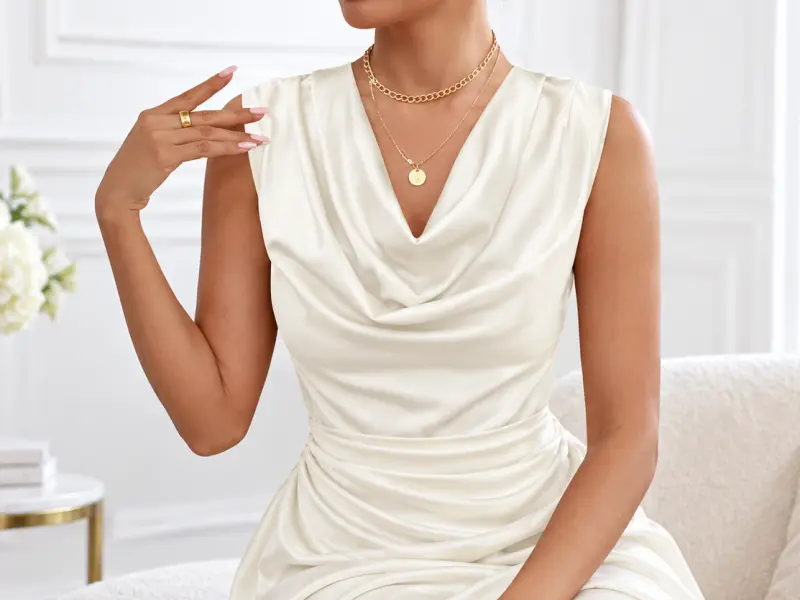
Cowl gaping is often described as a pattern problem, but the material should be checked before the neckline is shortened or reshaped. A soft fabric may drop farther than expected and create excessive exposure at center front. A firmer material can create the opposite problem: instead of falling toward the body, it bridges between the shoulder points and leaves visible space behind the neckline.
Both situations may be described as a cowl that is “too open,” yet they do not have the same cause. Reducing neckline length may help one condition and make the other worse. The developer should first compare the bulk or revised fabric with the material used in the approved sample and then review center-front depth, first-fold position, shoulder width, stretch direction, facing tension and lining length.
Coverage should also be judged from several viewpoints. A cowl may look secure in a straight front photograph while appearing significantly more open from above. This difference matters for party, occasion, wedding-guest and going-out dresses because wearers are constantly changing posture while sitting, walking, dancing or leaning forward.
A fit review should therefore consider both appearance and practical movement. If the design intentionally has a low neckline, the goal is not to remove that characteristic but to ensure that the opening behaves consistently with the intended level of coverage.
Collapse and Bulk
Soft folds are part of a cowl’s appeal, so the word “collapse” needs context. The problem is not that the fabric falls; the problem occurs when the folds lose separation and gather into an uncontrolled bundle. An extremely limp material combined with excessive neckline volume can concentrate several folds at center front, making the neckline look heavy rather than fluid.
The opposite problem happens when the fabric has too much body. Thick or stiff cloth can produce one large fold that projects away from the chest, creating visual bulk even when the pattern contains only moderate fullness. Increasing the cowl volume in an attempt to make the neckline look softer may actually worsen the effect.
Internal construction can amplify either condition. Several layers at the shoulder seam can create a rigid hinge. A thick self-facing may prevent the first fold from bending, while a lining cut too tightly can pull the shell upward and reduce the natural drop. Conversely, a facing with insufficient control may roll toward the outside during movement.
A cowl should therefore be assessed from inside as well as outside. Seam allowances, facing depth, lining tension and shoulder construction are often responsible for visual problems that appear to be caused by the outer fabric alone.
Movement and Internal Support
A static fitting provides useful information, but it cannot show whether the neckline remains functional during normal wear. A simple movement sequence can reveal problems that are hidden while the model is standing still. The wearer can raise both arms, rotate the shoulders, sit and stand, walk, turn the torso and lean forward before returning to a neutral position.
The goal is not to make the cowl completely immobile. Movement is part of the design. The important question is whether the neckline returns to a reasonably consistent resting position and whether the level of coverage remains appropriate for the product.
Brands can set internal tolerances for sensitive designs. A team might, for example, define an acceptable center-front change of several millimeters after a repeated movement sequence. Such numbers should be treated as style-specific development targets rather than universal industry rules because a deep evening cowl and a more conservative day dress have very different performance requirements.
The same principle applies to the left and right sides. Instead of writing “the folds look uneven,” the team can measure corresponding landmarks or compare the location of the first major fold on each side. Specific comments are easier to reproduce during revision and become particularly useful when the style later moves into bulk production.
How Do You Test Cowl Drape Before Production?
Cowl drape should be tested under repeatable conditions before bulk production. Compare candidate fabrics using the same pattern, allow bias-sensitive materials to settle, measure the neckline on a fit model or dress form, and document fold depth, symmetry, movement and coverage. If a replacement material changes the cowl noticeably, review the pattern again rather than assuming the approved sample remains valid.
Pre-Sample Fabric Tests
A useful cowl assessment can begin before a complete garment is made. Instead of judging fabric only while it lies flat, suspend a sufficiently large piece across a shoulder-width span and observe how it behaves under its own weight. This simple test can quickly separate fabrics that have similar appearance and weight but very different bending and diagonal behavior.
Look at how many natural folds form, how broad those folds are, whether the fabric springs away from the support points and how far the center drops. Gently move the fabric and observe whether it returns to roughly the same shape or continues shifting. For glossy materials, look at the direction of the highlights because irregular reflections can reveal fold imbalance that is less obvious from the silhouette alone.
Stretch fabrics should also be checked for recovery. Measuring a controlled length before stretching, at a specified extension and after release gives a clearer picture than simply describing a fabric as “stretchy.” For a deep cowl, a fabric with substantial extension but limited recovery may require additional stabilization or pattern compensation.
The purpose of this early test is not to replace garment sampling. It is to eliminate clearly unsuitable options before time is spent on cutting, sewing and full fittings.
Fit-Sample Measurements
Once the first garment is available, subjective comments should be converted into repeatable observations. “The cowl is too deep” can mean several things, while a center-front measurement taken from a fixed reference point gives the pattern maker an exact target.
A practical review can include center-front drop, shoulder opening, number of dominant folds, largest fold depth, left-right balance, bias growth, neckline position after movement and facing visibility. Not every number needs to become a permanent specification, but the measurements create a useful baseline for comparing sample rounds.
| Checkpoint | Unit | Practical Review |
| Center-front drop | mm | Measure from a fixed upper reference |
| Shoulder opening | mm | Measure between anchor points |
| Main fold count | count | Record folds in neutral position |
| Largest fold depth | mm | Measure peak-to-valley distance |
| Left-right difference | mm | Compare matching fold landmarks |
| Stretch change | % | Compare before and after controlled extension |
| Bias growth | mm or % | Measure before and after resting |
| Facing visibility | mm | Record exposed internal edge if present |
A comment such as “raise the center front by 12 mm while keeping the first two folds at approximately the same volume” is far more useful than asking for a less revealing neckline. It separates coverage from fold design and gives the pattern team a clear correction target.
Bulk Consistency Controls
Once the sample is approved, preserving the cowl becomes a material-control issue as much as a sewing issue. If the bulk fabric differs in hand, finish, weight, stretch or diagonal behavior, the neckline can change before the first production piece reaches a sewing machine. A matching color and fiber composition do not guarantee matching drape.
Pre-production fabric comparison should therefore review weight, hand feel, stretch and recovery where relevant, width, surface finish and bias behavior. The lining should be checked at the same time because a change in lining weight or stiffness can affect how the outer shell moves.
Cutting requires particular care for bias-oriented pieces. Fabric should not be distorted during spreading, numbering or bundling, and the grain position needs to remain consistent across the order. During sewing, operators should avoid stretching one shoulder or neckline section more than the other, while pressing procedures should not aggressively reshape the bias areas.
For sensitive styles, reviewing first pieces or a small pilot quantity before releasing the full run provides another opportunity to catch changes in fold depth, coverage or balance. The company’s documented bulk process similarly calls for fabric, lining, measurements and workmanship points to be locked before production and identifies drape inconsistency as one of the dress-specific risks to monitor during quality control.
Conclusion
A successful cowl neck is not created by the pattern or the fabric alone. It comes from the interaction between neckline volume, grain direction, fabric weight, softness, thickness, stretch, recovery, shoulder support and internal construction. Changing even one of those elements can alter the fold count, center-front depth, movement, coverage and overall character of the garment, which explains why apparently minor material substitutions sometimes lead to surprisingly large fitting changes.
For product developers, the most useful habit is to stop asking whether a fabric is simply “drapey enough.” The better question is whether that particular material produces the intended result on that particular pattern. Testing fabrics in a hanging position, measuring the fitted neckline, allowing bias-sensitive materials to settle and carrying the approved behavior into production creates a much stronger development process. When a design depends heavily on fluidity, early fabric and pattern decisions are usually cheaper and faster to correct than trying to repair the neckline after bulk production has already begun.
Frequently Asked Questions
What fabric is best for a cowl neck?
There is no single fabric that is best for every cowl neckline because different designs need different levels of softness and structure. Lightweight charmeuse, fluid satin, viscose jersey and soft crepe are common choices when the goal is a flowing neckline with rounded folds. A structured satin or taffeta may work better for a sculptural cowl. The most reliable choice is the fabric whose weight, softness and stretch produce the intended fold shape on the actual pattern.
Does a cowl neck need to be cut on the bias?
Many woven cowl neck designs benefit from bias cutting because woven fabric generally has more diagonal give around 45 degrees to the warp and weft. This helps the neckline form softer curves and reduces the rigid appearance that may occur on straight grain. However, bias is not mandatory for every design. Stretch knits such as viscose jersey already have substantial movement, so they can often create an effective cowl without using the same bias orientation as a woven dress.
Why does my cowl neck stick out instead of falling down?
A cowl can stick away from the chest when the fabric is too stiff, thick or resistant to bending for the amount of neckline volume in the pattern. Heavy facings, bulky shoulder seams and a lining that restricts the shell can make the problem more noticeable. Before removing pattern volume, compare the fabric with the intended reference material and check the internal construction. The neckline may need a softer fabric, a different facing treatment or a pattern adjustment rather than simply less fullness.
Why does a cowl neckline become lower after hanging?
A cowl can become lower after hanging because gravity continues to act on the suspended fabric. Bias-cut woven materials may gradually shear and lengthen, while stretch knits with limited recovery may grow under the weight of the neckline. The effect is usually greater when the cowl is deep or the fabric is heavy and fluid. Allowing a sample to rest before final fitting and recording the center-front position before and after resting helps identify this behavior before production.
How can I make a cowl neck less revealing without losing the drape?
Reducing exposure does not always require removing a large amount of cowl volume. Depending on the design, the pattern can sometimes be adjusted by raising the center-front position, changing the shoulder anchor spacing or redistributing fullness while preserving the main folds. Fabric behavior also matters because a softer or heavier material may hang lower than the original sample. The best correction separates the coverage requirement from the desired fold volume rather than treating them as the same problem.
Can I change fabric after a cowl neck sample has been approved?
Yes, but the replacement fabric should be treated as a development change rather than an automatic substitution. Even fabrics with similar fiber content, weight and appearance can have different bending stiffness, stretch, recovery and diagonal mobility. The replacement should be compared against the approved material on the same pattern, with attention to center-front drop, fold shape, symmetry and coverage. If those values change noticeably, the neckline pattern or internal construction may also need adjustment.
How do you keep cowl necks consistent in bulk production?
Consistency begins by matching the bulk material to the approved sample in more than color and composition. Fabric hand, weight, stretch, recovery and bias behavior should remain comparable, while grain placement and handling need control during cutting and sewing. Early production pieces can then be compared with the approved sample for neckline depth, fold balance, symmetry and facing visibility. Recording measurable reference points during sampling makes these production checks much more reliable than relying only on visual memory.