Skip to content


An off-shoulder neckline can look perfect while a model stands still and become frustrating as soon as she starts moving. She raises her arms and the neckline climbs toward the shoulders. She sits down and the center front drops. She walks across the room and one side slowly shifts lower than the other. At that point, the issue is no longer simply about styling. It is about how the neckline, sleeves, upper bodice, fabric, elastic, and internal support work together on a moving body.
The most reliable way to keep an off-shoulder neckline in place is to balance the neckline pattern, upper-body fit, elastic or internal support, fabric behavior, and sleeve movement. A well-developed garment should remain close to its intended position during normal movement without depending on extreme tightness, repeated adjustment, or fashion tape. Stability should come from the garment’s overall construction rather than one overly tight component.
That distinction matters because quick fixes such as body tape, safety pins, hidden hair ties, or stronger elastic can sometimes solve an immediate wearing problem, but they do not always correct the reason the garment moves. During product development, a slipping or riding neckline is useful information. It tells the pattern maker and technical team that one part of the system is overpowering another. The real work begins when the question changes from “How do we hold this neckline down?” to “What force is making it move?”
What Causes Off-Shoulder Necklines to Move?
An off-shoulder neckline moves when body motion, sleeve pull, garment weight, fabric growth, or poor fit creates more force than the neckline system can control. Riding up usually points toward restricted arm movement or upward sleeve pull, while slipping down more often relates to loose upper-body fit, excessive neckline length, weak elastic recovery, or insufficient structural support. These two problems should be diagnosed separately before corrections are made.
Riding Up vs. Slipping Down
The first useful observation is the direction in which the neckline moves. Development teams sometimes respond to almost every off-shoulder problem with the same instruction: make it tighter. That can easily create a second defect without solving the first. A neckline that rides upward may already have too much tension, while a neckline that falls downward may genuinely need more support or a smaller effective opening.
Riding up is particularly common in Bardot tops, gathered off-shoulder dresses, and elasticated sleeve-neckline constructions. When the wearer raises her arms, the sleeve must change angle and move upward around the body. If the upper-arm opening, sleeve depth, or neckline construction does not provide enough usable movement, the sleeve transfers force into the neckline. The garment follows the arm because that is mechanically easier than allowing the sleeve to move independently.
Slipping downward follows a different pattern. The neckline may start correctly and gradually lose position as gravity, fabric weight, weak elastic recovery, or loose bodice fit takes over. This can happen in structured party dresses as well as soft stretch styles. A neckline can feel surprisingly tight at the upper edge and still fall because the torso below it is not carrying enough of the garment’s weight.
Rotation is another common warning sign. If one side rises while the opposite side drops, the problem may involve uneven elastic distribution, left-to-right pattern imbalance, asymmetric sleeve openings, unequal gathering, or bust and side-seam balance. “Neckline unstable” is therefore not a useful fitting comment on its own. “Right side drops about 15 mm after repeated arm movement” gives the technical team something measurable to investigate.
| Visible problem | Likely areas to check | Useful development check |
|---|---|---|
| Neckline rises onto shoulders | Sleeve opening, arm mobility, neckline tension | Measure vertical rise after 10 arm lifts |
| Center front slips down | Opening length, bodice support, elastic recovery | Measure center-front drop after movement |
| One side sits lower | Pattern balance, elastic distribution, sleeve symmetry | Compare left and right neckline heights |
| Upper edge rolls outward | Edge growth, seam bulk, lining or facing balance | Compare pattern, cut, and sewn edge lengths |
| Garment is tight but still moves | Incorrect load distribution | Check torso support before adding more tension |
| Fit loosens during wear | Fabric or elastic growth | Measure before wear, after movement, and after recovery |
Fit, Fabric, or Construction?
Different technical problems can produce almost identical symptoms. Imagine three samples that each drop approximately 15 mm after movement. The first may be too loose through the upper torso. The second may fit well but use elastic that loses force after repeated extension. The third may use stable elastic and a correct pattern, yet the sleeves, lining, embellishment, or skirt may create enough weight to pull the bodice downward.
This is one reason changing several variables at the same time can make development less efficient. If the pattern is reduced, the elastic is shortened, silicone grip is added, the lining is changed, and the sleeve opening is enlarged in the same revision, the next sample may look much better, but the team will not know which change actually solved the problem. That becomes important when the style is repeated, recolored, resized, or moved to another production line.
A more controlled method is to keep one sample as the reference and alter one major variable at a time whenever practical. One trial can retain the original pattern but use a different elastic. Another can keep the elastic while correcting upper-bodice volume. A third can retain both and change the internal support. The purpose is not to create endless samples; it is to learn what actually controls the garment.
That knowledge becomes especially valuable for repeat production. If the team understands that neckline stability depends mainly on a certain upper-bust measurement and a specific elastic performance, those points can be protected later. If the only record says that “the third sample was approved,” reproducing the same result months later becomes much less reliable.
Start With Measurements
Visual evaluation should be combined with simple measurements. Useful checkpoints normally include finished neckline circumference, elastic cut length, upper-bust measurement, center-front neckline height, center-back height, sleeve opening, and left-to-right balance. These measurements help separate a true pattern problem from a garment that merely looks different because it has shifted during movement.
Measurements should be taken before and after a repeatable movement sequence. A static fitting only proves that the garment can sit correctly while the wearer remains still. It says little about what happens after reaching, walking, sitting, dancing, or lifting the arms. A sample intended for real social wear should be evaluated in conditions that resemble the way the customer will actually use it.
One practical routine is to mark the approved neckline position with removable fitting references, then ask the model to raise both arms 10 times, reach forward 10 times, sit and stand 5 times, and walk normally for several minutes. These numbers are not universal pass/fail standards; they are simply useful development starting points. After the sequence, the same neckline positions can be measured again.
Fabric and elastic recovery should also be considered. A neckline that moves during the test but returns close to its original position behaves differently from one that remains permanently larger. Measuring immediately after wear and again after a short recovery period helps distinguish temporary displacement from material growth. That distinction tells the technical team whether the next correction belongs in the pattern, the material specification, the support system, or the sewing process.
How Should the Pattern Hold the Neckline in Place?
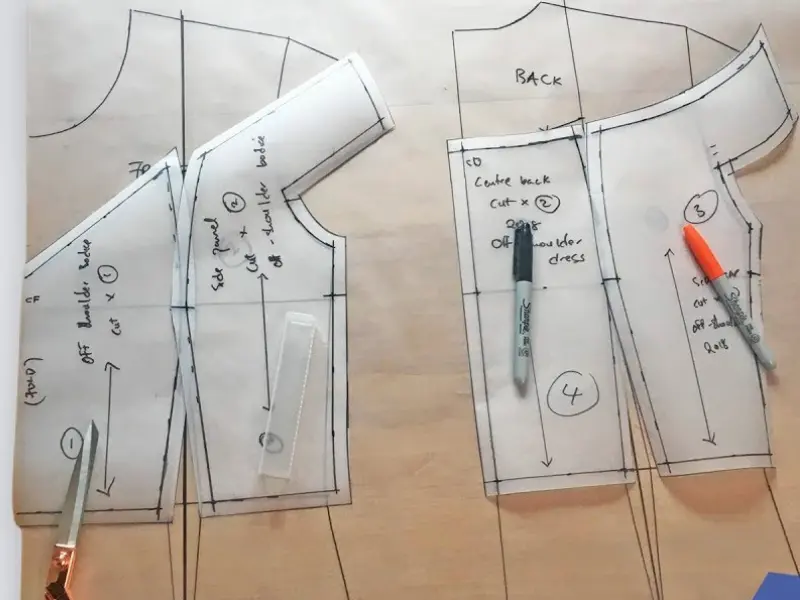
The pattern should position the off-shoulder neckline along its intended body path while allowing enough mobility for the upper arms and shoulders. Stability comes from balanced neckline length, correct bust and torso fit, suitable sleeve geometry, and controlled negative ease where necessary. A successful pattern does not depend on making the upper edge extremely tight; it lets the garment move naturally and then return close to its intended position.
Set the Neckline Path
“Off-shoulder” describes a wide range of silhouettes rather than one fixed neckline position. Some styles sit only slightly below the shoulder point. Others expose much more of the upper chest and back. A soft Bardot blouse can drape around the upper arms, while a fitted satin occasion dress may need a much more precise line because a small shift changes bust coverage and the overall silhouette.
The intended wearing position should therefore be defined before the neckline length is finalized. The development team should determine where the neckline sits at the center front, side, upper arm, and center back. Those locations create a body path that the pattern must follow. Once that path is clear, neckline circumference and elastic requirements can be developed around the actual design rather than chosen as an isolated measurement.
Elasticized styles often need negative ease, but there is no single correct percentage for every fabric and elastic. Two elastics that are both 10 mm wide can produce very different holding force at the same extension. Their yarn structure, density, construction, and supplier specification may differ even when the visible appearance is almost identical.
During sampling, it can be useful to compare several elastic lengths while leaving the pattern unchanged. For example, a development team might test elastic equal to approximately 90%, 95%, and 100% of the casing path as comparison versions. Those figures are not universal recommendations. The useful result is identifying which version provides sufficient hold without visible compression, uncomfortable pressure, excessive gathering, or restricted arm movement.
Balance Bust and Torso
A fitted off-shoulder dress should not hang entirely from the neckline. In a well-balanced body-conscious or occasion style, the bust shape, waist fit, side panels, lining, and internal structure can all contribute to stability. The upper edge then controls the visual neckline position rather than functioning as the only element preventing the garment from falling.
This becomes especially important when the style includes a full skirt, heavy drape, substantial sleeves, multiple layers, or embellishment. If the torso is too loose, more of the garment’s weight is transferred toward the neckline. Tightening the upper edge may make the wearer feel more secure during a static fitting, yet the dress can still move because the body below the neckline is not supporting it correctly.
Bust imbalance can also make a neckline travel upward. If the front bodice is too tight or lacks enough shaping, the fabric may move toward an area of lower resistance. The center front can rise, the side seam may rotate, and the neckline can appear to be the problem even though the real issue begins lower in the bodice.
During fitting, several areas should be evaluated together: bust apex position, upper-bust pressure, center-front neckline height, side-seam angle, waist position, center-back height, and overall torso contact. A neckline that stays in place while the side seam twists forward is not a complete solution. Good fit allows the whole upper garment to share the work.
Prevent Rolling and Gaping
Gaping often begins with excess edge length, while rolling may result from edge distortion, sewing stretch, seam bulk, lining imbalance, unsuitable interfacing, or the wrong relationship between the outer shell and internal layers. These defects are particularly common on curved necklines because the edge can change length during cutting, handling, sewing, pressing, and fitting.
Stretch fabrics can grow while being stitched, especially when the sewing operation pulls the edge. Woven fabrics cut partly on the bias can also lengthen under handling. A facing or lining that is slightly longer than the shell may push the neckline outward even when the outer paper pattern is correct. That is why simply removing length from the pattern does not always fix gaping.
A useful troubleshooting sequence is to compare the pattern length, cut-piece length, sewn shell length, lining or facing length, and finished neckline measurement. If the paper pattern is correct but the finished edge is longer, the development team should look carefully at feed, sewing tension, pressing, handling, and stabilization before modifying the pattern again.
Interfacing can help structured styles maintain dimension, but excessive stiffness can create new problems. A rigid edge may stop following the curved body surface and stand away from the skin. The goal is to control stretch without turning the neckline into a hard ring. In many cases, selective stabilization works better than reinforcing every part of the upper edge equally.
Grade by Behavior
A successful base-size fitting does not guarantee that the neckline will perform correctly across the entire size range. Upper-arm circumference, bust volume, torso shape, shoulder breadth, and upper-bust measurement do not always increase at the same rate. Mechanical grading can therefore create a neckline that becomes proportionally too loose in larger sizes or excessively restrictive in smaller sizes.
Fit-sensitive styles benefit from checking representative anchor sizes. For an XS–XL range, a smaller size, a middle size, and a larger size can provide more useful information than approving only the medium base size. Wider ranges may require additional fitting points, particularly when the design is structured, highly fitted, or relies on precise bust coverage.
The same movement routine should be repeated on each selected size. If the small size shifts 5 mm, the medium 7 mm, the large 10 mm, and the extra-large 23 mm under the same test, the sharp change in the larger size deserves investigation. The important issue is not whether one number is universally acceptable. The technical team needs to understand why performance changes across the grade.
Coverage should be evaluated alongside movement. A neckline may remain perfectly stable but sit too low across a fuller bust. Another size may remain in position but create excessive pressure on the upper arm. Good grading preserves the intended silhouette, support, comfort, and movement behavior rather than simply enlarging the base pattern mathematically.
Which Support Methods Keep the Neckline Stable?
Off-shoulder necklines can use elastic, silicone grip, fitted internal structures, boning, or hidden anchoring methods to improve stability. The best choice depends on fabric, silhouette, movement requirements, and how much of the garment’s weight the bodice itself can carry. Effective support should keep the neckline close to its intended position without creating visible distortion, strong pressure marks, skin discomfort, or unnecessary restriction around the arms.

Elastic and Recovery
Elastic is one of the most common support methods in soft off-shoulder garments, but specifying only the width leaves important variables uncontrolled. A technical note that says “10 mm elastic” does not explain the supplier, construction, force, cut length, joining method, placement, or performance after repeated extension. Two elastics with identical width and appearance can behave very differently once they are stretched around the body.
Recovery is particularly important. An elastic may feel strong during the first fitting and still lose effective holding force after repeated dressing, extension, and wear. The same can happen with stretch fabric around the neckline. A garment that passes the first five minutes of fitting but becomes noticeably looser after repeated movement has a different problem from one that starts loose immediately.
During development, the support system can be cycled before final approval. The neckline can be stretched repeatedly, the garment can be dressed and removed several times, and the model can complete a standard movement test. Measurements taken before cycling, immediately afterward, and after a recovery period show whether the opening is gradually becoming longer.
Elastic distribution during sewing also matters. If one area receives more stretch than another, the finished neckline may be tighter on one side and looser on the other. Quarter marks or additional control marks can help operators distribute tension consistently. The target is not maximum tightness. The wearer should feel supported without feeling that the neckline is gripping the upper body aggressively.
Silicone Grip
Silicone grip can improve security by increasing friction between the garment and the body. It is particularly useful in exposed-shoulder designs where conventional straps would interfere with the intended appearance. The important point is that silicone should support a correctly developed fit rather than compensate for a bodice that is fundamentally too large or poorly balanced.
If the upper torso is oversized, a strong grip strip may stop the neckline from moving in one area while the garment below it continues trying to shift. The result can be uncomfortable pulling because the silicone holds the skin while the rest of the dress moves. This is why more grip does not automatically mean better performance.
Width, softness, placement, stretch behavior, seam method, and care durability all need consideration. A wider strip may increase contact area, but it can also increase heat, pressure, and visibility under lightweight fabric. A narrow strip may be more comfortable but provide insufficient friction for a heavy garment.
A controlled sample comparison is useful. The same dress can be tested with and without the proposed silicone while all other variables remain unchanged. If the grip reduces noticeable neckline displacement without creating discomfort or edge distortion, it is contributing effectively. If performance changes very little, the team should return to the pattern, bodice fit, sleeve movement, or material selection instead of simply adding stronger grip.
Boning and Hidden Anchors
Structured off-shoulder dresses often benefit from support below the neckline. Boning, fitted linings, internal elastic, support panels, and hidden anchoring methods can transfer part of the garment’s load through the torso, which reduces the amount of work the upper neckline needs to do by itself.
Boning should be treated as one element within a larger system. Its location, length, stiffness, casing, waist fit, bust shaping, and connection to the rest of the bodice all influence whether it actually improves stability. A bodice can contain several bones and still slip if the torso is too large. In that situation, the boning simply moves downward with the garment.
A well-contoured bodice may remain stable with relatively light internal support because the load is distributed through the upper torso and waist. The technical team should therefore think about the garment’s load path. Where is the skirt weight supported? Which area controls bust position? What prevents the bodice from rotating? What keeps the sleeve from transferring too much force into the neckline?
Hidden anchors can be useful where local sleeve control is needed. Their placement should reduce unwanted travel without cutting into the arm or creating a visible pulling point. The best construction usually feels surprisingly uncomplicated to the wearer because several small structural decisions are working together rather than one component doing all the work.
Temporary Fixes vs. Built-In Support
Fashion tape, body tape, safety pins, and hidden hair-tie techniques can be useful for someone who already owns a difficult garment. They are popular because they are quick, inexpensive, and often effective enough for a single event. From a development perspective, they can also reveal useful information about what kind of support the garment is missing.
If a sample repeatedly rides upward but becomes stable when a temporary underarm anchor is added, that suggests sleeve movement is playing a significant role. If fashion tape substantially reduces downward slipping on a fitted dress, the team can ask whether more friction, better contour, or stronger internal anchoring should be built into the production version.
Temporary support may also be acceptable for highly stylized garments intended for limited movement, editorial styling, performance, or a specific campaign. Fashion products do not all require the same mobility standard. The intended use should determine the level of built-in control.
For a party or occasion dress expected to be worn through several hours of walking, sitting, dining, socializing, and dancing, however, repeated manual adjustment is usually a sign that another development round is worthwhile. The most successful garments allow the wearer to focus on the occasion rather than repeatedly checking whether the neckline is still where it started.
How Do Sleeves and Arm Movement Affect Stability?
Off-shoulder sleeves are mechanically connected to neckline stability. Tight upper-arm openings, insufficient sleeve depth, heavy gathered sleeves, and poor sleeve-to-bodice balance can pull the neckline upward or sideways whenever the wearer moves. A garment that looks perfect with relaxed arms should not be approved until it has been tested through reaching, lifting, sitting, walking, and other realistic upper-body movements.

Sleeve Opening and Pull
The upper-arm opening is one of the first places to investigate when an off-shoulder neckline repeatedly rides upward. As the wearer lifts her arm, the sleeve must change angle and travel around the upper body. If the opening is too tight, it grips the arm and follows it upward. Because the sleeve and neckline are connected, the neckline is pulled upward as well.
This explains why simply shortening neckline elastic can make riding-up worse. The stronger elastic resists movement, but the sleeve still needs additional room. The wearer experiences more pressure while the garment continues trying to move. The correction may instead involve sleeve depth, upper-arm circumference, attachment position, or the way the sleeve transitions into the neckline.
During a fitting, observe the sleeve with the arms relaxed, approximately horizontal, and raised overhead. Look for compression around the upper arm, sudden tightening of gathers, seam rotation, and changes in neckline height. If one side behaves differently from the other, compare both sleeve openings and attachment points rather than assuming the neckline itself is asymmetric.
The underarm position is equally important. A connection point that is too high can leave very little movement reserve, while one that is too low can make the sleeve sag and change the intended silhouette. Small adjustments around the sleeve can sometimes reduce neckline travel more effectively than much larger changes to the elastic.
Test Real Movement
Static fittings remain important for evaluating silhouette, proportion, balance, and basic coverage, but they are limited when the main defect appears during movement. A repeatable movement routine allows the development team to compare one sample against another instead of relying on general comments such as “this one feels more stable.”
| Movement test | Practical starting quantity | What it can reveal |
|---|---|---|
| Raise both arms overhead | 10 repetitions | Upward neckline travel |
| Reach forward | 10 repetitions | Back tension and sleeve restriction |
| Cross arms in front | 5 repetitions | Upper-arm pressure |
| Rotate torso left and right | 10 repetitions | Side-to-side instability |
| Sit and stand | 5 cycles | Downward bodice movement |
| Walk normally | 3–5 minutes | Gradual slipping or rotation |
| Wear before re-measuring | 15–20 minutes | Fabric and elastic growth |
These figures are useful development routines rather than universal technical standards. A relaxed resort top may reasonably allow more movement than a highly structured fitted mini dress. Each brand should decide which movements matter most for the product and how much displacement is acceptable before the design is approved.
Video can make the fitting much more useful. Recording the front and side during repeated movement allows the team to see which area begins to move first. Sometimes the sleeve tightens several moments before the neckline rises, clearly identifying the source of the problem. A short slow-motion clip can explain this relationship more effectively than a long written comment.
Measurements should be repeated after the movement sequence. Even one simple reference point at the center front can turn a vague opinion into useful data. When successive samples are tested in the same way, the team can see whether a change genuinely improves performance rather than simply looking better during a static fitting.
Watch Puff Sleeves and Ruffles
Puff sleeves, layered ruffles, bows, draped panels, and statement details change the mechanical behavior of an off-shoulder neckline because they add material, volume, seam bulk, and sometimes significant weight. A lightweight chiffon puff sleeve and a double-layer satin puff may have a similar silhouette but place very different loads on the bodice.
A heavy sleeve can pull downward while the arms are relaxed and then push or drag the neckline upward when the wearer moves. Ruffles can create asymmetric forces when gathering is not distributed evenly. These effects may be small on one sleeve, but once the garment includes two sleeves, lining, elastic, and decorative layers, the combined load can become noticeable.
Production consistency matters here as much as pattern accuracy. Two sleeves can use identical pattern pieces and still behave differently if gathering is concentrated in different places. Control notches and gathering marks help maintain both visual fullness and mechanical balance from piece to piece.
Seam bulk around the neckline should also be reviewed. Outer fabric, lining, ruffles, elastic casing, reinforcement, and seam allowances can create a thick local area that does not bend as easily as the rest of the edge. A garment may therefore appear symmetrical while standing and become noticeably asymmetric during motion. Movement testing is particularly valuable on these more elaborate sleeve constructions because the problem may not appear until the entire garment is assembled.
Which Fabrics Need More Neckline Support?
Fabrics with weak recovery, high stretch, smooth surfaces, heavy drape, or substantial garment weight usually need closer neckline development. Satin, soft jersey, stretch mesh, lightweight knits, and layered constructions can all change how an off-shoulder neckline behaves. Pattern, elastic, lining, and internal support should therefore be confirmed in the actual production material rather than assumed to perform the same way as an early substitute fabric.

Stretch and Recovery
Stretch and recovery are closely related but not identical. Stretch describes how far a material can extend. Recovery describes how effectively it returns after that extension. For an off-shoulder neckline, good recovery can be more important than high stretch because a fabric that easily expands but slowly grows during wear can gradually change the size of the upper opening.
This is especially important in fitted knitted dresses. A fabric can look excellent when the garment is first put on because it stretches smoothly around the body. After repeated movement, however, the neckline may become noticeably larger if the material does not recover well. The same paper pattern can therefore behave differently in two fabrics that seem similar during an initial hand-stretch test.
Development teams should compare fabric behavior through a consistent internal procedure or an appropriate textile test method. ASTM D2594, for example, is one recognized method used for stretch and growth evaluation on suitable knitted fabrics, although the correct method depends on the material structure and the customer’s own requirements.
Even at an early sample stage, simple comparisons provide useful information. A measured reference area can be extended under the same conditions for each candidate fabric, released, and checked after a defined recovery period. The goal is not to replace laboratory testing, but to identify meaningful differences before the garment is fully developed.
A material substitution after sample approval should trigger another fit review whenever stretch or recovery changes noticeably. Matching fiber content alone does not guarantee matching performance. Two polyester-spandex fabrics, for example, can behave very differently depending on knit structure, yarn, finishing, weight, and construction.
Weight, Friction, and Surface
Fabric weight affects the downward load carried by the upper bodice, while surface properties influence how easily the garment moves against the skin or lining. A smooth satin may have relatively low friction, whereas a textured material may naturally grip more. Neither is automatically better; the support strategy simply needs to match the behavior of the chosen material.
Weight becomes more significant when dresses include full skirts, heavy draping, ruching, embellishment, dense linings, or substantial sleeves. The neckline is not responding only to the few centimeters of fabric around the chest. It is part of a garment that may be carrying significantly more material below and beside it.
If a revised sample becomes less stable after adding a fuller skirt or heavier lining, the change deserves to be investigated rather than dismissed as a small styling adjustment. Weighing the original and revised samples can reveal whether the garment has gained enough mass to affect the load carried by the bodice.
Surface friction also affects perceived security. Two dresses made to the same pattern can feel different if one uses a very slippery lining and the other uses a more stable internal surface. Satin requires particular attention because designers often want a very clean upper edge with minimal visible structure. That can work well, but the bodice below may need more careful contouring or internal control.
Fabric selection should therefore include stretch, recovery, weight, drape, friction, and interaction with the lining. A beautiful swatch is only the beginning. The finished garment must still behave correctly when several layers and construction details are working together.
Lining and Interfacing
Lining is a structural part of many fitted dresses, even though the customer rarely sees it. It influences stretch, friction, support, opacity, seam stability, and how the outer fabric behaves during movement. A highly stretchy outer shell paired with a low-stretch lining can restrict motion and transfer more force toward the neckline. An extremely soft lining may provide too little stabilization for a structured silhouette.
The lining and outer fabric should therefore be evaluated both independently and as a combined system. Stretch direction, recovery, seam behavior, and finished hand feel all matter. If the two layers are working against each other, the wearer often feels the problem before the technical team can see it clearly.
Interfacing can help control clean structured edges, particularly where a woven fabric may grow during handling. It can maintain neckline length and create a sharper finish. However, excessive stiffness can make the upper edge stand away from the body, create visible ridges, or reduce comfort when the neckline sits directly against the upper arm.
Before committing to a revised construction, small neckline trials can save time. Several 200–300 mm sections can be sewn using no interfacing, lighter stabilization, and the proposed production option. The team can then compare seam bulk, flexibility, recovery, appearance, and hand feel without constructing three complete dresses.
Selective stabilization is often more successful than making the entire edge equally rigid. Areas that need dimensional control can be supported while sections near the upper arm retain enough flexibility for movement. The finished neckline should feel deliberate and stable rather than obviously reinforced.
How Do You Control Neckline Stability in Production?
Neckline stability becomes repeatable only when the approved fit is converted into measurable production controls. Important points normally include neckline dimensions, elastic reference and cut length, sleeve opening, support construction, symmetry, material behavior, and representative size fitting. First-piece or pilot checks should confirm these variables before volume production, followed by inline and final inspections that focus on the details most likely to change real-wear performance.
Approve the First Sample
The first sample should answer specific technical questions rather than simply prove that the style can be sewn. For an off-shoulder dress, the development team should know whether the sample is primarily testing neckline position, bust balance, sleeve mobility, material behavior, internal structure, overall silhouette, or several clearly identified priorities.
Useful review points include finished neckline circumference, center-front position, center-back position, left and right side height, upper-arm opening, elastic cut length, upper-bust measurement, bust and waist fit, and sleeve attachment position. Front, side, and back photographs before and after movement create a visual record that can be compared with later versions.
Wearer feedback should be recorded alongside measurements. A sample can meet every dimensional specification and still feel restrictive. Comments such as “pressure increases sharply when arms reach forward” are valuable because they describe a behavior that measurements alone may not capture.
Each revision should have a clear purpose. If the first sample rides up, the next version may increase sleeve mobility while leaving neckline circumference unchanged. If that improves movement, the team has learned something useful. If several variables change simultaneously, the result becomes harder to interpret.
Complex or highly fitted styles can also benefit from a first-piece or pilot check before full production is released. Discovering a movement problem on several trial garments is much easier to correct than finding the same defect after hundreds of units have already passed through the line.
Standardize Elastic
Once an elastic configuration works, the approved result should be converted into a specification detailed enough that another production team could reproduce it without relying on memory. Useful information includes elastic reference, supplier where required, nominal width, cut length, joining method, placement, casing construction, and the approved finished neckline measurement.
Operator technique can influence the result even when elastic pieces are cut to the same length. One operator may stretch the garment edge while sewing, another may distribute fullness unevenly, and a third may use a different overlap at the elastic joint. These small differences can change both finished circumference and the way tension is distributed around the body.
Producing several first pieces before releasing a larger quantity is therefore useful. If the same elastic specification produces noticeably different neckline measurements across three to five garments, the sewing process should be investigated before volume increases. The problem may involve feed, marking, gathering distribution, seam method, or operator handling rather than the elastic material itself.
Substitution deserves equal attention. A replacement elastic can match the original width and color while producing a different force at the same extension. Repeat orders are easier to control when the production record contains more information than “black 10 mm elastic.” Supplier references, retained samples, approved swatches, or internal test records provide a stronger foundation for consistency.
Verify Size Grading
Size grading should be verified through real garment behavior in addition to measurement tables. A multi-size range changes bust volume, upper-arm circumference, torso width, and body shape at the same time. The neckline system may therefore behave differently even when every graded measurement follows the approved rule.
Checking representative anchor sizes is a practical way to identify problems before bulk production. A smaller size, middle size, and larger size are often useful starting points, while wider size ranges or particularly structured styles may require additional fit checkpoints.
Each selected size should perform the same movement sequence. Comparable testing allows the team to identify whether a problem appears gradually or suddenly at a certain part of the size range. A record might show that smaller sizes remain stable, while a larger size begins to drop noticeably after walking or repeated arm movement. That pattern immediately directs attention toward grading rather than the base construction.
Coverage should also be reviewed. A neckline can remain stable and still sit too low across a fuller bust. Another size may remain at the correct visual height but feel restrictive around the upper arm. The commercial goal is not simply to produce mathematically graded measurements. It is to preserve the intended silhouette, comfort, exposure, and movement experience for customers across the range.
Lock QC for Bulk
Production inspection should focus most heavily on the variables that actually influence neckline performance. Not every measurement carries equal risk. When a style depends strongly on elastic tension, sleeve opening, bodice contour, and neckline symmetry, those points deserve clear checkpoints during first-piece, inline, and final inspection.
| Control point | What should be recorded | Production stage |
|---|---|---|
| Elastic reference | Supplier/reference, width, cut length | Material approval |
| Fabric behavior | Approved stretch and recovery reference | Before cutting |
| Neckline dimensions | Finished circumference or key control points | First piece and inline |
| Sleeve opening | Finished measurement | First piece and inline |
| Left/right balance | Side height and sleeve symmetry | First piece and inline |
| Elastic distribution | Even tension and gathering | Sewing line |
| Upper-edge finish | No rolling, twisting, stretching, or gaping | Inline inspection |
| Representative size fit | Brand-selected anchor sizes | Size-set approval |
| Movement behavior | Approved repeatable wear sequence | Pilot or PP stage |
| Repeat-order consistency | Materials and construction vs. approved reference | Every repeat program |
Tolerance levels should be established by the brand’s technical team for the actual silhouette rather than borrowed blindly from an unrelated style. A structured occasion dress may require much tighter visual control than a relaxed elasticated resort top because the consequences of a similar movement are very different.
The production team also needs to understand which measurements are truly critical. If neckline stability depends heavily on a particular sleeve opening and elastic reference, those details should be monitored more closely than measurements that have little effect on how the garment wears.
Retained samples, construction notes, approved elastic references, size-set comments, and movement-test records become particularly valuable during repeat orders. They help the team determine whether a later difference comes from material substitution, sewing execution, grading, pattern changes, or another source.
For brands developing fit-sensitive off-shoulder dresses, working with a development-focused manufacturer can make this process easier because pattern, fabric, sample, and production decisions can be reviewed as one connected system. Duolan’s role in this kind of project is not simply to make the neckline tighter, but to help identify where the movement begins and translate the approved solution into a version that can be repeated consistently in production.
Conclusion
Keeping an off-shoulder neckline in place is less about finding one clever trick and more about balancing several small technical decisions. The neckline opening needs the right effective length, the upper bodice needs to fit the body correctly, the sleeves need enough mobility, the fabric and elastic need suitable recovery, and any internal support needs to share the garment’s load without creating unnecessary pressure.
The most useful development mindset is to treat movement as part of fit rather than as a problem discovered after the garment is finished. A dress should be evaluated while the wearer raises her arms, reaches, walks, sits, turns, and wears the garment long enough for fabric and elastic behavior to become visible. That is where many weaknesses appear, and that is also where the most meaningful improvements can be made.
When the pattern, material, support, and production controls work together, the wearer usually does not notice any of them. She does not think about silicone, elastic recovery, sleeve geometry, or grading. She simply notices that the dress stays where it is supposed to stay and feels comfortable enough to forget about it. For an off-shoulder garment, that quiet reliability is one of the strongest signs that the product has been developed properly.
Frequently Asked Questions
How do I stop an off-shoulder neckline from riding up?
If an off-shoulder neckline rides upward when you lift your arms, check the sleeve opening and movement allowance before simply tightening the elastic. Tight upper-arm openings frequently pull the sleeve and neckline upward together. A development sample should be tested through repeated arm lifting and forward reaching. If increasing sleeve mobility reduces neckline movement, the problem was related to force from the sleeve rather than a neckline that was too loose.
How can an off-shoulder dress be kept from slipping down?
A dress that slips downward usually needs better support through the upper bodice, more appropriate neckline tension, improved fabric or elastic recovery, or a smaller effective opening. Structured styles may also benefit from silicone grip, internal elastic, fitted lining, or boning. The best solution depends on where the garment loses position. Tightening only the neckline can create discomfort without stopping the bodice itself from moving.
Is fashion tape enough to hold an off-shoulder dress in place?
Fashion tape can be useful for a finished garment, especially for an event where only modest additional security is needed. However, during product development it should not automatically replace correct fit and construction. If a sample requires substantial tape to remain stable during ordinary movement, the pattern, bodice support, sleeve balance, or material behavior should usually be reviewed. Tape works best as an optional styling aid rather than the main structural system of a commercially developed dress.
Should off-shoulder neckline elastic be shorter than the fabric opening?
In many elasticated styles, the elastic is shorter than the casing path so that it provides controlled tension, but there is no single correct percentage for every garment. Elastic modulus, width, construction, fabric recovery, neckline position, and wearer comfort all affect the required length. Development teams often compare several lengths in sampling and approve the version that provides stable hold without excessive gathering, visible pressure, or restricted arm movement.
Does boning help an off-shoulder dress stay up?
Boning can improve stability in a structured fitted dress because it helps distribute load through the bodice rather than leaving the neckline to support the garment alone. However, boning is effective only when the torso and bust fit are correct. If the bodice is too large, the boning may simply move downward with the dress. It should therefore be considered part of a complete support system that can also include contour shaping, lining, waist fit, grip, and internal elastic.
Which fabrics are hardest to control in off-shoulder dresses?
Fabrics with weak stretch recovery, very smooth surfaces, significant weight, or unstable edges often require additional development. Soft jersey may grow during wear, satin can have low surface friction, stretch mesh may change shape depending on direction, and heavy layered constructions can pull the bodice downward. The important point is not that these fabrics should be avoided, but that pattern and support decisions need to be confirmed using the actual material rather than assuming every fabric will behave like the development substitute.
How should an off-shoulder dress be tested before bulk production?
A practical pre-production review should combine measurements with movement. Check neckline circumference or approved control points, sleeve openings, symmetry, elastic specification, and representative size fit. Then ask the fitting model to raise the arms repeatedly, reach forward, rotate the torso, sit and stand, and walk for several minutes. Re-measuring afterward helps identify riding, slipping, twisting, or material growth before the same problem is repeated across a larger production run.