Skip to content

Elastic Ruching vs Fixed Ruching: Which Is Better for Fit, Fabric, and Bulk Production?
Your trusted Women’s Apparel Development & Manufacturing Partner from China
- Jerry
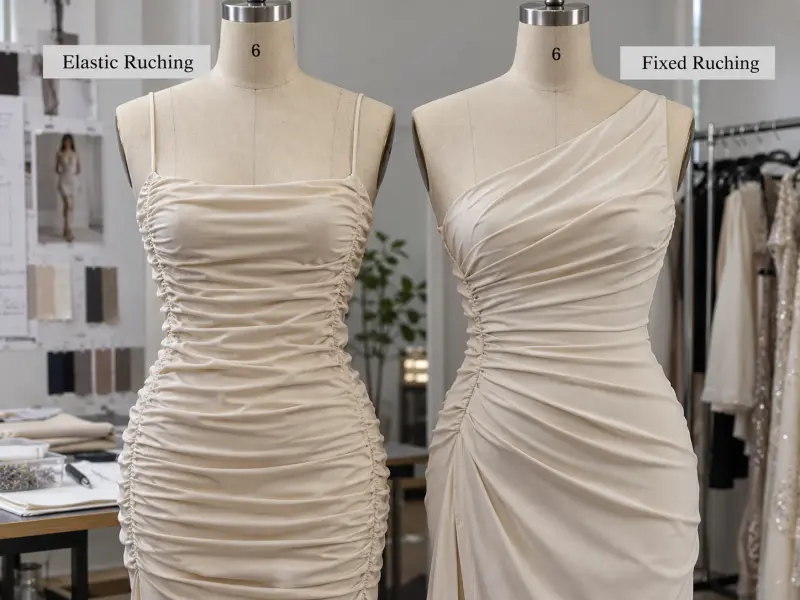
Ruching looks simple in a finished dress because the eye mainly sees texture: soft folds running along a side seam, controlled fullness over the bust, or gathered fabric shaping the waist. In development, however, two dresses with almost identical product photos can behave very differently once they are worn, stretched, graded, washed, and reproduced in volume. The construction behind the folds matters as much as the appearance itself. Elastic ruching is usually the stronger choice when a garment needs movement, body accommodation, and controlled stretch, while fixed ruching is usually better when the priority is stable fold placement, deliberate drape, and visual repeatability. Neither method is automatically better. The right choice depends on fabric behavior, garment ease, ruching location, intended silhouette, size range, lining structure, and the degree of production control required. A side-ruched bodycon dress can look perfect on a mannequin and then flatten across the hip on a wearer, while a beautifully draped fixed satin panel can become overcrowded after careless grading. The practical question is therefore not simply, “Which ruching looks better?” but “What does this ruching need to do after the garment leaves the sample room?”
Elastic ruching uses elastic tension to form or maintain gathered fabric, so the ruched area can usually expand and recover during wear. Fixed ruching secures fullness into a predetermined length or position with stitching, seams, tacks, or other anchoring methods. Elastic construction favors adaptability and movement; fixed construction favors controlled styling. For commercial dress development, the better option is the one that preserves fit, appearance, comfort, and consistency across the intended fabric, size range, and production quantity.
A useful way to think about the difference is to imagine two dresses that both show twenty centimeters of visible side ruching when they are hanging on a rail. On the first dress, that twenty-centimeter zone may stretch to twenty-five or twenty-eight centimeters on the body because elastic controls the gathering. On the second, the same twenty-centimeter zone may remain almost unchanged because the fullness has been fixed into a stable seam. The first dress lets the body change the folds; the second asks the pattern and fabric to fit the body while the folds largely stay where the designer placed them. That single distinction affects almost everything that follows, from material selection and fit comments to grading rules and quality inspection.
What Is Elastic Ruching and Fixed Ruching?
Elastic ruching gathers fabric with an elastic component that contracts the material and allows the finished area to expand again during wear. Fixed ruching gathers and secures fullness so the final length and fold placement remain relatively stable. Both methods can create similar visual texture, but elastic ruching behaves dynamically under tension, while fixed ruching depends more heavily on accurate pattern dimensions, controlled gathering, and deliberate anchoring.
Elastic Ruching
Elastic ruching is created when a longer section of fabric is controlled by a shorter elastic component. That component may be narrow elastic tape hidden inside a seam, elastic stitched directly to a seam allowance, elastic thread used through one or more rows of stitching, or an elasticized casing built into the garment. Once the tension is released, the elastic contracts and pulls the fabric into folds. When the wearer stretches the garment, part of that fullness opens again. If a forty-centimeter fabric section is attached to twenty-eight centimeters of elastic, the nominal reduction is thirty percent. That number is useful for comparing versions, but it is not a universal recipe. A soft stretch mesh, lightweight jersey, and compact double knit can all react differently to the same thirty-percent reduction because their thickness, friction, extension, and recovery are different.
The most important development point is that elastic ruching has at least two visual states: relaxed and worn. A side panel can look densely gathered on a hanger but noticeably flatter when stretched over the hip. That is not necessarily a defect; it is part of the construction. Problems arise when the team approves only the relaxed sample and never checks the garment at the intended body measurement. For fitted styles, the sample should be assessed on a fit model or form that represents the target size, because the visible density of ruching under real tension is what the customer will actually see. Elastic also adds a long-term performance question. If the elastic or shell fabric recovers poorly after repeated extension, the folds can gradually lose depth, the side seam can lengthen, and the dress may appear looser after wear even though the original sample looked correct.
Fixed Ruching
Fixed ruching uses controlled fabric fullness without relying on elastic extension to provide the main fit. A longer fabric edge may be gathered into a shorter seam, secured to a stable panel, held with tacks, caught under a facing, or arranged into deliberate folds before being stitched into position. For example, thirty-six centimeters of satin gathered into an eighteen-centimeter finished side section creates a 2.0:1 fabric-input-to-finished-length ratio. Once that section is secured into a stable seam, it does not automatically become twenty-four centimeters long because the wearer needs more room. The garment must obtain its fit from the base pattern, fabric stretch, darts, panel shaping, a zipper, or another structural element rather than from the ruching itself.
This makes fixed ruching especially useful when the folds are part of the visual identity of the garment. A designer may want a specific concentration of folds over the waist, a controlled diagonal drape toward the hip, or a precise amount of fullness through the bust. Those effects are easier to preserve when the fabric is anchored rather than allowed to move freely with elastic tension. “Fixed ruching” should therefore be understood as a functional description, not one standardized stitch. Different sample rooms may achieve the result through slightly different methods, which is why a technical pack should describe the measurable construction instead of relying on the term alone. Fabric input, finished length, start and end points, gathering distribution, tack locations, seam structure, and an approved visual reference together make the intended effect reproducible.
Ruching, Shirring, and Gathering
Ruching, shirring, and gathering overlap, but treating them as interchangeable can cause avoidable sample errors. Gathering is the basic operation of reducing a longer fabric edge into a shorter length. Ruching normally describes the visible styling effect created when that controlled fullness becomes an intentional feature of the garment. Shirring usually refers to multiple rows of elasticized stitching that contract a broader fabric area and create a relatively regular stretchable surface. A gathered skirt waist may not be described as ruched because the fullness simply releases into the skirt, while a fitted dress with deliberate folds running from waist to hip clearly uses ruching as a design element. Likewise, a single elasticized side seam can create elastic ruching without becoming a fully shirred panel.
The distinction matters most when instructions move from design to production. “Shirred waist” may lead a sample maker toward several horizontal rows of elastic thread. “Side ruching with 6 mm elastic from waist notch to high-hip notch” describes a much narrower and more localized construction. Strong development documents therefore pair terminology with dimensions and construction details. The name explains the intended look; measurements and reference points explain how to reproduce it. This becomes even more important when multiple factories, sample makers, or production lines are involved, because familiar fashion words can be interpreted differently while a defined finished length, elastic specification, balance notch, and approved sample are far harder to misunderstand.
How Do Elastic and Fixed Ruching Differ?
Elastic and fixed ruching differ most in how they respond to tension. Elastic ruching expands with movement and changes visually as the garment stretches, while fixed ruching keeps a more stable finished length and fold arrangement. Elastic construction generally offers more body accommodation; fixed construction generally offers more precise styling control. Their grading methods, failure points, comfort behavior, and bulk-production checks therefore need to be managed differently.

Comparison Point | Elastic Ruching | Fixed Ruching |
Finished length | Changes as elastic extends | Largely predetermined |
Main function | Stretch and body accommodation | Controlled visual fullness |
Fold density | Changes under body tension | More stable during wear |
Recovery dependency | High | Lower unless the base fabric is stretch |
Fit flexibility | Usually higher within a defined range | Depends more on accurate patterning |
Typical risk | Over-tension, growth, uneven recovery | Uneven distribution, bulk, misplaced folds |
Grading concern | Elastic length and wearing extension | Fullness ratio and anchor placement |
Bulk control | Elastic specification and tension | Notches, gathering ratio, and anchoring |
Stretch and Recovery
The clearest difference appears when the garment is measured in a relaxed state and then again on the body. Imagine an elasticized side section measuring twenty-four centimeters when relaxed and thirty centimeters during wear. The section has extended by twenty-five percent, and some of the fabric that previously appeared as visible fullness has been consumed by that extension. The ruching therefore becomes shallower. A fixed twenty-four-centimeter ruched section behaves differently. If the seam itself is stable, it stays close to twenty-four centimeters, so the pattern or surrounding fabric must provide the additional room. This can be desirable in a structured dress because the decorative folds remain controlled, but it puts more responsibility on pattern balance and fabric selection.
Recovery is the second major difference. A material may stretch comfortably but fail to return near its original length after repeated loading. A simple development check is to mark a twenty-centimeter section, extend it to a predetermined test length several times, allow it to relax, and measure it again. If it finishes at twenty point eight centimeters, the section has retained four percent growth. Whether that is acceptable depends on the fabric and product, but the number gives the development team something objective to discuss. In an elastic side-ruched dress, permanent growth may flatten the folds, lower the side seam, or change the hem balance. In fixed ruching, the visual folds are less dependent on elastic recovery, although the base stretch fabric may still need good recovery to maintain overall fit.
Visual Control
Fixed ruching usually offers stronger visual control because the amount of fabric, finished length, distribution marks, and anchoring points can all be specified independently of body tension. Consider a twenty-four-centimeter finished side section divided into four six-centimeter zones. If forty centimeters of fabric are entering that area, the pattern can include matching balance marks so the operator distributes fullness in a controlled way rather than pushing all of it toward one end. The folds will never be mechanically identical, and they should not look artificially uniform, but zoned control reduces obvious variation. This matters in satin, draped occasion dresses, and asymmetric styles where the direction of one prominent fold can change the way light and shadow shape the body.
Elastic ruching is intentionally more dynamic. Two wearers with different hip projection can create different fold depth in the same labeled size, because the section stretches according to body tension. That variation can be useful in a fitted commercial style where comfort and adaptability matter more than exact fold placement. The key is to decide what the design is trying to preserve. If the folds should adapt naturally, some movement is part of the intended function. If the folds create a signature drape that must remain visually stable across photography, retail display, and wear, fixed construction or a hybrid method usually gives the development team more control.
Fit Flexibility and Comfort
Elastic ruching can provide useful fit flexibility, but it should not become a shortcut for correcting an inaccurate base pattern. The amount of elastic reduction can be calculated as: elastic reduction percentage = (fabric section length minus elastic length) divided by fabric section length, multiplied by one hundred. If thirty centimeters of fabric are controlled by twenty-four centimeters of elastic, the reduction is twenty percent. If the same fabric is controlled by eighteen centimeters of elastic, the reduction becomes forty percent. Those two versions can feel and look dramatically different even when every pattern piece is otherwise identical. Stronger contraction may increase visible gathering in the relaxed garment, but it also increases local pressure and can shorten the seam.
Excessive tension can create side-seam rotation, a rising hem, vertical compression, or discomfort at the waist and hip. Fixed ruching offers less automatic dimensional tolerance, yet this can be an advantage when the garment already has another fit mechanism. A zip-back satin dress, boned corset dress, or stretch bodycon style with carefully graded negative ease may not need the ruching itself to provide fit. In those cases, separating function is often cleaner: the pattern and fabric handle body fit, while the fixed ruching handles surface styling. This approach also makes fit comments easier to diagnose because a visual fold problem is less likely to be confused with a tension problem caused by elastic.
Which Fabrics Work Best for Each Ruching Method?
Elastic ruching works best when the fabric can gather smoothly, tolerate repeated extension, and recover without severe distortion. Fixed ruching is often better when drape, fold direction, and visual placement are more important than stretch. Fabric weight, thickness, friction, stretch direction, recovery, grain, and lining behavior should be evaluated together, because fiber content alone rarely predicts how a ruched construction will behave in wear or production.

Stretch Fabrics
Stretch jersey, soft knits, stretch mesh, and some stretch crepes are natural candidates for elastic ruching because their mechanical behavior can work with the elastic rather than resisting it. Even so, two fabrics with the same quoted stretch percentage can produce very different results. One may have strong recovery and form rounded, clean folds; another may feel equally stretchy by hand but remain slightly elongated after wear; a third may recover well but be thick enough that gathering creates a bulky ridge in the seam. Development teams should therefore avoid selecting a fabric only because a supplier states “30% stretch.” The useful question is how the material behaves at the actual extension, seam construction, and layer combination used in the garment.
A practical sampling method is to photograph the same ruched panel relaxed and at several controlled extension levels, such as ten, twenty, and thirty percent. These are test points rather than universal wearing targets. Their purpose is to show how quickly the ruching disappears as tension increases. If the design looks richly gathered at zero percent but nearly flat at the expected wearing extension, the team can increase fabric input, revise elastic length, reduce negative ease, move the ruching to a lower-stress zone, or select a different material. This kind of early comparison is far cheaper than discovering after bulk cutting that the approved visual effect only existed on the hanger and not on the customer’s body.
Wovens and Drapey Fabrics
Satin, chiffon, woven crepe, georgette, and non-stretch mesh often respond well to fixed ruching because these materials can be arranged into deliberate folds without requiring the ruched seam itself to expand. Satin shows why fabric behavior matters so much. If thirty centimeters of satin are gathered into twenty centimeters, the ratio is 1.5:1. Increasing the same finished section to forty centimeters of fabric input creates a 2.0:1 ratio. The second sample will normally appear fuller, but whether it looks better depends on weight, stiffness, grain direction, seam allowance, and the scale of the garment. A heavier satin can become bulky very quickly, while a lightweight satin may accept more fullness but show puckering if stitch tension and handling are poor.
Chiffon creates a different set of challenges. It can produce soft, fluid ruching with relatively high fullness, yet the fabric is more vulnerable to edge distortion and uneven handling. Fixed gathering may need finer balance marks and gentler feed control because small differences in distribution can become obvious in a sheer layer. The best ratio is therefore not a number copied from another style. It is a relationship developed in the actual fabric and approved on the intended silhouette. Once the sample is correct, the ratio, anchor points, and visual reference become production standards that can be checked rather than reinterpreted on every line.
Linings and Layering
The shell fabric is only part of the ruching system. Many fitted and occasion dresses contain lining, power mesh, double layers, cups, boning channels, or stabilizing panels. If those layers stretch differently, the garment may behave according to the least flexible layer rather than the ruched outer shell. For example, a stretch-mesh shell may comfortably extend thirty percent while its lining becomes noticeably resistant at fifteen percent. Once the wearer reaches the lining’s practical limit, the extra stretch capacity of the mesh no longer improves comfort. The lining becomes the controlling structure, and an elasticized outer seam may continue stretching while the inner layer resists, creating pulling or distortion.
Fixed satin ruching has the opposite problem. The outer shell may contain substantial excess fabric while the lining is almost flat. If outer-layer gathers are accidentally caught into the lining seam, the lining can shorten and pull the garment out of balance. Good development instructions therefore describe shell and lining behavior separately. A phrase such as “ruched side seam” is not enough for a multi-layer dress. The team should know which layer carries the gathers, whether the lining remains flat, where the layers are connected, and whether the shell is allowed to move independently. Testing the complete layer package during sampling gives a much more realistic picture than evaluating a face-fabric swatch on its own.
Fabric Situation | Practical Starting Method | Main Development Check |
Stretch jersey bodycon | Elastic or hybrid ruching | Recovery under wearing tension |
Stretch mesh | Elastic or fixed depending on design | Transparency, curling, seam stability |
Lightweight satin | Fixed ruching | Fold direction and puckering |
Chiffon overlay | Fixed ruching | Even distribution and handling |
Heavy satin | Controlled fixed fullness | Seam bulk and pressing behavior |
Stretch shell with lining | Depends on both layers | Relative extension of shell and lining |
Multi-layer occasion dress | Often fixed or hybrid | Layer movement and anchoring |
How Does Ruching Affect Fit and Size Grading?
Ruching changes fit because fabric visible in folds is not the same as usable body ease. Elastic ruching also changes under tension, while fixed ruching keeps a more stable finished length. During grading, product teams must preserve body fit, fold density, placement, and comfort together rather than simply enlarging the base-size pattern. A mathematically consistent grade can still produce noticeably different ruching across smaller and larger sizes.

Ease and Body Fit
A ruched dress can look as though it contains a large amount of spare fabric, but much of that fabric may exist only to create surface texture. Suppose thirty-six centimeters of fabric are gathered into an eighteen-centimeter side seam. The additional eighteen centimeters do not automatically equal eighteen centimeters of usable ease. Once the fabric is folded and attached, the finished construction still occupies eighteen centimeters. In elastic ruching, some fullness may open during extension, but the wearer also encounters elastic resistance. A better fit review therefore records three separate measurements: fabric input length, relaxed finished length, and worn finished length. Those numbers show what the garment is actually doing instead of leaving the team to interpret the appearance by eye.
Ruching can also change vertical balance. Strong side gathering may shorten the garment locally and pull the hem upward, which is especially visible in mini and bodycon dresses. If front and back panels carry different tension, the side seam can rotate forward or backward while the folds hide the movement. Fit should therefore be checked from front, side, and back, both standing and moving. Sitting, walking, and raising the arms can reveal whether the ruched zone redistributes fabric smoothly or creates local pressure. A fit sample that looks attractive in a single still photograph may still need correction if the seam shifts several centimeters during movement or the hem climbs noticeably after a short wear test.
Grading Fixed Ruching
Fixed ruching should be graded by protecting the visual relationship between body size and fold density rather than mechanically increasing every dimension. Consider a base size with a twenty-centimeter finished ruched section and thirty-four centimeters of fabric input, producing a 1.70:1 ratio. If a larger size requires a twenty-four-centimeter finished zone but still uses thirty-four centimeters of input, the ratio drops to 1.42:1 and the ruching will generally appear flatter. Increasing the input proportionally to about forty point eight centimeters restores the 1.70:1 mathematical ratio. Even then, the larger size may not look identical because body curvature changes how the folds spread across the surface.
This is why visual grade reviews matter in fit-sensitive dresses. A base-size sample proves only that the construction works on the base size. Reviewing at least one representative smaller size and one larger size during development can reveal disappearing folds, overcrowded fullness, shifted waist placement, or bulk that becomes obvious only after grading. Directional fixed folds also need their anchor positions graded logically. A prominent fold intended to sit over the natural waist should follow the waist level of each pattern size rather than remain at one absolute distance from another seam simply because the base-size pattern was copied mechanically.
Grading Elastic Ruching
Elastic ruching adds another variable because both fabric length and elastic length may change by size. The development team has to decide what it wants to preserve: the same elastic reduction percentage, the same wearing extension, or a similar visible density of ruching. Those goals can conflict. If size S uses thirty centimeters of fabric with twenty-four centimeters of elastic, the reduction is twenty percent. If size L increases the fabric section to thirty-four centimeters, using twenty-seven point two centimeters of elastic preserves the same twenty-percent reduction. Mathematically the construction is consistent, but the larger wearer may still stretch the section more during wear, making the ruching appear flatter and the elastic feel tighter.
A more useful check is wearing extension. Wearing extension percentage can be calculated as the worn length minus relaxed length, divided by relaxed length, multiplied by one hundred. If a twenty-five-centimeter ruched section becomes twenty-nine centimeters on the fit model, the extension is sixteen percent. If the larger size routinely operates at twenty-eight percent extension, the wearing experience is not equivalent even if the graded elastic reduction looks correct on paper. The best grading rule is therefore confirmed on the body, not only in a spreadsheet. The target is comparable comfort, comparable fold presence, and stable seam placement across the size range, rather than identical numbers applied without regard to how each size actually behaves.
Which Ruching Is Better for Different Dress Designs?
Elastic ruching is usually stronger for fitted designs that need movement, stretch, or pull-on flexibility. Fixed ruching is usually stronger when folds must stay in a deliberate position or create a controlled draped effect. Bodycon, side-ruched, bust-ruched, satin, mesh, and occasion dresses may need different solutions. Hybrid constructions are often more effective than forcing one method across the entire garment when fit and visual styling have different requirements.

Bodycon and Side Ruching
Bodycon dresses often use elastic ruching because the garment already relies on stretch and close body contact. An elasticized side seam can create texture while allowing the waist-to-hip area to expand during movement, and it can help a pull-on style pass comfortably over a wider hip. The main risk is imbalance. If the elastic is too short, the side seam becomes much shorter than the neighboring panels, which can pull the hem upward, rotate the seam, or concentrate folds into one narrow section. This is particularly noticeable in mini dresses, where a small vertical change can alter the apparent hem level by several centimeters.
Fixed side ruching can be the better choice when the shell fabric already provides enough stretch and the designer wants deliberate styling. In that construction, the stretch fabric handles body accommodation while the fixed gathers control the surface. This separation is useful in premium bodycon styles where the folds should stay visually consistent. Regardless of method, side-seam position should be checked at the underarm, waist, high hip, full hip, and hem. If the front panel is under more tension than the back, the seam may move forward; if the back is tighter, it may move backward. Ruching can disguise that shift, so a clean side-view fit photograph is often more revealing than a front image.
Bust and Waist Ruching
Bust ruching affects more than decoration because it changes apparent volume, neckline behavior, coverage, and the direction in which fabric travels over the body. Elastic can work well in soft stretch styles, but excessive tension may pull the neckline inward, reduce usable bust volume, or create pressure through the underbust. Fixed ruching often offers better control when fullness needs to be concentrated over a specific area. A pattern can allocate more fabric around the bust point and less toward the underbust or side seam, creating three-dimensional shape without relying on one continuous elastic line to distribute everything evenly.
Ruching should not be used to hide an incorrect bust pattern. If the garment lacks enough cup volume, additional surface fullness may make the sample look better when flat but will not necessarily solve fit on the body. Bust point position, neckline stability, underbust width, armhole balance, and side-seam alignment should still be assessed separately. Waist ruching follows the same logic. In a soft stretch party dress, elastic can make movement easier. In a boned, corseted, or zip-back occasion dress, the waist size may already be controlled by the internal structure, so fixed ruching is often more logical. The folds can then shape the appearance of the waist without changing the actual waist measurement or introducing unnecessary tension.
Satin, Mesh, and Occasion Dresses
Satin rewards controlled ruching because every fold changes the way light reflects across the garment. A fold that rotates or shifts only a few centimeters can alter the visual balance of the waist or hip, especially under studio lighting. Fixed anchoring is therefore common when the design is built around sculptural drape rather than stretch. Stretch mesh offers more options. Elastic ruching can work effectively in fitted party dresses, but very lightweight mesh may curl, tunnel, or distort if a strong narrow elastic is stitched directly to one seam. A wider seam allowance, support layer, different elastic width, or selected tack points may be needed to keep the result stable.
Occasion dresses often benefit from hybrid construction. A softly ruched outer layer can be fixed into a controlled waist drape while a stretch lining underneath provides comfort. A fitted mesh panel may use elastic to create adaptable fullness but include several fixed anchors so the folds do not migrate during wear. This is often a better solution than insisting that every ruched detail must be purely elastic or purely fixed. Each construction element should have a clear job. If elastic is needed for movement, let it provide movement. If a fold must remain in one place, anchor it. Separating those functions generally makes fitting easier, technical instructions clearer, and bulk production more predictable.
How Do You Control Ruching in Bulk Production?
Consistent bulk ruching requires measurable standards rather than instructions such as “make it like the sample.” Fabric input, finished ruched length, elastic dimensions, gathering ratio, start and end points, distribution marks, anchoring, graded measurements, and visual references should be locked before production. The approved sample remains essential, but specifications and checkpoints are what allow hundreds or thousands of garments to reproduce that sample with controlled variation.

Setting Ruching Density
Ruching density begins with a simple relationship: gathering ratio equals fabric input length divided by finished ruched length. A forty-centimeter fabric section reduced to twenty centimeters produces a 2.0:1 ratio, while thirty centimeters reduced to the same twenty centimeters gives 1.5:1. The difference is large enough to change both appearance and seam bulk. The ratio should not be treated as a universal style standard because 2.0:1 can look soft in chiffon, rich in lightweight satin, and excessively bulky in a thick jersey. Its value comes after the sample is approved, when the ratio becomes a measurable reference for reproducing the same development result.
Distribution matters just as much as the total ratio. Forty centimeters of fabric gathered into twenty centimeters can be spread evenly, concentrated toward the waist, concentrated toward the hip, or divided into several clusters, and each version creates a different silhouette. Where visual placement matters, patterns should include balance marks that divide the gathering area into smaller zones. Instead of asking an operator to control one thirty-centimeter section by eye, the team might divide it into three ten-centimeter input zones matched to three corresponding finished zones. This reduces the chance that one operator pushes most of the fullness toward the top while another concentrates it near the bottom, even though both technically use the same total fabric length.
Controlling Elastic Tension
Elastic tension should be defined through material specification and finished measurement rather than by how strongly an operator happens to pull during sewing. If a thirty-two-centimeter fabric section requires twenty-four centimeters of elastic, that elastic length should be recorded together with width, type, approved supplier or equivalent, stitch method, and any relevant relaxation instructions. Changing to another elastic with the same nominal width does not guarantee the same force or recovery. Two six-millimeter elastics can feel very different once stretched, and that difference can show up as a change in fold density, local compression, or finished seam length.
Pre-marking the elastic and fabric into equal sections is a simple way to improve distribution. If both components are divided into quarters, each quarter can be matched during sewing instead of asking the operator to stretch the entire length continuously by feel. A pilot run should then be measured before full production continues. If the approved relaxed length is twenty-four point zero centimeters but early units range from twenty-two point five to twenty-six point zero centimeters, the process needs investigation even if individual garments appear acceptable. The correct tolerance depends on the style and brand requirement, but a wide unexplained range signals variation in handling, feeding, elastic performance, or measurement method that is likely to become larger once production volume increases.
QC and Repeat Orders
Quality control should inspect ruching as both a measurement issue and a visual issue. A garment can meet one finished length and still fail because the folds are concentrated in the wrong area, the left and right sides are unbalanced, the seam twists, or the elastic tunnels through the fabric. The most useful control sheet combines numbers with a visual reference. It should show the approved garment relaxed and, for fit-sensitive elastic ruching, on the intended body measurement. That gives QC a clearer benchmark than a written description alone and helps distinguish acceptable natural variation from a genuine production defect.
Control Point | Example of What to Record | QC Purpose |
Fabric input | 40 cm before gathering | Confirms designed fullness |
Finished length | 20 cm relaxed | Controls overall density |
Gathering ratio | 2.0:1 | Links input to finished result |
Start and end points | Waist notch to hip notch | Controls placement |
Elastic specification | Width, length, approved type | Controls tension source |
Distribution marks | 3-4 balance zones | Controls fold concentration |
Left/right balance | Style-specific tolerance | Prevents obvious asymmetry |
Seam condition | No twisting or severe tunneling | Protects workmanship |
Worn appearance | Compare with approved fit sample | Confirms real-body result |
Size grading | Approved measurements by size | Protects consistency across range |
Repeat-order records | Pattern, material, workmanship version | Prevents specification drift |
Repeat orders are where weak documentation becomes expensive. Several months after the first production, the original operator may be on another line, a new fabric lot may have slightly different stretch, or purchasing may propose an elastic that appears similar but behaves differently under extension. The useful records are straightforward: approved pattern version, fabric specification, elastic details, raw and finished measurements, graded size data, sewing method, distribution marks, photographs, PP sample reference, and known risk points. Before a repeat order starts, these records should be checked against current materials rather than assuming the previous specifications will automatically create the same result. If fabric recovery, handfeel, thickness, or elastic performance changes, the construction should be revalidated before the full quantity is released.
For brands developing fit-sensitive ruched dresses, a useful manufacturing partner should be able to discuss the detail at this level before the style reaches the production line. At Duolan, the practical value of a development review is not simply deciding whether a sample can be sewn; it is identifying whether the chosen fabric, pattern, elastic, lining, and gathering method can maintain the intended look as the style moves through fitting, grading, PP approval, and bulk production. That type of early review is particularly useful for bodycon, mesh, satin, and occasion styles where ruching is both a visual feature and a fit-sensitive construction.
Conclusion
Elastic ruching and fixed ruching are not competing versions of the same detail so much as two different ways of solving a design problem. Elastic ruching is strongest when the garment needs adaptable movement, stretch, and body accommodation. Fixed ruching is strongest when the design depends on deliberate fold placement, controlled drape, and visual stability. The best result often comes from separating functions: let the pattern create the correct body fit, let the fabric provide the right amount of stretch or structure, and let the ruching method control the surface effect it was actually designed to create. Once those roles are clear, sampling becomes easier to evaluate and grading becomes much more predictable.
The real test begins when one approved sample has to become a reliable product across multiple sizes and production quantities. Fabric input, finished length, elastic reduction, wearing extension, gathering distribution, anchor placement, lining behavior, and QC references all become part of the same system. A ruched dress should not rely on an operator remembering how the sample looked or on elastic quietly compensating for fit problems. It should be engineered so the visual result and wearing performance can be explained, measured, and reproduced. That is the difference between a detail that photographs well once and a construction that can support repeat orders season after season.
Frequently Asked Questions
Is elastic ruching better than fixed ruching for bodycon dresses?
Elastic ruching is often a strong choice for bodycon dresses because it can accommodate movement and work with negative ease, especially through the waist and hip. It is not automatically better, however. If the base stretch fabric already provides enough body accommodation, fixed ruching can give more stable fold placement and a cleaner visual result. The best choice depends on where the stretch should come from, how much ruching should remain visible on the body, and whether the side seam needs to expand during wear.
What is the main difference between ruching and shirring?
Ruching describes controlled fullness used as a visible design feature, while shirring usually refers to multiple rows of elasticized stitching that contract a broader area and create a stretchable surface. A dress can have elastic ruching along one side seam without having a fully shirred panel. In product development, the terminology should be supported by measurable details such as finished length, elastic width, number of elastic rows, start and end points, and an approved sample, because different factories may interpret the words slightly differently.
How much fabric is needed for ruching?
There is no single correct fullness ratio because fabric weight, thickness, drape, fold scale, and the desired visual effect all influence the result. A useful way to document a sample is to divide fabric input length by finished ruched length. For example, forty centimeters of fabric reduced to twenty centimeters gives a 2.0:1 ratio, while thirty centimeters reduced to twenty centimeters gives 1.5:1. These ratios are practical comparison tools, not universal rules, and should be confirmed in the actual fabric before bulk production.
Can fixed ruching be used on stretch fabric?
Yes. Fixed ruching can work very well on stretch fabric when the fabric itself provides the required body movement and the designer wants the folds to remain more controlled. This approach is common in fitted styles where stretch and styling are better treated as separate functions. The shell fabric can provide negative ease and recovery, while fixed gathering creates a consistent surface effect. The sample should still be tested under wearing tension because the base fabric may stretch beneath the fixed folds and change how they sit on the body.
How do you stop elastic ruching from becoming uneven in bulk production?
The most reliable method is to replace operator judgment with measurable controls. Specify fabric input length, elastic length, elastic width and type, finished ruched length, start and end notches, and distribution marks. Pre-dividing the elastic and fabric into equal sections can make feeding more consistent. A small pilot run should be measured before the full line proceeds, and QC should compare both dimensions and appearance. If early pieces show a wide range of relaxed lengths, the process should be corrected before the variation spreads through the order.
Does ruching need different grading rules for larger sizes?
Usually, yes. If a fixed ruched section becomes longer in larger sizes but the fabric input does not increase appropriately, the folds can become noticeably flatter. Elastic ruching has an additional complication because wearing extension may increase by size even when the same elastic reduction percentage is used. A strong grading approach therefore checks more than mathematics. It reviews the garment on representative smaller and larger sizes to confirm that fold density, placement, comfort, seam position, and visual balance remain comparable across the intended size range.
Share:
Our Services
Categories
Table of Contents
Here, developing fashion collections is more than manufacturing garments — it’s a collaborative process focused on transforming ideas into well-executed, market-ready products. From fabric sourcing and sample development to scalable production and delivery coordination, every stage is built to support quality, consistency, and efficient collection launches across global markets.