Skip to content
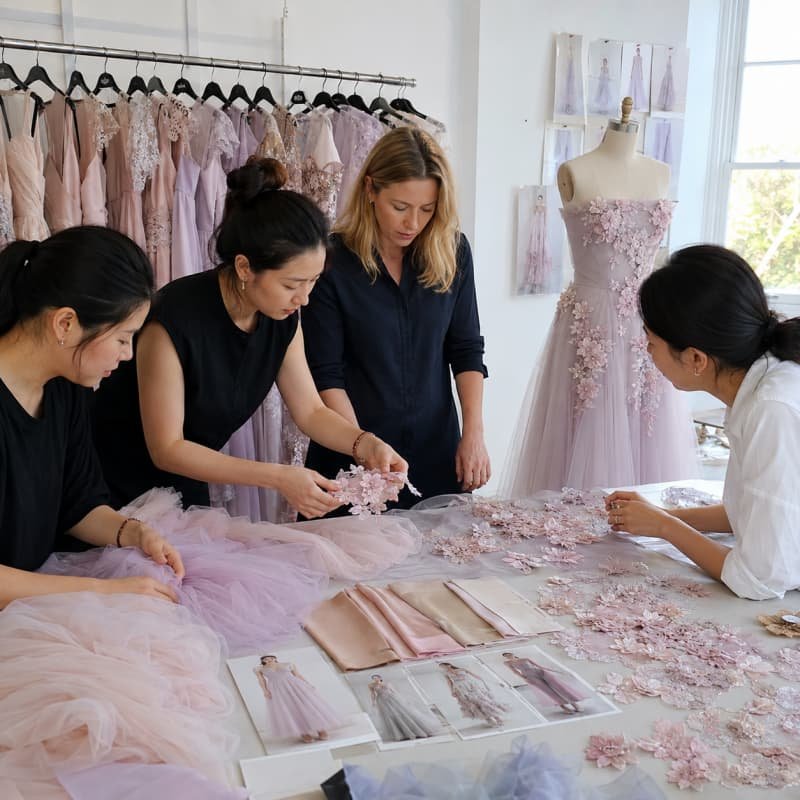
The most important change in 2027 occasionwear is not the simple return of decoration. Sequins, crystals, beads and fabric flowers never disappeared; what is changing is the relationship between embellishment and the garment itself. Decorative surfaces are becoming more dimensional, more precisely positioned and more closely tied to silhouette, movement and emotional impact. A successful embellished dress must now do several jobs at once: hold attention in a campaign image, reveal useful detail in close-up photography, move well in short-form video and remain comfortable enough for an evening of real wear.
Occasionwear embellishment in 2027 will be defined by sculptural surfaces, controlled shine, tactile florals, expressive fringe and precise placement. The strongest dresses will combine visual impact with manageable weight, secure attachment and repeatable production. Instead of decorating every area equally, designers will use embellishment to frame the neckline, shape the waist, balance the hips, highlight the back or animate the skirt.
Early Spring/Summer 2027 fashion, textile and component forecasts repeatedly point toward raised texture, cut-thread effects, dimensional flowers, mixed shine and a more deliberate form of femininity. These signals are useful, but they are not instructions to place every trend on one dress. The real work begins when a brand decides which detail belongs to its customer, price level and occasion calendar. A flower can pull a neckline forward, a beaded hip can twist a soft skirt, and an approved crystal surface can become inconsistent during bulk production. The 2027 opportunity lies in translating fantasy into dresses that still fit, move, photograph and reorder well.
What Will Define 2027 Embellishment?
Occasionwear embellishment in 2027 will be shaped by dimensional texture, controlled shine and deliberate placement. The strongest designs will not depend on covering an entire dress with decoration. Flowers, crystals, beads, sequins and fringe will instead reinforce the neckline, waist, hip, back or skirt movement while preserving comfort, fit and production consistency.
Dimensional Surfaces
Raised and layered surfaces are becoming more important because occasionwear now has to perform in several environments at once. A dress must look convincing from a distance, reveal enough detail in close-up photography and create movement in video. Three-dimensional flowers, folded organza petals, padded embroidery, layered appliqués and clustered beads can give a garment a recognisable identity without requiring complete surface coverage. The effect is strongest when the depth follows the silhouette rather than sitting on top of it as a separate decoration.
Every raised component changes the behaviour of the base fabric. A large flower on fine chiffon may drag the panel downward, while the same flower on stable mesh or structured satin may remain balanced. Motif height also affects packing: a low-profile appliqué may survive ordinary folding, whereas a flower projecting several centimetres may need shaped tissue, extra carton space or hanging delivery. Placement should be measured from finished construction points such as the waist seam, centre front or neckline edge. Around the bust and waist, even small movement can make a symmetrical design look visibly uneven when worn.
Modern Femininity
Femininity in 2027 occasionwear is becoming less predictable. Pearls no longer need to appear only on pale satin, and floral details do not have to feel delicate or traditional. Black mesh, sharp corsetry, dark grounds, asymmetric placement and translucent layers can make familiar materials feel more contemporary. The strongest products begin with a clear emotional direction: refined, sensual, romantic, dramatic or playful. Once that position is defined, the embellishment can reinforce it across different dress lengths and price points.
A refined cocktail collection may use tonal crystals, narrow beaded borders and low-contrast embroidery. A romantic event collection may favour rosettes, translucent beads and soft moving trims. A younger party line may combine metallic sequins with contouring crystal placement. Problems appear when too many moods are combined in one garment. Pearls, feathers, large flowers, crystals and heavy fringe may each be attractive, but together they can compete. A more disciplined design normally selects one dominant material, one supporting texture and one controlled highlight.
Controlled Maximalism
Controlled maximalism creates a strong visual effect without treating every part of the garment equally. Decoration may still be dense, but it has a focal area and a reason for being there. A crystal-covered corset with a clean satin skirt can feel more dramatic than a fully covered dress because the contrast directs the eye. Dense beadwork at one hip can define a drape, while a fringe hem can create movement without adding unnecessary weight around the bodice.
The commercial advantage is important. Concentrated decoration can reduce labour, component consumption and quality variation while preserving the campaign value of the original idea. It also supports several versions from one concept: a hero style with a fully embellished bodice, a core style with a neckline gradient and a more accessible style with a narrow crystal border. During development, every decorative area should be tested against four questions: does it improve the silhouette, is it visible in sales imagery, does it create a comfort risk, and can it be repeated reliably in production?
- Use one dominant embellishment zone rather than giving equal weight to the neckline, waist, hip and hem.
- Create density gradients so the surface moves from a clear focal point into quieter negative space.
- Remove details that add labour or weight but make little difference in photography or on the body.
- Develop hero, commercial and cost-controlled versions before the final sample is locked.
Light and Finish
The character of shine will be as important as the amount of shine. High-gloss sequins react strongly under flash photography but may appear harsh in daylight. Matte metallic beads create a softer surface, while transparent or translucent sequins allow more of the base colour to remain visible. Iridescent finishes can shift beautifully as the wearer moves, although batch-to-batch shade and coating differences must be checked carefully. Tonal decoration often feels more refined because the viewer notices texture before identifying the individual component.
Lighting approval should not be limited to a single studio environment. Samples are better reviewed under daylight, warm indoor light and direct photography lighting because a component that appears neutral silver in one setting may look blue, yellow or excessively bright in another. This matters when the dress must coordinate with accessories, footwear or matching separates. A balanced 2027 assortment can include high-reflection statement pieces, softer tonal dresses and lightly embellished products that remain useful across several occasions.
| 2027 Direction | Visual Role | Main Production Risk | Commercial Approach |
| 3D florals | Creates depth and recognisable identity | Collapse, twisting or inconsistent petal shape | Concentrate on one stable zone and test packing recovery |
| Crystal mapping | Defines body lines and focal points | Weight, abrasion and attachment loss | Use graduated density and avoid high-friction areas |
| Moving fringe | Adds motion in video and event wear | Tangling, uneven lengths and excess swing | Test walking, sitting and packing on the finished garment |
| Mixed beads | Builds rich tactile texture | Colour, size and thread inconsistency | Approve a physical component board and reverse-side standard |
| Tonal sequins | Produces subtle, wearable shine | Shade variation under different light | Review under daylight, warm light and direct flash |
Which Embellishments Will Lead?
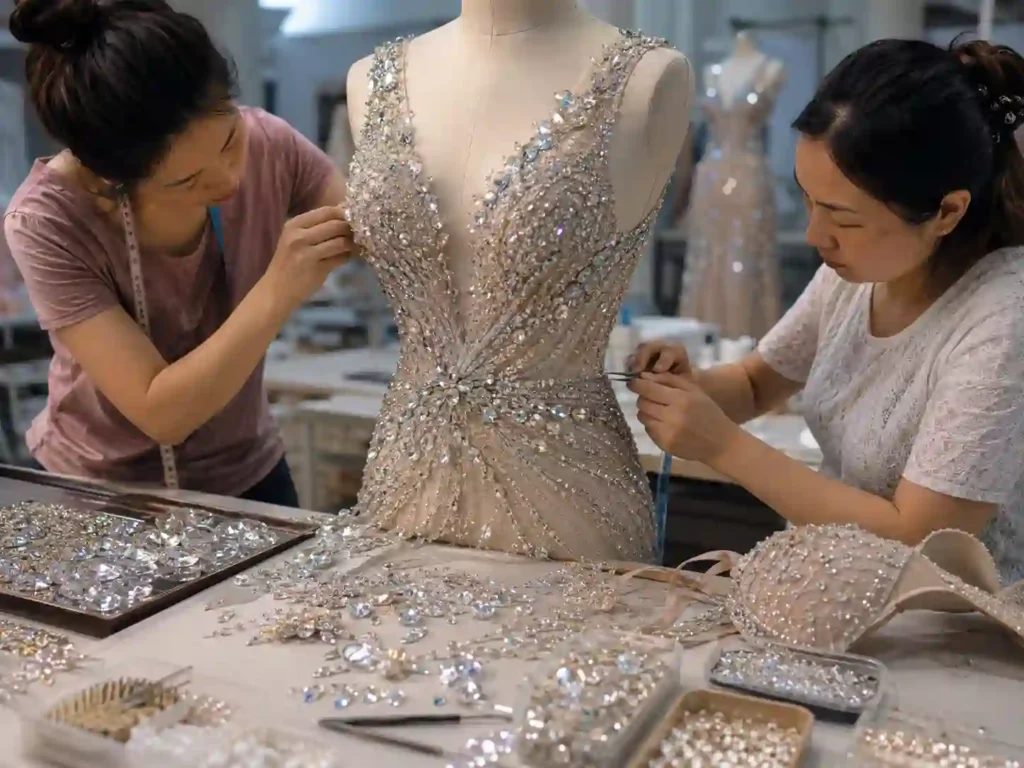
Sequins, beads, pearls, crystals, dimensional flowers and moving trims will lead 2027 occasionwear, but their relevance will come from lighter construction, tonal colour, irregular layouts and mixed techniques. The most convincing surfaces will use each component for a specific role, creating one coherent design rather than placing several decorative ideas on the garment without a clear hierarchy.
Sequins and Crystals
Sequins remain commercially important because they deliver immediate visual impact and respond well to movement. The newer direction is less dependent on one uniform sequin surface. Mixed sizes, scattered layouts, tonal colour and gradual changes in density create more depth and reduce the flat, costume-like appearance that can occur with continuous coverage. Micro-sequins are useful when a liquid surface is required, while larger sequins create stronger flashes but make orientation, stitch spacing and edge finishing more visible.
Crystal placement works best when it defines a line, contour or focal point. It can frame a neckline, follow a corset seam or create a gradient from dense to sparse. Underarm, waist and seating zones require caution because repeated friction increases the chance of discomfort or loss. Hotfix application can give clean placement, but temperature, pressure and dwell time must be recorded for the actual fabric. Fine mesh, coated materials and stretch surfaces can respond very differently from a stable woven base, even when the same stone is used.
Beads and Pearls
Beads offer more control over surface texture than continuous sequin coverage. Seed beads build dense, granular areas; bugle beads create linear direction; transparent beads add depth without hiding the base colour; and metallic beads can outline seams or body contours. Bugle beads need particular attention because damaged or exposed ends may feel sharp. Thread quality, stitch direction and the reverse-side finish should be reviewed as carefully as the front of the garment.
Pearls are moving beyond traditional formal styling. Small pearl clusters on black, coloured or skin-tone mesh can feel modern, while irregular sizes create a more organic surface. Large pearls should remain selective because their weight can distort soft materials and place stress on individual anchoring points. Secure knots, short controlled thread floats and a smooth lining make a noticeable difference during extended wear. A dress that looks polished in a five-minute fitting can still become uncomfortable after dinner, dancing or several hours of seated use.
Floral Dimension
Three-dimensional flowers can become a recognisable design signature, but scale and placement need to be developed with the garment rather than added after the silhouette is complete. A flower at the shoulder may affect neckline balance, a cluster at the hip can add visual volume, and a rosette at the waist may become the centre of an asymmetric drape. These effects can be useful, but they should be evaluated on a fitted sample rather than a dress form alone.
Petal materials behave differently. Organza creates crisp, translucent volume; chiffon gives softer movement but collapses more easily; satin produces stronger colour and shine, although folded edges can become bulky. Laser-cut synthetics may reduce fraying, while natural or blended fabrics often need more edge control. The flower should be checked after light compression, steaming and ordinary handling. Detachable flowers can solve some packing and care problems, but the attachment must remain secure, easy to understand and discreet when the flower is removed.
Fringe and Hybrid Surfaces
Fringe creates value through movement and is especially effective for dance dresses, party minis and products designed for social video. Beaded fringe gives a sharper swing, while yarn, cut-thread, feather-like textile trims and chiffon strands produce a softer response. Length consistency is one of the main quality risks. A small difference can become obvious across a straight hem, particularly when the dress is photographed against a clean background. Intended irregularity still needs an approved visual standard.
Hybrid surfaces combine several processes in one coordinated design. A motif may use embroidery as the structural base, sequins for reflection, beads for depth and cut fabric for volume. This approach can create richness without relying entirely on expensive handwork. The strongest hybrid designs assign a clear function to each component. When every material is included simply because it is decorative, the surface often becomes heavy, visually confusing and difficult to reproduce across operators, sizes and production batches.
| Embellishment | Common Planning Range | Suitable Applications | Main Control Point |
| Micro-sequins | About 2-4 mm | Liquid surfaces, party dresses and tonal overlays | Stitch density, orientation and shade |
| Standard sequins | About 5-8 mm | Focal panels, borders and density gradients | Edge finish and directional consistency |
| Seed beads | About 1.5-3 mm | Dense texture, outlines and compact clusters | Thread security and reverse-side comfort |
| Bugle beads | About 3-12 mm long | Linear motifs, contour lines and fringe | Sharp ends, alignment and breakage |
| Pearls | About 3-12 mm | Straps, necklines, corsets and scattered clusters | Fabric distortion and anchoring |
| 3D flowers | About 4-15 cm wide | Shoulder, bust, waist, hip and draped seams | Shape recovery, scale and multiple attachment points |
| Crystal stones | About 2-8 mm | Contour mapping, gradients and borders | Adhesion, abrasion and light response |
| Beaded fringe | About 5-30 cm long | Hems, sleeves, hip panels and moving godets | Tangling, swing and length tolerance |
How Will Embellishment Shape Occasionwear?

Embellishment should strengthen the silhouette and purpose of an occasion dress. Short styles need concentrated details, longer dresses benefit from directional placement, and fitted or structured designs require careful control of weight and stretch. Decoration becomes most effective when it guides the eye, supports movement and respects the mechanical demands of the fabric, lining and internal construction.
Mini and Party Dresses
Mini dresses have limited surface area, which makes every decorative decision more visible. A concentrated neckline, embellished cup, rosette at one hip or fringed hem often gives a clearer result than several competing zones. Weight also needs attention because dense decoration can represent a large proportion of the finished garment. A heavily embellished bust may pull the neckline downward, while a weighty hem can stretch the skirt or create an uncomfortable swing against the legs.
Party styles should be tested during realistic movement. Walking, sitting, dancing and raising the arms reveal problems that remain invisible on a mannequin. Underarm crystals may rub, long fringe may catch between the legs, and hard pearls on a side seam may become uncomfortable when seated. Decoration near the hem should be measured from the finished garment edge, and teams should decide whether hanging beads or fringe visually count as part of the dress length for the intended market and product photography.
Midi and Maxi Dresses
Midi and maxi dresses allow decoration to develop across a larger area. Vertical embroidery can lengthen the silhouette, a diagonal crystal gradient can reinforce draping, and scattered flowers can become denser toward one side without covering the complete garment. Longer dresses are also more sensitive to accumulated weight. Beading near the hem can cause length growth after hanging, particularly on bias-cut satin, chiffon and fine mesh, so the embellished sample should rest before the final hem is confirmed.
Asymmetric decoration can affect garment balance. A heavily beaded side panel may twist a soft skirt or pull one seam forward. Local reinforcement can help, but excessive backing may change the drape and make the panel look stiff. Sometimes the better answer is to reduce density or distribute the weight across a wider area. For floor-length styles, components close to the ground face additional impact, dirt and abrasion, so a cleaner lower hem may improve durability without weakening the overall design.
Fitted and Structured Dresses
Bodycon, corset, bustier, halter and backless dresses require embellishment to work with tension and support. On stretch bodycon styles, dense embroidery or rigid crystal maps can create non-stretch zones. If these areas cross the bust, waist or hip without enough flexibility, the dress may feel tight even when the measurements match the specification. Vertical and diagonal placement often follows the body more naturally than uninterrupted horizontal bands.
Corset and bustier dresses depend on internal construction. Crystals or pearls placed along cup edges can increase neckline weight, while heavy decoration over boning channels may interfere with pressing or create visible thickness. The outer fabric, cups, lining, boning and decorative layer should therefore be developed as one system. Halter dresses require a neck-pressure trial, and backless styles need seating checks because hard components along the back edge can become uncomfortable against a chair.
Occasion and Customer Use
Different events call for different levels of decoration. A high-shine mini may work for a birthday, dance venue or evening party but feel too aggressive for a daytime wedding. A tonal beaded midi can cover cocktail, dinner and wedding-guest occasions, giving it broader styling value. Prom and homecoming products often support stronger embellishment because photography and personal expression are central, while formal dinner and wedding-guest dresses usually benefit from more controlled surfaces and longer wear comfort.
The intended use should influence component choice, not only colour and silhouette. A dress designed for dancing must manage swing and snagging; a seated dinner style must avoid hard components at the waist and back; a travel-focused event dress needs decoration that recovers after packing. The design team should imagine the customer’s complete evening, including transport, sitting, eating, photography and movement. That practical view often reveals where decoration adds genuine value and where it simply creates an avoidable problem.
| Dress Type | Effective Embellishment Zones | Practical Weight Concern | Common Development Risk |
| Party mini | Bust, straps, hip or hem | Heavy bodice or swinging hem | Scratching, catching and fringe tangling |
| Bodycon midi | Contour lines and side panels | Loss of stretch across key fit zones | Restricted movement and distorted recovery |
| Corset dress | Cups, neckline and boning lines | Neckline pull and local stiffness | Structural distortion or visible thickness |
| Halter dress | Neck strap, bust and waist | Pressure transferred to the neck | Strap discomfort during extended wear |
| Backless dress | Back edge, shoulders and waist | Local pressure against the body | Discomfort when seated |
| Column maxi | Vertical panels and gradients | One-sided weight imbalance | Twisting after hanging |
| Flared maxi | Bodice, godets and skirt borders | Hem growth and panel drag | Uneven fall or decoration near the floor |
| Cocktail dress | Neckline, waist or shoulder | Moderate, depending on coverage | Over-decoration that limits repeat wear |
Which Materials and Methods Work Best?

The best embellishment method depends on the base fabric, garment structure, order volume and required visual effect. Stable mesh, velvet and structured satin can carry more weight than chiffon or soft jersey. Handwork offers flexibility, while machine embroidery and controlled hotfix applications improve repeatability. Backing, lining and attachment must be planned together to protect drape, comfort and durability.
Fabric Support
Every decorative component places a load on the base fabric. The load may be small at one point, but hundreds of components can change how a panel hangs, stretches and returns to shape. Stable mesh is useful for illusion surfaces because it can hold embroidery and scattered stones while remaining visually light. Fine mesh may require a second layer or local backing around dense motifs. Structured satin supports shaped bodices, although needle holes and stitch tension can create puckering around compact embroidery.
Chiffon and lightweight satin need smaller components and lower stitch density. Large bead clusters may create dimpling, while rigid appliqués interrupt natural movement. Stretch jersey requires decoration that expands with the garment; a beautiful non-stretch motif can make a bodycon dress difficult to put on if it crosses the wrong area. The first technical test should use the real base fabric, thread, backing and component. A substitute swatch may save time early, but it can give misleading information about heat response, needle marking, recovery and drape.
Hand and Machine Methods
Hand application is useful for irregular clusters, sculptural flowers, final adjustments and high-value focal areas. It allows the worker to respond to curves and seams more easily than a fixed automated layout. The limitation is variation. Stitch length, tension and placement can differ between operators unless the approved standard includes clear photographs, component counts and reverse-side requirements. Handwork should be reserved for details that visibly benefit from it rather than used as a general signal of quality.
Machine embroidery offers stronger repeatability for motifs and continuous surfaces. Sequin embroidery can cover larger areas efficiently, while multi-head equipment supports scalable production. Hotfix crystal application is effective for precise maps when the adhesive, surface, temperature, pressure and dwell time are compatible. Hybrid methods are often the strongest commercial answer: machine embroidery establishes the structure, then selected flowers, beads or statement stones are applied by hand. This preserves depth while controlling labour, density and variation.
Backing and Lining
Backing supports the decorated surface, distributes weight and prevents stitches from pulling through delicate fabric. It should be strong enough to stabilise the motif but light enough to preserve the intended drape. A heavy backing on illusion mesh may create visible blocks, while a stiff fusible on satin can produce a hard edge around the embellishment. Local backing shaped to the decorated area is often more effective than covering an entire panel.
Lining protects the wearer from thread ends, knots, stone settings and rough component backs. It also contributes to opacity, support and temperature comfort. The lining must stretch with the outer fabric when required; a rigid lining under an embellished stretch dress can restrict movement even when the outer shell performs correctly. Underarms, necklines, waist seams, bust edges, halter straps and seating areas deserve special attention because pressure and rubbing often become noticeable only after the dress has been worn for some time.
Testing and Packaging
Testing should reflect the actual material, care method and end use. Common checks include attachment security, snagging, rubbing, colour transfer, stretch recovery and appearance after the intended cleaning process. Raised flowers and fringe also need packaging trials. A dress may leave the sewing line in perfect condition and arrive flattened or tangled when the carton, tissue placement and folding method do not match the surface. Testing a loose component or unlined swatch is not enough; the finished garment system must be reviewed.
Hanging delivery can protect sculptural garments but increases freight volume. Flat packing is more efficient but may require shaped tissue, protective sleeves or spacing between decorated areas. Vacuum compression is usually unsuitable for delicate raised embellishment unless recovery has been proven. After the packing trial, the garment should be opened, allowed to rest and then reviewed for flower recovery, fringe alignment, crystal marking and permanent creasing. Packaging becomes part of product engineering whenever the surface cannot tolerate ordinary handling.
| Base Material | Suitable Embellishment | Typical Support Approach | Main Risk |
| Stable mesh | Crystals, beads and embroidery | Local backing or a controlled double layer | Sagging or visible stress around dense motifs |
| Fine stretch mesh | Scattered stones and light sequins | Stretch-compatible stabiliser | Loss of recovery and distorted fit |
| Structured satin | Appliqué, crystals and focal beadwork | Local woven or carefully selected fusible support | Puckering, needle marking and heat damage |
| Soft satin | Light embroidery and tonal sequins | Minimal lightweight backing | Drape distortion and seam pull |
| Chiffon | Fine sequins, small beads and light appliqué | Sheer stabiliser with low stitch density | Pulling, tearing and visible dimpling |
| Velvet | Beads, embroidery and appliqué | Sewn support where required | Crushed pile and pressure marks |
| Stretch jersey | Flexible trims and scattered stones | Elastic backing and open placement | Rigid decorated zones |
| Organza | Flowers, appliqué and embroidery | Layered organza or local support | Creasing, sharp edges and compression damage |
How Can Brands Commercialize the Trends?

Brands can commercialise 2027 embellishment by separating image-led pieces from scalable sales styles. Cost, comfort and repeatability should be considered during design rather than after sampling. Strong programmes use clear component specifications, staged approvals, realistic wear and packing tests, and archived production standards so successful dresses can be reordered without losing the appearance of the original sample.
Assortment Balance
An occasionwear collection needs visual excitement, but every product does not need the maximum amount of decoration. Hero pieces attract attention in campaigns, shop windows and social media. They can support heavier surfaces, more complex flowers or additional handwork because their role includes brand image. Commercial statement styles carry one recognisable decorative idea in a more controlled form, while supporting products repeat the same crystal colour, motif or surface language with lighter application.
A practical starting model may allocate roughly 10-15% of a collection to image-led hero pieces, 35-45% to statement sellers and the remaining styles to more accessible decoration. These are planning ranges rather than fixed rules. A specialist prom label may need more highly decorated products, while a contemporary cocktail brand may prefer tonal, restrained surfaces. The purpose is to prevent development time and budget from becoming concentrated in garments that look impressive but are difficult to price, fit, pack or reorder.
Cost Control
The cost of embellishment is not determined only by the purchase price of sequins, beads or stones. Application time, backing, panel handling, inspection, rejection risk, repair and packaging all contribute to the finished cost. Surface coverage is one of the most useful levers. Reducing a fully crystal-covered bodice to a neckline gradient may preserve most of the visual impact while lowering component consumption and labour. Machine embroidery can replace repeated handwork in less visible areas, leaving hand application for focal details.
Design teams benefit from developing three levels from one idea: a full-impact version, a commercially balanced version and a cost-controlled version. These should share the same motif, placement language or colour story so the customer recognises them as one collection. Late cost reduction is risky because removing components after the pattern and sample are approved can expose gaps, change weight distribution or weaken the focal point. Cost engineering works best when it begins with the first strike-off rather than after the sales team receives the quotation.
Sample Approval
A complete embellished garment should not be the first time the brand sees the surface. Small strike-offs allow the team to compare component size, density, colour, stitch tension and attachment before a full sample is made. The strike-off should use the correct base fabric, backing, thread and components. A practical approval path moves from artwork and a physical component board to a strike-off, partial panel where necessary, first garment, fit and movement review, revised sample, pre-production standard and trial-production check.
Approvals should be measurable. Comments such as ‘more sparkle’ or ‘less dense’ can be interpreted differently by design, merchandising and production teams. A stronger instruction records the number of components within a measured area, finished border width, motif spacing, gradient start and end points, and placement from finished seams. Fit approval and surface approval also need to remain connected. Heavy beadwork added after fit confirmation can change the neckline, side seam or overall length, so the final standard should represent the intended bulk construction as closely as possible.
- Approve the artwork, placement map and focal zones before purchasing production components.
- Create a component board with colour, size, finish, supplier reference and approved substitute rules.
- Make a strike-off on the actual fabric and backing, then review the front and reverse sides.
- Test the full garment for fit, movement, weight, comfort and packaging recovery.
- Lock a pre-production standard and confirm repeatability through first-piece or trial-production inspection.
Bulk and Reorders
Bulk consistency depends on converting the approved sample into a measurable production standard. The team needs more than a photograph; it needs component codes, colours, sizes, suppliers, attachment methods, placement dimensions, backing, reverse-side finish and acceptable tolerance. A first-piece or trial-production check is valuable for complex dresses because it reveals whether operators and machines can reproduce the approved density, balance and construction before a large quantity has passed through the line.
In-line inspection should review decoration before too much value has been added to the garment. Correcting a misplaced motif on a separate panel is easier than repairing the same problem after lining, zipper installation and final assembly. Repeat orders create another risk: the original component may be discontinued, or the available colour may differ from the first batch. Physical archives are more reliable than digital images. Approved substitutions, revised machine settings and any change in supplier should be recorded so the next production run remains traceable.
A Practical Closing Perspective
Occasionwear embellishment for 2027 is not a contest to apply the greatest number of sequins, flowers or crystals. The more useful opportunity is to make decoration feel inseparable from the silhouette. A raised flower should strengthen a shoulder or waist line. A crystal gradient should direct attention without turning the dress into a rigid shell. Fringe should reveal movement. Beading should add depth while preserving comfort, balance and the possibility of consistent production.
Brands do not need to adopt every forecast direction. They need to identify the surfaces that fit their customer, price level, occasion calendar and visual identity, then develop those surfaces with the fabric, pattern and internal construction from the beginning. The strongest 2027 programmes will make design and manufacturing decisions together, approve measurable standards and preserve the information needed for repeat orders. That discipline allows an expressive sample to become a reliable commercial dress rather than a one-off development success.
Custom Development with Duolan Apparel: Duolan develops fashion-led occasion dresses, party dresses, fitted dresses and coordinated women’s fashion collections for established brands and product teams. The company is backed by more than 30 years of dress development experience, 16 owned women’s fashion factories, 20+ long-term satellite factories and specialised embroidery and finishing resources. Send a tech pack, sample, design sketch, embellishment artwork or collection brief for a fabric, structure, sampling and production feasibility review.