Skip to content

Partywear in 2027 will not be defined by one fabric or one obvious kind of sparkle. The stronger direction is contrast: transparent layers over structured foundations, soft draping beside engineered corsetry, polished satin interrupted by tactile embroidery, and shine that appears in selected zones rather than covering every centimetre. That shift changes the development conversation. The useful question is no longer simply which material is fashionable, but which combination of fabric, finish, silhouette, lining and construction will create a dress that still feels valuable after the campaign image has done its job.
The leading partywear fabrics for 2027 are fluid and structured satins, crisp taffeta, stretch mesh, chiffon, organza, dimensional lace, velvet, metallic jersey, moire, embellished tulle and refined sequin grounds. Their commercial value depends on how well weight, stretch, opacity, support and surface treatment match the intended silhouette, season and wearing occasion.
A fabric can look convincing on a hanger and still fail the dress. Satin may collapse around the bust, sequins may scratch at the armhole, and fine mesh may become unexpectedly transparent under direct flash. These are not minor factory details; they decide whether a style is comfortable, photographable and repeatable. The most successful 2027 collections will therefore treat trend forecasting as the beginning of product development rather than as a shopping list. The interesting part starts when a directional textile is tested against fit, movement, care, costing and the realities of bulk production.
What Is Shaping Partywear in 2027?
Partywear in 2027 is being shaped by controlled shine, layered transparency, tactile surfaces and closer attention to comfort. The strongest materials create contrast through soft and structured qualities, matte and glossy finishes, or sheer and opaque layers. They also need to move well, photograph clearly and retain the intended appearance when a sample is repeated across production.
What Is Changing in Material Direction?
For several seasons, partywear was easy to recognise from a distance: high-gloss satin, dense sequins, stretch bodycon shapes and exposed mesh panels. Those ingredients are not disappearing, but they are being used with more discipline. A tonal sequin ground with negative space can feel fresher than a fully covered surface, while a matte base interrupted by metal yarn or crystal placement can create more depth than uniform shine. The change is less about rejecting glamour and more about making every visible effect earn its place in the design.
The most convincing material stories often combine two opposing qualities. A crisp taffeta skirt can sit beneath a soft mesh bodice, a liquid satin dress can contain a firm internal corset, and a compact jersey base can gain value through ruching, metallic yarn or jewel-like trim. These contrasts help a collection feel varied without becoming visually chaotic. They also allow brands to assign different roles to different garments, from image-led campaign pieces to repeatable commercial styles with more forgiving wear and care requirements.
A fabric should therefore be judged as part of a system rather than as an isolated swatch. The outer material, lining, stretch direction, closure, support components, decoration weight and pressing method all influence the result. A fashionable surface that cannot tolerate seam tension, packing or repeated movement is not automatically a useful development choice. Trend relevance opens the conversation, but compatibility with construction and end use determines whether the finished garment deserves a place in the collection.
How Do SS27 and AW27/28 Differ?
Spring and summer partywear will generally express drama through lightness, translucency and movement. Mesh, chiffon, organza, lace and lighter satin can create volume without visual heaviness, making them useful for destination events, summer birthdays, rooftop parties and warm-weather occasion collections. The main technical questions concern opacity, airflow, seam visibility and support. A sheer fabric may appear delicate, but the hidden engineering around cups, zippers, cut-outs and waist seams often needs to be more precise than it would be in an opaque dress.
Autumn and winter can support denser surfaces, deeper lustre and stronger construction. Velvet, moire, jacquard, metallic knits, embellished mesh and heavier satin work naturally with holiday dressing and evening launches. Even so, a winter party dress should not become heavy by default. Dense beads, multiple lining layers and metal trims can add more weight than the face fabric, so the full garment should be weighed and worn rather than evaluated from a fabric card alone. The ideal winter material looks substantial while still allowing the wearer to sit, dance and move freely.
| Development Factor | SS27 Direction | AW27/28 Direction | Primary Risk |
| Transparency | Chiffon, stretch mesh, organza and lace | Dark sheer grounds, flocked mesh and decorated tulle | Unexpected exposure or visible internal construction |
| Shine | Pearl, liquid and translucent lustre | Metallic, jewel, foil and deep satin shine | Uneven reflection, cracking or abrasion |
| Structure | Light taffeta and crisp organza | Velvet, jacquard and bonded bases | Excess bulk, stiffness or restricted movement |
| Decoration | Rosettes, light beads and fine sequins | Crystals, dense beads, fringe and metallic yarn | Weight imbalance and attachment failure |
| Lining | Light stretch or tonal linings | Stable satin, jersey or structured linings | Twisting, show-through or poor recovery |
Seasonal direction affects much more than appearance. It changes needle selection, seam type, lining weight, pressing temperature, finishing and packaging. Organza may need tissue support to prevent crushing, while velvet demands strict nap direction and low-pressure pressing. A strong seasonal plan considers these downstream consequences early, because correcting them after the first complete sample is slower and more expensive than choosing an appropriate construction route at the fabric-selection stage.
Are Glamour and Wearability Converging?
Glamour and wearability are increasingly expected to work together. Customers still want a clear visual moment, but they are less willing to tolerate scratchy embellishment, unstable cups, slipping straps, rolling hems or fabrics that lose their shape before the evening is over. Comfort does not mean making every style casual. It means removing the avoidable problems that distract from the garment, reduce repeat wear and generate returns that could have been prevented during development.
Wearability begins with material behaviour. Stretch jersey should recover after sitting, satin should hold a seam without excessive rippling, and mesh should remain stable around zippers and cut-outs. Beading needs to be distributed so it does not pull a neckline forward or distort the waist. Velvet should allow movement without building thick ridges where several seams meet. These details are difficult to judge on a mannequin, so a dress should be reviewed while walking, sitting, raising the arms and wearing the undergarments expected for the final product.
Lighting is part of the wear test as well. Pale satin can reveal seam allowances under flash, mesh can become more transparent when stretched, and metallic coatings can highlight every tension line. A useful approval routine includes daylight, warm indoor light, bright retail light and direct photography. The strongest 2027 partywear will feel dramatic in all of these conditions while allowing the wearer to move through an event without continuously adjusting the dress.
Which Fabrics Will Lead 2027 Partywear?
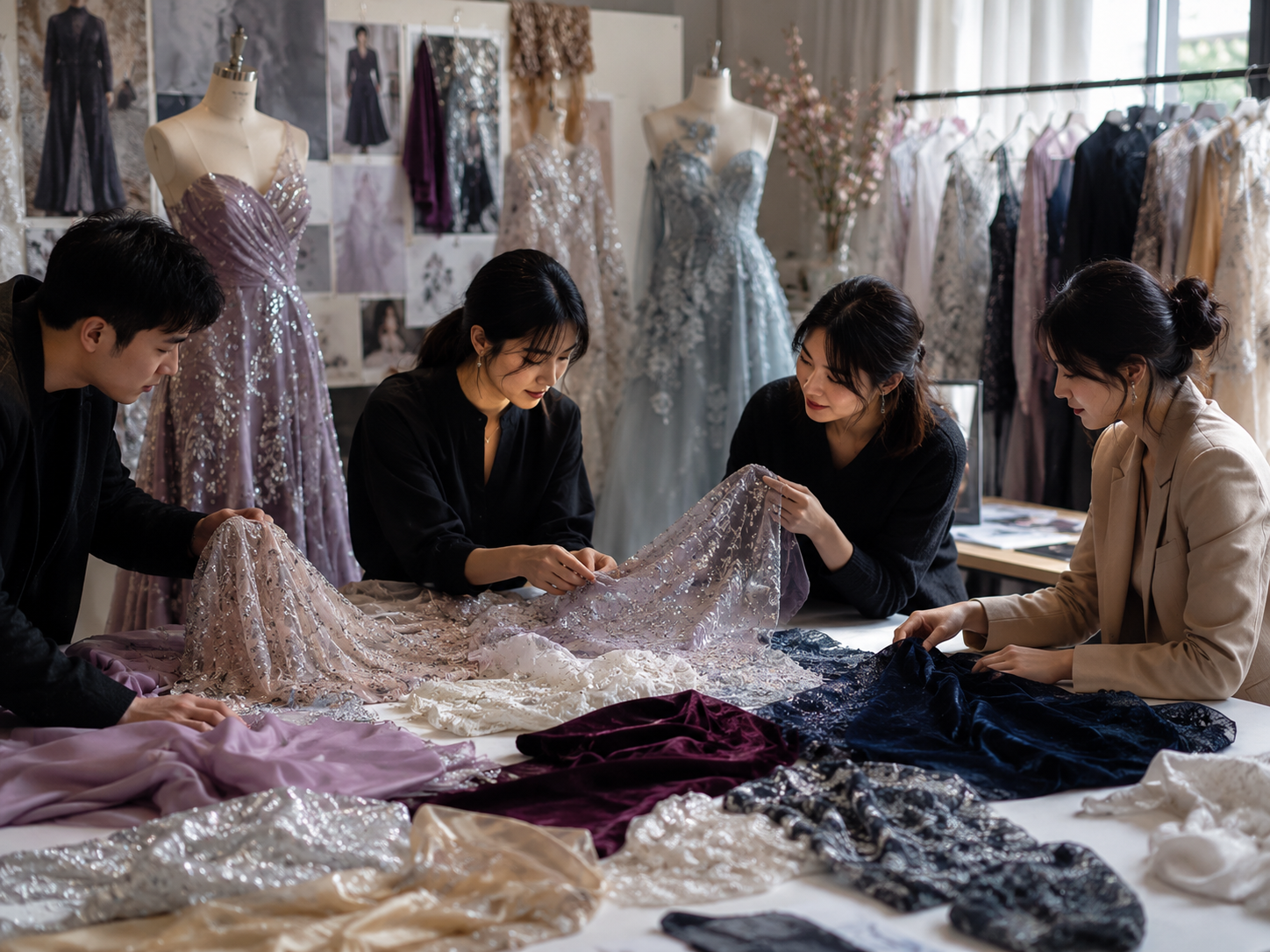
The leading 2027 partywear fabrics include satin, taffeta, mesh, chiffon, organza, lace, velvet, metallic jersey, moire, jacquard and refined sequin textiles. No fabric will lead every category. Selection should follow the silhouette, season, target price and wearing occasion, with particular attention to weight, stretch, recovery, opacity, surface durability and availability for repeat production.
Are Satin and Taffeta Returning?
Satin never left partywear, but its use is becoming more specific. Fluid satin, stretch satin, duchess satin and back-crepe satin behave differently enough that they should not be treated as interchangeable qualities. Lightweight constructions are suited to bias slips, cowl necklines and soft draping, while heavier or firmer satins can support corseted bodices and cleaner midi silhouettes. Stretch satin can help fitted dresses move, but excessive stretch or weak recovery may cause seam waviness and a surface that looks less polished after wear.
Taffeta offers a crisper kind of glamour. It can hold bubble hems, gathered skirts, bows and compact sculptural shapes that would collapse in a fluid fabric. The attraction is not simply volume; it is the visible tension between a small dress and an architectural surface. Taffeta also carries practical risks, including sharp creasing, noisy movement and permanent pressing marks. These need to be judged against the target occasion and price rather than treated as defects only after sampling begins.
Typical development ranges can help narrow the first selection, although construction matters as much as weight. Fluid satin often appears between roughly 70 and 130 gsm, stretch satin may sit around 140 to 220 gsm, and structured satin can move above 180 gsm. These ranges are not standards, but they provide a useful starting point. Final approval should cover lustre under several lights, snagging, seam puckering, water marking, shade consistency and the ability of the lining to move without gripping the outer fabric.
Which Sheer Fabrics Are Rising?
Mesh, chiffon, organza and lace remain central because they add movement and dimension without automatically adding bulk. The more current approach is layered transparency rather than exposure for its own sake. Fine stretch mesh can create fitted sleeves and illusion panels, power mesh can add internal support, chiffon can produce scarves, gathered layers and rosettes, while organza can hold transparent volume around a skirt or shoulder. Each fabric has a different relationship with seams, linings and the body, so the word sheer is never specific enough for sourcing.
Opacity should be tested when the material is relaxed, stretched over the expected body area and photographed with flash. A black mesh swatch may look sufficiently dense on a table but become much more transparent over the hip. Pale chiffon may reveal a lining edge that is invisible in ordinary room light. The colour of the underlayer also changes the final effect: warm nude, cool taupe and deep brown create noticeably different results beneath the same outer fabric.
| Fabric | Typical Development Range | Stretch Profile | Best Uses | Common Risk |
| Stretch mesh | 70-160 gsm | Moderate to high | Bodycon overlays, sleeves, illusion panels | Poor recovery, seam growth or excessive exposure |
| Power mesh | 120-250 gsm | High with firm recovery | Internal support and contour panels | Too much compression or visible support lines |
| Chiffon | 35-90 gsm | Usually low | Drapes, sleeves, layered skirts and rosettes | Fraying, seam show-through and weak support |
| Organza | 25-100 gsm | Usually low | Bows, sculptural overlays and crisp volume | Creasing, sharp edges and pressing damage |
| Decorative lace | 70-250 gsm | Low to moderate | Bodices, overlays, inserts and panels | Motif mismatch, weak edges and uneven stretch |
Sheer garments reveal their internal construction, which raises the workmanship requirement. Cups, labels, boning channels, elastic, seam allowances and zipper tapes must be placed deliberately. Clear elastic can still catch light, and an unfinished edge can look far more obvious through organza than it would beneath satin. The cleaner the intended transparency, the more detailed the internal plan must become. Sheer fabric is therefore not a shortcut to a lighter dress; it often requires more careful engineering than an opaque alternative.
Do Velvet and Metallics Still Matter?
Velvet and metallic textiles remain important, especially for holiday, evening and winter collections. Their opportunity lies in refinement rather than predictable styling. Stretch velvet can support fitted minis and draped midis, while woven velvet creates a richer, more stable surface for shaped bodices and clean skirts. In both cases, pile direction must be controlled because neighbouring panels can appear to be different shades when cut against the intended nap, even if they come from the same roll.
Metallic direction is broader than gold or silver sequins. Fine lurex jersey, foil-printed mesh, metallic-coated knits, lamé, pearlised satin, iridescent organza and metal-thread jacquard all offer different levels of reflection. These materials can perform strongly in photography but should be tested in high-friction zones. Coatings may crack at the hip or underarm, metallic yarn can feel rough against the skin, and some lamé structures lose stability when cut on the bias.
The most commercial use may be selective. A liquid-finish bodice, a metallic sleeve or a foil mesh panel can deliver a memorable surface without making the entire garment difficult to wear or manufacture. Strategic placement also helps control cost and weight. A material does not need to cover the whole dress to define it; sometimes the strongest result comes from one precisely chosen area that catches light as the wearer moves.
Which Lace and Jacquard Updates Feel New?
Lace is becoming more dimensional and architectural. Corded lace, embroidered mesh, guipure-style motifs, laser-cut effects and mixed-scale florals create clearer identity than flat, generic repeats. The freshest applications often use contrast: lace over a clean corset base, matte embroidery on glossy satin, dense floral placement over transparent mesh, or smooth jersey interrupting a heavily textured panel. These combinations make the surface feel designed around the body instead of added after the silhouette has already been decided.
Jacquard and moire create pattern through weave, relief or light reflection rather than through separate trims. They can increase perceived material value while reducing the number of components that need to be attached. Motif scale, however, has to match the garment. A large repeat may be lost on a mini dress or cut awkwardly across princess seams, while moire can appear inconsistent when neighbouring panels run in different directions.
Before bulk fabric is ordered, the pattern should be placed over a full-width sample or digital repeat map. Centre-front balance, major seam symmetry, hem placement and directional reflection need approval in the actual sample size. Pattern matching may also increase consumption, which affects cost and minimum fabric commitments. The best results usually come from allowing the fabric to carry the design rather than covering an already complex jacquard or moire surface with additional decoration.
How Will Surface Effects Evolve?
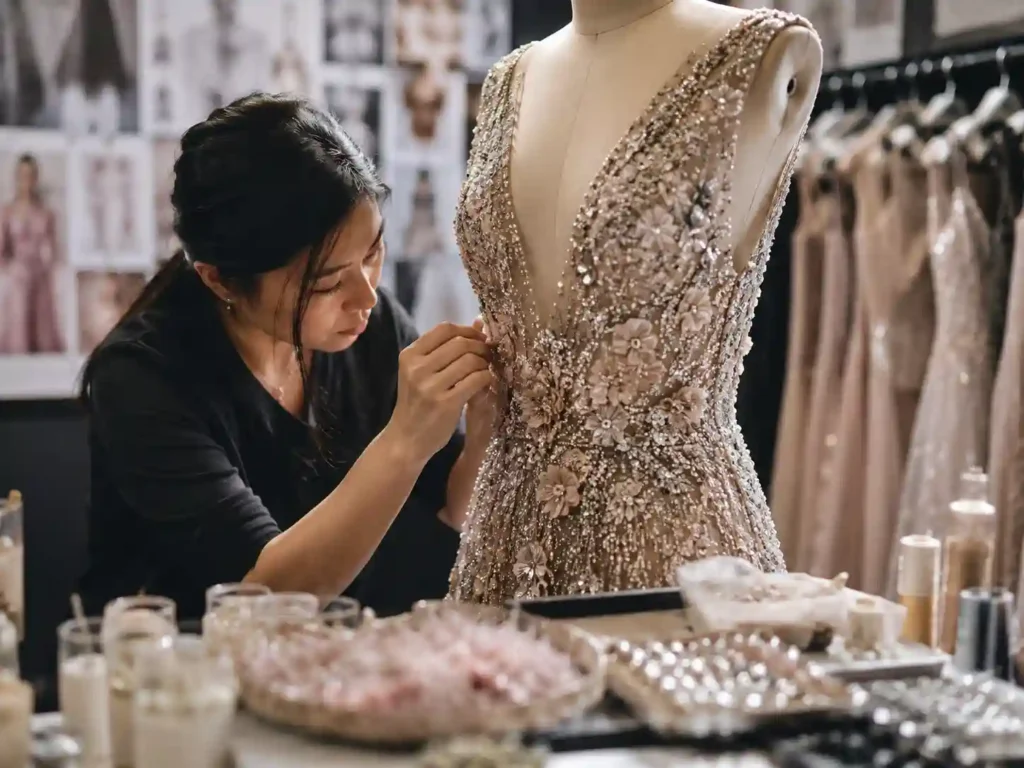
Surface effects in 2027 will become more selective, dimensional and connected to the garment’s construction. Tonal sequins, embroidery, crystals, pearls, rosettes, fringe and feather-like trims will remain relevant, but premium results will depend on controlled density, balanced weight, secure attachment and clean finishing. Decoration should strengthen the silhouette rather than compensate for an ordinary base fabric.
How Are Sequins Becoming More Refined?
Sequins are evolving through scale, spacing, colour and shine rather than disappearing. A single glossy disc applied at uniform density can still sell, but it no longer represents the full opportunity. Micro-sequins, mixed sizes, tonal colour, matte finishes and areas of negative space create surfaces that respond more subtly to light. A fitted mini can carry greater density through the centre body and less around the side seams or underarms, where comfort and seam construction become more difficult.
The ground fabric determines whether the decoration remains stable. Weak mesh may stretch under dense sequins, while rigid backing can prevent a fitted dress from moving with the body. Seam allowances also need a defined method. Sewing directly through heavy sequin areas can break needles, create sharp fragments and make seams uneven. Depending on the style, production may require removal from seam zones, reinforcement, binding or planned clear areas within the embroidery layout.
A useful specification records sequin size and shape, spacing, direction, ground-fabric weight, embellishment weight, seam clearance, skin-contact comfort and the accepted tolerance for isolated loss. These details make the surface repeatable across sizes and production lines. More sequins do not automatically create more value; controlled light distribution can look more sophisticated, reduce garment weight and improve comfort at the same time.
Which Embellishments Add Value?
Crystals, rhinestones, beads, pearls and embroidery add value when they explain the architecture of the garment. Crystal lines can frame a neckline, pearls can emphasise corset channels, and beading can follow the direction of a drape. Embroidery can create opacity over selected areas of mesh instead of requiring a heavy full lining. These applications feel intentional because the decoration works with the silhouette rather than floating across it without a clear visual reason.
Attachment must suit both the component and the base fabric. Dense hand beading on light stretch mesh can cause sagging, while heat-applied stones may not bond reliably to velvet pile or certain coatings. Heavy pearls near a neckline can pull the front of a dress downward. A small trial panel, often around 20 by 20 centimetres, can expose distortion, rough backing and weak adhesion before a complete sample is constructed.
A production-ready embellishment pack should include artwork at actual scale, measurements from fixed garment points, component finish, attachment method, backing, approved density, sample-size garment weight and care restrictions. Descriptions such as make it richer or add more sparkle are too subjective for reliable production. A placement map, approved trial and signed reference sample turn the intended visual effect into something that can be measured and repeated.
Are Rosettes, Fringe and Feathers Commercial?
Rosettes, fringe and feather-like trims can be commercially successful when they have a clear role in the collection. Rosettes work particularly well at the shoulder, bust, hip, waist or hem, where the dress can support their volume. Diameter, layer count and attachment area should be controlled. Chiffon flowers may flatten during packing, while satin versions can crease, so packaging trials belong in development rather than at the final shipping stage.
Fringe creates movement that performs well in video, dance and social content, but it can tangle, shed and change the balance of a garment. Heavy fringe may pull down an asymmetric neckline or distort a mini skirt. Feather and feather-effect trims deliver immediate drama, yet they bring sourcing, care, crushing and market-specific compliance considerations. Synthetic alternatives can offer better consistency, although they may not create the same softness or movement.
These details are often best reserved for campaign pieces, limited capsules, holiday edits or higher price tiers where their extra handling is justified. The decision should consider expected sales volume, return risk, cleaning guidance and replacement availability. A visually memorable trim is useful only when the construction, packaging and customer expectation support it through the full life of the product.
What Makes Texture Feel Premium?
Premium texture is created by proportion, consistency and compatibility. Customers may not describe the technical reason a dress feels expensive, but they notice when decoration follows the body cleanly, when shine is balanced and when the surface remains controlled during movement. Motif scale should suit the garment area, density should not overpower the ground fabric, and directional elements such as velvet nap, sequin grain, embroidery flow and fringe should reinforce the intended line.
Backing and finishing are equally important. Reinforcement should support a decorated area without making it rigid or scratchy. Heavy beads on weak mesh, thick embroidery across a high-stretch zone or dense sequins carried into the underarm usually produce a garment that looks impressive on a hanger but performs poorly on the body. These mismatches also create inconsistent bulk results because operators have to force incompatible materials through the same construction route.
Close-up photographs, placement maps, density measurements and approved swatches are essential when a surface will be produced by several operators or factories. Words such as light, scattered and dense are interpreted differently by different teams. Texture feels premium when it remains expressive from a distance and disciplined at close range, with the internal construction supporting rather than fighting the visible effect.
Which Fabrics Suit Each Silhouette?

Fabric should match the mechanical and visual needs of the silhouette. Bodycon dresses need stretch and recovery, corset styles require stable support, draped dresses need controlled fluidity, and sheer designs demand clean internal construction. A fashionable material used on the wrong shape can create poor fit, weak support, seam distortion, unexpected transparency and inconsistent production results.
Which Fabrics Work for Bodycon Dresses?
Bodycon dresses depend on the relationship between stretch, recovery, weight, opacity and compression. Fibre content alone is not enough to predict performance. Two polyester-elastane fabrics can behave very differently because of knit structure, yarn, finishing and weight. Double knits can create cleaner contour, stretch jersey is useful for ruching and soft drapes, power mesh can add internal support, and bonded constructions can hold more sculptural fitted shapes.
Stretch should be measured in both directions and reviewed at the extension expected on the body. Recovery matters just as much as stretch because a fabric that expands easily but does not return can bag at the waist, hip or seat after sitting. Opacity should also be judged at full garment stretch. A swatch that appears dense while relaxed may reveal underwear lines or lining transitions once it is extended over the body.
A practical bodycon review includes at least twenty minutes of sitting, walking, stair movement and arm movement. Side seams, zippers, hems and high-stress points should remain stable, and the surface should recover after the garment is removed. The pattern should be developed in the confirmed production fabric. Replacing that fabric after fit approval may require new ease, lining, seam and support decisions even when the replacement looks similar on a hanger.
What Supports Corset and Bustier Dresses?
Corset and bustier dresses require a complete material system. The outer face may be satin, velvet, lace, jacquard or embellished mesh, but the shape depends on the interaction of lining, interfacing, boning, cups, seams and closure. Stable satin and jacquard can create clean bodices, while lace and mesh normally need a supportive base. Stretch can be useful, but uncontrolled stretch around the bust or waist may weaken support and shift cup placement.
Before the first fit sample, the team should define the intended bust shape, support level, cup type, boning placement, waist contour, outer-fabric stretch, lining recovery, interfacing weight and back tension. A corset should be judged from the side and back as carefully as from the front. Cup edges, underarm height, back opening and waist balance often reveal problems that are not obvious in a straight-on photograph.
| Silhouette | Useful Fabric Direction | Typical Performance Need | Main Fit Risk |
| Bodycon mini | Stretch jersey, bonded knit or stretch satin | Approx. 20-50% stretch with reliable recovery, depending on design | Riding up, bagging or surface show-through |
| Corset midi | Stable satin, jacquard or velvet over structured layers | Low outer stretch with firm internal support | Cup collapse, waist distortion or back strain |
| Draped maxi | Fluid satin, crepe or fine jersey | Controlled drape, moderate weight and stable neckline | Neckline pull, bias growth or uneven hem |
| Sheer fitted dress | Stretch mesh over stretch lining | Recovery, opacity and clean seam stability | Excess transparency or visible support components |
| Sculptural mini | Taffeta, organza or bonded fabric | Crisp shape retention with manageable seam bulk | Excess stiffness, creasing or restricted sitting |
When a sheer or embellished outer layer is added to a corset, the internal construction becomes part of the visible design. Boning channels, seam allowances and cup edges should be aligned intentionally rather than hidden at the last moment. The most reliable corset development treats support, outer fabric and decoration as one system from the first pattern, because changing one element often affects the fit and balance of the others.
How Do Draped Dresses Need to Move?
Draped dresses need enough fluidity to create natural folds and enough stability to preserve the intended line. Bias satin, fine crepe, stretch jersey and chiffon can all produce draping, but they create different effects. Satin reflects light and exposes every fold, crepe gives a quieter and more controlled surface, jersey stretches around the body, and chiffon creates floating layers that usually need a separate supportive base.
Surface friction, weight and directional behaviour should be tested together. The outer fabric needs to slide appropriately against the lining, while the completed drape should not pull a neckline or shoulder seam downward. Bias-cut sections may grow after hanging, pressing or wearing, so a sample should rest before the final hem is levelled. A drape that looks balanced on a mannequin can shift noticeably when the wearer walks, turns or sits.
Grading also needs more thought than simply enlarging the pattern. A fold that is elegant in the sample size may become too deep or too shallow in other sizes. Fixed attachment points should be measured, while free folds need enough allowance to fall naturally. The aim is not to make every drape identical, but to preserve the same visual balance and coverage across the intended size range.
Which Fabrics Suit Sheer Layering?
Sheer layering works best when each layer has a defined job. The outer fabric can create movement, texture or decoration, while the inner layer provides opacity, support or contrast. Stretch mesh over a fitted lining works for bodycon styles, chiffon over satin creates colour depth and movement, organza over corsetry adds transparent volume, and lace over tonal mesh can provide coverage without a heavy full lining.
Colour interaction should be approved physically rather than from separate swatches. Warm nude, cool taupe and deep brown linings produce noticeably different results beneath black or coloured mesh. Small shade changes can alter whether the dress feels soft, graphic or more transparent. The final combination should be photographed from the front, side and back under daylight, warm interior light, bright retail light and direct flash.
Internal workmanship becomes highly visible in sheer products. Cups, labels, seam allowances, boning channels, zipper tapes and elastic need deliberate placement. Clear elastic can still catch light, and a lining edge that appears invisible indoors may become obvious in photography. Transparency is therefore not only a styling choice; it affects construction planning, quality inspection, product imagery and the customer’s expectation of coverage.
How Should Brands Develop These Trends?

Brands should turn 2027 fabric trends into controlled development programmes rather than ordering production fabric from images alone. A reliable route includes swatch screening, lab dips or strike-offs, construction trials, fit sampling, pre-production approval and bulk inspection. Every choice should be evaluated for appearance, performance, cost, lead time, care requirements and repeat-order availability.
What Should Be Tested Before Sampling?
Testing should begin before a complete garment sample is cut. A small seam, edge or embellishment trial can reveal an unsuitable material more quickly and at lower cost than a finished prototype. Base fabrics should be reviewed for weight, width, stretch, recovery, shrinkage, colourfastness, snagging, seam slippage and pressing response. Satin needs puckering and watermark checks, mesh needs opacity and recovery checks, velvet needs nap review, and embellished textiles need attachment and backing assessment.
A practical pre-sample pack may include three to five fabric options, one colour standard, a lining comparison, a seam trial, an embellishment panel and a preliminary cost and lead-time comparison. The purpose is not to complete every laboratory test before the design has been approved. It is to remove obvious mismatches before pattern and sample time are invested, while documenting the risks that will need more formal testing later.
| Test | Practical Method | Common Approval Reference | Risk Identified |
| Fabric weight | GSM cutter or supplier test report | Often controlled within an agreed tolerance such as +/-5% | Changed drape, support or opacity |
| Shrinkage | Controlled wash, steam or relaxation test | Common targets may sit around 2-3%, depending on material and care method | Measurement instability and twisted seams |
| Stretch and recovery | Marked extension and release test in both directions | Must suit intended garment extension and return close to original length | Bagging at waist, hip, knee or seat |
| Seam slippage | Trial seam under load at planned stitch settings | No unacceptable opening at stress points | Weak side seams, zipper areas or fitted panels |
| Colourfastness | Rub, wash, perspiration or care-specific testing | Set according to market, colour depth and end use | Colour transfer to skin, lining or other garments |
| Embellishment security | Pull, rub, flex and wear trial | Attachment remains stable through expected handling | Crystal, bead, sequin or fringe loss |
| Flash opacity | Photograph relaxed and stretched under direct flash | Coverage matches approved design intent | Unexpected transparency or visible construction |
| Pressing response | Trial at planned heat, pressure and dwell time | No glazing, watermark, flattening or coating damage | Permanent surface damage during production |
Development data should be treated as a starting point rather than a universal pass-or-fail standard. A two percent shrinkage result may be acceptable for one product and problematic for a fitted corset with multiple rigid components. The right tolerance depends on construction, size specification, care label and market requirement. Recording the test method is just as important as recording the result, because figures obtained under different conditions cannot be compared reliably.
How Do Drape, Stretch and Opacity Affect Fit?
Drape controls how a fabric falls around the body, stretch controls how it accommodates movement, recovery determines whether it returns to shape, and opacity determines whether construction and undergarments remain controlled. These properties should be evaluated together. A soft satin may drape beautifully but lack the stability for a corset neckline, while a dense stretch knit may contour the waist yet pull a strapless bodice downward.
For fitted products, record the relaxed width, stretched width, stretch percentage, recovery after release and the appearance at the intended garment extension. For fluid products, assess the fabric while hanging, walking and turning. For sheer products, inspect it both relaxed and under tension. These observations should feed back into the pattern, because ease, seam allowance, lining, zipper length and support components all depend on the confirmed behaviour of the production material.
Fabric substitution is therefore not always a simple sourcing decision. A heavier replacement may require less ease but stronger internal support, while a softer alternative may need more lining or revised drape points. A less stable satin may require wider seam allowances, finer needles and different tension settings. The pattern belongs to the confirmed fabric behaviour, not only to the sketch or the dimensions written in the first specification.
Are Sustainable Options Production-Ready?
Many recycled and certified materials are ready for partywear, but each quality still has to meet the product’s visual and technical requirements. Certification does not automatically guarantee suitable drape, recovery, colour consistency or shine. Recycled polyester satin, recycled mesh and certified fibre blends can perform well when the yarn, construction and finishing are appropriate, yet two fabrics carrying a similar fibre claim may feel and behave very differently.
A responsible material should be assessed through the same development questions as a conventional option. It needs to support the silhouette, achieve the required colour and surface, pass the relevant wear and care tests, remain available for repeat orders and work with the planned lining and decoration. Claims should also be supported by valid scope and transaction documentation where applicable, rather than broad phrases such as green, sustainable or eco-friendly.
The Global Recycled Standard is designed to verify recycled content and chain of custody while adding processing requirements, OEKO-TEX STANDARD 100 addresses testing for harmful substances, and GOTS applies requirements across certified organic textile processing and manufacturing. These frameworks answer different questions, so one label should not be treated as evidence for every sustainability or safety claim. The useful approach is specific: identify the desired claim, confirm which standard supports it, and verify the actual material and supply-chain documents for the order.
How Is Bulk Consistency Controlled?
Bulk consistency begins before production starts. An approved sample alone is not enough unless its appearance and construction are translated into measurable controls. Material standards should cover composition, weight, shade, hand feel, stretch and opacity. Construction standards should define seam type, lining, support components and measurement tolerances. Surface standards should control placement, density, direction and attachment, while presentation standards should cover pressing, labels, folding and packaging.
A pre-production sample should use confirmed bulk materials and methods. The first production pieces should then be reviewed before the line reaches full speed, with inspection focused on the known risks of the style. Partywear often needs checks for bust, waist and hip deviation, satin puckering, sheer-panel alignment, twisted lining, sequin direction, decoration loss, velvet shading, unbalanced draping, sharp internal edges and excessive garment weight.
Visual references should include full-garment images and close-up standards, especially when embroidery, crystals, pearls or scattered sequins are involved. Consistency does not mean removing every natural variation from a textile. It means defining which variations are acceptable and preventing those that change fit, appearance, durability or customer experience. A stable repeat order is built through clear approvals, first-piece confirmation, in-line checks and final inspection, not through a last-minute comparison at the packing table.
Duolan Apparel develops custom party dresses, occasion dresses, bodycon styles, corset and bustier dresses, satin dresses, mesh dresses, velvet dresses, sequin garments and embellished fashion collections. A project can begin with a tech pack, reference garment, fabric direction, collection mood or existing sample. To request a development review and quotation, share the target market, planned silhouettes, expected quantities, launch calendar, reference images and preferred materials. The team can then identify fabric and construction risks, propose a practical sampling route and prepare the project for production-ready approval.