Skip to content

Satin is one of those fabrics that seems simple until a real garment has to be developed. Most people recognize its shine immediately, yet two satin dresses that look almost identical in a photograph can feel, fit, and perform very differently. One may fall softly around the body, while another holds a sculpted shape. One may stay comfortable through an evening event, while another traps heat, builds static, or pulls at the seams. Those differences do not come from appearance alone. They come from the fiber, yarn, weave density, weight, finish, stretch, lining, and construction choices hidden beneath the glossy surface.
Satin is a smooth, lustrous fabric created with a weave that places longer yarn floats across the face. It can be woven from silk, polyester, nylon, viscose, acetate, or blended fibers. The weave creates the shine, while the fiber and fabric specification determine the drape, comfort, strength, opacity, price, care method, and suitability for a particular garment.
That distinction becomes important the moment a design moves from a mood board to a fitting room. A fluid charmeuse may be ideal for a bias-cut slip dress but completely unsuitable for a structured corset mini. A dense satin may photograph beautifully on a mannequin yet feel too rigid once the wearer sits, walks, or dances. Many costly development problems begin with the phrase, ‘Let us use satin,’ when the real question should be, ‘Which satin will give this silhouette the right movement, fit, finish, and production stability?’ The rest of this guide follows that question from the loom to the finished dress.
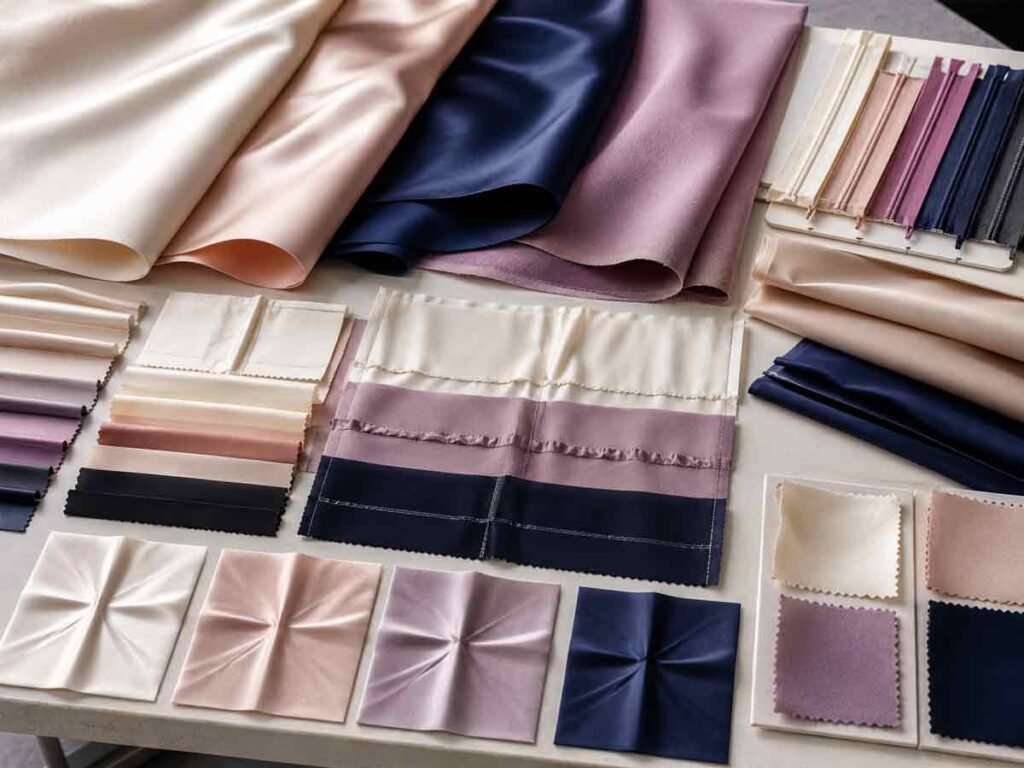
What Is Satin Fabric?
Satin is a fabric defined mainly by its weave rather than by one specific fiber. Long yarn floats create a smooth, reflective face with fewer visible interlacing points. Satin can be woven from silk, polyester, nylon, viscose, acetate, or blended yarns, so its drape, comfort, durability, cost, and care requirements vary considerably.
Is Satin a Weave?
Satin is primarily a weave structure, not a fiber name. Cotton, silk, polyester, nylon, and viscose describe the substance used to make yarn. Satin describes how those yarns are arranged. In a plain weave, each yarn passes over and under neighboring yarns at frequent intervals, creating many visible crossing points. A satin weave reduces those intersections on the face and allows one set of yarns to float over several others before passing underneath. The result is a flatter surface that reflects light more evenly and feels smoother against the hand.
Many apparel satins are warp-faced, which means the warp yarns dominate the visible surface, although commercial fabrics may use related structures and mills do not always apply terminology in exactly the same way. For product development, the practical issue is how the construction behaves. Longer floats improve luster, but they can also increase snagging, abrasion sensitivity, and yarn movement at stressed seams. A sourcing note that says only ‘satin’ is therefore incomplete. A usable specification should identify the fiber composition, fabric weight, usable width, stretch direction, finish, color standard, opacity requirement, and intended care method.
How Is the Shine Created?
Satin’s shine comes from the way light meets a relatively flat, uninterrupted surface. Longer yarn floats create broader reflective areas than plain or twill weaves. Continuous filament yarns usually enhance this effect because they are smoother and have fewer loose fiber ends than spun yarns. Silk filaments create a soft, deep luster, while polyester filaments can be engineered to look subdued, pearly, bright, or almost mirror-like. The final appearance also changes with yarn shape, fabric density, dye color, calendering, heat-setting, and other finishing processes.
More shine does not automatically mean better quality. Under retail lighting or camera flash, an overly bright surface may look harsh, reveal seam puckering, emphasize wrinkles, or make a thin fabric appear inexpensive. Pale colors can expose lining edges and seam allowances, while dark jewel tones often show deeper color and stronger light contrast. A refined satin usually balances luster with color depth, stable construction, and controlled drape. When assessing a swatch, it helps to view it in daylight, warm indoor light, cool retail light, and direct flash rather than judging it under a single showroom lamp.
How Does Satin Feel?
Satin is generally smooth, but there is no single satin hand feel. Lightweight charmeuse may feel almost liquid and slide easily through the fingers. Duchess satin feels denser, firmer, and more structured. Stretch satin often has a slightly springy hand, while acetate satin can feel cool and crisp. Fiber content changes the wearing experience as much as the weave. Silk and viscose generally absorb more moisture than polyester, while tightly woven polyester satin may feel warmer or build more static in close-fitting garments.
The reverse side also matters because it may sit directly against the skin. Some satins have a smooth back, while others have a dull or lightly textured reverse. Lining, seam allowances, labels, cups, boning, fusible support, and internal elastic can all change comfort even when the shell fabric feels pleasant on a swatch card. A small sample should therefore be folded, gathered, stretched, pressed, and draped over a curved surface. Ideally, it should also be made into a trial garment, because fabric that feels attractive on a table can behave very differently across the bust, waist, hips, and hem.
What Does Good Satin Look Like?
Good satin has a clean, consistent face without obvious pulled floats, streaks, broken filaments, patchy shine, oil marks, or irregular dyeing. The surface should reflect light evenly across the usable width, and the fabric should not change appearance unpredictably when viewed from different angles. Because satin is directional, panels cut in opposite orientations can look like different shades even when they come from the same roll. Cutting plans should therefore control face direction and roll shade from the beginning rather than trying to correct visible differences after sewing.
Quality should always be judged against the intended garment. A lightweight polyester satin can be a sound choice for a commercial slip dress when it has controlled luster, sufficient opacity, stable yarns, and clean seam performance. An expensive silk satin may still be unsuitable for a tightly fitted style if it slips at seams or cannot meet the planned care promise. Useful checks include gentle crushing to observe marking, light rubbing to expose loose filaments, bias draping to assess fall, and a small seam trial to reveal puckering or needle damage. The best satin is not the most expensive one; it is the one that delivers the intended appearance and remains reliable through production and wear.
| Construction | Surface Appearance | Relative Stability | Common Apparel Effect |
| Plain weave | Even and usually matte | High | Crisp shirts, lightweight dresses, stable linings |
| Twill weave | Diagonal texture with moderate luster | Medium to high | Structured trousers, jackets, durable dresses |
| Satin weave | Smooth and reflective face | Medium; density dependent | Slip dresses, occasionwear, blouses, formal skirts |
| Sateen weave | Soft sheen with less glare | Medium | Cotton dresses, trousers, shirts, bedding |

What Is Satin Made Of?
Satin can be made from silk, polyester, nylon, viscose, rayon, acetate, or blended fibers. The satin weave creates the glossy surface, while the fiber determines much of the fabric’s softness, breathability, moisture behavior, strength, static level, dye response, price, and care requirements. Satin is therefore not automatically silk or synthetic.
Silk and Synthetic Satin
Traditional luxury satin was closely associated with silk, which is why the words satin and silk are still mixed together in everyday conversation. Silk’s long, naturally smooth filaments work well with a satin weave and produce a deep, soft luster. Silk satin is often selected for premium slip dresses, lingerie, scarves, blouses, and occasionwear where natural fiber content, fluid movement, and luxury positioning justify a higher material cost and more delicate care.
Most satin used in mainstream fashion is now made from polyester because polyester provides stable supply, consistent color, strong wrinkle resistance, dimensional stability, and broad finishing options. It can be produced in lightweight, heavyweight, matte, bright, stretch, recycled, and textured versions. Synthetic satin is not automatically low quality. A dense, well-finished polyester satin may drape more cleanly and reproduce more consistently than a loosely woven silk satin. The choice should be based on the garment’s target price, care promise, silhouette, expected order volume, repeat availability, and market positioning rather than on fiber prestige alone.
Common Fiber Options
Polyester is the most common satin fiber in commercial apparel because it combines strength, color consistency, easy care, and competitive pricing. Silk is chosen when natural luster, moisture behavior, and premium positioning are more important. Viscose and rayon satins can provide a soft touch and rich drape, although shrinkage, seam movement, and wet stability need careful testing. Acetate satin creates elegant color and a cool hand but can be sensitive to heat, moisture, and certain cleaning chemicals. Nylon satin offers strength and smoothness but generally absorbs little moisture and may build static.
Blends are used when one fiber cannot provide every required property. Polyester-elastane satin gives fitted garments more stretch and recovery. Silk-elastane satin provides controlled movement in premium styles. Viscose blends may improve softness while another fiber contributes stability. The composition label alone is still not enough to predict performance. Two fabrics marked 97% polyester and 3% elastane can have different stretch percentages, recovery, density, opacity, and surface quality. Development teams should compare the physical fabric, not just the percentage printed on the header card.
| Fiber | Useful Strengths | Points to Check | Frequent Dress Applications |
| Silk | Natural luster, soft drape, moisture absorption | Cost, abrasion, water marking, delicate care | Luxury slip dresses, blouses, premium occasionwear |
| Polyester | Stable supply, vivid color, easy care, wrinkle resistance | Static, heat retention, excessive glare in low-grade qualities | Party dresses, commercial collections, linings |
| Viscose or rayon | Soft hand, fluid movement, rich color depth | Shrinkage, seam movement, reduced wet stability | Bias dresses, skirts, blouses |
| Acetate | Cool touch, elegant surface, strong color | Heat and chemical sensitivity | Linings, occasion dresses, vintage-inspired styles |
| Nylon | Strength, smoothness, abrasion resistance | Low moisture absorption, static | Performance-influenced fashion, accessories |
| Fiber-elastane blend | Stretch, recovery, closer fit | Heat sensitivity, relaxation, growth | Bodycon dresses, fitted skirts, close-cut tops |
How Is Satin Different from Silk?
Silk is a natural protein fiber, while satin is a weave. Silk can be woven into satin, chiffon, crepe, organza, twill, or many other structures. Satin can be woven from silk, polyester, viscose, nylon, acetate, or blended yarns. That distinction explains why two garments both described as satin may have very different prices, care labels, comfort levels, and expected lifespans. ‘Silk satin’ identifies both the fiber and the construction; ‘polyester satin’ does the same for a synthetic version.
Silk satin often has a softer, deeper shine and can absorb more moisture than polyester satin. Polyester usually resists wrinkles more effectively, costs less, and is easier to reproduce in large quantities and repeated colors. Neither material is universally better. A silk satin may support a luxury positioning but be impractical for a high-volume collection that requires simple care and very stable color. A well-selected polyester satin may offer stronger seam stability, more predictable repeat production, and better commercial value. The useful question is not whether silk is superior, but whether the chosen fiber supports the design, customer expectations, price level, care instructions, and production plan.
Is Satin the Same as Sateen?
Satin and sateen use related float-based constructions, but they are not the same fabric. Satin is traditionally associated with smooth continuous filament yarns and a more reflective face. Sateen is commonly made with spun yarns, particularly cotton, and usually has a softer, warmer, less glass-like sheen. Cotton sateen is often used for dresses, trousers, jackets, shirts, and bedding, while satin is more common in slip dresses, lingerie, occasionwear, linings, scarves, and fluid blouses.
The two fabrics also behave differently during production and wear. Cotton sateen is usually less slippery and easier to control during cutting, although it can crease more readily. Satin may create a more formal, flowing appearance but can snag, shift on the cutting table, or reveal puckering. Product descriptions should use the terms accurately because customers associate them with different shine, drape, fiber content, care, and price. Calling cotton sateen satin may create unrealistic expectations, while describing polyester satin as silk can misrepresent both the material and the product’s value.

Which Types of Satin Are Common?
Common satin types include charmeuse, duchess, stretch satin, crepe-back satin, formal satin, antique satin, and lightweight lining satin. They differ in weight, fiber, luster, structure, stretch, opacity, and drape. The right type depends on whether the garment needs fluid movement, close fit, firm support, volume, reversibility, or a light internal layer.
Charmeuse Satin
Charmeuse is one of the most recognizable dress satins. It is lightweight, smooth, and fluid, with a glossy face and a duller reverse. Many commercial qualities fall around 60 to 100 GSM, although the exact range changes with fiber, yarn, and mill construction. Charmeuse is widely used for slip dresses, bias-cut skirts, camisoles, cowl-neck tops, blouses, scarves, and lingerie-inspired pieces because it follows the body and creates soft movement rather than holding a rigid shape.
That fluidity also makes charmeuse demanding. Lightweight panels can shift during spreading, stretch on the bias, reveal underwear lines, and show seam allowances through pale colors. Poor handling may produce needle marks, pulled filaments, puckered seams, or an uneven hem. The apparent simplicity of a slip dress often hides precise pattern work and careful grain control. A lower-grade polyester charmeuse may look overly bright, cling because of static, or become transparent under flash. A stronger option provides controlled luster, consistent density, clean recovery after handling, and enough opacity for the intended design or lining system.
Duchess Satin
Duchess satin is heavier, denser, and more structured than charmeuse. Commercial qualities often sit around 180 to 300 GSM, although there is no universal specification behind the name. Silk duchess is associated with luxury formalwear, while polyester and blended versions are widely used for structured occasion dresses, corset bodices, sculpted mini dresses, formal skirts, statement bows, and necklines that need to hold a clear shape.
Its body helps support pleats, folds, princess seams, and volume, but it also exposes construction errors. Thick seam intersections can become bulky around waist seams, zippers, boning channels, facings, and lined bodices. Needle holes may remain visible when stitches are removed, and excessive pressing can leave gloss changes or hard impressions. A structured dress should be assessed while the wearer sits, walks, bends, and raises the arms. A silhouette may look impressive on a mannequin yet feel restrictive in real use. Pattern balance, lining, internal support, seam placement, and pressing method must work together rather than being treated as separate decisions.
Stretch Satin
Stretch satin contains elastane, stretch filament, or a construction engineered to provide measurable extension. Many commercial versions contain roughly 2% to 8% elastane, but fiber percentage does not directly show how far a fabric stretches or how well it returns. Stretch satin is commonly used for bodycon dresses, fitted skirts, slim jumpsuits, close-cut tops, and occasion styles that need movement around the bust, waist, and hips while maintaining a polished surface.
Stretch direction and recovery matter more than a simple ‘stretch’ label. Two-way stretch usually provides most extension across the fabric width, while four-way stretch allows movement in both directions, although the percentages may differ. A fabric can stretch easily and still perform poorly if it does not recover. Weak recovery can cause gaping necklines, loose waists, bagging at the seat, and uneven hems. Heat during pressing can also damage elastane. Patterns should be developed with the approved fabric because negative ease, lining stretch, zipper length, seam reinforcement, and grading may all need adjustment when the stretch quality changes.
Crepe-Back and Other Satins
Crepe-back satin combines a glossy face with a textured crepe reverse. Designers can use either surface or show both in the same garment, creating contrast without adding a second base fabric. It is suitable for draped dresses, blouses, evening trousers, skirts, lapels, cuffs, and reversible details. Compared with very light charmeuse, it often has slightly more body and a less fragile feel, although weight, fiber, and density vary widely between mills.
Formal or bridal satin is a broad commercial description rather than one fixed technical construction. It usually refers to medium- or heavyweight satin intended for structured dresses, full skirts, and bodices. Antique satin has a more textured or irregular surface and is often selected for vintage-inspired garments or decorative applications. Lining satin is usually lightweight and designed to reduce friction between the body and outer garment. It still needs to be checked for static, breathability, colorfastness, seam strength, and compatibility with the shell. Commercial names are useful starting points, but a physical specification and approved sample are more reliable than the name alone.
| Satin Type | Common Reference Weight | Drape | Structure | Frequent Uses |
| Charmeuse | 60-100 GSM | Very fluid | Low | Slip dresses, cowl necks, blouses, bias skirts |
| Crepe-back satin | 90-170 GSM | Fluid to medium | Medium-low | Draped dresses, occasionwear, fashion tops |
| Stretch satin | 100-190 GSM | Medium | Flexible | Bodycon dresses, fitted skirts, jumpsuits |
| Formal satin | 150-250 GSM | Controlled | Medium-high | Cocktail dresses, structured bodices, full skirts |
| Duchess satin | 180-300 GSM | Low to controlled | High | Corset dresses, sculpted silhouettes, statement details |
| Lining satin | 50-100 GSM | Fluid | Low | Dress linings, skirts, jackets |
These weight ranges are practical reference points, not fixed industry standards. Mills may sell fabrics under the same commercial name while using different yarns, densities, finishes, and widths. A development team should compare the actual swatch, test report, and sample garment rather than relying on the name or GSM alone. Two 120 GSM satins can differ noticeably in opacity, drape, stretch, seam stability, and surface shine.

What Are Satin’s Properties?
Satin is known for its smooth face, reflective luster, rich color presentation, and graceful drape. Its breathability, stretch, wrinkle resistance, durability, and care needs depend on the fiber and construction. The long surface floats that create its shine can also increase snagging, abrasion risk, seam movement, and sensitivity to pressing and handling.
Breathability and Comfort
Satin is not automatically breathable or non-breathable. Comfort depends on the fiber, fabric density, finish, garment fit, lining, and internal construction. Silk and viscose generally absorb more moisture than polyester and nylon. Polyester absorbs very little moisture, so perspiration may remain between the skin and garment when airflow is limited. A loose polyester satin blouse can still feel comfortable, while a tightly fitted double-layer dress with cups, boning, and fusible support may feel warm even when the shell is lightweight.
The reverse side and lining influence comfort as much as the glossy face. A smooth lining can help the dress move over the body, but a dense synthetic lining may increase heat and static. Pale satin may need another layer for opacity, raising the total fabric weight. Dark, fitted satin can show moisture differently from a loose, pale style. A useful wear test should last longer than a quick fitting. The wearer should sit, walk, raise the arms, and remain in the garment long enough to judge heat, cling, static, moisture marks, and restriction. Initial coolness at first touch does not predict comfort through an entire event.
Stretch and Recovery
Standard woven satin often has little stretch along the warp and weft, although it can move more freely on the bias. Bias movement allows a non-stretch fabric to shape around the body, which is why satin is often cut diagonally for slip dresses and fluid skirts. Bias flexibility is not the same as elastane stretch. A bias-cut panel may lengthen under its own weight and may not return quickly, while stretch satin extends because of elastic fibers, engineered yarns, or construction.
Four measurements are especially useful during development: crosswise stretch, lengthwise stretch, recovery after extension, and growth after wear or hanging. Saying that a fabric has 15% stretch gives only part of the picture. If it does not recover close to its original width, the garment may lose shape at the neckline, waist, seat, or hem. Stretch can also change after steaming, heat-setting, washing, and repeated use. The approved sample fabric and bulk fabric should therefore be compared under the same method. Even a modest difference can alter bodycon fit, zipper behavior, grading, and hem balance across several sizes.
Wrinkling and Durability
Satin’s wrinkle behavior changes with fiber, weight, finish, and garment construction. Polyester satin usually resists creasing better than silk, viscose, or acetate satin, but lightweight qualities can still show packing marks. Satin makes creases more visible because every fold interrupts the reflection of light. Pulling caused by incorrect fit can also look like wrinkling. Horizontal lines at the hips, diagonal stress lines from the bust, or collapse around the waist may point to pattern problems rather than poor fabric.
Durability includes more than breaking strength. Long floats can catch on rough jewelry, nails, zippers, hook-and-loop fasteners, unfinished furniture, or factory equipment. Seam slippage may occur in smooth or loosely balanced constructions, especially around fitted hips, center-back zippers, armholes, straps, and side openings. Adequate seam allowance, realistic garment ease, suitable stitch density, and reinforcement are important. Pressing, perspiration, rubbing, and cleaning can also change the surface or color. A fabric that seems strong in the hand may still fail commercially if it snags, glazes, water-marks, or shifts at seams during normal wear.
Advantages and Limitations
Satin’s main strength is visual impact. It reflects light, deepens color, and gives movement to simple silhouettes. It can look soft and intimate in a slip dress, polished in a midi dress, or architectural in a structured mini. That versatility explains its long use in occasionwear, party dresses, blouses, skirts, lingerie, linings, and formal fashion. The same smooth surface, however, reveals imperfections that a matte or textured fabric might hide.
Satin can expose seam puckering, needle damage, poor fit, pressing marks, panel direction, and small shade differences. Lightweight qualities may be transparent or cling through static. Dense synthetic satin can feel warm, while loosely constructed satin may slip at seams. Its low-friction surface can shift during spreading and sewing, and bias sections can distort after hanging. These limitations do not make satin impractical. They mean that fabric selection, pattern work, testing, cutting, sewing, and pressing must be managed as one connected process. When those decisions are aligned, satin can deliver a clean, high-value appearance without sacrificing wearability or production stability.
| Property | Practical Benefit | Common Risk | Useful Check |
| Luster | Strong visual impact and color depth | Harsh glare or inexpensive appearance | View in daylight, retail light, and flash |
| Fluid drape | Elegant movement | Clinging, distortion, uneven bias drop | Fit test and 24-48 hour hanging review |
| Smooth face | Soft touch and polished finish | Snagging and needle marks | Surface abrasion and sewing trial |
| Low friction | Easy movement over the body | Cutting and sewing slippage | Spreading and seam test |
| Dense construction | Better structure and opacity | Heat, stiffness, seam bulk | Wear and movement test |
| Light construction | Softness and fluidity | Transparency and weak seams | Opacity and seam-slippage check |
| Strong color reflection | Rich visual presentation | Shade variation becomes obvious | Lab dip, shade band, and roll grouping |

How Do You Choose Satin for Dresses?
Choose satin by matching its fiber, weight, drape, stretch, opacity, luster, care method, and sewing performance to the intended silhouette. A successful satin dress also depends on pattern balance, lining, seam construction, pressing, testing, and sample approval. The most attractive swatch is not always the most reliable material for wear or bulk production.
Match Satin to the Silhouette
The silhouette should lead the fabric decision. A lightweight satin that works for a fluid slip dress may be completely unsuitable for a structured corset mini. Slip dresses and cowl-neck styles normally need a soft fabric with clean bias behavior and enough opacity for the intended construction. Bodycon dresses need controlled stretch and reliable recovery. Corset, bustier, and structured occasion styles require a denser shell or a planned internal system that may include lining, cups, boning, fusible support, or power mesh.
Halter and backless dresses need particular attention at necklines, underarms, side seams, and closures. A satin that slips or grows too much can create gaping and instability. Ruched designs need a fabric that gathers cleanly without becoming bulky, while full skirts need enough body to hold volume without becoming heavy. Each style should be assessed for movement, sitting comfort, undergarment compatibility, photography, climate, and expected wear time. The same satin can sometimes support several pieces in a coordinated collection, but forcing one quality across incompatible silhouettes usually weakens fit and finish.
Weight, Drape, and Lining
Fabric weight influences opacity, movement, seam bulk, and comfort, but GSM should never be read in isolation. Two satins at the same weight can behave differently because of fiber, yarn size, density, finish, and stretch. Lightweight satin tends to follow the body closely and may show underwear lines or seam allowances. Medium-weight satin often offers a useful balance between drape and coverage. Heavy satin supports structure but can become bulky at darts, pleats, gathered sections, waist seams, and zippers.
Drape should be tested on a form or fitting model, not only by holding a folded swatch. The fabric should be reviewed in gathers, bias panels, fitted sections, pleats, and a full-length hem. Bias-cut or heavy-skirted samples often benefit from hanging for 24 to 48 hours before the final hem is marked because panels may drop unevenly. Lining should solve a defined problem, such as opacity, static, support, or internal cleanliness. A rigid lining beneath stretch satin can restrict movement, while a heavy lining beneath charmeuse can destroy fluidity. Shell and lining should always be viewed together because lining color can alter the appearance of pale satin.
Cutting, Sewing, and Finishing
Satin should be allowed to relax before cutting, particularly when it contains elastane or has been tightly rolled. The cutting room needs clear control of fabric face, grain, nap direction, roll shade, and panel orientation. Reversing one panel can create a visible color difference because the surface reflects light in another direction. Major panels should normally follow the same orientation unless the design intentionally uses contrast. Smooth tables, clean tools, and careful handling reduce pulled floats before sewing even begins.
Fine satin often performs well with a sharp or Microtex needle. A size 60/8 or 70/10 needle is a common starting point for lightweight qualities, while medium satin may require 70/10 or 75/11. A stitch length around 2.0 to 2.5 mm is often used for dress satin, but the final setting must be established through trials because thread size, density, seam type, and machine tension all influence puckering. Production tests should inspect seam slippage, zipper rippling, needle holes, pulled filaments, edge fraying, pressing impressions, and marks from internal components. Pressing should use the lowest effective heat, controlled steam, light pressure, and a press cloth when appropriate.
Testing and Care
Testing should reflect the fiber, color, garment fit, market, and intended care method. Fabric inspection should identify pulled floats, weaving faults, oil marks, streaks, shade variation, and irregular luster before cutting. Usable width and GSM should be recorded because they affect consumption and marker planning. Shrinkage should be tested using the intended wash or cleaning process. For stable synthetic dress fabrics, many product teams aim for dimensional change around 2% to 3%, but the permitted limit must follow the garment specification and brand standard rather than a generic number.
Stretch satin should be measured for extension, recovery, and growth. Pale colors should be checked for opacity over several skin-tone cards and under daylight, studio lighting, and flash. Fitted areas need seam-performance trials, while color approval should include lab dips, shade bands, and review under the required light source. Care instructions must follow the actual fiber and construction. Some polyester satin dresses can be gently washed, while silk, acetate, structured bodices, embellished garments, and certain linings may require professional cleaning. Low heat, mild detergent, limited agitation, and careful storage away from rough surfaces reduce unnecessary damage.
For brands developing satin dresses, the most useful starting point is a clear product brief rather than a generic fabric request. Share the silhouette, target fit, color direction, size range, expected order stage, care promise, reference images, and preferred price position. Duolan Apparel can review a tech pack, original sample, reference image, or collection concept and help align satin selection, lining, pattern, sample development, construction, and bulk feasibility. To request a practical quotation, send the available design files, estimated quantity, target market, and delivery timeline to info@duolanapparel.com.