Skip to content
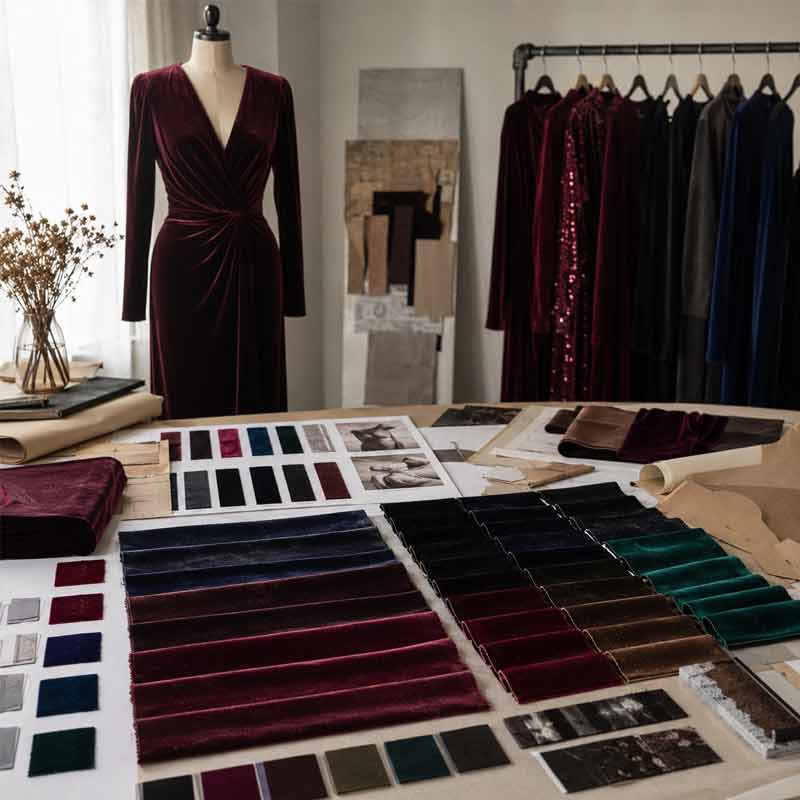
Velvet can make a simple dress look richer before a designer adds a single bead, print, or decorative trim. Its surface changes as the wearer moves, so black becomes deeper, jewel tones become more dimensional, and even a clean silhouette gains visual drama. That beauty can be misleading, however, because fabrics sold under the same name may behave very differently during cutting, sewing, fitting, pressing, washing, packing, and repeat production.
Velvet is a pile fabric with a dense surface of short, raised fibers. It may be woven or knitted and can be made from silk, cotton, viscose, polyester, nylon, elastane, or blends. Its softness, sheen, drape, stretch, durability, price, and care requirements depend on both the fiber composition and the way the pile and ground structure are produced.
For someone choosing a velvet dress, softness and color may be enough to create an emotional response. For a product team, the same fabric also raises practical questions about pile direction, stretch recovery, backing coverage, lining, seam stability, shade control, garment weight, and pressure marks during shipping. A fabric can look excellent under studio lighting and still disappoint after wear if the waist grows, the pile flattens, or the second production lot reflects light differently from the first. The following guide explains what to check before that attractive swatch becomes an expensive production problem.
What Is Velvet Fabric?
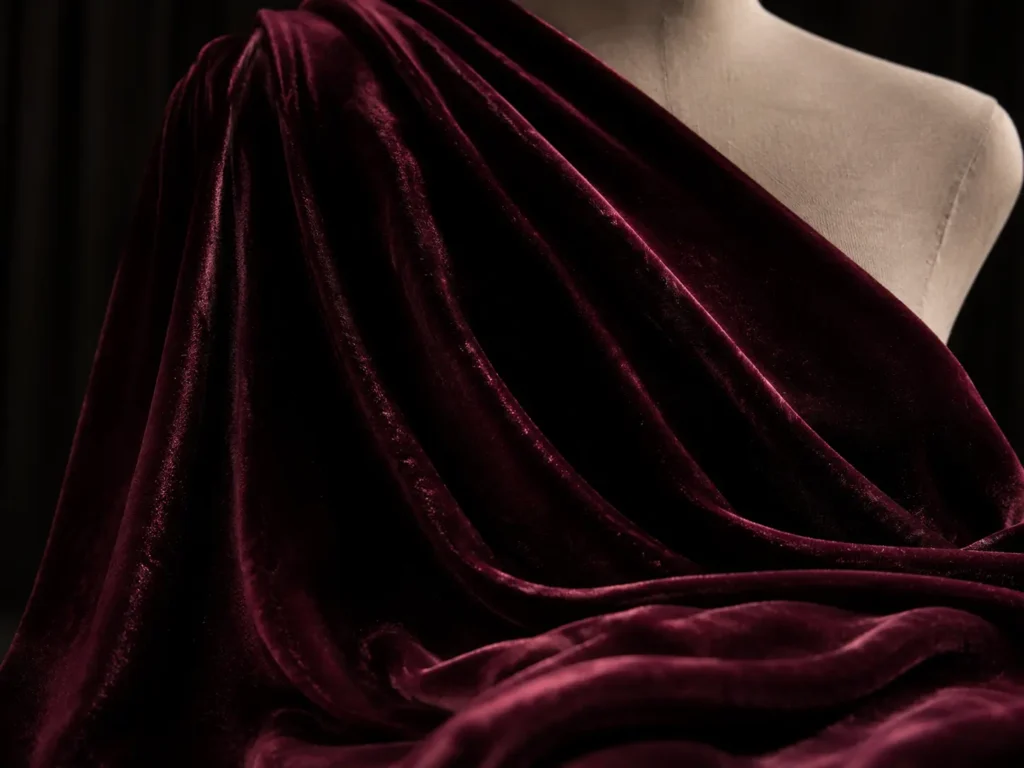
Velvet is defined by its short, dense pile rather than by one specific fiber. The raised surface creates softness, deep color, and directional sheen. Traditional velvet is commonly woven, while many modern stretch versions are knitted. Fiber, ground construction, pile density, weight, finishing, and nap direction determine how the material looks, feels, sews, fits, and wears.
The Pile Structure
Velvet is identified by the layer of fibers standing above its base fabric. These closely spaced fibers are called pile. Their height, density, angle, and finishing determine whether the material feels plush, smooth, dry, fluid, or slightly synthetic. A dense pile usually gives stronger color depth and hides the base more effectively, while a sparse pile may expose the ground when the fabric is stretched across the bust, hip, seat, or elbow.
Traditional woven velvet is often made through a double-cloth process in which two layers are woven at the same time and connected by additional pile yarns. A blade cuts between those layers, producing two pieces with raised surfaces. The quality of the result depends on even yarn tension, accurate cutting, consistent pile height, and controlled finishing. Longer pile can feel luxurious but may crush more easily, while a shorter pile often looks cleaner in fitted or structured garments.
Fiber Composition
The word velvet does not identify the raw material. Silk, cotton, viscose, polyester, nylon, elastane, and blended yarns can all produce a velvet surface, but each composition changes the commercial result. Silk can provide refined movement and subtle luster, cotton usually feels fuller and more matte, viscose often delivers deep color and fluid drape, and polyester can offer stronger consistency, availability, and care practicality for larger fashion programs.
Composition must be read together with construction. Two polyester velvets may differ in weight, pile density, stretch, shine, backing stability, and recovery even when their fiber labels look identical. The same applies to viscose or cotton versions. A useful fabric specification therefore includes fiber percentages, woven or knitted structure, weight in grams per square metre, usable width, stretch in both directions, recovery, shrinkage, nap direction, and the proposed care method.
Woven and Knitted Velvet
Woven velvet generally offers more dimensional control and can support structured dresses, jackets, tailored skirts, and fitted bodices. Its limitations include lower stretch, possible seam slippage, visible needle marks, and a tendency for the pile faces to shift against each other while cutting or sewing. A pattern developed for stable woven velvet usually depends on darts, seams, closures, and internal structure rather than the fabric stretching around the body.
Knitted velvet is more flexible and is widely used for bodycon dresses, ruched styles, fitted tops, dance-inspired garments, and soft occasionwear. The key measurement is not simply how far the material stretches, but how well it returns after extension. Weak recovery can cause the waist, hip, seat, or bust to relax after a few hours. When a style changes from woven to knitted velvet, pattern reduction, lining, zipper choice, seam type, and garment balance normally need to be reconsidered.
Nap and Light
Velvet appears darker or lighter according to the direction of its pile. This directional effect is known as nap. When the pile faces toward the viewer, the color may look deeper; when it faces away, the surface may reflect more light. If a front panel and a back panel are cut in opposite directions, the garment can appear to contain two different shades even when both panels came from the same roll.
Most velvet garments therefore require one-way cutting, which reduces marker flexibility and often increases fabric consumption. A practical allowance of roughly 5-15% above a comparable non-directional fabric may be needed, although the real figure depends on width, dress length, flare, sleeve shape, panel count, and marker efficiency. Color approval should also consider daylight, warm retail lighting, flash photography, and movement, because a small flat swatch cannot show the full visual range of a finished velvet dress.

Which Types of Velvet Are Common?
Common velvet categories include silk, cotton, viscose, polyester, stretch, crushed, panne, embossed, and burnout velvet. Some names describe the fiber, while others describe construction or surface finishing. The best option depends on silhouette, target price, drape, stretch, care expectations, desired sheen, production volume, and the level of consistency required from sample approval through repeat orders.
Silk, Cotton, and Viscose
Silk velvet is often used as the luxury reference because it can combine a soft pile with fluid movement and a subtle, deep luster. It suits draped evening dresses, relaxed gowns, soft skirts, and premium occasion pieces. The material is expensive and sensitive to moisture, pressure, heat, and needle damage, so cutting loss, specialist pressing, careful storage, and protective packing may all add to the finished garment cost.
Cotton velvet is usually fuller, firmer, and more matte. It can support structured mini dresses, jackets, A-line skirts, and vintage-inspired silhouettes, although thick seam allowances may create bulk. Viscose velvet normally offers greater fluidity and rich color, making it attractive for draped necklines, long skirts, and soft sleeves. Its sensitivity to moisture and pressure means that shrinkage, pressing response, seam behavior, and pile recovery should be checked before the style moves into production.
Polyester Velvet
Polyester velvet is widely used in commercial fashion because it can balance appearance, cost, availability, color consistency, and scalable supply. It may be woven or knitted, lightweight or heavy, matte or highly reflective. A dense, well-finished polyester velvet can look refined, while a weaker version may expose the backing under stretch, develop an artificial shine, or lose shape at fitted areas after wear.
The surface should be assessed across the full width rather than from a small cutting. Streaks, side-to-center shading, pile lines, crushed zones, and uneven luster may not appear in a hand-sized swatch. Heat sensitivity also matters because aggressive pressing can flatten or glaze the pile. A good approval process reviews a full garment under relevant lighting, confirms dimensional stability and colorfastness, and checks whether future lots can reproduce the same visual and mechanical performance.
Stretch Velvet
Stretch velvet is generally built on a knitted ground and often contains elastane. It is commonly used for bodycon dresses, ruched minis, fitted tops, jumpsuits, and occasion pieces that need both softness and movement. Stretch must be measured separately in the width and length directions. A fabric with 30% widthwise extension may have very little useful lengthwise movement, which changes comfort, pattern reduction, zipper needs, and garment length stability.
Recovery deserves equal attention. A 10 cm section that stretches to 13 cm has 30% extension, but the test is incomplete until the fabric has rested. If it returns only to 10.4 cm, it retains 4% growth. Many fitted-fashion developments try to keep residual growth around 3-5%, although the acceptable level depends on the style and test method. Opacity should also be reviewed at maximum intended stretch because a dense-looking surface can reveal the backing over curves.
Surface-Effect Velvet
Crushed velvet is deliberately finished with an irregular pile direction, producing broken highlights and a less formal surface. Panne velvet normally has a flattened pile and stronger shine. Embossed velvet uses heat and pressure to create a motif, while burnout or devore velvet removes part of a blended structure to produce transparent and opaque areas. These effects can create strong visual value without relying on heavy embellishment.
Decorative surfaces also create placement and consistency risks. Burnout motifs may expose seam allowances, cups, boning, labels, or undergarments unless the lining is planned carefully. Embossed patterns can vary if pressure or temperature changes across the roll. Crushed finishes may look different between lots because irregularity is part of the effect. Approval should consider motif scale, usable width, repeat, transparency, shade, panel placement, and the way the finished garment looks while moving.
| Velvet Type | Typical Apparel Weight | Best Known For | Main Development Risk |
| Silk velvet | 160-280 GSM | Fluid drape and refined luster | Pressure, moisture, and handling marks |
| Cotton velvet | 220-420 GSM | Body, structure, and matte depth | Bulk at enclosed seams and edges |
| Viscose velvet | 180-320 GSM | Rich color and elegant movement | Dimensional change and pressure sensitivity |
| Polyester velvet | 170-350 GSM | Repeatability and commercial versatility | Sparse pile, harsh shine, or heat damage |
| Stretch velvet | 200-330 GSM | Close fit, comfort, and ruching | Weak recovery and backing exposure |
| Burnout velvet | 80-180 GSM | Sheer decorative pattern | Delicacy, motif placement, and lining |
| Crushed velvet | 170-320 GSM | Irregular reflective texture | Lot-to-lot visual variation |
The weight ranges above are practical starting points rather than universal rules. Yarn size, pile density, ground construction, finishing, and testing method can move a fabric outside these values. A lighter velvet with dense pile may perform better than a heavier fabric with a loose ground, so weight should always be reviewed together with stretch, recovery, opacity, drape, and the intended silhouette.

What Are Velvet’s Main Properties?
Velvet is generally soft, visually rich, and capable of producing deep color, but its performance varies widely. Breathability depends on fiber and construction, stretch depends on the ground and elastane content, and durability includes both structural strength and surface appearance. Common risks include pile crushing, shading, seam impressions, snagging, shrinkage, backing exposure, and weak recovery.
Softness, Warmth, and Comfort
Velvet feels soft because the skin touches thousands of pile fibers rather than a flat woven surface. The sensation changes with pile height, density, yarn fineness, fiber type, and finishing. Fine viscose or silk velvet can feel smooth and fluid, cotton velvet often feels drier and fuller, and polyester versions range from plush and refined to noticeably slick depending on the yarn and surface treatment.
The material is often perceived as warm because its pile traps a thin layer of air, but appearance alone is a poor guide to comfort. A lightweight knitted velvet may feel less insulating than a dense woven fabric, and the lining can change the experience more than the outer layer. A close-fitting dress also keeps more material against the skin than a loose silhouette. Wear trials should reflect the actual event, climate, coverage, and length of time the garment will be worn.
Stretch and Recovery
Velvet may have almost no functional stretch, limited mechanical give, or substantial engineered elasticity. Woven constructions usually rely on seams, darts, closures, and shaping, while knitted versions can extend around the body. Product specifications should record extension in both directions, recovery after release, residual growth after repeated movement, and the surface appearance at the maximum stretch expected in the finished garment.
Coverage is easily overlooked. A fabric may appear opaque while relaxed but reveal the ground or lining over the bust, hip, seat, or elbow. The sewing construction must also move with the material. A rigid seam can break even when the velvet itself stretches comfortably, while a poorly balanced elastic seam can wave. Stretch testing, pattern reduction, seam choice, thread, zipper, lining, and fit review should be treated as one connected development process.
Durability and Appearance
For velvet, durability includes appearance retention as well as tensile strength. A fabric can remain physically intact while its pile becomes polished, flattened, snagged, or permanently marked. High-contact areas include underarms, waistbands, hips, seats, elbows, zipper edges, hanger points, and the fold lines created during packing. Some pile recovers after steaming and rest, while other constructions retain visible pressure marks.
Seam allowances can also press through to the face, especially on pale colors or smooth, dense pile. Grading, trimming, binding, or changing the construction may reduce the problem, whereas heavy pressing often makes it worse. Surface testing should reflect real use: sitting, dancing, handbags, jewelry, repeated cleaning, and long-distance delivery. Roll inspection and shade grouping remain important because pile density and direction can create visible panel differences even when the dye lot appears acceptable.
Performance Checks
No single test proves that velvet is suitable for a garment. A fabric may pass shrinkage testing but show weak recovery, or it may withstand abrasion while developing severe pressure marks. The most useful approach combines laboratory results with seam trials, pressing trials, a complete fit sample, and a packing test. Acceptance levels should follow the brand specification, applicable test standard, material type, care method, and the real demands of the finished style.
Dark shades deserve particular attention because loose dye can transfer during rubbing, while pale shades can reveal seam impressions and contamination more easily. Fitted garments need stronger control of growth and opacity than relaxed dresses. Long skirts need length stability, and embellished velvet needs testing around the attachment area. The table below presents common working targets used during apparel development, not claims that every velvet must meet the same numbers.
| Check | Common Working Target | What It Helps Prevent | Notes |
| Fabric weight | Agreed value, often within about +/-5% | Unexpected drape, warmth, or consumption | Use the same test method for approval and bulk |
| Dimensional change | Often within +/-3% after approved care | Length change, twisting, and fit complaints | Final limit depends on fabric and care label |
| Dry rubbing fastness | Grade 3-4 or better is often requested | Color transfer in normal wear | Dark shades may need tighter control |
| Wet rubbing fastness | Grade 3 or better is a common starting point | Transfer from moisture or perspiration | Assess against customer standard |
| Residual growth | Often around 3-5% maximum for fitted styles | Bagging at waist, hip, or seat | Method and recovery time must be defined |
| Opacity under stretch | No unintended backing or lining exposure | See-through areas over curves | Test at the intended garment extension |
| Pressing response | No unacceptable shine or pile flattening | Irreversible production marks | Confirm temperature, steam, and pressure |
| Seam performance | No objectionable slippage, breakage, or waving | Weak or distorted garment seams | Test the actual stitch, thread, and feed |
The figures in this table should be treated as development references rather than universal specifications. A premium occasion dress, casual velour garment, stretch bodycon style, and home-textile velvet may require different limits. The most reliable standard is the one agreed before production and verified on the nominated fabric, trims, lining, seam construction, and completed garment.

How Is Velvet Used in Clothing?
Velvet is used in dresses, skirts, tops, jackets, trousers, sets, costumes, and accessories. In women’s fashion, it is especially effective for party, occasion, holiday, cocktail, fitted, and evening-led products. The best garment use depends on weight, stretch, recovery, drape, pile density, opacity, internal support, lining, and the conditions in which the item will be worn.
Dress and Garment Categories
Velvet can support very different fashion directions. Heavy cotton velvet may create a structured jacket, tailored skirt, or A-line mini dress. Fluid viscose velvet can form a draped midi, soft maxi, or gathered sleeve, while knitted stretch velvet works well for bodycon silhouettes, ruched styles, fitted tops, jumpsuits, and dance-influenced garments. Burnout velvet is often used for sleeves, yokes, overlays, and dresses that mix opaque and transparent areas.
Color is central to how velvet is merchandised. Black, navy, burgundy, forest green, plum, chocolate, and ruby emphasize depth and luster. Ivory, champagne, blush, ice blue, and other pale shades can look elegant but reveal pressure marks, stains, seam impressions, and pile inconsistency more easily. Velvet can also be combined with mesh, satin, lace, rhinestones, sequins, or embroidery, but those materials must work mechanically as well as visually.
Weight, Drape, and Fit
Fabric weight affects how the garment hangs and how much stress it places on straps, necklines, waist seams, and bust support. Heavy velvet can create a clean vertical fall, yet it may lengthen a maxi dress during wear or pull on a halter neckline. Lightweight velvet may drape beautifully but reveal cups, boning, zipper tape, seam allowances, or the base fabric when stretched over the body.
Drape must suit the silhouette. Fluid velvet works for cowls, soft gathers, and flowing skirts; medium-body fabric supports fitted dresses and controlled flare; firm velvet suits A-line panels, structured bodices, and jackets. Fit approval should include walking, sitting, arm movement, turning, and recovery after motion. A dress that looks balanced on a mannequin may ride up, twist, gape, stretch out, or become uncomfortable once it is worn for an actual event.
Lining and Internal Support
Many velvet garments benefit from lining, but the lining should solve a defined problem. It may improve comfort, conceal internal construction, reduce transparency, protect the outer fabric, control static, or support the silhouette. A highly stretchable velvet should not be paired casually with a rigid lining because the mismatch can restrict movement, increase seam tension, and change the approved fit.
Structured bodices may use cups, boning, waist tape, underbust elastic, stay tape, or stabilized seam allowances so the internal components carry the load rather than relying on the velvet surface. Burnout velvet often needs modesty panels or strategic lining because transparent motifs can reveal labels and support elements. Lining color should be checked under strong light and at full stretch, as a contrasting shade can show through sparse pile or sheer sections.
Seasonal Wear
Velvet is strongly associated with autumn, winter, holiday dressing, and evening events, but it is not automatically limited to cold weather. A dense, fully lined, long-sleeved cotton velvet dress will feel warm, while a lightweight sleeveless stretch-velvet mini may work comfortably for indoor parties in a warmer region. Burnout velvet and lighter viscose constructions can also support transitional-season occasionwear.
Seasonal suitability depends on fabric weight, density, fiber content, lining, coverage, fit, climate, and wearing duration. Dark jewel tones naturally suit holiday and autumn collections, while pale pink, powder blue, ivory, champagne, and brighter colors can move velvet into spring events, graduation capsules, birthdays, or resort eveningwear. Comfort remains the practical test: a visually striking dress will underperform if the wearer overheats, the skirt feels too heavy, or the lining restricts movement.
| Garment Style | Useful Starting Specification | Main Development Priority | Common Risk |
| Bodycon mini | 220-320 GSM; roughly 20-40% width stretch | Recovery, opacity, seam extension | Bagging or backing exposure |
| Ruched dress | 180-290 GSM; soft knit base | Even gathers and controlled bulk | Uneven ruching or heavy seams |
| Corset dress | 220-350 GSM; stable outer or supported stretch | Boning, cups, lining, pressure control | Pile marks over internal structure |
| Draped midi | 170-270 GSM; fluid fall | Length stability and hem balance | Distortion after hanging |
| Maxi dress | 170-280 GSM; controlled total weight | Skirt growth and consumption | Neckline pull or length increase |
| Halter dress | Medium weight with stable neckline | Neck comfort and armhole control | Excess load at the neck |
| Backless dress | Strong recovery with secure edges | Elastic support, gaping control, lining | Edge growth and poor hold |
| A-line mini | 220-360 GSM; moderate body | Panel shading and clean hem | Bulky seams or nap mismatch |
These values are sensible development starting points rather than fixed rules. A fabric with lower weight and dense pile may perform better than a heavier option with weak recovery or a loose base. The final choice should be made after reviewing the nominated velvet in the intended color, lining, pattern, seam construction, and complete sample rather than selecting material from weight or composition alone.

How Do You Choose and Care for Velvet?
Choose velvet by checking fiber content, construction, weight, pile density, nap, stretch, recovery, usable width, shrinkage, color behavior, seam performance, and care requirements. Review it on a finished garment rather than relying on a small swatch. Washing, pressing, storage, and packaging methods must be confirmed through testing because different velvet constructions can react in very different ways.
Velvet, Velour, and Velveteen
Velvet, velour, and velveteen can look similar, but the terms do not always describe the same construction. Traditional velvet commonly has a cut pile and may be woven, although knitted versions are now widespread. Velour is generally knitted, naturally flexible, and often used for loungewear, tracksuits, casual dresses, costumes, and comfortable separates. Velveteen is usually woven, often cotton-based, with a shorter pile, firmer body, and a more matte appearance.
Commercial naming is inconsistent, especially among suppliers of synthetic knitted pile fabrics. A material called velvet by one mill may be sold as velour by another. The name should therefore be treated as an introduction rather than a complete technical description. The final decision should rely on fiber composition, construction, weight, stretch, recovery, pile height, density, sheen, width, shrinkage, care method, and the way the fabric performs in the intended garment.
Fabric Approval
A small swatch rarely reveals the full risks of velvet. It may hide side-to-center shading, streaks, pile lines, pressure marks, usable-width loss, inconsistent luster, or the effect of large panels reflecting light. A hanger sample or several metres of fabric gives a more realistic view. For an important style, the material should move through a prototype, fit sample, revised sample, and pre-production sample before bulk cutting begins.
Approval records should include composition, woven or knitted structure, weight, total and usable width, nap direction, stretch in both directions, recovery, shrinkage, rubbing fastness, pile density, backing coverage, pressing response, seam behavior, shade continuity, and lining compatibility. Replacing the fabric after fit approval is risky because a similar-looking velvet may have different friction, recovery, drape, or surface density. The existing pattern may no longer produce the same fit or visual result.
Cutting and Sewing
All visible pattern pieces should normally follow the same nap direction, and that direction should appear on the pattern, marker, cutting order, and bundle instructions. Knitted velvet should be allowed to relax before cutting. Layer height must remain controlled because too much pressure can shift the pile and reduce accuracy. Single-ply or automated cutting may be appropriate for delicate, stretchable, or high-value fabrics where panel precision is especially important.
Needle size around 70/10 to 80/12 is a useful starting point for lightweight velvet, while 80/12 to 90/14 may suit medium or heavier fabrics. Stitch lengths near 2.5-3.0 mm are common starting settings, but every construction requires a trial. Reduced presser-foot pressure, controlled feeding, a walking or roller foot, and temporary stabilization can help when the layers shift. These settings are not universal and must be confirmed on the actual fabric, thread, seam, and number of layers.
Pressing is one of the highest-risk operations. Velvet should generally be pressed from the reverse with minimal pressure, using a needle board, velvet board, thick towel, or a spare piece placed pile-to-pile. Heat and steam must be tested because excessive temperature can glaze, flatten, or permanently mark the surface. Seam allowances should be graded carefully to reduce impressions, and heavy pressing should never be used as a substitute for accurate sewing.
Cleaning and Storage
Velvet care depends on fiber, dye, pile structure, finishing, lining, embellishment, and garment construction. Silk and many viscose velvets are commonly dry-cleaned because water may affect dimensions, color, hand, or pile appearance. Some polyester and stretch-polyester fabrics can tolerate gentle washing, but only when the completed garment has passed an approved care test rather than relying on the outer fabric result alone.
When washing is permitted, cool water, mild detergent, gentle movement, and controlled drying are usually safer than heat, twisting, or aggressive rubbing. Heavy velvet can stretch when hung wet, so flat or well-supported drying may be needed. Direct ironing on the pile should be avoided. Storage should prevent pressure marks through padded hangers, tissue support, and generous spacing. Shipping methods should also be tested by packing, storing, unpacking, and allowing the garment to recover before approval.
| Production or Care Check | Recommended Practice | Failure It Helps Prevent | When to Confirm |
| Nap direction | Mark and cut all visible panels one way | Apparent shade mismatch | Pattern and marker approval |
| Fabric relaxation | Relax knitted velvet before cutting | Size and length distortion | Before bulk spreading |
| Stretch and recovery | Measure both directions and residual growth | Poor fit and bagging | Fabric approval and fit sample |
| Opacity | Check at maximum intended extension | Backing or lining exposure | Fit sample under strong light |
| Needle and seam trial | Confirm point, size, stitch, thread, and feed | Holes, puckering, breakage, or waving | Before production sewing |
| Pressing trial | Use low pressure and pile protection | Shine and permanent flattening | Before setting iron parameters |
| Care test | Test the complete garment with trims and lining | Shrinkage, twisting, color change | Before care label approval |
| Packing trial | Pack, store, unpack, and assess recovery | Compression and fold marks | Before final carton method |
| Bulk shade control | Group rolls and inspect under agreed lighting | Panel and repeat-order inconsistency | Before cutting and during replenishment |
From Fabric Selection to Production
The most successful velvet garments are rarely created by choosing the softest swatch and solving the technical details later. The fabric, silhouette, pattern, lining, internal support, seam construction, pressing method, care label, and packing plan need to be developed as one system. That approach reduces unnecessary sample rounds, protects the intended appearance, and gives the production team a clearer standard to reproduce across colors, sizes, and future orders.
Duolan Apparel supports fashion brands with velvet fabric sourcing, dress development, pattern and fit refinement, sample execution, construction review, and coordinated bulk production in Guangdong, China. Product teams can send a tech pack, reference image, original sample, target fabric, size specification, planned quantity, and launch date to duolan apparel. The team can then review material suitability, likely development risks, sample requirements, and a practical path toward production-ready custom velvet dresses.