Skip to content
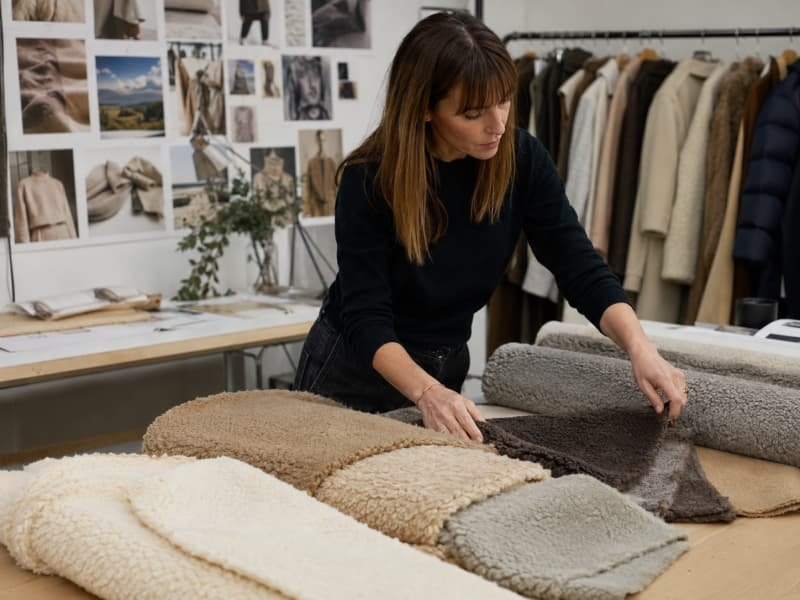
Sherpa can look reassuringly simple on a hanger: a soft, curled surface, an unmistakable winter mood, and the promise of warmth. In product development, however, it is one of those fabrics that exposes weak decisions quickly. Two rolls sold under the same name may differ in pile density, backing stretch, shedding, recovery, seam bulk and wash performance. A swatch that feels luxurious in the hand can become flat after packing, reveal its backing when stretched, or make an otherwise balanced jacket look much larger than the original sketch.
Sherpa fabric is a raised-pile textile made to resemble sheep fleece. Most commercial versions are knitted from polyester, although recycled polyester, acrylic, cotton blends and wool blends are also available. It is used for jackets, vests, linings, hoodies, fashion tops and cold-weather details because its three-dimensional pile traps insulating air while adding a distinctive soft, wool-like texture.
The useful question is not simply whether Sherpa is warm or fashionable. It is whether a particular Sherpa construction is right for a particular garment, customer climate, care expectation and retail price. A cropped jacket may need a compact pile and stable backing, while an oversized coat can support more visual volume. The difference often becomes clear only after the fabric has been cut, sewn, fitted, washed and packed, which is where informed development saves far more time than a beautiful swatch alone.

What Is Sherpa Fabric?
Sherpa fabric is a soft, raised-pile textile developed to imitate the curled appearance of sheep fleece. It usually has a fluffy face and a flatter knitted backing. Most versions are synthetic, and their warmth comes from air held within the pile. Weight, density, pile height, backing stability and finishing determine how the fabric feels, wears and performs in a finished garment.
Surface and Structure
Sherpa is recognized by its fluffy, irregular surface, which usually consists of small curls, clusters or loops rather than the smooth nap found on ordinary polar fleece. The face can range from compact and slightly pebbled to deep and cloud-like. Beneath that surface sits a knitted backing that holds the pile and determines how much the fabric stretches, recovers and resists distortion during cutting, sewing and daily wear.
The backing is easy to overlook when reviewing a small showroom swatch, yet it has a major influence on finished-garment quality. A loosely knitted base can make the fabric feel flexible and soft, but it may open visibly when stretched across the body. A firmer backing offers better dimensional stability, although it can make a jacket feel stiffer or heavier. When Sherpa is used without a full lining, the reverse side also affects skin comfort and the appearance of internal seams.
Commercial Sherpa may be supplied as a single-face fabric, a double-face construction or a bonded material. Single-face Sherpa has a pile surface and a relatively flat reverse. Double-face versions may have fleece or pile on both sides. Bonded constructions combine Sherpa with faux suede, woven cloth, membrane film or another knitted layer. Bonding can add structure and wind resistance, but it may reduce breathability and create extra requirements for peel strength and wash durability.
Pile direction must be identified before cutting because the raised surface reflects light differently depending on the nap. Panels cut in opposing directions can appear to be different shades even when they come from the same roll. One-way cutting is therefore common for visible outerwear. It increases fabric consumption, but the cost is usually easier to manage than a finished production run with mismatched fronts, sleeves or collars.
| Construction feature | Common reference range | Practical effect |
| Fabric weight | About 180-450+ GSM | Influences warmth, drape, bulk and freight volume |
| Pile height | About 3-15 mm | Changes texture, visual volume and seam thickness |
| Usable width | Often around 145-160 cm | Affects marker efficiency and consumption |
| Stretch | Minimal to moderate | Influences fit, pattern allowance and recovery |
| Backing type | Single knit, double face or bonded | Determines stability, airflow and finish |
| Surface density | Open to highly compact | Affects coverage, shedding and perceived quality |
Wool or Synthetic?
The appearance of Sherpa leads many people to assume that it contains sheep’s wool. In most contemporary apparel, however, Sherpa is synthetic and is commonly made from polyester. The name refers more to the wool-like surface than to a specific fiber. Genuine shearling is different because it is made from sheepskin or lambskin with the natural fleece still attached to the hide, while Sherpa recreates that visual effect through textile construction and finishing.
Fiber content should still be confirmed rather than guessed. Some Sherpa fabrics contain acrylic, cotton, wool or blended yarns, and the pile may use a different fiber from the backing. A fabric can have a polyester face on a cotton-rich base, for example, or a recycled-polyester pile bonded to a synthetic suede reverse. This matters because the complete composition controls labeling, care instructions, shrinkage risk, customs declarations and any recycled or animal-free claims.
A wool-like hand is not proof of wool content, and a synthetic face does not automatically make the complete garment vegan. Leather trims, wool labels, shell buttons, coatings or adhesives may introduce animal-derived materials elsewhere in the bill of materials. Brands that make specific material claims need accurate supplier documentation and, where required by the selling market or retailer, independent fiber-content verification rather than relying on trade names or visual appearance alone.
Warmth and Breathability
Sherpa feels warm because its raised pile creates many small pockets of still air. These pockets slow heat transfer and help retain body warmth, but the level of insulation varies significantly between constructions. Pile height, density, overall thickness, backing openness and garment coverage all contribute. A dense short-pile Sherpa can feel more substantial than a longer but loose pile, so warmth cannot be judged accurately by surface appearance or fabric weight alone.
Sherpa is not automatically windproof. Air can move through an open knitted backing, particularly when the material stretches over the shoulders, elbows or upper back. A thick jacket may therefore feel warm in calm conditions and surprisingly cool in strong wind. Garments intended for exposed outdoor use often need a tightly woven shell, bonded membrane or wind-resistant lining, while indoor fashion pieces may prioritize softness and breathability instead.
The same caution applies to water resistance. Polyester fibers absorb relatively little moisture, but water can remain between the pile fibers and make a deep-pile garment feel heavy. Unless a coating, membrane or treatment has been tested, Sherpa should not be described as waterproof. Breathability also depends on the complete garment. An unlined vest can release heat reasonably well, while a dense pile combined with a non-breathable lining may become uncomfortable indoors or during active movement.
Warmth is best evaluated in a finished sample because pockets, interlinings, facings, zippers and seam layers all change how the garment traps air and feels on the body. A fabric specification can narrow the options, but only the completed sample shows whether the customer can move comfortably, layer clothing underneath and wear the product across the intended temperature range.
Quality in Real Use
A Sherpa swatch can feel excellent when new and still perform poorly after a few weeks of wear. The areas most likely to reveal weaknesses are the underarms, cuffs, side seams, pocket openings, collar edge and points that rub against bags or seat belts. These high-friction zones can show pilling, matting, pile flattening or bald patches long before the rest of the garment appears worn.
Shedding occurs when loose fibers detach from the fabric. Some fiber loss immediately after cutting is normal, especially with deep pile, but persistent shedding after cleaning or laundering can indicate weak pile anchoring. Pilling forms when loose fibers tangle into small balls. Matting is different: the pile becomes compressed and loses its separation and loft. A fabric can pass a visual inspection when new yet become commercially unacceptable after repeated friction or heat exposure.
Recovery after packing is another practical quality check. Sherpa garments occupy considerable carton space, so they are often folded and compressed for shipping. Better materials regain most of their original loft after unpacking and gentle handling. Weak recovery can leave flat panels, fold lines or uneven pile that reduces retail presentation. Trial packing before bulk shipment helps the team choose a carton size and folding method that protect both appearance and freight efficiency.
Color consistency deserves equal attention because the three-dimensional surface creates shadows that make small shade differences more visible. Bulk inspection should review roll-to-roll variation under controlled lighting and confirm that all panels follow the approved nap direction. The approved standard should include not only color but also curl definition, surface density, hand feel and recovery, since customers notice these qualities together rather than as separate technical measurements.

What Is Sherpa Fabric Made Of?
Sherpa is most commonly made from polyester because polyester can form a stable raised pile, accept many colors and dry relatively quickly. Recycled polyester, acrylic, cotton blends and wool blends are also available. Composition influences labeling, care, static, shrinkage and cost, but yarn quality, backing construction, surface density and finishing are equally important to garment performance.
Polyester Sherpa
Polyester dominates commercial Sherpa because it offers a practical balance of cost, durability and production consistency. It can be knitted into lightweight lining fabrics or dense outerwear materials, and it accepts a broad color range. Its relatively low moisture absorption also helps many garments dry faster than cotton-rich or wool-rich alternatives, provided the pile is not so deep that water remains trapped between the fibers.
For fashion collections, polyester makes it easier to coordinate colors across jackets, vests, trims and accessories. Mills can adjust pile height, curl size, backing weight and density without changing the basic fiber family. That flexibility supports both compact Sherpa with a clean contemporary surface and larger teddy-like textures intended to create stronger visual volume. It also helps when a brand needs several colorways or expects repeat orders across a season.
Polyester is not automatically low quality. Well-developed synthetic Sherpa can feel soft, recover after compression and remain stable through repeated wear. Problems appear when the yarn is weak, the pile is poorly anchored or the finish is too aggressive. Low-density fabric may expose the backing when stretched, while uncontrolled heat during finishing, pressing or laundering can create a harsh, shiny or flattened surface that no longer resembles the approved sample.
A useful evaluation goes beyond the fiber label. The fabric should spring back after pressing, keep the backing covered when bent, resist excessive shedding after rubbing and retain an even surface after washing. Teams should also compare several parts of the roll rather than relying on one cutting. Bulk repeatability matters because a beautiful development swatch has limited value when the approved hand and density cannot be reproduced at production scale.
Other Fiber Options
Acrylic Sherpa is often selected for a softer, more wool-like appearance. Acrylic can create rich color and a full pile, but it may build static or pill under friction. The performance difference between yarn grades can be substantial, so abrasion, pilling and laundering tests are especially important for cuffs, underarms, side seams and other areas that experience repeated contact during normal wear.
Cotton Sherpa is less common in fashion outerwear, although cotton-rich blends and cotton-backed constructions are available. Cotton can create a drier, less synthetic hand, which some customers prefer, but it also absorbs more moisture and may shrink more than polyester. Drying time, dimensional stability and pile recovery should be checked carefully, particularly when the garment combines cotton-rich Sherpa with trims or linings that respond differently to washing.
Wool-blend Sherpa can support a more premium product position and may provide a distinctive natural hand. It also brings higher material cost, more variation and greater care sensitivity. Shrinkage, felting, odor retention and color consistency may require tighter control. A wool-rich surface can look luxurious, but it is not automatically suitable for a product expected to be machine washed or sold at a price that leaves little room for specialist handling.
Blended constructions are sometimes the most practical choice because they balance softness, stability and cost. A polyester pile can sit on a cotton-rich backing, or wool can be blended with synthetic fibers to improve durability. The face and reverse should be evaluated separately because they may react differently to heat, moisture and stretching. The care label must reflect the behavior of the complete construction, not only the most marketable fiber in the blend.
| Fiber option | Typical strengths | Main cautions | Suitable applications |
| Polyester | Stable pile, broad color range, quick drying | Static, heat sensitivity, microfiber shedding | Jackets, linings, vests and trims |
| Recycled polyester | Similar versatility with verified recycled content | Documentation, lot consistency, microfiber concerns | Fashion outerwear and seasonal ranges |
| Acrylic | Wool-like appearance and soft hand | Pilling, static and variable wear performance | Plush outerwear and fashion trims |
| Cotton blend | Drier hand and natural-fiber content | Shrinkage, slower drying, moisture retention | Casual tops, lounge pieces and light layers |
| Wool blend | Warmth, premium hand and natural character | Cost, shrinkage and care complexity | Premium seasonal capsules |
| Mixed face/backing | Can balance softness and stability | Different shrinkage or care behavior | Specialized fashion constructions |
Recycled Polyester
Recycled-polyester Sherpa has become more widely available as brands look for alternatives to virgin synthetic fiber. The feedstock may come from post-consumer bottles, factory waste or textile waste, depending on the supplier and certification system. A well-developed recycled option can look and feel very close to a virgin-polyester version, although shade consistency, yarn fineness and pile uniformity still vary between mills and production lots.
Environmental claims need evidence rather than assumption. A supplier declaration may be useful during early development, but formal marketing statements often require stronger documentation. Depending on the program, a brand may request chain-of-custody records, transaction certificates or recognized recycled-material certification. The documentation requirements should be agreed before bulk ordering because proving content after the garments are completed can be slow, expensive or impossible.
Recycled content does not remove every environmental concern associated with Sherpa. The material can still release microfibers, and bonded or heavily blended constructions may be difficult to recycle at the end of the garment’s life. A weak recycled fabric that mats quickly may have a shorter useful life than a durable virgin-polyester alternative. Product life, wash stability, repairability and repeat wear should therefore be considered alongside the source of the polymer.
A credible material decision compares recycled and virgin options using the same color, weight and construction wherever possible. This helps the team see whether performance differences come from the fiber source or from unrelated changes in density and finishing. Specific, documented claims are more trustworthy than vague language such as eco Sherpa, green fleece or sustainable plush, which gives customers little information about actual content or performance.
Weight, Density and Pile
GSM, pile height and pile density work together, but they describe different aspects of the fabric. GSM is the weight of one square meter. Pile height measures how far the raised fibers extend from the backing. Density describes how closely those fibers cover the surface. A material can have a high GSM because the backing is heavy while the face remains relatively open, so weight alone does not confirm warmth or visual quality.
For collars and cuffs, a short pile of roughly 3-6 mm often creates cleaner edges and reduces seam bulk. Medium pile around 6-10 mm gives the familiar Sherpa appearance used in many jackets and vests. Longer pile can create a dramatic teddy effect but increases visual volume, cutting waste, packing space and the possibility of fibers being trapped in seams. These ranges are practical development references rather than universal industry grades.
Density influences whether the knitted base becomes visible when the fabric bends or stretches. A compact face normally looks richer and maintains coverage across curved areas, while a loose face can open over the bust, shoulders or elbows. This is particularly important for fitted or semi-fitted garments. A fabric that appears full while lying flat may look thin once it is placed under tension on the body.
The final selection should follow the silhouette. A boxy coat can support more pile and weight than a shaped fashion top. A body lining needs softness and abrasion resistance but may require lower bulk than a visible shell. Fabric selection therefore belongs beside pattern development and fit review, not in a separate sourcing process where the material is approved before anyone studies how it will behave in the intended garment.

How Does Sherpa Compare With Similar Fabrics?
Sherpa usually has a visibly curled, sheep-fleece-like pile, while polar fleece is smoother and more uniform. Teddy fabric is a broad fashion term covering several plush surfaces, faux shearling often combines a wool-like face with a suede-like reverse, and genuine shearling is natural sheepskin. Warmth, durability and comfort depend more on construction than on the commercial name.
Sherpa vs Fleece
Sherpa and polar fleece are often grouped together because both are commonly knitted from polyester and used for warmth. Their surfaces are noticeably different. Polar fleece normally has a short, even nap created by brushing, while Sherpa has a more irregular curled pile developed to resemble sheep fleece. The difference changes not only appearance but also layering comfort, sewing difficulty, visual bulk and the way the garment recovers after packing.
Polar fleece is generally easier to layer because it is flatter and often lighter. It is widely used in outdoor mid-layers, casual jackets, hoodies and performance garments where mobility and quick drying are priorities. Sherpa makes a stronger fashion statement and is chosen when texture is central to the design. Its deep surface can provide a warmer visual impression even when the actual insulation is similar to a conventional fleece of comparable thickness.
The smoother face of polar fleece slides more easily under another garment. Deep Sherpa creates more friction, which can make sleeves harder to put on or cause the shell to catch. That is why Sherpa-lined jackets often use a smooth woven or quilted lining inside the sleeves. The body keeps the soft, warm effect, while the arms retain movement and dressing comfort without requiring an excessively wide sleeve pattern.
Neither material is automatically warmer. A heavy polar fleece can outperform a light Sherpa, and a dense Sherpa can outperform an open decorative fleece. Total thickness, trapped air, backing openness, fit, wind protection, moisture conditions and body coverage all matter. From a manufacturing perspective, polar fleece is normally easier to sew, while Sherpa requires tighter control of nap direction, seam cleaning, zipper alignment and pile trapped in topstitching.
Sherpa vs Shearling
Genuine shearling is a natural material made from sheepskin or lambskin with the fleece still attached. Sherpa is a textile imitation created without the natural hide structure. The difference affects sourcing, cutting, cost, weight, color consistency, care and production methods. Shearling offers a distinctive luxury character, while Sherpa provides a similar visual language in roll goods that are easier to standardize for larger apparel programs.
Shearling arrives as individual skins rather than continuous rolls. Natural variations in shape, thickness, shade and surface character must be managed during cutting, and specialist machines or operators may be required. Material utilization can be lower because each skin has a unique outline and may contain imperfections. These factors contribute to the higher cost and make future reorders more difficult to match exactly.
Sherpa is supplied in rolls, making marker planning and color matching more predictable. It can be produced in repeatable widths, weights and shades, which supports seasonal color programs and scaled manufacturing. It is also generally lighter and more affordable. The trade-off is that synthetic Sherpa may mat, build static or lack the natural moisture regulation of wool, depending on its fiber and construction.
Faux shearling sits between the two in appearance. It often combines a synthetic Sherpa face with a suede-like reverse, either through bonding or an integrated double-face construction. The turned-back edge can look premium and reduce the need for a separate lining, but bond strength, edge finish and laundering performance require careful testing. It should still be described according to its actual composition rather than presented as genuine shearling.
Sherpa vs Teddy
Teddy fabric is not one tightly defined textile category. It is a fashion and retail term used for fabrics that resemble the soft surface of a teddy bear. Some teddy materials are almost identical to Sherpa, while others have larger loops, straighter fibers, bouclé texture or faux-fur pile. Because suppliers use these names differently, a physical swatch and measurable specification are far more reliable than a trade label alone.
A mill may call a compact curled polyester fabric Sherpa, while another lists the same appearance as teddy fleece, lamb fleece or faux lambswool. Product teams should compare curl size, pile height, density, fiber content, backing structure, stretch, recovery and wash appearance. Photographs can support an early search, but they rarely show whether the backing becomes visible or whether the pile returns after compression.
Teddy fabrics are often used for oversized coats and bold outerwear because their texture is intentionally prominent. Sherpa covers a broader range, from lightweight lining material to deep-pile statement fabric. A compact Sherpa can look neat and contemporary, while an open teddy pile often creates a relaxed, voluminous silhouette. The correct choice depends on the brand image, garment proportion, target climate and expected retail price.
The design objective should guide the terminology rather than the other way around. A refined cropped jacket may need small controlled curls, stable support and clean edges. An oversized winter coat can accept a fuller, more irregular surface. A lining needs softness, abrasion resistance and manageable sleeve friction more than dramatic texture. Clear specifications prevent the supplier from substituting a visually similar fabric that performs differently in production.
Warmth and Performance
Comparing Sherpa, fleece, wool and faux shearling requires more than touching a swatch. Warmth is created by a complete system that includes fiber, fabric structure, trapped air, wind resistance, moisture behavior, fit and layering. A lightweight wool jersey may be cooler than dense polyester Sherpa, while a structured wool coat with a wind-resistant weave may outperform an open synthetic pile in exposed conditions.
Wool can regulate moisture and temperature well, but not every wool fabric is thick or wind resistant. Polyester fleece dries quickly, yet an open backing can lose heat in wind. Sherpa may feel warmer because of its deep surface, but a thin base can limit protection. Faux shearling with a suede-like reverse can block more air, although the bonded structure may reduce breathability and increase weight.
The most useful comparison begins with the wearing situation. A city fashion jacket, outdoor mid-layer, indoor lounge set and cold-weather coat do not require the same balance of insulation, airflow and weight. Garments worn during activity need better moisture release, while pieces intended for short outdoor use can prioritize appearance and immediate warmth. Fit also matters because a very tight garment compresses the pile and reduces the air space that supports insulation.
Performance should therefore be assessed in the completed sample under realistic conditions. The team can compare movement, wind penetration, surface recovery, lining friction and comfort over a typical base layer. A single ranking such as Sherpa is warmer than fleece may sound convenient, but it can mislead customers and product teams because the construction and garment design usually matter more than the category name.
| Material | Typical surface | Relative bulk | Key strength | Common limitation |
| Sherpa | Curled wool-like pile | Medium to high | Visual warmth and soft texture | Matting, seam bulk, variable wind resistance |
| Polar fleece | Smooth brushed nap | Low to medium | Lightweight warmth and easy layering | Less natural-looking surface |
| Teddy fabric | Plush, looped or irregular pile | Medium to high | Strong fashion impact | Inconsistent naming and performance |
| Faux shearling | Wool-like face with suede-like reverse | Medium to high | Structured premium appearance | Bonding may reduce breathability |
| Wool fabric | Woven or knitted natural fiber | Varies | Temperature regulation and premium hand | Cost, shrinkage and care sensitivity |
| Genuine shearling | Natural fleece on hide | High | Strong insulation and luxury positioning | Weight, cost and material variation |

Which Garments Use Sherpa Fabric?
Sherpa is widely used in jackets, vests, shackets, hoodies, fashion tops, collars, cuffs and cold-weather linings. It works best where visible texture and seasonal warmth strengthen the design. Because the pile adds physical and visual volume, the pattern, seam structure, lining and hardware should be developed for the selected fabric rather than copied directly from a thinner material.
Outerwear and Layers
Jackets remain the most familiar Sherpa application. Cropped jackets, oversized bombers, zip-front styles, trucker jackets, vests and relaxed shackets all benefit from the material’s immediate winter appeal. The raised surface photographs well and can make a simple silhouette feel more tactile and seasonal. The best results usually come from allowing the texture to lead while keeping panel lines, hardware and color combinations controlled.
Deep pile makes the body appear larger, particularly around the shoulders, chest and sleeves. A jacket that looks balanced in a flat sketch may feel too wide once sampled. Cropped lengths can help control volume, while dropped shoulders and oversized sleeves should be checked carefully on a fit model. The material can create a strong visual silhouette without much decorative detail, so adding too many contrast trims can make the product look heavy or confused.
Sherpa also works in fashion tops and coordinated sets when the pile is shorter and the backing is stable. Compact constructions can suit zip-neck tops, structured sweatshirts or winter co-ords, while very deep pile may create uncomfortable bulk at the waist and underarm. The fabric should connect with the rest of the collection through color, trims or silhouette rather than appearing as a single novelty item that is difficult to merchandise.
Full Sherpa dresses are possible but less common because the fabric obscures body lines and holds considerable heat. It is more suitable for loose winter mini dresses, tunics or intentionally sculptural shapes than for close-fitting occasionwear. Accessories such as hats, bags and boot trims can extend the texture across a seasonal range without making every garment heavy, helping the collection feel coordinated while preserving practical wearability.
Shell or Lining
When Sherpa is used as an outer shell, its surface becomes part of the product’s retail value. Color consistency, pile direction, seam appearance and recovery after packing must be tightly controlled. Pocket openings, front plackets and zipper edges need support because the pile can hide small details or make them appear uneven. The backing must also remain stable enough to carry hardware without stretching or tearing around attachment points.
As a lining, Sherpa adds warmth and softness inside denim, faux-leather, corduroy, suede-like or woven jackets. Lining-grade material may be lighter than outerwear Sherpa, but abrasion resistance becomes important because the surface rubs against the wearer’s clothing. A lining that feels exceptionally soft when new can become matted at the side seams and lower back if the pile is loose or the garment is worn frequently.
A common construction uses Sherpa through the body and a smooth lining in the sleeves. This makes the sleeves easier to put on, reduces friction, improves arm movement and keeps sleeve bulk manageable. The body retains the desired warmth while the arms avoid the restricted feeling that can occur when deep pile is combined with a close sleeve. This mixed-lining solution often gives a better customer experience than using the same material everywhere.
Bonded faux shearling can function as shell and lining in one material. The reverse may be exposed at turned-back cuffs, collars or raw edges, creating a premium visual effect without additional internal layers. The design can look simple, but it demands accurate cutting, clean edge treatment and reliable bond strength. Any separation between the face and reverse becomes immediately visible, so peel and laundering tests should be completed before bulk approval.
Fit and Pattern Control
Sherpa changes fit because the fabric occupies space inside and outside the garment. A standard jacket pattern developed for denim, twill or woven wool cannot be reused without review. Additional thickness at seams, facings and underarms can reduce usable ease even when the flat measurements appear unchanged. The effect becomes more noticeable when the garment also includes full lining, interlining or bulky knitwear underneath.
Pattern makers commonly review upper-arm width, armhole depth, across-chest and across-back measurements, shoulder slope, collar roll, sleeve-head ease, placket width and hem structure. They should consider both compressed and relaxed thickness because a seam may look flat after pressing but regain bulk when the pile recovers. Intersections where several layers meet can become rigid, so the construction may need thinner facings, reduced seam allowances or simplified internal components.
Fit evaluation should include a realistic layering trial. A winter jacket worn over a knit top needs more functional ease than a fashion piece intended for indoor wear. The sample should be tested over the expected base layer rather than only on a fit model wearing a thin top. Movement checks should include reaching forward, bending the elbow, raising the arm and fastening the garment while seated.
Size grading also deserves attention. The same numerical grade used for a flat fabric may not preserve adequate movement across the full size range when deep pile and lining are added. Upper-arm, bust and shoulder ease should be reviewed in more than one size. A well-fitted base size does not guarantee that the visual volume and functional comfort will remain balanced in larger or smaller sizes.
Sewing and Finish
Sherpa requires disciplined cutting and sewing. The pile direction should be marked before marker placement, and visible panels should normally be cut in one direction. Reversing a sleeve or front panel can create an apparent shade difference even when the material comes from the same roll. One-way markers may increase fabric consumption, but they protect the visual consistency that customers notice immediately on a finished jacket.
Cut edges release loose fibers, so the cutting area needs effective cleaning and extraction. Components should be cleaned before sewing and packing, otherwise loose pile can become trapped in seams, contaminate neighboring garments or create the impression of excessive shedding when the customer opens the package. This is a process-control issue as much as a fabric issue, and a clean production environment makes a visible difference.
Needle size, thread and stitch length should be selected through trial sewing. Very short stitches can compress the backing and create a rigid seam, while an unsuitable needle may damage the knit base. Pile often becomes caught inside the seam line and should be released carefully after sewing to restore a clean surface. Zipper edges, collar points, cuffs, patch pockets, hoods, labels and snap attachments deserve specific construction trials because they concentrate thickness or stress.
Pressing must be controlled because heat and pressure can flatten synthetic pile. Direct high-temperature ironing is usually unsuitable. Steam, low pressure and protective pressing methods should be tested on scrap fabric before being used on samples. A refined Sherpa garment often looks simple, but its clean edges, balanced proportions and even pile direction are the result of careful engineering rather than decorative complexity.

How Do You Choose and Care for Sherpa Fabric?
Choose Sherpa by confirming fiber content, GSM, pile height, density, backing, stretch, width, color, shedding, pilling and wash appearance. Approve a physical swatch and finished sample instead of relying on a supplier name or photograph. Most synthetic Sherpa responds best to cool, gentle washing and low heat, but the final care label must follow tested garment performance.
Buying Specifications
A request for soft cream Sherpa is too vague for reliable sourcing. Different suppliers may present several fabrics under that description, each with a different weight, backing and pile structure. A useful specification connects the material to the intended product, customer climate, care expectation and target price. The fabric for a lining, cropped jacket, oversized coat and fitted top should not be assumed to be interchangeable.
The development brief should identify fiber content, recycled percentage where relevant, target GSM, pile height, curl scale, surface density, backing type, stretch, recovery, usable width, color standard, hand feel, garment application, care method, testing requirements, expected order quantity and likely repeat demand. These details help the mill and manufacturer narrow the search and explain trade-offs instead of sending a large collection of unrelated swatches.
A physical reference is more reliable than descriptive words. Terms such as premium, thick, natural and luxurious are interpreted differently by every supplier. A reference swatch or garment allows the development team to evaluate pile size, softness, density and color more accurately. When no physical reference is available, photographs should include close views, full-garment views, a scale reference and lighting that does not exaggerate texture.
Once the material is approved, a dated and coded swatch should become the control standard. Bulk rolls can then be checked against the approved color, weight, surface, hand feel and recovery. This reduces the risk of silent substitution after sampling. A production team should also confirm whether the approved fabric will remain available for repeat orders, since recreating a distinctive pile several months later may be more difficult than matching an ordinary flat knit.
Testing Before Bulk
Sherpa should be evaluated through both laboratory testing and garment trials. A fabric can meet general test requirements and still create fit, seam or visual problems. The development sample reveals whether the backing stretches around pockets, whether the pile hides the zipper edge, whether arm movement feels restricted and whether the garment recovers after packing. Laboratory results and wear evaluation answer different questions, so neither should replace the other.
Testing methods and acceptance criteria vary by market, retailer and product category. The important point is to define the required standard before production. A report produced after bulk is complete may identify a weakness, but it cannot recover the lost time and material. The approved standard should include a new sample, a washed sample and, for high-friction products, a wear or abrasion reference that shows the maximum acceptable surface change.
Wash testing should be completed on the whole garment as well as the fabric. Zippers, adhesives, linings, prints, embroidery and bonded panels may change the result. The weakest component determines the final care instruction. A fabric may tolerate machine washing while a bonded trim begins to peel, or the body may remain stable while a cotton-rich facing shrinks and distorts the front edge.
Packing recovery should also be part of pre-production review for bulky outerwear. A trial carton can reveal permanent fold lines, crushed pile, excessive garment weight and inefficient use of shipping volume. Adjusting the folding method or carton dimensions before shipment is usually easier than steaming hundreds of garments at the destination or accepting a retail presentation that looks tired before the product reaches the customer.
| Test or review | What it measures | What to watch for |
| Fiber-content test | Confirms label composition | Difference from supplier declaration |
| GSM check | Confirms fabric weight | Roll-to-roll variation |
| Dimensional stability | Measures shrinkage or growth | Change that affects fit or panel matching |
| Pilling and abrasion | Reviews surface wear | Fuzz balls, matting or bald areas |
| Shedding review | Checks loose fiber loss | Continued loss after cleaning and washing |
| Colorfastness | Evaluates fading and transfer | Shade change, rubbing or wash staining |
| Seam-strength trial | Reviews backing stability | Opening, tearing or distortion |
| Wash test | Checks final appearance | Flattening, harshness, shrinkage or delamination |
| Bond-peel test | Assesses bonded materials | Separation between face and reverse |
| Fit and movement trial | Reviews garment comfort | Restricted movement and excess bulk |
| Packing recovery | Reviews post-shipping appearance | Permanent flat or crushed areas |
Shedding, Pilling and Matting
Some loose fibers after cutting are normal because the blade passes through the pile. These fibers should be removed during production. Continued shedding during wear or after laundering is a different issue and may indicate weak yarn anchoring or poor finishing. Rubbing a dark cloth across a light Sherpa surface, followed by a controlled wash review, can help distinguish cutting debris from ongoing fiber loss.
Pilling appears when surface fibers rub together and form small balls. It is most visible at underarms, cuffs, side seams and areas touched by shoulder bags. Matting occurs when the pile becomes compressed and tangled, causing a flat or patchy appearance. Heat, repeated friction, detergent residue and long-term compression can all contribute, and a very soft loose pile may be more vulnerable than a compact surface.
Development teams can reduce these risks by choosing stronger pile anchoring, suitable density, controlled finishing and construction that avoids unnecessary friction. Packaging also matters. A bulky Sherpa coat may remain folded in a carton for weeks, and excessive compression can create visible lines that do not recover fully. Trial packing allows the team to assess carton size, folding method and recovery time before finalizing the shipping plan.
Customer expectations should match the material. A deep, irregular pile creates a relaxed fashion texture but may not remain perfectly uniform throughout wear. A compact short pile is usually easier to keep neat. Honest product descriptions, realistic care instructions and a finish appropriate to the price point are more useful than promising that any plush surface will remain unchanged after repeated friction and washing.
Washing, Storage and Claims
Most polyester Sherpa garments respond best to cool water, mild detergent and gentle mechanical action. High heat can deform synthetic fibers, reduce curl definition and damage bonded layers. Washing with rough towels or lint-producing fabrics can increase friction and surface contamination. Zippers and fasteners should be secured according to the care plan, and heavy loads should be avoided because they compress the pile and limit rinsing.
Air drying is often the lowest-risk method. When tumble drying is permitted, low temperature is safer than high heat. Fabric softener should not be added automatically because some formulations leave a coating that changes the hand or traps residue. Bleach and strong stain removers may affect shade and finish, while aggressive brushing can pull fibers from the backing even when it temporarily restores loft.
For storage, the garment should be clean and fully dry. Long-term tight compression can flatten the pile, so heavy coats benefit from enough space to avoid pressure from neighboring garments. Light steaming may release packing marks, but heat should be tested first. Care instructions must consider every component because a polyester Sherpa jacket may also contain bonded panels, coated hardware, adhesive labels or delicate embroidery that require stricter handling.
Sherpa can be made without animal fibers, but the complete garment must be reviewed before making a vegan claim. Recycled-polyester claims also need documentation and an accurate percentage. Sustainability includes more than fiber source: durable pile construction, reduced shedding, efficient marker planning, lower-bulk packaging, replaceable hardware and clear care instructions all influence product life. Specific evidence and restrained language are more credible than broad environmental promises.
For brands developing Sherpa jackets, winter fashion tops, coordinated sets or mixed-material styles, the most useful starting point is a complete brief rather than a fabric photograph alone. Duolan Apparel can review the target silhouette, source suitable Sherpa options, assess construction and fit risks, develop samples and plan the transition to bulk production. Project teams can send a tech pack, reference sample, target color, size range, estimated quantity and launch date to duolan apparel for a development and quotation review.