Skip to content
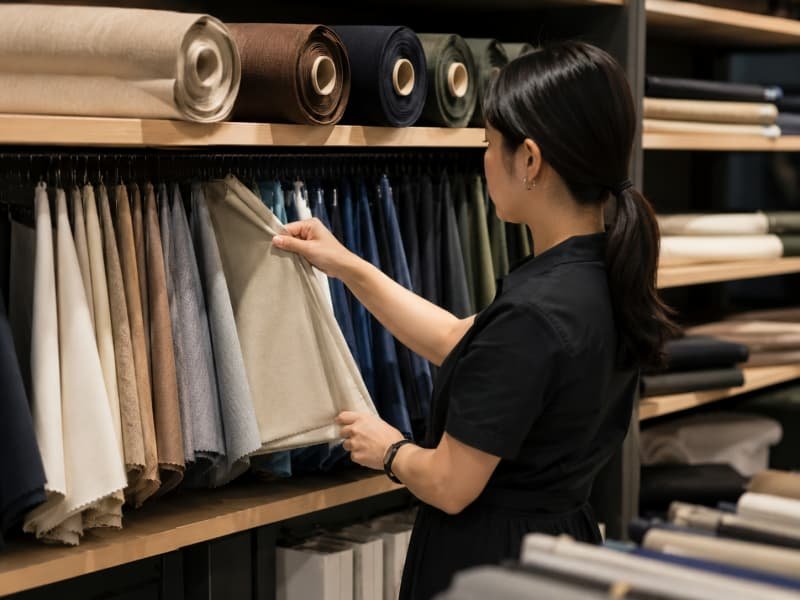
Twill is one of those fabrics people recognize long before they learn its name. Its diagonal surface appears on jeans, chinos, tailored trousers, utility dresses, structured skirts, cropped jackets, uniforms, handbags, and upholstery. The difficulty begins when a product description simply says ’twill,’ because that word does not identify one fiber, one weight, or one level of quality. A soft 135 GSM lyocell twill and a firm 340 GSM cotton drill belong to the same broad weave family, yet they create completely different garments. Understanding the distinction prevents a common and expensive mistake: choosing a fabric because its label sounds familiar rather than because its measured behavior suits the design.
Twill fabric is a woven textile identified by diagonal ribs formed as warp and weft yarns interlace in a staggered sequence. Twill describes the weave, not the fiber, so it may be made from cotton, polyester, wool, rayon, lyocell, nylon, silk, or blended yarns. Its weight, density, finish, stretch, and fiber content determine how it feels and performs.
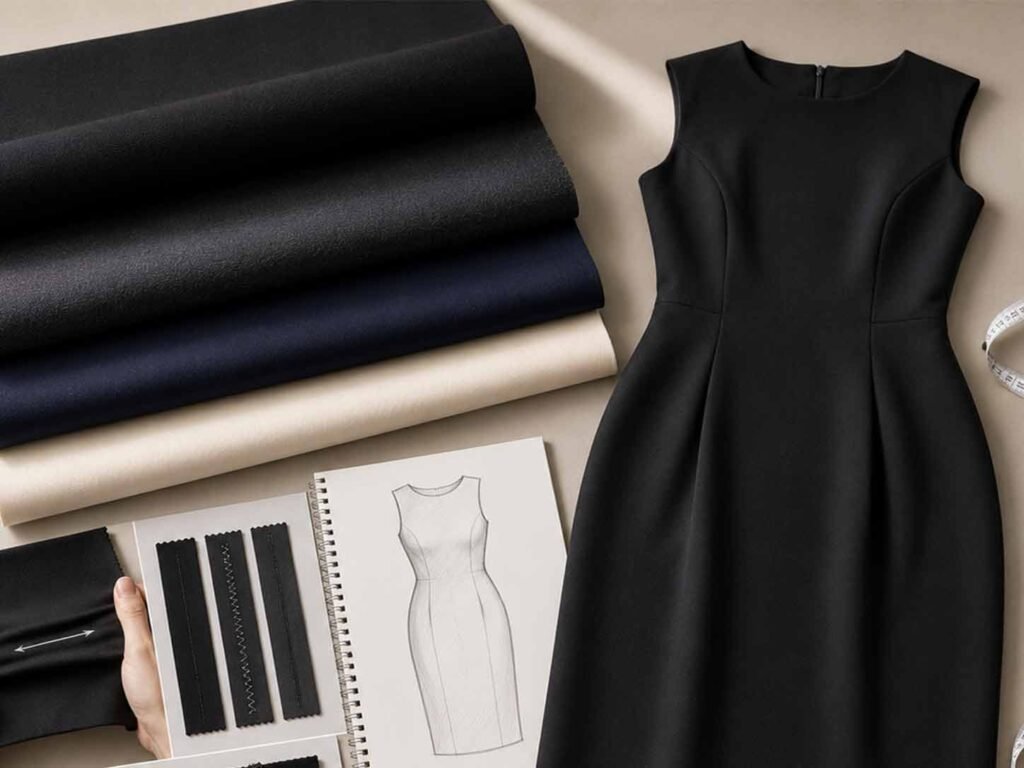
A dress developer once selected a cotton twill from a small swatch for a fitted utility mini-dress. The swatch looked crisp and substantial, but the first sample collapsed around the waist and stretched unevenly over the hip. A second option held the shape but felt too heavy after lining was added. The successful version used a medium-weight stretch twill with stronger recovery, a lighter pocketing fabric, and controlled shrinkage. The sketch remained the same; only the material decision changed. That experience captures the practical value of twill knowledge: the weave name opens the conversation, while the full specification decides whether the finished garment looks polished, fits correctly, survives care, and can be repeated in production.
What Is Twill Fabric?
Twill fabric is a woven construction with diagonal ribs across its surface. The ribs are created by shifting the points where warp and weft yarns cross. Twill is not a fiber, so cotton, polyester, wool, rayon, lyocell, nylon, silk, and blended yarns can all be woven as twill. Fiber content, weight, density, finish, and stretch determine the final performance.
A Weave, Not a Fiber
The most important fact about twill is that it describes a construction method rather than a raw material. Cotton, polyester, wool, rayon, nylon, and silk are fibers. Twill explains how yarns made from those fibers are interlaced. This distinction matters because two fabrics may both be sold as twill while showing very different softness, warmth, shrinkage, cost, strength, and drape. A fluid viscose twill can suit a relaxed midi dress, while a heavy cotton drill can support utility outerwear. Both are genuine twills, but they should never be treated as substitutes without testing.
A request for ‘black twill’ is therefore incomplete in professional product development. A useful brief should identify the fiber composition, fabric weight, usable width, surface finish, stretch direction, stretch percentage, recovery, shrinkage limit, color standard, care method, and intended silhouette. Without those details, a mill could offer a 130 GSM rayon twill, a 220 GSM cotton chino, or a 320 GSM polyester gabardine. Every option could match the simple name, yet only one might deliver the correct balance of drape, support, opacity, comfort, and sewing stability for the garment.
| Feature | What to Check | Why It Matters |
| Diagonal rib | Direction, width, and visibility | Affects appearance, panel matching, and cutting consistency |
| Face and reverse | Surface dominance and shade | Prevents panels from being cut on the wrong side |
| Fabric weight | GSM or oz/yd2 | Influences drape, warmth, opacity, and structure |
| Density | Yarn compactness and porosity | Affects breathability, strength, and seam behavior |
| Finish | Washed, brushed, peached, coated, or resin-treated | Changes touch, color, sewing response, and care |
| Stretch | Direction, elongation, and recovery | Controls fit, comfort, and pattern requirements |
| Stability | Shrinkage, skew, and bowing | Reduces twisting and size change after care |
Diagonal Surface
The easiest way to recognize twill is to look for diagonal ribs running across the face of the cloth. The diagonal may be fine and understated, as in compact gabardine, or bold and easy to see, as in denim and heavy drill. Its angle and visibility change with the weave ratio, yarn thickness, warp and weft density, yarn color, finishing process, and whether the cloth is warp-faced, weft-faced, or balanced. Strong directional surfaces also reflect light differently, which is important when garment panels are cut from different orientations.
Warp-faced twill shows more warp yarn on the surface. Traditional denim is the best-known example because dyed warp yarns dominate the face while lighter weft yarns remain more visible on the reverse. Balanced twill shows a more even contribution from both systems. The textured surface often makes minor creases, dust, and light abrasion less obvious than they would be on a very flat weave. That visual advantage explains part of twill’s popularity in trousers, uniforms, jackets, and frequently worn fashion garments, but it should not be confused with guaranteed stain resistance or strength.
Fiber Changes Performance
Because the same weave can be made from many fibers, broad questions such as ‘Is twill breathable?’ or ‘Is twill soft?’ have no single answer. Cotton twill is generally absorbent and comfortable but may crease or shrink. Polyester twill often provides stronger dimensional stability and wrinkle recovery, although a dense or heavily finished quality may feel warmer. Rayon, viscose, and lyocell twills are valued for fluid movement and softness, yet some qualities need closer control of seam slippage, shrinkage, and distortion. Wool twill can range from crisp tailoring cloth to warm, compact outerwear.
Elastane is commonly added to cotton, polyester, rayon, or nylon twill when a fitted garment needs movement. Compositions containing roughly 1% to 5% elastane are common in fashion apparel, but the percentage does not directly reveal the stretch performance. Yarn type, fabric density, heat setting, and finishing also matter. Two fabrics labeled 97% cotton and 3% elastane may show different elongation and recovery. A fit-sensitive style should be developed from measured stretch and repeated-cycle recovery data, not only from a hand-pull test or composition label.
Weight and Hand Feel
Twill can feel silky, brushed, dry, crisp, dense, or almost board-like. Weight offers a useful first reference, although it never tells the whole story. Lightweight twills around 100-160 GSM often suit shirts, soft dresses, and warm-weather separates. Medium qualities around 170-280 GSM are common in skirts, utility dresses, trousers, fashion uniforms, and lightweight jackets. Heavy twills above 300 GSM are more often selected for outerwear, workwear, structured skirts, denim garments, and products that need firm shape retention.
Fabrics with identical weight can still behave differently. A 200 GSM lyocell twill may feel fluid and cool, while a 200 GSM compact cotton chino may feel crisp and controlled. A 250 GSM stretch twill can work comfortably in a fitted dress, while a rigid fabric of the same weight may restrict movement. Experienced developers assess a full-width cutting or at least a large swatch because a small sample cannot show how the cloth hangs across a body, responds to curved seams, presses at hems, or changes after lining, interfacing, pockets, and decorative construction are added.
How Is Twill Fabric Made?
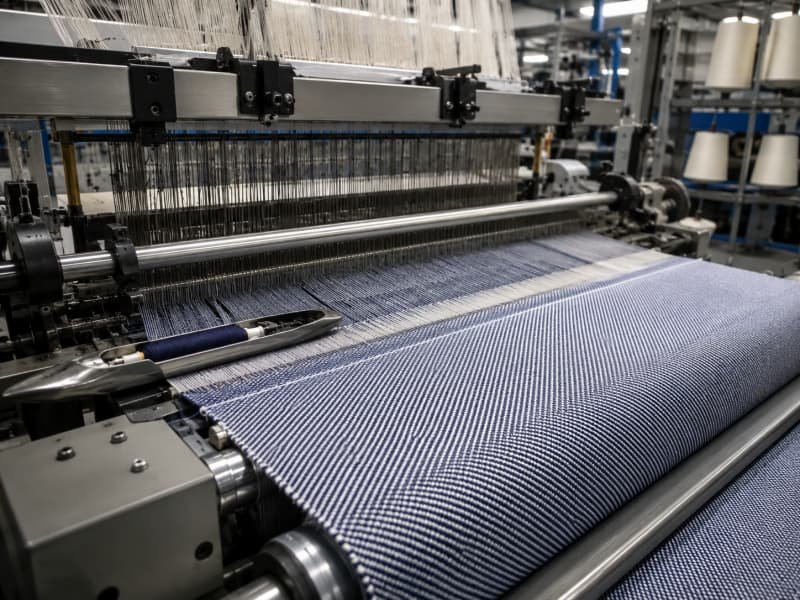
Twill is made by shifting the interlacing points of warp and weft yarns in each successive row. Instead of a simple one-over, one-under sequence, yarns pass over two or more opposing yarns before going under. The repeated shift forms the diagonal rib. Weave ratio, float length, yarn density, twill direction, and finishing determine the final surface and performance.
Warp and Weft
Warp yarns run along the length of the fabric, while weft yarns travel from selvage to selvage. During weaving, the loom raises selected warp yarns and passes the weft through the opening. Plain weave normally alternates over one and under one, creating many interlacing points. Twill uses longer floats and fewer crossings. A yarn may pass over two, three, or more opposing yarns before moving under the next. The following row begins at a shifted point, and the exposed segments align to form the familiar diagonal line.
Longer floats can produce a smoother surface and more flexible drape because the yarn bends less often. They can also increase snagging or abrasion risk when the cloth is loosely set or used in a demanding application. Shorter floats create more interlacing points and often improve stability, although the material may feel firmer. The right balance depends on the product. A trouser fabric needs stability around seams, pockets, and knees, while a dress twill may need softer movement. A heavy outerwear quality may prioritize compactness and abrasion resistance over fluidity.
| Weave | Basic Sequence | Typical Surface | Practical Considerations |
| 2/1 twill | Over 2, under 1 | Clear diagonal with moderate face dominance | Versatile for lighter apparel, chinos, and dresses |
| 2/2 twill | Over 2, under 2 | More balanced face and reverse | Flexible and even, common in apparel |
| 3/1 twill | Over 3, under 1 | Strong face dominance and longer floats | Common in denim and dense bottom-weight fabrics |
| Broken twill | Direction changes within the repeat | Less continuous diagonal | Creates distinct texture and may reduce visible twisting |
| Herringbone | Direction reverses regularly | Repeated V-shaped pattern | Decorative option for tailoring, skirts, and outerwear |
Common Weave Ratios
Twill constructions are often described as 2/1, 2/2, or 3/1. The first number indicates how many yarns a working yarn passes over, while the second shows how many it passes under within one repeat. A 2/1 twill passes over two and under one. A 2/2 twill passes over two and under two, producing a more balanced structure. A 3/1 twill creates longer floats and stronger face dominance, which is one reason it is common in denim and compact bottom-weight fabrics.
The notation is useful, but it cannot predict the complete behavior of the material. Two 3/1 twills may use different fibers, yarn counts, densities, dyes, and finishes. One could be rigid denim, while another could be a lightweight polyester quality. Product teams still need to ask practical questions: Does the cloth hold the intended shape? Does it recover after stretching? Will it remain stable after washing? Can it be sewn without seam puckering, slippage, needle cutting, or excessive bulk? The weave ratio is one line in the specification, not the final decision.
Twill Direction
The diagonal may run in an S direction or a Z direction, named after the central stroke of each letter. Direction affects the visual character of the cloth and can interact with yarn twist. It becomes particularly important during cutting because panels placed in opposite orientations may reflect light differently. A dark gabardine, brushed twill, coated quality, or fabric with a pronounced rib can look like two different shades when neighboring pieces are reversed, even when they came from the same roll and dye lot.
Markers are therefore often planned with all visible garment pieces running in one direction. One-way cutting can increase consumption, but it protects surface consistency. Direction also matters when diagonal ribs meet at a center seam, shaped corset panel, patch pocket, placket, or waistband. Some designers deliberately reverse panels for contrast, but the effect should be controlled during pattern planning. Production instructions should identify the fabric face, top and bottom orientation, cutting permission, rib-matching expectations, and roll shade grouping before bulk cutting begins.
Skew and Bowing
Skew occurs when the weft is not perpendicular to the selvage, while bowing occurs when the weft curves across the width. Some movement can appear after weaving or finishing, but excessive distortion may cause visible twisting after cutting, sewing, washing, or wearing. Trouser legs are especially sensitive because a distorted fabric can rotate the side seam toward the front or back. In a fitted dress, the same issue can pull a center seam, slit, zipper, or printed placement away from the intended line.
Fabric should be relaxed before cutting because rolling and finishing tension can temporarily change its dimensions. Many production teams use roughly 12-24 hours as an initial working period for stable woven fabrics and extend it for tightly rolled, highly elastic, or moisture-sensitive qualities. Skew and bow limits must be agreed with the relevant test method. Around 3% or less is often discussed as a practical starting point for many apparel fabrics, although the correct limit depends on the garment, brand standard, visual sensitivity, fiber composition, and finishing route.

What Are the Main Types of Twill?
Common twill fabrics include cotton twill, chino, denim, gabardine, drill, stretch twill, herringbone, cavalry twill, serge, rayon twill, lyocell twill, and wool twill. These names describe different combinations of fiber, weave, yarn, density, weight, and finish. They should not be treated as interchangeable simply because each fabric has a diagonal structure.
Cotton and Chino
Cotton twill is one of the broadest and most adaptable categories. It can be light enough for a shirt dress or dense enough for workwear. Chino is usually a smooth, tightly woven cotton or cotton-blend twill associated with trousers and uniforms, although modern fashion versions also appear in structured mini-dresses, cargo skirts, cropped jackets, corset-inspired garments, and coordinated sets. The final use depends on weight, yarn thickness, fabric density, surface treatment, and whether elastane is included.
Common finishes include enzyme washing, garment washing, peach finishing, brushing, silicone softening, resin treatment, pigment dyeing, and water-repellent applications. Every finish changes more than the hand. Washing can improve softness but increase shade variation. Brushing adds warmth and a pleasant touch while raising pilling concerns. Resin can improve crease recovery but may reduce tear strength when applied too aggressively. A cotton twill should therefore be approved as a complete quality code with its finish, color, and care route, rather than as an unfinished construction in isolation.
| Twill Type | Common Weight Range* | Typical Hand | Frequent Apparel Uses |
| Light cotton twill | 100-160 GSM | Soft to lightly crisp | Shirts, dresses, summer skirts |
| Rayon or lyocell twill | 110-220 GSM | Fluid and soft | Dresses, blouses, wide-leg trousers |
| Chino twill | 180-280 GSM | Smooth and compact | Trousers, skirts, utility dresses |
| Gabardine | 180-320 GSM | Dense and controlled | Tailoring, dresses, uniforms, jackets |
| Cotton drill | 240-420 GSM | Firm and substantial | Workwear, heavy skirts, outerwear |
| Denim | 200-450+ GSM | Rigid to highly elastic | Jeans, dresses, skirts, corset pieces |
| Wool twill | 180-450+ GSM | Crisp, warm, or tailored | Trousers, dresses, coats, suits |
*Commercial ranges vary by mill, yarn, density, and finishing. They are useful sourcing references, not fixed definitions.
Denim, Drill and Gabardine
Denim is normally a warp-faced twill made with colored warp yarns and lighter weft yarns. Traditional indigo denim develops gradual fading because the color sits mainly near the yarn surface. Fashion denim may add sulfur dyes, coatings, stretch yarns, prints, washes, abrasion effects, embroidery, or other decoration. Drill is typically firmer and more utilitarian, making it suitable for uniforms, utility pieces, heavy skirts, structured jackets, and workwear-inspired fashion. Its hand is often more robust than dress-weight cotton twill.
Gabardine is tightly woven and usually has a fine, steep diagonal. It can be made from wool, cotton, polyester, rayon, or blended fibers and is widely used in tailored trousers, skirts, dresses, uniforms, trench-inspired garments, and jackets. The compact surface often provides a polished appearance and controlled drape. These fabrics share a twill foundation but cannot be swapped casually. A lightweight denim can feel softer than a compact chino, while a polyester gabardine may resist wrinkles better than wool but offer a different touch, thermal comfort, and pressing response.
Stretch Twill
Stretch twill combines a woven appearance with additional movement and is widely used in modern womenswear. It is common in fitted dresses, pencil skirts, slim trousers, corset styles, cropped jackets, and coordinated sets. Stretch may come from elastane, mechanical construction, bicomponent yarns, or a combination of methods. Two-way stretch usually moves mainly across the width, while four-way stretch provides movement in both directions. The wording should always be supported by measured elongation because the amount of movement may differ significantly between warp and weft.
For close-fitting garments, elongation and recovery must be reviewed separately. A fabric may stretch by 25% but retain part of that extension after wear, leading to bagging at the waist, hip, seat, elbows, or knees. Development testing should record initial stretch, recovery after a fixed rest period, repeated-cycle growth, heat-setting stability, shrinkage, and seam appearance under tension. Patterns must be based on the actual quality used for production. Replacing one stretch twill after fit approval can change pressure, zipper behavior, seam grin, and mobility even when the composition and GSM look similar on paper.
Patterned Twills
Herringbone reverses the diagonal direction at planned intervals, creating a repeated V-shaped pattern. Cavalry twill has pronounced double ridges and a firm surface, while serge is a compact twill often associated with uniforms, schoolwear, and tailoring. Broken twill changes direction within the repeat and interrupts the continuous diagonal. These structures add visual interest without relying on printing, and they can bring depth to coats, skirts, trousers, tailored dresses, blazers, and textured separates.
Patterned twills need thoughtful marker planning. Herringbone points, stripe-like ridges, and directional repeats may need alignment across center seams, pockets, lapels, waistbands, yokes, and plackets. Matching increases cutting time and can raise fabric consumption, particularly on curved or asymmetrical panels. A fabric that appears easy to use in a single swatch may become costly when matching rules are applied to a complete garment. Consumption should therefore be checked during sample marker planning, not estimated solely from a basic garment shape or from a non-directional fabric.

What Are Twill Fabric’s Properties?
Twill is often durable, opaque, flexible, and effective at disguising minor creases or wear, but these are tendencies rather than guarantees. Breathability, softness, stretch, recovery, shrinkage, pilling, colorfastness, seam strength, and snag resistance depend on the fiber, yarn, density, weight, finish, and garment construction. Performance should be confirmed through testing against the intended care method.
Durability and Wear
Twill is frequently selected for garments that face regular wear because the diagonal construction can distribute stress efficiently and create a compact surface. Denim, chino, drill, and uniform gabardine demonstrate how well-designed twills can resist abrasion while keeping a clean appearance. The weave name alone, however, does not guarantee durability. A lightweight rayon twill with long floats may tear more easily than a dense plain weave, and a heavily brushed surface may feel luxurious while wearing faster at high-friction zones.
Garment durability depends on the relationship between fabric and construction. Pocket openings, side slits, zipper ends, armholes, crotch seams, waistbands, corset panels, belt loops, buttons, and snaps concentrate stress. Reinforcement, stitch density, thread strength, seam allowance, interfacing, and needle selection should be developed together with the shell material. A strong twill can still fail when a seam is too narrow or the stitch line cuts the yarns. Abrasion and tear results should be interpreted against the intended product rather than copied from workwear standards into a fashion dress without context.
Breathability and Warmth
Twill may feel breathable or relatively closed because airflow depends on fiber content, density, thickness, porosity, surface treatment, and lining. A lightweight cotton, rayon, or lyocell twill with moderate density can work well in warm weather. A dense polyester quality with resin, coating, or heavy pigment may feel considerably warmer. Weight gives a useful starting point, but a lower GSM does not always mean better comfort when yarns are packed tightly or the surface has been sealed by finishing.
Garment design also changes thermal performance. A sleeveless, relaxed dress made from 190 GSM twill may feel cooler than a fitted, fully lined style cut from a lighter cloth. Dark colors absorb more heat in direct sunlight, while synthetic lining can reduce moisture comfort. For summer products, development teams should review fabric weight, air permeability, moisture behavior, finish, lining weight, color, and wearing ease as one system. This approach is more reliable than assuming that cotton is always cool or polyester is always unsuitable.
Stretch and Recovery
Traditional woven twill offers limited mechanical give, especially on the bias, but noticeable stretch normally comes from elastane, stretch yarns, or engineered construction. Broad working ranges for fashion products may include 5%-10% for mild comfort, 10%-20% for moderate movement, 20%-35% for many fitted dresses and slim bottoms, and more than 35% for highly body-conscious products when recovery remains strong. These figures are development references rather than universal requirements, and the pattern must respond to the actual test result.
Recovery matters as much as elongation. A fabric that extends easily but does not return can lose shape at the waist, hip, seat, elbows, or knees. Negative ease must therefore be used carefully. A bodycon dress approved in a 30% stretch twill cannot usually be transferred to a 15% stretch replacement without pattern correction. The lower-stretch fabric may create excessive pressure, zipper strain, seam grin, or restricted movement. Repeated-cycle tests and post-heat checks are more informative than a single hand pull because elastane performance can change after pressing, fusing, washing, and drying.
Shrinkage and Appearance
Cotton, rayon, viscose, lyocell, and wool twills can show dimensional change when they are not properly stabilized. Polyester is generally more stable but can still move under heat or finishing tension. A target around plus or minus 3% is often discussed as a practical starting point for many washable garments, yet the correct tolerance depends on the size specification, care method, product type, test method, and brand requirement. On a 120 cm maxi dress, 3% length shrinkage equals 3.6 cm, which is enough to alter the intended hem position.
Appearance risks include skew, bowing, color migration, rubbing, pilling, shine, and shade variation. Indigo denim is expected to fade progressively, while pigment-dyed twill may show intentional edge wear and lot variation. Reactive-dyed cotton often provides stronger wash durability, but dark shades still need wet and dry rubbing tests. Brushed and peached finishes feel softer but may require closer pilling review. A practical approval plan can include dimensional change, skew, pilling, wash and rubbing fastness, seam slippage, tear strength, GSM tolerance, and roll-to-roll shade consistency, all tested on the exact bulk quality and color.
- Dimensional change after the stated care cycle, with warp and weft results recorded separately.
- Stretch and recovery after repeated extension, not only an initial hand test.
- Pilling and abrasion performance under a method appropriate to the product category.
- Dry and wet rubbing fastness, especially for dark, indigo, pigment-dyed, or brushed qualities.
- Skew, bowing, and roll-to-roll shade variation before bulk cutting.
- Seam slippage, tear strength, fusing response, and needle damage where construction is demanding.

Which Garments Use Twill Fabric?
Twill is used in dresses, skirts, trousers, shorts, jackets, blazers, shirts, uniforms, corset pieces, workwear, bags, and home textiles. Lightweight twill suits fluid garments, medium-weight twill supports clean shapes, stretch twill works well in fitted products, and heavy drill or denim is better for structured pieces that need firmness, durability, and clear surface definition.
Dresses and Skirts
Twill can be an excellent dress fabric when its weight, stretch, and movement match the silhouette. Light rayon, viscose, or lyocell twill suits wrap dresses, shirt dresses, midi dresses, relaxed vacation styles, and softly gathered shapes. Light to medium cotton twill works well for utility mini-dresses, A-line dresses, button-front styles, tailored day dresses, and structured sundresses. Stretch twill is widely used for fitted minis, body-skimming midis, pencil skirts, corset dresses, and close-cut sets because it provides a woven appearance with greater mobility.
Opacity should be checked under realistic tension. A pale twill may look fully opaque on a cutting table but become translucent over the bust, hip, or seat. Drape also needs to be assessed after construction details are introduced. Darts, curved seams, lining, boning, pockets, topstitching, and interfacing can make a fluid material feel much firmer. A cloth that hangs beautifully as an uncut length may become bulky when divided into many corset panels. Testing a complete sample is more reliable than judging a swatch in isolation.
| Garment | Useful Starting Weight | Desired Behavior | Main Development Checks |
| Fluid dress | 100-170 GSM | Soft drape and movement | Opacity, shrinkage, seam slippage |
| Utility mini-dress | 170-260 GSM | Crisp but wearable | Structure, pocket stability, topstitching |
| Fitted stretch dress | 180-300 GSM | Stretch with controlled recovery | Growth, fit, zipper wave, seam grin |
| A-line or cargo skirt | 180-300 GSM | Shape retention | Hem balance, pocket drag, bulk |
| Tailored trousers | 200-320 GSM | Controlled drape | Knee bagging, crease recovery, shine |
| Cropped jacket | 220-340 GSM | Stable structure | Fusing, seam bulk, wash behavior |
| Heavy outerwear | 300-450+ GSM | Firm and abrasion-resistant | Mobility, needle damage, thickness |
These weight ranges are starting points. Fiber, density, finish, lining, and silhouette may justify a lighter or heavier quality.
Trousers and Shorts
Twill is one of the most common constructions for trousers because it can balance appearance, stability, and wear resistance. Chino twill suits casual trousers, tailored shorts, uniforms, and clean utility styles. Stretch cotton twill is common in slim trousers and fitted shorts, while gabardine supports polished tailoring. Drill and denim are better for cargo shapes, workwear references, and heavier fashion products. The selected fabric must be assessed at the seat, knees, crotch, pocket openings, and waistband because these areas face repeated pressure, friction, and extension.
A fabric may appear strong in a standard tensile test yet develop knee bagging, seam grin, or pocket distortion after wear. Pocket bags that are too heavy can pull on a lighter shell, while dense twill may require seam grading and thinner internal components to reduce bulk. Stretch qualities need stable pocket openings and waistbands. Shrinkage should be confirmed before inseam, rise, and waistband measurements are approved because movement in both directions can alter leg length, hip fit, and comfort. Pressing response also matters when the design depends on a sharp crease.
Jackets and Structured Styles
Medium and heavy twills are widely used in cropped jackets, overshirts, blazers, trench-inspired garments, utility jackets, corsets, bustiers, and structured sets. A soft overshirt may use around 160-220 GSM, a cropped utility jacket may need 220-320 GSM, and heavy denim or drill outerwear may use 300-450 GSM or more. These ranges are practical starting points rather than fixed rules because fiber, yarn, and finishing can make two fabrics of the same weight behave very differently.
Fusing tests are essential for tailored and structured garments. Interfacing must bond without bubbling, strike-through, stiffness, or shade change, and the result should be checked after washing or cleaning. Dense twill can create excessive bulk at collar points, lapels, cuffs, waistbands, pockets, and multi-layer corset seams. Needle size, thread, stitch length, presser-foot pressure, clipping, grading, and pressing must be adjusted during sampling. A material that looks premium on the roll can appear clumsy in the finished garment when construction thickness is not controlled.
Specification and Care
A professional twill specification should use measurable requirements rather than relying only on a fabric name or supplier swatch. The development file should record fiber composition, fabric weight and tolerance, usable width, weave direction, stretch, recovery, shrinkage, skew, finish, color standard, fabric face, cutting direction, test requirements, and care method. Bulk approval should also cover roll-to-roll shade variation. Dark navy, black, khaki, pigment-dyed, and brushed qualities can show differences that become obvious when panels from different rolls are combined.
Care instructions must be based on the complete garment rather than the word ’twill.’ A cotton utility dress may tolerate machine washing, a wool gabardine jacket may require professional cleaning, and a rayon twill dress may need gentle washing and controlled drying. Coated, bonded, embroidered, printed, or embellished twills require care decisions that include every component. The finished garment should be tested with its lining, zipper, interfacing, trims, and decoration because a shell fabric may pass independently while the complete product fails through differential shrinkage, bubbling, zipper wave, or color transfer.
Developing Twill Garments
The best twill is not simply the softest, strongest, or most expensive option. It is the quality that supports the intended silhouette, target fit, seasonal comfort, appearance, care method, sewing construction, and repeat-production requirements. A useful development review begins with the garment rather than the fabric label: where the style needs drape, where it needs support, which zones are under tension, whether the cloth must stretch, and how the product will be cleaned. These questions narrow the sourcing field more effectively than choosing from color cards alone.
Duolan Apparel supports fashion brands and product teams with fabric sourcing, alternative material evaluation, pattern development, fit correction, sample development, production-readiness review, bulk manufacturing, and repeat-order coordination. For a practical assessment, provide the tech pack or reference, intended silhouette, preferred composition, target weight, stretch expectations, colorways, size range, testing requirements, estimated quantity, and launch schedule. The development team can then evaluate whether the nominated twill provides the required drape, opacity, recovery, support, sewing stability, and bulk consistency before the project moves into production.
To discuss a custom twill dress, skirt, trouser, jacket, or coordinated collection, send your project details to duolan appare. A clear brief makes the first material review more useful, especially when it includes the target garment, desired hand feel, fit direction, expected care method, color references, and timing. The aim is not to force every design into a standard fabric, but to match the material and construction so the approved sample can be reproduced with confidence.