Skip to content
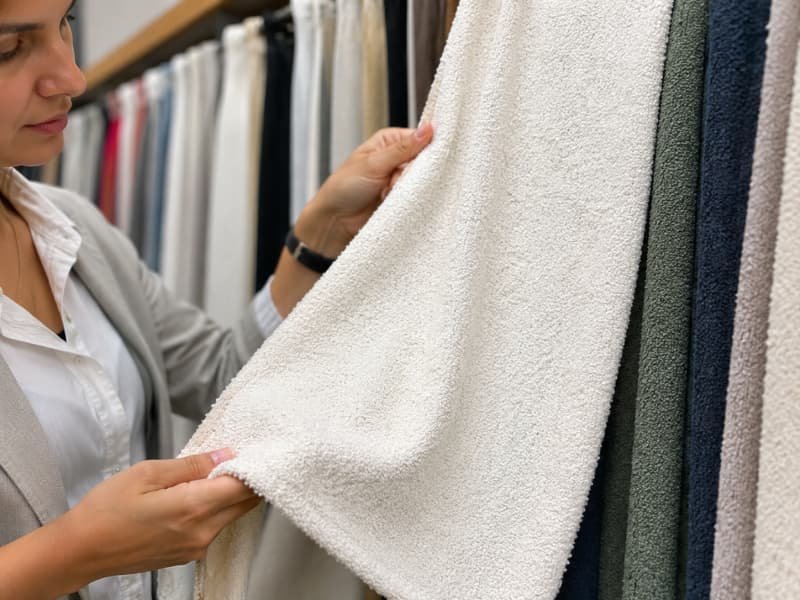
Terry cloth is easy to recognize but surprisingly easy to misunderstand. Most people picture a bath towel, yet the same looped-surface idea can appear in beach dresses, resort sets, sweatshirts, shorts, robes, coordinated travel pieces, and fashion accessories. The important point is that terry does not describe one fixed fiber, weight, or garment category. It describes a surface structure, and that structure can be engineered in very different ways depending on how the final product should look, feel, stretch, absorb moisture, and recover after washing.
Terry cloth is a woven or knitted fabric characterized by raised, generally uncut yarn loops. These loops increase surface area, create a cushioned hand, and help the material collect moisture. Apparel versions may be lightweight, compact, and flexible, while French terry usually has a smooth face and looped reverse that makes it more suitable for everyday clothing.
That definition sounds simple, but fabric selection becomes more complicated once a product team starts comparing loop height, pile density, yarn type, fiber composition, stretch, recovery, weight, dyeing, and finishing. Two materials labeled cotton terry may look similar in a swatch book yet behave very differently after cutting, sewing, pressing, laundering, and wear. A resort dress that feels relaxed on a showroom hanger may become too heavy over wet swimwear. A French terry set may look clean in the first sample but twist after washing. A velour surface may photograph beautifully while revealing directional shade differences under store lighting. The real story of terry cloth begins when its loops meet a finished garment, and that is where this guide goes next.
What Is Terry Cloth?
Terry cloth is a woven or knitted fabric with raised yarn loops on one or both surfaces. The loops increase surface area, create a soft and cushioned hand, and help the fabric collect moisture. Terry describes the construction rather than a specific fiber, so it may be made from cotton, polyester, modal, lyocell, elastane, or blended yarns.
What Creates the Loops?
The defining feature of terry cloth is the yarn that projects above the fabric base instead of lying flat. In traditional woven terry, a stable ground structure holds the fabric together while a separate pile-yarn system forms visible loops. Knitted versions use loop, tuck, or float arrangements to create a raised surface, commonly on the technical back. These loops increase the amount of yarn exposed to water, skin, and air, which is why terry generally feels softer and collects more moisture than a flat fabric of similar composition. The spaces around the loops also trap small pockets of air, adding bulk and warmth without requiring a heavily brushed finish. The result is not one universal texture; loop height, yarn twist, pile density, and the strength of the base determine whether the fabric feels compact, plush, open, firm, or fluid.
Loop design must match the product. Tall, open loops create a full towel-like effect, but they can catch on jewelry, zippers, hook-and-loop fasteners, and rough accessories. Short, compact loops produce a cleaner surface that is easier to use around fitted seams, collars, waistbands, pockets, and decorative topstitching. A common sourcing mistake is to choose the fabric with the tallest or softest loops and assume it is the highest-quality option. In apparel, loop security, surface consistency, seam behavior, wash stability, and recovery are often more important than first-touch softness. A fabric that feels luxurious as a loose swatch can become bulky or unstable once several layers meet inside a garment.
Is Terry a Fiber?
Terry is not a fiber name. Cotton, polyester, viscose, modal, lyocell, and elastane identify the raw materials used to make yarn. Terry identifies the way those yarns are arranged to create a looped or pile surface. This distinction matters because the phrase cotton terry still leaves many technical questions unanswered. The fabric may be woven or knitted, single-sided or double-sided, lightweight or towel-heavy, compact or open, stretch or non-stretch. Two fabrics with the same fiber-content label can perform very differently because yarn count, stitch or weave density, loop length, dyeing route, and finishing are not the same. Treating terry as a structure gives designers and sourcing teams a clearer way to compare materials and avoid choosing solely by composition.
A useful material specification should record construction, usable face, finished weight, usable width, loop appearance, stretch, recovery, expected shrinkage, shade standard, colorfastness, pilling or snagging risk, and intended care method. This information prevents misleading assumptions. Cotton-rich terry often offers strong natural absorbency, but a thick cotton fabric may dry slowly and become heavy when wet. A polyester-rich version may absorb less into the fiber itself, yet it can dry faster and retain shape more consistently. Neither is automatically superior. The right choice depends on whether the garment is expected to behave like a poolside cover-up, an everyday knit dress, a travel set, a robe-inspired layer, or a polished velour fashion piece.
Which Fibers Are Used?
Cotton is the most familiar fiber used in terry cloth because it provides softness, moisture absorption, and a natural hand. It works well for towels, robes, beachwear, relaxed sets, and resort-inspired clothing, although it must be managed for shrinkage, drying time, and wet weight. Cotton-polyester blends are selected when a product needs improved dimensional stability, faster drying, lower moisture retention, or more predictable commercial performance. Polyester can also help maintain color and reduce some forms of distortion, but a high synthetic percentage may feel less natural if the yarn is coarse or the finish is too dry. The target product, selling season, care expectation, and intended retail hand should guide the blend rather than a general belief that one fiber is always better.
Modal, viscose, and lyocell blends can create a smoother surface and more fluid drape, making them useful for soft tops, premium lounge pieces, and lighter dresses. Their behavior depends heavily on the supporting fiber, stitch density, and finishing process, because a very soft cellulosic terry may grow during wear or lose shape if its base is not stable. Elastane is often added to knitted terry for fitted clothing. Even a small percentage can improve movement and recovery, but the result depends on how the elastane is inserted and how the material is heat-set. Fiber percentage alone cannot prove recovery, so actual stretch and wear testing remain necessary.
| Fiber Direction | Typical Benefits | Common Risks | Suitable Product Directions |
| 100% cotton | Natural hand, strong moisture absorption, familiar premium softness | Shrinkage, slower drying, increased wet weight | Beach dresses, robes, relaxed shorts, resort sets |
| Cotton/polyester | Better stability, faster drying, durable commercial performance | Less natural hand when polyester content is high | Travel sets, casual dresses, lounge collections |
| Cotton/elastane | Stretch, comfort, improved body movement | Growth or weak recovery when construction is unstable | Fitted dresses, body-skimming sets, zip-front styles |
| Modal or lyocell blends | Smooth touch, fluid drape, premium softness | Possible growth, pilling, or dimensional movement | Lightweight tops, soft dresses, premium loungewear |
| Polyester-rich terry | Quick drying, clear color, lower water retention | Synthetic touch and lower natural absorbency | Performance-inspired pieces, printed sets, travel clothing |
What Determines Softness?
Softness is influenced by fiber type, yarn quality, yarn twist, loop length, pile density, finishing, and laundering. A cotton fabric made from finer and longer fibers often feels smoother than one made from coarse, highly twisted yarn. Low-twist pile yarns can open more easily and create a fuller hand, although lower twist may reduce abrasion resistance if the construction is not well controlled. Loop density also changes the way softness is perceived. A dense field of short loops can feel refined and even, while long open loops feel fluffy and more towel-like. Dense loops normally use more yarn and add weight, while open loops may reveal the ground when the fabric is stretched.
Finishing has a major effect on showroom hand. Enzyme treatment can reduce surface fuzz, mechanical softening can relax the material, and silicone or other softeners can create a slippery first touch. Excessive softener may influence water pickup, sewing control, or long-term surface behavior. The most reliable review compares the original fabric, a washed swatch, a sewn seam panel, and a complete garment. The material should remain appropriate after the care process the customer will actually use. Initial softness helps a product sell, but lasting softness, stable dimensions, secure loops, and consistent production performance determine whether the garment continues to feel well made after repeated wear.

How Is Terry Cloth Made?
Terry cloth is made by creating a stable woven or knitted base and introducing additional yarn that forms loops, floats, or pile above the surface. Woven terry generally uses separate ground and pile-yarn systems, while knitted terry relies on controlled stitch arrangements. Yarn tension, loop length, fabric density, finishing, and compaction determine the final weight, stretch, softness, and stability.
Woven Terry Construction
Traditional woven terry normally uses ground warp yarns, pile warp yarns, and weft yarns. The ground warp is held under relatively firm tension to create a stable base, while the pile warp is delivered under separately controlled tension so that it can form loops as groups of weft yarns are beaten into position. This construction allows the fabric to combine stability with a raised, soft surface. The ground yarns carry much of the mechanical load, while the pile yarns create absorbency and texture. Woven terry may have loops on both sides, one side, or selected areas depending on the loom setup and design. The fabric is usually less elastic than knitted terry, which makes it suitable for boxy and relaxed silhouettes but less forgiving around closely fitted body areas.
Woven terry can work well for beach shirts, structured shorts, loose dresses, overshirts, robes, and resort pieces where a visible towel surface is part of the design. Cutting and sewing require careful control. Loops can hide chalk marks and notches, and the pile can make two apparently equal layers feed at different speeds. Thick seam intersections may become bulky around collars, waistbands, plackets, pockets, and turned hems. Wider seam allowances, controlled pressing, suitable needle selection, stable facings, and selective pile trimming can improve the result. The objective is not to force towel terry to behave like a flat shirting fabric, but to simplify the construction so its texture looks deliberate rather than uncontrolled.
Knitted Terry Construction
Knitted terry is produced through stitch arrangements that create a smooth face and a looped, floated, or pile-like reverse. French terry is the most familiar apparel example. Its outer surface generally resembles single jersey, while the inside shows unbrushed looped floats. The knitted base gives the fabric more flexibility than conventional woven terry. Depending on yarn, machine gauge, stitch density, and elastane content, the material may offer mild mechanical stretch or substantial widthwise extension. This makes it suitable for pull-on garments, sweat-inspired dresses, joggers, cropped tops, coordinated sets, and fitted casualwear. The smooth face also supports printing, embroidery, zippers, and cleaner topstitching more easily than a heavily looped outer surface.
Knitted construction introduces risks that are less pronounced in woven terry. The fabric may curl at cut edges, grow during sewing, distort at side seams, or twist after washing. Heavy pockets, zippers, and trims can pull a garment out of shape when the base is too soft. A material may recover well after a brief hand stretch yet lose shape after several hours of wear. Before pattern development, stretch and recovery should be measured in both directions, and the same checks should be repeated after laundering. A pattern created from unwashed fabric data may fit correctly in the first sample but become shorter, wider, or more twisted after care testing, especially in long dresses and vertical panelled styles.
Loop Height and Density
Loop height describes how far the pile yarn extends from the base, while loop density describes how closely the loops are packed. Together, these variables influence absorbency, softness, appearance, fabric weight, snagging risk, and manufacturing difficulty. High loops create more visible texture and can increase the surface available for moisture collection, but they also create a greater chance of catching on jewelry, exposed zippers, hook-and-eye closures, chains, and rough labels. Short loops create a neater surface and are often easier to use in fitted garments because they add less bulk at seam allowances. They can also improve print definition and make embroidery or topstitching easier to read.
Density must be considered together with the strength of the ground fabric. A dense-looking pile does not guarantee stable construction. If the ground is open or weak, the material may distort even though the surface appears rich. A stable base with moderate loop coverage can deliver better durability and garment shape. During bulk approval, loop consistency should be checked across usable width and between rolls. Variations in loop height or pile density can create visible shade changes, inconsistent hand, and uneven garment weight. These differences become particularly noticeable when several panels meet across the front of a dress, jacket, or coordinated set, where a small surface change can make adjacent pieces look mismatched.
GSM and Finishing
Fabric weight is commonly expressed in grams per square meter, or GSM. It helps development teams compare materials, estimate garment weight, plan seasonal use, and anticipate seam bulk, but it does not describe the complete fabric. Two materials with the same GSM can have very different loop profiles, yarn counts, stretch, and ground density. Lightweight terry can suit summer clothing, yet it still needs enough loop coverage and opacity. Heavy terry gives a richer hand but can feel uncomfortable in a long dress and may become substantially heavier after absorbing moisture. Finished garment weight matters more than the fabric number alone because length, sleeves, lining, pockets, and trims all add load.
| Approximate Weight | General Character | Common Garment Use | Main Points to Check |
| 180-240 GSM | Lightweight, flexible, lower bulk | Summer tops, cover-ups, light shorts | Opacity, seam stability, loop coverage |
| 240-320 GSM | Balanced softness and body | Dresses, skirts, resort sets, casual separates | Shrinkage, recovery, pocket support |
| 320-420 GSM | Plush, substantial, warmer | Premium sets, overshirts, robe-inspired pieces | Seam bulk, garment weight, drying time |
| Above 420 GSM | Dense, towel-like, heavy | Bathrobes, statement layers, limited fashion uses | Wet weight, thick hems, storage, drying |
Finishing can change the material almost as much as construction. Scouring and washing improve cleanliness and water uptake, enzyme treatment can reduce surface hairiness, and compacting controls part of the residual shrinkage. Shearing turns loops into a velour-like cut pile, while brushing creates a warmer and fuzzier surface. The same fabric may be tested several times during development because dyeing and finishing alter dimensions, stretch, hand, and shade. Measurements taken before compacting or final finishing should not be treated as production values. Finished weight, usable width, loop appearance, stretch, shrinkage, and shade should be confirmed from the route that will actually be used for the order.

Which Types of Terry Cloth Are Common?
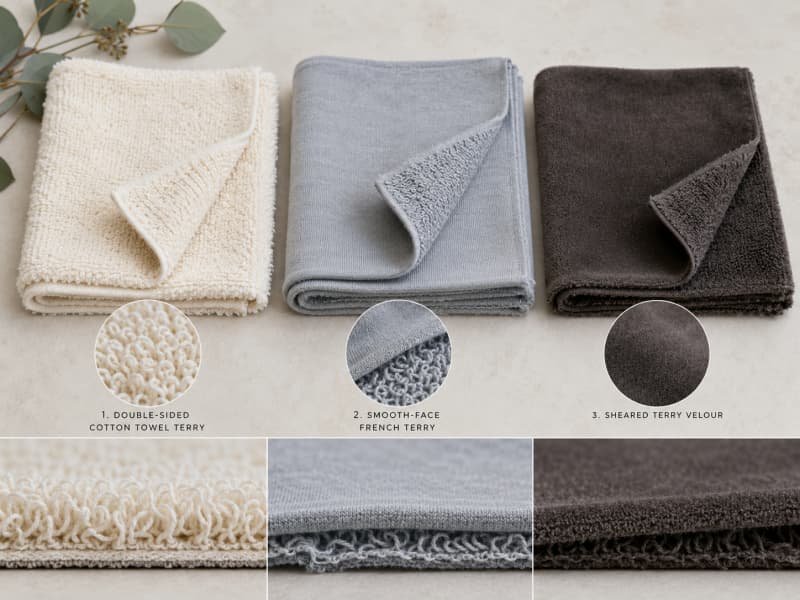
The most common forms are towel terry, French terry, and terry velour. Towel terry has visible uncut loops and strong moisture capacity. French terry usually has a smooth knitted face and looped reverse. Terry velour has a cut or sheared pile that creates a smoother, more polished surface. Each type requires different pattern, sewing, testing, and care decisions.
Towel Terry
Towel terry is the classic construction associated with bath towels and robes. It normally has clearly visible loops on one or both sides and is often woven from cotton or a cotton-rich blend. In clothing, it works best when the material is part of the design story rather than a substitute for ordinary woven fabric. Poolside shirts, beach shorts, cabana sets, relaxed mini dresses, cover-ups, and robe-inspired layers use its tactile surface to communicate leisure, travel, softness, and easy dressing. The material can also give a simple silhouette more visual value because the loops create texture without requiring print, embroidery, or heavy decorative trim.
The design must respect the fabric’s volume. Narrow straps, very small collars, tightly turned seams, dense corsetry, and complicated internal structures can become thick and uneven. Buttonholes may be difficult to keep clean when loops interfere with stitching, while concealed zippers can ripple if the pile is not controlled at the seam. Practical solutions include simpler panels, moderate seam allowances, stable facings, wider hems, controlled topstitching, and reduced pile in selected seam areas. Towel terry is not automatically suitable for swimming. It can absorb pool or seawater, but it is not a substitute for swim fabric. A cover-up should be evaluated for wet weight, drying time, color transfer, and comfort over damp swimwear.
French Terry
French terry is a knitted fabric with a smooth or jersey-like outer face and unbrushed looped floats on the reverse. It is generally lighter and more wearable than traditional towel terry, which is why it appears in sweatshirts, joggers, dresses, skirts, casual sets, and travel clothing. Its smooth face supports cleaner color, printing, embroidery, zippers, and topstitching. The reverse adds softness and moderate insulation without the thick brushed layer found in fleece. Lightweight French terry can suit transitional or warm-season clothing, while heavier versions create more structure and warmth. This broad range is one reason the name covers materials that can look and feel quite different in the market.
Stretch varies considerably. Some materials rely only on knitted mechanical extension, while others include elastane. A fabric listed as 95% cotton and 5% elastane may still recover poorly if stitch density, yarn quality, or heat setting is unsuitable. French terry can be used for fitted clothing, but the pattern must reflect actual extension and recovery. A body-skimming dress made from stable 10% to 15% widthwise stretch needs a different pattern from one offering 40% stretch. Excess negative ease can open the looped reverse, create shine on the face, and place stress on seams. Skew should also be checked because side seams may rotate after washing even when basic width and length measurements still pass.
Terry Velour
Terry velour is created by cutting or shearing the looped pile to produce a smooth, velvet-like face. Depending on construction, the reverse may retain its loops. The cut surface reflects light differently from uncut terry, giving the material a richer and more polished appearance. Velour is suitable for fashion dresses, tracksuits, tops, coordinated sets, robes, and premium lounge products. It can hold deep color and produce a strong tactile impression in photographs and retail displays. Printed velour can also create rich graphic effects, although pile direction changes how clearly the print and shade are perceived from different viewing angles.
Nap direction is one of the most important production controls. Panels cut in opposite directions can appear to be different shades because light reaches the pile differently. Most visible garment pieces therefore require one-way cutting, which raises fabric consumption compared with a non-directional material. Pile crushing is another concern. Pressure from folding, pressing, stacking, or tight packing can flatten selected areas. Steam may help the pile recover, but excessive heat can damage synthetic fibers or create shine. Surface durability should be assessed at the seat, underarm, side seam, pocket edge, and bag-contact areas. A complete sample should be worn, washed, packed, and viewed under directional lighting before bulk approval.
Type Comparison
The correct type should be selected according to silhouette, use environment, care expectation, and the visual message of the collection. A brand should not choose towel terry simply because it appears more absorbent, or French terry simply because it is common in clothing. Construction must support the intended garment. A structured poolside shirt may benefit from woven towel terry because the material holds a boxy form. A fitted zip-front mini dress is generally easier to develop in stable French terry. A premium lounge set designed around surface sheen may gain more value from velour. Each decision changes pattern, sewing method, testing priorities, consumption, and final cost.
| Feature | Towel Terry | French Terry | Terry Velour |
| Typical surface | Visible uncut loops | Smooth face, looped reverse | Smooth cut-pile face |
| Common construction | Usually woven; knitted versions also exist | Knitted | Woven or knitted pile, then sheared |
| Stretch | Usually limited unless knitted | Low to high, depending on construction | Depends on the base |
| Visual character | Tactile, casual, towel-inspired | Clean, sporty, versatile | Polished, plush, light-reflective |
| Best-known uses | Robes, beach sets, shorts, cover-ups | Dresses, sweatshirts, joggers, sets | Dresses, tracksuits, premium lounge pieces |
| Main production risk | Snagging and seam bulk | Growth, skew, shrinkage, pilling | Nap direction, shade variation, pile crushing |
Cost should be evaluated at garment level rather than by meter price alone. Dense towel terry increases sewing time, garment weight, and freight. French terry containing high-quality elastane may cost more than a basic knit and often requires stabilization around zippers, shoulders, pockets, and waist seams. Velour usually needs one-way cutting, reducing marker efficiency and increasing consumption. A lower-priced material can therefore produce a more expensive garment when its handling, wastage, reinforcement, and quality risks are included. The most commercial option is the one that creates the intended appearance while staying stable through sampling, bulk production, care, packing, and actual wear.

How Does Terry Cloth Perform?
Terry cloth is generally soft and moisture-friendly, but performance varies with fiber content, loop construction, weight, density, and finishing. Cotton-rich versions often take up more water, while synthetic blends usually dry faster and retain shape more easily. Key risks include shrinkage, skew, snagging, pilling, color transfer, slow drying, seam distortion, and increased garment weight after moisture exposure.
Absorbency and Drying
Terry collects moisture efficiently because its raised surface exposes more yarn than a flat material. Water can spread across fibers, move through spaces between yarns, and collect around the loops. The degree of uptake depends on more than thickness. Cotton readily takes up moisture, making cotton-rich terry useful for towels, robes, and beach-related products. Polyester takes far less water into the fiber itself, but liquid can still travel through the yarn spaces and evaporate relatively quickly. A blend can therefore balance moisture pickup, drying speed, and dimensional stability. Yarn twist and finishing also matter. Loosely twisted pile can expose more fiber and feel softer, while a heavily softened surface may initially resist wetting despite looking very absorbent.
For clothing, maximum absorption is not always desirable. A resort dress that takes up a large amount of water can become uncomfortable and heavy over wet swimwear. A lighter cotton-polyester blend may offer a more useful balance of moisture pickup and drying. Development should compare the complete garment in both dry and damp conditions. A practical evaluation records dry weight, lightly saturates the garment under controlled conditions, allows excess water to drain, and then observes weight, shape, comfort, and drying time. The aim is not to imitate a formal laboratory method, but to understand real use. Beach dresses, cover-ups, robes, and poolside sets often fail because wet behavior was never considered during fabric approval.
Breathability and Warmth
Terry can be breathable, but looped texture alone does not guarantee airflow. Breathability depends heavily on the compactness of the ground, overall weight, fiber content, and garment construction. A lightweight knitted terry with an open base may allow comfortable air movement. A dense woven material above 400 GSM can feel warm and heavy even when it is made from cotton. The loops trap air and add insulation, which is useful in robes, sweatshirts, and travel clothing but may be uncomfortable in a fitted summer dress. Moisture absorption, air permeability, and drying should be treated as separate properties because a material can absorb perspiration yet remain wet for a long time.
Product use should determine the balance. Warm-weather resortwear usually benefits from lower bulk, manageable moisture pickup, and faster drying rather than maximum towel-level absorbency. Transitional sets and cooler-climate casualwear can use denser French terry for warmth and body. Lining changes comfort significantly. A full synthetic lining may reduce airflow and trap heat behind an absorbent outer fabric. Partial lining, lightweight stretch lining, mesh, or strategic facings may provide opacity and seam coverage without turning the garment into a heavy layered product. Breathability should therefore be judged on the complete garment, including lining, cups, elastic, support tape, pockets, and trims, rather than inferred from an isolated swatch.
Shrinkage and Snagging
Cotton-rich terry can shrink when yarns relax during washing and drying. Knitted versions may change in length and width, and some materials twist or skew. Pre-shrinking and compacting reduce risk but do not guarantee stability in the final garment. Many apparel programs work with dimensional-change limits somewhere around 3% to 5%, although the correct limit depends on the style, care label, market, and brand standard. A fitted mini dress usually needs tighter control than an oversized robe because the same movement creates a larger fit problem. Shrinkage should be measured in both directions rather than covered by one general pattern allowance, because a fabric may lose 4% in length but only 1% in width.
Skew is particularly important in knitted terry. After washing, a side seam may rotate toward the front or back even when width and length remain acceptable. Snagging is a different surface risk. Uncut loops can catch on rough objects and pull away from the base, with long loose loops generally more vulnerable than compact loops. Common contact points include zippers, hook-and-loop tape, rough labels, metal chains, rings, and unfinished internal hardware. Pulled loops should not simply be cut without evaluation because cutting can release yarn and enlarge the defect. Loop security, trim smoothness, and internal contact points should be reviewed before production, not after customer complaints begin.
Care and Testing
The care method should reflect fiber content, dye, finish, construction, trims, and the product claim. Cotton-rich terry generally tolerates machine washing, but high washing and drying temperatures can increase shrinkage and distort loops. Garments with exposed pile are often safer when washed inside out, with zippers closed and abrasive items separated. Velour requires additional care because pressure and heat can flatten or mark the cut surface. Fabric softener may improve hand, but some treatments can slow initial water pickup. That matters when a product is promoted for beach, bath, or practical moisture use. Care instructions should support the intended function instead of copying a standard label from an unrelated garment.
| Test Area | What It Reveals | Common Commercial Consideration |
| Dimensional change | Length and width movement after washing and drying | Many apparel programs use limits around 3%-5%, depending on style |
| Skew or spirality | Side-seam rotation and fabric twisting | Especially important for long knitted garments |
| Colorfastness to washing | Shade change and staining during laundering | Dark and saturated resort colors need close review |
| Crocking | Dry and wet color transfer through rubbing | Important for dark shades worn over light swimwear |
| Pilling | Surface fiber balls after abrasion | Relevant to French terry and soft blended constructions |
| Snagging | Loop pulling and visible surface damage | Essential for long-loop towel terry |
| Stretch and recovery | Extension and return after tension | Critical for fitted dresses and waistbands |
| Seam performance | Puckering, opening, slippage, and breakage | Check with the intended production needle and thread |
| Absorbency | Speed and amount of moisture pickup | Important when moisture performance is part of the claim |
| Garment appearance | Fit, twist, pile, and shape after care | Final approval should be completed on a full garment |
Testing should use the intended production fabric, color, finish, thread, trims, and care cycle. A result from a white development fabric may not represent a dark dyed bulk color, because dye concentration, softener, printing, brushing, and compacting can change performance. The most useful approval combines technical data with garment-level review. The sample should be measured, photographed, washed, dried, remeasured, and worn. This reveals issues a small specimen cannot show, including pocket sagging, zipper distortion, hem twisting, pile crushing, loss of body shape, and uncomfortable wet weight. A test report is useful, but the real product is the finished garment, and that is ultimately what must remain acceptable.

Is Terry Cloth Suitable for Clothing?
Terry cloth is suitable for clothing when its weight, loop profile, stretch, recovery, and drying behavior match the silhouette. Lightweight towel terry works well for resortwear and cover-ups, French terry supports casual dresses, sets, and fitted styles, and terry velour suits polished lounge and fashion pieces. Very heavy or unstable constructions are less suitable for complex, sharply tailored garments.
Best Garment Categories
Terry cloth performs best when its tactile character supports the product concept. Resort and beach collections are natural applications because the fabric communicates comfort, softness, and poolside use. Common products include mini dresses, shirt dresses, short sets, cabana shirts, relaxed skirts, cover-ups, and robe-inspired layers. French terry has a broader fashion range. Lightweight and medium constructions can be used for body-skimming dresses, casual midi dresses, zip-front styles, cropped tops, skirts, joggers, and coordinated travel sets. Terry velour fits products where appearance matters more than maximum absorbency. Its cut pile can create a premium surface for fitted dresses, tracksuits, tops, lounge sets, and statement separates.
Not every silhouette is a good match. Very thick towel terry is difficult to use for sharply tailored bodices, tiny straps, dense corsetry, narrow rouleau loops, complicated pleating, or any design where many layers meet in a small area. Long garments need careful weight control. A maxi dress made from dense terry may feel acceptable on a hanger but pull downward during wear, placing stress on the neckline, shoulders, waist, and zipper. Damp conditions make this issue more pronounced. The strongest designs allow the fabric to remain visible and tactile while using clean proportions, controlled seam placement, and enough structure to prevent sagging without turning the garment stiff.
Weight and Stretch
Weight should be selected according to silhouette, climate, garment length, and expected use. Light summer cover-ups may work around 180 to 240 GSM when coverage and seam stability are adequate. Dresses and coordinated sets often sit comfortably in the approximate 240 to 320 GSM range. Heavier constructions can support overshirts and robe-inspired garments but need close evaluation of total weight and drying time. These ranges are practical development references rather than universal quality rules. A lower weight is not automatically better for summer if the material becomes transparent or loses shape, and a higher weight is not automatically more premium if it creates bulky seams and uncomfortable wear.
Stretch requirements depend on fit. A relaxed dress may need only modest mechanical extension, while a fitted dress needs controlled stretch and strong recovery. Widthwise stretch around 20% to 40% is common in many fitted casual knits, but the correct value depends on negative ease, composition, and garment structure. High stretch is not automatically beneficial. A material that extends easily but does not recover will grow at the elbows, seat, waist, and pocket openings. Development records should state widthwise and lengthwise stretch, recovery after a fixed extension, post-wash recovery, fabric growth after hanging, and garment growth after wear. Pattern decisions should be based on these observations rather than elastane percentage alone.
Pattern and Sewing Controls
Terry requires pattern and sewing decisions that account for pile, bulk, stretch, and directional appearance. A pattern developed for flat jersey or plain woven cotton should not be transferred without review. For towel terry, seam allowances may need enough width to control loops inside the seam. Thick intersections can be reduced through graded allowances or selective pile removal, while facings may use a lighter supporting fabric rather than a second full layer of terry. For French terry, shoulder seams, pocket openings, waist seams, and zipper areas may need stabilization with clear elastic, knit tape, lightweight fusible material, or stay tape, depending on the movement required.
Needle and thread selection should be tested on the actual production material. Ballpoint or stretch needles are often suitable for knitted terry, while woven versions may require a sharp needle matched to fabric density. The wrong needle can cut yarns, skip stitches, or push loops into the seam. Seam type must also match use. Four-thread overlock provides flexibility for many knit seams, coverstitch can create stretch hems, and high-stress areas may need reinforcement. Decorative topstitching should be sampled because pile can hide the stitch line or make it look irregular. Velour needs strict nap control, with visible panels generally cut in one approved direction even when this reduces marker efficiency.
Pre-Production Approval
A complete pre-production approval should confirm more than color and general hand. Terry garments are strongly affected by finishing, washing, sewing pressure, and panel direction, so a production-ready sample is essential. The fabric should be approved from the intended mill, composition, weight, usable width, color, and finish. A small lab dip cannot confirm loop appearance, pile direction, or garment stability. Where possible, a larger cutting should be reviewed so the team can see variation across the width. The production sample should use bulk-quality fabric, correct lining and support materials, approved zippers and trims, intended needle and thread, final seam construction, pressing method, wash route, labels, and packaging arrangement.
The sample should then be checked before and after care testing. Measurements should cover garment length, chest, waist, hip, sleeve, pocket position, zipper length, and any fitted internal structure. Visual review should include side-seam twist, pile direction, puckering, loop damage, lining movement, hem balance, and surface changes after packing. When several styles share one terry fabric, it is useful to approve a common material-performance standard and then confirm how each silhouette responds. A short set, fitted dress, and oversized shirt may use the same base but need different stabilization and pattern allowance. Good approval work allows the material to remain soft without looking uncontrolled and stable without feeling rigid.
Develop Terry Cloth Womenswear with Duolan Apparel
A successful terry garment begins with the relationship between fabric structure, silhouette, pattern, and production method. Duolan Apparel supports fashion-led womenswear teams with fabric sourcing, material comparison, pattern development, sampling, fit correction, construction engineering, testing coordination, and scalable production. The team focuses on dresses, occasionwear, partywear, fitted silhouettes, fashion sets, and refined fashion tops, supported by nearly three decades of womenswear development experience and a manufacturing network built for repeat programs rather than one-off sample making.
For a new terry dress, resort capsule, French terry set, or velour fashion program, an effective inquiry should include reference images or a tech pack, target composition and weight, expected stretch, intended retail season, size range, colorways, quantity plan, target delivery window, and any care or performance requirements. Sharing these details makes it possible to compare suitable fabrics, identify fit and construction risks, prepare a more accurate sampling route, and build a production plan that protects the intended hand, appearance, and commercial use of the collection.