Skip to content

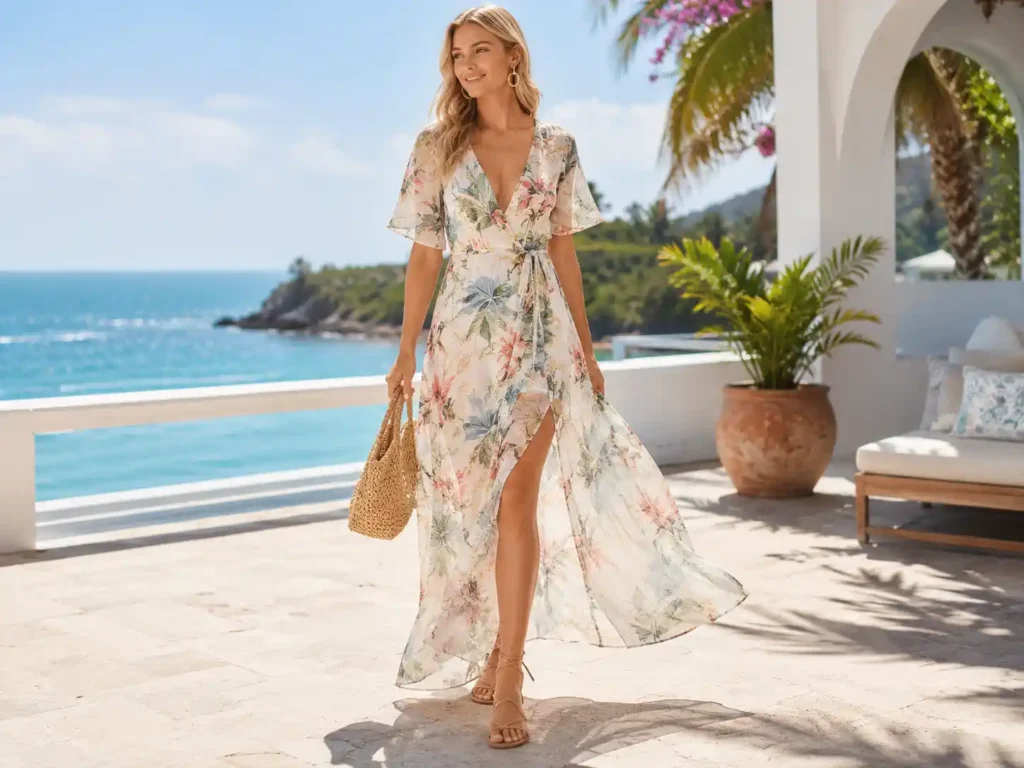
Vacation dressing is becoming harder to define, and that is exactly what makes the 2027 market interesting. A customer may want one dress for a coastal lunch, an afternoon in town, sunset photographs and dinner later that evening. She still expects comfort, but she no longer accepts a shapeless garment simply because it is labeled resortwear. The strongest products now combine destination ease with the polish of occasion dressing, while also surviving the less glamorous realities of travel: compression inside luggage, changing temperatures, unfamiliar dress codes and long periods of wear.
The leading vacation dress trends for 2027 include elongated drop-waist proportions, fluid maxi and midi shapes, halter and bandeau necklines, open backs, asymmetric draping, expressive color, reworked florals, coastal stripes, lightweight mesh, soft satin, rosettes and jewelry-inspired details. The most commercially useful styles will balance these visible trend signals with secure fit, breathable construction, packability and repeatable production.
Current Resort 2027 collections suggest that the next vacation wardrobe will feel romantic without becoming overly delicate, and polished without becoming formal. The opportunity is not to copy every runway detail. It is to recognize which proportion, color or surface idea can be translated into a dress that people will actually pack, wear more than once and recommend after the trip. A trend becomes valuable when the customer forgets how carefully it was engineered and simply remembers how good she felt wearing it.
What Is Driving Vacation Dress Trends in 2027?
Vacation dress trends in 2027 are being shaped by multi-occasion travel, stronger demand for visual individuality and growing expectations around comfort, packability and secure fit. Resortwear is no longer limited to beach cover-ups. It now includes polished dresses that can move through daytime activities, social events, destination dinners and warm-weather celebrations without requiring an entirely separate wardrobe.
Travel Is Reshaping the Category
The modern vacation wardrobe is expected to do more with fewer pieces. A customer may leave her hotel in the morning, walk through a coastal town, spend the afternoon at a beach club and go directly to dinner. That routine favors dresses with adjustable straps, stable necklines, manageable hems and fabrics that recover after sitting. A dramatic garment can still succeed, but it must work in motion rather than only during a carefully staged photograph.
Packability is therefore becoming part of product quality. Lightweight fabric alone does not guarantee travel performance. Some fine viscose qualities crease deeply, while soft satin can show every fold under flash photography. A useful development test is to fold the complete garment in its intended packaging for 12 to 24 hours, then hang it and review crease recovery, cup shape, rosette condition, lining position and trim damage. This simple check reveals problems that a flat fabric swatch cannot show.
Resort and Occasionwear Are Converging
Travel now includes more social occasions, from destination weddings and cruise dinners to rooftop parties and birthday trips. That is pushing vacation dresses closer to occasionwear, but without the weight and stiffness of traditional evening garments. Halter necklines, open backs, satin surfaces and controlled ruching create an elevated impression, while elasticized backs, soft cups, adjustable straps and partial linings keep the dress wearable for longer periods.
The most useful crossover styles usually combine one expressive feature with one dependable foundation. A shoulder rosette can sit on a clean one-shoulder body. A printed maxi can use a familiar bodice with a fresher low waist. A fitted mesh midi can feel directional while relying on a secure stretch lining. When every component is complex, the garment becomes harder to fit, harder to pack and more expensive to repeat. Editing is what turns visual excitement into an actual wardrobe piece.
Runway Ideas Need Editing
A runway trend is a signal rather than a finished commercial product. Low waists, transparent layers, large flowers and exposed bodices attract attention because they alter proportion or reveal the body in a new way. A brand still has to decide how much of that idea its customer can comfortably wear. A shaped deep yoke may create the effect of an extreme drop waist without shortening the legs, while a sheer skirt can keep its lightness through a carefully positioned lining rather than full transparency.
Good commercial editing preserves the part that makes the style recognizable and removes the part most likely to cause returns or inconsistent production. Bandeau dresses may need grip tape, side boning or removable straps. Backless dresses need controlled edge tension. Rosettes must recover after packing. Heavy metal details require pull testing and careful placement so they do not distort the fabric. The final dress should still feel current, but it should not ask the customer to solve the designer’s construction problems.
Commercial Relevance Comes First
Trend relevance should be considered alongside wearing frequency, fit sensitivity and production stability. A highly directional style can work well as a campaign image even when its audience is narrow, but it should not automatically become the largest order in the range. Cleaner interpretations of the same trend are often better suited to repeat orders because they offer easier styling, more reliable fitting and simpler color expansion.
A practical collection therefore needs several product roles. Core dresses support broad conversion, trend styles keep the range visually current, image pieces create campaign attention and reorder-ready products provide continuity. The strongest 2027 assortments will not contain the greatest number of new ideas. They will contain a smaller number of ideas that are expressed clearly across different prices, lengths and occasions.
| Market Driver | Product Response | Useful Development Check | Main Risk |
| Multi-occasion travel | Day-to-evening dresses | Seated, walking and flat-shoe fit | Too casual or too formal |
| Packability | Lightweight resilient construction | 12-24 hour fold and recovery test | Deep creasing or crushed details |
| Visual impact | One strong neckline, print or trim | Review in daylight and flash | Competing details |
| Climate comfort | Breathable or low-weight materials | Opacity and heat review | Cling, heat or transparency |
| Repeat wear | Versatile length and styling | Bra, footwear and layering checks | Narrow occasion range |

Which Silhouettes Will Lead in 2027?
The leading 2027 vacation silhouettes include drop-waist dresses, deep-yoke shapes, fluid maxis, controlled midis, halter necklines, backless dresses, bandeau bodices and one-shoulder designs. No single length will dominate every market. The strongest styles will use clearer proportions, focused upper-body detail and skirts that move naturally without creating excessive fabric weight or difficult fit.
Drop Waists and Deep Yokes
The return of the drop waist is one of the clearest ways to refresh the vacation dress after several seasons of high-waisted sundresses. The look extends the torso before releasing into a gathered, pleated or softly flared skirt. For commercial collections, a shaped deep yoke is often easier to manage than a very low straight seam because it can follow the upper hip, control fullness and grade more smoothly across sizes.
The first sample should be assessed from the front, side and back. Shoulder-to-yoke depth, upper-hip ease, skirt release and finished hem position must work together. On a mini dress, lowering the waist without increasing total length may leave too little skirt. On a midi, too much gathering below the yoke can create bulk around the hip. Cotton poplin gives the shape a crisp daytime character, while viscose and satin produce softer versions for dinner and occasion-focused resort collections.
Fluid Maxis and Controlled Midis
Maxi dresses remain central because they create strong movement and destination imagery with relatively simple styling. The 2027 update is less about adding more fabric and more about controlling it. Panelled A-line skirts, partial circles and measured gathering can provide visual flow without the weight, hem length and fabric consumption of a full circular skirt. This matters when a garment must pack easily and be worn with flat sandals.
Midi dresses can carry more structure and often move more easily between city travel and evening occasions. Fitted mesh midis, asymmetric draped shapes, satin columns and softly corseted silhouettes all fit the category. Length should be approved with intended footwear and while the wearer is seated. Side slits, wrap openings and shaped hems can improve movement, but their height must be checked in motion because a dress that appears balanced while standing may reveal far more during walking or sitting.
Halter, Backless and Bandeau Shapes
Halter, backless and bandeau dresses naturally suit warm-weather collections because they frame the shoulders and create a clear resort image. Their apparent simplicity hides significant fit work. A halter must distribute tension without pulling heavily at the neck, while the armhole needs enough control to avoid gaping. A backless dress requires stable edge tension so the garment does not move away from the body when the wearer turns, bends or raises her arms.
Bandeau construction is especially sensitive because the entire upper section must remain secure without visible shoulder support. Internal elastic, silicone grip tape, side boning, shaped lining, cups, smocking or removable straps may be used, but each choice changes comfort, cost and appearance. Bra compatibility should be considered early rather than added as a product-description disclaimer. The most successful open silhouettes look effortless because their support systems have been resolved before the final sample.
One-Shoulder and Asymmetric Draping
One-shoulder dresses provide visual interest with a more manageable support structure than a fully strapless shape. They work particularly well in mesh, jersey, satin and soft crepe, where draping can travel diagonally across the body and emphasize the waist. The main risk is imbalance. Diagonal tension can pull one side seam forward, twist the skirt or create an uneven hem, so the garment must be judged on the body rather than from flat measurements alone.
Ruching should be engineered rather than left to operator interpretation. The technical information needs to define the original panel length, the finished gathered length, placement marks and the intended direction of folds. Decorative weight also affects balance. A large rosette, chain or jeweled strap placed on one shoulder may alter the hang of a lightweight dress. The base fit should therefore be approved before the decorative feature is finalized.
| Silhouette | Best Use | Indicative Fabric Direction | Fit Sensitivity | Key Check |
| Drop-waist mini | Resort lunch and day party | Poplin, crepe, stretch woven | High | Yoke depth and skirt proportion |
| Deep-yoke midi | City travel and dinner | Viscose, cotton blend, satin | Medium-high | Hip ease and skirt release |
| Fluid maxi | Cruise, beach club and evening | Chiffon, viscose, light satin | Medium | Hem, weight and movement |
| Halter dress | Poolside to dinner | Jersey, satin, woven crepe | High | Neck pressure and armhole gape |
| Bandeau dress | Resort evening and party | Ponte, structured woven, satin | Very high | Support and slippage |
| Backless dress | Destination event | Crepe, satin, stretch woven | Very high | Edge tension and support solution |
| One-shoulder midi | Cocktail and dinner | Mesh, jersey, drapey woven | High | Diagonal balance and twisting |

Which Colors and Prints Will Matter?
Vacation dress colors for 2027 will mix aquatic brights, energetic warm tones, botanical greens and grounded neutrals. Luminous blue, orange, pink, green, clay, bleached white and summer brown provide useful starting points. Prints will become less literal, with expressive florals, coastal stripes, abstract botanicals and recolored animal patterns replacing predictable tropical repeats.
Aquatic Brights and Natural Neutrals
The most useful 2027 color story is a conversation between water-inspired brightness and grounded natural shades. Aquatic blue and green connect immediately with coastal environments, while orange, yellow and pink add the energy required for social content and occasion-led capsules. Clay, brown, chalk and warm white prevent the range from becoming visually exhausting and provide colors that can carry into city travel, late summer and early resort deliveries.
Color should be reviewed on the intended fabric rather than selected from a digital screen. A bright orange can become harsh on high-shine satin, while the same shade may feel softer on crepe or washed viscose. White requires particular care because opacity, lining tone and fabric finish affect whether it appears refined or inexpensive. A focused palette of five or six main shades usually creates a clearer collection than using every forecast color in equal quantities.
Florals Become More Graphic
Florals remain important, but the strongest versions will feel more deliberate than an evenly repeated small flower. Oversized blooms, blurred petals, hand-painted botanicals, tonal floral shadows and engineered placement prints can give vacation dresses a stronger identity. Scale must be judged on a complete garment because a motif that looks balanced on an artwork file can be divided awkwardly by bust seams, zippers, ruching or a low-waist yoke.
Three-dimensional flowers extend the floral story beyond print. A single chiffon rosette at the shoulder, neckline or hip can transform a clean dress without covering the entire garment in decoration. Travel performance still matters. Large padded flowers may crush in packaging, while flatter layered forms often recover more easily. A commercial floral product usually has one clear focus: a strong print, a textured surface or a sculptural detail, rather than all three competing on the same dress.
Stripes and Coastal Geometry
Stripes communicate summer without relying on literal palm leaves or beach icons. The 2027 opportunity includes towel stripes, irregular painted bands, vertical deckchair patterns, diagonal panels and mixed-width layouts. Vertical lines can lengthen a maxi, while diagonal stripes strengthen asymmetric silhouettes. Border stripes can frame a low waist or hem, but they require controlled marker placement and may increase cutting waste if the artwork repeat is large.
Stripe matching should be specified by visibility rather than demanded at every seam. Center fronts, major waist seams and obvious side seams may need close alignment, while hidden areas or heavily gathered sections can allow variation. Geometric coastal prints can also use abstract waves, tile motifs, rope lines and umbrella-inspired arcs. The artwork should support the silhouette; a small busy repeat may lose clarity inside heavy ruching, while a large motif can disappear in an extremely full skirt.
Animal and Abstract Prints
Animal prints still have commercial potential when their color and scale are refreshed. Familiar leopard, zebra and tiger references can be translated into blue tonal graphics, clay-and-pink spots, watercolor stripes or enlarged abstract markings. These treatments preserve immediate recognition while giving the brand a more ownable visual language. Lightweight chiffon, mesh, satin and viscose are better suited to hot destinations than the heavy tactile surfaces sometimes used on runway pieces.
Abstract prints offer another route for brands that want destination energy without conventional tropical imagery. Water reflections, blurred sunsets, mineral textures, painted checks and irregular gradients can produce strong campaign images while remaining versatile. Print scale should be checked across the full size range. Random repeats are generally more forgiving, whereas placement prints require accurate grading and cutting control so the main motif remains balanced on every size.
| Color or Print Direction | Collection Role | Strong Applications | Control Point |
| Aquatic blue | Hero color or core bright | Maxis, mesh midis, satin dresses | Daylight and flash shade review |
| Orange and yellow | Seasonal accent | Minis, halters and printed styles | Colorfastness and fabric shine |
| Pop pink | Social and occasion focus | Bodycon and ruched dresses | Lining tone and transparency |
| Botanical green | Natural foundation | Printed midis and cotton dresses | Shade matching across materials |
| Clay and summer brown | Grounded neutral | Openwork, slips and animal prints | Avoid dull lab dips |
| Bleached white | Resort foundation | Sundresses and low-waist styles | Opacity and yellowing risk |
| Graphic florals | Main print story | Fluid maxis and fitted midis | Motif placement at seams |
| Coastal stripes | Daywear and coordinates | Poplin dresses and knit midis | Matching and cutting waste |
| Recolored animal print | Directional capsule | Mesh, satin and bias shapes | Scale and color consistency |

What Fabrics and Details Will Shape the Market?
The most useful 2027 vacation dress materials will combine drape, comfort, visual character and manageable care. Lightweight viscose, chiffon, satin, stretch mesh, cotton blends, jersey and openwork textures all have a role. Ruching, rosettes, asymmetric layers, controlled transparency and jewelry-inspired details will add value when they are designed for secure wear and repeatable production.
Drape, Recovery and Packability
Fabric selection should begin with the intended silhouette. A fluid maxi needs movement, while a bandeau bodice needs support and recovery. A drop-waist dress may require enough body to define the elongated yoke. Selecting material only by appearance often leads to pattern changes after sampling because the same design can behave very differently in poplin, viscose, satin or stretch jersey.
Drape does not automatically mean good travel performance. Lightweight viscose can produce a beautiful skirt yet crease deeply, while polyester crepe may recover better but feel warmer in humidity. Stretch recovery is essential for fitted styles because weak recovery can cause loose necklines, rippled seams and growth around the seat. Fold testing, hanging tests and wear trials should be completed on the finished garment, since lining, stitching, cups and trims all influence performance.
Sheer Layers and Mesh
Sheer materials create the lightness associated with vacation dressing, but transparency must be planned by body zone. Bust, waist, hip and upper-thigh coverage should be reviewed separately instead of applying one short lining to every style. Stretch mesh works well for printed overlays, ruched dresses and fitted midis, but its greatest stretch should normally run around the body. Incorrect orientation can make the garment grow in length while feeling restrictive in width.
Chiffon is suited to fluid skirts, sleeves, scarves and rosettes, but very light qualities can pucker, fray or slip during sewing. Seam construction should match the fabric weight and transparency. Lining color also changes the result: matching lining creates a richer solid effect, nude lining highlights the outer design and contrast lining adds depth. The complete dress should be reviewed in daylight, indoor lighting and flash photography because transparency can change dramatically between environments.
Satin, Crinkle and Openwork
Satin remains valuable for resort evenings because it provides movement, color depth and photographic shine. Its quality must be chosen carefully. Extremely glossy satin can appear inexpensive, while very lightweight satin may expose every dart, seam and lining edge. Needle size, thread tension, stitch length and pressing method should be tested before full sampling because seam puckering and pressing shine are difficult to hide once the garment is assembled.
Crinkle fabrics offer a relaxed alternative because the intentional texture reduces the need for a perfectly pressed surface. The finish still has to remain stable after washing and production handling. Openwork knits, crochet-look lace and engineered panels provide the artisanal mood associated with vacationwear without the consistency challenges of fully hand-crocheted garments. Long open structures should be tested for growth after hanging, and layered combinations should be checked for friction, twisting and shrinkage compatibility.
Details That Earn Their Cost
A decorative feature should improve identity, perceived value or fit. Ruching can create texture and offer limited fit tolerance, but it must be controlled through clear starting length, finished length and placement marks. Rosettes provide a strong seasonal signal when they are positioned as a focal point, yet they need shape-recovery and attachment testing. A heavy flower on a fine strap can twist the entire neckline if the base structure is not strong enough.
Jewelry-inspired details can make a dress feel finished without separate accessories. Chains, crystals, rings and jeweled straps require checks for skin comfort, corrosion, snagging, pull strength and replacement availability. Decorative density should also be considered in relation to weight and price. One precise, memorable detail often creates more value than many small additions that complicate production without improving the customer’s first impression.
| Fabric Direction | Indicative Weight | Suitable Dresses | Main Checks |
| Lightweight viscose woven | 90-140 GSM | Printed maxis and gathered midis | Shrinkage, seam slippage and creasing |
| Chiffon | 45-90 GSM | Overlays, sleeves, scarves and rosettes | Snagging, puckering and transparency |
| Lightweight satin | 80-150 GSM | Slips, ruched midis and halters | Seams, shade and pressing |
| Stretch mesh | 60-130 GSM | Fitted midis and layered minis | Recovery, print stretch and edge stability |
| Cotton poplin | 100-160 GSM | Drop waists and sundresses | Shrinkage, opacity and wrinkle recovery |
| Cotton-linen blend | 120-190 GSM | Resort midis and structured maxis | Creasing, shrinkage and seam strength |
| Soft jersey | 160-240 GSM | Draped and body-conscious dresses | Recovery, opacity and pilling |
| Openwork knit or lace | Construction dependent | Overdresses, panels and fitted styles | Growth, snagging and lining compatibility |

How Can Brands Build a Sellable 2027 Collection?
A sellable 2027 vacation collection should connect trend direction with real wearing occasions, disciplined color and fabric choices, early fit testing and a clear reorder plan. Strong ranges normally include dependable core dresses, current silhouettes and a limited number of high-impact campaign pieces rather than treating every style as an experimental statement.
Build Around Wearing Occasions
A collection becomes easier to understand when every dress has a clear reason to exist. The word vacation is too broad on its own. A resort lunch, beach club, cruise dinner, destination wedding and city break create different expectations for coverage, fabric, footwear and styling. Mapping those occasions helps a team avoid developing several dresses that look different on a mood board but serve the same moment in the customer’s trip.
Each product should be tested against practical questions. Can the wearer use a normal bra, or does the garment provide another support solution? Does the hem work with flat shoes? Can she sit comfortably without the lining riding upward? Will the neckline remain secure in wind? Can the dress be folded without damaging its main feature? A strong range can include breathable day dresses, polished midis, evening maxis and one or two event pieces, all linked by a coherent color and material story.
Balance Core, Trend and Image Styles
A successful assortment needs different product roles. Core dresses support broad styling and easier replenishment. Trend-led products keep the collection current. Image styles generate campaign attention even when their audience is narrower. Reorder-ready styles provide continuity through proven patterns, stable materials and color expansion. These roles can overlap, but naming them during range planning prevents every style from carrying the same cost, risk and commercial expectation.
For a 20-style capsule, a practical working mix could include seven or eight core styles, five or six trend-led products, two or three high-impact image pieces and four or five designs prepared for recoloring or repeat production. This is not a universal formula; the correct balance depends on brand positioning and historical performance. The important point is to avoid a range in which every dress uses complex draping, special fabric and hand-applied decoration, leaving no stable product to support volume.
Test Before Bulk Production
An approved sample proves that one garment can be made, but it does not prove that the style can be repeated reliably across sizes, fabric lots and production operators. Fit-sensitive silhouettes such as bandeau, corset, halter, backless and close-fitting mesh dresses need movement trials as well as static fitting. Sitting, walking, raising the arms and turning the body often reveal neckline movement, pressure points and lining exposure that are not visible in front-view photographs.
Key measurements should reflect the silhouette. A drop-waist dress needs a controlled yoke depth and low-waist dimension. A ruched dress needs relaxed and stretched references, plus a defined gathering ratio. A halter needs finished strap length and neck opening. Material checks commonly include dimensional stability, colorfastness, stretch recovery, seam performance and trim attachment, although methods and acceptance limits should be confirmed for the target market. A pre-production sample should use approved bulk materials whenever possible.
Plan Reorders From the First Sample
Reorder readiness begins during development. A style cannot be replenished quickly when its fabric source, print file, trim specification or pattern version is poorly documented. The approved sample should be supported by final measurements, material codes, color approvals, print or embroidery artwork, construction details, packaging instructions and clear photographs of critical points. Hand-finished details need repeatable standards for size, density and position rather than informal visual references.
Material continuity deserves equal attention. A distinctive fabric may support a strong launch but become unavailable when the product needs replenishment. Likely carryover styles should use qualities that can be reproduced, or an approved alternative should be tested early. The same principle applies to trims, special dye effects and decorative components. Production-friendly design does not mean removing character. It means identifying which details create genuine value and controlling them carefully enough to survive repeat orders and larger seasonal programs.

A strong 2027 vacation dress program should feel fresh at first glance and dependable after repeated wear. The visible trend may be a low waist, an aquatic color, a sheer layer or a sculptural flower, but the long-term value comes from the less visible work: fabric behavior, balanced pattern engineering, secure construction, clear specifications and a production plan that can reproduce the approved sample. Those decisions protect both the customer’s experience and the brand’s ability to reorder successful styles.
Duolan Apparel supports fashion labels with vacation dress development from concept, reference sample or technical pack through fabric selection, pattern work, sampling and scalable production. The team is based in Guangdong, China, and focuses on fashion-driven dresses, including resort, party, occasion, body-conscious, halter, backless, satin and mesh styles. Brands preparing a 2027 vacation collection can submit their design direction, target market, expected quantities and delivery window for a project review and quotation.