Skip to content
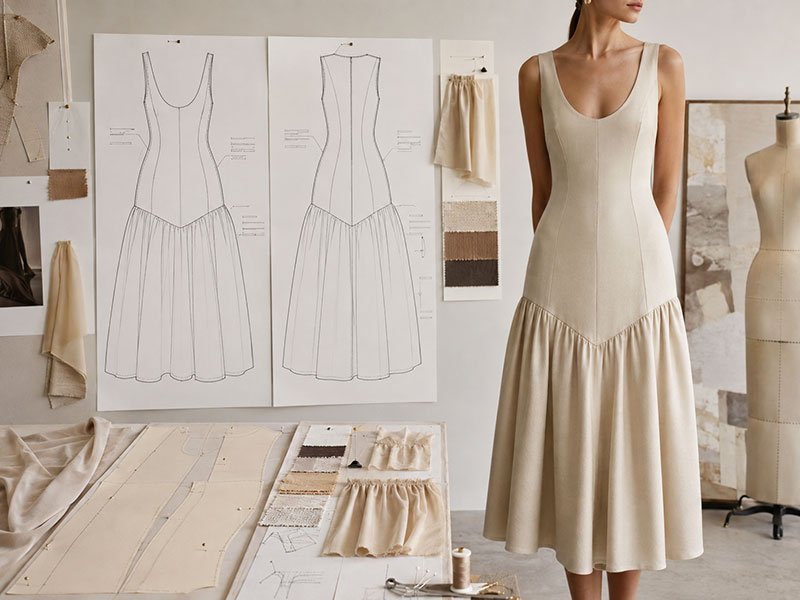
A drop-waist dress can look almost effortless on a sketch: extend the bodice, lower the joining line and release the skirt beneath the hip. In a sample room, however, that one decision changes the balance of the entire garment. Torso length, hip ease, skirt weight, zipper placement, lining behavior and size grading all begin to interact. That is why one version looks fresh and controlled while another feels restrictive, overly youthful or visually out of proportion.
Drop-waist dresses in 2027 will be shaped by controlled proportion rather than one fixed waist position. The strongest styles will combine an elongated torso, a deliberate skirt-release point, fabric-appropriate support and fit that survives real movement. Deep yokes, curved seams, compact bubbles, fluid midis and restrained Basque hybrids will lead the direction across day, party, resort and occasion collections.
The silhouette has already moved beyond a single-season novelty. Spring 2026 and Resort 2027 runway reporting repeatedly returned to lowered waists, long bodices and skirts opening below the hip, but the most useful lesson is not that every label should copy a flapper dress. The real opportunity lies in choosing the right degree of drop for a specific customer. Two dresses can begin with nearly identical reference images; one becomes the campaign piece that sells the collection, while the other needs four sample rounds and still feels wrong. The difference is usually hidden in the development decisions explored below.
What Will Define Drop-Waist Dresses in 2027?
Drop-waist dresses in 2027 will be defined by controlled proportion rather than a single fixed seam level. Leading designs will use elongated bodices, deep or shaped yokes, deliberately placed skirt volume and fabrics selected for the intended structure. The strongest commercial styles will modernize the silhouette for real movement, varied occasions and repeatable production instead of reproducing 1920s references literally.
What Is a Drop-Waist Dress?
A drop-waist dress places the main waist seam, yoke seam or skirt-release point below the wearer’s natural waist. The transition may sit slightly above the high hip, across the high hip or lower toward the full hip. Its purpose is not simply to make the upper section longer. The lower placement must change how the garment is read, fitted or constructed by controlling the beginning of flare, gathers, pleats, panel volume or a visible change in material.
Several constructions can create the effect. A straight horizontal seam gives the clearest graphic division, while a curved yoke softens the line around the body. A V-shaped transition pulls attention toward the center front, and an elongated panelled bodice can create a dropped proportion without an obvious horizontal seam. Relaxed day dresses may use a deep yoke with generous ease, whereas fitted party styles often extend a shaped bodice over the high hip before releasing into a compact skirt.
For technical development, the style name alone is not precise enough. A useful specification identifies the vertical distance from the high shoulder point or natural waist to the seam at center front, side seam and center back. It also shows the seam shape, skirt fullness and intended hip ease. These measurements prevent a pattern team from interpreting “low waist” as a generic location and help preserve the same visual balance through revisions and later production.
Is the Trend Still Growing?
The direction is still growing, although it has entered a more mature phase. Earlier commercial versions leaned heavily on bubble hems, shirred bodices and relaxed cotton shapes. By Spring 2026, lowered waists appeared across a broader range of designer collections, and Resort 2027 continued the proportion through deep yokes, long torsos and skirts that opened below the hip. Repetition across consecutive seasons matters because it suggests ongoing design development rather than a one-show novelty.
Maturity does not mean every interpretation will sell at the same rate. A seam positioned near the upper thigh can create a memorable editorial image, but it narrows the range of body proportions and occasions for which the dress feels comfortable. A moderate drop around the high hip is easier to fit and usually has broader commercial reach. Brands should therefore track the performance of individual silhouettes rather than treating all drop-waist dresses as one trend category.
The strongest evidence comes after launch. Search interest and social engagement reveal curiosity, while product-page conversion, size-level sell-through, return reasons and fit comments reveal whether the shape works in real wardrobes. A useful internal review compares drop depth, skirt type and material across styles. If high-hip midis retain customers while very-low minis generate fit returns, the lesson is not that the trend failed; it is that the more extreme proportion was mismatched to the customer.
| Development Stage | Visible Direction | Practical Product Meaning |
| Early revival | Bubble hems, smocking and relaxed cotton shapes | Strong novelty and immediate visual recognition |
| Spring 2026 | Fit-and-flare proportions and historical references | Broader use across day and occasion categories |
| Resort 2027 | Deep yokes, elongated torsos and blooming skirts | More sophisticated seam and pattern development |
| 2027 commercial adoption | Multiple lengths, shaped lines and controlled volume | Greater need for fabric-specific fit and grading |
| Longer-term potential | Quieter, brand-specific interpretations | Better opportunity for repeatable seasonal programs |
How Is 2027 Different?
The 2027 version is becoming less dependent on literal Jazz Age decoration. Fringe, beads and straight flapper shifts may still appear, but the more relevant development is happening through pattern shape, seam placement and controlled volume. A clean dress can communicate the trend through a deep curved yoke, geometric topstitching or a fitted upper section that releases into a precisely shaped skirt, without relying on costume-like trim.
Skirt volume is also becoming more selective. Instead of gathering fabric evenly around the full hip, designers can place box pleats at the sides, introduce godets below the seam or reserve fullness for the back. These choices keep the center front cleaner, reduce bulk over the abdomen and make the dress easier to wear. The upper section may use long princess panels, subtle corset shaping or a relaxed line that narrows only slightly before the skirt begins.
Commercially, the update is more versatile than the early revival. Cotton and lightweight jacquard can carry the silhouette into day and resort collections, while satin, crepe, velvet and layered mesh support party and occasion categories. The best product teams will not ask how to copy a runway look exactly. They will identify the one or two features that create recognition, then adjust seam depth, support, volume and fabrication to fit their own price point and customer.
Drop Waist vs Basque Waist
A drop waist lowers the principal transition between bodice and skirt, often creating a horizontal, curved or gently shaped line below the natural waist. A Basque waist usually extends downward into a pronounced V or U while keeping greater definition around the natural waist and side body. Both lengthen the torso visually, but a drop waist tends to emphasize a long proportion, whereas a Basque line directs attention inward and downward toward the center front.
Hybrid versions are increasingly relevant. A dress may use a lowered side seam with a deeper curved center front, combining the easier hip transition of a drop waist with the sculpted appearance of a Basque waist. This approach can feel contemporary in prom, formal, party and occasion dresses, but it requires accurate curve development. A point that is too shallow loses the intended character, while an excessively deep point can distort the skirt or create pressure when the wearer sits.
Technical communication should therefore include more than a style label. Front and back line drawings should show the natural-waist reference, center-front drop, side-seam drop, center-back drop and the exact curve shape. The pattern notes should also state where skirt fullness begins and whether internal support is required. These details reduce interpretation errors and make it easier to compare the first sample with the approved design intent.
Which Drop-Waist Silhouettes Will Lead 2027?
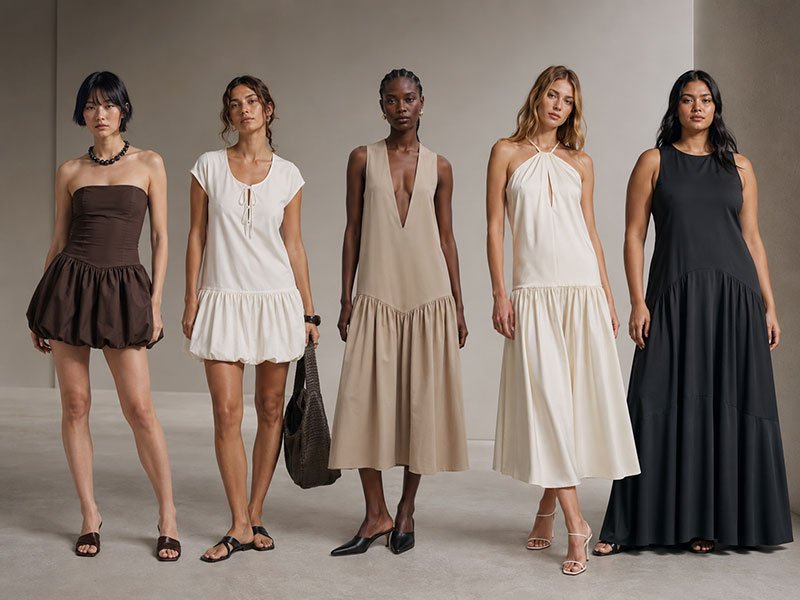
The leading 2027 silhouettes will include fitted minis with compact volume, versatile midis with deep yokes and fluid maxis with subtle hip-level transitions. Minis will deliver the strongest visual impact, midis will offer the broadest commercial flexibility, and maxis will support elevated occasion dressing. The winning shape will depend on how length, bodice fit and skirt volume work together.
Which Lengths Matter Most?
Mini dresses create the clearest visual tension because the elongated torso occupies a large percentage of the garment. The remaining skirt depth is short, so a bubble, compact flare or box pleat reads immediately. This makes the mini well suited to party, birthday, club and going-out collections. The technical risk is that lowering the seam can leave insufficient skirt length, particularly after fitting and hem-turn allowances are confirmed.
Midi dresses provide the greatest room for commercial interpretation. Their length allows the seam to move below the natural waist while preserving enough skirt for graceful flare, pleats or movement. A midi can be developed in crisp cotton for daytime, compact jersey for a closer fit, satin for events or crepe for a polished contemporary line. It also gives pattern teams more freedom to correct hip balance without losing the original proportion.
Maxi and ankle lengths support drama but require careful weight management. A full lower skirt attached beneath the hip can pull on the waist seam, zipper, straps and shoulder points. Fluid panels and godets reduce that load, while dense gathers and layered volume may need stabilizing tape, stronger seam construction or an internal foundation. The drop must remain visually clear, because an overly subtle transition can disappear within a long continuous silhouette.
| Length | Typical Drop Position | Useful Skirt Shapes | Strong Applications | Main Risk |
| Mini | High hip to mid-hip | Bubble, box pleat, compact flare | Party, birthday, going out | Skirt becomes too short after lowering the seam |
| Above knee | Moderate high-hip drop | A-line, side pleats, light gathers | Day party, brunch, resort | Torso can look overly long |
| Midi | High hip or deep yoke | A-line, godet, rounded volume | Daywear, occasion, wedding guest | Skirt weight may distort the seam |
| Ankle | Subtle or shaped drop | Fluid flare, panelled skirt | Resort, evening, contemporary formal | Drop line may become visually weak |
| Maxi | High-hip transition | Full flare, layered or narrow column | Prom, formal, statement occasion | Weight, hem balance and movement |
Are Fuller Skirts Replacing Straight Shapes?
Fuller skirts are becoming more visible, but they are not replacing straight silhouettes. The most recognizable development is the contrast between an extended upper body and a lower section that opens decisively through a bubble, fan pleat, gathered flare or softly blooming shape. This contrast photographs well and communicates the trend quickly, which makes it useful for campaign styles and highly visual product launches.
Straight and controlled versions serve a different purpose. A narrow column, soft shift or subtle A-line can feel more refined, mature and repeatable. These shapes are easier to layer, often require less fabric and may attract customers who like the long-torso proportion but do not want exaggerated volume. They can also reduce production variation because there are fewer gathers, pleats or lining relationships to control.
A balanced collection usually benefits from both roles. One statement dress can carry the strongest bubble or pleat treatment, while cleaner midis and maxis translate the same lowered proportion into everyday or occasion pieces. This avoids repeating one novelty across too many styles and makes the trend accessible at several levels, from a highly directional campaign item to a restrained dress that can remain in the range for more than one season.
Which Bodices Will Evolve?
Longline bodices will become more varied and technically refined. Strapless, halter, tank, cap-sleeve and deep-V shapes can all support a lowered waist, but each transfers garment weight differently. A fitted strapless dress needs enough internal support to resist sliding, especially when the skirt is full. Boning, cup placement, elastic grip, zipper strength and an internal waist stay may need to work together without making the dress feel rigid or bridal.
Halter and backless versions place more load on the neck, upper back and side seams. A heavy skirt can turn an attractive neckline into an uncomfortable garment, so these styles often benefit from lighter lower fabrics, more controlled fullness or hidden support at the side body. Neckline edges should be stabilized carefully, because stretching during sewing can change both coverage and the position of the dropped seam.
Relaxed deep-yoke bodices provide a softer alternative. They can hang from the shoulder, skim the natural waist and release below the hip without tracing every curve. This approach suits cotton, linen blends and lightweight jacquards. Panelled bodices offer the greatest fit control, using princess seams or shaped side panels to manage bust, waist and hip while maintaining a clean surface and a clear relationship with the skirt.
Which Occasions Fit?
Drop-waist construction can serve several occasions because material and skirt shape change its character more than the seam position alone. Cotton poplin, seersucker, lightweight denim and textured wovens work for day, resort and brunch dresses. Stretch jersey, satin and compact knits support party, birthday and going-out styles. Crepe, velvet, layered mesh and controlled embellishment move the silhouette toward formal and occasion categories.
The intended wearing situation should be decided before sampling. A dress for a seated dinner needs reliable hip ease and a seam that does not cut into the body. A party mini must allow dancing and prevent the skirt from riding upward. A resort dress needs breathability and walking comfort, while a formal maxi must manage skirt weight and hem movement. These practical requirements determine pattern ease, closure choice, lining and support.
The silhouette is less suitable when the customer strongly prefers natural-waist emphasis or requires extensive utility. Even then, a deep-yoke version can introduce the trend without placing a firm seam across the widest part of the hip. The most useful approach is to define the occasion in specific behavioral terms – sitting, walking, dancing, travelling or standing for photography – and test the sample accordingly.

Which Fabrics and Details Will Work Best?
The best fabrics will either flow smoothly over the elongated torso or hold the transition into the skirt with clear definition. Satin, crepe, chiffon and soft jersey suit fluid versions, while poplin, faille, taffeta and compact jacquards support pleats, bubbles and sculpted volume. Weight, stretch, recovery, opacity and shrinkage should be tested on the actual silhouette rather than judged from a swatch alone.
Which Fabrics Create Fluidity?
Fluid drop-waist dresses require cloth that can pass cleanly over the torso and release into movement without forming a hard ridge at the joining seam. Satin, crepe, chiffon, georgette and softer jerseys are practical starting points, but the fabric name does not predict the final result. Satin can be liquid and light or dense and firm, while crepe ranges from dry and controlled to soft enough to cling around the hip.
A very soft satin may reveal every tension line across the abdomen and make the lowered waist look accidental. A firmer satin holds a seam more clearly but can show puckering, pressing marks or shine changes. Chiffon normally requires lining, and the lining can make the dress heavier and less fluid than the outer swatch suggests. Testing should therefore use the complete layer combination, including interlining, cups, facings and seam allowances.
Bias construction can produce elegant movement, yet it needs time to settle. Bias panels may lengthen after hanging, and inconsistent grain direction can twist the skirt. Samples should rest before final hemming, and the same procedure should be repeated during pre-production rather than applied only to the first prototype. Soft jersey offers comfort, but recovery must be measured because a fabric that stretches easily and returns poorly can allow the dropped line to sag after wear.
Which Fabrics Hold Structure?
Structured fabrics are useful when the silhouette depends on pleats, rounded volume or a clear geometric break below the torso. Cotton poplin, faille, taffeta, compact jacquard and firmer blended wovens can maintain shape more effectively than soft cloth. Their advantage is clarity; their main risk is bulk where multiple layers meet across the hip, particularly when the skirt is densely gathered.
Uniform gathering in a firm fabric can create three or four stacked layers at the seam, widening the body visually and making pressing inconsistent. Selected box pleats, panel flare or side gathers often create cleaner volume. Seam allowances may need grading, and zipper ends should be kept away from the thickest section. A lighter lining can reduce weight, but the lining still needs enough stability to control the outer skirt.
Bubble hems require a planned relationship between outer skirt and inner layer. If the lining is too short, it pulls the entire dress upward and reduces movement. If it is too long, the bubble loses definition. The joining circumference, turn-under point and fullness distribution should be measured rather than shaped by eye. Structured fabrics also reveal small pattern errors, so panel balance and notch matching need tighter control than they might in a forgiving soft material.
| Fabric Direction | Practical Starting Weight* | Suitable Silhouette | Important Test |
| Cotton poplin | 100-180 gsm | Day mini or midi with pleats or gathers | Shrinkage, seam bulk and hip mobility |
| Fluid satin | 90-180 gsm | Occasion midi, bias maxi or fitted mini | Puckering, shine, opacity and snagging |
| Crepe | 140-260 gsm | Controlled midi and formal dress | Drape consistency and seam sagging |
| Stretch jersey | 180-320 gsm | Body-skimming mini, midi or maxi | Stretch, recovery and seam waviness |
| Taffeta or faille | 120-220 gsm | Bubble, pleated or sculpted skirt | Noise, crease retention and bulk |
| Layered mesh | Construction-dependent | Party and occasion styles | Stretch mismatch, twisting and transparency |
| Compact jacquard | 180-350 gsm | Long bodice and shaped skirt | Weight, grading stiffness and seam pressure |
*The ranges are practical development references, not universal specifications. Fiber content, weave, finish and layer construction can matter more than weight alone.
How Do Yokes and Seams Shape the Dress?
The yoke or seam controls more than garment assembly. It decides where the eye reads the waist, where the skirt begins to move and how the torso relates to the legs. A straight seam gives the strongest horizontal division but may widen the body when placed across the full hip. A shallow curve softens that effect, while a deeper center-front curve extends the torso without forcing the side seam equally low.
A V-shaped line creates a sharper, more corseted impression and can make a simple fabric feel more directional. It also demands accurate center-front matching because even a small offset is easy to see. Asymmetric seams introduce movement and can distribute gathers selectively, although they increase the number of pattern pieces, cutting controls and balance marks needed to prevent twisting during sewing.
Deep yokes are particularly useful for relaxed dresses because they can control the beginning of fullness without fitting tightly around the natural waist. The side seam should be checked while the wearer is seated, not only standing. Topstitching, piping and inserted trim can make the line more visible, but they expose sewing inconsistency. Stitch length, thread thickness, seam stabilization and pressing method should be approved on a development sample before bulk standards are locked.
Which Details Refresh the Look?
Details work best when they reinforce the lowered proportion rather than cover it. Pleats can create controlled fullness with less softness than gathers. Box pleats feel architectural, knife pleats produce more movement and godets introduce flare without building a thick ridge around the full hip. Pleat depth must be tested against fabric thickness because a deep fold in a compact cloth can become bulky and difficult to sew consistently.
Ruching is useful in jersey and mesh because it softens the transition and absorbs small fit variations visually. The tension must remain consistent across production, or the seam will appear uneven. Contrast stitching, piping and fabric blocking can define the dropped line on otherwise minimal dresses, but a strong horizontal contrast should be reviewed on a full sample because it can shorten the legs more than expected.
Embellishment requires weight control. Sequins, pearls, stones and beads concentrated around a low seam can pull down a soft bodice or distort the curve. Decoration may need to be applied to individual panels before assembly, with seam allowances kept clear. Sheer inserts can lighten a structured design, but shell, lining and internal support must align precisely so the visual effect feels deliberate rather than exposing construction that should remain hidden.

How Should Drop-Waist Fit Be Developed?
Drop-waist fit should begin with the wearer’s torso and hip proportions, not a standard distance below the natural waist. The seam must remain visually balanced while allowing sitting, walking and normal movement. Fabric stretch, bodice structure, skirt weight and size grading all influence its position. Successful development keeps the lowered line stable without pulling, sagging, tilting or shifting upward during wear.
Where Should the Waist Seam Sit?
The ideal seam position depends on the design, body proportions and intended level of drama. As a practical sample-size reference, a moderate drop may sit approximately 5-10 cm below the natural waist, while a pronounced version may extend 10-18 cm or farther. These are development starting points rather than universal standards. The same measurement can appear subtle on a long torso and extreme on a short torso.
The line should be reviewed against the natural waist, high hip and full hip. A seam slightly above the high hip is usually easier to fit because the body has not widened substantially. A seam crossing the high hip needs more shaping and movement allowance. A line close to the full hip may restrict sitting unless the fabric stretches, the bodice has additional ease or the design includes a higher side seam or opening.
Center front, side seam and center back do not need identical drop measurements. A curved line can sit lower at center front and rise toward the side, preserving the long-torso effect while improving leg movement. The center back may need additional length to prevent the seam from lifting over the seat. Front, side, back, seated and walking views should all be recorded during fitting because a level seam on a standing form can tilt noticeably in motion.
How Does Fabric Change the Pattern?
A drop-waist pattern cannot be moved unchanged from one fabric to another. Stretch, recovery, weight, drape and thickness influence the bodice dimensions and the final seam position. A close woven version usually needs positive ease across the high hip to avoid drag lines. Depending on the intended fit, approximately 2-4 cm of total hip ease may be a useful starting point for a close silhouette, while a relaxed design may begin around 4-8 cm before fitting refinement.
Stretch fabrics may use reduced or negative ease, but the percentage should follow tested extension and recovery. A material with 20 percent available stretch does not automatically support 20 percent negative ease. The garment can become uncomfortable, transparent or distorted long before the fabric reaches its maximum extension. Test strips should be measured before stretching, immediately after release and again after a resting period to identify growth.
Skirt weight also changes the pattern balance. A dense or layered lower section can pull the seam downward and lengthen the bodice visually, while a light skirt may not provide enough weight for a fluid fall. Shrinkage can move the line upward after finishing. Shell, lining, interfacing and stabilizing tapes should be tested as one construction because differing shrinkage rates can create bubbling, twisting or an uneven seam after pressing or cleaning.
Which Fit Problems Occur Most Often?
Horizontal pulling across the high hip is one of the most common problems. It appears when the bodice is too narrow, the seam crosses a wider area of the body or the fabric lacks recovery. Excess fabric above the seam creates the opposite issue, allowing the torso to collapse into folds. Correcting either problem requires identifying where tension or excess begins rather than simply shortening or widening the whole upper section.
The back deserves separate attention. A seam may rise at center back when there is insufficient seat length or hip ease, even though the front looks level. A heavy skirt can tilt the waistline forward, and an overly short bubble lining can make the entire dress ride upward. Zipper waves often result from a combination of stretch, seam bulk and poor stabilization rather than from the zipper alone.
Fit comments should describe causes and measurable corrections. “Remove wrinkles” is not a production-ready instruction. A stronger comment identifies the location of the drag line, proposes a specific width or length adjustment and notes which adjoining seams must be rebalanced. Photographs should use the same camera height and model stance between rounds so the team can distinguish genuine improvement from a change in presentation.
| Fit Problem | Likely Cause | Practical Correction |
| Seam rises at center back | Insufficient seat length or hip ease | Add back length, reshape seat or increase ease |
| Horizontal drag lines | Bodice too tight across the high hip | Add width or raise seam above the widest area |
| Skirt hangs lower at sides | Uneven fullness, bias growth or weak joining seam | Rebalance pattern and stabilize the seam |
| Bodice collapses above seam | Excess torso length or insufficient shaping | Remove length at the correct level and refine darts |
| Dress rides upward | Hip restriction or lining too short | Add mobility, revise lining and check drop position |
| Waistline tilts forward | Skirt weight or front-back balance error | Rebalance vertical lengths and internal support |
| Bubble hem looks uneven | Outer and inner skirt mismatch | Correct circumference, length and joining notches |
| Zipper waves | Stretch, seam bulk or poor stabilization | Review zipper type, tape tension and seam support |
How Should Sizes Be Graded?
Drop-waist grading should preserve the visual proportion rather than enlarge every measurement mechanically. Bust, waist and hip circumferences do not grow at identical rates, and torso length normally changes more slowly than width. If the vertical drop is increased too aggressively in larger sizes, the seam may move from the high hip toward the full hip, creating restriction and altering the intended skirt balance.
A practical grading review begins by defining the design anchor. For some styles, the key is a fixed relationship between the seam and the high hip. For others, the center-front depth or the visible proportion between bodice and skirt is more important. The pattern team can then distribute vertical growth selectively rather than adding the same increment at center front, side seam and back.
Fitted styles should be tested in at least one size above and one size below the base sample before the full grade is released. High-risk designs, including strapless longline bodices, very-low seams and non-stretch bubble minis, benefit from testing farther from the base size because proportion errors become more visible. Grade rules should also consider bust shaping, seat length, armhole balance, neckline coverage and skirt-volume growth rather than focusing only on circumference.
The final size set should be reviewed in motion and photographed consistently. A seam that appears balanced on the base size may tilt or cross a different body landmark in another size. When this happens, the solution may be a revised vertical grade, added back length or a different distribution of skirt fullness. The goal is not to make every size mathematically identical; it is to make the intended silhouette visually and functionally consistent.

How Can Brands Develop Commercial Drop-Waist Dresses?
Commercial drop-waist development begins by separating the visual idea from the product requirements. Brands should define the target occasion, customer, price level, fit commitment and expected order path before finalizing the seam depth or skirt volume. The most successful styles retain one recognizable feature, use materials that can be sourced consistently and move from prototype to bulk without losing comfort, proportion or finish.
Which Concepts Become Commercial Styles?
A commercial style does not need to be visually quiet, but its strongest feature must survive real constraints. The first question is which element makes the concept recognizable: the long torso, the curved seam, the bubble skirt, the contrast topstitching or the shift from a fitted upper section to fluid volume. Once that feature is identified, secondary details can be simplified if they increase cost, complicate fit or weaken repeatability without adding meaningful value.
The customer and occasion determine how much exaggeration the design can carry. A social-first party brand may accept a very low seam and compact skirt because the visual impact supports its identity. A contemporary occasion label may prefer a subtler curved yoke, longer hem and cleaner surface. Price level also matters. A low-cost fabric combined with a complex longline bodice often produces disappointing fit, while a simpler panel construction in a better material can look more premium and be easier to reproduce.
Before sampling, teams should test the concept against four filters: visual distinction, wearability, material availability and manufacturing stability. A design can pass three filters and still fail commercially if the fourth is ignored. An attractive bubble mini may be wearable and easy to make, yet unsuitable if the selected taffeta has inconsistent color lots. A beautiful satin midi may be available and affordable, but fail if the seam puckers under normal production speed.
How Should a Capsule Be Built?
A drop-waist capsule works best when each style has a different role rather than repeating the same silhouette in several colors. A practical four-to-six-style group might include one campaign mini with stronger volume, one easier day midi, one refined occasion dress and one fluid longer style. Additional options can introduce a different neckline or material, but the collection should still share a clear seam language, color direction or proportion story.
The assortment should balance visual impact with repeat potential. The most directional piece may attract attention and support campaign photography, while a moderate-drop midi can provide broader size and occasion coverage. A fluid maxi can extend the story into formal or resort use. The fabric plan should also be coordinated. Using one approved material across two styles can improve color consistency and reduce sourcing fragmentation, provided the material genuinely suits both constructions.
Color selection should reflect the construction. Pale satin exposes lining edges, seam allowances and tension more readily than dark crepe. Strong contrast blocking makes the lowered line obvious but may shorten the legs visually. A capsule can therefore use one high-contrast style for emphasis and quieter tonal versions for versatility. The range should be reviewed on a line sheet at consistent scale so the team can see whether hem lengths, skirt volumes and neckline shapes feel intentionally balanced.
How Should Samples Be Evaluated?
A drop-waist sample should be evaluated as a moving garment, not only as a front-view image. The review needs standing, side, back, seated and walking checks. For party and occasion styles, light dancing or step movement can reveal whether the skirt rides up, the seam cuts into the hip or the neckline shifts under load. Video often exposes balance problems that remain hidden in still photography.
Fit and appearance should be recorded separately. A seam can be visually attractive but uncomfortable, while a technically comfortable sample may lose the intended proportion. Useful review points include seam position, bust balance, high-hip ease, skirt-release direction, hem level, zipper behavior, lining visibility, opacity and recovery after movement. Each comment should state the priority and measurable correction so the pattern team understands which element must remain unchanged.
The sample should also be assessed for production logic. Check whether notches are clear, curves can be sewn consistently, pleats have measurable depth and decorative work stays away from seam allowances. Confirm that the approved fabric is the one intended for bulk or document the differences. Before final approval, compare the sample with the technical drawing and original design goal; repeated revisions can gradually improve fit while unintentionally removing the feature that made the style distinctive.
How Can Bulk Risks Be Reduced?
Bulk risk falls when the sample standard is converted into measurable controls. The final pattern, approved fabric, trims, lining, stitch type, seam allowance, pleat depth, drop measurements and pressing method should be locked before cutting. A pre-production sample made with bulk materials is particularly important for low seams, bubble construction, shaped yokes and fabrics that show puckering or growth.
Material control begins before sewing. Fabric rolls should be checked for shade variation, width, weight, shrinkage and visible defects according to the project standard. Stretch and recovery should be verified when fit depends on negative ease. If the dress uses shell, lining and interfacing, the components should be tested together because different shrinkage or heat response can distort the waistline after pressing.
Inline inspection should focus on the features most likely to drift: center-front curve matching, side-seam drop, pleat depth, gathering distribution, zipper alignment and skirt balance. Measurements should be taken from stable reference points rather than from a stretched seam edge. For size-set and early-production review, garments should be hung for a consistent period before checking hem level, especially when bias panels or heavy skirts are involved.
A dependable manufacturing partner should be able to connect trend interpretation with fabric sourcing, pattern work, sample revisions, production engineering and quality control. Duolan Apparel supports fashion dress programs through this sequence, backed by a Guangdong manufacturing network that includes 16 owned factories, more than 20 long-term satellite factories, approximately 300 sewing lines and over 50 flexible-response lines. Its core factory system has completed a SMETA 2-Pillar audit and can work with customer-specific quality, testing and compliance requirements.
The drop-waist direction offers more than a nostalgic shape for 2027. It gives product teams a flexible way to change proportion, control volume and create a recognizable collection language across day, party, resort and occasion dresses. The opportunity is strongest when the seam position, fabric behavior, fit and manufacturing method are developed together. A visually striking sketch is only the beginning; the commercial value appears when the approved silhouette can be worn comfortably, graded consistently and reproduced without losing its character.
For a new drop-waist capsule or a wider seasonal dress program, Duolan Apparel can review reference images, technical packs, original samples, fabric ideas and target price requirements before development begins. The team can support fabric and trim sourcing, pattern and fit development, prototype sampling, size review, pre-production confirmation and scalable manufacturing. Send the planned styles, target market, expected quantities and launch schedule to request a project assessment and quotation for custom development.