Skip to content
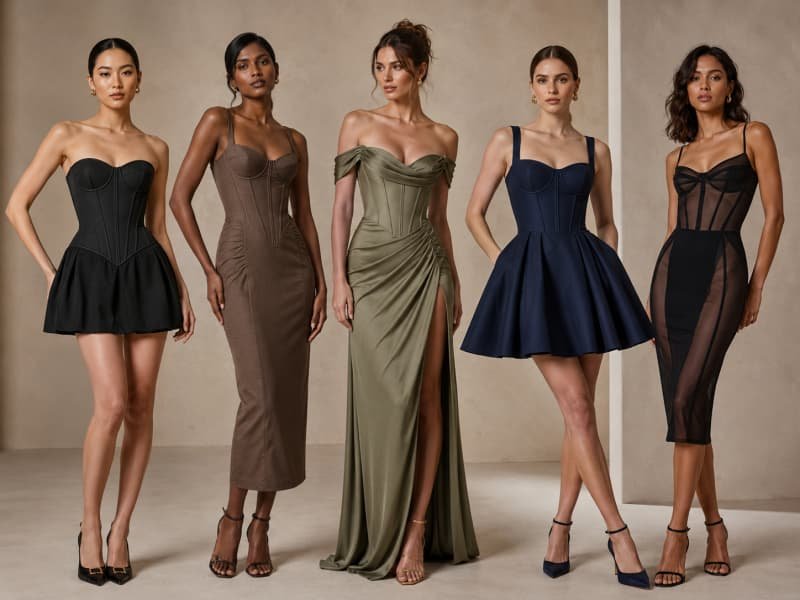
Every season brings another version of the corset dress, but 2027 is unlikely to reward brands that simply repeat exposed boning on a satin mini. The stronger direction is more architectural and more wearable at the same time: longer bodices, curved or pointed waistlines, cleaner cup shapes, controlled transparency, and support that remains comfortable through sitting, walking and dancing. Early Spring/Summer 2027 reporting is already treating the torso as a larger design space, with Basque-drop waist hybrids, reworked strapless lines, draping and deliberate proportion changes appearing across formalwear and broader womenswear. For product teams, the real opportunity is not to ask whether corsetry is still popular. It is to decide which version belongs in the collection, how that version should fit the intended customer, and whether the construction can be repeated consistently across sizes, colorways and production runs. A strong 2027 corset dress will need to look clear in a campaign image, feel secure on the body and remain technically sensible after the first sample leaves the sample room.
Corset dress development in 2027 will be shaped by elongated bodices, Basque and curved waistlines, refined strapless necklines, selective sheerness and more comfortable internal support. The most viable styles will combine a recognizable waist effect with reliable cup coverage, stable fabric recovery, practical movement and construction methods that can be graded and reproduced consistently in bulk production.
That last point is where attractive references often separate from successful products. Two dresses can look almost identical on a rack, yet one becomes a repeat seller while the other generates complaints about gaping cups, rolling waist seams and painful boning. The difference usually appears in the less visible decisions: fabric recovery, cup allocation, torso length, seam placement, lining balance and the discipline used between sample approval and bulk release. The following analysis looks at the 2027 direction through that practical lens, so the trend can be translated into dresses that are not only current, but also wearable, scalable and worth repeating.
What Will Define Corset Dresses in 2027?
Corset dresses in 2027 will be defined by purposeful structure rather than visible boning alone. Expect longer bodices, shaped waist seams, reworked strapless necklines and a stronger balance between body definition and movement. The clearest products will translate runway-level ideas into wearable dresses designed for specific occasions, price points and size ranges.
Is Corsetry Still Growing?
Corsetry is still growing as a design language, but the category is becoming less forgiving of generic products. Vertical panel seams or decorative piping can create a familiar corset look, yet they no longer make a dress feel new by themselves. The more convincing 2027 developments reshape the torso through bodice length, waist placement, cup geometry and the relationship between a controlled upper body and a softer or more dynamic skirt. Peclers Paris describes Spring/Summer 2027 womenswear through modern femininity, precise silhouettes, tactile materials and comfort, while current 2027 formalwear reports repeatedly identify corsetry and extended waist construction. Together, these signals support continued relevance, but they also suggest a move away from structure used only as surface decoration.
It is useful to separate the category into visual, supportive and sculptural corsetry. Visual corsetry relies on seam lines, piping and light stabilization to suggest a corset without strong compression. Supportive corsetry uses cups, lining, interfacing and flexible boning to improve neckline security and shaping. Sculptural corsetry uses longer panels, firmer support and more dramatic waist architecture to create a statement silhouette. None of these levels is automatically superior. A lightweight visual corset may be the better choice for a dance-focused party dress, while a strapless prom maxi may need more dependable internal support. The correct level should follow the occasion, expected wear time, target price and customer tolerance for firmness.
The practical shift for 2027 is from asking whether a dress looks corseted to asking what the corset construction is doing. It may lengthen the torso, control a strapless neckline, support a heavier skirt, create a softer hourglass or frame a transparent panel. When the function is clear, the style is easier to explain, photograph and scale. When the construction has no purpose beyond decoration, the result can feel like a repeat of earlier seasons and may add sewing operations without improving fit or perceived value.
Are Basque Waists Becoming Mainstream?
Basque waists are moving closer to mainstream occasionwear because they create a noticeable proportion change without requiring heavy decoration. The center front drops below the natural waist in a pointed or curved line, which visually lengthens the torso and directs attention toward the narrowest part of the body. Spring 2027 coverage from The Knot, Inside Weddings and independent bridal-market reports shows Basque waists merging with dropped waists, draped transitions and extended corset bodies. Bridal collections are an early signal rather than a ready-to-copy formula, yet the proportion is already suitable for prom, homecoming, cocktail and party dresses when the depth and skirt connection are moderated.
For commercial sampling, a center-front extension of roughly 3-6 cm below the natural waist can provide a visible but manageable interpretation on many adult womenswear blocks. That is a working development range, not a universal rule. A deeper point can suit image-led formal styles, but it also increases pressure over the lower abdomen and upper hip, particularly when the wearer sits. The side-waist position must be reviewed together with the center point. If the side remains too high, the seam can twist or form diagonal tension; if the whole lower bodice becomes too long, it may buckle above the hip or force the skirt to hang unevenly.
Basque development also depends on how the skirt begins. A smooth fitted skirt exposes every imbalance in the waist seam, while gathering can hide small inconsistencies but add bulk that weakens the pointed effect. A curved Basque can work well with draping because the seam feels integrated rather than sharply historical. Another option is to create the visual line through paneling or contrast fabric while keeping the true skirt seam closer to the natural waist. That approach can preserve the 2027 proportion with less grading and sitting risk, especially for shorter torsos.
Do Customers Want Structure With Comfort?
Customers increasingly want the visual effect of corsetry without the restriction associated with historical waist training. A modern dress may need to define the bust, stabilize a strapless neckline and shape the waist, but it should still allow the wearer to breathe, sit, eat, walk and dance. Comfort is not a soft benefit added after the design is complete; it is built through pattern balance, pressure distribution and material choice. A bodice that is too tight at the waist often rides upward because the garment is searching for a wider area of the torso, while a shallow cup can push the bust upward and make the neckline feel unstable even when the waist measurement is correct.
Wearable support usually comes from several moderate systems working together: accurate contour seams, appropriately weighted interfacing, cups with sufficient width and depth, boning that stops clear of sensitive areas, a stable upper edge and a smooth lining. Adjustable straps, elastic sections or lace-up backs can improve tolerance when they belong naturally in the design, but they should not be used to hide a weak base pattern. A strapless bodice should be stable before detachable straps are attached, and a lace-up back should refine the fit rather than compensate for incorrect cup position or torso length.
Longer wear tests are especially valuable for occasion products. A five-minute fitting may not reveal boning pressure, fabric growth, waist rolling or underarm irritation. The fit model should sit for several minutes, walk, raise the arms, turn the upper body and bend forward while the team observes neckline movement and pressure points. The goal is not to remove structure. It is to spread support across the bodice so that the dress remains secure without concentrating force at the bust edge, underarm or lowest Basque point.
Which Dress Categories Have the Most Potential?
Corsetry has the greatest potential in categories where visible shaping already supports the customer’s expectations: prom, homecoming, party, cocktail, birthday, graduation, wedding-guest and other occasion-led dresses. Each category needs a different balance of drama, coverage, wear time and price. Prom styles can carry longer bodices, fuller skirts and stronger embellishment because customers expect a statement. Party and going-out minis need immediate visual impact but usually benefit from lighter construction and easier movement. Graduation and wedding-guest dresses may be worn for several hours, making reliable coverage and seated comfort more important than extreme compression.
The same bodice should not simply be shortened or lengthened for every category. A strapless mini experiences more arm movement and dancing, so upper-edge security becomes critical. A maxi may carry significant skirt weight, which can pull the bodice downward unless the waist seam and internal support are reinforced. A fitted midi exposes hip and stride problems that a fuller skirt can hide. Category-specific engineering is therefore more useful than a single universal corset block, even when several styles share the same neckline or panel language.
For a coherent 2027 collection, brands can build a small family rather than betting on one extreme piece. A shallow-Basque party mini, a long-line cocktail midi and a draped corset maxi can share cup shapes, seam language or trim details while serving different occasions. The family looks connected in merchandising, yet each product has support and movement standards suited to its use. That approach also creates a clearer path for testing, repeat orders and later extensions into new colors or fabrications.
Corset Construction Levels and Their Best Applications
| Development Level | Primary Purpose | Typical Construction | Best Applications | Main Risk |
| Visual corsetry | Creates a clear corset appearance | Panel seams, piping, light interfacing | Going-out, party and summer dresses | Adds operations without real support |
| Supportive corsetry | Shapes and stabilizes the bodice | Cups, lining, flexible boning, reinforced seams | Prom, cocktail and occasion dresses | Cup or neckline mismatch |
| Sculptural corsetry | Builds a dramatic torso and waist | Long-line panels, stronger boning, complex waist architecture | Statement occasion and image-led formal styles | Comfort, cost and grading difficulty |
Which Corset Silhouettes Will Lead?
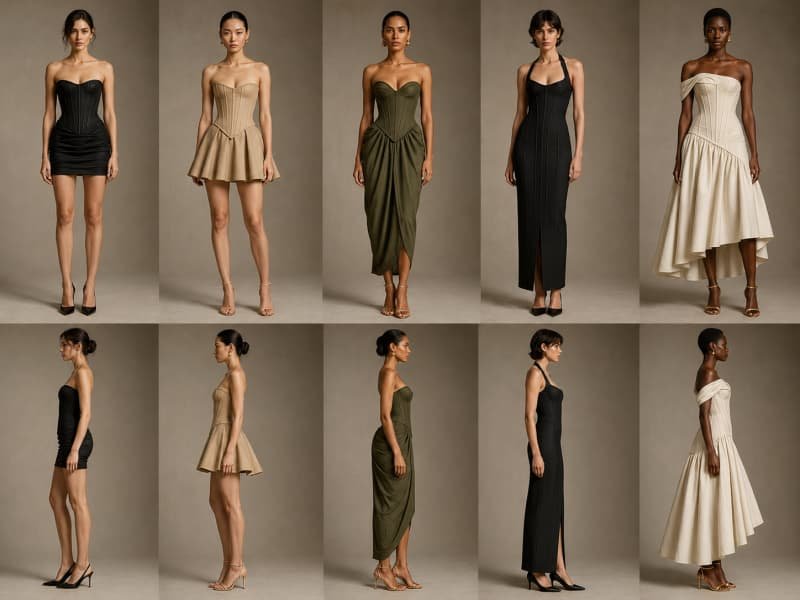
The leading 2027 silhouettes will change torso proportion through waist placement, bodice length and skirt contrast. Natural waists will remain commercially useful, while shallow Basque points, elongated corsets, curved dropped waists and reworked strapless lines provide the strongest newness. Each silhouette must be adjusted for dress length, skirt weight and expected movement.
Which Waistlines Will Lead?
Five waist directions are likely to remain useful through 2027: the natural waist, shallow Basque, deeper Basque, elongated long-line bodice and curved drop waist. The natural waist offers familiar proportions and the lowest grading risk. A shallow Basque creates a current center-front extension while keeping the side seam close to the natural waist. A deeper Basque produces a stronger hourglass effect but requires closer review of torso length and sitting comfort. Long-line bodices smooth the waist-to-hip transition, while curved dropped waists provide a softer alternative to a sharp V point and work naturally with draping.
The waistline should be documented through several measurements rather than a single front length. The technical package should identify the natural-waist reference, center-front lowest point, side-waist position, center-back position, lower-bodice length and the exact shape of the skirt seam. Boning termination and zipper placement also matter because a deep point can become uncomfortable when a rigid channel ends directly above it. A front image may look correct while the side seam pulls forward or the lower bodice folds when seated, so side, back and seated views belong in the fit record.
Brands should also decide whether the waistline is structural or visual. A structural Basque means the skirt truly joins the bodice along the pointed seam. A visual Basque can be created with panel lines, contrast fabric, piping or an overlay while the actual load-bearing seam remains simpler. The visual option is useful when the brand wants the proportion but needs easier grading, faster sewing or less lower-abdomen pressure. Neither method is inherently more premium; the better option is the one that preserves the intended look with fewer fit surprises.
Which Necklines Will Feel New?
Strapless corset dresses will remain important, but the standard rounded sweetheart is no longer the only strong choice. Cat-eye points, softened squares, shallow scoops, straight lines, asymmetric cups and curved envelope shapes can make a familiar bodice feel more directional. The Knot’s 2027 formalwear reporting highlights reinvention in strapless necklines, while Resort 2027 collections continue to explore bandeau shapes and exposed-bust framing. The useful takeaway for ready-to-wear is not to copy the most extreme runway line, but to create a neckline that reads clearly in photographs and stays secure during real movement.
Neckline stability depends on cup position, upper-edge length, center-front depth, boning support and the distance between the bust point and edge. A sharply raised cat-eye corner can fold outward without internal stabilization. A low sweetheart may expose too much when the wearer bends forward. A straight neckline can feel modern, yet it often needs shaped ease or edge control to prevent gaping. Fit approval should include relaxed arms, raised arms, forward bending and sitting, because a neckline that appears perfect in a static front photo may open as soon as the shoulder girdle moves.
The design team should decide early whether the dress is bra-friendly, built around internal cups or intended for adhesive support. That choice affects back height, strap position, neckline depth and lining construction. Detachable straps can add versatility, but they should not rescue a weak strapless fit. When the base bodice is correct, straps are an option; when the base bodice is unstable, straps become a hidden structural necessity and the product no longer performs as promised.
Are Mini, Midi, and Maxi Shapes Equal?
Mini, midi and maxi corset dresses are not technically interchangeable. Dress length changes movement, visual balance and the amount of weight suspended from the bodice. A lightweight mini can use a softer internal build because it must move easily during dancing and social wear. A bodycon midi places sustained tension across the waist, hip and seat, making recovery and stride allowance critical. A maxi can support a more dramatic bodice, but a lined, embellished or full skirt may pull downward and disturb neckline position if the waist seam is not properly reinforced.
Bodice length should also change with the total silhouette. An extended corset can look elegant above a full skirt because the lower volume balances the long torso. The same bodice may appear visually heavy on a short fitted mini, particularly on customers with shorter body lengths. Conversely, a very short corset can suit a playful mini but look underdeveloped above a floor-length skirt. Proportion should be approved as a complete garment on the fit model rather than judged from a separate bodice toile or flat sketch.
Movement tests should reflect the use of each length. Minis need walking, sitting, stair and dance tests, with attention to hem rise and waist migration. Midis need stride, chair and prolonged sitting tests because the skirt can restrict the lower body and force the bodice upward. Maxis need stair, turning and skirt-handling tests, particularly when the train, mermaid line or detachable overskirt adds weight. These tests often reveal problems that static measurement checks cannot show.
How Will Skirt Volume Change the Look?
Skirt volume determines whether the corset reads as sensual, romantic, minimal, youthful or dramatic. A fitted skirt continues the body line and creates a sharper hourglass. An A-line or gathered skirt exaggerates the waist. A bubble hem feels playful and fashion-led, while a draped or ruched column softens the strict geometry of the bodice. Vogue’s Resort 2027 trend report highlights drop-waist proportions and ruched gowns, and Spring 2027 formalwear reporting shows longer torsos paired with both soft sheaths and fuller lower-body volume. The common idea is contrast rather than one dominant silhouette.
Volume must be controlled where the skirt meets the corset. Heavy gathering can make a pointed waist look blunt or bulky. Pleats placed too close to center front may hide the V line. A smooth fitted skirt exposes every imbalance in the lower bodice, including uneven waist tension or a twisting grain. The pattern team should therefore decide the skirt attachment method before finalizing the corset waist, not after the bodice has already been approved in isolation.
Fabric direction and weight add another layer. Bias-cut skirts may lengthen after hanging and can pull unevenly on a fixed bodice. Dense ruching can rotate the waist seam when gathering tension varies from unit to unit. A full skirt may need a waist stay or internal support so its weight is not carried only by the fashion fabric. The strongest products usually create one clear contrast: clean corset with fluid drape, long torso with controlled volume, or sharply defined waist with a soft skirt. When both halves are equally complex, the dress can become crowded and harder to repeat consistently.
Silhouette Development Matrix for 2027 Corset Dresses
| Dress Format | Recommended Bodice Direction | Key Movement Test | Main Engineering Concern | Development Priority |
| Fitted mini | Natural or shallow Basque waist | Walking, sitting and dancing | Hem rise and waist movement | Secure fit with light structure |
| Flared mini | Pointed or curved waist | Twisting and stair movement | Bulk at the waist seam | Clean waist definition |
| Bodycon midi | Natural or long-line corset | Stride and prolonged sitting | Hip restriction and fabric growth | Recovery and contour balance |
| Draped midi | Curved drop waist | Seated drape and side view | Uneven fold placement | Controlled drape |
| Mermaid maxi | Elongated corset | Walking and knee movement | Restricted stride | Support with lower-body mobility |
| Full-skirt maxi | Basque or natural waist | Dancing and skirt handling | Bodice pulled down by skirt weight | Waist reinforcement |
Which Materials and Details Will Matter?
The best 2027 materials will support the intended silhouette without making the dress feel bulky or rigid. Satin, crepe, mesh, lace, velvet, stable jersey and structured wovens all remain relevant, but their value depends on weight, stretch, recovery, opacity and seam performance. Details should be selected for both visual effect and repeatable production.
Which Fabrics Hold Shape Best?
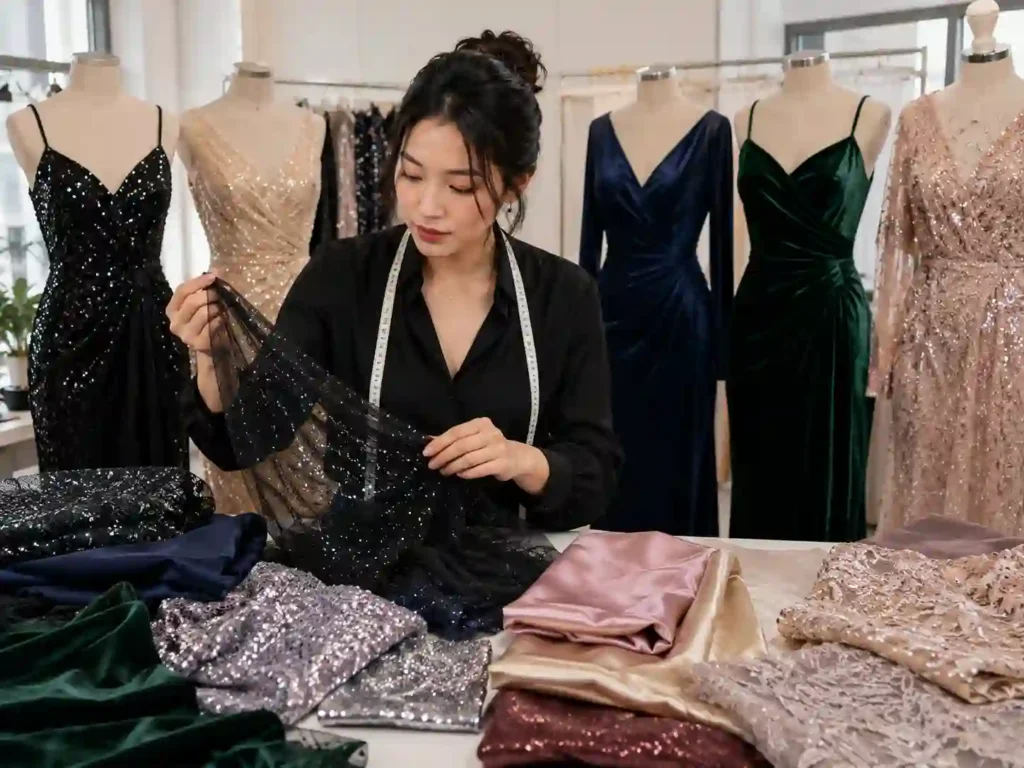
No single fabric is best for every corset dress. A material that creates a clean sculpted mini may be too heavy for a draped maxi, while a soft satin that looks luxurious on a hanger may expose seam puckering and pressing marks once it is structured. Stretch satin, crepe, power mesh, stable jersey, velvet and woven satin can all work, but the correct choice depends on whether the bodice needs compression, light visual shaping, transparent paneling, heavy embellishment or a smooth surface for photography.
Fabric weight is a useful starting point, but construction and finishing can make two fabrics at the same grams per square meter behave very differently. A 200 gsm stretch satin with strong recovery may hold a fitted silhouette more reliably than a heavier satin with weak recovery. A low-weight fashion mesh may create visual transparency but almost no support, while a denser power mesh can become an effective internal control layer. The team should assess hand feel, stretch direction, recovery, opacity, seam slippage, shrinkage and how the fabric behaves after lining and interfacing are added.
The final material package matters more than the shell alone. A flexible stretch shell paired with a rigid lining can behave like a woven garment and may require more wearing ease. A non-stretch satin combined with a small power-mesh section can improve tolerance without changing the visible surface. Interfacing can stabilize a neckline but also introduce stiffness, bubbling or color change. Materials should therefore be tested as a complete layered construction, including cups, channels and seam intersections, before the pattern is finalized.
How Should Boning and Cups Be Chosen?
Boning should be selected according to support function, bodice length and customer comfort, not simply because the channels need to remain visible. Flexible plastic boning is suitable for many party and occasion dresses because it is light and can move with the body. Firmer plastic, spiral steel or flat steel may be appropriate for demanding formal silhouettes, but they add weight, cost and handling requirements. The number of channels is less important than their position. Boning works best when it supports load-bearing seams and prevents collapse rather than following decorative lines with no structural purpose.
A technical package should identify boning material, width, thickness, finished length, channel position and the clearance from neckline and waist edges. Many sample rooms begin by testing roughly 5-10 mm of clearance at the ends, then adjust for the casing, edge construction and pressure points. The exact value is not universal. A few millimeters can determine whether the boning supports the bodice or presses painfully into the underarm and lower waist when seated. Ends must be smooth and secured so they cannot work through the channel during wear or cleaning.
Cup development should happen at the same time. Molded cups offer a smooth and repeatable shape, but one cup profile may not serve a broad size range. Cut-and-sew cups provide more control over width, projection and grading, although they require additional pattern and sewing work. Underwire can improve support but introduces wire shape, channel and comfort requirements. A successful bodice balances cup volume, underbust placement, side-panel control, neckline tension and boning rather than expecting a single component to carry the entire fit.
Are Sheer Panels and Lace Still Relevant?
Sheer panels remain relevant because they make structured dresses feel lighter and reveal the logic of the corset. The more useful 2027 applications are selective: mesh can frame the waist, separate cups, expose controlled channels or lighten the side body while maintaining coverage where it matters. Full transparency can work for editorial or stage-led products, but occasion customers usually need a more considered balance between visual impact, skin-tone compatibility and confidence under strong lighting.
Transparency changes dramatically between a relaxed swatch and a worn garment. Mesh should be reviewed at the actual stretch level under daylight, studio lighting and flash photography, because seam allowances, cup edges and boning channels can become darker and more visible. Color should also be approved after stretching; a tone that appears close to the skin when relaxed may become lighter or more obvious across the torso. Front, side and back photographs help reveal areas that the mirror or fitting-room light can hide.
Lace adds a separate placement decision. Engineered symmetry can create a premium effect but increases consumption and cutting labor. Random placement is less costly but may look inconsistent across units. The design team should identify which motifs must appear at the neckline, center front or waist and where natural variation is acceptable. Lace edges, appliqué boundaries and seam allowances should be tested on the final mesh or satin combination so that the surface remains smooth and the motif does not pull the underlying fabric out of shape.
Which Details Can Scale Reliably?
A detail scales reliably when its position, method and acceptable variation can be explained clearly. Concealed zippers, fixed straps, standardized cups, machine-applied trims and measured ruching are generally easier to repeat than irregular draping, dense hand beading or lace motifs that require individual artistic placement. Complex decoration is not a problem by itself. The risk appears when the sample maker creates an attractive result by eye and the bulk line receives no notches, templates, placement guides or workmanship reference.
Draping and ruching need measurable control. Fold positions can be tied to notches, stitch points and panel lengths, while ruching density can be defined through the relationship between the gathered edge and its finished length. A comment such as ‘make it fuller’ is too subjective for production. Bows, crystals, pearls, sequins and appliqué should be measured from fixed seams or balance points, and the acceptable left-right variation should be agreed before bulk. The attachment method must also be tested on the final fabric, because a crystal that bonds well to a stable woven may detach from stretch mesh.
Detail weight should be considered as part of fit. Heavy beading can pull a neckline forward, collapse a cup or distort a Basque point. Dense sequins can reduce stretch and make one panel behave differently from the rest of the bodice. Metal trims may create pressure points or fail pull tests if the surrounding fabric is too light. The best 2027 details will not simply look expensive in the first sample; they will remain stable after movement, pressing, packing and repeat production.
Working Material Ranges for Corset Dress Development
| Material | Indicative Weight | Typical Behavior | Suitable Use | Main Control Point |
| Lightweight satin | 90-140 gsm | Fluid, low structure | Skirts, overlays and soft corset looks | Seam puckering and opacity |
| Stretch satin | 150-230 gsm | Smooth with moderate support | Fitted minis and midis | Stretch direction and recovery |
| Fashion mesh | 40-90 gsm | Sheer with limited support | Illusion panels and overlays | Snagging and seam slippage |
| Power mesh | 120-220 gsm | High stretch and stronger recovery | Internal support and control panels | Compression consistency |
| Stretch crepe | 180-280 gsm | Matte with controlled drape | Bodycon and cocktail dresses | Growth after wear |
| Velvet | 200-320 gsm | Rich surface with seam bulk | Winter party and event dresses | Pile direction and crushing |
| Stable jersey or ponte | 250-380 gsm | Firm stretch and recovery | Sculpted fitted silhouettes | Thickness at seam intersections |
| Taffeta or structured woven | 110-220 gsm | Crisp and shape-holding | Full skirts and sharp bodice panels | Crease recovery and seam stress |
How Should Corset Fit Be Developed?
Corset fit should be developed as a relationship between bust support, waist shaping, torso length, fabric behavior and movement. A correct measurement chart is not enough. Brands should test neckline security, cup capacity, seated comfort, arm movement, zipper behavior and silhouette recovery across representative sizes before approving a style for production.

How Is Bust Support Balanced?
Bust support comes from a system rather than one component. Cups shape the bust, underbust seams control the lower edge, side panels guide volume forward, boning stabilizes the torso and the neckline prevents the upper edge from opening. When one part is wrong, strengthening another part rarely solves the problem. A tighter neckline cannot correct a cup that is too shallow, and stronger boning cannot fix an underbust seam that sits above the natural bust root.
A useful fit sequence begins with bust-point position. The bust point should sit naturally inside the cup rather than above, below or outside it. Cup width is then checked against the intended breast-root width, followed by depth, center-front contact and side coverage. The side seam should remain vertical, and the upper edge should stay secure when the wearer raises her arms or leans forward. Underbust depth deserves special attention: when the seam sits too high, the cup can feel small even if its total volume appears adequate; when it sits too low, support decreases and the bust drops inside the garment.
Larger sizes usually require more than proportional enlargement. Cup depth, side support, strap position, neckline height and internal layers may need separate adjustments. The exterior design can remain visually consistent while the internal geometry changes. That is often preferable to forcing every size to use the same cup profile and then accepting overflow, empty space or unstable coverage. Fit consistency means the dress performs similarly across the range, not that every internal measurement grows by the same percentage.
How Do Stretch and Recovery Affect Fit?
Stretch describes how far a fabric extends; recovery describes whether it returns to its original measurement. Both are essential in body-conscious corset dresses. A fabric can stretch generously and still perform poorly if it remains enlarged after an hour of wear. The sample may fit at the beginning of a fitting, then loosen at the waist, neckline or hip as the fibers fail to recover. Recovery is therefore more informative than a single stretch percentage when the dress relies on negative ease.
A simple comparison method marks a 10 cm section across the main stretch direction and extends it without excessive force. If it reaches 12 cm, the extension is 20 percent. After several extension cycles, the fabric is released and measured again. If the original 10 cm remains at 10.4 cm, it has retained 4 percent growth under that test condition. This is not a laboratory replacement, but it provides a consistent internal method for comparing candidate fabrics before sampling. The force required to reach the extension should also be noted because two fabrics with the same percentage can feel very different on the body.
Direction matters. Two-way stretch generally runs around the body, while four-way stretch also provides vertical movement. Vertical stretch can improve comfort, yet it may cause an elongated corset or heavy skirt to grow downward. Lining and interfacing must be included in the evaluation. A stretch shell paired with a rigid lining may behave almost like a woven garment, while a fully stretch lining may provide insufficient stability for a strapless neckline. Pattern reduction should be based on the complete material system rather than the shell fabric alone.
Which Fit Risks Cause Returns?
The most common return risks are often small problems that become unacceptable during real wear. Bust gaping can come from an incorrect neckline curve, excessive upper-edge length, unsuitable cup volume or weak internal support. Cup overflow may result from inadequate depth, low neckline placement or grading that enlarges width without adding projection. Waist riding usually points to excessive reduction, poor upper-hip allowance or a bodice that is too short for the wearer’s torso.
Boning discomfort can come from channels that are too long, poorly finished ends or placement close to the underarm and lowest waist point. Zipper waves may be caused by stretching the fabric during insertion, using an unsuitable zipper tape or creating too much negative ease at center back. Other recurring issues include rotating side seams, collapsing cups, underarm edges that cut into the body, center-front panels that fold while seated, uneven waist seams, twisting skirts, lining that pulls against the shell and transparent panels that become more revealing under tension.
Fit comments should describe the location, amount and intended correction. ‘Too tight’ is not actionable enough. A stronger comment might state: add 1 cm total at the upper waist between the front princess seam and side seam, keep the center-front point unchanged and reassess the seated fold. Clear comments prevent the next sample from solving one problem while creating another. Photographs should include front, side and back views with marked areas, and the updated pattern should be checked against the comment record before cutting the revision.
How Should Size Grading Be Tested?
Corset dresses should not be graded by applying one uniform increment to every panel. Bust volume, cup width, cup depth, torso length, waist suppression, strap position and upper-hip shape do not increase at the same rate. A narrow size range may be handled from one proven block, but a broader range often benefits from a second fit model or a separate base once body proportions begin to change more noticeably.
Cup grading requires an explicit strategy. Some brands keep one cup profile across several garment sizes and adjust the frame around it, while others increase cup capacity as the garment size rises. Both systems can work when the customer profile is understood, but the logic must be written into the specification. The pattern team should know whether a larger size represents a larger frame, greater bust volume or both. Without that decision, the neckline and cup can drift unpredictably across the range.
Representative-size testing is more useful than checking only the base size. For a range covering eight sizes, a practical review might include the base, one smaller size, one middle-large size and the largest planned size, with the exact selection adjusted to sales distribution and fit-block history. Critical points include bust position, cup width and depth, neckline coverage, underarm height, strap angle, center-front length, side-waist length, Basque depth, upper-hip circumference and zipper opening. The goal is to preserve the silhouette while allowing each size to sit correctly on the body.
How Can Brands Move From Trend to Production?
Brands can move from trend to production by converting visual ideas into measurable decisions before bulk begins. The process should define the target customer, occasion, fit priority, material behavior, sample purpose and acceptable production risk. Corset dresses benefit from staged sampling, representative-size fitting, production-readiness review, first-piece confirmation and a clear approved reference.

How Do Brands Validate a Trend?
A trend is worth developing only when it fits the brand’s customer, price level and product calendar. Seeing Basque waists and extended corsets across Spring 2027 collections does not mean every label needs a deep-pointed satin dress. Bridal and runway coverage can reveal early proportion changes, but the product team still needs to decide how much structure, coverage and decoration its own customer will accept. The most useful question is not whether the feature is fashionable; it is whether the feature creates a product the brand can explain, price, fit and repeat.
Validation should cover five areas: brand fit, customer fit, occasion fit, price fit and production fit. Brand fit asks whether the silhouette belongs beside existing bestsellers. Customer fit considers body confidence, neckline tolerance and expected wear time. Occasion fit separates a two-hour going-out dress from an all-day graduation or event product. Price fit checks whether cups, lining, boning, embellishment and sewing operations can sit inside the target retail level. Production fit asks whether the design can be graded, repeated across colorways and supported by stable materials.
A small silhouette family can reduce the risk of betting on one extreme idea. For example, a 2027 capsule could include a shallow-Basque party mini, a long-line cocktail midi and a softer corset maxi with draping. Shared seam language or trim details create collection consistency, while different support levels serve different occasions. Trend validation should end with a written product brief that identifies the customer, target price, planned size range, support level, key visual feature, non-negotiable details and the specific decision the first sample must enable.
Which Samples Are Needed?
Not every dress needs the same number of samples, but corset styles benefit from staged development because visual approval and fit approval are rarely achieved at exactly the same time. The first prototype tests proportion, cup position, waistline and basic feasibility. A fit sample focuses on body balance and movement. A revised sample confirms the corrections and near-final details. A size-set review checks grading, and the pre-production sample locks final materials, measurements and workmanship before bulk.
Each sample should have a declared purpose. A visual presentation sample may use substitute internal components, while a fit sample should use materials that behave close to the intended bulk combination. Confusing those purposes creates unnecessary revisions. A beautiful sample made in a firmer substitute satin may be approved visually, then lose its shape when the nominated stretch fabric arrives. The sample record should therefore state whether the garment is fit approved, visual approved, sales approved, a pre-production basis or still pending refinement.
Rejected options should remain in the project file. If one cup profile, boning type, interfacing or mesh color was tested and failed, that information is useful during later colorways, repeat orders and supplier changes. Staged progress updates also reduce misunderstandings. For structure-sensitive dresses, the development team can share the material direction, key fit risk and any decision needed before the sample is completed, rather than waiting until the finished garment exposes a preventable issue.
Recommended Development Gates for a Corset Dress Program
| Development Gate | Main Purpose | Critical Decisions | Expected Output |
| Development brief | Defines the product before sampling | Occasion, silhouette, price, fabric direction and fit priority | Confirmed sample brief |
| First prototype | Tests initial pattern and construction | Proportion, cup position, waistline and feasibility | First sample with comments |
| Fit and revised samples | Corrects body balance and confirms changes | Bust, waist, torso length, movement, neckline and drape | Near-final approved direction |
| Size-set review | Checks grading logic | Coverage, cup growth, Basque depth, strap position and length | Grading comments or approval |
| Pre-production sample | Locks the production standard | Final fabrics, trims, measurements, workmanship and packaging | Approved PP reference |
| First-piece or pilot review | Verifies the bulk method before release | Sewing sequence, pressing, attachment, symmetry and consistency | Production release decision |
How Is Bulk Risk Controlled?
Bulk risk is controlled by locking materials, measurements, construction and inspection points before the production line is released. Corset dresses are sensitive because small changes in fabric recovery, cup profile, boning stiffness, seam tension or pressing can alter the fit. A production-readiness review should confirm whether the current sample is the true bulk basis and whether shell fabric, lining, trims, color, graded patterns, measurement tolerances, workmanship points, packaging and labeling have all been resolved.
A first-piece or pilot review is especially valuable for long-line corsets, strapless styles, satin dresses, mesh-layered bodices and heavily decorated occasion products. The aim is to confirm that the production method reproduces the approved sample before a large quantity passes through the same operation. Cup position, boning length, Basque balance, zipper installation, neckline symmetry, drape placement and embellishment security should be checked early, because corrections become more expensive once lining is closed and the garment is fully assembled.
Inline control should focus on high-risk operations rather than waiting for final inspection. Repeat orders also need renewed checks because fabric lots, trim suppliers, sewing lines or pressing conditions can change. The approved reference sample, measurement chart and critical construction points should be reviewed before every repeat run. Consistency is not created by assuming the previous order will repeat itself; it is created by restoring the same control points each time the style returns to production.
What Should Brands Ask a Manufacturer?
Brands should ask questions that reveal how a manufacturer thinks, not only what equipment it owns. A supplier may say it can make corset dresses, but the useful evidence is how it handles cup selection, stretch recovery, Basque grading, neckline stability, sample comments and the transition into bulk. Specific answers show whether the team understands structure-sensitive dresses or is relying on general sewing experience.
Questions should cover development basis, fabric sourcing, fit correction, sample purpose, size testing, production readiness and confidentiality. Ask whether the team can work from a tech pack, reference image or original sample; how it changes the pattern when stretch changes; which sizes it recommends fitting; how it selects cups, boning, lining and interfacing; what happens when a nominated material is unstable; which sample becomes the official bulk reference; and whether complex styles receive a first-piece or pilot confirmation before full release.
The best answer is not always an immediate yes. A capable development partner should challenge a risky brief when the fabric cannot support the neckline, the cup profile does not suit the size range or a draped detail cannot be repeated reliably. Raising the issue during sampling protects the product calendar far more effectively than hiding it until bulk. The relationship should feel like structured problem solving, with clear decisions, visible progress and a shared understanding of what must be true before production begins.
The 2027 corset dress is less about adding more visible structure and more about making every structural choice count. A longer bodice should improve proportion, a Basque waist should remain comfortable when seated, a sheer panel should preserve confidence under real lighting, and decorative work should remain measurable enough to repeat. Brands that connect trend research with fabric behavior, fit testing and production-readiness control are more likely to create a style that photographs well, earns positive wear feedback and returns for another order instead of disappearing after one launch.
Duolan Apparel supports custom development for corset and bustier dresses, body-conscious styles, party dresses, prom dresses, graduation dresses, homecoming dresses, cocktail dresses and other occasion-led collections. Projects can begin from a tech pack, reference image, original sample or mixed development brief, with attention to fabric selection, pattern balance, cup and boning structure, sample revision, grading and sample-to-bulk transition. For higher-risk styles, the documented workflow includes production-readiness review and first-piece or pilot confirmation before full release.