Skip to content
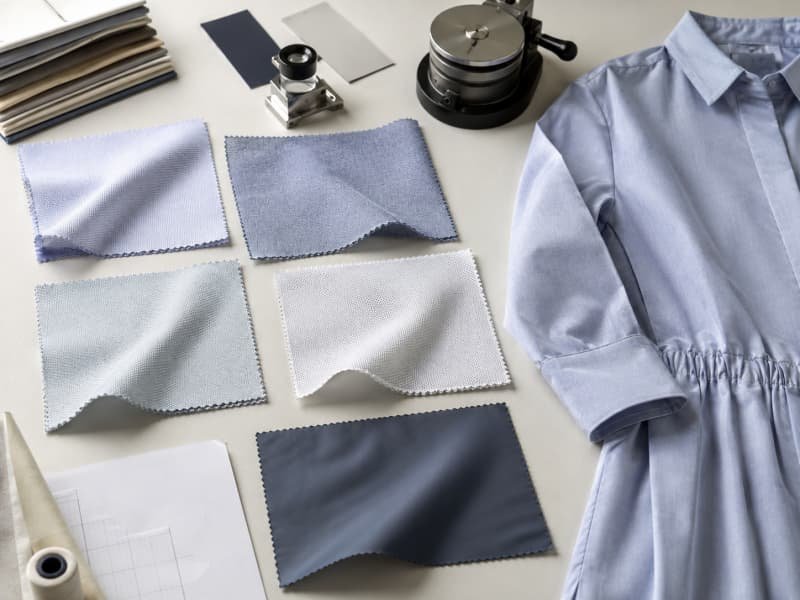
Oxford fabric is one of those textile names that sounds simple until several swatches arrive on the development table. One may be a soft cotton shirting with a subtle two-tone surface, another may be a crisp stretch cloth suitable for a fitted shirt dress, and a third may be a coated polyester material intended for luggage or outdoor covers. They can all be sold as Oxford, yet they do not belong in the same garment, respond to the same sewing settings, or offer the same comfort. The confusion comes from treating Oxford as a fixed raw material when it is better understood as a family of woven constructions whose performance changes with fiber, yarn size, density, weight, and finishing.
Oxford fabric is a woven textile recognized by a basket-like structure that creates a lightly textured, stable surface. Traditional apparel Oxford is often made from cotton and used for shirts or structured clothing, while modern versions may contain polyester, nylon, or elastane. Its breathability, drape, durability, wrinkle resistance, and water performance depend on the complete fabric specification, not the Oxford name alone.
That distinction is not academic. A product team can approve a beautiful swatch, develop the pattern, and still discover that the finished dress is too stiff at the waist, too transparent under studio lighting, or too warm after lining is added. Experienced developers therefore ask a more useful question than “Is this Oxford fabric?” They ask what the cloth is made from, how much it weighs, how it moves, what finishing it has received, and whether those characteristics support the intended silhouette. The following guide approaches Oxford from that practical point of view, moving from construction and common types to apparel performance, garment use, production testing, and everyday care.
What Is Oxford Fabric?
Oxford fabric is a woven material identified mainly by its basket-like construction rather than one fixed fiber. It may be made from cotton, polyester, nylon, or blends, so its comfort and performance vary. Traditional apparel Oxford is commonly used for shirts and structured clothing, while heavier coated versions are more suitable for bags, covers, and outdoor products.
Is Oxford a Weave or a Fiber?
Oxford is primarily a construction name, not a fiber name. Fiber content explains what the yarn is made from, while weave explains how the yarns are arranged. Cotton contributes absorbency, softness, and a natural hand. Polyester usually improves drying speed, crease recovery, and dimensional stability. Nylon is used where abrasion resistance and tensile strength matter, while elastane may be added when a garment requires controlled stretch and recovery.
This distinction is important because the same commercial label can cover materials that belong in completely different product groups. A 120 GSM cotton Oxford may be comfortable enough for a summer shirt dress, while a coated 600-denier polyester Oxford is designed for technical durability rather than skin comfort. Both may be correctly described as Oxford, but their patterns, needles, seam structures, pressing temperatures, test plans, and care labels will not be interchangeable.
A reliable fabric request should therefore go beyond the name. Product teams normally need fiber percentages, finished weight in grams per square meter, usable width, weave density, stretch direction, finishing method, expected shrinkage, colorfastness data, and any coating or lamination. Without those details, costing and sample approval remain vulnerable to substitution. A visually similar fabric may be cheaper per meter yet create greater cutting loss, higher shrinkage allowance, more sewing difficulty, or a noticeably different finished silhouette.
How Is Oxford Fabric Woven?
Classic Oxford cloth uses a basket-like variation of plain weaving. Instead of every warp yarn crossing every weft yarn individually, two or more yarns may act together, creating a small raised texture rather than a completely flat face. The exact construction varies by mill and quality level, but the grouped appearance is responsible for the familiar soft grid seen in many Oxford shirts and shirt dresses.
The weave affects more than appearance. It gives the cloth enough body to support collars, cuffs, plackets, pleats, patch pockets, and visible topstitching. It can also create attractive color depth when colored yarns cross white yarns. Pale blue Oxford, for example, often appears softly mottled rather than uniformly flat, which helps casual garments look less severe than a smooth formal shirting.
International suppliers sometimes use the word Oxford broadly, describing fabrics that reproduce the visual texture without following one identical yarn grouping. That is why a physical swatch remains essential. Holding it against light reveals opacity and density; folding it shows bending resistance; rubbing the surface exposes fuzzing or snag sensitivity; pulling at a cut edge shows yarn stability; and sewing a test seam reveals puckering, fraying, needle marking, and seam movement before the fabric reaches bulk production.
What Is Oxford Fabric Made Of?
Traditional apparel Oxford is commonly made from cotton. It feels natural against the skin, absorbs moisture, and often becomes softer after repeated washing. Cotton-rich versions suit shirts, casual dresses, children’s garments, and products where comfort matters more than rapid drying. Their main development risks are shrinkage, wrinkling, color change, and variation in hand after washing, all of which should be checked before measurements are finalized.
Cotton-polyester blends are widely used for uniforms, commercial programs, workwear-inspired clothing, and easy-care shirt dresses. The cotton portion supports comfort, while polyester helps the garment dry faster and maintain dimensions. The final result depends on blend ratio, yarn quality, density, and finishing, so a nominal composition should never replace a wash test and fit review.
Polyester and nylon Oxford cover a much wider technical range. Lightweight qualities may be suitable for uniforms or selected outer layers, while high-denier versions are common in luggage, covers, tents, and storage products. Polyurethane or PVC coatings can improve resistance to water, but they reduce airflow and change drape. Stretch apparel Oxford may contain roughly 2-5% elastane; even this small amount can alter seam choice, pattern ease, pressing temperature, shrinkage behavior, and shape recovery.
| Oxford category | Typical composition | Approx. apparel weight | Practical character | Common use |
| Lightweight cotton Oxford | 100% cotton | 100-140 GSM | Breathable, lightly textured, softens with washing | Shirts, loose dresses, summer tops |
| Cotton-blend Oxford | Cotton/polyester | 120-180 GSM | Stable, practical, easier care | Uniforms, shirt dresses, commercial programs |
| Stretch Oxford | Cotton or polyester with 2-5% elastane | 140-220 GSM | Structured with controlled give | Fitted shirts, shaped dresses, co-ordinates |
| Heavy apparel Oxford | Cotton-rich or synthetic blend | 180-260 GSM | Firm, opaque, shape-retaining | Utility dresses, overshirts, jackets |
| Technical Oxford | Polyester or nylon | Usually specified by denier | Abrasion-resistant and often coated | Bags, covers, outdoor equipment |
How Does Oxford Fabric Feel?
Oxford fabric usually feels more textured and substantial than fine poplin, but the hand can range from washed and relaxed to crisp and architectural. Fine yarns create a smoother surface, coarse yarns make the basket texture more visible, and higher density generally increases opacity and structure. A lightweight cotton version may feel dry and breathable, while a dense polyester version can feel firmer, smoother, and less absorbent.
Finishing can change the first impression dramatically. Enzyme washing softens the cloth, garment washing creates a broken-in appearance, resin treatments improve crease recovery, brushing adds warmth, and coating produces a more technical touch. None of these changes should be approved from a hanger swatch alone. The fabric needs to be folded, gathered, pressed, washed, and placed over a curved body form because bulk at the waist or stiffness in a sleeve often appears only after construction.
Color also affects how the fabric is perceived. White and pale shades tend to look crisper and may expose transparency under strong light. Dark shades can appear denser, but they may show lint, abrasion, chalk residue, or pressing shine more readily. The most dependable decision comes from a full sample made in the intended color and finish, followed by a wear trial and repeated care cycles rather than a quick hand-feel comparison in the sourcing room.
Which Types of Oxford Fabric Are Common?
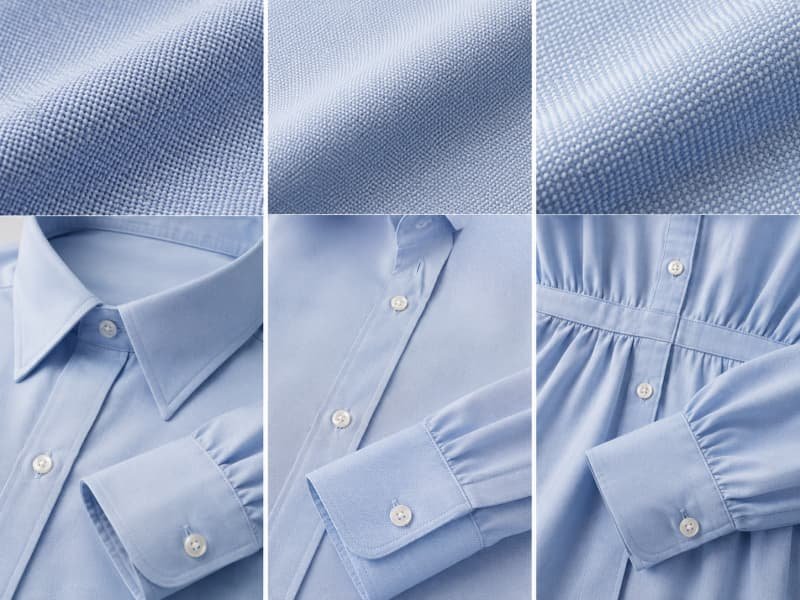
The most common apparel varieties are Plain Oxford, Pinpoint Oxford, and Royal Oxford. They differ in yarn size, texture, density, and formality. Cotton, blended, stretch, polyester, and nylon versions add further variation. The best choice depends on whether the garment needs natural softness, refined texture, easy care, controlled stretch, abrasion resistance, or technical protection.
What Is Plain Oxford?
Plain Oxford, also called standard Oxford, has the visible basket texture most people associate with casual button-down shirts. It is normally more substantial and less smooth than poplin, giving clothing a relaxed but structured character. The fabric works especially well when collars, cuffs, patch pockets, belts, pleats, or topstitching need to remain clearly defined after wearing and laundering.
In womenswear, standard Oxford is useful for oversized shirts, shirt dresses, A-line minis, utility dresses, pleated skirts, belted styles, and casual co-ordinates. It is less convincing in designs that rely on liquid movement, fine ruching, or a close bias drape. The fabric can be softened, but it will not behave like satin, rayon, chiffon, or lightweight crepe without losing the qualities that make it Oxford.
Construction needs to account for thickness at folded areas. Double-layer cuffs, enclosed waistbands, narrow collars, button plackets, and multi-fold hems can become bulky in a dense quality. Looser constructions may show seam slippage at the armhole, hip, or seat, while very dense cloth can pucker if thread tension and stitch density are not balanced. A representative seam test across both grain directions is more informative than simply checking the fabric’s tensile strength.
What Is Pinpoint Oxford?
Pinpoint Oxford uses finer yarns and a smaller-scale weave than standard Oxford. The surface is smoother and more polished, placing it between casual Oxford and fine dress shirting. It is suitable for refined shirts, office dresses, fitted blouses, premium uniforms, and tailored daywear where the garment needs enough body for a clean collar or placket without looking heavy.
The word Pinpoint does not automatically mean fragile. A tightly constructed cotton-polyester Pinpoint can perform well under repeated laundering, while a lightweight all-cotton quality may require greater control of seam puckering and shrinkage. Fine construction can make needle marks and poor pressing more visible, so needle size, thread, stitch density, presser-foot pressure, and temperature should be confirmed during sampling rather than corrected after bulk sewing begins.
Opacity is particularly important in pale colors. A white Pinpoint may look dense on a table yet become transparent when stretched over the bust, hip, or seat. The test should be performed on the intended size, over realistic underwear or lining colors, and under daylight as well as studio lighting. A full lining is not always the best solution because it changes heat, drape, and cost; selective lining or a slightly denser shell may work better.
What Is Royal Oxford?
Royal Oxford uses a more decorative structure that creates greater surface depth, a subtle geometric effect, and sometimes a soft sheen. It is more refined than standard Oxford and can elevate simple womenswear shapes without printing or heavy embellishment. Premium shirts, polished blouses, formal uniform programs, and refined shirt dresses are among its most suitable applications.
The complex surface requires careful handling. Pulled yarns, snagging, needle damage, and uneven pressing may show more clearly than they do on a basic cloth. If the woven pattern has a noticeable direction, pocket placement, center-front alignment, and placket matching can increase material consumption. A fabric that looks luxurious in a small swatch may become visually busy across a full dress, especially when gathered or cut into multiple panels.
Lighting and color can change the effect. Dark shades may reveal press marks and flattened texture, while pale shades can expose yarn irregularity. Directional studio light may exaggerate the pattern in ecommerce photographs, so the actual production color should be photographed during approval. Pressing trials should use the final interlining and seam construction because excess heat or pressure can create shine, seam impressions, or permanent loss of surface depth.
How Do Cotton, Polyester, and Nylon Oxford Differ?
Cotton Oxford is usually the most comfortable choice for clothing worn directly against the skin. It absorbs moisture, feels natural, and often improves in softness with laundering. Its limitations include wrinkling, slower drying, and shrinkage when stabilization is inadequate. Polyester Oxford dries faster, recovers from creasing more easily, and offers consistent dimensions, making it useful for uniforms and travel-friendly clothing, although dense versions can feel less breathable.
Nylon Oxford is valued for strength and abrasion resistance. It can deliver excellent toughness at a relatively low weight, but it is more sensitive to high heat and is usually associated with technical products rather than conventional dresses. Blends make it possible to balance properties: cotton-polyester improves easy care, cotton-elastane adds mobility, and polyester-elastane can support fitted garments if recovery and heat sensitivity are controlled.
Composition changes should trigger a new sample and test review. Replacing cotton with polyester can alter dye depth, static, pilling, odor retention, pressing behavior, drape, and care labeling. Even when the replacement meets the target price and looks similar on the roll, it may sit differently at the waist, create a sharper sleeve, or feel less comfortable after several hours of wear. The garment is the final test, not the trade name or laboratory swatch alone.
| Oxford type | Surface and feel | Relative formality | Main advantage | Typical apparel direction |
| Plain Oxford | Visible basket texture, medium body | Casual to smart casual | Clear structure and durable everyday character | Shirts, utility dresses, casual skirts |
| Pinpoint Oxford | Fine, tight, smoother surface | Smart casual to formal | Refined appearance without losing stability | Blouses, office dresses, premium uniforms |
| Royal Oxford | Dimensional texture, possible soft sheen | Refined to formal | Surface interest in simple silhouettes | Premium shirts and polished shirt dresses |
| Stretch Oxford | Base texture with controlled give | Depends on finish | Mobility for shaped garments | Fitted shirts, dresses, co-ordinates |
| Washed Oxford | Softened, relaxed, lived-in hand | Casual | Comfort and natural appearance | Oversized shirts and relaxed dresses |
What Are the Properties of Oxford Fabric?
Oxford fabric is generally stable, durable, and moderately structured, but it does not have one fixed level of breathability, wrinkle resistance, or waterproofing. Those properties depend on fiber content, weight, density, finishing, and coating. Untreated cotton Oxford behaves like breathable apparel cloth, while coated polyester Oxford may function as a water-resistant technical material.

Is Oxford Fabric Breathable?
Cotton Oxford is normally breathable enough for shirts, casual dresses, and everyday clothing, although it may feel warmer than a very light poplin. Air movement depends on yarn thickness, construction density, fabric weight, and finishing. A 105 GSM cotton Oxford can feel noticeably cooler than a dense 185 GSM version, but a lighter fabric may also be more transparent and less able to support structured details.
Fiber content changes moisture comfort. Cotton absorbs perspiration and can feel comfortable initially, although it dries more slowly. Polyester absorbs much less water and dries quickly, yet a tightly woven polyester Oxford can trap warmth close to the body. A cotton-polyester blend offers a compromise, but the actual balance depends on blend ratio, yarn structure, finish, fit, and the number of garment layers.
Finishes often reduce airflow. Water-repellent treatment, resin-based easy-care finishing, heavy pigment, polyurethane coating, PVC coating, and lamination all change breathability. Lining can have an equally large effect. A full polyester lining may solve transparency in a white dress but make the garment much warmer. Selective lining, lightweight cotton voile, or a slightly denser shell can provide better comfort when the design and price point allow it.
Is Oxford Fabric Durable?
Oxford is generally durable because the grouped yarn structure creates a stable surface and distributes stress across the weave. Good cotton Oxford can tolerate repeated wear and laundering, while synthetic versions often provide greater abrasion resistance. Durability, however, is not a single number. A fabric may resist tearing yet still fail commercially through pilling, fading, seam slippage, snagging, coating separation, or excessive dimensional change.
The test plan should reflect the garment. Pilling matters where the cloth rubs against bags, chair edges, or outer layers. Seam slippage is critical at the hip, seat, armhole, and fitted waist. Colorfastness to rubbing and perspiration is essential for black, navy, red, and saturated shades. Shrinkage affects any style with a fixed waist position, precise sleeve length, or graded skirt length, even when the fabric remains visually intact.
Garment engineering can strengthen or weaken the material. Dense stitching can perforate a lightweight cloth, a large pocket can distort a soft quality, and a narrow seam across the hip can fail even when the fabric has strong tensile results. Reinforcement may be needed at zipper ends, pocket corners, belt loops, high splits, and topstitching intersections. The shell, lining, thread, interfacing, zipper, button, and care method should be considered as one system.
Does Oxford Fabric Wrinkle?
Cotton Oxford wrinkles because cotton absorbs moisture and does not recover from compression as efficiently as polyester. The visible texture may disguise minor creases better than a smooth poplin, but untreated cotton will still show folds after sitting, packing, washing, or air drying. Lightweight cloth can form many fine wrinkles, while heavier cloth may form fewer but deeper creases.
Cotton-polyester blends usually recover more effectively. Easy-care finishing can reduce wrinkling further, although excessive resin may alter softness, breathability, or strength. A fabric should be checked after several wash cycles because the smooth appearance created by mill finishing may change once residual chemicals are removed and the yarns relax. Garment washing can make natural creasing look intentional, which suits casual products better than polished officewear.
Production pressing also affects the result. Interfacing that shrinks differently from the shell can create bubbling, and excessive heat can produce shine or permanent seam impressions. Ecommerce brands should carry out a packing trial: fold the garment as it will be shipped, store it for a representative period, unpack it, and observe recovery. This reveals whether the product reaches the customer looking acceptably presentable or requires unrealistic steaming before first wear.
Is Oxford Fabric Waterproof?
Oxford fabric is not automatically waterproof. Untreated cotton absorbs water, and uncoated polyester or nylon may delay wetting without preventing water from passing through the weave. A water-repellent finish makes droplets bead for a limited period; a water-resistant construction delays penetration; and a waterproof material uses a coating or membrane designed to resist water under a defined pressure.
Light water repellency can be useful for overshirts, utility dresses, transitional jackets, and selected outer layers. It should not be presented as rainwear unless the finished product supports that claim. Polyurethane and PVC coatings offer stronger barriers but reduce breathability, increase stiffness, and may feel uncomfortable in close-to-skin garments. They are more common in bags, covers, tents, and technical products than in conventional dresses.
Seams remain a weak point because sewing needles create holes. Even a coated shell can leak unless seams are taped, welded, or otherwise sealed. Water performance also declines with abrasion, contamination, and repeated laundering. Claims should therefore be based on the final product and tested after care, not borrowed from a raw-fabric datasheet. Clear wording such as water-repellent or water-resistant is more trustworthy than using waterproof as a broad marketing phrase.
| Property | What affects it | Useful evaluation | Common product risk |
| Breathability | Fiber, density, GSM, finish, lining | Air permeability plus wear trial | Garment feels hotter than expected |
| Shrinkage | Fiber, finishing, wash and dry method | Length and width change after repeated care cycles | Short hems, tight fit, twisted panels |
| Colorfastness | Dye class, shade depth, finishing | Washing, dry/wet rubbing, perspiration | Fading or color transfer |
| Pilling and abrasion | Fiber type, yarn twist, surface finish | Pilling and abrasion testing | Prematurely worn appearance |
| Seam stability | Weave density, seam type, stitch settings | Seam slippage and strength checks | Opening at hip, armhole, or seat |
| Water performance | DWR, coating, membrane, seam treatment | Spray or hydrostatic testing on finished product | Claims exceed real protection |
How Is Oxford Fabric Used in Clothing?
Oxford fabric is used in shirts, shirt dresses, utility dresses, skirts, lightweight jackets, uniforms, structured tops, and coordinated sets. It performs best when the design benefits from clean lines, moderate body, and visible construction details. Softer lightweight versions suit relaxed clothing, while heavier or stretch qualities support structured and fitted silhouettes.

Which Garments Use Oxford Fabric?
Oxford is best known for shirts, yet its stable surface supports a broad range of womenswear. Shirt dresses are a natural application because the cloth can hold a collar, cuff, and placket while remaining comfortable enough for everyday wear. Belted midi dresses benefit from clear waist definition, and utility dresses use the fabric effectively for patch pockets, tabs, epaulettes, visible seams, and topstitching.
Lightweight qualities can work for babydoll dresses, relaxed minis, summer tops, and casual co-ordinates. Medium weights suit skater dresses, tailored day dresses, pleated skirts, and office styles. Heavier qualities are more appropriate for overshirts, jackets, workwear-inspired sets, and outer-layer dresses. The cloth is less convincing in bias-cut slips, fine ruching, or liquid evening silhouettes because it prefers controlled folds to fluid collapse.
A single fabric should not be forced across an entire collection. The quality approved for an oversized shirt may become too bulky in a gathered sleeve or too stiff across a fitted waist. Brands can keep visual consistency by sourcing related Oxford constructions in more than one weight or finish. The color palette, yarn effect, and texture remain coherent while each garment receives the movement, opacity, and structure it actually needs.
Is Oxford Fabric Suitable for Dresses?
Oxford is suitable for dresses when the silhouette needs structure, opacity, and clean construction. Shirt dresses, A-line minis, utility dresses, skater shapes, tailored day dresses, and belted styles are among the most dependable choices. Lightweight cloth creates a more relaxed effect, while medium and heavier weights support clearer panels, pocket shapes, pleats, and hems.
Fitted designs require closer attention. A non-stretch Oxford may restrict movement at the bust, waist, hip, and armhole. A quality containing elastane can improve mobility, but stretch percentage must be considered together with recovery. A fabric that extends easily and fails to return will grow at the waist, seat, elbow, or knee. Shaped seams, correct ease, and fit testing are still necessary even when stretch is present.
Gathered designs also depend on weight. A lightweight Oxford may create soft controlled volume, while a dense 210 GSM quality can produce excessive bulk at the waist or sleeve head. Pale dresses should be checked under daylight and flash photography because opacity can change when the cloth is stretched over the body. Selective lining often preserves comfort and movement better than automatically adding a full synthetic lining.
| Approx. weight | Likely behavior | Suitable dress direction | Main development concern |
| 100-130 GSM | Light, breathable, softer | Loose shirt dresses, summer minis | Transparency and seam puckering |
| 130-170 GSM | Balanced body and movement | Belted dresses, office styles, A-line shapes | Shrinkage and collar balance |
| 170-220 GSM | Structured and more opaque | Utility dresses, skater shapes, tailored minis | Bulk at gathers and seam intersections |
| 220-260 GSM | Firm and substantial | Outer-layer dresses and workwear styles | Restricted movement and heavy hems |
| Stretch Oxford 150-220 GSM | Structured with controlled give | Fitted shirt dresses and shaped sets | Recovery, seam growth, heat sensitivity |
How Does Oxford Affect Fit and Drape?
Oxford creates controlled drape. It tends to hold folds and stand slightly away from the body rather than flowing closely around it. This can make a shirt dress look crisp and intentional, but it can also exaggerate volume around the waist, bust, or sleeve if the pattern was developed for a softer fabric. A paper pattern created for rayon, chiffon, or crepe should not be transferred without adjustment.
Bust shaping needs particular care. Darts must distribute volume without creating a pointed shape, and princess seams may give better control in fitted styles. Armhole depth and sleeve width should allow normal movement without forcing a non-stretch cloth to distort. Gather ratios often need to be reduced, hem structures may need to be simplified, and interfacing should support rather than overpower the shell.
Fit approval should include sitting, reaching, walking, raising the arms, and using any functional pockets or belts. A static fitting can hide restriction at the back, armhole, or hip. Stretch Oxford introduces a different risk: developers may use too much negative ease because the cloth feels flexible by hand. Extension and recovery should be measured, and the garment should be worn long enough to reveal growth before size specifications are locked.
Which Finishes Improve Garment Performance?
Preshrinking is one of the most useful treatments for cotton Oxford because it reduces dimensional change after laundering. The term does not mean zero shrinkage, so results still need to be measured. Enzyme washing and garment washing soften the fabric and suit relaxed shirts or casual dresses, although they can introduce shade variation, seam abrasion, and measurement changes that must be built into the approval process.
Wrinkle-resistant finishing supports uniforms and officewear, but excessive resin can reduce softness, breathability, or tear strength. Mercerization can improve cotton luster, dye affinity, and strength. Brushing or peaching creates a warmer hand, while light water-repellent treatment adds practical protection to utility-inspired styles and outer layers. Every finish influences sewing, pressing, color, hand, and care, so the final treated cloth must be used for sampling and testing.
Softener can change feeding during sewing, washing can alter shade and dimensions, resin can increase needle resistance, and coating can reduce seam flexibility. Problems often appear when the sample is made from untreated yardage and bulk is produced from finished fabric. The safer sequence is to approve the final finish first, then complete fit, wash, color, pressing, and pre-production checks using that exact construction.
How Do You Choose and Care for Oxford Fabric?
Choose Oxford fabric by matching composition, weight, density, stretch, opacity, finish, and tested performance to the intended garment. Compare alternatives, make a full sample, complete wash and wear trials, and confirm bulk consistency before cutting. Care instructions must reflect the complete garment, including lining, trims, printing, coating, and interlining, rather than the shell fabric alone.

How Does Oxford Compare with Other Fabrics?
Oxford is frequently compared with poplin, twill, chambray, and canvas because all can appear in shirts, dresses, uniforms, or structured casualwear. Poplin is smoother and often lighter, producing a cleaner formal appearance. Oxford has a more visible texture and usually more body. Twill is recognized by diagonal ribs and often bends more easily, while chambray is typically softer and more relaxed. Canvas is heavier and more rigid.
The comparison should begin with the consumer experience rather than a hierarchy of quality. Poplin may be the better option for a polished summer blouse, twill may provide more flexibility for trousers or utility garments, chambray may suit a relaxed day dress, and canvas may be appropriate for workwear or bags. Oxford becomes the stronger choice when texture, moderate structure, easy styling, and clearly defined garment details are central to the design.
Price per meter can be misleading when alternatives are compared. Usable width, shrinkage allowance, fraying, defect rate, pattern matching, cutting efficiency, and sewing time all contribute to finished cost. A slightly more expensive Oxford may be commercially better if it cuts cleanly, maintains dimensions, and requires less rework. The final decision should be made from a production sample and cost sheet rather than a swatch-book impression.
Which Oxford Fabric Suits Each Garment?
Selection starts with silhouette. A loose summer shirt dress may need lightweight cotton Oxford with a soft finish. A fitted office style may require a denser stretch blend, and a utility mini may perform better in medium-weight cotton-polyester Oxford that holds pockets and topstitching. Season, target retail price, expected laundering, and the customer’s tolerance for natural creasing should all influence the brief.
Color changes the requirement. White and pastel qualities need stronger opacity checks, while black, navy, red, and saturated fashion shades require careful wet and dry rubbing tests. Dark cloth can also show lint, abrasion, and pressing shine. A fabric that performs well in pale blue should not be assumed to behave identically after dyeing in a deep shade, especially when the finishing route changes.
The most reliable selection method follows a practical sequence: define the silhouette and movement, rank the required properties, request several weight and finish options, review the cloth in the intended color, make a full garment, and complete fit, wash, pressing, and wear trials. One base construction may be developed in multiple weights or finishes so that a collection remains visually connected without forcing every style into the same physical behavior.
What Should Brands Test Before Production?
Testing should reflect the real risks of the product and its destination market. A loose casual shirt and a fitted pale dress do not need identical priorities. The fitted dress requires closer control of opacity, seam slippage, stretch recovery, and dimensional stability, while a uniform program may place greater emphasis on repeated laundering, color retention, crease recovery, and trim durability.
Shrinkage should be measured in length and width after the intended wash and drying method, preferably over more than one cycle. Colorfastness commonly includes washing, dry rubbing, wet rubbing, and perspiration. Seam slippage should be checked at stress areas using the intended seam type, allowance, thread, and stitch density. Bulk control should include roll inspection, shade grouping, width, GSM, and shrinkage comparison because an approved laboratory sample does not guarantee identical behavior across every production roll.
A useful approval path moves from fabric swatch to laboratory testing, first sample, revised fit sample, wash sample, pre-production sample, and bulk inspection. The sequence can be adapted to product complexity, but removing the wash or pre-production stage often creates risk that only becomes visible after cutting. For international programs, test methods and acceptance limits should be agreed with the brand or appointed laboratory rather than presented as universal numbers for every Oxford garment.
How Should Oxford Fabric Be Washed?
Most cotton and cotton-blend apparel Oxford can be machine washed, but care instructions must be confirmed on the completed garment. Cold or moderate-temperature washing is often safer for colored cotton because it reduces shrinkage and dye loss. Removing the garment promptly helps limit set-in creases, and ironing cotton Oxford while slightly damp can restore a crisp appearance without excessive heat.
Polyester and nylon blends need lower pressing temperatures to avoid shine, flattening, or heat damage. Dark garments are usually best washed inside out to reduce surface abrasion. Strong bleach should not be recommended unless the shell, lining, thread, printing, interlining, buttons, zipper, and embellishment have all passed the process. Fabric softener can interfere with water-repellent treatments and should not be treated as a universal care solution.
Coated Oxford needs a different approach because machine agitation, high heat, dry-cleaning solvents, and aggressive detergents can damage the coating. Some technical products are better cleaned by gentle wiping or low-temperature hand washing. The care label must follow the weakest component in the garment, not the most tolerant one. Several complete wash cycles should be carried out before final labeling because one cycle may reveal initial shrinkage while later cycles expose puckering, continued dimensional change, or loss of surface quality.
From Fabric Choice to Production-Ready Garments
A successful Oxford garment begins with more than a fabric that looks attractive on a hanger. The cloth must support the silhouette, remain comfortable in motion, survive the intended care method, reproduce consistently in bulk, and reach the target cost without weakening construction. That requires fabric sourcing, pattern development, sample fitting, testing, production engineering, and quality control to work as one connected process rather than as isolated approvals.
Duolan Apparel develops fashion dresses, occasionwear, party dresses, fitted styles, coordinated sets, and refined womenswear for established fashion programs. Its supporting manufacturing structure includes dedicated fabric, trim, pattern, sample, technical, production, and quality resources, allowing material behavior to be reviewed alongside fit and production feasibility. Oxford may be the right answer for a structured shirt dress, utility-inspired mini, tailored top, or coordinated collection, but the choice should be proven through the exact color, finish, pattern, and care route.
For a custom Oxford garment or wider womenswear collection, send the available tech pack, reference image, original sample, target composition, expected GSM, color direction, size specification, order plan, and required test standards. The development team can review fabric suitability, suggest alternatives where needed, prepare a sample, refine fit, and build a production-ready specification before quotation and bulk scheduling.