Skip to content
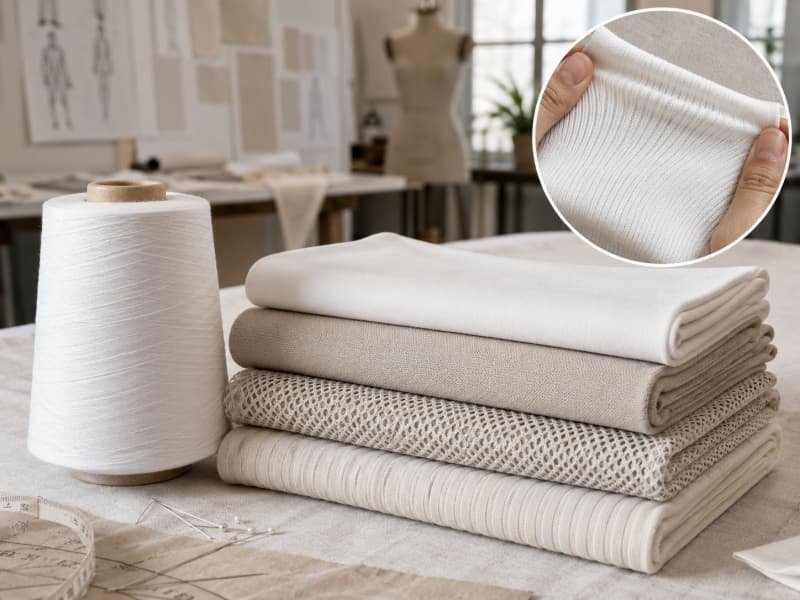
A dress can look polished on a hanger and still fail the moment someone sits, walks, raises an arm, or wears it for several hours. In fitted fashion, the real issue is rarely whether a fabric stretches at all. The important question is how that stretch works with recovery, opacity, pattern reduction, lining, seams, garment weight, and the pressure placed on the body. That is why two fabrics carrying the same 95% polyester and 5% Spandex label can produce completely different dresses.
Spandex is a synthetic elastic fiber added to textiles to improve stretch, recovery, close fit, and freedom of movement. It is usually blended with cotton, polyester, nylon, rayon, viscose, or other fibers rather than used alone. The final fabric’s drape, comfort, opacity, support, and durability depend on the complete blend, construction, finishing, and garment design.
In real product development, composition is only the beginning. A fabric may stretch beautifully in the hand yet grow at the seat, turn sheer across the hips, ripple along a zipper, or lengthen after a short fitting. One development team can approve a smooth sample, change to a supposedly equivalent bulk fabric, and discover that the waist now feels looser while the hem hangs lower. The label has not changed, but the product has. Understanding Spandex fabric means learning to read the behavior behind the percentage, not simply the percentage itself.
What Is Spandex Fabric?
Spandex is an elastic synthetic fiber rather than a complete fabric type. Mills combine it with other fibers and build the blend into jersey, rib, mesh, interlock, double knit, lace, denim, or stretch-woven textiles. The finished material is defined by its base fiber, construction, weight, finishing, stretch direction, recovery, and intended garment use.
Fiber or Fabric?
Technically, Spandex is a manufactured fiber. The phrase “Spandex fabric” is everyday shorthand for a knitted or woven textile that contains Spandex yarn. This distinction sounds minor until a product team has to select a material. A label reading 95% polyester and 5% Spandex gives the fiber composition, but it does not reveal whether the material is lightweight single jersey, dense interlock, stretch mesh, rib, ponte-like double knit, or a woven fabric with limited comfort stretch.
Construction changes almost everything a designer and manufacturer care about. A lightweight jersey may feel fluid and extend easily, while a compact double knit with the same composition may feel firm, supportive, and more opaque. One may suit ruching or a draped midi dress; the other may perform better in a body-contouring mini. A practical fabric specification therefore includes composition, weight in grams per square meter, usable width, construction, stretch in both directions, recovery, finish, color, shrinkage, opacity, and the intended silhouette.
What Is It Made From?
Spandex belongs to a family of synthetic elastic fibers commonly based on segmented polyurethane chemistry. Its molecular structure combines flexible sections that extend under force with stronger sections that help the fiber return toward its original length. That internal balance gives Spandex much greater elastic movement than ordinary cotton, polyester, nylon, or viscose fibers can provide by themselves, although the final textile will never behave exactly like the raw elastic filament.
The elastic yarn is normally introduced alongside a primary yarn. In circular knitting, it may be plated behind cotton, polyester, nylon, or viscose so the wearer mainly sees and touches the face yarn while the elastic component works inside the structure. Once tension is released, the Spandex contracts and draws the fabric together. This influences width, density, weight, recovery, surface smoothness, and even color appearance. Yarn tension, heat setting, dyeing, finishing, and fabric relaxation can therefore change the result even when the nominal composition remains unchanged.
Spandex, Elastane, and Lycra
Spandex and elastane are generic names for the same broad class of elastic synthetic fiber. “Spandex” is widely used in the United States, while “elastane” is common in Europe and in international fiber-content documentation. LYCRA® is different because it is a trademarked fiber brand. A fabric may contain elastane without containing branded LYCRA® fiber, so technical specifications and marketing claims should not use the trademark unless the branded yarn is actually specified and traceable.
The phrase “stretch fabric” is broader than any of these terms. Knitted loops naturally create movement, while textured yarns, special weave structures, and mechanical finishes can give a textile stretch even without a meaningful amount of Spandex. The reverse is also true: a textile containing Spandex may still offer limited usable extension if its structure is tight or the elastic yarn is restrained. Terminology helps identify the material family, but measured performance is what determines whether a fabric is suitable for a dress.
| Term | Technical Meaning | Common Apparel Use | Important Limitation |
| Spandex | Generic elastic synthetic fiber | Common on US labels and specifications | Does not describe fabric construction or stretch level |
| Elastane | Generic name for the same fiber class | Common in Europe and global sourcing | Not a separate fiber from Spandex |
| LYCRA® | Trademarked elastane fiber brand | Used when the branded fiber is specified | Should not be used as a generic claim |
| Stretch fabric | Any textile with useful extension | Knits, stretch wovens, mesh, lace, denim | May gain stretch from structure rather than Spandex |
| Mechanical stretch | Movement created by yarn, weave, knit, or finishing | Comfort-stretch and lightweight fashion fabrics | Recovery may differ from true elastic-fiber blends |
How Is It Made?
Commercial Spandex production begins with controlled polymer formation. The material is prepared as a spinning solution, pushed through very fine openings, converted into filaments, combined to reach the required yarn size, treated, wound, and prepared for knitting or weaving. The exact chemistry and process settings vary by producer and product grade, but the apparel user rarely buys the raw fiber directly. Mills select an elastic yarn and integrate it into a specific textile construction designed for a target weight, stretch range, surface, and price.
The mill stage is where much of the future garment behavior is established. Spandex feeding tension affects how tightly the fabric contracts. Heat setting influences width stability and recovery. Dyeing temperatures and finishing can alter power and hand feel. If the fabric is delivered under tension and cut before it has relaxed, garment panels may contract or grow after sewing. For this reason, experienced product teams request a production-quality swatch, condition the material, and approve the actual fabric performance rather than relying only on a composition certificate or a small hand sample.
Which Properties Define Spandex?
Spandex is defined by high extensibility and elastic recovery, but good garment performance also requires controlled growth, suitable compression, stable dimensions, adequate opacity, compatible seam extension, and resistance to repeated wear and care. A fabric that stretches farther is not automatically better; the useful material is the one that returns reliably and supports the intended silhouette.
Stretch and Recovery
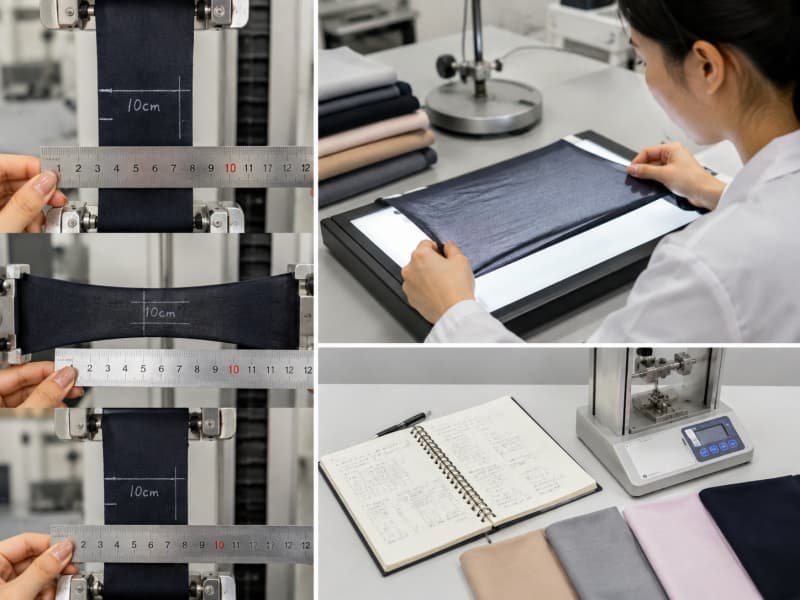
Stretch describes how far a fabric extends from its relaxed length, while recovery describes how effectively it returns after the force is removed. The two properties must be recorded separately. A common development calculation is: stretch percentage equals extended length minus original length, divided by original length, multiplied by 100. If a marked 10-centimeter section reaches 15 centimeters under a defined method, the measured stretch is 50%. The result is only comparable when force, direction, sample size, conditioning, and holding time remain consistent.
Recovery can be judged by measuring the sample after release and relaxation. If the original 10-centimeter section settles at 10.3 centimeters, the residual growth is 3% under that test condition. A lower figure is often preferred for fitted garments, yet there is no universal acceptable limit for every style. A fluid maxi dress may tolerate more vertical movement than a short bodycon dress. The important comparison is between the fabric’s tested behavior, the approved pattern reduction, the wearing period, and the brand’s fit and care requirements.
Compression and Comfort
Compression is the pressure created when the garment is smaller than the body area it covers. It depends on fabric power, density, yarn type, stretch direction, pattern reduction, seam placement, and garment size, not simply on the Spandex percentage. Two fabrics containing 8% Spandex can feel completely different: a dense double knit may strongly resist extension, while a lightweight jersey may stretch easily and provide limited support. The first may sculpt the silhouette; the second may offer movement with a softer feel.
Controlled pressure can improve contour and help a dress remain close to the waist and hips, but excessive pressure creates real product risks. The wearer may feel restricted around the rib cage, edges may roll, horizontal drag lines may appear, ruching may flatten, and seams may move away from their intended positions. Comfort also depends on wearing time. A strongly fitted party dress may be acceptable for a short event but unsuitable for all-day use. Fittings should include sitting, walking, breathing, dressing, undressing, and repeated movement rather than a quick front-view inspection.
Breathability and Moisture
Spandex itself is not selected for moisture absorption or natural breathability. The finished garment’s comfort is shaped mainly by the base fiber, yarn size, fabric construction, weight, surface finish, lining, coverage, and fit. An open nylon-Spandex mesh can allow considerable airflow because of its structure, while a dense polyester-Spandex double knit may feel warm even at a similar fiber ratio. Cotton-Spandex can absorb more moisture, yet it may dry more slowly than a lightweight synthetic blend.
A close-fitting garment also reduces the air space between fabric and skin, so a light textile can still feel warm when stretched tightly over the body. Designers should consider climate, season, wearing duration, lining layers, sleeve coverage, and the position of open panels. For warm-weather occasionwear, a breathable shell can be undermined by a heavy non-breathable lining. For pale or sheer dresses, adding coverage may improve confidence but increase heat. Comfort is therefore a garment-system decision, not a single-fiber claim.
Advantages and Limitations
When correctly specified, Spandex improves freedom of movement, helps close-fitting garments recover after wear, reduces strain at fitted points, and supports cleaner contours around the bust, waist, hips, elbows, and knees. It can make pull-on designs practical and allow a dress to follow the body without relying entirely on zippers or generous ease. Strong recovery can also reduce the loose seat, stretched neckline, and bagged knee appearance that often develops in non-elastic materials.
The limitations are equally important. Excessive heat can damage elastic performance, and repeated exposure to chlorine, harsh chemicals, body oils, or high-temperature drying may accelerate deterioration. Overstretched fabric can become shiny, reveal the lining, distort prints, or show seam allowances. Blended textiles are also difficult to recycle because the components are not easily separated. The best material is therefore not the one with maximum stretch. It is the one that maintains the approved fit, surface, color, opacity, and recovery through realistic wear and care.
| Property | Simple Measurement | Garment Meaning | Typical Risk When Uncontrolled |
| Widthwise stretch | Extension across fabric width | Movement around bust, waist, and hips | Restriction, transparency, or distorted seams |
| Lengthwise stretch | Extension along fabric length | Mobility, shoulder reach, and vertical comfort | Hem drop, sleeve growth, or garment lengthening |
| Recovery | Return after extension and relaxation | Shape retention after sitting and movement | Bagging, neckline gaping, or loose waist |
| Residual growth | Permanent extension after a test cycle | Long-term dimensional stability | Seat, knee, and elbow deformation |
| Fabric power | Resistance felt during controlled extension | Compression, contour, and support | Discomfort, rolling edges, and drag lines |
| Opacity under stretch | Coverage at intended wearing extension | Confidence across bust, hip, and seat | Sheerness, shine, and visible lining or seams |
| Seam extension | How far the sewn seam extends without failure | Movement without popped stitches | Thread breakage and restricted dressing |
How Do Spandex Blends Work?
Spandex blends work by combining an elastic component with a primary fiber that supplies most of the fabric’s surface, drape, moisture behavior, strength, and appearance. The percentage alone does not predict stretch or quality. Yarn selection, knit or weave construction, weight, finishing, and elastic-yarn tension determine how the finished material feels and performs.

Why Fibers Are Blended
A dress fabric needs several qualities at once. It may need softness, drape, color depth, strength, opacity, print clarity, shape retention, and movement. Spandex contributes elasticity, but it cannot create all of those properties by itself. Blending allows a mill to use a relatively small elastic component to change the behavior of a larger textile structure while the base fiber continues to control much of the surface and wearing character.
Cotton-Spandex can retain a familiar matte hand while recovering better than ordinary cotton jersey. Polyester-Spandex offers a wide range of weights, finishes, and print options. Nylon-Spandex often feels smooth and works well in refined mesh or close-fitting panels. Rayon- or viscose-Spandex can combine fluid drape with enough elasticity for ruching and fitted shapes, although growth and shrinkage need close control. A good sourcing brief describes the desired result – soft or firm, matte or lustrous, fluid or structured, lightly fitted or compressive – rather than asking for composition alone.
Common Blend Types
Common blends each have recognizable tendencies, but those tendencies are not fixed rules. Cotton-Spandex often feels soft and familiar, yet shrinkage and surface growth may need attention. Polyester-Spandex can be lightweight and drapey or dense and supportive, depending on construction. Nylon-Spandex is often smooth, strong, and suitable for mesh, but snagging and heat sensitivity remain relevant. Viscose-Spandex can create an attractive fall, although spirality, wet handling, and vertical growth must be assessed in long or heavily ruched dresses.
The same 95/5 composition can describe a 150 gsm single jersey, a 220 gsm interlock, a 300 gsm double knit, or a sheer mesh. Each material will require different pattern reduction, seam choice, lining, pressing, and end use. Fabric weight also changes with color and finishing, so a single approved hand swatch is not enough for a multi-color program. Dark colors may appear more opaque, while pale colors reveal stretch and seam details more clearly. Development should use the planned color, construction, and production-quality fabric whenever possible.
| Blend or Construction | Typical Character | Useful Dress Applications | Development Watchpoints |
| Cotton-Spandex | Soft, matte, familiar hand | Casual rib dresses, fitted daywear, knit sets | Shrinkage, fading, width growth, surface recovery |
| Polyester-Spandex | Versatile, printable, broad weight range | Bodycon, printed dresses, party styles, fashion sets | Pilling, shine, heat response, breathability |
| Nylon-Spandex | Smooth, strong, refined stretch | Stretch mesh, sleek fitted panels, supportive layers | Snagging, dye variation, heat sensitivity |
| Rayon/Viscose-Spandex | Soft, fluid, drapey | Ruched dresses, jersey midis, soft maxi dresses | Shrinkage, spirality, wet growth, length change |
| Rib-Spandex | Textured, body conforming | Knit minis, midis, tops, coordinated sets | Width expansion, torque, recovery after wear |
| Dense Double Knit | Firm, stable, supportive | Structured fitted and body-contouring dresses | Bulk, seam impression, excessive compression |
| Stretch Mesh | Flexible, sheer or semi-sheer | Sleeves, overlays, cutouts, lining and shaping panels | Seam strength, edge recovery, transparency |
| Stretch Woven | Tailored appearance with controlled movement | Fitted day dresses, tailored silhouettes, panels | Limited recovery, fraying, directional stretch |
Spandex Percentage
Spandex percentage describes fiber weight, not usable stretch. A knit containing 3% Spandex may extend farther than a woven containing 8% because the loop structure already moves. In broad fashion use, around 1-3% often adds comfort to stretch wovens, 3-6% is common in many jerseys and ribs, and 6-10% may provide closer fit or stronger recovery. Higher levels appear in power mesh, compression materials, swimwear, and specialist constructions. These ranges are observations, not universal performance standards.
Higher content can improve recovery and power, but it can also increase pressure, sewing difficulty, heat sensitivity, and cost. A pale fitted fabric may become transparent at 30% or 40% extension even if it looks opaque while relaxed. The useful question is therefore not which percentage sounds premium. It is whether the tested fabric provides the intended fit at the extension it will experience on the body. Suppliers should provide measured stretch in each direction, and the garment should be fitted in the actual production-quality material.
Stretch Direction
Two-way stretch usually means the fabric has meaningful movement along one axis, most often across the width. Four-way stretch generally means useful extension both across and along the fabric. These trade terms are not always used consistently. A supplier may call a fabric four-way stretch when the lengthwise movement is slight, so measured values are more dependable than a category name. The strongest direction is usually placed around the body in fitted dresses because that is where the greatest circumference change occurs.
Lengthwise stretch can improve shoulder reach, sleeve movement, pull-on access, and comfort in close-fitting garments, but it can also create vertical growth. Long skirts, heavy ruching, embellishment, and lining add weight that may lower the hem over time. Pattern orientation must therefore remain controlled during cutting. Rotating pieces to improve marker efficiency can change fit, print direction, rib appearance, recovery, and garment length. Shell, lining, mesh, elastic, and support panels should also be checked together because mismatched stretch directions can restrict movement or pull the dress out of balance.
Which Dresses Use Spandex Best?
Spandex is especially useful in dresses that need close fit, movement, stable openings, controlled drape, or shape recovery. Bodycon, jersey, rib, stretch-mesh, ruched, fitted occasion, and bandage-inspired styles often benefit from it. The correct choice still depends on fabric power, opacity, lining, pattern reduction, support details, wearing duration, and the intended silhouette.

Suitable Dress Styles
Bodycon dresses are an obvious application because the material must move over the bust, waist, hips, and seat while returning after wear. Jersey dresses also benefit from elasticity, particularly when the design is pull-on, closely fitted, ruched, or gathered. Stretch mesh can support sleeves, overlays, cutouts, and close-fitting lining panels. Rib fabrics are often used for casual minis and midis, while compact double knits can create cleaner structure in fitted party or occasion dresses.
Not every fitted dress needs a high-Spandex textile. A tailored woven dress may use only limited comfort stretch while darts, panels, zippers, cups, boning, or internal construction provide the shape. A satin-look dress may use a stretch backing or elastic lining instead of a highly elastic face. Before choosing the material, the team should define what the stretch is expected to do: allow entry, improve comfort, contour the body, support a neckline, stabilize a cutout, reduce bagging, or combine several of these functions.
Fit by Body Zone
Stretch fabric distributes tension across the body, and that tension changes from one zone to another. The bust requires enough extension for projection and movement without flattening the shape, opening the neckline, or turning the shell sheer. The waist needs recovery after sitting. The hip and seat need movement without side-seam migration, print distortion, or visible seam allowances. Armholes and necklines need stable edges, while hems must remain balanced after the garment has been worn and allowed to relax.
A static fitting can miss many of these problems. The wearer should sit for a defined period, walk, take longer steps, raise and rotate the arms, bend, and put the dress on and off several times. Front, side, back, and movement photographs provide a clearer record than a general comment such as “fit looks good.” Measurement checks before and after wear reveal growth that may not be obvious to the eye. Pale shades and high-stretch areas should also be viewed under bright and natural light to assess coverage.
Drape and Support
Drape describes how fabric falls, while support describes how it resists movement and holds shape. These qualities often pull in opposite directions. A soft viscose-Spandex jersey may hang beautifully but continue lengthening under the weight of a maxi skirt. A compact polyester-Spandex double knit may support the waist and hips but feel too rigid for a fluid design. Stretch mesh may follow the body cleanly yet require reinforcement at necklines, cutouts, zippers, or attachment points.
The right balance depends on the visual purpose of the dress. Soft ruching usually needs fluidity with enough recovery to keep gathers in place. Body contouring needs stronger power and adequate opacity. Sculpted silhouettes need density and support, while long skirts need controlled vertical growth. Pale colors generally need better coverage than dark colors, and printed fabrics need enough stability to prevent motif distortion. Lining should move with the shell; a rigid lining inside an elastic dress can restrict the wearer and force the outer layer into unwanted folds.
Pattern and Negative Ease
Stretch patterns are not ordinary woven patterns cut one size smaller. They are developed around the measured behavior of the chosen fabric. Negative ease means that the garment measurement is smaller than the corresponding body measurement. If a garment circumference is 84 centimeters for a 90-centimeter body area, the reduction is approximately 6.7%. That figure is only an example, because the correct reduction changes by body zone, fabric power, stretch direction, lining, support structure, and the desired silhouette.
The bust may need a different reduction from the waist, and the skirt may need less compression than the bodice. The pattern must also account for fabric relaxation before cutting, grain direction, seam allowance, stitch extensibility, edge stabilization, print or rib alignment, and size grading. A replacement fabric should trigger a fit review even when the composition label is unchanged. It may require new pattern reduction, differential-feed settings, lining, reinforcement, or grading. Approving the shape in the planned bulk-quality fabric is one of the most reliable ways to prevent fit changes during production.
| Dress Direction | Main Job of Stretch | Material Priorities | Frequent Development Risk |
| Bodycon mini or midi | Contour, movement, and recovery | Strong recovery, suitable power, opacity | Overcompression, ride-up, shine, or sheerness |
| Ruched jersey dress | Movement and controlled gathering | Fluid drape, moderate power, length stability | Uneven ruching, twisting, and vertical growth |
| Stretch-mesh dress | Flexible overlay and close fit | Edge recovery, seam strength, consistent transparency | Seam failure, gaping, and excessive sheerness |
| Fitted occasion dress | Comfort within a polished silhouette | Shell-lining compatibility, support, stable fit | Shell and lining moving at different rates |
| Halter or backless style | Stable contact at necklines and edges | Recovery, reinforcement, comfortable pressure | Neck pressure, edge gaping, and slippage |
| Rib-knit dress | Body conforming comfort | Width recovery, surface stability, soft hand | Bagging, torque, and width growth |
| Long jersey maxi | Movement and fluid fit | Controlled lengthwise stretch and low growth | Hem drop, shoulder stretch, and skirt lengthening |
| Stretch-woven fitted dress | Comfort without a knitted appearance | Controlled extension, recovery, tailored surface | Restricted movement or permanent growth |
How Do You Evaluate Spandex Fabric?
Evaluate Spandex fabric as a complete garment material, not by hand stretching alone. Review composition, weight, width, stretch, recovery, growth, dimensional change, pilling, colorfastness, strength, opacity, seam extension, fit, wash performance, and lot consistency. The approved sample should use production-representative materials and construction so its performance can be repeated in bulk.

Tests Before Production
A useful test plan begins with the garment’s risk profile. A black rib day dress may need strong dimensional and recovery control. A pale bodycon party dress needs careful opacity assessment. A printed mesh style may require attention to colorfastness, snagging, seam strength, print distortion, and edge recovery. Fiber composition, fabric weight, usable width, stretch in both directions, recovery, growth, shrinkage, pilling, strength, colorfastness, and seam extension are common checkpoints, but the final list should reflect the destination market and customer specification.
Testing should use representative production material because development swatches and bulk rolls can differ through yarn lot, dyeing, finishing, heat setting, width control, and relaxation. Multi-color programs also need shade-specific checks. White, cream, and pastel colors often reveal transparency and seam details more readily than black. A fabric may pass a general stretch test but fail once it is sewn with a zipper, lining, cup, boning, elastic, or trim. Laboratory results are therefore essential evidence, but they must be connected to the actual garment construction.
Garment Performance Checks
A repeatable fitting routine gives more useful information than a quick mirror check. The sample should be measured before wear, then assessed while standing, sitting, walking, taking longer steps, raising the arms, bending, and dressing or undressing several times. The team should inspect seam position, neckline contact, armhole stability, bust coverage, waist pressure, hip opacity, hem balance, ride-up, surface shine, lining movement, and residual growth. The garment can then be allowed to relax before a second measurement comparison.
Production controls must preserve the approved conditions. Fabric relaxation, marker direction, cutting accuracy, bundling, stitch type, thread choice, differential feed, presser-foot pressure, seam tension, pressing temperature, and final measurement handling can all change a stretch garment. A sample-room operator may achieve a clean seam through careful hand control, while a bulk line needs a repeatable machine setting and method. The pre-production sample should therefore represent the intended production construction rather than an idealized technique that cannot be maintained across thousands of pieces.
Common Failure Causes
Many apparent Spandex failures are actually system failures. Bagging can come from weak recovery, excessive pattern reduction, incorrect fabric direction, insufficient relaxation, or a mismatch between shell and lining. Wavy seams may result from stretched feeding, unsuitable differential feed, excessive presser-foot pressure, incorrect thread tension, or a stitch that does not extend with the fabric. Transparency can come from low weight, pale color, insufficient coverage, or a pattern that extends the textile beyond its intended working range.
Other warning signs include side seams moving forward, popped stitches during dressing, skipped stitches in dense elastic fabrics, uneven ruching after washing, vertical growth in long dresses, heat marks from pressing, and color transfer under rubbing or perspiration. Root-cause analysis should compare fabric lot, cutting direction, relaxation time, sewing settings, pattern measurements, lining behavior, and care conditions. Replacing a stronger needle or tighter thread does not solve a pattern that overstretches the material, just as changing the pattern does not solve an unstable bulk fabric lot.
Care and Sustainability
Care instructions should be based on the complete garment and verified through testing. Moderate wash temperatures, gentle mechanical action, mild detergent, controlled drying, and limited exposure to chlorine or extreme heat often help preserve elasticity, but the correct label depends on the shell, lining, trims, print, embellishment, color, and construction. A dress may contain heat-sensitive elastic fiber while also using cups, boning, adhesive, sequins, or coatings that create additional care limits. Generic advice should never replace garment-specific validation.
Conventional Spandex is generally petrochemical-based, and even a small elastic percentage can make blended-textile recycling more difficult. Recycled-content, lower-impact, or alternative elastic-fiber claims should be supported by supplier documentation and the relevant chain of custody rather than broad marketing language. Durability remains a practical part of sustainability: a dress that retains its fit and surface through repeated wear has more value than one that quickly bags or loses recovery. Material efficiency, accurate sampling, stable bulk quality, and fewer rejected garments also reduce avoidable waste.
For custom fashion dresses, the commercial decision is not simply whether a fabric contains Spandex. The real question is whether the selected material can produce the intended silhouette, fit the target size range, remain comfortable during realistic movement, survive the expected care cycle, and deliver the same result when the project moves from sample development into repeatable production. That requires fabric data, pattern judgment, fitting evidence, construction control, and a clear record of what was approved.
Duolan Apparel develops fashion dresses, party dresses, occasion dresses, body-conscious and fitted styles, mesh dresses, jersey dresses, fashion sets, and related women’s fashion products. A productive inquiry can include a tech pack, reference image, original sample, intended fabric hand, stretch direction, target fit, size range, lining and support requirements, destination market, launch schedule, and expected order volume. The development team can then review fabric behavior, identify fit and production risks, prepare the sample, and align the approved construction with scalable manufacturing.