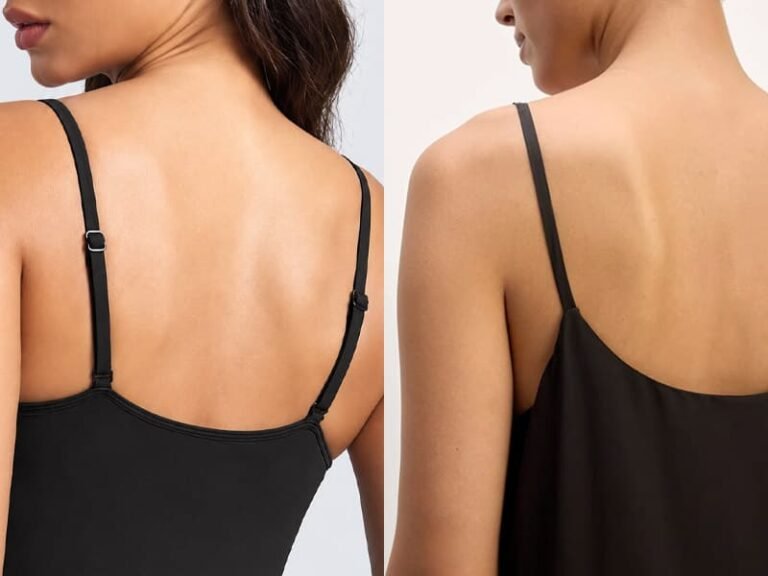
A shoulder strap looks like one of the simplest parts of a dress, yet it can quietly change the whole upper body. Move its attachment point, alter its finished length, or change the way it slides through hardware, and the neckline can rise or fall, the armhole can open or tighten, the bust can sit higher or lower, and the back can shift. That is why a dress may look perfectly balanced on a hanger but feel completely different on two people who technically wear the same size.
Adjustable straps are usually better when a dress needs flexibility across different torso lengths, bust positions, or neckline preferences. Fixed straps are often better when the design depends on a clean, uninterrupted line, precise proportions, or hidden hardware. Neither option is automatically superior: the best choice depends on the silhouette, fabric, support structure, size range, fit block, sampling accuracy, and how consistently the dress must be reproduced in production.
The interesting part appears during fitting. A fixed strap that looked beautifully minimal on a sketch may make a shorter wearer feel exposed, while an adjustable strap chosen as the “safe” option may introduce bulky sliders that weaken an otherwise refined satin dress. The real decision is therefore not which strap is more fashionable. It is which construction solves the fit problem the dress actually has without creating a new problem in appearance, comfort, grading, sourcing, or bulk consistency.
What Is the Difference Between Adjustable and Fixed Straps?
Adjustable straps let the wearer change the effective shoulder-to-bodice length, giving a dress more tolerance for different torso lengths and bust positions. Fixed straps are sewn at a predetermined length and rely more heavily on accurate pattern development and grading. Adjustable straps provide fit flexibility, while fixed straps provide cleaner visual control and remove moving hardware from the design overall.
How Do Adjustable Straps Work?
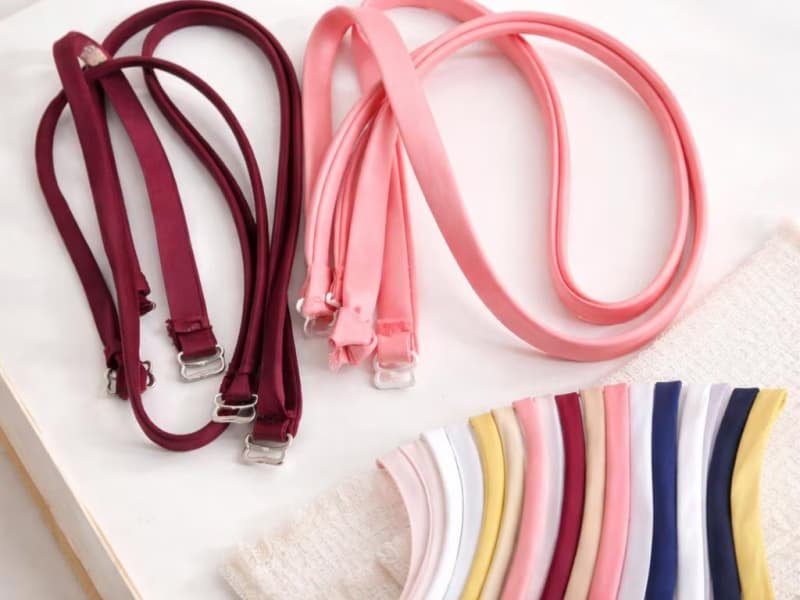
An adjustable dress strap normally uses a slider together with a ring, loop, or similar connection point. Part of the strap passes back through the slider so the wearer can shorten or lengthen the distance between the shoulder and the bodice. On a well-developed dress, that adjustment changes the vertical position of the upper bodice without making the strap twist, the slider creep, or the underarm area distort. The mechanism is simple, but its performance depends on the strap fabric, thickness, width, hardware size, attachment angle, and the weight of the dress below it.
For narrow fashion straps, finished widths of roughly 6-12 mm are common development starting points, although there is no universal width that suits every dress. A delicate charmeuse slip may need something finer, while a heavier satin or structured fitted dress may benefit from a wider strap. The useful adjustment range matters just as much as the slider itself. A strap that moves only 15-20 mm is technically adjustable but offers limited fit flexibility, while a functional range around 50-90 mm can accommodate noticeably different upper-body proportions in many slip, vacation, party, and fitted styles. These figures are practical starting ranges, not mandatory industry tolerances.
The hardware also has to match the strap rather than simply looking attractive on a trim card. If the ring or slider opening is much wider than the finished strap, the strap can shift sideways, rotate, and bunch. If the opening is too narrow, adjustment becomes stiff and the fabric can abrade at the edges. Smooth satin creates an additional issue because it can slowly travel through poorly matched hardware during movement. The safest approval process therefore checks the real strap and real hardware together, not only their nominal measurements on a specification sheet.
Adjustability should finally be treated as fit tolerance, not as a repair tool for a weak bodice pattern. A wearer may be able to raise a low neckline by shortening the straps, but if the bust is too shallow, the neckline is too wide, or the armhole has been cut incorrectly, the garment still has a pattern problem. A slider can move the bodice vertically; it cannot create missing bust volume, change shoulder slope, or correct an unstable back neckline.
How Do Fixed Straps Work?
Fixed straps are sewn into their final front and back positions during production, so the wearer cannot change the shoulder-to-bodice distance after purchase. That makes strap length, front attachment, back attachment, strap angle, neckline position, bust height, and upper-bodice length part of one connected fit system. A fixed strap is simpler in component count, but it demands greater confidence in the approved fit because there is no adjustment range available to absorb variation once the garment leaves the factory.
The visual effect can be excellent when the pattern is right. Wide satin straps, twisted straps, embellished shoulders, contrast straps, decorative loops, and clean architectural necklines often look more intentional without a visible slider or a doubled-back strap section. This is especially relevant in occasionwear, corset-inspired dresses, minimal evening styles, and premium-looking satin designs where even a small hardware component can interrupt the line. Fixed straps also remove the risk of a slider gradually changing position during wear and reduce trim continuity concerns on repeat orders.
The compromise is fit tolerance. A fixed strap that is 20 mm too long on a short upper torso can lower the neckline, open the armhole, and shift the back. A strap that is too short can pull into the shoulder, lift the neckline, and create tension around the underarm. Those changes are particularly obvious in low necklines and narrow-strap dresses because the upper bodice has fewer elements available to hide or redistribute the error. Fixed straps are therefore most successful when the brand has a reliable block, strong vertical measurements, deliberate grading, and fit data from styles with similar necklines and support levels.
Which Trade-Offs Matter Most?
The useful comparison is not simply “adjustable is more comfortable” and “fixed looks cleaner.” A product team should compare the type of risk created by each construction. Adjustable straps add hardware, movement, sourcing, and functional inspection points, while fixed straps concentrate more risk in pattern accuracy and finished length. Both constructions still depend on a balanced bodice, because neither can compensate for incorrect bust volume, armhole shape, neckline width, or shoulder placement.
| Development factor | Adjustable straps | Fixed straps | Practical effect |
| Wearer length adjustment | Commonly about 50-90 mm in functional fine-strap development | None | Adjustable straps tolerate more vertical body variation |
| Typical fine-strap width | Often about 6-12 mm | Can be narrow, wide, or decorative | Hardware matching matters more on narrow adjustable straps |
| Moving hardware | Usually present | None | Adjustable styles add sourcing and functional QC points |
| Vertical fit tolerance | Higher | Lower | Fixed styles need stronger fit validation before production |
| Clean uninterrupted look | Moderate to high, depending on hardware | High | Fixed straps often suit minimal or decorative designs |
| Risk of strap creep | Possible | None | Smooth fabrics need slider testing |
| Repeat-order trim dependency | Higher | Lower | Adjustable hardware should be locked for continuity |
| Pattern accuracy required | High | Very high | Both rely on a correctly balanced bodice |
The best choice becomes clearer when the team asks what the strap is supposed to solve. A fluid satin slip sold to customers with varied torso proportions may benefit from real adjustment. A structured occasion dress developed from a mature brand block may be more convincing with fixed straps because the bodice already controls the correct position. Choosing a fixed strap only to save a small trim cost, or choosing an adjustable strap simply because it feels safer, usually avoids the real question: how much fit tolerance does this silhouette actually need?
Which Strap Type Fits More Body Shapes?
Adjustable straps generally accommodate a wider range of upper-body proportions because the wearer can change the distance between the shoulder and bodice. This helps with differences in torso length, bust height, and bust projection. Fixed straps can fit a broad size range well, but they require more deliberate grading and stronger fit validation because every wearer receives the same predetermined strap relationship within each size.
How Do Torso Length and Shoulder Slope Affect Fit?
Two customers can have very similar bust, waist, and hip measurements while needing noticeably different shoulder-strap lengths. Most commercial size charts describe circumference more clearly than vertical body proportion, yet vertical differences become highly visible in strappy dresses. A shorter upper torso can make the neckline sit lower and the armhole appear more open, while a longer upper torso can make the same strap feel restrictive and pull the whole bodice upward. The customer may blame the strap, but the actual issue is the relationship between her body length and the vertical balance built into the pattern.
Shoulder slope adds another variable. A wearer with more sloped shoulders may experience outward strap movement even when the finished length is technically correct. A wearer with squarer shoulders may need slightly more effective length because the strap travels over a different shoulder profile. Moving the attachment point inward can sometimes improve stability, but it also changes the neckline visually, so it should not be treated as an isolated alteration. The strap length, shoulder angle, front neckline, back neckline, and armhole all need to be reviewed together.
During development, it is helpful to compare more than the strap measurement itself. Shoulder point to bust apex, shoulder point to front neckline, and shoulder point to back neckline give a clearer picture of the vertical relationship the dress is trying to create. Differences of roughly 20-30 mm in upper-torso proportion can be visually meaningful on low-cut slip or party dresses, even when the wearers share the same nominal size. Adjustable straps can absorb part of that variation, but they still need stable attachment points and a well-shaped bodice to work properly.
How Does Bust Volume Change Strap Length?
Bust volume changes the three-dimensional path the fabric takes over the body. A fuller bust can require more front length and more shaped volume even when the underbust or waist measurement is similar to that of another customer. This is why a strap complaint sometimes starts in the bodice. If the bust area is too shallow, the wearer may lengthen an adjustable strap to gain space, but the neckline then drops. If she shortens the strap to regain coverage, the bust becomes compressed and the armhole can start pulling.
A good fitting therefore separates three questions: is the strap length correct, is the bust volume correct, and is the neckline sitting at the intended height? When all three are changed at once, it becomes difficult to know what actually solved the problem. In fitted dresses, corset-inspired bodices, and low necklines, the strap should position the garment rather than act as the main device forcing the bust into place. If the whole dress only looks correct when the strap is pulled unusually tight, the pattern or internal support system probably needs another review.
| Fit observation | Possible cause | Useful fitting check |
| Neckline low and armhole loose | Strap may be too long | Shorten temporarily by about 10-20 mm and reassess the whole bodice |
| Neckline low but bust feels compressed | Bust volume may be insufficient | Review bust shaping before shortening further |
| Strap slips outward | Attachment position or shoulder slope may contribute | Check front and back strap placement, not only length |
| Underarm gapes after shortening | Armhole or bust balance may be wrong | Reassess the pattern instead of continuing to shorten |
| Bodice rides upward on a fuller bust | Front length or bust projection may be insufficient | Check bust depth and vertical balance |
| Most fit models use the shortest slider position | Base strap is probably too long | Rebalance standard strap length |
| Most fit models use the longest slider position | Base strap may be too short | Increase starting length or review front balance |
The table is most useful as a diagnosis guide rather than a list of automatic corrections. Ten or twenty millimeters can be an informative fitting test, but it is not a universal alteration amount. The purpose of a controlled change is to reveal which part of the dress is causing the symptom. Once the cause is clear, the final correction should be made in the pattern, strap specification, attachment point, or bust construction rather than hidden by a last-minute strap adjustment.
Are Adjustable Straps Better for Petite or Fuller-Bust Fits?
Adjustable straps are often more forgiving for petite and fuller-bust customers because both groups can sit outside the vertical assumptions of a standard fit block. A petite wearer may have a shorter shoulder-to-bust distance even when her bust circumference places her in the same size as a taller customer. Shortening the strap can lift the neckline and bring the bust seam, dart, cup, or underbust line closer to its intended position without requiring an alteration before the dress can be worn.
A fuller-bust wearer may need additional effective strap length because the bodice travels over greater projection, but extra strap length only helps when the bodice contains enough volume. An adjustable strap cannot convert a standard bust block into a fuller-bust block, and relying on the slider to create space often lowers the neckline more than the design intended. For brands covering a broad size range, the safer approach is to develop the bust correctly first and then use adjustability as secondary tolerance rather than as a substitute for shaped fit.
The distribution of slider positions during fitting provides useful evidence. If nearly every wearer ends up at one extreme, the base strap length is not well centered. Ideally, the expected fit sits somewhere away from both ends so the customer still has usable room to adjust shorter or longer. That gives the adjustment feature a real purpose and reduces the chance that customers receive a dress that is technically adjustable but already “used up” before they put it on.
How Should Fit Be Graded?
Strap grading deserves its own rule rather than being treated as an automatic percentage increase from one size to the next. Circumference and vertical body growth do not increase at identical rates, and the correct grade depends on the neckline, bust construction, back shape, fabric, and size architecture. A satin slip dress, bodycon mini, and corset midi can therefore require different strap rules even when all three are produced in the same nominal size range.
Fixed straps are less forgiving because the wearer cannot correct the result later. The grade needs to preserve neckline height, bust position, armhole balance, and the intended shoulder relationship as the bodice grows. Adjustable straps create more room, but their minimum and maximum usable lengths still need to make sense in every size. Simply adding a very long adjustment range is not a substitute for checking whether the larger size has enough front length or whether the strap attachment is moving too far outward during grading.
A practical approval process reviews the base size and at least one larger graded size before the rule is locked. For a wider size range, checking an additional upper-end size is especially valuable because bust growth and upper-bodice proportions can behave differently from simple mathematical expectations. The aim is not to make every size look identical on every body; it is to preserve the design logic so the neckline, strap angle, bust position, and comfort remain recognizably consistent across the range.
How Do Straps Affect Neckline and Support?
Strap length affects neckline height, bust position, armhole balance, and how securely the upper bodice sits on the body. Shorter straps usually raise the neckline and bodice, while longer straps lower them. True support, however, should come from the whole garment – pattern shape, bust volume, waist anchoring, fabric, seams, cups, boning, elastic, or lining – rather than from shoulder tension alone.

How Does Strap Length Change Neckline Height?
On a simple camisole or slip dress, the strap behaves like a suspension point between the shoulder and the bodice. Shortening it lifts the upper body of the dress, while lengthening allows that section to drop. The effect is immediately visible at the neckline, but the underarm and back move too. A fit comment that focuses only on cleavage can therefore create a new problem somewhere else if the team does not watch the whole garment while the strap is being changed.
The relationship is not perfectly one-to-one because fabrics settle differently. A stable woven satin responds differently from a high-stretch jersey. A bias-cut dress can lengthen slightly under its own weight, while a heavy embellished bodice can place more downward force on the strap. Bust projection and back-neckline shape also influence the way a dress rotates around the body. A 20 mm strap change may therefore create a noticeable neckline movement without producing exactly 20 mm of vertical movement at every point of the bodice.
For adjustable dresses, a useful sample review photographs the shortest practical setting, the intended middle setting, and the longest practical setting. The goal is not for all three positions to look identical. It is to confirm that the adjustment remains wearable throughout the designed range and does not allow the wearer to pull the dress into obvious distortion. For fixed straps, the same reasoning can be tested by temporarily pinning or basting controlled changes. Small corrections around 10-15 mm can solve genuine strap-length errors; much larger corrections often indicate that the bodice balance deserves further investigation.
Do Adjustable Straps Reduce Slipping and Gaping?
Adjustable straps can reduce slipping and gaping when excessive strap length is actually the cause. If a strap is simply too long, shortening it improves shoulder contact and can lift the bodice enough to reduce a low neckline or open armhole. The difficulty is that several other problems create the same symptom. A strap can fall outward because the attachment is too close to the shoulder edge, the back neckline is too wide, the wearer has more sloped shoulders, or the slider gradually moves during wear.
The most useful fitting method changes one variable at a time. Shorten the strap by a controlled amount, such as 10-20 mm, and watch the neckline, armhole, shoulder security, and back simultaneously. If the strap becomes stable and the neckline improves without new tension, length was probably part of the issue. If the neckline becomes tight while the strap still drifts outward, shortening further is unlikely to be the right solution. Attachment position and shoulder geometry should be reviewed instead.
Gaping needs the same discipline. If shortening the strap closes an underarm gap but creates excessive pressure at the neckline, the armhole shape or bust volume may be the real problem. This is why useful sample comments describe both the measurement change and the intended result. “Shorten strap 15 mm to raise neckline while maintaining current armhole comfort” gives the pattern and sample teams a clear objective, while “strap too long” leaves too much room for interpretation and can encourage an overcorrection.
Are Fixed Straps More Stable in Structured Dresses?
Fixed straps can be more stable in a structured dress because there is no slider that can change position during movement. This is useful in corset-inspired dresses, bustier shapes, wide-strap occasion styles, embellished designs, and garments where the shoulder point is part of a carefully controlled line. Once the approved length and attachment positions are correct, the strap behaves as a predictable component rather than an adjustable one, which can help the dress maintain a consistent visual position during wear.
Stability should not be confused with support, however. A narrow 6-8 mm strap should not be expected to carry the structural responsibility of a heavy corset bodice. In better-engineered fitted dresses, the load is shared through bodice circumference, waist anchoring, panel seams, cup shaping, lining, boning where appropriate, neckline reinforcement, and sometimes elastic. The strap helps position the bodice, but it should not be the only reason the bust shape remains upright or the neckline stays in place.
A revealing development test is to reduce shoulder tension temporarily and observe what happens. If the bust collapses, the neckline folds, or the bodice drops dramatically as soon as the strap is loosened, the internal support system may be relying too heavily on the shoulders. When the structure itself is stable, fixed straps can be especially effective because they preserve a clean line without giving away much practical fit flexibility. Brands with reliable historical fit data and a mature structured-dress block are usually in the strongest position to use them confidently.
Which Dresses Suit Each Strap Type?
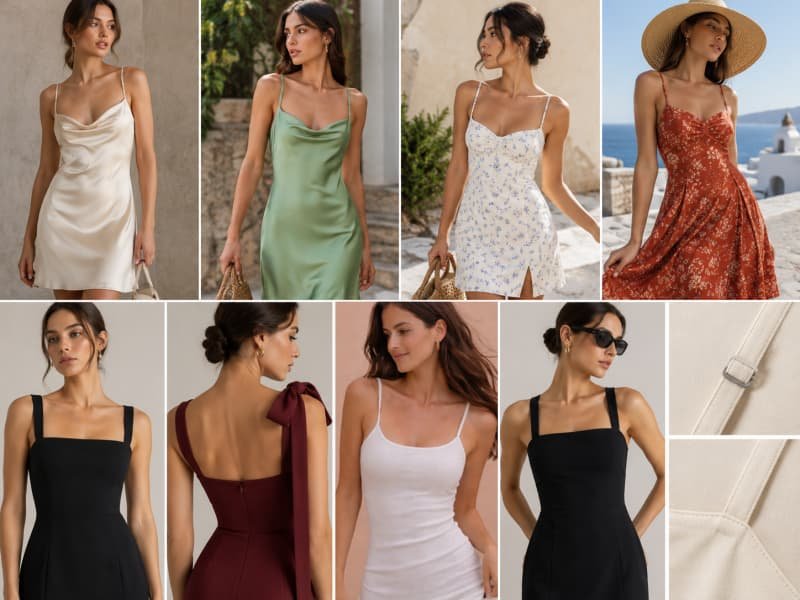
Adjustable straps are particularly useful for slip dresses, satin dresses, camisole silhouettes, vacation styles, and other designs where neckline flexibility helps accommodate different torso proportions. Fixed straps often suit structured dresses, wide straps, decorative shoulder details, and minimalist styles where visible hardware would interrupt the design. Fabric, neckline depth, support level, strap width, and customer fit profile should determine the choice.
Which Straps Work Best for Slip and Satin Dresses?
Slip and satin dresses are natural candidates for adjustable straps because the upper bodice is often lightly structured and a small change in vertical position can noticeably alter cleavage, armhole fit, and bust placement. Fine straps also suit the visual language of these dresses. When the hardware is small and well matched, the wearer gains useful control without substantially changing the silhouette, which is particularly helpful when the same style must accommodate different upper-torso lengths within a conventional size range.
The challenge is that satin makes small quality differences visible. Its surface reflects light, so oversized sliders, bright plating, rough edges, inconsistent metal color, or a bulky doubled strap section can stand out immediately. For fine satin straps, widths around 6-10 mm are common development starting points, but the width should follow the fabric and design rather than a fixed formula. The ring and slider should sit close to the finished strap width, and the sample should be moved repeatedly through the hardware to check whether the satin creeps or abrades.
Fixed straps can also look exceptional on satin, especially in bias-cut dresses or minimal evening silhouettes where the design depends on an uninterrupted line. In those cases the brand is trading user adjustment for visual purity, so the fit block needs to be more reliable. The neckline height, back depth, and strap attachment should be validated on more than one upper-body proportion before production, because a fixed satin strap offers little room for the customer to correct a low front or loose armhole after purchase.
Which Straps Suit Bodycon and Corset Dresses?
Bodycon dresses can benefit from adjustable straps when the main fabric has significant stretch and the neckline needs to remain secure across different torso lengths. Stretch does not remove the need for fit development, though. A fabric with poor recovery can relax during wear and allow the bodice to move downward, which in turn places more load on the shoulder straps. If the slider also creeps, the wearer may find that a neckline that looked correct when she dressed gradually becomes lower as the evening continues.
Corset and bustier dresses require even more deliberate engineering because the bodice may already contain cups, boning, panel seams, underbust shaping, lining, elastic, and internal stabilization. The strap should complement that structure rather than replace it. Adjustable straps are useful when fit tolerance is valuable and the hardware fits the design language, while fixed straps can be stronger when the shoulder detail is architectural, decorative, or visually continuous. The right answer depends on where the bodice actually gets its support and how much vertical adjustment the customer needs.
A useful warning sign is a dress that only looks correct when the straps are pulled unusually tight. In that situation the strap may be compensating for insufficient bust depth, weak waist anchoring, or a neckline that is not stable enough on its own. The better development approach is to correct the foundation and then decide how much work the strap should do. That usually leads to a dress that feels better on the shoulder, moves more naturally, and behaves more consistently across different bodies.
Are Fixed Straps Better for Minimal or Structured Styles?
Fixed straps are often a strong choice for minimal or structured designs because every visible component matters. A slider creates a visual break, adds a doubled-back section, and increases thickness at one point of the strap. On a highly refined dress, those details can be more noticeable than expected. Wide satin straps, twisted straps, asymmetric shoulder details, embellished straps, braided straps, ruched straps, and contrast constructions often look more intentional when the strap itself remains uninterrupted.
They are also appropriate when the bodice already has enough structure to control its position. A corset-inspired evening dress with stable cups, internal seams, lining, and waist support may not gain much from an adjustable shoulder strap if the approved block already performs well. In that case, a fixed strap can improve the visual result and reduce the number of moving components without significantly increasing fit risk, provided the length and grading have been validated carefully.
The key question is how well the brand knows its customer proportions. A mature label with years of fit feedback from similar necklines has more freedom to use fixed straps because its pattern decisions are based on evidence rather than assumptions. A new silhouette, a new size range, or a dramatically lower neckline creates more uncertainty. In those cases, an adjustable construction can provide useful tolerance until the brand has enough fit information to decide whether a cleaner fixed construction would be safe in future versions.
Which Strap Works for Low-Back Dresses?
Low-back dresses deserve separate attention because the back provides less fabric to stabilize the upper bodice. A strap that is too long or attached too widely can allow the front to drop, while a strap that pulls at the wrong angle can drag the neckline sideways. Cross-back and multi-way straps add further complexity because their effective length changes with the crossing angle and with how far the back attachment points sit from the center line.
Adjustable straps can help compensate for vertical differences, but very long strap paths create more opportunity for twisting and slider movement. Fixed straps can work beautifully when the low-back pattern is precise and the garment has another anchoring point, such as a fitted waist, underbust seam, internal elastic, or structured front. In either case, a static fitting is not enough because low-back designs often move more during walking, reaching, sitting, and turning than they appear to on a standing fit model.
The most revealing wear test asks the model to raise both arms, reach forward, sit, stand, walk several steps, and rotate the torso. The team should then check whether the neckline has moved, whether the strap has rotated, and whether the back has shifted. A low-back dress that photographs well but needs constant adjustment during normal movement is not fully resolved, even if every flat measurement is within tolerance.
How Do Strap Choices Affect Production?
Adjustable straps add hardware, assembly steps, sourcing requirements, and functional QC checks. Fixed straps reduce trim complexity but make finished length and attachment accuracy more critical. Adjustable designs carry hardware, slider, and trim-continuity risks; fixed designs carry greater fit-tolerance risk. Production should be planned around which type of risk can be controlled most consistently for the specific dress and target customer.
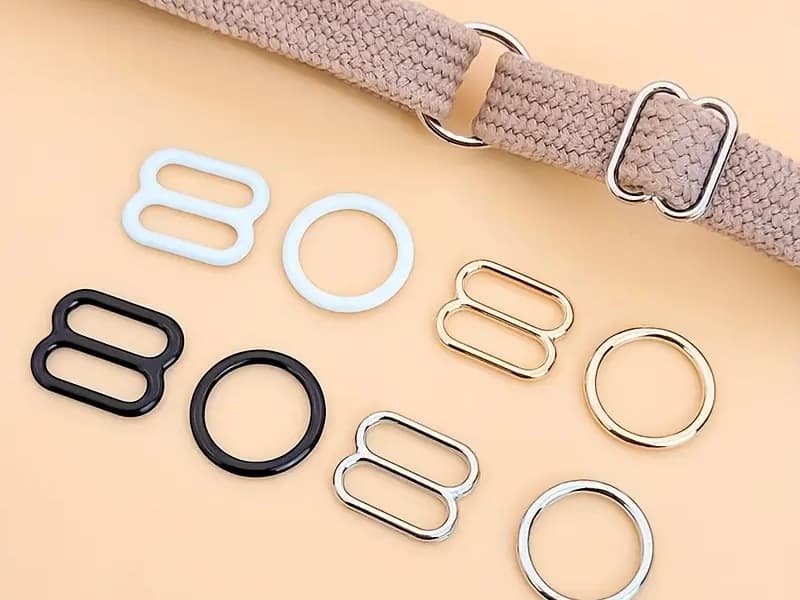
What Hardware Do Adjustable Straps Need?
Most adjustable fashion straps use a slider together with a ring, loop, or direct back connection. Each component needs a specification because small differences affect appearance and function. The development team should know the internal width, external dimensions, material, plating or coating, weight, edge finish, color, and how the piece behaves against the actual strap fabric. Hardware that looks refined in isolation can feel oversized once placed on an 8 mm satin strap, while a component that is technically the right width can still be too heavy or too sharp for a delicate fabric.
For narrow straps, keeping the internal hardware opening close to the finished strap width is a useful starting principle. A difference of roughly 0.5-1.5 mm can be tested during sampling, but thickness and friction matter as much as width. A thick folded satin strap may need more clearance, while a thin slippery strap may need tighter control to stop sideways movement. The sample should be adjusted repeatedly and worn under normal movement before the hardware is approved, because a slider that works on a table can behave differently when it carries the weight of the dress.
Repeat orders add another concern: continuity. A replacement slider may share the same nominal size but have a different tone, shape, edge profile, weight, or friction. Those changes can alter both appearance and performance. Once a style becomes commercially important, the approved hardware reference, supplier code, finish, and strap construction should be retained with the production record rather than left to memory or a general description such as “gold slider.”
How Should Rings, Sliders, and Strap Width Match?
The correct relationship between strap and hardware is functional rather than purely numerical. A good slider allows smooth adjustment but holds its position under normal tension. A good ring keeps the strap centered without forcing the fabric to fold or twist. The quickest way to judge the relationship is to test the finished sample rather than relying only on supplier dimensions, because different fabrics change thickness, friction, and edge behavior after folding, stitching, turning, or bonding.
A simple development test can reveal most problems early. Move the strap through the slider 20-30 times, wear the dress, raise and lower the arms, sit and stand, and then check whether the slider has shifted. Look at the strap edges for abrasion and confirm that the ring does not rotate the strap off center. Smooth satin may need more holding friction, while thicker straps may need slightly more clearance. These are practical tests rather than formal universal standards, but they are easy to repeat and catch problems before bulk production.
| Development or QC item | Practical starting point | Main risk to watch |
| Fine fashion strap width | About 6-12 mm is common in development | Width must suit fabric weight and design scale |
| Hardware opening | Often near strap width; about +0.5 to +1.5 mm can be tested initially | Too loose may twist; too tight may jam |
| Useful adjustment range | About 50-90 mm on many fine-strap dresses | Very short ranges add hardware without much fit benefit |
| Left-right strap difference | Aim around 3-5 mm or tighter on visually sensitive styles | Follow the brand’s approved tolerance |
| Slider cycle check | About 20-30 manual adjustments during sampling | Look for fabric damage or loss of holding power |
| Attachment position | Measure from fixed pattern or seam references | Small placement differences change neckline balance |
| Wear test | Several normal movement cycles | Check slider creep, twisting, and bodice movement |
These figures should be treated as development references rather than specifications that can be copied unchanged into every tech pack. The final values depend on fabric, strap construction, hardware shape, garment weight, and the brand’s own tolerance standard. The value of the table is to show which relationships deserve measurement and testing. Once the approved sample is locked, its confirmed measurements and functional results should take priority over generic starting ranges.
Do Fixed Straps Simplify Sewing and Cost?
Fixed straps usually simplify production because they remove sliders, rings, threading operations, and some trim purchasing. The scale effect is easy to see. If an adjustable dress uses two rings and two sliders, a 5,000-piece order needs about 20,000 individual hardware components in addition to the straps themselves. Every component must be purchased, counted, color-matched, distributed to the line, installed correctly, and inspected, so even a small trim can create a meaningful amount of operational work.
That does not mean fixed straps are always cheaper in commercial terms. If the finished length is wrong for a meaningful part of the customer base, the brand may face more alterations, fit complaints, returns, or poor product reviews. Those costs do not appear in sewing minutes or trim consumption, but they still affect the success of the style. A small saving in factory cost can therefore become a larger retail problem when the product has a neckline-sensitive fit and no user adjustment.
The right calculation compares total product risk rather than only the bill of materials. A simple casual dress developed from a proven block may gain little from adjustable hardware, making fixed straps an efficient choice. A low-cut satin or occasion dress sold across varied torso proportions may benefit from the extra trim and sewing operations because adjustability reduces a more important fit risk. Cost engineering works best when it protects the wearing experience instead of removing details merely because they add a few components or minutes.
How Do Strap Choices Affect QC?
Adjustable straps require dimensional, visual, and functional inspection. Inspectors should confirm that both sliders move smoothly, hold their position under reasonable tension, and face the correct direction. The straps should not twist through the rings, the hardware should not have sharp edges or finish defects, and both sides should present a similar visible adjustment length when set to the same target position. Smooth fabrics need particular attention because slider creep may only become obvious after repeated movement.
Fixed straps reduce those functional checks but make finished length and symmetry more important. On a low neckline or narrow strap, a left-right difference of only a few millimeters can be visible. A practical target around 3-5 mm or tighter is common for visually sensitive development, although the brand’s approved tolerance should always control the final inspection standard. Attachment position also needs measurement because identical strap lengths can create different fits when one side is sewn several millimeters farther toward the arm or neck.
For complex, fitted, or structured dresses, the first-piece stage is one of the most useful controls. The initial completed garments should be compared with the approved sample for strap length, angle, hardware function, neckline height, back position, and symmetry before the full quantity is released. A 5 mm error is easy to fix on a first piece; the same error repeated across 3,000 dresses becomes a bulk consistency problem. Good production control therefore catches strap issues while they are still small enough to correct without disrupting the whole order.
How Should Brands Choose the Right Strap?
Brands should choose by starting with the intended fit, neckline, fabric, customer body range, visual standard, and production risk. Adjustable straps are stronger when fit flexibility is genuinely valuable. Fixed straps are stronger when visual purity and controlled proportions matter more. The final decision should be confirmed through fitting, movement testing, grading, trim validation, and pre-production review rather than made from the sketch alone.

What Should Be Checked During Sampling?
Sampling should evaluate the strap as part of the entire upper bodice. A technically correct strap measurement means little if the neckline sits too low, the bust seam misses its intended position, or the armhole opens during movement. Begin with the bodice in its natural position and check bust placement, neckline height, underarm coverage, shoulder security, and back balance before changing the strap. This creates a baseline and prevents the team from using strap length to hide a different pattern issue.
For adjustable styles, fit the sample at the shortest practical position, the intended middle position, and the longest practical position. If only one of those settings is actually wearable, the range may be too broad or the base length may be poorly centered. If nearly every model needs one extreme, the strap should be rebalanced rather than leaving the customer to correct the design. For fixed straps, pinning controlled increments during fitting helps distinguish a genuine length problem from issues in bust volume, armhole shape, or attachment placement.
Movement should be included before approval. Ask the fit model to raise both arms, reach forward, sit, stand, walk, and rotate the torso. A satin slip or low-back party dress can look excellent during a still fitting and move several centimeters during normal activity. Fit comments should also be measurable. “Reduce finished strap length by 15 mm at the target position while maintaining current front attachment” is more useful than “strap slightly long” because the pattern, sample, and production teams can all work from the same objective.
How Should Strap Length and Attachment Points Be Approved?
Strap length should never be approved in isolation. The front attachment, back attachment, and strap angle determine how that length behaves on the body. Moving the front attachment inward can make the neckline appear narrower and often improves shoulder security, while moving it outward creates a more open look but may increase slipping risk. The back attachment has a similar influence, and many shoulder problems begin because the strap is traveling from an unstable point on a wide or low back.
The technical specification should record the finished strap width, target or finished length, front attachment reference, back attachment reference, attachment angle where necessary, and adjustment range for adjustable constructions. Stable references matter. Measuring from a neckline seam, armhole seam, or defined pattern point is much more repeatable than asking operators to place the strap “slightly inward.” Photographs from the front, back, and three-quarter view are also useful because a strap can look balanced from one angle while being visibly different from another.
For repeat orders, these references should remain linked to the approved sample or clear construction photographs. A new sewing line can reproduce the correct strap length and still create a different fit if the attachment is moved by 8-10 mm. That is why the most reliable production records preserve the relationship between measurements and placement rather than storing only a single finished-length number.
Which Fit Tests Matter Before Bulk Production?
One fit model cannot represent every customer, particularly for strappy dresses where vertical variation matters so much. For commercially important styles, a practical validation set can include the base-size model, one wearer with a noticeably shorter upper torso, one with a longer upper torso, and at least one adjacent size where feasible. The purpose is not to make the dress look identical on every body. It is to discover whether the neckline, armhole, strap angle, and bust position remain stable enough outside the exact proportions of the original fit model.
For adjustable straps, record where each wearer sets the slider. The pattern of results tells a useful story. If most people move to the shortest position, the standard strap is probably too long; if most use the maximum, it may be too short or the front balance may need more length. The preferred setting should generally leave some adjustment available in both directions. That gives customers actual control rather than a decorative slider that is already at its limit on the intended body.
Graded sizes should also be reviewed before full production, because the strap interacts with changes in bust width, armhole depth, back width, and neckline shape. After the pre-production sample is approved, the first bulk pieces should be compared directly with it. Checking strap length, attachment position, slider behavior, neckline height, and left-right balance at that stage is far less expensive than discovering the same issue after the complete quantity has been sewn.
Is One Strap Type Better for Repeat Orders?
Neither construction is automatically better for repeat business. Fixed straps can become extremely reliable once a brand has confirmed the correct length, grading rule, shoulder position, and customer response. With fewer trims, there is less dependency on hardware continuity, and the sewing operation can be highly repeatable. Adjustable straps can be equally stable when the brand locks the strap fabric, finished width, ring, slider, stitch method, target adjustment range, and inspection points.
The main repeat-order risk for adjustable straps is substitution. A slider with the same nominal width may still differ in color, friction, weight, shape, or edge finish. The main repeat-order risk for fixed straps is silent fit drift, especially when attachment positions or sewing methods change between lines or factories. Both problems are manageable when the production record includes approved dimensions, attachment references, hardware codes where applicable, construction photographs, fit comments, grading rules, QC tolerances, and a retained approved sample.
For a development team, this is also the point where supplier collaboration becomes useful. If the strap decision is still uncertain, bring the tech pack, intended fabric, size range, target neckline, reference sample, and expected retail use into the discussion before the construction is locked. Duolan can be approached at that stage to review the dress as a complete fit-and-production problem rather than treating the strap as an isolated trim decision. That conversation is usually more valuable before the first sample than after a neckline issue has already been repeated across several rounds.
Choosing between adjustable and fixed straps is ultimately a product decision, not a hardware decision. Adjustable straps earn their place when they provide meaningful tolerance for real variation in torso length, bust position, or neckline preference. Fixed straps earn their place when the fit has been engineered confidently and the design benefits from a cleaner, uninterrupted shoulder line. Neither option should be used to cover weak pattern work, and neither should be rejected simply because the alternative looks easier to sew.
A well-resolved dress makes the strap feel almost invisible to the wearer because the neckline stays where it should, the shoulder remains comfortable, the bust sits correctly, and the garment moves without constant adjustment. That result comes from treating strap length, attachment, fabric, bodice balance, grading, hardware, and production control as one system. When those decisions are made together, both adjustable and fixed straps can produce excellent commercial dresses; when they are made separately, even a small strap can become the detail customers notice for the wrong reason.
Frequently Asked Questions
Are adjustable straps better than fixed straps on dresses?
Adjustable straps are better when the dress needs to accommodate meaningful differences in torso length, bust position, or preferred neckline height. They are especially useful on slip, satin, camisole, and lightly structured styles. Fixed straps can be better when the brand already has a reliable fit block and wants a cleaner shoulder line without visible hardware. The stronger option is the one that supports the intended silhouette without forcing the strap to compensate for problems elsewhere in the bodice.
Do adjustable straps improve dress fit for a fuller bust?
They can improve vertical positioning, but they do not create additional bust volume. A fuller-bust wearer may need extra strap length because the garment travels over greater projection, yet the bodice still needs enough shaped capacity through the bust. If the dress feels tight while the neckline is already low, lengthening the strap usually makes the neckline lower without solving the real problem. Bust depth, front length, cup shape, and armhole balance should therefore be checked before relying on strap adjustment.
How much adjustment should a dress strap have?
There is no universal standard, but a useful adjustment range of roughly 50-90 mm is a practical development starting point for many fine-strap fashion dresses. A much shorter range may provide only minor positioning changes, while a very long range can create excess doubled strap, awkward hardware placement, or an unrealistic maximum setting. The correct range should be tested on the intended size block and should leave the expected wearer somewhere away from both extremes whenever possible.
Why do fixed dress straps keep falling off the shoulders?
A fixed strap can fall because it is too long, but length is not the only cause. The front or back attachment may sit too far outward, the back neckline may be too wide, the wearer may have more sloped shoulders, or the bodice may be shifting during movement. Shortening the strap without checking those factors can make the neckline too high while the strap still slips. A better fitting test changes the length in a controlled amount and watches the shoulder, neckline, armhole, and back together.
Are fixed straps better for corset or structured dresses?
Fixed straps can work extremely well on structured dresses when the bodice already has stable support from its pattern, cups, panel seams, lining, boning, waist anchoring, or other internal construction. They remove moving hardware and can create a cleaner visual line. The strap should not be responsible for holding the entire corset in place, however. If the bodice collapses as soon as shoulder tension is reduced, the underlying support structure should be reviewed before the strap type is finalized.
What should be checked before producing adjustable strap dresses in bulk?
Before bulk production, confirm the approved strap width, minimum and maximum length, ring and slider compatibility, front and back attachment positions, left-right symmetry, slider holding power, and the way the dress behaves during movement. The graded sizes should also be reviewed because neckline and armhole geometry change as the bodice grows. A first-piece check against the approved sample is especially useful, since a small attachment or hardware error is much easier to correct before it has been repeated across the full order.