Skip to content

A drop-waist dress can look clean, youthful, and sharply proportioned in one fabric, then look heavy or strangely unbalanced in another even when the pattern is almost identical. The reason is simple: moving the waist seam below the natural waist changes where the garment meets the widest part of the torso, so fabric behavior becomes part of the silhouette itself. Weight affects how strongly the skirt pulls downward, drape changes how the fabric follows the hip, structure controls how clearly the low waist is defined, and stretch influences whether the bodice stays stable during movement.
The best fabric for a drop-waist dress is the one that creates the intended silhouette while remaining stable through fitting, sewing, wear, and production. Cotton poplin and linen work well for many relaxed styles, fluid satin and crepe suit softer occasion dresses, and taffeta, Mikado, faille, shantung, or structured satin can support sculptural designs. No fabric is best without considering weight, drape, structure, stretch, recovery, opacity, lining, and skirt volume.
That distinction matters in real development. Two black fabrics can look nearly identical on a swatch card, yet the first sample may show a clean low-waist seam while the second develops hip bulk, zipper rippling, or a skirt that hangs too close to the body. Good fabric selection is therefore less about choosing a fashionable material name and more about understanding how the cloth, pattern, lining, and construction will behave together once the dress is worn.
What Fabric Is Best for a Drop-Waist Dress?
The best fabric is the one that supports the intended drop-waist silhouette at the bodice, hip seam, and skirt at the same time. Crisp woven fabrics suit clean or voluminous shapes, fluid fabrics suit softer dresses, and stable stretch fabrics suit closer fits. Weight, drape, structure, recovery, opacity, and seam bulk usually matter more than the fiber name printed on a fabric card.
Fabric Properties That Matter Most
A drop-waist dress asks more from its fabric than a conventional waist-seam dress because the bodice extends farther down the torso before the skirt begins. That longer section has to remain smooth across the waist and high hip while the lower section may suddenly introduce gathers, pleats, flare, ruffles, or extra layers. A fabric can therefore perform beautifully across the bust but become unsuitable at the low-waist seam. The most useful first screen covers weight, drape, structure, stretch, recovery, opacity, surface finish, and how much thickness develops when several layers are sewn together.
Weight tells you how much downward load the skirt may place on the upper body, but weight alone is not enough. A 150 g/m2 crisp woven can project away from the hip more strongly than a 200 g/m2 fluid crepe. Drape shows whether the fabric falls close to the body or holds some distance from it, while structure shows whether the low seam stays visually defined. Opacity needs to be checked under wearing tension rather than only on a hanger, especially for pale colors and fitted bodices. The best evaluation asks how the exact material behaves after cutting, stitching, lining, pressing, fitting, and several hours of wear.
Structure or Drape?
Structure and drape should be treated as a balance rather than competing qualities. A relaxed cotton mini may need enough body to keep the extended bodice clean while still allowing the skirt to move. A satin midi may need noticeably more drape so the dress feels elegant instead of rigid, but it still needs enough stability around the low waist to prevent the seam from collapsing into the hip. A party dress in taffeta or Mikado may intentionally favor structure because visible projection below the low waist is part of the design rather than a defect.
A practical way to choose is to define the skirt behavior before approving the fabric. If the skirt should fall almost vertically, a softer material may be appropriate. If it should swing away from the body, hold box pleats, or create a bubble effect, the cloth needs more body. The same pattern can therefore produce very different proportions in satin, poplin, and taffeta. Experienced development teams do not ask only whether a fabric feels premium; they ask whether it creates the required distance from the body at the exact place where the skirt begins.
Woven or Stretch?
Woven fabrics are common in drop-waist dresses because their dimensional stability makes the silhouette easier to control, but stretch fabrics can be excellent when the pattern is developed specifically for their behavior. Problems usually appear when a woven pattern is transferred directly into jersey or stretch satin without adjusting ease, seam construction, lining, or support. A fitted stretch bodice may use negative ease, while a woven bodice usually requires positive wearing ease, so the same body measurements cannot be interpreted in exactly the same way.
Mixed-material construction can also solve conflicting requirements. A compact stretch jersey can provide comfort and contour through the upper body, while a crisp poplin skirt creates the volume that the jersey cannot hold on its own. This approach is useful when a design wants a close-fitting torso and a visually strong skirt transition. The important principle is not that woven is better than knit, but that the shell, lining, zipper, elastic, seams, and pattern must respond to the same movement. If one component stretches and another stays rigid, the low-waist area is often where the conflict becomes visible first.
Which Fabrics Work Best for Different Drop-Waist Styles?
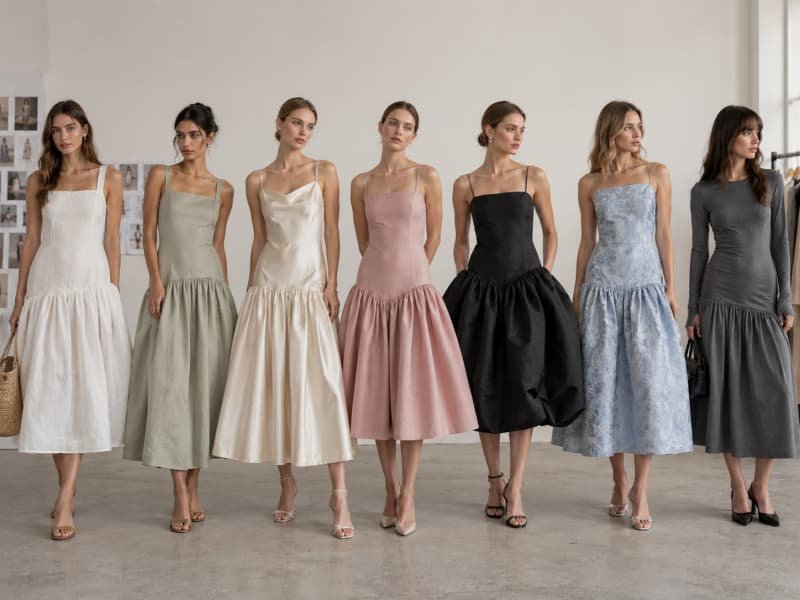
Different drop-waist styles need different fabrics. Cotton poplin and linen suit relaxed day and resort dresses, satin and crepe suit softer occasion silhouettes, while taffeta, Mikado, faille, sateen, and structured jacquards are stronger choices for sculptural shapes. Stretch jersey can work for fitted versions when recovery and seam stability are carefully controlled and the skirt weight does not overpower the bodice.
Poplin and Linen
Cotton poplin is one of the safest starting points for a modern drop-waist day dress because it offers a useful combination of crispness, manageable weight, and relatively low seam bulk. It works particularly well for mini and midi silhouettes where the skirt needs visible shape without becoming formal. Many dress-weight poplins fall around 100-180 g/m2, although commercial poplin exists far outside that range, so GSM should be treated as a screening figure rather than a specification by itself. A tightly woven 120 g/m2 poplin can feel crisper than a softer fabric with a higher weight.
Linen creates a different result. It tends to suit resort, vacation, and summer styles where texture, breathability, and a more relaxed surface are part of the look. Linen blends can reduce some of the wrinkling and dimensional movement found in loose pure-linen constructions, but relaxation and shrinkage still deserve attention before the pattern is locked. If the design brief calls for a clean, polished low waist and defined gathers, poplin is often easier to control. If natural texture and softer movement are more important than perfect crispness, linen or a linen blend may be the stronger direction.
Satin and Crepe
Satin works well when the low waist should feel elegant rather than sporty or architectural. Lightweight and medium-weight satins can create attractive movement through a midi or maxi skirt, but satin is unforgiving in production because its smooth surface makes seam puckering, needle marks, press impressions, zipper rippling, and lining show-through easier to see. A practical starting zone for softer dress satins is often around 90-180 g/m2, while Duchess satin and other structured satins may sit substantially higher and behave more like sculptural occasion fabrics than fluid slip-dress materials.
Crepe usually offers more surface texture and often a little more visual forgiveness. Depending on construction, roughly 140-260 g/m2 can cover many useful dress directions, from soft occasionwear to more controlled silhouettes. Some crepes, however, can grow during hanging, stretch on bias areas, or shift during cutting. For either satin or crepe, a hanging test is valuable before the final hem is approved. If a skirt includes large bias sections or carries significant weight, reviewing the garment again after 12-24 hours can reveal length changes and asymmetry that were not visible immediately after sewing.
Structured Occasion Fabrics
Taffeta, Mikado, faille, shantung, cotton sateen, Duchess satin, and compact jacquards are useful when the design depends on a strong contrast between a long clean bodice and a skirt that projects outward. These materials can hold pleats and fuller gathers more clearly than fluid fabrics, which makes them effective for party, cocktail, and occasion dresses. The risk is not that they are too formal; the risk is building too much thickness at the low-waist seam. A structured shell, dense lining, wide seam allowances, and high gathering ratio can combine into an uncomfortable ridge around the high hip.
The table below gives practical development ranges rather than universal rules. Fabric weight must always be read together with stiffness, weave, fiber, finishing, lining, and the actual construction. A lightweight organza can be highly structural, while a heavier viscose fabric may collapse almost vertically, so GSM should help narrow choices rather than make the final decision. The sewn garment remains the final reference for approval.
| Fabric Direction | Useful Starting Range | Typical Drop-Waist Result | Main Risk to Check |
| Cotton poplin | 100-180 g/m2 | Crisp day mini or midi | Shrinkage, excessive crispness |
| Linen / linen blend | 120-220 g/m2 | Relaxed resort silhouette | Wrinkling, relaxation |
| Fluid satin | 90-180 g/m2 | Soft occasion shape | Puckering, transparency |
| Crepe | 140-260 g/m2 | Controlled fluidity | Growth, cutting distortion |
| Taffeta / faille | 120-220 g/m2 | Strong skirt volume | Seam bulk, creasing |
| Mikado / Duchess satin | 180-300+ g/m2 | Sculptural occasion shape | Rigidity, weight |
| Stretch jersey | 180-320 g/m2 | Close body fit | Poor recovery, waviness |
| Compact jacquard | 180-350 g/m2 | Defined premium silhouette | Heavy seams, stiffness |
Stretch Jersey
Stretch jersey is useful when the upper body should closely follow the bust, waist, and hip, and it can make a low-waist bodice more comfortable because the wearer needs mobility across a larger fitted area. The important number is not only maximum stretch. Recovery matters just as much. A fabric may extend comfortably to 25% or 30%, yet if it does not return close to its original length after repeated movement, the low seam can drift downward and the upper body may lose its intended contour during wear.
Stretch should be checked in both directions because a fabric with 30% crosswise stretch and almost no lengthwise stretch behaves very differently from a four-way stretch material. Lining, elastic, zipper choice, seam type, and thread should be reviewed at the same time. A rigid lining inside a flexible shell can create restriction or rippling, especially around the high hip. For fitted drop-waist dresses, the best material is normally the one that provides enough movement without allowing the garment to relax permanently under the weight of the skirt.
How Does Fabric Change the Drop-Waist Silhouette?
Fabric changes the entire visual balance of a drop-waist dress. Soft materials make the low waist less pronounced and create a longer, more fluid line, while crisp materials define the seam and push volume outward. Fabric weight affects how strongly the skirt pulls downward, and stretch affects whether the extended bodice stays smooth and stable while the wearer walks, sits, bends, and moves throughout the day.

Drape and the Low Waist
The low waist is sensitive because it usually sits across a wider circumference than the natural waist. That means the same gathering ratio introduces more actual fabric into the seam. For example, if a natural waist measures 72 cm and a lower seam measures 88 cm, a 1.8x gathering ratio uses about 130 cm of skirt edge at the natural waist but about 158 cm at the lower seam. The ratio did not change, but nearly 29 cm more fabric must now be controlled within the seam, which can noticeably change thickness and projection.
Fluid and crisp fabrics handle that fullness in different ways. A soft crepe may compress relatively well and fall downward soon after the seam, creating a long, elegant line. A taffeta may push the same fullness outward, creating stronger volume around the hip. Neither result is inherently correct or incorrect. The design has to decide whether the low waist should be subtle or deliberately visible. This is why gathering ratio, seam circumference, fabric thickness, and fabric stiffness should be reviewed together rather than treated as separate technical decisions.
Weight and Skirt Volume
Fabric weight influences gravity, but structure determines how strongly the material resists gravity. A light organza may project sharply because of its stiffness even though it weighs very little, while a heavier viscose can fall almost straight because it has little structural resistance. In a drop-waist dress, this difference becomes important because the skirt begins lower on the body and may place more leverage on a fitted bodice. A heavy skirt can gradually pull the upper section downward, especially when the shell contains stretch or when the lining is also substantial.
If the skirt starts dragging the bodice, simply adding more internal support is not always the best fix. Developers can reduce the gathering ratio, use panels to distribute fullness, change a circular skirt into controlled gores, choose a lighter companion fabric, or keep the same visual volume with a lighter but more structural cloth. This is one reason product development should not treat fabric usage as a styling decision only. More material can increase cost and seam bulk without improving the silhouette, while a more efficient pattern can create a cleaner result with less weight.
Stretch and Stability
Stretch percentage can be measured with a simple controlled test. Mark a 10 cm section of fabric without tension, stretch it comfortably rather than to its absolute limit, and record the new length. If the section reaches 12.5 cm, the usable stretch is approximately 25%, calculated as (12.5 – 10) / 10 x 100. That number is helpful, but the recovery measurement after release is equally important. If the fabric repeatedly returns to 10.0-10.1 cm, it is behaving very differently from one that relaxes to 10.4 cm or longer.
The practical effect appears around the low waist because this area experiences movement, body expansion, and the downward load of the skirt at the same time. Weak recovery can cause bagging, seam migration, and a looser fit after several hours. For a fitted style, developers should test crosswise stretch, lengthwise stretch, immediate recovery, repeated recovery, and the behavior after pressing or the intended care process when relevant. High stretch may sound attractive on a specification sheet, but moderate stretch with strong recovery often produces a more stable commercial garment.
Surface and Visual Proportion
Fabric surface changes how the eye reads the same pattern. Matte poplin absorbs more light and makes the geometry of the silhouette easy to see, while satin reflects light and emphasizes curves, seams, tension, and changes in body contour. Jacquard adds depth and pattern that can make an area appear visually fuller even when the physical measurements are unchanged. This matters at the low waist because the horizontal transition between bodice and skirt is already a focal point and can become more prominent in shiny or highly textured materials.
Color and print can intensify the effect. Pale satin often reveals seam allowances and tension more strongly than a dark matte crepe. Large motifs can become distorted across gathers, while narrow stripes can expose a waist seam that is only slightly off level. A development sample should therefore be reviewed under both workroom light and stronger photography-style lighting. A fabric that looks smooth during fitting can show unexpected shadows, shine, or construction lines under direct studio light, which matters for brands selling primarily through e-commerce imagery.
How Do You Choose Fabric Weight, Drape, and Stretch?
Choose weight, drape, and stretch by defining the finished silhouette first. Decide whether the bodice should fit, skim, or stand away from the body, then determine how much volume and movement the skirt needs. GSM is useful for screening fabrics, but it should always be evaluated together with bending behavior, recovery, lining, opacity, seam thickness, and the construction methods planned for sampling and bulk production.

Choosing the Weight
GSM is useful because it gives sourcing and development teams a shared number, but it is frequently overused. Two fabrics at 180 g/m2 can behave completely differently. A dense satin may feel compact and smooth, while a textured crepe at the same weight may feel softer and more flexible. Finish, yarn size, weave density, coating, fiber content, and mechanical stretch can all influence behavior, so weight should narrow the search rather than become a pass-or-fail rule.
The ranges below are practical screening zones. They help identify likely development questions before a swatch reaches the pattern table, but each fabric still needs to be handled, draped, sewn, and reviewed as part of the garment system. This is especially important for drop-waist dresses because seam position and skirt weight can magnify relatively small differences in fabric behavior during fitting and wear.
| Approximate Weight | Common Development Direction | Key Question |
| Below 100 g/m2 | Chiffon, organza, very light satin | Does the garment need lining or support? |
| 100-180 g/m2 | Poplin, light satin, light woven | Will the skirt hold enough shape? |
| 180-250 g/m2 | Sateen, faille, compact woven | Will the low seam become bulky? |
| 250-320 g/m2 | Dense crepe, heavy jersey | Will skirt weight pull the bodice? |
| Above 320 g/m2 | Heavy jacquard or dense structured cloth | Is the dress becoming too rigid? |
Judging Drape
Drape should be assessed in a shape that resembles the garment rather than only by hanging a small square from one corner. A useful development test is to cut a larger piece, create the intended gathering or pleating, and attach it to a waistband or mock bodice circumference close to the real low-waist measurement. This quickly shows whether the fabric collapses, projects, bunches, or becomes too thick where fullness is concentrated. It also reveals whether the garment needs a different gathering ratio before a full sample is cut.
Direction matters as well. Satin, crepe, and loosely constructed woven fabrics can hang differently on straight grain, cross grain, and bias. If the design uses diagonal panels, asymmetric hems, or large bias sections, the finished skirt may lengthen unevenly after hanging. Reviewing the sample again after 12-24 hours is a sensible step before final hem approval. Drape testing should therefore imitate the real garment as closely as practical, because a fabric that looks beautiful as a loose swatch can behave very differently once its fullness is concentrated around the high hip.
Measuring Stretch and Recovery
Avoid descriptions such as “slightly stretchy” when the fit depends on the material. A simple measurement gives a more useful development reference. Mark 10 cm in the crosswise direction, stretch it comfortably, record the maximum usable length, and then repeat the process in the lengthwise direction. If 10 cm extends to 13 cm, that is roughly 30% stretch. Repeat the movement three to five times and allow the fabric to rest before checking whether the mark returns to the original length.
Recovery should be recorded because two fabrics with the same 30% stretch may behave very differently after wear. One may return almost completely, while another may remain several millimeters longer. For a close-fitting drop-waist dress, that difference can affect high-hip contour and seam position. It is also useful to repeat the test after pressing or the intended care treatment when relevant. The goal is not to chase the highest stretch percentage, but to select a material that gives enough mobility while maintaining the pattern shape over repeated movement.
Lining and Opacity
Lining can change the effective weight, drape, stretch, friction, and opacity of the dress, so it should be selected with the shell rather than added at the end of development. A fluid satin can become noticeably stiffer when paired with a dense woven lining, while a stretch bodice can lose much of its comfort when attached to a lining that barely moves. If shell and lining have different dimensional changes after care, bubbling, twisting, or uneven hems can also appear even when each material looks acceptable by itself.
Opacity should be checked under tension and strong light. A pale fabric may look fully opaque on a hanger but become transparent across the seat or high hip where the material is stretched. The same test can reveal internal construction: seam allowances, pocket bags, boning channels, cups, or support layers may show through even though skin does not. For polished occasionwear, this kind of visibility can make an otherwise expensive fabric look unfinished, so the shell, lining, and internal structure should be evaluated as one visual system.
What Fabric Problems Should Be Tested Before Sampling?
Before sampling, check shrinkage, skew, stretch recovery, opacity, seam appearance, pressing response, zipper compatibility, and interaction with lining. These checks do not replace a full garment sample, but they identify materials that are likely to distort the silhouette, create unnecessary revision rounds, or become difficult to reproduce consistently once the style moves from one sample into commercial production at scale.

Shrinkage and Distortion
Shrinkage should be checked before the pattern is treated as final because even a small dimensional change can move the low-waist seam. If a bodice measures 50 cm vertically from shoulder to low waist, a 2% lengthwise change represents 1 cm. In a relaxed garment that may be tolerable, but in a fitted drop-waist dress a 1 cm shift can noticeably change where the skirt starts relative to the high hip. Width change can also tighten the bodice and encourage the garment to ride upward during wear.
Measure both length and width before and after the intended care process, and record the percentage rather than writing only “minor shrinkage.” Shell and lining should be compared because different shrinkage rates can create bubbling or twisting. Skew deserves attention too, especially when the design contains stripes, vertical seams, ribs, or long panels that make distortion obvious. A material that repeatedly rotates after relaxation may create a dress that looks correct on the cutting table but gradually appears twisted after laundering or extended wear.
Seam and Hip Bulk
The low-waist seam deserves a physical mock-up before the full sample when the design includes dense gathering, pleats, lining, ruffles, or multiple internal layers. Use the actual shell, the expected number of layers, the intended seam allowance, the production-type zipper, and the planned pressing method. A simplified test using only one layer can create false confidence because the final seam may contain two or three times as much material once lining and finishing are added.
If the seam becomes too bulky, changing fabric is only one option. Gathering can be reduced, fullness can be redistributed into panels or pleats, seam allowances can be graded, the lining can be suspended differently, or the skirt can use a lighter companion material while preserving the same visual direction. The table below shows a practical pre-sampling check. The warning signs are not automatic rejection criteria; they indicate where a full sample or construction adjustment deserves closer attention.
| Risk | Simple Development Check | Warning Sign |
| Shrinkage | Measure before and after intended care | Bodice or skirt changes unevenly |
| Skew | Compare grain direction after relaxation | Vertical lines begin rotating |
| Seam puckering | Sew a 30-50 cm representative seam | Fabric ripples after pressing |
| Stretch recovery | Repeat a measured stretch test | Marked length does not recover |
| Opacity | Test under tension and strong light | Skin or construction becomes visible |
| Zipper rippling | Insert the planned zipper type | Wavy seam appears around closure |
| Seam bulk | Build the actual low-waist layer stack | Ridge forms around the high hip |
| Press sensitivity | Use the intended press process | Shine, flattening, marking, distortion |
Surface and Sewing Behavior
Some fabrics reveal manufacturing problems much more easily than others. Satin can show needle holes, puckering, press marks, and tiny differences in tension. Velvet can show nap-direction mistakes and crushing. Linen can expose irregular seam tension or excessive wrinkling near construction points. Jersey can develop waviness around hems, zippers, or stabilised seams. These risks are often predictable with a few small sewing trials before the full sample is cut, particularly when the fabric is expensive or the garment has a time-sensitive development schedule.
Sew representative seams using the expected needle, thread, stitch length, seam allowance, and machine type. Add an invisible zipper if the dress will use one, then press the test exactly as the sample room intends to press the garment. The result often exposes a mismatch that was invisible on the swatch card. A satin may look perfect until zipper insertion creates rippling, while a jersey may show acceptable hand recovery but stretch excessively under the presser foot. A short construction trial can save an entire sample round when the risk is identified early.
Wear Behavior
A finished dress does not stay motionless, so fabric evaluation should include walking, sitting, bending, and repeated movement. For fitted drop-waist styles, watch whether the garment climbs upward after the wearer sits. Repeated riding can indicate insufficient high-hip ease, excessive friction, weak stretch recovery, or an incorrectly positioned low waist. If the skirt is heavy, check whether the upper body lengthens during wear or whether the neckline and armholes are pulled downward as the garment settles.
Fluid fabrics deserve a different check. Watch for twisting, uneven length, or bias growth after the wearer moves and the dress hangs again. Structured fabrics should be reviewed for comfort while sitting because the extended bodice must bend with the body even when the cloth is relatively rigid. A dress can photograph well during a five-second front-view fitting and still create poor customer feedback after two hours of use. The strongest fabric decision therefore considers movement and recovery, not only the first visual impression.
How Do Brands Validate Fabric Before Bulk Production?
Brands should validate fabric through controlled swatch comparison, representative garment sampling, fit and movement review, construction testing, and a final production-readiness check. The approved bulk fabric should match the intended sample in the properties that create the silhouette – weight, drape, structure, stretch, recovery, opacity, color, and surface – rather than simply sharing the same supplier description or fiber name on paper.

Comparing Fabric Options
When several candidate fabrics look similar, compare them using the same criteria instead of choosing by touch or price alone. Record composition, GSM, usable width, stretch, recovery, shrinkage, opacity, drape, structure, surface finish, color consistency, lead time, and available quantity. This makes the discussion more objective and is particularly useful when the original inspiration fabric is unavailable or commercially impractical. The replacement does not always need the same fiber content; it needs to reproduce the performance characteristics that are essential to the intended dress.
For example, if the target style depends on a crisp skirt standing away from the hip, structural behavior may be more important than matching an original cotton composition. If the target is a fluid midi with a long vertical line, drape and surface may matter more than identical GSM. Cost should enter the decision after the critical performance requirements are defined. Choosing the lowest-priced fabric first and then forcing the pattern to compensate can add sampling rounds, increase construction complexity, and erase much of the apparent saving.
Proto and Fit Sample
A commercially important drop-waist style should normally be evaluated as a garment before bulk approval because the low seam interacts with the wearer’s body in ways a flat pattern cannot fully predict. The first proto can answer questions about silhouette, construction, skirt volume, and fabric suitability. A fit sample should go further by checking bust balance, waist contour, high-hip ease, low-waist placement, skirt level, and mobility. The purpose of the sample should be clear so the team knows which decisions can be locked and which are still provisional.
Fit should be reviewed from the front, side, and back, then during walking and sitting. The side view is especially useful because it shows whether the low waist stays level or is being pulled upward over the seat. The back view can reveal excess fabric above the seam or a skirt that is dragging the bodice down. For fitted collections, reviewing at least one additional size before final grading is valuable because waist-to-hip proportions do not scale in a perfectly uniform way. The goal is not only to make the base sample fit, but to protect the silhouette as the size range expands.
Approving Fabric Alternatives
Material substitutions are common in fashion production. A nominated fabric may miss the required delivery date, become unavailable, fail a color requirement, carry an impractical minimum, or move outside the target cost. When that happens, the replacement should be compared against the approved performance target rather than the supplier’s marketing name. Two satins at 140 g/m2 can differ in weave density, friction, opacity, recovery, shine, and how clearly they reveal internal construction, so matching weight alone is not enough.
The replacement should be checked in the areas most important to the style, which may include drape comparison, representative seams, zipper insertion, shrinkage, color review, lining compatibility, and a partial garment mock-up. For a shape-sensitive dress, another full sample may be the cheaper decision when compared with discovering a silhouette change after thousands of units have been cut. A well-managed alternative is not a downgrade; it is a controlled decision to preserve the design while improving availability, cost, or production reliability.
Keeping Bulk Consistent
The final step is turning the approved sample into a repeatable production standard. Bulk teams need clear references for shell fabric, lining, trims, color, measurements, construction, gathering distribution, pressing, and finishing. If those details remain scattered across emails or depend on the memory of the sample room, consistency becomes harder as quantities increase, new sewing lines are added, or a successful style is reordered several months later.
Before large quantities are cut, compare bulk fabric with the approved material for weight, width, hand feel, color, drape, stretch, and visible surface quality. Where the design is particularly sensitive, a first-piece or short pilot run can confirm that production sewing creates the same result as the development sample. This is also the stage where a specialist dress-development team can add real value: if your brand is preparing a drop-waist style for sampling or bulk, sharing the reference image, target fabric, size specification, and intended order direction allows the team to assess fabric, fit, and construction risks before they become expensive production problems.
Choosing the best fabric for a drop-waist dress begins with a visual question: what should the garment do on the body? Once that answer is clear, weight, drape, structure, stretch, recovery, lining, seam thickness, and testing can all be evaluated against the same target. A crisp poplin mini, a fluid satin midi, and a sculptural Mikado occasion dress can all be excellent drop-waist products, but they succeed for different technical reasons. The strongest development process does not force a favorite fabric into every silhouette; it selects and tests the material that makes the intended shape easier to reproduce from sample through repeat production.
Frequently Asked Questions
What is the best fabric for a casual drop-waist dress?
Cotton poplin is often one of the most practical choices for a casual drop-waist dress because it provides enough structure to define the lower seam without creating excessive weight. Linen and linen blends are also strong options for resort or summer styles when a more relaxed texture is desired. The final choice should still consider the skirt construction, because a heavily gathered mini needs different body and seam control from a lightly flared midi even when both are casual dresses.
Is satin a good fabric for a drop-waist dress?
Yes, satin can work very well for drop-waist occasion dresses when the goal is fluid movement, shine, and a more elevated finish. The challenge is that satin exposes technical problems easily, including seam puckering, zipper rippling, needle marks, press impressions, and lining show-through. Lightweight satin may create a soft low-waist transition, while Duchess satin can produce a much more sculptural silhouette. Sampling should therefore use the actual satin quality rather than a generic substitute with a similar color.
Can I use stretch fabric for a fitted drop-waist dress?
Yes, but the pattern should be developed around the stretch and recovery of the chosen material. A jersey or stretch woven can improve comfort across the waist and high hip, yet poor recovery may allow the low seam to move downward during wear. Measure stretch in both directions, check how closely the fabric returns to its original dimension, and make sure the lining, zipper, elastic, and seam construction are compatible with the same movement before approving the fit.
What fabric weight is best for a drop-waist dress?
There is no single ideal GSM because fabric structure can matter as much as weight. Many crisp day-dress fabrics fall around 100-180 g/m2, fluid crepes may sit roughly around 140-260 g/m2, and structured occasion fabrics can extend well above 200 g/m2. These ranges are useful starting references rather than fixed rules. A lightweight but stiff fabric can create more skirt projection than a heavier soft fabric, so drape and construction must be tested alongside GSM.
How do I prevent a drop-waist seam from looking bulky?
Start by checking the total layer stack at the low-waist seam rather than blaming the shell fabric alone. Dense gathering, lining, wide seam allowances, zipper tapes, and structured fabrics can combine into a visible ridge around the high hip. Possible solutions include reducing the gathering ratio, distributing fullness through panels or pleats, grading seam allowances, changing the lining attachment, or using a lighter skirt fabric. A small seam mock-up can reveal the problem before an entire sample is assembled.
Should fabric be tested before making the first drop-waist sample?
Yes, especially when the fabric is expensive, unstable, highly stretchable, very shiny, or likely to be used in a large commercial order. Basic checks for shrinkage, skew, recovery, opacity, seam puckering, zipper behavior, and press sensitivity can identify obvious risks before the first proto is cut. These checks do not replace garment sampling because fit and skirt balance still need to be evaluated on the body, but they can prevent avoidable sample rounds caused by unsuitable material behavior.
How should a brand approve fabric before bulk production?
A brand should approve more than the fabric name and color. The bulk material should be compared with the approved sample for weight, hand feel, drape, structure, stretch, recovery, opacity, width, color, and surface quality. Lining and trims should also be locked because they can change how the shell behaves. For shape-sensitive drop-waist dresses, a first-piece or short pilot check before full production can confirm that the approved silhouette survives the transition from sample-room construction to production-line methods.