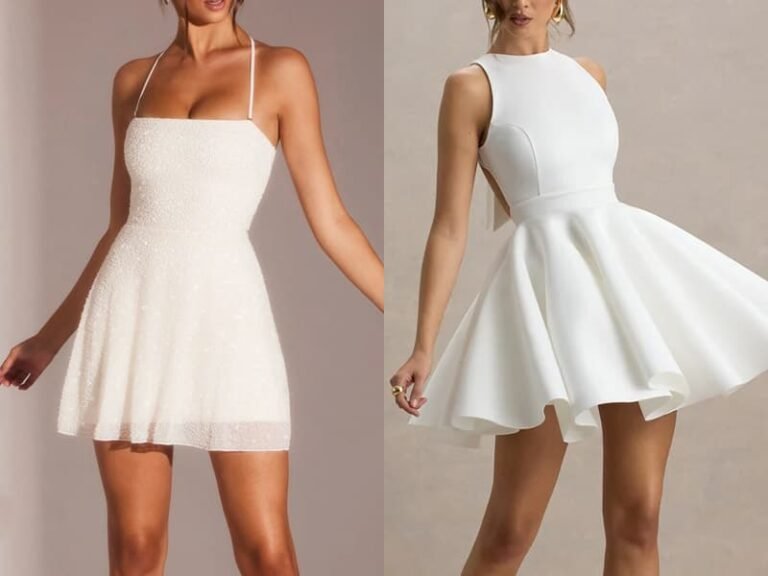
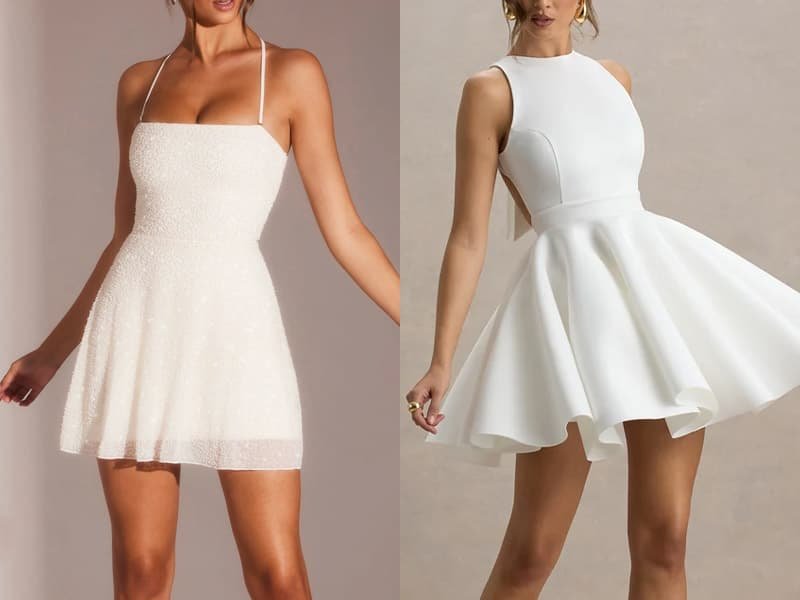
A-line and skater dresses are often placed next to each other in online stores because both narrow around the upper body and become wider toward the hem. That surface similarity is also the reason people confuse them. In real product development, however, the difference is much more useful than a style label. It affects where the garment is fitted, how quickly the skirt opens, how much fabric sits below the waist, how the dress behaves when the wearer moves, and how the pattern needs to be graded across a size range. Those points can change comfort, visual balance, photography, fabric consumption, sewing difficulty, and bulk consistency, so understanding the silhouette is valuable whether you are choosing a dress to wear or developing a collection.
An A-line dress widens progressively toward the hem, usually creating a cleaner and more continuous A-shaped outline. A skater dress normally combines a fitted bodice, a clearly defined waist, and a fuller skirt that releases more quickly from the waist. The practical difference is therefore not simply skirt width: it is the location of the flare, the amount and distribution of volume, the strength of waist definition, and the way the skirt moves.
The interesting part is that real dresses do not always sit neatly inside one textbook category. A retailer may call a style A-line, a designer may call the same piece fit-and-flare, and a shopper may describe it as skater because the skirt swings. Once the dress reaches a pattern room, the name matters less than measurable questions: Where is the narrowest point? How far below the waist does the flare begin? What is the finished hem sweep? How much of the skirt runs near the bias grain? How does the fabric respond after hanging, pressing, walking, and sitting? Those questions reveal the actual silhouette, and they are the reason two dresses that look similar in a front photo can behave very differently on the body.
What Is the Difference Between an A-Line Dress and a Skater Dress?
An A-line dress becomes progressively wider toward the hem, while a skater dress usually has a fitted upper body, a defined waist, and a fuller skirt that opens more quickly from the waist. The easiest way to tell them apart is to look at where the flare begins and how the volume is distributed: gradual expansion suggests A-line, while a sharp fitted-to-full transition around the waist suggests skater.
Silhouette at a Glance
The simplest mistake is to judge the dress only by the width of the hem. Both silhouettes can have generous hems, yet they can reach that width through very different pattern shapes. An A-line dress normally develops width over a longer vertical distance, so the eye follows a relatively smooth line from the upper body toward the floor. The garment may begin releasing from the waist, high hip, full hip, or even higher on a relaxed design. A skater dress creates stronger contrast: the bodice stays closer to the body, the waist reads clearly, and the skirt moves outward more decisively below that point. That visible break between control and volume gives the skater dress its familiar energetic character.
Movement makes the distinction even clearer. A moderate A-line skirt tends to form longer, quieter folds that travel down the body and open gradually as the wearer walks. A fuller skater skirt can swing away from the legs, rotate more noticeably during a turn, and create a stronger bounce when the wearer changes direction. This is one reason a static product image is not enough when evaluating the silhouette. Front, side, back, and movement views reveal whether the dress is truly a restrained A-line, a fuller fit-and-flare, or a skater shape that depends on the waist-to-skirt contrast for its visual identity.
| Measurement or Feature | A-Line Dress | Skater Dress | Useful Development Check |
| Flare start | Often gradual from waist, high hip, or hip | Usually clear release at or near waist | Record vertical distance from waist to flare point |
| Waist definition | Soft to strong | Usually strong | Measure finished waist and confirm waist level |
| Skirt volume | Controlled to moderate, sometimes full | Moderate to high | Record finished hem sweep, not only side width |
| Hem movement | Fluid and controlled | More swing and rotation | Review walking and turning videos |
| Length range | Common from mini through maxi | Often short or mini, but not limited to it | Rebalance sweep whenever length changes |
| Pattern structure | Side flare, panels, princess seams, darts | Circular, panelled, pleated, or gathered | Confirm how fullness is distributed |
Where the Flare Begins
Flare position is one of the most useful technical clues because it shows how the dress creates shape rather than merely how wide it looks at the bottom. If the garment follows the torso and hip and then widens slowly, the result usually reads as A-line. If the bodice remains fitted and the skirt starts separating from the body almost immediately below the waist seam, the result moves much closer to skater. This is especially obvious when comparing side views. An A-line often shows a steady diagonal line, while a skater dress can show a more pronounced outward change just below the waist, particularly when the skirt is cut with circular volume or concentrated flare.
That difference becomes important during sample revisions because comments such as “make it more A-line” or “make it more skater” can be interpreted in several ways. A clearer instruction identifies the physical change: reduce fullness at the waist, move the flare lower toward the high hip, increase hem sweep without adding waist gathers, or keep the bodice fitted while adding more skirt release from the waist seam. These comments can be translated into pattern changes and then checked against the approved sample. Precise language also reduces the chance that the sample room adds volume in the wrong place and produces a dress that is technically wider but visually farther from the intended silhouette.
Volume Is Not the Only Difference
It is tempting to describe a skater dress as simply a fuller A-line, but that explanation overlooks proportion. A dress can have a large finished hem and still look A-line if the extra width develops smoothly through the lower body. Conversely, a shorter skirt with only moderate sweep can still read as skater when the bodice is compact, the waist is clearly defined, and the skirt releases quickly below it. The relationship between the upper and lower sections matters as much as the total quantity of fabric. That is also why waist placement and bodice length can change the identity of a dress even when the skirt pattern itself remains unchanged.
Fabric can push the same pattern toward one visual category or another. A crisp cotton, compact crepe, or firm jacquard can hold the skirt away from the legs, making a moderate amount of flare look stronger. A soft satin, lightweight viscose, or drapey crepe can collapse toward the body, making a fuller pattern appear more streamlined. On skater dresses, this effect is especially noticeable because the style depends on movement and clear waist contrast. For reliable development, the silhouette should therefore be approved on the intended fabric or a material with genuinely comparable weight, drape, stretch, and recovery rather than on a substitute that behaves differently.
How Do A-Line and Skater Dresses Differ in Shape and Fit?
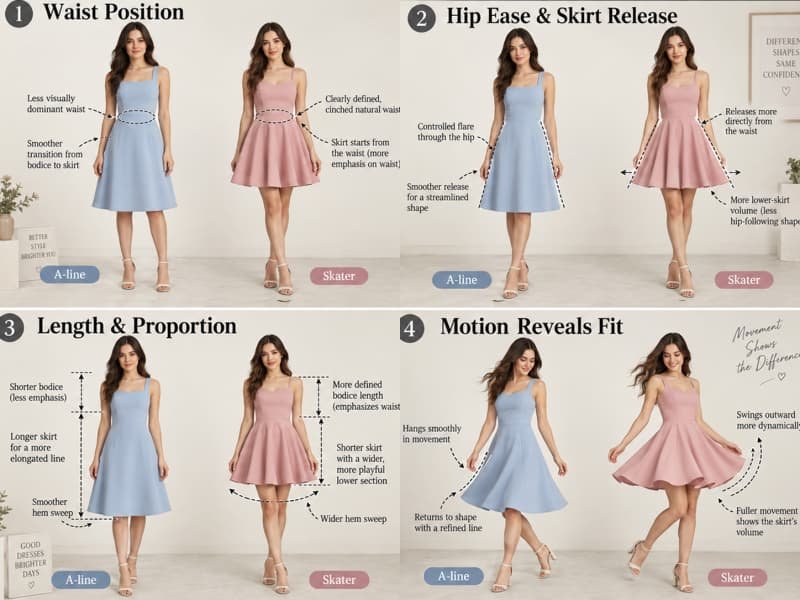
A-line dresses generally create a smoother transition from the upper body to the hem, while skater dresses create stronger contrast between a fitted waist and a fuller lower section. The most important fit variables are waist placement, hip ease, skirt release, length, and hem sweep. These factors determine whether the finished dress feels streamlined, balanced, playful, bulky, or unstable when the wearer moves.
Waist Position
Waist position has more influence on the silhouette than many product images suggest. On an A-line dress, the waist can be softly shaped or visually understated, and some designs do not need a horizontal waist seam at all. Princess seams, darts, or long panel lines can control the bust and waist while keeping the eye moving vertically through the garment. A skater dress usually relies more strongly on the waist as the visual anchor. If the intended natural waist sits too low, the bodice can look stretched and the skirt heavier. If it sits too high, the style may start to resemble a raised-waist fit-and-flare rather than the balanced skater proportion the design team approved.
For that reason, waist fit should be checked in two directions. The horizontal dimension is the finished waist circumference and the amount of wearing ease, while the vertical dimension is the position of the waist on the body. Front body length, back body length, side-waist level, bust position, and the location of the narrowest point should work together. A dress can match the waist circumference perfectly and still look wrong if the seam sits 1-2 cm away from the intended position on the fit model. This is especially noticeable in short dresses, where a small vertical change alters the ratio between bodice length, skirt length, and visible leg.
Hip Ease and Skirt Release
A-line dresses usually need a controlled relationship between hip ease and flare. If the pattern becomes wide too early, the silhouette can look triangular or tent-like instead of refined. If it stays too close through the hip before releasing, the dress may pull during walking or lose the smooth line that makes an A-line appealing. The correct amount of ease depends on fabric stretch, lining, length, body measurements, and the design intent, so a useful fitting review looks beyond one circumference. Side seams should fall naturally, the skirt should not climb upward during movement, and the front and back panels should hang without unexpected drag lines.
Skater dresses often release from the waist before the skirt needs to follow the hip closely, which can create more freedom below the waist. The trade-off is that the bodice fit becomes more visible. A waist that is too loose weakens the silhouette immediately because the design depends on a clear contrast between the controlled upper body and the expanding skirt. A waist that is too tight can produce zipper rippling, seam strain, or uncomfortable pressure after sitting and eating. The best fit is not the smallest possible waist measurement; it is a stable waist that stays in position, supports the intended shape, and still allows normal movement and breathing.
Length Changes the Proportion
Length changes the visual balance of both silhouettes because it changes the relationship between vertical distance and horizontal volume. A short skater dress with a generous hem can look lively because the skirt has enough width to move but not enough length to become visually heavy. Extending that same pattern to midi length without adjusting the sweep can make the lower half look dense or costume-like, especially in structured fabric. Reducing sweep too aggressively, however, can remove the movement that made the original skater attractive. Each new length should therefore be treated as a proportion exercise rather than a simple pattern extension.
A-line dresses also change character as length increases. A mini A-line can feel sharp and modern, a midi version can appear more polished, and a maxi can become fluid or dramatic depending on fabric and hem width. Product teams can keep the silhouette consistent by tracking three relationships: bodice length to total dress length, skirt length to finished hem sweep, and waist position to hip position. There is no universal ideal ratio because body proportions and styling goals vary, but recording these relationships on the approved sample gives the grading and pattern teams a measurable reference when developing additional lengths or size ranges.
Motion Reveals Fit Problems
Static fit photographs can hide problems that appear immediately when the wearer walks, sits, turns, or climbs stairs. A skater skirt may look balanced from the front yet rotate around the body because one panel is off-grain or because the lining is pulling the shell. An A-line dress may appear smooth while standing but ride upward at the front when walking because the hip or thigh area is too restricted. These issues are easy to miss if fitting consists only of a front photo and a tape measure, particularly when the design uses slippery satin, stretch mesh, or asymmetrical seams.
A practical wear test should include normal walking, sitting for several minutes, standing again, turning in both directions, raising the arms, and checking the garment from front, side, and back. For fuller skirts, a controlled turn is particularly useful because uneven hem drop and panel stretch become more visible when the fabric moves. The goal is not to perform a theatrical spin test on every style; it is to see whether the silhouette returns to its intended position after movement. A well-developed dress should not require the wearer to constantly pull down the skirt, reposition the waist, or straighten twisted seams.
Are A-Line, Skater, and Fit-and-Flare Dresses the Same?
No. The terms overlap, but they describe different aspects of silhouette. A-line mainly describes a garment that becomes wider toward the hem. Fit-and-flare describes a fitted upper section followed by a flared lower section. Skater is usually a more specific fit-and-flare shape with a defined waist and noticeable skirt movement. One dress can reasonably fit more than one description, especially in retail naming.
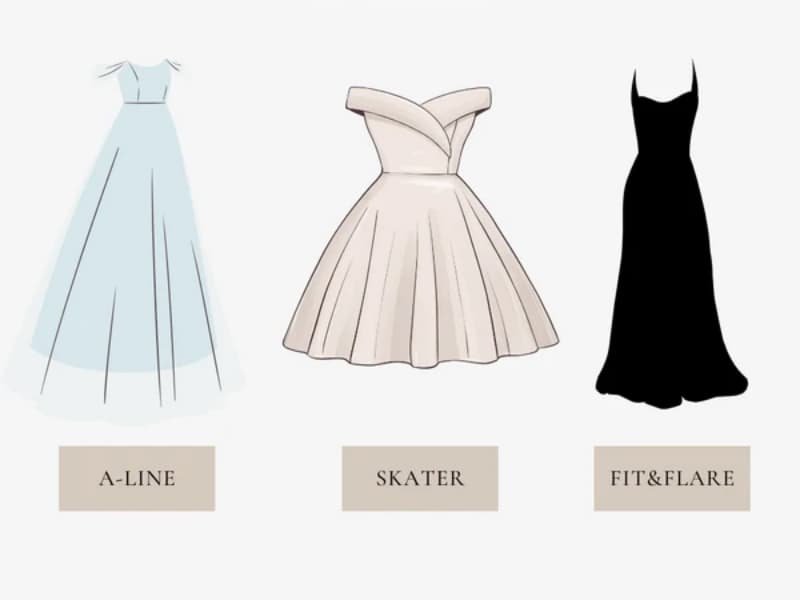
A-Line Is a Shape Family
A-line is best understood as a broad silhouette family rather than a single pattern formula. The garment becomes wider toward the bottom, but the construction may vary considerably. Some A-line dresses are only lightly shaped at the waist and rely on side seams for flare. Others are fitted through the bust and high hip and use multiple panels to release width gradually. Princess seams can run from the shoulder or armhole through the entire dress, while darts can control the upper body before the skirt opens. These construction differences affect fit and production, yet the overall visual impression can still remain recognizably A-line because the silhouette expands progressively rather than changing suddenly at one horizontal seam.
This broad definition explains why two A-line dresses can feel completely different in a store. A compact wool-blend midi can look architectural and hold space away from the body, while a viscose summer dress can fall softly and move close to the legs. A denim mini may use very little drape, while a chiffon-lined occasion dress may depend on fluid layers. The category tells you the general direction of the silhouette, not the full technical specification. For design and sourcing teams, the next questions should therefore be about flare position, hip ease, panel structure, hem sweep, fabric behavior, and intended movement rather than assuming the word A-line communicates all of those decisions.
Fit-and-Flare Is About Contrast
Fit-and-flare describes the relationship between a controlled upper section and an expanding lower section. The transition may occur at the natural waist, slightly above it, or lower depending on the style, but the essential idea is that one part of the garment fits relatively close while another part opens out. This broad family can include structured occasion dresses, polished office styles, cocktail dresses, and youthful short dresses. A garment can therefore be fit-and-flare without looking like a skater dress, especially when the skirt is longer, less full, more tailored, or designed to fall in restrained folds rather than swing freely.
The distinction becomes useful when reviewing reference images. If a design team says only “fit-and-flare,” the sample room still needs to know how strong that contrast should be. A fitted bodice attached to a six-panel midi skirt produces a different result from the same bodice attached to a half-circle mini. Both fit the broad description, but the hem sweep, grain distribution, waist bulk, and movement are different. A good development brief therefore converts the category into measurable decisions: where the fit ends, where the flare begins, how much ease exists at the waist and hip, how wide the finished hem should be, and whether the lower section should feel controlled, fluid, or visibly playful.
Skater Is More Specific
Skater dresses usually occupy a more specific area inside the wider fit-and-flare family. Their identity comes from the combination of a relatively fitted bodice, clear waist definition, and enough skirt fullness to create visible movement. The skirt does not have to be a full circle. Half-circle constructions, multiple flared panels, pleats, or moderate gathers can all create a skater effect when the transition at the waist is clear. Conversely, a very full skirt attached to a loose or dropped-waist bodice may not read as skater because the upper-to-lower contrast is missing even though the hem circumference is large.
This is useful for ecommerce taxonomy and product libraries because one garment can be described through several attributes instead of forcing a single label to carry every meaning. A style might be recorded as fit-and-flare in silhouette, defined waist in fit, mini in length, half-circle in skirt construction, and satin in material. That structure helps internal teams search for comparable styles and gives customers clearer product information. It also reduces confusion when two teams use different fashion vocabulary. When the measurable attributes are visible, it becomes less important whether merchandising calls a dress skater while the technical team files the pattern under fit-and-flare.
Flared Does Not Mean A-Line
Any skirt that becomes wider can be described as flared in a general sense, but not every flared dress belongs to the A-line family. A mermaid or fishtail dress stays close to the body much farther down before opening around the knee or lower leg. A trapeze dress can begin widening from the shoulder or upper torso and may have little waist definition. A drop-waist dress can stay fitted through the torso and upper hip before releasing much lower. Tiered dresses can create volume through gathered horizontal sections, and godets can add flare locally instead of through a continuous A-shaped side seam.
A practical classification process asks three questions in order: where the garment is closest to the body, at what vertical point the expansion begins, and how quickly the circumference increases after that point. Those three answers usually reveal more than the marketing name. They are also useful when developing from photographs because they direct attention toward pattern geometry. Two skirts can share the same waist and hem circumference but look different when one distributes width through evenly flared panels and the other concentrates extra fabric in gathers or pleats. Silhouette is therefore created by both the quantity of fabric and the way that quantity is distributed around the body.
Which Dress Works Better for Different Body Shapes and Occasions?
Neither silhouette is universally more flattering. A-line dresses usually create a smoother vertical line, while skater dresses place stronger emphasis on the waist and add more lower-body movement. The better option depends on the wearer’s proportions, desired coverage, preferred waist definition, dress length, fabric, and occasion. Personal comfort and the intended visual effect are more useful than rigid body-shape rules.
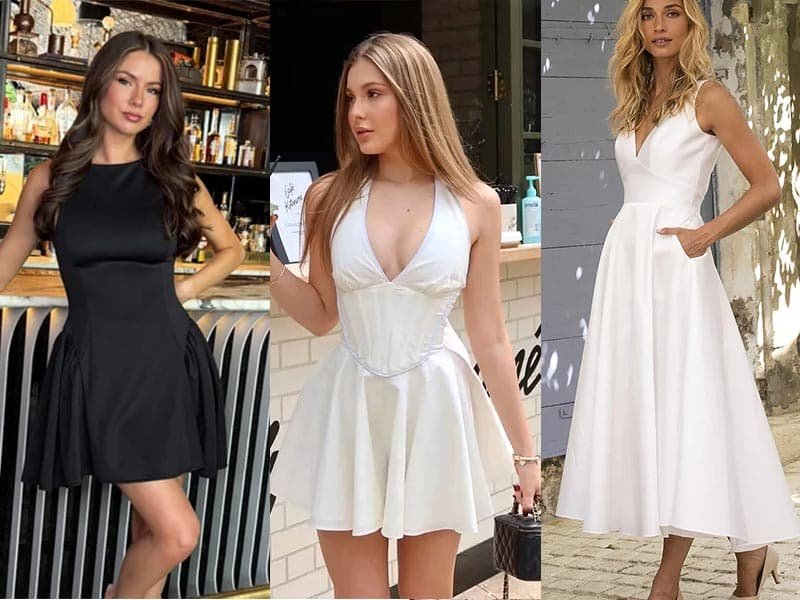
Proportion Matters More Than Labels
Body-shape labels such as pear, hourglass, rectangle, or inverted triangle can be useful shorthand, but they are not precise fitting systems. Two people placed in the same category can have different torso lengths, shoulder slopes, waist heights, hip distribution, bust proportions, and overall height. An A-line dress is often attractive when the wearer wants a relatively uninterrupted line because the flare can create room below the waist without concentrating obvious volume at one point. A skater dress gives a different effect by creating a stronger visual center at the waist and a clearer change between the upper and lower body.
Instead of asking which silhouette a particular body “should” wear, it is more practical to decide what the wearer wants to emphasize or soften. Someone who prefers gentle waist definition and a cleaner hip line may choose a moderate A-line. Someone who enjoys a more pronounced hourglass effect may prefer a skater dress with a fitted bodice and fuller skirt. Shoulder width, skirt volume, and neckline should also be considered together because the dress is read as one whole shape. A very full lower half paired with a narrow or delicate neckline can feel different from the same skirt combined with stronger shoulders, sleeves, or a wider neckline.
Length and Coverage
Length changes how both silhouettes interact with the body and how secure the garment feels in everyday use. A short skater dress can create a dramatic contrast between the waist, the moving skirt, and the visible leg, but the same fullness can also increase lifting during walking, wind, or dancing. Lining, hem weight, skirt sweep, and the stiffness of the fabric all affect coverage. A softer half-circle skirt may feel easier to manage than a very lightweight full circle at the same length because it carries less fabric and may lift less aggressively during movement.
A-line dresses usually move across mini, midi, and maxi lengths more easily because the flare can be controlled progressively. A mini can remain crisp with moderate sweep, while a midi can gain a little more width to preserve walking ease without becoming full. A maxi requires attention to total weight, hem width, and footwear clearance. In each case, the designer should consider not only how the dress looks while standing but also how it behaves when the wearer sits, climbs stairs, enters a car, or walks quickly. Coverage is part of usability, and usability has a direct effect on whether a style becomes a repeat favorite or a one-time purchase.
Matching the Occasion
A-line dresses have a particularly broad occasion range because their volume can be adjusted without losing the core silhouette. A restrained woven A-line can work for office or polished daytime dressing, while a satin or jacquard A-line with a sharper neckline can move easily into cocktail, wedding-guest, or formal event territory. A soft floral A-line can feel relaxed for brunch or resort wear, and a long fluid version can become an evening or vacation piece. The silhouette gives the designer a flexible base, while fabric, finish, neckline, color, and length determine how casual or elevated the final garment feels.
Skater dresses are especially effective when movement and waist definition support the occasion. Partywear, graduation looks, homecoming-inspired styles, social events, and youthful going-out collections often use this shape because the skirt creates visual energy when the wearer moves. The same silhouette can still be refined: reducing skirt volume, choosing a heavier satin or crepe, lengthening the skirt, and using cleaner construction can make a skater-inspired dress more sophisticated. The useful question is not whether one category is “formal” and the other “casual,” but whether the proportion, material, and movement communicate the mood the wearer expects for that setting.
Comfort Is Part of Fit
A dress can photograph beautifully and still become uncomfortable after thirty minutes of wear. This matters on skater dresses because the fitted bodice can create pressure at the waist, zipper, underbust, armhole, or neckline when ease is reduced too aggressively. A stable waist should stay in place without digging into the body or forcing the wearer to adjust the dress after sitting. Stretch fabrics add another concern because a sample may initially feel comfortable but lose recovery after repeated wear, allowing the waist to relax or the bodice to lengthen in ways that weaken the silhouette.
A-line dresses are not automatically comfortable either. If the high hip is too tight, the skirt can climb upward during walking and create wrinkles that disappear only when the wearer stands still. If the bust, armhole, or shoulder balance is incorrect, the extra room below the waist does not solve the upper-body problem. A useful wear test includes sitting, walking, bending slightly, raising the arms, and returning to a neutral standing position. The dress should recover naturally without twisting or needing repeated adjustment. Comfort is not separate from silhouette; it is one of the clearest signs that the pattern and fabric are working together properly.
How Do Fabric and Construction Affect Each Silhouette?
Fabric and construction can change the same pattern dramatically. Weight, drape, stretch, recovery, thickness, grain direction, and surface structure determine whether a skirt hangs close to the body, holds a clean A-line, or swings freely like a skater skirt. Construction then controls where volume appears through side flare, panels, circular cutting, gathers, pleats, godets, seams, and hem treatments, so material and pattern decisions must be reviewed together rather than separately.
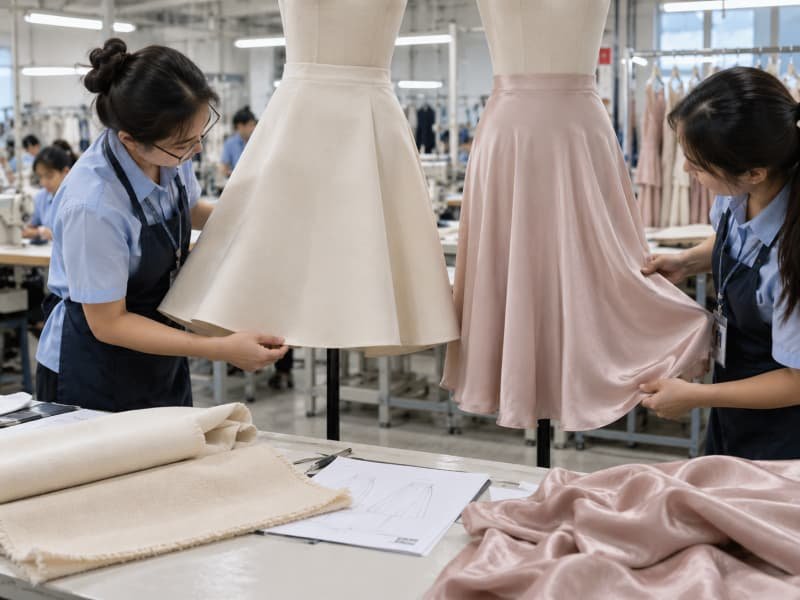
Fabric Behavior
Fabric should be selected for the intended silhouette rather than only for color, print, or hand feel. A compact woven such as poplin, firm crepe, denim, twill, or structured jacquard can hold an A-line away from the legs and create a crisp geometric outline. Softer fabrics such as lightweight crepe, satin, viscose, or chiffon create a more fluid interpretation because gravity pulls the skirt downward and allows the folds to sit closer to the body. The pattern may be identical in basic dimensions, yet the visual flare can look substantially different once the fabric changes.
Skater dresses are even more sensitive because movement is often part of the design. A lightweight fabric can produce strong swing and fast response during turning, while a heavier material creates slower movement and may pull the skirt downward. Stretch fabrics introduce recovery as another variable: the bodice must return to shape after sitting and movement, and the waist seam must remain stable under the weight of the skirt. Before approving fabric, it is useful to compare at least six properties – weight, drape, stretch, recovery, opacity, and structural support – and evaluate them on a representative skirt section rather than judging only from a small swatch.
Circular Cutting and Sweep
Circular cutting is common in fuller skater and fit-and-flare skirts because it creates flare without compressing large amounts of fabric into gathers at the waist. The pattern geometry has a direct effect on sweep. A quarter-circle uses about 90 degrees of circular development, a half-circle about 180 degrees, a three-quarter circle about 270 degrees, and a full circle 360 degrees. Increasing the angle generally increases hem circumference, bias exposure, and movement, although the final appearance still depends on waist size, skirt length, fabric stiffness, and the number of seams.
The mathematics can also help a technical team check whether a pattern concept is reasonable before sampling. If C represents the finished waist seam circumference before allowances, the theoretical waist radius for a full circle is approximately C divided by 2pi, while a half circle uses C divided by pi. These formulas describe ideal geometry, not a finished factory pattern, because seam allowances, stretch compensation, darts, panel seams, elastic, and fabric behavior may require adjustments. The value of the calculation is that it gives the team a measurable starting point and makes it easier to understand how changing the circle percentage changes both the waist radius and the amount of material flowing into the hem.
| Skirt Geometry | Approx. Angle | Theoretical Waist Radius* | Typical Visual Effect |
| Quarter circle | 90 degrees | 2C / pi | Restrained flare, controlled movement |
| Half circle | 180 degrees | C / pi | Noticeable swing, versatile fit-and-flare |
| Three-quarter circle | 270 degrees | 2C / 3pi | Fuller movement with less volume than a full circle |
| Full circle | 360 degrees | C / 2pi | Strong sweep and rotation |
C represents the waist seam circumference used for the theoretical geometry before production adjustments. The formulas help compare quarter-, half-, three-quarter-, and full-circle concepts, but they are not finished factory pattern specifications. Seam allowances, closures, stretch compensation, elastic, darts, panel seams, and fabric relaxation can all change the final radius, so the sample pattern must still be tested and corrected in the actual material before approval.
Panels, Gathers, and Pleats
Volume can be created in several ways, and each method distributes fabric differently around the body. A two-panel or four-panel A-line usually places much of the flare in the side and panel seams, allowing the garment to remain relatively clean at the waist and hip. Increasing the number of panels gives the pattern maker more places to control contour and flare, which can be helpful when a dress needs a fitted upper section and a smooth lower expansion. Panels also make it easier to shape around the hip without relying on a single aggressive side-seam angle that can distort the silhouette.
Gathers create fullness by compressing extra fabric into a shorter seam, so the volume becomes visible immediately below the joining point. This can work well for softer, romantic skater dresses, but thick fabric can produce unwanted bulk at the waist. Pleats organize the extra fabric into deliberate folds and can create a cleaner top edge while still opening into substantial movement below. Circular cutting creates another effect because fullness is distributed continuously around the waist without visible compression. None of these methods is automatically better. The choice depends on whether the design needs smooth flare, visible texture, directional folds, low waist bulk, or maximum movement, and it should be tested in the actual fabric before bulk approval.
Bias and Hem Stability
Fuller circular skirts expose more of the fabric to different grain directions. Some sections sit close to the straight grain while others approach the bias, where many woven fabrics can stretch more easily under their own weight. This is one reason a circular skirt can develop an uneven hem even when the paper pattern was perfectly symmetrical. Fluid materials such as viscose, rayon, chiffon, or soft satin can be particularly sensitive, but the degree of movement varies by weave, finish, yarn, weight, and construction, so there is no single waiting time that suits every fabric.
For fabrics known to relax, sample rooms often allow the skirt to hang before making the final hem correction. A 12-24 hour hanging check is a practical development step for many bias-heavy samples, but it should be treated as a test rather than a universal rule. Longer skirts, heavier fabrics, or highly unstable materials may need different handling. The hem method also changes the result. A narrow baby hem adds little weight but requires clean control around curved edges, while a wider turned hem adds stability but can resist the curve or create rippling. The correct finish should support the intended movement without forcing the lower edge into a shape the fabric does not naturally want to hold.
How Should Brands Develop A-Line and Skater Dresses for Production?
Production-ready development requires the silhouette to be translated into measurable standards before bulk cutting. Waist position, hip ease, flare start, skirt length, finished hem sweep, grain direction, fabric behavior, and construction should be locked at sample stage. Grading must preserve the relationship between the bodice and skirt across sizes, while production checks should confirm that bulk garments reproduce the approved shape rather than merely match isolated measurements.
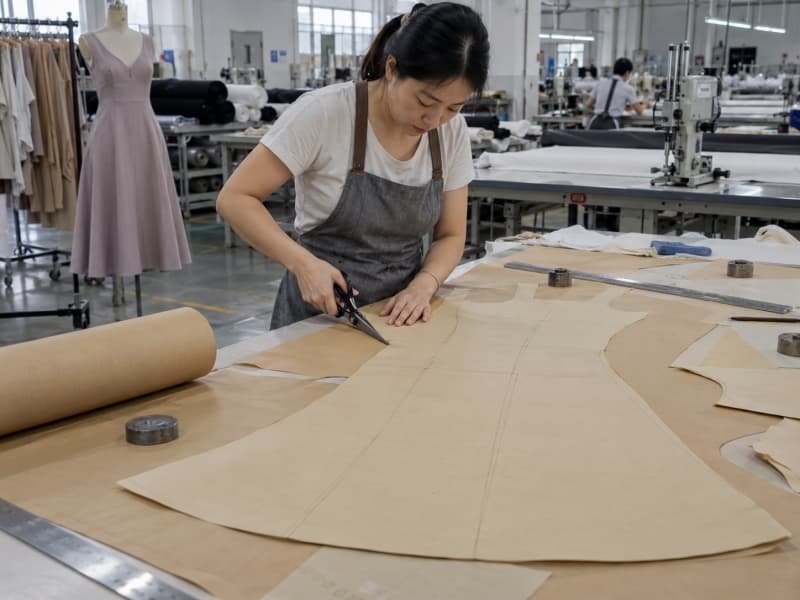
Lock the Silhouette
Terms such as “more flared,” “less bulky,” or “more skater” are useful in conversation but too subjective to control a production order. Once the visual direction is approved, the sample should be converted into measurable checkpoints. For an A-line dress, these often include waist or high-hip circumference, full hip where relevant, skirt length, hem sweep, flare start, and side-seam shape. For a skater dress, the relationship between the fitted waist and the opening skirt becomes even more important, so the team should record waist circumference, waist position, skirt attachment method, finished sweep, length, and the amount of fullness created by circular geometry, panels, pleats, or gathers.
Photographs and short movement videos are useful alongside the measurement specification because not every part of silhouette can be described by one number. Front, side, and back images can show how far the skirt sits away from the body, where folds naturally form, and whether the waist-to-skirt contrast is sharp or soft. If development is based on a reference image, the same principle applies before the first sample: identify the fit priority, fabric direction, silhouette target, and likely construction risks instead of asking the sample room to imitate the image blindly. This creates a clearer basis for revisions and reduces the chance that every sample round solves one problem while creating another.
Grade the Shape, Not Just the Size
Grading is one of the stages where a strong sample can become an inconsistent product range. Measurements need to increase or decrease across sizes, but the dress should still look like the same design. On a skater dress, simply increasing the waist and hem by fixed increments can change the relative fullness. If the skirt grows too quickly, larger sizes may appear dramatically fuller than the approved base size. If it grows too slowly, the silhouette can become straighter and lose the movement that defines the style. Tracking the relationship between waist circumference and hem sweep is therefore more useful than examining either measurement alone.
A-line dresses have a similar issue. Excessive side-seam expansion can make larger sizes look more triangular, while insufficient flare can reduce walking ease and cause the skirt to cling around the thigh. Product teams can monitor ratios rather than relying only on absolute measurements: bodice length to total dress length, waist circumference to hem sweep, waist position to hip position, and skirt length to flare development. These ratios do not replace fit testing, but they reveal unexpected changes quickly. Key sizes should still be reviewed on appropriate bodies or dress forms because digital grading can preserve mathematical increments while missing the way fabric and proportion change visually across the size range.
Build Production Checkpoints
A production specification should combine measurable checkpoints with visual controls because silhouette, drape, and movement cannot be reduced to one tolerance figure. The exact measurement tolerances should follow the brand’s approved technical standard and the style’s construction rather than being copied from a generic chart. A fitted waist may need tighter control than a very full hem, while a bias-heavy skirt may need extra attention to visual leveling even when the nominal length measurements are within tolerance. The objective is to control the areas that materially change appearance and wearability rather than creating a long measurement sheet that treats every point as equally important.
For A-line and skater dresses, the most useful checkpoints are those that connect pattern, fabric, sewing, and finished balance. Waist position confirms vertical proportion; finished waist and hip measurements control fit; hem sweep controls lower volume; grain direction helps prevent twisting; center-front, side, and center-back lengths reveal uneven drop; and movement review catches problems that static inspection can miss. When these points are checked before, during, and after production, the quality team has a practical way to compare bulk garments with the approved sample instead of relying only on general statements such as “the skirt looks too full” or “the silhouette feels different.”
| Production Check | Minimum Practical Record | What It Protects |
| Waist position | Vertical level at front, side, and back | Bodice proportion and skirt release point |
| Finished waist | Approved measurement plus brand tolerance | Fit and waist definition |
| Hip or high hip | Relevant circumference for the style | Movement and clean side seam |
| Skirt length | Center front, both sides, center back | Hem balance and uneven drop |
| Hem sweep | Finished circumference or approved pattern reference | Volume and movement |
| Grain direction | Panel grain against approved pattern | Twisting and asymmetric hanging |
| Fabric identity | Approved quality, lot, weight or test reference | Drape, stretch, recovery, opacity |
| Movement review | Walk, sit, stand, turn | Riding, twisting, lifting, recovery |
Protect the Sample-to-Bulk Transition
One of the most common mistakes in dress development is treating sample approval as the end of technical decision-making. In reality, approval is the point where production control becomes more important. Before bulk cutting, the team should confirm the final pattern version, fabric quality, lining, zipper, trims, seam construction, hem method, pressing requirements, grain direction, and any special handling needed for bias or stretch areas. If a material changes after approval, the silhouette should be reassessed because even a visually similar substitute can alter skirt fall, waist stability, opacity, and movement.
A structured transition also keeps design comments from disappearing between the sample room and the production line. Duolan’s dress-development workflow, for example, begins by clarifying the development basis, fit priority, fabric direction, and sample purpose, then reviewing feasibility and key risks before moving toward production readiness. That approach is useful for A-line and skater projects because it connects the visual target with practical manufacturing decisions instead of assuming that an approved sample will automatically reproduce itself in bulk. When the brand and manufacturer share one confirmed pattern, one material standard, one measurement specification, and one visual reference, repeatability improves and troubleshooting becomes faster if a production batch starts to drift from the approved silhouette.
A-Line and skater dresses can look closely related in a product grid, but their development logic is different enough to affect fit, fabric choice, movement, grading, and bulk stability. The A-line family is built around progressive expansion toward the hem, while the skater shape relies more strongly on a fitted upper body, defined waist, and a skirt that releases with visible energy. Fit-and-flare sits between and around these categories, which is why fashion terminology often overlaps even when the underlying pattern geometry is not the same.
The most reliable way to choose between them is to move beyond the label and describe the dress in measurable terms: where the waist sits, where the flare begins, how much hem sweep is required, how the fabric behaves, and how the shape should look across sizes and in motion. For brands developing new styles from tech packs, reference images, samples, or collection concepts, those decisions are also the foundation of a smoother sample-to-production process. When silhouette, fabric, fit, and construction are agreed early, the finished dress is much more likely to look intentional on the model, feel comfortable on the customer, and remain consistent when the order moves beyond the first sample.
Frequently Asked Questions
Is a skater dress the same as an A-line dress?
Not exactly. Both can create an A-like outline, but the way they create that shape is different. An A-line dress generally becomes wider progressively as it moves toward the hem, while a skater dress usually stays fitted through the bodice and waist before opening more noticeably below the waist. Many skater dresses can therefore be described as part of the broader fit-and-flare family, and some retailers may also tag them as A-line, but the waist contrast and skirt movement are usually stronger on a true skater silhouette.
What is the easiest way to tell an A-line dress from a skater dress?
Look first at the waist and then at the first 10-20 cm of the skirt below it rather than looking only at the hem. If the dress widens gradually with a smooth side line, it is more likely to read as A-line. If the bodice is clearly fitted and the skirt begins opening quickly from the waist, it is more likely to read as skater. Movement is another useful clue because skater skirts normally show more swing and rotation than a controlled A-line in comparable fabric.
Is a fit-and-flare dress the same as a skater dress?
Fit-and-flare is a broader category. It describes any dress with a relatively fitted upper section and a lower section that flares outward, so it can include structured midi dresses, cocktail styles, office dresses, and short party dresses. A skater dress is usually a more specific fit-and-flare variation with a clearly defined waist and enough skirt volume to create visible movement. In product development, it is more reliable to specify waist fit, flare point, length, and hem sweep than to depend on either label alone.
Which is more flattering, an A-line dress or a skater dress?
Neither silhouette is automatically more flattering because proportion matters more than the category name. A moderate A-line can create a long, clean visual line and provide room around the hip without adding concentrated volume at the waist. A skater dress places more emphasis on the waist and can create a stronger hourglass effect because the skirt expands quickly below it. The better choice depends on torso length, waist position, shoulder balance, desired coverage, fabric, and the amount of lower-body volume the wearer feels comfortable carrying.
Which fabrics work best for skater dresses?
Skater dresses can work in many fabrics, but the best choice depends on the desired movement and structure. Lightweight crepe, satin, viscose, and other fluid materials create softer swing, while poplin, compact crepe, jacquard, ponte, and other firmer materials hold the skirt farther from the body. Fabric weight, stretch, recovery, opacity, and drape should be reviewed together. A very full circle skirt in heavy fabric can become bulky, while an extremely light fabric may lift too easily or develop an uneven hem if large areas are cut near the bias.
Do A-line and skater dresses need different grading methods?
They use the same fundamental grading principles, but the proportions that need monitoring are different. On an A-line dress, the team should preserve the relationship between hip ease, side-seam flare, length, and hem width so larger or smaller sizes do not become noticeably straighter or more triangular. On a skater dress, the waist-to-hem relationship is particularly important because skirt volume defines the style. Grading should therefore be checked visually on key sizes rather than assuming that mathematically correct increments will automatically preserve the approved silhouette.
How can a brand keep the same silhouette from sample to bulk production?
The approved sample should be converted into a shared production standard that includes the final pattern version, waist and hip measurements, flare point, skirt length, hem sweep, grain direction, fabric quality, lining, construction, pressing method, and hem finish. Front, side, and back photos are useful because some visual features cannot be captured by a measurement table alone. When material substitutions or pattern revisions occur after approval, the silhouette should be reviewed again before bulk cutting so that small changes do not become large inconsistencies across a production run.