Skip to content

A metal repair can feel rock solid five minutes after application and still separate the first time the part becomes hot, wet, twisted, or exposed to vibration. That happens because metal bonding is not decided by the word “strong” printed on a tube. The metal alloy, coating, gap, load direction, operating temperature, moisture, preparation method, and curing conditions all influence whether a joint lasts for years or fails within days.
The best adhesive for metal-to-metal bonding depends on the application. Two-part epoxy is often preferred for strong, gap-filling repairs; structural acrylic works well when fast fixture and impact resistance matter; cyanoacrylate suits small, close-fitting components; anaerobic adhesive is designed for threads, shafts, bearings, and flanges; and polyurethane or hybrid systems are useful where flexibility and repeated movement are expected.
Consider a steel bracket that separated from an aluminum panel after a single summer outdoors. The adhesive may have been strong enough in a room-temperature test, yet the joint experienced water at the edges, different expansion rates between the metals, and a peeling force concentrated at one corner. Choosing a reliable metal adhesive therefore begins with understanding the entire joint, not simply choosing the product with the highest strength claim.
What Is Metal-to-Metal Adhesive?
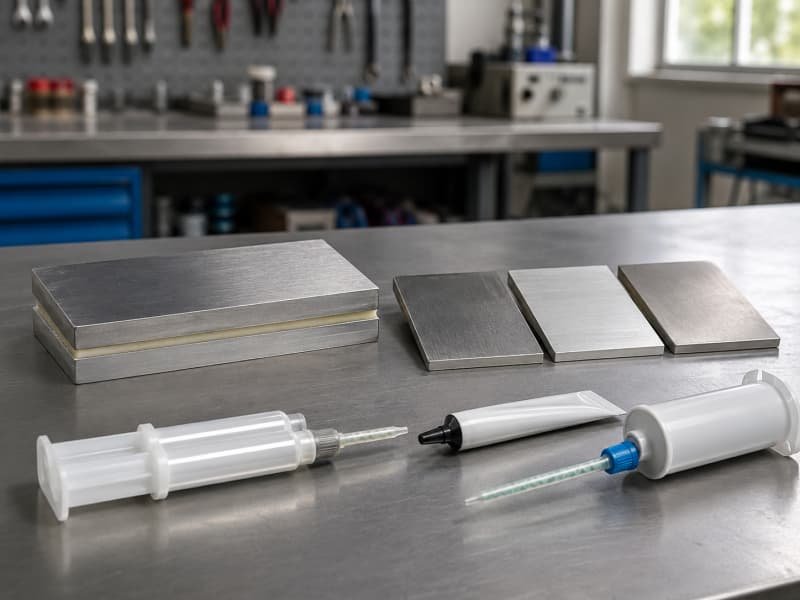
Metal-to-metal adhesive is a formulated bonding material that joins two metallic surfaces through chemical attraction, surface wetting, and mechanical interlocking. A successful bond depends on the adhesive chemistry, metal finish, surface preparation, bond-line thickness, load direction, temperature, moisture, and curing process. Structural epoxies and acrylics suit broad load-bearing joints, while cyanoacrylates and anaerobic products serve smaller or more specialized assemblies.
How Metal Adhesives Work
Metal adhesive must first spread across the surface before it can form a reliable bond. This spreading behavior is often described as wetting. When wetting is good, the liquid adhesive makes close contact with the metal, enters microscopic scratches and irregularities, and displaces air from the bond area. Oil, wax, silicone, water, polishing residue, or loose oxidation can prevent that contact even when the surface looks visually clean.
Different adhesive families cure through different chemical mechanisms. Epoxy hardens when resin and hardener react. Structural acrylic may use two reactive components or a separate activator. Cyanoacrylate polymerizes rapidly in a thin layer with the help of trace surface moisture. Anaerobic adhesive remains liquid in air but cures when confined between close-fitting metal surfaces where oxygen is excluded. These differences affect open time, fixture speed, packaging, gap capability, and application method.
After curing, the adhesive transfers force from one metal part to the other across the bonded area. A screw or rivet concentrates stress around a limited number of holes, while a properly designed adhesive joint distributes stress over a wider surface. That wider stress distribution can benefit thin sheet metal, decorative products, enclosures, vehicle trim, lighting components, signs, appliances, tools, and mixed-material assemblies.
The cured adhesive may also seal the joint, reduce vibration, prevent rattling, isolate dissimilar metals, improve appearance, and eliminate exposed fasteners. These advantages make adhesive bonding valuable beyond simple repair. In many manufactured products, the adhesive contributes simultaneously to structural performance, sealing, noise reduction, corrosion protection, and design freedom.
What Makes a Bond Structural?
A structural adhesive is intended to carry a meaningful load as part of the finished assembly. It does more than temporarily hold a decorative piece or keep a component aligned before another fastening step. The term does not mean that every structural adhesive can support unlimited weight or replace welding in every application. Structural performance always belongs to a defined joint, substrate, load, and environment.
Several properties influence structural performance. Lap-shear strength measures resistance when force acts parallel to an overlapping joint. Tensile performance describes resistance to pulling through the bond. Peel and cleavage resistance become important when force is concentrated near an edge. Toughness, elongation, impact resistance, and fatigue life determine how the joint behaves under sudden shocks, movement, and repeated vibration.
Joint geometry often matters as much as the adhesive formulation. A wide overlap generally performs more reliably than a small butt joint because the adhesive carries more of the load in shear. A butt joint concentrates stress at the edge and gives the adhesive little area to distribute force. Increasing overlap, adding a flange, or supporting the joint edge can improve performance without changing the adhesive.
Bond-line thickness also matters. Many structural metal joints use a controlled layer measured in fractions of a millimeter rather than an extremely thick mass of glue. A thin, continuous layer promotes efficient load transfer, while enough thickness must remain to wet the surfaces and accommodate small tolerances. The correct range depends on viscosity, chemistry, part geometry, movement, and the adhesive manufacturer’s data.
For commercial evaluation, useful test data should identify the exact metal, surface treatment, adhesive thickness, cure time, test method, temperature, and conditioning procedure. A strength value measured on grit-blasted carbon steel should not automatically be applied to powder-coated aluminum, polished stainless steel, galvanized sheet, or a greasy production component.
Is Metal Glue Permanent?
Metal glue can produce a long-lasting joint when the formulation, surface preparation, joint design, and service conditions are correctly matched. “Permanent” should not be interpreted as indestructible. Every adhesive has practical limits, and even a strong room-temperature bond can weaken when exposed to excessive heat, continuous moisture, aggressive chemicals, sustained load, repeated vibration, or movement between different metals.
Long-term deterioration often begins gradually. Water can move along the adhesive-metal interface. Heat can soften the polymer or accelerate aging. A constant load can cause slow deformation known as creep. Repeated vibration can create fatigue damage over thousands or millions of cycles. Corrosion can also form beneath an exposed edge and spread into the bonded area.
The weakest layer determines the final life of the joint. Adhesive applied over weak paint may remove the paint while remaining fully cured. Glue applied to rust may stay attached to corrosion that later separates from the steel. A rigid formula may perform well on a thick bracket but crack when used on a thin panel that flexes repeatedly.
Failure appearance provides useful information. Adhesive remaining mainly on one side often indicates an interface or preparation problem. Adhesive remaining on both surfaces can indicate cohesive failure inside the cured material. Paint attached to the adhesive suggests coating failure. Softening, swelling, discoloration, or cracking may point to heat, chemical, or environmental exposure beyond the product’s limits.
Users should also distinguish fixture time from full cure. A repair may feel firm after several minutes yet still require roughly 24 hours before reaching its intended strength. Moving, washing, heating, loading, or vibrating the joint too early can damage the developing bond even when no immediate separation is visible.
When Adhesive Makes Sense
Adhesive bonding is useful when welding, drilling, screws, or rivets would damage the metal, create visible marks, concentrate stress, add weight, or complicate assembly. Thin sheet can distort under welding heat. Decorative surfaces may not tolerate holes or weld discoloration. Dissimilar metals may be difficult to weld directly, while adhesive can join them through a continuous separating layer.
Common applications include metal housings, brackets, signs, lighting fixtures, handles, appliances, automotive trim, furniture, tools, electronic enclosures, machinery covers, HVAC components, and household repairs. Adhesive is also valuable when the same joint must be sealed against water, dust, air, or vibration while the parts are being joined.
Adhesive is less appropriate when the assembly must be dismantled frequently, the surfaces cannot be cleaned, the service temperature exceeds the polymer’s capability, or safety regulations require a qualified weld or mechanical connection. Large structural loads, pressure-containing equipment, overhead assemblies, and critical vehicle components may require engineering review and formal validation.
A combined joining method can provide a practical balance. Adhesive may be used with rivets, screws, clips, tabs, clinching, or spot welds. The mechanical feature holds the parts immediately and provides redundancy, while the adhesive seals the seam, distributes stress, reduces vibration, and increases stiffness across the assembly.
The decision should begin with the job rather than the product label. Define what metals are being joined, how they are loaded, how large the gap is, where the item will operate, how quickly it must be assembled, and whether disassembly will ever be required.
Which Adhesive Type Is Best?
No single metal adhesive is best for every joint. Two-part epoxy is a dependable option for strong, gap-filling repairs. Structural acrylic offers rapid fixture and good impact performance. Cyanoacrylate suits small, accurately fitting parts. Anaerobic adhesive works inside metal threads, shafts, bearings, and flanges. Polyurethane and hybrid products are useful where flexibility, vibration absorption, or differential movement matters.

Epoxy and Acrylic
Two-part epoxy is one of the most widely used metal-bonding systems because it can combine high strength, gap filling, dimensional stability, and resistance to water, oils, and many household or industrial chemicals. The resin and hardener must be mixed in the specified ratio, after which the material cures into a rigid or toughened polymer network.
Fast epoxies may set in several minutes, while slower structural grades can provide working times of 20, 30, 60 minutes, or longer. A longer cure does not automatically guarantee higher strength, but it can provide more time for assembling large parts and can allow different formulation choices for toughness, heat resistance, or chemical durability.
Epoxy is useful for brackets, tools, castings, frames, housings, equipment, metal furniture, and irregular repairs. Paste or putty grades can bridge scratches, casting texture, and moderate gaps. Low-viscosity grades flow into narrow joints more easily but may run on vertical surfaces. Metal-filled putties help rebuild missing material, although they should not be assumed stronger than a properly designed structural liquid adhesive.
Structural acrylic adhesive is commonly chosen when fast fixture, impact resistance, and production speed matter. It can work well on signs, panels, appliances, transport equipment, fabricated metal products, and assemblies where parts need to move quickly to the next manufacturing step.
Some acrylic formulations tolerate a light manufacturing oil film better than standard epoxies. That does not mean visible grease should be ignored. Cleaning still improves consistency. Acrylic systems may also have stronger odor, greater exothermic heat, and different storage requirements, so production conditions and worker handling must be reviewed.
| Adhesive family | Common working profile | Primary strengths | Important limitations | Typical metal applications |
| Two-part epoxy | Several minutes to over one hour | Strong, gap filling, widely available | Mixing required; cure slows in cold conditions | Brackets, castings, frames, tools, repairs |
| Structural acrylic | Often fast fixture with short or moderate working time | Tough, impact resistant, production friendly | Odor, heat generation, and compatibility vary | Panels, signs, appliances, transport parts |
| Cyanoacrylate | Very short positioning time | Fast, precise, one-component application | Limited gap filling and peel resistance | Jewelry, clips, models, small hardware |
| Anaerobic adhesive | Cures inside confined metal joints | Locks, seals, retains, and prevents loosening | Unsuitable for wide open bond lines | Threads, flanges, shafts, bearings |
| Polyurethane | Moderate or slower cure | Flexible, vibration absorbing, mixed-material capable | Lower rigidity and slower through-cure | Panels, trims, flexible construction |
| Hybrid adhesive | Varies widely by formula | Balanced adhesion, sealing, and flexibility | Product category covers very different properties | General repair and multi-material assembly |
Epoxy is often the practical choice for uneven surfaces, household repairs, and applications where the user needs repositioning time. Acrylic is often better when the factory needs rapid handling strength and the joint must tolerate impact or vibration. The final comparison should use actual metal parts rather than relying on a general ranking.
Super Glue and Anaerobic Adhesive
Cyanoacrylate, commonly known as super glue, bonds metal effectively when the parts are small, clean, and closely fitted. It is widely used for jewelry, electronic components, decorative hardware, clips, knobs, models, tools, and minor repairs where only a controlled drop is required.
Its extremely fast cure can be an advantage and a limitation. Parts must be aligned before contact because repositioning time may be only a few seconds. Applying more adhesive does not necessarily increase strength. A thick drop can cure less evenly, create a brittle mass, or leave visible residue around the bond.
Liquid cyanoacrylate suits very narrow gaps, while gel and high-viscosity grades provide more control on vertical surfaces and slightly irregular joints. Toughened cyanoacrylates may improve impact and vibration resistance, but broad panels, large brackets, outdoor assemblies, and wide gaps are generally better served by epoxy, acrylic, or another structural system.
Anaerobic adhesive works through a different mechanism. It remains liquid while exposed to air and cures when confined between close-fitting metal surfaces. Metal ions help activate the reaction, making the technology especially suitable for threads, flanges, bearings, shafts, bushings, gears, and sleeves.
Threadlockers help prevent nuts and bolts from loosening under vibration. Thread sealants fill the spiral leakage path in metal pipe connections. Retaining compounds secure cylindrical parts such as bearings and shafts. Flange sealants form a gasket between rigid metal faces while filling small machining imperfections.
Anaerobic products are available in different strength grades. A medium-strength threadlocker may allow normal servicing, while a high-strength retaining compound may require heat or special tools for disassembly. Stainless steel, plated parts, and passivated metals can cure more slowly than active metals such as plain steel or copper, so an activator may be useful.
Anaerobic adhesive is not normally suitable for two plates separated by a large open gap. Oxygen remains present, and the bond geometry does not provide the confined condition needed for full cure.
Flexible Adhesives
Polyurethane and hybrid adhesives suit joints that experience movement, flexing, vibration, or different rates of thermal expansion. Their elasticity allows the bond line to absorb some movement rather than transferring all stress directly to the metal surface.
This can be valuable when aluminum is joined to steel, metal is bonded to wood or plastic, or a thin panel is attached to a rigid frame. Aluminum and steel expand by different amounts as temperature changes. A slightly flexible adhesive can reduce the stress created during repeated heating and cooling.
Flexible bonding systems are common in vehicle interiors, construction panels, metal facades, furniture, appliance trim, equipment covers, and decorative assemblies. They can also reduce noise and rattling by forming a continuous layer between components.
Flexibility should not be confused with low strength. Some elastic industrial adhesives can carry substantial loads when the bonded area is large and the joint is designed correctly. The trade-off is greater movement under load, which can be unacceptable in precision fixtures, machinery alignment, bearings, or other rigid assemblies.
Important comparison values include tensile strength, elongation, Shore hardness, stiffness, skin time, cure rate, recommended bond thickness, weather resistance, paintability, and temperature range. A one-component moisture-curing adhesive may cure slowly in the center of a large closed metal joint because moisture reaches the interior only from the edges.
Hybrid adhesives vary significantly. Some behave mainly as sealants, while others offer semi-structural or structural performance. Product data should be reviewed carefully instead of assuming that every hybrid formula offers the same balance of strength and flexibility.
Choosing by Application
Product labels such as “industrial,” “heavy duty,” and “maximum strength” are less useful than a clear definition of the application. A small indoor ornament, an outdoor steel bracket, a vibrating machine shaft, and an aluminum vehicle panel require different adhesive behavior.
For a small, tight-fitting indoor component, cyanoacrylate may provide the fastest and cleanest solution. For a broken bracket with an irregular gap, a two-part epoxy is often more forgiving. For a factory line that needs handling strength within minutes, structural acrylic may be more suitable. For a bearing, flange, or threaded fastener, anaerobic chemistry is designed around the joint geometry.
The following questions help narrow the selection:
- Which exact metals and finishes are being joined?
- Is the joint tight, or must the adhesive fill an irregular gap?
- Will the load act mainly in shear, tension, peel, or impact?
- Will the parts vibrate, flex, or experience repeated movement?
- What are the lowest and highest operating temperatures?
- Will the joint contact water, oil, fuel, cleaners, or solvents?
- How much working and repositioning time is required?
- How soon must the assembly be handled, packed, or shipped?
- Must the joint be dismantled for maintenance?
- Which regulations and labeling requirements apply in the sales market?
Packaging also influences the real result. A technically strong adhesive can generate complaints when the nozzle is too wide, the cap clogs, the two components are difficult to measure, or the instructions do not clearly distinguish set time from full cure.
Fine metal nozzles suit narrow seams and precise repairs. Dual syringes simplify small two-part applications. Cartridges with static mixers improve ratio consistency in repeated assembly. Larger containers and metered equipment may be more economical for continuous production.
Which Metals Can You Bond?
Steel, stainless steel, aluminum, galvanized steel, copper, brass, and cast iron can all be bonded with suitable adhesive systems. The critical factor is the actual surface rather than the general metal name. Oil, rust, plating, paint, powder coating, anodizing, passivation, polish, and oxidation affect adhesion. Dissimilar metals also require attention to thermal expansion, electrical contact, and corrosion.

Steel and Stainless Steel
Carbon steel is generally straightforward to bond after oil, loose rust, mill scale, and unstable coating have been removed. Epoxy and structural acrylic are common choices for plates, brackets, frames, housings, machinery, furniture, and tools. Cyanoacrylate works on smaller close-fitting parts, while anaerobic adhesive is particularly useful for steel threads and cylindrical assemblies.
Manufactured steel may carry cutting fluid, stamping oil, corrosion inhibitor, protective wax, fingerprints, or workshop dust. The part can appear clean while still carrying a thin film that prevents wetting. Degreasing should therefore happen before abrasion so sanding does not spread oil or press it into the surface texture.
Loose rust must be removed because adhesive attached to corrosion is not directly bonded to sound steel. If rust has reduced the metal thickness, the part may no longer have enough structural strength for a simple adhesive repair. Gap-filling glue can fill pitting but cannot restore metal that has already been lost.
Stainless steel can also be bonded reliably, although its passive chromium-rich oxide layer and polished finish may reduce initial wetting or slow the cure of certain anaerobic systems. Polishing compounds, protective films, and fingerprints should be removed before bonding.
A practical stainless-steel process includes degreasing, controlled abrasion where appearance allows, dust removal, final cleaning, and prompt adhesive application. Abrasives and brushes previously used on carbon steel should not be used on stainless steel because transferred particles can lead to staining or localized corrosion.
For kitchenware, medical equipment, food-contact products, or consumer goods, bonding strength is only one part of the specification. Cleaning resistance, chemical documentation, migration requirements, hygiene, and regional compliance may also need to be reviewed before the formulation is approved.
Aluminum and Galvanized Steel
Aluminum is widely bonded in signs, lighting, windows, vehicles, appliances, electronics, furniture, and industrial equipment. Epoxy and structural acrylic products are frequently used, but preparation requires special care because aluminum forms a natural oxide layer very quickly.
The goal is not to prevent oxidation forever. The goal is to create a clean, stable, and repeatable surface that the adhesive can wet. For ordinary repairs, the sequence usually includes degreasing, light abrasion, particle removal, a final clean, and prompt bonding before fresh contamination reaches the surface.
Industrial aluminum programs may use anodizing, conversion coatings, chemical etching, or dedicated primers. These processes can improve environmental durability and batch consistency, particularly when assemblies are exposed to humidity, salt, heat cycling, or outdoor weather.
Aluminum also expands more than steel as temperature changes. When the two metals are bonded together across a long joint, repeated heating and cooling can create substantial stress. A toughened or moderately flexible adhesive can accommodate that movement better than an extremely brittle bond.
Galvanized steel has a zinc coating that protects the underlying steel from corrosion. Grinding away the coating may expose clean steel but can reduce corrosion protection. In many applications, the better approach is to bond to a clean, stable zinc surface with a compatible adhesive.
Galvanized surfaces vary. Hot-dip galvanizing, electrogalvanized sheet, passivation treatments, weathered zinc, and new zinc coatings can behave differently. Trial bonds should use the exact material and finish planned for production rather than a generic galvanized coupon.
Copper, Brass, and Cast Iron
Copper can be bonded with epoxy, acrylic, cyanoacrylate, polyurethane, and anaerobic adhesives. The surface is chemically active, which can accelerate the cure of some anaerobic products and shorten assembly time. Tarnish, flux residue, fingerprints, oils, and oxidation should be removed before bonding.
Electrical applications require an additional decision. Most general structural adhesives are electrical insulators, but conductive adhesives also exist. Conductivity, thermal transfer, corrosion, and compatibility with electronic components should be defined before choosing a formula.
Brass may be bare, polished, lacquered, plated, or chemically darkened. A clear lacquer can be difficult to notice, yet the adhesive will bond to that coating rather than directly to the brass. If the coating is weak, the complete joint can fail even while the adhesive remains attached.
Decorative brass and copper parts should be tested for staining, blooming, gloss change, and visible residue. Jewelry, lighting, bathroom fixtures, furniture hardware, and kitchen accessories often require both strong adhesion and a clean appearance.
Cast iron has a porous, rough surface that may retain machining oil below the visible area. Repeated degreasing, controlled warming, or a more thorough cleaning method may be needed. A single wipe is often inadequate when oil has penetrated the casting.
Paste epoxy and other gap-filling adhesives are useful on rough cast surfaces because they remain in the joint and bridge irregularities. Cracked castings that hold pressure, carry heavy loads, or operate at high temperature require professional evaluation. Adhesive may seal or reinforce some damage, but it is not a universal replacement for welding, brazing, or component replacement.
Dissimilar and Coated Metals
Adhesive bonding is often well suited to joining different metals because it forms a continuous layer between the surfaces. Common combinations include aluminum to steel, stainless steel to aluminum, copper to steel, and decorative brass to a structural metal frame.
Thermal expansion is one of the main design concerns. Different metals change dimensions by different amounts as temperature rises and falls. A long aluminum panel bonded rigidly to steel may place repeated stress on the adhesive during outdoor temperature cycles. Toughened chemistry, a controlled bond thickness, and suitable overlap help manage that movement.
Galvanic corrosion is another concern. When two dissimilar metals are electrically connected in the presence of water or salt, one metal may corrode more rapidly. Adhesive can reduce direct contact, but exposed edges, scratches, fasteners, and voids can still provide an electrical path.
Coated metal requires a separate evaluation because the adhesive bonds to the coating rather than the metal beneath it. The final joint can be no stronger than the coating-to-metal attachment. Paint, powder coating, anodizing, plating, lacquer, and passivation layers must be checked for strength and chemical compatibility.
| Metal surface | Main concern | Practical preparation | Adhesive selection focus |
| Carbon steel | Oil, rust, mill scale | Degrease, abrade, remove loose corrosion | Structural epoxy or acrylic |
| Stainless steel | Passive oxide and polish residue | Clean, abrade carefully, consider activator | Surface compatibility and cure speed |
| Aluminum | Rapid oxide formation | Prepare consistently and bond promptly | Toughness and thermal movement |
| Galvanized steel | Zinc coating and passivation | Clean gently and test the actual finish | Adhesion without damaging corrosion protection |
| Copper and brass | Tarnish, lacquer, staining | Remove oxidation and identify coatings | Cure speed and visual appearance |
| Cast iron | Porosity and absorbed oil | Repeated cleaning and gap-filling approach | Paste viscosity and heat resistance |
| Painted metal | Coating strength | Test coating adhesion before bonding | Compatibility with paint chemistry |
| Dissimilar metals | Expansion and galvanic corrosion | Isolate, seal edges, and control gap | Toughness and environmental durability |
Powder coating may be strong and stable, but formulations vary. Some powder coats bond well after cleaning, while others require abrasion or primer. Painted surfaces may soften when exposed to solvent-rich adhesive. Anodized aluminum can provide a reliable surface, although sealed and unsealed anodizing may behave differently.
Production testing should use finished parts from the intended supply chain. A successful result on bare laboratory metal does not prove that the adhesive will perform on the painted, plated, polished, or passivated component sold to the end user.
How Do You Prepare Metal?
Metal should be clean, stable, dry, and free of weak surface layers before adhesive is applied. A dependable sequence is to remove oil, abrade when appropriate, clear particles, perform a final clean, allow complete drying, and bond without touching the prepared area. Rust, loose paint, silicone, dust, wax, and condensation can cause failure even when the adhesive formula is suitable.

Degreasing and Cleaning
Surface cleaning determines whether the adhesive contacts the metal or remains separated by a contamination layer. Oil, grease, cutting fluid, fingerprints, silicone, wax, polish, release agents, and rust-prevention coatings can all reduce wetting and create inconsistent results.
Start by identifying the contamination. A light fingerprint film does not require the same process as bearing grease, silicone polish, or heavy machining oil. The cleaner must dissolve the contamination without damaging paint, plating, plastic components, or printed markings around the bond area.
A practical method uses one clean, low-lint cloth to loosen and remove contamination, followed immediately by a second dry cloth. Reusing one dirty cloth can spread oil across the surface. Cleaner should not simply be sprayed on and left to evaporate because dissolved contamination may remain after the solvent disappears.
Cleaning should normally happen before sanding. Abrading an oily surface can force contamination into scratches and spread it over a wider area. After abrasion, perform another clean to remove dust and any remaining residue.
Prepared parts should be handled with clean gloves. Bare fingers can deposit skin oil immediately. Compressed air must also be clean and oil-free; air from an poorly maintained compressor can recontaminate the surface.
For production, the cleaner, wipe material, number of passes, drying time, and glove requirements should be documented. A sample prepared carefully by a laboratory technician must be reproducible by normal operators during bulk manufacturing.
Abrasion and Rust Removal
Abrasion removes weak oxidation, increases surface area, and produces a more consistent texture. It is particularly helpful on polished, weathered, smooth, or coated metal. The goal is controlled preparation rather than aggressive grinding.
Very coarse sanding can cut deep grooves, distort thin sheet, damage decorative finishes, and trap air beneath a thick adhesive layer. Extremely fine polishing may smooth the surface without removing contamination effectively. A uniform medium abrasion is often more useful, but the correct abrasive should be confirmed on the actual metal and adhesive.
After sanding, all particles must be removed. Dust trapped in the bond becomes a weak layer. The surface should then receive a final compatible clean and be protected from fingerprints, humidity, and workshop debris.
Loose rust must be removed until a stable surface remains. Adhesive applied over flaky corrosion is attached to material that is already separating. Deep pitting may require a gap-filling product, although the remaining metal thickness should first be checked.
Paint and powder coating should not automatically be ground away. A stable finish may provide corrosion protection and may already be qualified as part of the manufactured product. Removing it can expose steel, create visible damage, or change dimensions. The coating should be tested before deciding whether direct metal exposure is necessary.
Primers and Passive Metals
Primer can improve adhesion, accelerate cure, protect a prepared surface, or increase reliability on passive metals and difficult coatings. It is not required for every metal adhesive, and unnecessary primer can add cost, variation, and another potential failure layer.
Stainless steel, aluminum, plated metal, and passivated surfaces can cure more slowly with certain anaerobic products. An activator may help when fast fixture is required or when the metal surface is not chemically active enough to support a predictable cure.
Cyanoacrylate primers can improve performance on difficult surfaces, while epoxy and acrylic systems may use specialized metal primers for moisture durability or corrosion resistance. The primer and adhesive should be treated as one tested system rather than mixing unrelated products.
Primer application needs control. Too much material can form a weak film. Bonding before the solvent flashes off can trap liquid. Waiting too long may allow contamination to return. Application amount, coverage, drying time, maximum open time, storage, and shelf life should all be defined.
Decorative metal requires appearance testing. Primer may change gloss, stain a coating, or become visible outside the bond area. Trial application should be made in a hidden area before full production.
Process Control
A preparation method must be repeatable. A single successful sample does not prove that the process will work across hundreds or thousands of parts. Production metal can arrive with different oil levels, coating batches, storage conditions, or surface roughness.
A written preparation specification should define the approved metal and finish, cleaner, wiping material, abrasive, abrasion pattern, drying time, maximum delay before bonding, glove requirements, primer method, and storage of prepared parts.
Temperature and humidity also affect consistency. Metal brought from a cold warehouse into a warm room can collect condensation. Cold adhesive becomes more viscous and often cures more slowly. Prepared steel left in humid air can begin oxidizing before assembly.
| Preparation stage | Main purpose | Practical control | Frequent error |
| Surface inspection | Identify oil, rust, coating, and damage | Record actual finish and contamination | Treating every steel part as identical |
| Initial cleaning | Remove grease and soluble residue | Use clean low-lint wipes | Spreading oil with one dirty cloth |
| Controlled abrasion | Remove weak layers and create texture | Standardize pressure and coverage | Grinding too aggressively |
| Dust removal | Eliminate abrasive particles | Vacuum or wipe with clean material | Using oily compressed air |
| Final cleaning | Remove remaining contamination | Use compatible residue-free cleaner | Touching the area afterward |
| Drying | Prevent water or solvent entrapment | Confirm surface temperature and dryness | Bonding over condensation |
| Timed assembly | Limit oxidation and recontamination | Define maximum delay before bonding | Leaving prepared parts uncovered |
Pilot parts should be prepared using the same steps intended for bulk production. Testing more than one metal or coating lot helps reveal supplier variation. Control coupons can be bonded alongside production parts and checked after cure.
Surface preparation is sometimes treated as simple labor, but it is one of the strongest predictors of adhesive reliability. A premium formulation cannot consistently overcome dirty, wet, corroded, or poorly controlled surfaces.
How Do You Bond Metal Properly?
Bond metal by dry-fitting the parts, controlling the gap, preparing both surfaces, dispensing the correct ratio, applying a continuous layer, assembling within the working time, and holding the joint without squeezing out all adhesive. Full load, water, heat, vibration, and machining should be delayed until complete cure. Reliable application depends on joint design, controlled dispensing, alignment, and curing conditions.

Fit and Joint Design
Dry-fit the parts before opening or mixing the adhesive. This confirms alignment, reveals the actual gap, and allows clamps or fixtures to be prepared before the working time begins.
A low-viscosity cyanoacrylate needs a narrow, close-fitting joint. A paste epoxy can bridge a larger irregularity. Anaerobic adhesive requires close metal contact and oxygen exclusion. A flexible polyurethane may work well in a thicker bond line where movement is expected.
Joint geometry should favor shear rather than peel. A broad lap joint distributes force across a larger area. A simple end-to-end butt joint concentrates stress at the edge and provides little resistance to bending.
Peel resistance can be improved by increasing overlap, adding a flange, supporting the outer edge, selecting a toughened adhesive, or combining glue with a mechanical feature. Rounded joint ends also reduce abrupt stress concentration.
A zero-thickness joint is not always desirable. Structural adhesives need enough thickness to wet both surfaces and accommodate tolerances. Excessive clamp force can squeeze out too much adhesive and create direct metal contact, leaving a starved bond.
Very thick layers can shrink, trap air, generate heat, and permit excessive movement. When the gap exceeds the adhesive’s recommendation, the part design should be corrected, a spacer should be added, or a specialized repair compound should be used.
Mixing and Application
Two-part adhesives must be dispensed in the correct ratio and mixed completely. Incorrect proportioning can leave soft, tacky, brittle, or partially cured material. Hand mixing should continue until the color and texture are uniform, including material from the edges of the mixing surface.
Dual syringes and cartridges simplify proportioning, but setup still matters. Both components should reach the outlet before a static mixer is attached. The initial small amount may need to be discarded when the manufacturer specifies that step.
Working time begins when the two components meet. A large mixed mass can react faster and become hotter than the same material spread into a thin layer. Only enough adhesive for the immediate assembly should be prepared.
Apply a continuous layer sufficient to wet the joint. Too little material leaves dry spots and voids. Too much increases squeeze-out, cost, cure heat, and the risk of parts floating out of alignment.
Common application errors include using contaminated tools, measuring components by eye, applying material after it has thickened, leaving corners uncoated, trapping air through aggressive mixing, and touching the package nozzle to dirty metal.
Packaging should match the task. Fine nozzles support narrow seams and detailed household repair. Dual syringes suit small two-part applications. Cartridges with static mixers improve ratio control during repeated assembly. Metered equipment can reduce waste and variation in high-volume production.
Clamping and Cure
Clamps and fixtures keep the parts aligned while the adhesive develops handling strength. Their purpose is stability rather than maximum pressure. Excessive force can squeeze adhesive out, distort thin metal, or shift the assembly.
Spring clamps, screw clamps, magnets, tape, weights, temporary rivets, jigs, and vacuum fixtures can all be effective. Decorative surfaces may require soft pads to prevent marks. Long panels need pressure distributed across the full length rather than concentrated at one point.
Fixture time is the stage when the part can usually be removed from support. Handling strength means the assembly can be moved carefully. Full cure is the stage when the adhesive approaches its intended final performance. These times may differ by several hours.
A fast epoxy may set within five or ten minutes yet still require approximately 24 hours before full loading. Cold conditions slow the reaction. Excessive heat shortens working time and can cause large mixed quantities to cure rapidly.
The joint should not be pulled, twisted, or bent to test it during early cure. Microscopic movement can damage the developing interface even when the parts appear to remain attached.
Full cure should normally be reached before the assembly is loaded, washed, immersed, heated, exposed to chemicals, machined, sanded, drilled, tightly packed, or operated under vibration.
Failure Prevention
Most failures come from a mismatch between the adhesive, surface, joint, or process. A stronger formula will not solve every problem.
Oil, silicone, rust, weak paint, incorrect mixing, expired adhesive, poor storage, excessive clamping, late assembly, insufficient cure, peel loading, high heat, water exposure, and uncontrolled gaps are among the most common causes.
The separated parts should be examined before cleaning. Photographs can preserve useful evidence. Adhesive remaining mainly on one surface suggests an interface problem. Adhesive split between both surfaces may indicate cohesive failure. Paint or oxide attached to the glue suggests that the surface layer failed.
Bubbles and voids can result from aggressive mixing, uneven application, rough surfaces, or insufficient adhesive volume. In transparent or appearance-sensitive repairs, a controlled dispensing method becomes especially important.
Production programs should retain approved reference samples, raw-material lot information, viscosity checks, cure observations, and packaging records. Bulk material can then be compared with the agreed standard.
A robust process should be repeatable by trained operators using clear instructions and practical tools. When success depends on one technician judging the amount by instinct, the formula, nozzle, fixture, or instructions should be improved.
Is Metal Adhesive Strong Enough?
Metal adhesive can be strong enough for household repair, industrial assembly, machinery, sealing, and structural products when the joint is designed and validated correctly. Strength must be assessed through shear, peel, impact, vibration, heat, water, chemical exposure, and aging. A high laboratory number alone does not prove suitability, and replacing welding requires realistic testing and compliance review.

Strength and Load Direction
The phrase “strongest metal glue” is incomplete because adhesive strength changes with the metal, surface preparation, overlap, bond thickness, cure schedule, temperature, and direction of force.
Lap-shear testing is common because overlapping metal strips create a repeatable joint loaded parallel to the adhesive layer. Structural adhesives often perform well in shear. Peel and cleavage tests are more severe because force becomes concentrated along a narrow edge.
A rigid adhesive may report a high shear value but fail when a thin panel flexes repeatedly. A slightly lower-strength but tougher formula can provide better real-world life under impact and vibration.
Bonded area also affects capacity. Increasing overlap generally allows more load transfer, although stress is not distributed perfectly evenly. Making the adhesive excessively thick is not an efficient substitute for improving the joint area.
Published data should identify the test type, units, metal grade, preparation method, bond thickness, cure conditions, test temperature, aging treatment, and average variation. A single value without these details is difficult to apply responsibly.
Engineering designs should include a safety factor rather than operating continuously near the maximum laboratory result. Real products contain edges, tolerances, contamination, production variation, and environmental aging that ideal test coupons may not represent.
Water, Heat, and Chemicals
Water resistance must be defined by the actual exposure. Occasional splashes, rain, repeated washing, hot water, saltwater, and continuous immersion create different demands.
Water may not dissolve the cured adhesive, yet it can move along the interface, weaken adhesion, or promote corrosion beneath exposed edges. Outdoor joints should be designed to avoid standing water, and exposed bond edges may need sealing or coating.
Heat can soften the polymer, reduce stiffness, accelerate creep, and shorten service life under load. Short-term peak temperature is different from continuous operating temperature. An adhesive may survive brief heat while losing substantial strength during prolonged exposure.
Thermal cycling is often more demanding than steady heat. Each cycle makes the metal expand and contract. Dissimilar metals create additional stress because their expansion rates differ.
Chemical resistance is also specific. Oil, gasoline, diesel, alcohol, alkaline cleaner, acid, detergent, disinfectant, and solvent can affect the same adhesive differently. Testing should use the actual fluid concentration, contact duration, temperature, and mechanical load.
| Exposure condition | Useful evaluation | Main risk | Practical precaution |
| Occasional water | Visual inspection and retained adhesion | Moisture entering at edges | Allow full cure and seal exposed edges |
| Continuous immersion | Long-duration conditioning | Interface degradation | Use a formula tested for immersion |
| Elevated temperature | Strength measured while hot | Softening and creep | Separate peak and continuous limits |
| Thermal cycling | Repeated hot-cold exposure | Expansion stress | Use toughened chemistry and controlled gap |
| Oil or fuel | Retained strength and swelling check | Softening or chemical attack | Test the exact fluid |
| Cleaning chemicals | Repeated wipe or soak cycles | Surface degradation | Match real concentration and contact time |
| Saltwater | Humidity and salt conditioning | Galvanic and edge corrosion | Isolate metals and protect the joint |
| Outdoor weather | Heat, moisture, and exposed-edge aging | Gradual durability loss | Combine adhesive with coating and drainage |
Room-temperature strength should not be used as the only basis for engine parts, outdoor panels, appliances, marine accessories, cleaning equipment, or machinery. The joint should be tested in the conditions that matter.
Vibration, Gaps, and Aging
Adhesives can resist vibration effectively because they spread load and reduce the microscopic movement that loosens mechanical fasteners. Toughened epoxy, structural acrylic, flexible polyurethane, anaerobic threadlocker, and hybrid systems are all used in vibration-prone assemblies.
The right stiffness depends on the product. A precision metal fixture needs rigidity. A thin vehicle panel may need flexibility and fatigue resistance. A very hard adhesive can crack at the edge of a moving panel, while a soft formula may permit too much movement in a tightly aligned machine.
Anaerobic threadlockers prevent threaded fasteners from rotating loose. Retaining compounds fill small gaps between shafts, bearings, bushings, and sleeves while resisting shock and vibration.
Gap-filling performance must be matched to the formula. A paste epoxy can bridge an uneven repair. Standard cyanoacrylate needs a thin bond line. High-viscosity grades tolerate somewhat larger gaps, but none should be used beyond the stated capability.
Excessive thickness can increase shrinkage, trapped air, cure heat, and movement. Very large voids may need a spacer, insert, redesigned component, or repair compound developed for deep filling.
Long-term aging combines sustained load, humidity, vibration, heat cycling, corrosion, cleaning, UV exposure at the edges, and polymer creep. Accelerated aging can compare formulas but cannot always predict an exact number of service years.
Commercial development commonly progresses through initial adhesion, water conditioning, heat testing, chemical exposure, thermal cycling, vibration, storage stability, and pilot production on actual components.
Welding Replacement and Validation
Adhesive can replace welding in many engineered assemblies, especially thin sheet, decorative metal, mixed materials, enclosed panels, signs, appliances, and products where heat distortion or visible weld marks are unacceptable.
Adhesive bonding can join dissimilar materials, distribute stress, avoid drilled holes, seal the joint, isolate surfaces, reduce vibration, and simplify appearance. It also allows parts to be connected without the localized heat introduced by welding.
Its limitations must be respected. Adhesive requires controlled preparation, dispensing, curing, and inspection. It may not satisfy structural codes that specifically require welding or mechanical fastening. Fire exposure, pressure, overhead loads, and safety-critical failure consequences need formal evaluation.
Hybrid joining is often the most practical solution. Adhesive can be combined with screws, rivets, clinching, tabs, or spot welds. Mechanical features provide immediate handling and backup, while the adhesive seals the seam and spreads the load.
Before replacing welding, the validation plan should consider static load, impact, fatigue, vibration, temperature, water, fire, corrosion, manufacturing variation, repairability, and applicable standards.
For custom or private-label metal adhesive development, the initial brief should include the exact metals, finishes, gap, joint drawing, load, working time, fixture time, cure time, temperature, chemicals, package size, annual volume, sales countries, and target performance benchmark.
GleamGlee supports metal adhesive development for retailers, distributors, hardware chains, repair-product companies, e-commerce brands, Amazon FBA sellers, and industrial users. Available services include mature formula selection, formulation adjustment, viscosity optimization, cure-speed development, precision-nozzle packaging, cartridge systems, multilingual instructions, label design, and destination-market documentation.
More than 25 chemists, materials specialists, and process engineers support adhesive testing, surface compatibility studies, accelerated aging, filling, packaging, and scale-up. Custom projects may begin from 200 units depending on the formulation and package. Packaging artwork can be prepared in as little as two days, samples commonly require 7–14 days, and standard bulk production is generally completed in approximately 20 days after approval.
Available documentation and labeling support may include SDS, CLP, REACH, GHS, ISO 9001, ISO 14001, UFI integration, and market-specific instructions based on the formula and destination. Regional warehousing and logistics support are available for North America, Canada, the United Kingdom, Germany, Europe, and other international markets.
To request a quotation or sample, provide the metals being joined, surface treatment, expected gap, service temperature, exposure conditions, required cure speed, package size, target sales market, order quantity, and reference product. The technical team can recommend an existing formula or prepare a customized solution for evaluation on the actual application.