Skip to content


Fashion brands are entering 2026 with a difficult combination of modest market growth, cautious consumers, changing trade rules, shorter product cycles, and greater pressure to protect margin. That does not mean brands should simply cut development. It means every new dress must earn its place in the collection. A style now needs a clear wearing occasion, reliable fit, controlled cost, suitable materials, and a production route that can move from sample approval to repeat orders without losing quality.
The 2026 custom dress manufacturing outlook points toward focused collections, tighter cost control, diversified sourcing, faster development, stronger material traceability, and more disciplined sample-to-bulk management. Brands are likely to favor manufacturers that combine dress-specific technical knowledge with reliable capacity, quality systems, compliance support, and the ability to scale proven styles.
The broader fashion market is not collapsing, but easy growth is becoming harder to find. McKinsey expects the global fashion industry to post low single-digit growth in 2026, while the World Trade Organization expects merchandise trade volume growth to slow from 4.6% in 2025 to 1.9% in 2026. Those figures do not tell a brand which satin midi, corset mini, or vacation maxi will sell. They do show why weak product decisions, late approvals, unstable materials, and avoidable rework will be harder to absorb.
Picture a buying team reviewing two nearly identical satin dresses. One has a slightly lower opening price. The other has a corrected bust balance, confirmed color continuity, documented workmanship, tested materials, and reserved repeat-order capacity. In 2026, the second dress may be the less expensive decision once returns, delays, and missed replenishment are counted.
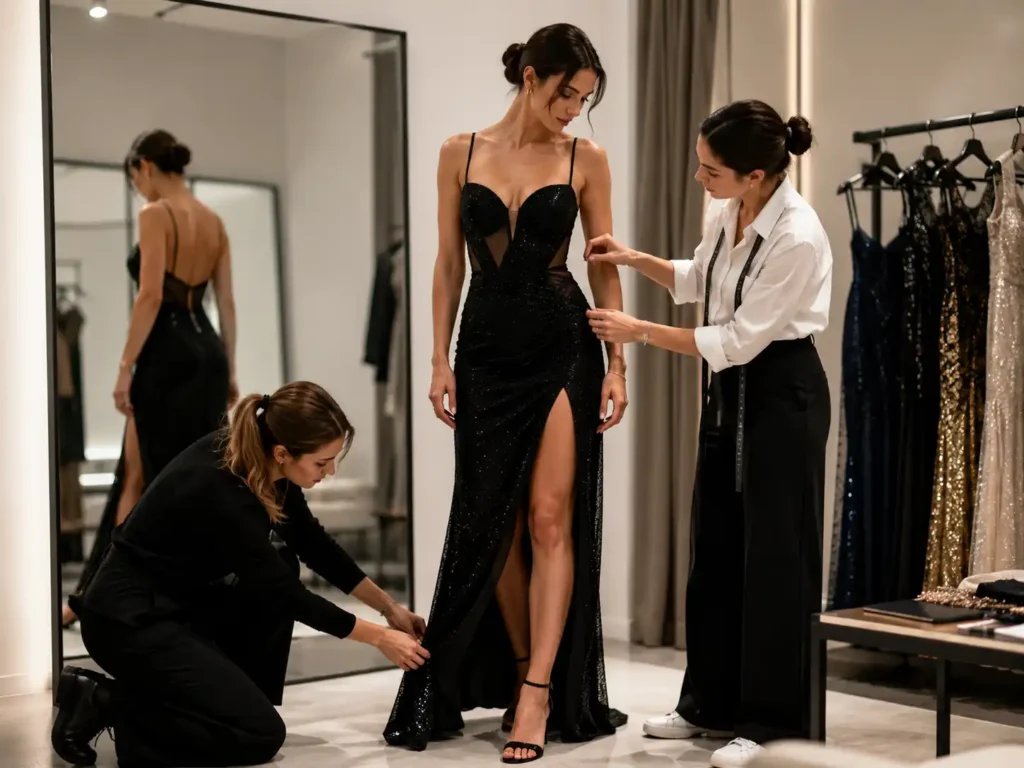
What Is Shaping Dress Manufacturing in 2026?
Custom dress manufacturing in 2026 is being shaped by modest fashion growth, cautious consumer spending, trade uncertainty, shorter launch calendars, and pressure to hold less inventory. Brands are still developing newness, but they are approving styles more selectively and judging suppliers on landed cost, sample accuracy, material control, compliance readiness, repeat-order speed, and capacity reliability.
How Is Dress Demand Changing?
Dress demand is not disappearing, but purchasing decisions are becoming more deliberate. Consumers still buy for weddings, graduation, holidays, birthdays, vacations, formal events, parties, dinners, and other social occasions. The difference is that a dress now needs a clearer reason to be purchased. Weak fit, ordinary fabric, or a vague wearing occasion is harder to hide when customers can compare more options and are watching their spending.
For product teams, demand planning should move beyond broad labels such as “mini dress” or “occasion dress.” A commercially useful brief is more precise: a packable vacation maxi for a warm climate, a supportive party mini for evening wear, a wedding guest midi that remains comfortable for several hours, or a satin style designed around repeat colors. Each description gives the design, sourcing, pattern, costing, and manufacturing teams a clearer target.
Strong collections usually contain several product roles. Campaign pieces create attention. Commercial styles balance visual impact, achievable cost, and broad wearability. Core styles use repeatable materials and proven construction. Test styles introduce a new silhouette or detail in a controlled quantity. Repeat candidates are engineered around stable fabric, scalable workmanship, and clear replenishment records. Problems arise when every visually dramatic design is expected to become a high-volume seller.
Demand should also be evaluated by customer use rather than photography alone. Ask how long the garment will be worn, whether the customer will sit or dance, whether special underwear is required, how the fabric behaves after travel, and whether the retail price feels justified when the dress is handled in person. These questions connect market demand to manufacturing reality.
| 2026 indicator | Current signal | Effect on dress programs | Practical response |
| Global fashion growth | Low single-digit growth forecast | Weakly differentiated styles face greater sell-through pressure | Approve styles with a clear occasion, customer role, and price position |
| Executive sentiment | 46% expect conditions to worsen; 25% expect improvement | Development budgets receive closer scrutiny | Rank styles before sampling and stop weak concepts earlier |
| World merchandise trade | Growth forecast to slow from 4.6% in 2025 to 1.9% in 2026 | Freight, trade, and sourcing plans remain exposed | Build time and cost buffers into seasonal calendars |
| U.S. apparel sourcing | Top seven Asian suppliers provide 78% of imports | Diversification remains concentrated in major Asian systems | Compare technical capability and landed cost, not wages alone |
| Generative AI adoption | More than 35% of executives report use in selected functions | Research may accelerate faster than physical development | Connect digital decisions to fabric, fit, and sample validation |
Are Brands Planning Smaller Collections?
Many brands are planning more focused collections rather than simply reducing product count. A focused range can still contain mini, midi, maxi, party, vacation, fitted, and occasion dresses. The difference is that overlapping designs are removed and every approved style has a defined commercial job.
A useful collection plan separates campaign styles, dependable commercial products, core repeat programs, controlled test styles, and likely replenishment candidates. This gives teams a practical reason to spend more development time on the products that matter most. Pattern technicians can study fit more carefully, fabric teams can compare realistic alternatives, and buying teams can consolidate material demand instead of dividing it across too many small commitments.
Reducing the number of styles without improving the decision process does not solve inventory risk. A collection of twenty poorly differentiated dresses can be more dangerous than a collection of forty well-planned products. The deciding factor is whether each style serves a distinct customer, occasion, price point, or merchandising need.
Color planning deserves the same discipline. A six-color proposal may look attractive during a line review, but every color introduces dyeing minimums, shade risks, photography costs, SKU complexity, and slower stock movement. Launch colors should be separated from colors that can be added after sales data is available. A focused collection is not a cautious collection; it is one in which creativity and inventory are directed toward products with a credible route to market.
Which Markets Are Driving Orders?
The United States, United Kingdom, Europe, and Australia remain important dress markets, but the same garment cannot be planned for every region without adjustment. Climate, event calendars, body proportions, retail channels, labeling, compliance, and price expectations all affect product decisions.
U.S. dress programs often cover several climate zones and large ecommerce audiences. British brands operate in a highly competitive online market where product newness and event dressing are important. Australian brands frequently build strong vacation, summer, party, and social-event categories on a seasonal calendar opposite to the Northern Hemisphere. European programs increasingly require stronger product information, material records, and preparation for sustainability-related rules.
Before approving one style for several markets, teams should check garment length, lining and opacity expectations, size assumptions, care labeling, climate suitability, testing requirements, local event timing, packaging, barcode rules, and the final retail price after duty and freight. A lightweight unlined style may work in one channel but generate transparency complaints in another. A highly structured corset dress may justify a premium price for occasionwear but be too expensive for a broad promotional category.
A global collection does not require completely different products for every country. It requires enough technical and commercial adjustment to prevent one market’s assumptions from being imposed on another. The best suppliers ask where the dress will be sold before they finalize fabric, fit, construction, and packing.
What Do Tariffs Mean for Brands?
Tariffs influence more than the import bill. They can change target costs, supplier geography, fabric selection, retail pricing, margin, order quantity, and the number of styles approved for production. USFIA reports that China, Vietnam, Bangladesh, Cambodia, India, Indonesia, and Pakistan together supply 78% of U.S. apparel imports. China remains the largest supplier by quantity, while Vietnam leads by value.
A tariff comparison should be completed at product level. Duty treatment can vary with fiber composition, garment type, and construction. Applying one assumed rate across an entire collection can distort product margins. Teams should also separate factory cost from landed cost so that changes in freight, duty, insurance, inspection, and financing remain visible.
The lowest sewing quotation does not automatically produce the lowest landed result. A lower price can be offset by imported materials, extra sample rounds, longer lead times, rework, higher inspection costs, airfreight after delay, or poor fit that increases returns. Complex dresses often depend on a manufacturing ecosystem of fabrics, linings, cups, boning, zippers, printing, embroidery, embellishment, testing, and packaging. Moving final assembly does not always remove those dependencies.
Diversification works best when suppliers are assigned according to product strength. A partner that performs well on basic jersey dresses may not be suitable for corset structures, delicate satin, fitted mesh, or dense decoration. Brands should model several landed-cost scenarios and ask which technical capability is being gained or lost with each sourcing move.

Which Dress Categories Will Lead Demand?
Occasion, party, vacation, fitted, and visually distinctive dresses should remain commercially important in 2026. Strong products will combine an obvious wearing occasion with reliable fit, suitable materials, controlled construction, and repeat-order potential. Trends may attract initial attention, but brands gain more from silhouettes and details that can be delivered consistently across sizes, colors, production batches, and selling seasons.
Are Occasion Dresses Still Important?
Occasion dresses remain valuable because they are linked to a recognizable purchase moment. Weddings, graduation ceremonies, homecoming, birthdays, holidays, formal dinners, vacations, and parties give customers a direct reason to seek a new outfit. The category is broad, however, and each occasion creates different product requirements.
A wedding guest dress may need comfort for sitting, dining, dancing, and several hours of wear. A graduation dress must work under a gown, photograph well, and allow movement. A club dress may prioritize secure body contour and visual impact. A vacation maxi needs airflow, packability, opacity, and easy care. Treating all occasionwear as one technical category often produces dresses that look attractive in a static image but fail during actual use.
Before development begins, the brief should explain how long the garment will be worn, how the customer will move, whether special underwear is required, whether internal cups or grip tape are needed, how the fabric behaves after packing, and which details justify the retail price. These practical questions influence neckline stability, strap position, skirt sweep, lining, closure, and material selection.
Occasionwear performs best when the product creates a strong first impression without punishing the wearer. A dramatic dress that feels insecure may generate returns and one-time purchases. A well-engineered style can support multiple colors, seasonal updates, and reliable repeat orders because customers trust how it fits and feels.
Which Silhouettes Will Matter?
Bodycon, corset, bustier, halter, backless, one-shoulder, drop-waist, ruched, draped, mini, midi, and maxi silhouettes all have commercial potential. The real difference lies in execution. A bodycon dress is not created by simply reducing garment measurements. The pattern must account for fabric stretch, recovery, seam placement, lining tension, and negative ease.
Corset and bustier styles require a balance between visual structure and wearable comfort. Cups, boning, seam position, lining, neckline shape, and closure must work as one system. A small change in cup position can alter the neckline, underarm, waist, and center-front length. Halter and backless products depend on strap angle, internal elastic, grip tape, hidden panels, or controlled body tension to remain secure.
Draped and drop-waist dresses also require disciplined grading. The relationship between torso length, waist position, hip level, and skirt volume changes across sizes. Adding equal increments everywhere may distort the original proportion. Fit reviews should include front, side, and back balance; neckline position during movement; bust containment; waist and hip placement; strap security; zipper behavior; sitting comfort; walking movement; and hem level after the garment has rested.
The silhouettes that lead demand will not necessarily be the most unusual ones. They will be styles that feel current while remaining comfortable, understandable to the customer, and repeatable on a production line. Experienced pattern and sample teams are especially valuable when a design uses stretch, exposed skin, internal support, or asymmetric construction.
What Fabrics Will Brands Prioritize?
Satin, mesh, jersey, chiffon, crepe, lace, velvet, sequined fabrics, and structured stretch materials will continue to support fashion-led dress collections. Fabric names alone are not enough because two materials sold under the same description can behave very differently.
Satin varies in weight, shine, drape, snag resistance, opacity, and seam performance. A light satin can create fluid movement but expose seam impressions and undergarment lines. A heavier satin may improve coverage while changing cost and skirt fall. Mesh should be evaluated for stretch direction, recovery, transparency, surface feel, and compatibility with lining. Jersey needs relaxation and shrinkage control because its dimensions can change after unrolling, cutting, steaming, or washing.
Before bulk approval, the material record should include fiber composition, weight per square meter, full and usable width, stretch in both directions, recovery, shrinkage under the intended care method, colorfastness, opacity, snagging or pilling risk, dye-lot control, lining requirements, minimum order, and replenishment lead time. A small swatch cannot show every one of these risks.
The best fabric is not always the most expensive or visually dramatic option. It is the one that creates the intended appearance, fits the target price, and remains stable through cutting, sewing, finishing, customer wear, and repeat production. A substitute must be treated as a new technical decision because changes in stretch, weight, drape, or thickness may require pattern corrections and new fit approval.
How Will Dress Details Evolve?
Ruching, draping, pleating, cut-outs, corset panels, sequins, pearls, stones, embroidery, prints, and mixed decorative techniques will continue to help dresses stand out online. The strongest details will add recognizable value without making the garment unnecessarily fragile or difficult to reproduce.
Every decorative process affects more than appearance. Dense sequins increase weight and change the way a skirt falls. Stones create local stress on lightweight materials. Pleating changes consumption and may behave differently after steaming. Draping depends on grain, notches, seam construction, and operator handling. Cut-outs alter tension around the body and may expose lining or support components.
Before approval, teams should ask whether the effect remains consistent across sizes, feels comfortable against the skin, survives dressing and transport, can be repeated in reorders, and adds enough customer value to justify the cost. A first sample can hide difficulty because one skilled sample maker spends extra time perfecting it. Bulk production requires templates, positioning marks, stitch counts, process photographs, approved density, and attachment tests.
Duolan’s development background includes sequins, print combinations, pearls, beadwork, rhinestones, embroidery, and other fashion-focused surface processes. The useful skill is not adding decoration for its own sake. It is understanding how decoration interacts with fabric strength, silhouette, movement, comfort, production variation, and order scale.

How Are Costs and Sourcing Changing?
Dress costs in 2026 are being influenced by materials, labor, construction complexity, tariffs, testing, packaging, freight, and the efficiency of the development process. Brands should compare total landed cost and production risk rather than selecting a supplier from the lowest opening quotation. A useful quote must define the product, quantity, materials, workmanship, commercial terms, and assumptions behind the price.
What Is Raising Production Costs?
Dress cost begins with fabric consumption but rarely ends there. A fitted corset dress may contain outer fabric, lining, cups, boning, fusing, elastic, binding, a concealed zipper, and multiple shaped panels. A sequined style may require special cutting, seam clearing, reinforcement, needle control, and additional inspection. A draped satin design can consume more fabric than its finished dimensions suggest because pattern pieces cannot be tightly nested.
Development quality also affects cost. An unclear technical package creates repeated samples, incorrect material sourcing, pattern revisions, and lost production time. A late fabric decision can force air shipment or a more expensive replacement. An unresolved fit issue can reappear as bulk alteration, rework, claims, returns, or a missed market date.
Cost reduction should begin with engineering rather than late-stage pressure on the factory. Removing an unnecessary panel, controlling decorative density, changing a hidden trim, simplifying a seam, or selecting a stable lining can reduce cost without damaging the design. Replacing the main fabric only to meet a target price can change drape, opacity, fit, and perceived quality. A cheaper material that prevents repeat orders is not a genuine saving.
A useful costing discussion explains what creates the price and what can be changed. The brand should understand whether the biggest driver is fabric, manual decoration, complex fitting, small color quantities, special testing, packaging, or low cutting efficiency. Once the driver is visible, design and buying teams can decide where compromise is acceptable.
| Cost area | Data required for a reliable quote | Common reason for later change | Useful control |
| Main fabric | Composition, weight, usable width, unit price, consumption, color quantity | Final material is narrower, heavier, or more expensive | Recalculate consumption from confirmed bulk fabric |
| Lining and support | Coverage, cups, boning, fusing, elastic, tape, padding | Internal construction was unclear in the first brief | Approve internal construction with the outer design |
| Workmanship | Panel count, seam type, draping, ruching, closures, finishing | Sample reveals more operations or manual handling | Prepare an operation breakdown after a workable sample |
| Decoration | Method, size, density, placement, attachment, test requirement | Artwork or coverage changes after the estimate | Approve a strike-off or decoration panel before final cost |
| Order structure | Units by style, color, size, and expected repeat volume | Total units are split across more colors or small lots | Quote the actual color and size split |
| Testing | Destination market and product-specific test matrix | Requirements are added after order confirmation | Confirm testing during development |
| Packaging | Hanging or flat pack, protection, barcode, carton limits | Delicate dresses need extra protection or larger cartons | Run a packing trial before PO finalization |
| Trade terms | Currency, Incoterm, destination, duty assumption, validity | Freight, exchange rate, or tariff treatment changes | Keep factory cost and landed cost separate |
Is China Still Competitive?
China remains competitive for custom fashion dresses when a program depends on rapid material sourcing, strong sample rooms, experienced pattern development, special processes, and the ability to scale approved products. Its advantage is less obvious when the comparison is limited to sewing wages.
Complex dress manufacturing depends on an ecosystem. A supplier may need quick access to satin, mesh, lace, jersey, sequined fabric, linings, cups, boning, zippers, embroidery, printing, dyeing, washing, testing, and specialized packaging. When these resources are close to the development and production teams, problems can be corrected without restarting the sourcing process.
Country selection should consider sample accuracy, number of revision rounds, local material access, special-process capability, production-line experience, quality management, repeat-order readiness, freight reliability, and duty exposure. China is often strongest where product complexity and development density are high. Simpler, stable products may be suitable for a wider range of locations.
Duolan’s South China base benefits from the mature textile and accessory networks around Guangdong, including fabric markets, trim resources, printing, embroidery, dyeing, washing, and finishing partners. Its wider manufacturing system includes sixteen owned fashion factories and more than twenty long-term satellite factories. Actual project suitability still depends on style, fabric, complexity, quantity, and delivery schedule.
How Are Brands Diversifying Suppliers?
Brands are diversifying production to manage tariffs, capacity constraints, shipping risk, geopolitical exposure, and category specialization. Effective diversification creates additional capability. Poor diversification creates duplicated development work and inconsistent standards.
One supplier may be strong in fitted occasion dresses. Another may perform well with basic jersey products. A regional factory may support urgent replenishment. A specialist may handle embroidery or hand-applied decoration. Assigning work according to proven strength is usually more effective than asking every factory to produce every category.
Brands should also examine hidden material dependency. A garment may be sewn in one country while its lace, mesh, zipper, cups, or embellished fabric still comes from another. Moving final assembly does not automatically remove supply concentration. Patterns, measurement records, fitting comments, material standards, artwork, and defect references should remain under brand control so that a second source does not need to rediscover the product from the beginning.
A new supplier should be evaluated with an equivalent technical challenge. Useful measures include days to first sample, number of major revisions, measurement accuracy, material sourcing time, sample-to-bulk consistency, on-time delivery, problem response, material continuity, and landed cost after inspection and logistics. A second source is valuable only when it can reproduce the intended standard.
Which Costs Should Quotes Include?
A professional quotation should make clear what is included, excluded, and subject to change. A single unit price without a product basis is difficult to compare. At minimum, the quote should identify the style version, main fabric, lining, consumption basis, trims, internal support, special processes, quantity by color, size range, packaging, testing, delivery term, currency, validity, and conditions that trigger repricing.
Brands should distinguish an early estimate from a confirmed bulk quotation. An early estimate is useful for design decisions, but it cannot be fully reliable while fabric, construction, color split, and quantity remain open. A confirmed quotation should follow an approved or near-approved sample, when actual consumption, operation time, decoration, packing, and production risk can be assessed.
The quote should also explain volume effects. A larger order may improve material price and sewing efficiency, while small quantities per color can remain expensive. High volume can require additional inspection, project coordination, or capacity reservation. A transparent quotation does not guarantee the lowest number; it gives the brand a stable basis for deciding whether design, margin, quality, and production can work together.
For complex products, ask the supplier to identify the cost-sensitive elements before the sample is finalized. A small change to lining coverage, cup type, boning, zipper, decorative density, or pattern yield may protect the visual result and bring the product closer to target cost without creating a lower-quality version of the original idea.
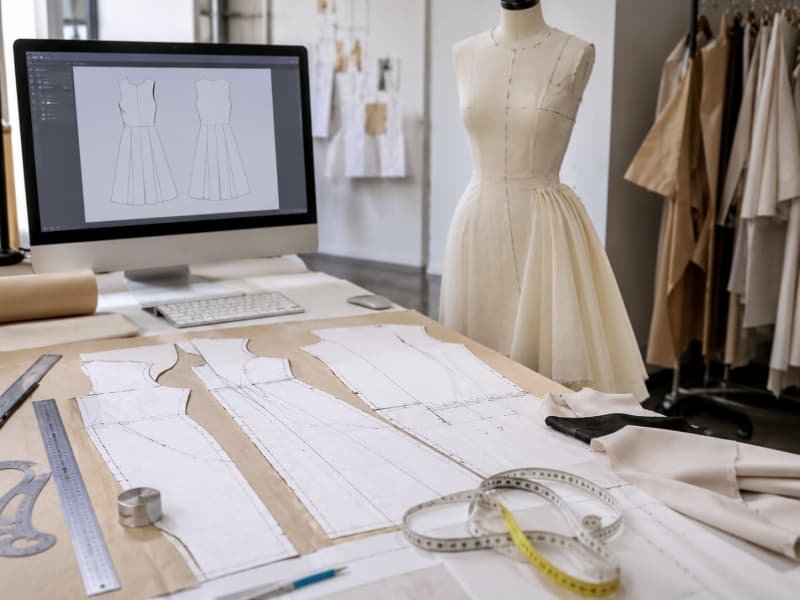
How Will Development Become Faster?
Dress development will become faster through clearer technical information, earlier material decisions, structured sample comments, stronger project ownership, and selective use of AI and 3D tools. Real speed is not the fewest days to any sample. It is the shortest controlled route to an approvable garment that preserves design intent, fits correctly, meets cost targets, and can be repeated in bulk.
How Are AI and 3D Used?
AI is increasingly used to organize trend information, compare assortments, summarize customer reviews, create early design variations, and support demand planning. Three-dimensional tools can help teams review color, length, proportion, and basic silhouette before every physical variation is sampled. These tools are valuable because they reduce time spent processing weak options.
They do not confirm physical performance. A digital dress cannot prove that a neckline remains stable during movement, satin drapes without puckering, mesh recovers after several hours, a zipper stays flat in a fitted silhouette, boning feels comfortable, or lining remains hidden. AI may suggest an attractive detail without understanding sewing sequence, fabric availability, minimum order, or cost.
A practical workflow uses data and AI to identify promising occasions, colors, and silhouettes; creates controlled visual concepts; reviews material and construction feasibility with the manufacturer; and then moves the strongest options into pattern development, physical sampling, fitting, movement checks, and production engineering. Digital tools should narrow the field, not replace the checks that determine whether the product is wearable.
The strongest teams will combine machine speed with experienced judgment. Trend signals can be processed quickly, but someone still needs to decide whether a low-back satin dress will remain secure, whether a sequin fabric can be cut consistently, and whether the approved look can survive several thousand units of production.
Do Better Tech Packs Reduce Errors?
A good tech pack reduces assumptions. It gives designers, pattern technicians, sample makers, sourcing teams, and quality inspectors one controlled description of the product. Useful files include front, back, and detail views; point-of-measure diagrams; base-size specifications; grading rules; fabrics; trims; stretch direction; stitch requirements; artwork; color standards; labels; packaging; testing; fit-model information; and tolerances.
More pages do not automatically create a better package. Contradictory measurements, outdated drawings, copied construction notes, and unclear artwork can create more mistakes than a shorter, accurate document. The manufacturer should review the package before cutting and flag conflicts. A low back may not work with the proposed zipper. A neckline opening may be too small for dressing. The specified fabric may not provide the support shown in the sketch.
The tech pack should be updated after fittings. If the waist, cup, lining, closure, or measurements change, the file used for bulk production must show the final decision. Scattered email comments combined with an unchanged original file are a common cause of production error. The final pre-production version should match the sealed sample and clearly identify any approved difference.
Good technical communication does not remove the need for discussion. It makes the discussion specific. When a factory asks focused questions before sampling, it usually indicates that the team is checking feasibility instead of making silent assumptions.
How Can Sampling Cycles Shrink?
Sampling becomes faster when every sample has a defined purpose and comments are measurable. Many delays are caused not by sewing time but by incomplete briefs, late fabric decisions, slow internal feedback, and several major changes being introduced in one revision.
A controlled sequence may include a first prototype for design interpretation, a fit sample for measurements and support, a revised sample for agreed corrections, a sales or photography sample for presentation, and a pre-production sample for the final manufacturing standard. Not every style needs every stage. A proven pattern in a familiar fabric can move faster than a new corset dress in an untested material.
Comments should describe the required action. “The waist looks wrong” leaves room for interpretation. “Raise the center-front waist seam by 1.5 cm and the side seam by 1 cm” gives the pattern technician a measurable correction. Front, side, and back photographs; pinned changes; updated measurements; approved items; responsibility; priority; and return deadlines all shorten the next round.
Brands should measure their own response time as carefully as supplier lead time. A sample cannot stay on a ten-day calendar when it waits two weeks for comments or when design, buying, and fit teams send conflicting instructions. One consolidated comment file and one decision owner can remove days from development without asking the sample room to sew faster.
What Supports Faster Reorders?
Fast repeat orders depend on records created during the original development and first production run. Without them, a reorder becomes a partial redevelopment. A repeat-ready style should have an approved pattern, grading, material reference, color standard, workmanship record, critical measurements, packaging specification, and production history.
Material continuity must be discussed before the first order. A stock fabric may disappear after one season. A custom dye lot may require a new minimum. A particular sequin, buckle, zipper, or trim may not be available when the product needs replenishment. For high-potential styles, brands can reserve greige fabric, maintain approved core trims, or qualify an alternative during initial development.
Repeat speed should be measured through preparation, not only sewing. The team needs to know how long it takes to confirm material availability, approve a new dye lot, reserve the correct line, issue the size breakdown, and recheck packaging. A well-documented product can move quickly because the important decisions have already been made.
| Development metric | Calculation | What it reveals | Useful management response |
| First-sample cycle | Days from complete brief and material confirmation to dispatch | Actual sample-room responsiveness | Separate factory time from delays caused by missing information |
| Measurement accuracy | Approved points within tolerance ÷ points checked × 100 | Pattern and sample execution quality | Review repeated errors by silhouette and pattern type |
| Major revision count | Rounds involving fit, fabric, or construction changes | Quality of the brief and technical interpretation | Identify whether the issue began with design, material, or execution |
| Approval lead time | Days from development start to production-ready approval | Total process effectiveness | Record waiting time between decisions |
| Comment turnaround | Days from sample receipt to consolidated feedback | Internal decision speed | Use one owner and one comment file |
| Sample-to-bulk conversion | Styles entering production ÷ styles sampled × 100 | Development productivity | Review why sampled styles were cancelled |
| Reorder preparation | Days to confirm materials, pattern, quantity, and line | Repeat-production readiness | Pre-approve alternatives for fragile components |
| On-time sample rate | Samples dispatched by agreed date ÷ samples due × 100 | Calendar reliability | Track standard and complex products separately |

What Quality Risks Will Brands Face?
The main dress-quality risks are fit deviation, unstable materials, inconsistent construction, shade variation, weak decoration, lining problems, and differences between approved samples and bulk production. Final inspection alone cannot control these issues. Effective quality management begins with fabric and pattern decisions, continues through pre-production and inline checks, and ends with measurable inspection standards, traceable records, and corrective action.
Which Fit Problems Cause Returns?
Fit problems are particularly damaging in dresses because the garment controls several areas of the body at once. A small error at the bust, neckline, waist, hip, strap, or back opening can change comfort and appearance across the entire style. Flat measurements are necessary, but they do not describe pattern balance.
Two dresses can meet the same width specifications and fit differently because of dart position, seam shape, front-to-back length, stretch direction, or lining tension. Halter dresses require stable necklines and correctly angled straps. Backless styles need controlled gaping and support. Corset dresses depend on cup position, under-bust shape, waist alignment, and closure balance. Bias-cut products require grain control, hanging time, and careful hemming.
Fit should be evaluated while the wearer stands, sits, walks, turns, and raises her arms. A dress that looks correct in a front-facing photograph may become insecure during movement. High-risk styles also need size-set review. Adding equal increments everywhere can move straps outward, deepen necklines, distort cups, or change waist placement.
Measurement tolerances should be agreed by point of measure. Structural areas may require tighter control than a wide skirt sweep or a long hem. The tolerance should reflect fabric stretch, construction method, product risk, and the brand’s fit expectation rather than one generic number applied to the entire garment.
How Should Fabrics Be Controlled?
Fabric control begins before cutting and continues through production. Each delivery should be checked against the approved standard for composition, width, weight, color, surface appearance, stretch, hand feel, and visible defects. Testing should reflect the material, care method, product use, and destination market.
Depending on risk, relevant checks may include dimensional stability, colorfastness, stretch and recovery, pilling, abrasion, seam slippage, tensile or tear strength, print durability, embellishment attachment, skew, spirality, restricted substances, and flammability where legally applicable. OEKO-TEX STANDARD 100 assesses textile articles and components against more than 1,000 harmful substances, with stricter requirements for greater skin contact. It supports material-safety evidence but does not replace order-specific performance testing.
Results must lead to action. If shrinkage exceeds the pattern allowance, the pattern or process must change. If mesh has poor recovery, the product should not be approved simply because the first sample looks attractive. If dye lots vary visibly, shade segregation and packing controls are needed. Satin, velvet, and other directional surfaces also require marker planning so that pile, grain, and viewing angle remain consistent.
The bulk fabric should be compared with the material used for the approved sample. Differences in weight, finish, stretch, or shade can alter fit and appearance even when the supplier article number appears similar. Production should not begin until the team understands whether the bulk material needs a pattern or process adjustment.
What Can Fail in Complex Dresses?
Complex dresses often fail because several acceptable-looking components do not work together after assembly. A structured satin style may combine slippery outer fabric, fusing, cups, boning, lining, and a concealed zipper. A problem in one part can change the overall silhouette.
Common failures include boning ending at a pressure point, cups positioned differently from the sample, lining cut shorter than the shell, zippers inserted under uneven tension, mesh seams stretched during sewing, sequin edges left rough against the body, stones pulling away from lightweight fabric, draping varying between operators, and hems becoming uneven after hanging.
A quality plan should identify critical operations before bulk production. The line may need templates, approved operation samples, photographs, notches, positioning guides, stitch-density requirements, or a first-output review. The first completed garments should be checked before the full order advances. Correcting ten garments is easier than correcting one thousand.
Final inspection can use an AQL-indexed sampling plan when agreed by the brand and supplier. ISO 2859-1:2026 provides lot-by-lot acceptance sampling schemes and switching rules for normal, tightened, reduced, and skip-lot inspection. The selected AQL, inspection level, and defect categories should be written into the quality agreement rather than assumed.
| Risk area | Measurable control | Production checkpoint | Evidence to retain |
| Fit and measurements | Approved specification and point-specific tolerances | First output, inline checks, final inspection | Measurement reports by size |
| Fabric and shade | Approved swatch, lab dip, dye-lot identity, defect grading | Fabric inspection and cutting release | Roll inspection and shade records |
| Stretch products | Approved stretch direction and recovery result | Spreading, cutting, first sewing output | Test result and marked pattern direction |
| Structured bodice | Cup, boning, seam, and closure placement | Pre-production sample and first-line output | Internal construction sample |
| Draping and ruching | Notches, gathering ratio, placement reference | Operator setup and inline comparison | Sealed operation sample |
| Embellishment | Position, density, attachment, strength requirement | Trial panel, inline check, final inspection | Approved strike-off and test record |
| Lining | Shell-to-lining relationship and hem position | Pre-production and first output | Lining measurements and construction photos |
| Final lot | Agreed sampling plan and defect classification | After packing and before shipment | Inspection report and corrective action |
Are Testing and Traceability Essential?
Testing and traceability are becoming part of commercial readiness, not just compliance administration. Brands need to know which materials were used, where they came from, which production batch they entered, and which test and inspection records support the finished product.
The EU textile strategy calls for products that are more durable, repairable, recyclable, free of hazardous substances, and supported by better information. The strategy includes Digital Product Passports and wider producer responsibility. The ban on destroying unsold textiles and footwear applies to large enterprises from 19 July 2026, increasing the value of better inventory and product records.
Practical traceability may include the main fabric supplier and article number, fiber declaration, dye lot, lining and trim sources, lab dips, test reports, production factory and line, cutting batch, packing batch, inspection result, shipment details, and corrective-action history. These records make problem isolation faster. If a zipper fails in one color or a shade problem appears in one dye lot, the affected units can be identified without treating the entire program as unknown.
Duolan’s factory system has completed a SMETA 2-Pillar audit and maintains a SMETA social-audit record. It can coordinate projects that require customer-specific standards and testing connected with systems such as BSCI, ISO 9001, AATCC, ASTM, OEKO-TEX, EN, China GB standards, and GOTS. The exact audit, certification, and test scope should be confirmed for each order and destination market.
How Should Brands Plan Production?
Brands should plan dress production backward from the required market date, allowing time for material sourcing, sampling, fitting, testing, pre-production approval, bulk manufacturing, inspection, and transport. Capacity must be reserved according to product complexity, not only quantity. Repeat-order routes should be discussed before launch so successful styles can scale without losing fabric continuity, fit, workmanship, or delivery control.
When Should Capacity Be Reserved?
Capacity should be discussed once the brand has a credible style list, estimated quantities, delivery date, material direction, and complexity assessment. Waiting until every detail is approved can leave no suitable production line available, especially before graduation, summer, homecoming, holiday, and year-end party seasons.
Total factory capacity is not the same as suitable capacity. A line experienced in simple knit garments may not be appropriate for fitted satin, corset structures, draping, mesh insertion, or dense embellishment. The correct line needs trained operators, suitable equipment, technical support, and enough time for the expected quality level.
A practical calendar is built backward from the required warehouse or launch date. Initial feasibility review may take roughly two to five working days after complete information is received. Available fabrics and trims may require one to three weeks, while custom development can take longer. First samples often require one to three weeks, fit and revision one to four weeks, testing and pre-production preparation one to three weeks, and bulk production three to eight weeks depending on quantity, complexity, material readiness, and line availability. These are planning ranges, not universal promises.
Duolan’s broader manufacturing system includes approximately 300 sewing lines and more than 50 rapid-response and flexible lines. Its stated regular group capacity is about 6.5 million garments per month, with peak capacity of up to 10 million. Project capacity is still matched according to fabric, style complexity, required workmanship, order structure, and confirmed schedule.
How Should Sample-to-Bulk Be Managed?
The move from approved sample to bulk production should be treated as a controlled transfer. Visual approval alone is not enough. Before cutting, teams should lock the final pattern and grading, measurements and tolerances, fabric, lining, trims, color standards, decoration, internal construction, labels, packaging, testing status, inspection plan, and delivery calendar.
A pre-production meeting should identify operations most likely to affect fit, appearance, or consistency. For a corset dress, these may include cup placement, boning, neckline, waist seam, zipper, and lining. For a satin bias dress, grain direction, fabric relaxation, seam handling, pressing, and hemming may be more important.
The first production output should be reviewed before the full order advances. The approved sample must be clearly identified because factories sometimes receive several samples carrying different corrections. A sealed pre-production reference, final tech pack, and written approval record should all point to the same standard.
Production changes need control. When bulk fabric behaves differently from sample fabric, the response should be documented and approved. Quietly adjusting a pattern or operation on the line can create size and batch inconsistency. Sample-room success becomes commercial success only when the product standard is translated into repeatable production instructions.
What Should Brands Ask Suppliers?
Supplier evaluation should move beyond price, minimum quantity, and a general lead-time promise. Those details matter, but they do not reveal whether the supplier can protect the product from first sample through repeat production.
- Which dress categories, fabrics, and silhouettes are developed most frequently?
- Who reviews the tech pack before sampling and who owns fit corrections?
- How are fabric stretch, shrinkage, shade, opacity, and surface defects checked?
- How are corset, halter, backless, draped, and bodycon styles controlled?
- How many major sample revisions are common for comparable products?
- How is the approved sample translated into line instructions and inspection points?
- Which operations are checked inline and how are tolerances recorded?
- How are external printing, embroidery, dyeing, washing, and embellishment partners managed?
- Can several styles be developed and produced in parallel without losing control?
- How are rush reorders, material continuity, testing, and customer-specific compliance handled?
- Who is responsible for communication and corrective action when a problem appears?
Strong answers describe people, records, and checkpoints. “We offer high quality” is not enough. A useful answer explains who checks the first production output, which measurements are critical, how material batches are identified, and what happens when a result falls outside the approved standard. A reliable supplier should also be willing to identify limits rather than claiming equal expertise in every product and every lead time.
Which Evidence Proves Readiness?
Manufacturing readiness is proven through a chain of evidence. One capacity number, one audit report, or one attractive showroom cannot demonstrate that a supplier can execute a specific dress program. Useful evidence includes comparable samples, pattern and fit records, fabric inspection, material approvals, technical comments, pre-production samples, operation standards, inline reports, measurement records, test documents, final inspection, corrective action, and repeat-order performance.
Capacity claims should be interpreted carefully. Brands need to know whether figures refer to one factory, a manufacturing group, owned facilities, or partner facilities. They should ask how capacity is divided between categories and whether the relevant technical lines are available during the required period.
Duolan focuses its website and development resources on fashion dresses, occasion dresses, party dresses, fitted and body-conscious dresses, fashion sets, and refined fashion tops. The company’s manufacturing foundation combines nearly three decades of dress-development experience with fabric and process resources, sample and pattern teams, owned factories, satellite capacity, quality coordination, and formal social-audit support.
The strongest evidence is connected. The sample demonstrates product understanding. The technical file shows how the result will be repeated. The production plan identifies the right line. Inspection records show how quality will be measured. Audit and traceability documents demonstrate supply-chain discipline. When those elements support one another, a brand can evaluate the supplier as a long-term manufacturing partner rather than a source of isolated quotations.
The 2026 outlook does not suggest that fashion brands should stop taking creative risks. It suggests that creativity needs stronger manufacturing decisions. Brands are likely to gain more from collections built around clear occasions, approved materials, disciplined fit, transparent cost, repeat-order planning, suitable technical capacity, and measurable quality control.
A slower market makes good manufacturing more valuable. When consumers are selective, a poor neckline, unstable fabric, or missed delivery has less room to hide. When margins are pressured, unnecessary sample rounds and bulk rework become more damaging. When tariffs and supply chains change, a manufacturer with strong material access and organized project management becomes a strategic asset.
Duolan Apparel supports fashion brands with custom development and manufacturing for mini, midi, and maxi dresses; party and occasion dresses; vacation and fitted dresses; and satin, mesh, jersey, velvet, sequin, and other fashion-led collections. Projects can begin from a tech pack, reference sample, design concept, fabric direction, or structured collection brief.
Request a Project Review: Share your intended styles, target market, quantities, fabrics, size range, and delivery schedule so the team can review development, cost, sampling, production routing, quality control, and repeat-order feasibility.