Skip to content


The lowest factory quote is not always the least expensive way to manufacture a fashion collection. A CMT supplier may quote only cutting, sewing, trimming, and finishing, while the brand separately pays for fabrics, trims, pattern development, material transport, inspections, storage, and the people required to coordinate every supplier. Full-package production may appear more expensive per garment, yet it can remove many of those fragmented costs and responsibilities.
Full-package production is usually better for brands that need one manufacturing partner to coordinate development, materials, sampling, production, quality control, and packaging. CMT is usually better for brands that already control patterns, approved materials, technical specifications, and supplier relationships. The right choice depends on internal capability, product complexity, required control, total cost, and the amount of production risk the brand can manage.
The real decision is therefore not simply, “Which quotation is lower?” It is, “Which operating model allows our team to launch the right product, at the right quality, on the right date, without creating hidden work and unmanaged risk?” A fashion team once saved several dollars on a sewing quotation, only to miss its launch because the lining arrived late, the zipper supplier shipped the wrong color, and nobody had clearly accepted responsibility for checking material compatibility. That is where the difference between CMT and full-package production becomes commercially important.
What Are Full-Package and CMT Models?
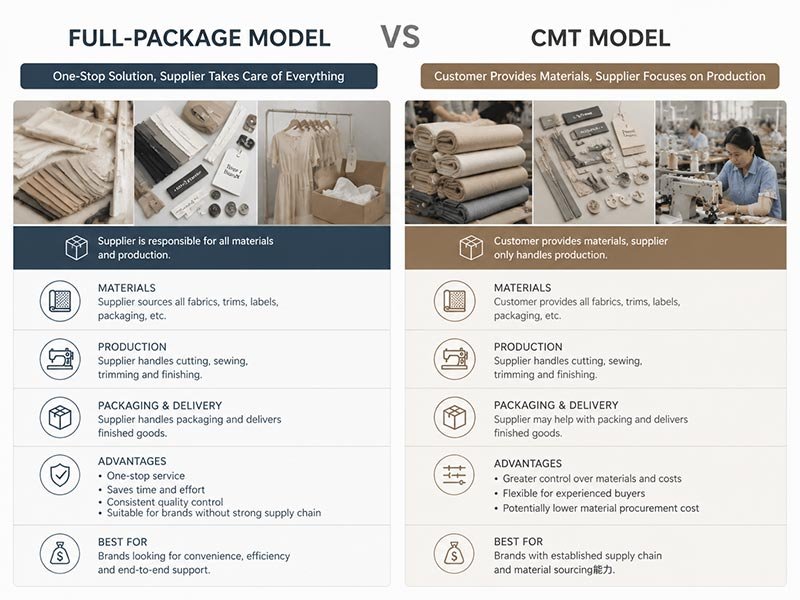
Full-package production covers a broad manufacturing scope, often including product development, material sourcing, sampling, production, quality control, and packaging. CMT – Cut, Make and Trim – focuses mainly on manufacturing garments from materials, patterns, and specifications supplied by the brand. The key difference is how development, sourcing, coordination, cost, and production responsibility are divided.
What CMT Includes
In a CMT arrangement, the factory is primarily responsible for converting production-ready materials into finished garments. The brand or its sourcing office normally provides the fabric, lining, trims, labels, approved patterns, measurement specifications, construction instructions, and production sample.
The factory then completes the agreed operations, which may include:
- Fabric spreading, marker control, and cutting
- Bundling, shade grouping, and size identification
- Sewing, assembly, pressing, and agreed finishing work
- Measurement checks, loose-thread removal, and basic packing
The exact meaning of “Trim” should always be confirmed. Some factories include sewing thread, standard polybags, pressing, and carton packing in the CMT price. Others quote only cutting and sewing, while every zipper, hook, elastic, cup, piece of boning, label, and packaging item must be supplied by the brand.
CMT is most effective when the product has already been fully developed. A factory can accurately sew a fitted satin dress when it receives a correct pattern, approved materials, clear seam instructions, and a sealed production sample. It cannot safely compensate for an unsuitable fabric, an incomplete grading rule, or a poorly balanced pattern unless technical development has been added to the agreement.
For that reason, CMT is an execution model rather than a reduced-price version of full-package production. The apparent simplicity of the factory scope shifts a significant amount of technical and supply-chain work back to the brand.
What Full-Package Includes
Full-package production places more operational responsibility with the manufacturer. The brand still controls design direction and final approvals, but the manufacturer coordinates many of the steps needed to turn an idea into a finished order.
- Technical review of sketches, tech packs, or reference samples
- Fabric, lining, trim, label, and packaging sourcing
- Pattern development, grading, prototypes, fit samples, size sets, and pre-production samples
- Lab dips, print strike-offs, trim approvals, and material alternatives
- Bulk purchasing, cutting, sewing, external processes, finishing, and inspection
- Packing, export preparation, and shipment coordination where agreed
A capable full-package manufacturer does more than purchase materials and add them to the garment price. It connects design decisions with manufacturing consequences. Changing from matte crepe to lightweight satin, for example, may alter drape, seam appearance, opacity, pressing temperature, lining choice, and pattern balance. These effects should be identified during development, not after bulk fabric has been cut.
Full-package production does not remove the brand from decision-making. The brand must still approve fabric, color, fit, workmanship, cost, packaging, and production standards. The manufacturer centralizes execution; it does not replace commercial judgment.
Where the Models Differ
The clearest way to understand the two models is to compare ownership of each production activity. The table below reflects common practice, but every project should be confirmed in writing because manufacturers use these labels differently.
| Production activity | CMT model | Full-package model |
| Design direction | Brand | Brand |
| Tech pack preparation | Brand | Brand or jointly refined |
| Pattern development | Usually brand | Often manufacturer |
| Fabric and trim sourcing | Brand | Usually manufacturer |
| Lab dips and strike-offs | Brand coordinates | Manufacturer coordinates |
| Sample sewing | Factory | Manufacturer |
| Fit correction | Brand technical team | Joint development |
| Bulk material purchasing | Brand | Manufacturer |
| Cutting and sewing | Factory | Manufacturer |
| External processes | Brand or factory by agreement | Usually manufacturer-managed |
| Quality control | Shared or separately appointed | Manufacturer-led, brand-approved |
| Packaging and shipment preparation | Brand, factory, or forwarder | Often manufacturer-supported |
One supplier may call its service “full-package” while excluding pattern development, testing, retail packaging, or freight coordination. Another may describe itself as CMT but offer sourcing and technical support as separately priced services. The commercial agreement, not the marketing label, defines the real operating model.
How Sampling Changes
Both CMT and full-package factories can make samples, but the responsibility behind the sample is different. In a pure CMT arrangement, the brand may provide a finished pattern, graded size rules, approved sample fabric, construction details, a measurement chart, an original reference garment, and written fit comments. The factory is mainly assessed on whether it followed those inputs correctly.
In full-package production, sampling may involve active development. The manufacturer may create the pattern, suggest fabrics, change internal support, improve seam construction, adjust lining, and revise fit after comments.
A practical sample sequence for fashion dresses may include:
1. First prototype
2. Fit sample
3. Revised fit sample
4. Size-set sample
5. Photo or salesman sample
6. Pre-production sample
Not every style needs every stage. A repeat jersey dress developed from an approved block may need fewer rounds than a new corset dress with cups, boning, draping, and mesh panels. The important point is to define what each sample is approving. Visual appearance, fit, fabric, color, construction, measurements, and packaging should not be assumed to have been approved at the same time unless the record says so.

Who Manages Each Production Step?
Under CMT, the brand manages most development, sourcing, and supplier coordination before the factory begins production. Under full-package production, the manufacturer manages a larger share of those activities while the brand controls approvals. Successful projects still require one named owner for every document, material, deadline, and decision, regardless of the model used.
Technical Files and Patterns
A factory cannot produce consistently from a reference image alone. It needs controlled technical information that explains what should be made, how it should fit, and which details must remain unchanged.
- Front and back technical drawings with construction callouts
- Point-of-measure chart, base-size measurements, tolerances, and grading rules
- Fabric, lining, trim, stitch, seam, label, artwork, and packaging specifications
- Approved pattern files and a clearly identified production sample
Under CMT, these files are normally supplied by the brand. If a neckline is too low because the approved pattern was incorrect, the factory may have followed the instructions perfectly even though the result is commercially unsuitable.
Under full-package production, the manufacturer may create or refine patterns and specifications. This is especially useful when a design has not yet been engineered for production. The brand should still approve the final measurement chart, fit direction, construction, and grading before bulk production.
Pattern control is particularly important in fitted womenswear. A change of one or two centimeters at the bust, waist, or hip can materially alter the appearance and comfort of a body-conscious dress. Stretch percentage, recovery, lining tension, and support construction must also be considered. The correct measurements cannot be separated from the behavior of the selected fabric.
A reliable style should have one current tech pack, one approved pattern version, and one identified production sample. Old and new versions should never circulate without clear status markings.
Fabrics and Trims
Material management is one of the most demanding parts of fashion production because a dress may contain far more components than the main fabric shown in the design.
- Outer fabric, lining, interfacing, and fusible materials
- Cups, underwire, boning, channels, elastic, and support tape
- Concealed zippers, hooks, buttons, decorative trims, and embellishments
- Main labels, size labels, care labels, hangtags, polybags, and cartons
In CMT, the brand usually controls these materials directly. This can be an advantage when the brand has exclusive mill agreements, centrally purchased fabrics, nominated suppliers, or a strong sourcing office. The same control creates responsibility for minimum quantities, payment terms, shade approvals, tests, delivery dates, replacement claims, and transport to the sewing factory.
In full-package production, the manufacturer normally coordinates these tasks. A capable sourcing team should compare more than price and appearance. It should assess composition, weight, width, stretch, recovery, shrinkage, drape, opacity, seam slippage, pilling, colorfastness, surface consistency, and bulk availability.
A satin may look attractive on a hanger but show severe seam puckering after sewing. A mesh may have sufficient stretch but weak recovery, causing a fitted dress to lose shape after wear. A lining may feel soft but create static or restrict the outer fabric. Material approval should therefore be based on garment performance, not only on a small swatch.
Approvals and Records
Approval control protects both parties. It prevents informal comments from becoming production instructions and reduces disputes when different teams remember decisions differently.
A practical approval record should show the style number, item being approved, version or color reference, date sent, date approved, approver, conditions, remaining open points, and production status.
A common sequence is:
1. Fabric quality approval
2. Color lab dip or print strike-off approval
3. Trim and component approval
4. First sample review
5. Fit and revised sample approval
6. Size-set review
7. Pre-production sample approval
8. Packaging approval and bulk authorization
Comments need to be measurable. “Make the neckline better” leaves too much room for interpretation. “Raise the center-front neckline by 1 cm and retain the approved shoulder position” creates a usable instruction.
Approval also needs a stated purpose. A brand may approve the color of a lab dip without approving the fabric quality. It may approve the fit of a sample made in substitute fabric without approving that substitute for bulk. The safest files distinguish clearly between received, under review, commented, conditionally approved, approved for sampling, and approved for bulk.
Production and External Processes
Many dresses do not move directly from cutting to sewing to packing. They may pass through printing, embroidery, pleating, washing, heat transfer, laser cutting, beadwork, or sequin processes.
Every external movement creates a control point. The team must know how many panels or garments were sent, which style, color, and size they belong to, which approved standard applies, who checks the processed work, how rejected units are replaced, and whether the operation affects shrinkage or measurements.
In CMT, the brand may nominate and manage these suppliers. In full-package production, the lead manufacturer normally coordinates them. The second option reduces communication layers only when the lead manufacturer has proper process control.
A 15-style collection using printing, embroidery, and pleating across different groups can create dozens of routing and approval points. One missing strike-off or unrecorded placement change can delay several styles. Before bulk production, the team should review final materials, patterns, measurements, approved samples, construction risks, external-process standards, line allocation, inspection points, packing instructions, and delivery dates.
This pre-production review is where development decisions become production controls. Without it, knowledge often remains with the sample maker and never reaches the bulk sewing line.

How Do Cost and Control Differ?
CMT usually gives the brand more direct control over material suppliers and component pricing, while full-package production reduces the number of activities the brand must coordinate. The correct financial comparison is total production cost, not sewing price versus finished-garment price. Development, sourcing, inspections, transport, delays, wastage, and internal labor must all be considered.
The Real CMT Cost
CMT quotations often appear lower because many costs sit outside the factory’s offer. This is not misleading when the scope is clear. It becomes misleading when the brand compares a sewing-only quote with a full-package quote that includes materials, development, quality control, and project coordination.
A useful calculation is:
Total CMT Cost = CMT Charge + Materials + Development + Quality Control + Coordination + Logistics + Risk Recovery
Possible costs outside the CMT price include pattern development, grading, fabric and trim sampling, lab dips, strike-offs, bulk materials, testing, fabric inspection, transport between suppliers, storage, third-party inspection, internal technical staff, internal sourcing staff, overage, replacement stock, and rush freight after delays.
Internal workload should not be treated as free. When a product developer spends several days correcting incomplete files or a sourcing manager spends 30 hours chasing late trims, the cost belongs to the project even if it never appears on the supplier invoice.
CMT can still be the less expensive option when the brand has established mill relationships, experienced staff, stable products, and sufficient purchasing scale. The savings come from the efficiency of the brand’s own system, not simply from moving services outside the factory quotation.
What Full-Package Pricing Covers
A full-package price should state what is included and which assumptions may change. A single unit price without a defined service scope is not enough.
| Cost item | Questions to confirm |
| Pattern development | Is a new pattern included or charged separately? |
| Sample rounds | How many revisions are included, and what triggers extra fees? |
| Main fabric | What composition, weight, finish, width, and source were quoted? |
| Lining and trims | Are all internal support components included? |
| Special processes | Is printing, embroidery, pleating, sequin work, or handwork included? |
| Testing | Are material or finished-garment tests included? |
| Labels and packaging | Does the price cover retail-ready packing or only basic polybags? |
| Quality control | Are first-piece, inline, and final inspections included? |
| Delivery term | Is the price EXW, FOB, CIF, DDP, or another agreed term? |
| Freight, duties, and taxes | Which party pays each cost? |
A professional supplier should explain why a style costs what it does. A structured corset dress may cost more because it contains more pattern pieces, lining, cups, boning, underwire, support tape, precision fitting, additional pressing, and more inspection points. A vague statement that the garment is “difficult” is not a sufficient cost explanation.
Transparent assumptions allow the product team to adjust the garment intelligently. Removing one hidden support layer, changing the embellishment method, or grouping colors may reduce cost without destroying the intended visual direction.
Control and Visibility
CMT can provide strong direct control because the brand selects suppliers, negotiates prices, and owns the purchasing relationship. This is valuable for companies using exclusive fabrics, centralized purchasing, or one material across several factories.
Direct control is only useful when supported by reliable records. A brand may own the fabric order but still lose control if it cannot trace which dye lot went to which factory, which test report applies to which batch, which pattern version was approved, which trim substitution was accepted, or how much stock remains.
Full-package production can also provide strong control when the manufacturer supplies transparent approvals and records. The brand may still approve fabric sources, a costed bill of materials, lab dips, print strike-offs, trim boards, test reports, patterns, fit samples, production schedules, and inspection results. The difference is that the manufacturer carries out the coordination.
A poor full-package model hides information behind one unit price. A strong model gives the brand enough visibility to approve commercial decisions while avoiding daily supplier management. The better question is not “Who sends the purchase order?” It is “Can every decision affecting cost, fit, quality, and timing be seen and traced?”
Comparing Quotes Fairly
Supplier quotes should be converted into the same structure before a decision is made. The example below shows why prices cannot be compared until services and responsibilities are normalized.
| Comparison point | CMT supplier | Basic full-package | Integrated full-package |
| Pattern | Brand supplied | Included | Included |
| Fabric | Brand supplied | Included | Included |
| Trim development | Brand supplied | Partly included | Included |
| Sample revisions | Charged per round | 1 round included | 2 rounds included |
| Testing | Brand arranges | Excluded | Included to agreed standard |
| Inline/final inspection | Inline; final by brand | Included | Included |
| Packaging | Brand supplied | Basic polybag | Retail-ready specification |
| Material transport | Brand pays | Included locally | Included locally |
| Shipping term | EXW | FOB | FOB |
| Reorder records | Not stated | Basic | Controlled style file |
The cheapest unit price may still produce the highest total cost after materials, staff time, inspection, and transport are added. Quotes should also be checked for product equivalence. A factory may have priced a lighter lining, cheaper zipper, less embellishment, fewer support pieces, simpler seams, or lower packaging specifications. These are product changes, not true manufacturing savings.
A useful comparison includes three figures: the quoted unit price, the estimated landed cost, and the internal management cost per order. This prevents a low initial quote from hiding a high operating burden.

How Do Time, Quality, and Risk Change?
CMT spreads timing and quality responsibility across the brand, material suppliers, specialist processors, and sewing factory. Full-package production places more coordination under one lead manufacturer. Neither model is automatically faster or safer. Results depend on material readiness, technical clarity, approval speed, production planning, quality controls, and the ability to manage changes.
Lead Time Starts Before Sewing
Brands often focus on sewing lead time because it is the most visible production period. In reality, the critical path usually starts much earlier.
- Technical review and material search
- Lab dip, print, and trim approvals
- Pattern development, first sample, fit comments, and revisions
- Pre-production approval and bulk fabric production
- Fabric inspection, cutting, sewing, finishing, inspection, and packing
A factory may quote four weeks for bulk production, but that period may begin only after the deposit is received, the pre-production sample is approved, all materials are ready, packaging information is final, and the production line is confirmed.
Under CMT, the brand must ensure that every required material reaches the factory before the booked date. A fabric arriving five days late does not always create only a five-day delay. The original line may have been assigned to another order, pushing the start back much further.
Full-package production can reduce handover delays because one team manages more of the schedule. The brand must still approve materials and samples quickly. A manufacturer cannot protect a seasonal launch when comments remain unresolved for two weeks. Every project should have latest approval dates, not only a final delivery date.
Quality Responsibility
Quality problems are easier to resolve when responsibility follows both cause and control. If the brand supplies fabric with excessive shrinkage, the factory uses the wrong pattern version, or the manufacturer sources an unapproved zipper, the responsible party is different in each case.
The quality agreement should define incoming fabric inspection, shrinkage checks, shade control, relaxation, measurement tolerances, stitch and seam standards, first-piece approval, inline inspection frequency, final inspection, packaging checks, defect handling, and rework or replacement responsibility.
“Good quality” cannot be inspected. A measurement tolerance, approved sample, seam standard, zipper specification, and color reference can be inspected.
Responsibility may be shared. If the brand supplies fabric but the factory has agreed to inspect it before cutting, the factory should report visible defects or unacceptable shade variation. If it cuts without completing the agreed check, both the supplied material and the missed control may need to be considered. The best time to settle responsibility is before the order, not after a defect is found.
Sample-to-Bulk Control
The sample room and the bulk sewing floor operate differently. A sample may be made by one highly skilled technician who spends several hours on a single garment. Bulk production divides the garment into operations completed by different workers. The approved sample must therefore be converted into a repeatable production standard.
- Sealed pre-production sample and final pattern
- Final measurement chart and approved bill of materials
- Construction sheet, operation sequence, and workmanship photos
- First-piece inspection, inline measurements, and final packing instructions
For a fitted occasion dress, high-risk points may include bust shape, waist position, hip measurement, neckline symmetry, zipper insertion, boning placement, lining tension, mesh recovery, hem balance, and seam puckering.
These points should be identified before the line starts. Inspecting them only after the order is finished is inefficient because the same defect may already appear across hundreds of garments. The first completed pieces from the production line should be compared with the approved sample before full output continues.
Risk and Repeat Orders
Each model creates a different risk profile. Full-package production generally reduces the number of interfaces the brand manages, but it increases dependence on the lead manufacturer. CMT keeps more supplier relationships under brand control, but it creates more handovers and responsibility boundaries.
| Risk area | CMT exposure | Full-package exposure | Practical control |
| Material delay | Higher brand coordination burden | Manufacturer coordinates | Critical-path schedule |
| Supplier failure | Spread across several suppliers | Concentrated under lead supplier | Approved alternatives |
| Cost visibility | High when records are strong | Varies by transparency | Costed bill of materials |
| Technical error | Brand often owns specification | Shared development responsibility | Version control |
| Quality dispute | More interfaces | Fewer interfaces | Written quality agreement |
| Production delay | Brand must deliver all inputs | Manufacturer manages more dependencies | Milestone tracking |
| Dependency risk | Lower dependence on one supplier | Higher dependence on lead supplier | Backup capacity plan |
| Reorder continuity | Brand manages materials and files | Manufacturer retains style record | Controlled repeat-order file |
A repeat order is not simply a request to make the same style again. The team must confirm fabric availability, dye-lot variation, surface finish, trim availability, pattern version, grading file, measurement changes, packaging files, production-line availability, and earlier quality findings.
Even black fabric can change between orders. Two black satins may differ in luster, depth, weight, and drape. CMT can support quick repeats when the brand controls stock fabric or long-term mill reservations. Full-package production can support quick repeats when the manufacturer retains approved material references, patterns, samples, construction records, inspection findings, and packing specifications.
Without these records, the second order becomes a redevelopment project rather than a true repeat.

Which Model Fits Your Brand?
CMT suits brands with experienced sourcing, technical, quality, and production teams that can deliver complete materials and specifications to the factory. Full-package production suits brands that need one manufacturing partner to coordinate more of the development and supply chain. A hybrid model is often practical when the brand wants direct control over selected fabrics or technical assets.
Your Internal Capability
Before choosing CMT, assess whether the internal team can manage the entire process without relying on the sewing factory to fill technical or sourcing gaps.
- Pattern, grading, and technical-file control
- Fabric and trim sourcing, supplier qualification, and color approvals
- Bulk purchasing, testing, inspection, and material delivery
- Production scheduling, quality management, claims, and logistics
The number and variety of styles matter. Managing five styles made from one common jersey is not the same as managing 25 occasion dresses using satin, mesh, sequins, velvet, prints, cups, boning, and specialist trims. A range with three colors per style and several material categories can produce hundreds of approval combinations. Many can be grouped, but each group still needs clear records.
Full-package production can free the internal team to focus on brand direction, range planning, merchandising, fit approval, commercial decisions, launch planning, sales, and inventory. That does not make it suitable for every company. Brands with mature global sourcing offices may manage CMT more efficiently than the manufacturer can manage sourcing on their behalf.
The right model reflects real operating capacity, not the desired image of the organization.
Product Complexity
Product complexity should be judged by the number of interacting decisions, not by how dramatic the garment looks. A simple-looking fitted dress may be technically demanding because it requires precise stretch and recovery, stable neckline construction, accurate bust and waist balance, clean concealed zipper insertion, controlled lining tension, and consistent seam appearance.
A structured corset dress may add cups, underwire, boning, support tape, multiple shaped panels, internal lining, mesh inserts, draping, and embellishment. Changing one component can affect several others. A heavier satin may require stronger support; a different cup shape may change the neckline; a stiffer boning material may improve structure but reduce comfort.
CMT can produce complex garments successfully when the brand provides a fully engineered and tested package. Full-package production is often more practical when pattern, material, structure, and construction still need to be developed together.
- Stable repeat styles generally move into CMT more easily.
- New, material-sensitive styles benefit more from full-package development.
- Complex styles with approved technical packages can use either model.
- Complex styles without approved standards should not be treated as simple CMT projects.
Collection Size and Rhythm
Brands launching multi-style collections manage several development stages at the same time. One style may be awaiting fabric approval, another under fit review, and another already in bulk production. Without a controlled calendar, urgent work starts replacing planned work.
A 20-style range with three sample stages per style may involve around 60 sample events before color samples, size sets, and packaging approvals are counted. The challenge is not sending 60 requests. It is ensuring that every sample uses the correct pattern, fabric, trim, measurement chart, comment version, and cost assumption.
Full-package production may be more suitable when the brand wants one supplier to coordinate the collection. The manufacturer should show how it handles parallel sampling, shared fabrics, production priorities, and staggered deliveries.
CMT can be efficient when the brand has a sourcing office capable of acting as the collection coordinator. The brand can purchase shared materials centrally and allocate styles to factories based on specialization and capacity.
Fast launch rhythms require clear decision deadlines. Neither model can compensate for repeated late approvals, frequent design changes, or quantities that remain unconfirmed until production should already have started.
Hybrid Production
Many established brands do not use one model for every style. They combine them according to product maturity, material ownership, commercial importance, and development risk.
- The brand supplies the main fabric; the manufacturer sources lining and trims.
- The brand supplies patterns; the manufacturer manages materials and production.
- The manufacturer develops new styles; repeat styles later move to CMT.
- Core products use CMT; seasonal fashion styles use full-package.
- The brand nominates the mill; the manufacturer purchases and coordinates delivery.
Hybrid production can give the brand direct control where it matters most while reducing work elsewhere. The risk is unclear ownership. Every activity should have one operational owner.
When the brand nominates a fabric supplier but asks the manufacturer to purchase the fabric, the agreement should clarify who negotiates price, approves bulk quality, handles late delivery, files claims, pays for supplier minimums, and owns unused stock. “Joint management” sounds cooperative, but it is not enough for daily execution. One party should obtain, approve, purchase, track, or inspect each item.
Brands can also change models over time. A company may begin with full-package support, build an internal sourcing team, and later take direct control of strategic materials while retaining the manufacturer for development and production coordination. Changes are safest when introduced with a controlled group of styles rather than changing factory, fabric, pattern, trim, and construction all at once.
How Do You Choose the Right Manufacturer?
Choose a manufacturer by examining the work it must perform under your selected model. A full-package partner should prove development, sourcing, technical, planning, quality, and delivery capability. A CMT factory should prove precise execution, material control, sewing discipline, inspection, and capacity. In both models, relevant product experience and reliable records matter more than broad factory claims.
Full-Package Evidence
A full-package manufacturer should be able to show how it moves a style from initial information to bulk production. Useful evidence includes technical review records, pattern and sample-room capability, fabric and trim approval processes, costed material lists, sample comments, production schedules, pre-production meeting records, inline and final inspection reports, packaging controls, and repeat-order files.
The supplier should also have direct experience with the intended category. Dress manufacturing is not interchangeable with basic garment production. A factory making mainly loose T-shirts may own excellent equipment but have limited experience with satin seam control, mesh construction, corset support, body-conscious fit, concealed zippers, draping, narrow hems, cups, boning, sequins, or beadwork.
Ask the team to walk through a real project. How was the brief reviewed? Which technical risks were found? What changed after fitting? How were bulk materials controlled? Which inspection points protected the approved result? A detailed explanation is more useful than a long client list with no supporting process.
For large and multi-style programs, the manufacturer should also show how development, sourcing, special processes, production allocation, and repeat orders are coordinated across teams rather than relying on one salesperson to remember every detail.
CMT Evidence
A CMT factory should prove that it can reproduce an approved standard accurately and consistently. Important areas include fabric inspection, shade grouping, relaxation, marker accuracy, cutting control, bundle identification, relevant machinery, operator skill, first-piece approval, inline measurements, final inspection, packing accuracy, and needle or metal control where required.
The factory should explain how it manages technical questions. When a construction detail conflicts with the sample or measurement chart, does the team stop and request clarification, or make an unapproved decision? The best CMT factories are not passive. They follow instructions closely but identify risks before those risks become defects.
For fitted dresses, inspect examples of curved seams, bust shaping, waist joins, concealed zippers, neckline edges, mesh attachment, lining insertion, boning channels, narrow hems, and embellishment security.
A perfect showroom sample does not prove bulk capability. Ask whether the factory can maintain the same standard across sizes, colors, sewing lines, and repeat orders. Repeatability, not one exceptional sample, is the real value of a disciplined CMT supplier.
Quality and Capacity
Factory capacity should be assessed against the actual collection, not only against headline monthly output. A supplier may have high total capacity but limited availability for complex dress lines, skilled sample makers, special machines, handwork, peak-season delivery, small parallel orders, or fast repeat production.
Ask which site will make the samples, which line will make the bulk order, whether that line has produced similar products, whether one style will be split across factories, how standards will be shared, what happens if quantity increases, and whether repeat capacity can be reserved.
Quality planning should match style risk. A relaxed day dress does not need the same control plan as a fitted corset dress. High-risk styles may need extra checks for bust and waist balance, stretch recovery, support construction, zipper strength, seam puckering, transparency, lining movement, embellishment attachment, and measurement consistency.
Duolan Apparel’s wider manufacturing structure is designed for fashion-led womenswear programs, with 16 self-owned fashion factories, more than 20 long-term satellite factories, approximately 300 sewing lines, over 50 flexible lines, and supporting resources for pattern, sampling, fabrics, trims, printing, embroidery, washing, quality, packaging, and delivery coordination. Actual project allocation, capacity, lead time, and production site should still be confirmed against the specific collection.
RFQ Questions
A complete request for quotation helps manufacturers price the same product and reveals missing information early. Provide product category, technical drawings, measurements, size range, fabric specifications, trim details, colors, quantities, construction, special processes, tests, packaging, delivery date, destination, and trade term.
Then ask the manufacturer:
1. Which services and materials are included in the price?
2. Which costs are provisional, and what can change them?
3. Who develops and owns the pattern and grading files?
4. How many sample rounds are included?
5. When does the quoted lead time begin?
6. Which approvals are required before bulk production?
7. How are material substitutions and cost changes approved?
8. What inspections are completed during production?
9. How are defects, rework, replacements, and claims managed?
10. How are patterns and standards retained for repeat orders?
11. Can the required capacity and delivery window be reserved?
12. Which parts of the project remain the brand’s responsibility?
The quality of the manufacturer’s questions is also revealing. A supplier that immediately quotes from one reference image may be overlooking important variables. A supplier that asks about fabric behavior, lining, fit, quantities, testing, packaging, and delivery is more likely to understand the full production task.
The practical decision is to choose CMT when your company already owns the technical package, material supply chain, quality standards, and production-management capability; choose full-package production when you need the manufacturer to connect product development, sourcing, sampling, manufacturing, quality, and delivery coordination; and use a hybrid structure when selected materials or technical assets must remain under direct brand control.
For established fashion brands, the strongest manufacturing relationship is rarely based on one label. It is based on a clearly designed operating system in which every approval, cost, deadline, and responsibility has an owner.
Duolan Apparel supports fashion and dress brands with product development, fabric and trim coordination, pattern and sample development, special-process integration, bulk manufacturing, quality control, packaging coordination, and scalable repeat production. Its core focus includes fashion dresses, party dresses, occasion dresses, fitted and body-conscious styles, vacation dresses, fashion sets, and related fashion-led womenswear collections.