Skip to content
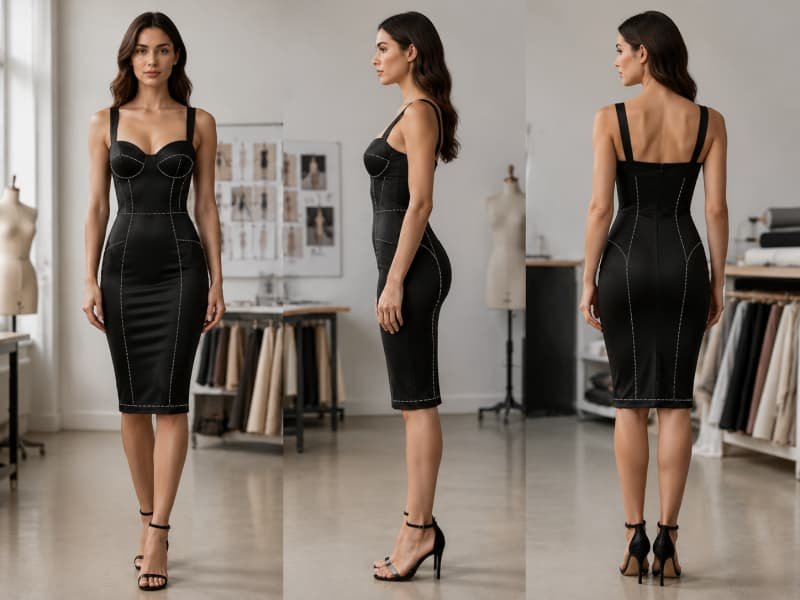
A bodycon dress can look deceptively simple on a hanger. It may appear to be little more than a close-fitting tube of stretch fabric, yet a commercially successful style depends on dozens of connected decisions. Change the fabric weight, knit density, elastane performance, seam placement or waist suppression by a small amount, and the dress can become transparent, restrictive, loose at the back waist or unstable at the hem. The real challenge is not making a dress tight. It is controlling where the garment stretches, where it supports the body and how quickly it returns to its intended shape.
A well-constructed bodycon dress combines a suitable stretch fabric, carefully distributed negative ease, balanced bust-waist-hip proportions and dependable elastic recovery. The pattern must respond to the fabric rather than treating every knit alike. Seams, lining and targeted reinforcement then stabilize high-stress areas so the approved fit can survive movement, laundering and repeated wear.
This is where many promising styles fail. A sample may look perfect during a five-minute fitting but lose its waist definition after several hours. Another may fit beautifully in black yet become visibly sheer in white. The true test begins after the first photograph, when the wearer sits, walks, dances, washes the dress and puts it on again. The sections below explain how experienced product teams examine those moments before a style is released into production.
What Defines Good Bodycon Construction?
Good bodycon construction creates a close, controlled silhouette without relying on excessive tightness. The fabric, pattern, seams and internal support must work as one system. A successful dress follows the bust, waist and hips smoothly, remains stable while the wearer moves, and returns close to its original shape after sitting, walking, washing and repeated wear.
Silhouette Control
A bodycon dress is not simply a smaller version of a regular dress. Its shape is created through controlled negative ease, meaning selected garment measurements are smaller than the corresponding body measurements. The fabric stretches to accommodate the body, while its elastic force holds the garment close to the intended silhouette. The important word is controlled. When an entire pattern is reduced by one percentage, the dress may become tight across the bust and hips while remaining loose through the back waist.
Strong pattern development distributes tension according to body shape, fabric behavior and the intended level of support. The bust needs enough volume and neckline security, the waist needs definition without uncomfortable pressure, the hips and seat need stretch plus recovery, and the hem needs enough stability to resist climbing during movement. A soft jersey mini dress and a structured occasion dress may both be called bodycon, but they should not be engineered in the same way. One may depend mainly on fabric stretch and curved side seams, while the other may require panels, lining, cups, boning or internal waist support.
Stress Zones
Bodycon dresses experience concentrated stress because the garment remains under tension while worn. The most heavily loaded areas are usually the bust, underarm, waist, high hip, seat, thigh and hem opening. Straps, zipper ends, slits and cut-outs create additional stress points. These zones need to be reviewed in motion rather than only on a mannequin. Sitting increases tension across the seat and lap, walking repeatedly stretches the hip and thigh, and pulling the dress over the body places temporary load on necklines, straps and seams.
Good construction anticipates these movements. Shoulder seams may need light stabilization to prevent length growth, a low neckline may need clear elastic to retain its shape, and a zipper opening may require support so the zipper does not wave or buckle. A high slit needs secure reinforcement at the upper point because force is concentrated there during walking. The right solution is rarely to reinforce every seam heavily. Excess support can make a stretch dress rigid, uncomfortable and visibly bulky, so reinforcement should be placed only where uncontrolled growth or concentrated stress is likely.
Construction Failures
Many bodycon defects are blamed on sewing even when the actual cause is a mismatch between fabric, pattern and construction. A wavy seam may come from incorrect differential feeding, but it can also appear because the material is unstable or the seam allowance is too heavy. A dress that rides up may be too narrow through the thigh, yet poor recovery, insufficient back length or high surface friction can create a similar result. The most useful diagnostic question is not simply what the defect looks like, but when it appears.
When a garment is loose before fitting, the pattern may contain too much ease. When it becomes loose only after thirty minutes, recovery is a stronger suspect. A neckline that grows during sewing points toward feed control or stabilization, whereas growth that develops only after wear may indicate weak fabric recovery or an unsuitable elastic specification. Fit correction should address the cause rather than hide the symptom. Pressing can temporarily flatten seam waves and styling can conceal a rising hem in photographs, but neither protects the customer from the same failure during real use.
| Visible problem | Likely causes | Practical checks |
| Loose back waist | Insufficient contouring, weak recovery or unbalanced side-seam shaping | Pin out center-back and side-seam excess separately; compare after a 30-minute wear test |
| Hip drag lines | Too little circumference, excessive negative ease or high stretch force | Compare worn extension with comfortable fabric stretch; inspect side-seam direction |
| Hem ride-up | Restricted thigh, short back balance, lining friction or poor recovery | Repeat walking, sitting and stair tests; measure hem migration |
| Twisting side seams | Fabric torque, off-grain cutting or pattern imbalance | Check roll relaxation, grain direction and seam placement before cutting |
| Wavy zipper | Unstable opening, stretching during insertion or weak support | Compare zipper length with stabilized opening; inspect feeding and pressing |
| Sheerness at seat | Low knit density, excessive extension or color-specific coverage loss | Test opacity at expected hip extension under daylight and flash |
| Neckline gaping | Excess edge length, weak recovery or missing stabilization | Measure neckline before sewing, after fitting and after wear |
| Seat bagging | Poor recovery, excessive vertical stretch or unsuitable knit structure | Measure immediately after wear and again after 30 minutes and 24 hours |
Bodycon vs Bandage
Bodycon and bandage dresses are related but not interchangeable. Bodycon is a broad silhouette category covering soft jersey dresses, rib-knit styles, lined mesh dresses, compact double knits and many other garments that follow the body closely. A bandage dress usually relies on a denser knit with greater resistance to extension, creating firmer compression and a more sculpted shape. This difference changes the pattern reduction, seam strength, garment weight and expected comfort level.
Stretch percentage alone does not explain the difference. Two materials may both reach 40 percent extension, yet one can move with very little force while the other requires strong resistance and produces noticeable compression. Product teams therefore benefit from defining the intended fit as soft contouring, close body fit, supportive shaping, firm compression or structured shaping. This shared language gives designers, fabric developers, pattern technicians and sample makers a much clearer target than the word bodycon by itself, reducing the risk that each department develops a different interpretation of the same style.
Which Fabrics Work Best for Bodycon Dresses?
The best bodycon fabric delivers the required stretch, recovery, opacity, support and comfort for the intended silhouette. Compact jersey, rib knit, ponte, interlock, scuba and nylon- or polyester-spandex blends can all perform well. Selection should be based on measured behavior at the garment’s expected extension, not only on fiber composition, elastane percentage or a supplier’s fabric name.
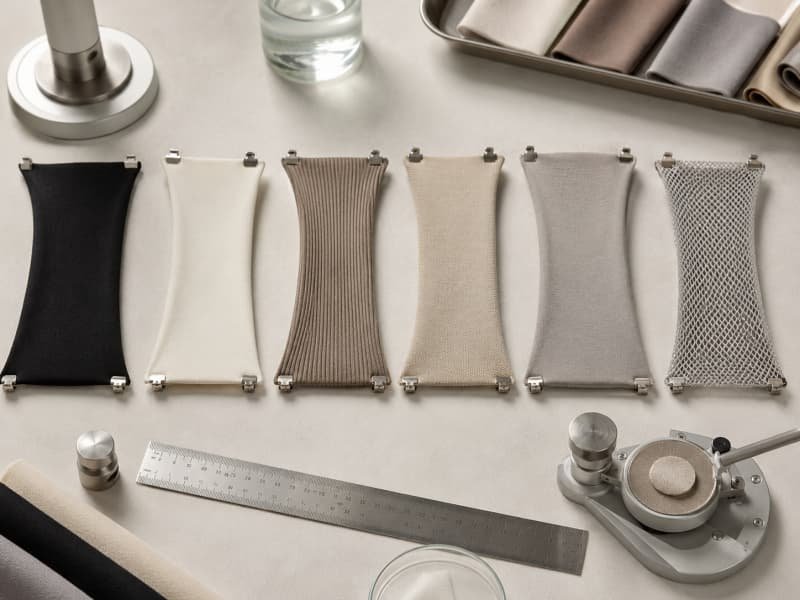
Knit Structure
Knit structure determines how easily a fabric extends, how stable its surface remains and how well it covers the body. Two fabrics with the same fiber content and weight can produce very different dresses because their loop construction, density and finishing differ. Single jersey is common in soft bodycon styles because it drapes well and feels familiar, but lightweight qualities may curl at the edges, show underwear lines or become transparent at the hips. Compact jersey offers more control because the knit is tighter and the surface is smoother.
Rib knit expands easily across the width and gives the garment visible texture, making it adaptable across body shapes. Its ribs may open under tension, however, and the fabric can grow during wear if recovery is weak. Interlock and ponte are more stable double-knit structures that generally provide better coverage, reduced curling and a cleaner silhouette. Scuba adds body and can create sculptural curves, but its thickness increases seam bulk and heat retention. Each structure can be appropriate when its behavior matches the intended use, customer climate, price point and fit character.
| Fabric type | Common development weight | Typical fit result | Main risks |
| Lightweight jersey | 160-220 GSM | Soft, fluid contour | Transparency, cling and weak recovery |
| Compact jersey | 200-280 GSM | Smooth, controlled fit | Surface shine or stress marks when overstretched |
| Rib knit | 180-320 GSM | Flexible, textured fit | Rib opening, width growth and color show-through |
| Interlock | 220-340 GSM | Stable, comfortable contour | Added weight and reduced fluidity |
| Ponte | 250-380 GSM | Firm, polished silhouette | Excess compression and bulky seam intersections |
| Scuba | 280-420 GSM | Structured, sculptural shape | Heat retention, stiffness and thick hems |
| Power mesh | 120-250 GSM | Supportive internal layer | Excess compression when used throughout |
Fiber and Elastane
Fiber composition influences touch, moisture behavior, color performance and durability, but the composition label cannot predict bodycon performance by itself. A fabric containing 5 percent elastane can feel firmer than one containing 8 percent when the first material has a denser knit and stronger elastic yarn. Heat setting, yarn tension, dyeing and finishing also change how the material behaves after washing and repeated wear. This is why the same nominal blend from two mills can require different patterns.
Cotton-spandex blends provide a familiar and breathable hand feel but may relax during wear or retain moisture. Viscose- and rayon-spandex qualities can feel soft and fluid, yet loose constructions may grow in length. Polyester-spandex often offers stable color and practical recovery, although lower-quality versions may feel hot or develop shine under tension. Nylon-spandex is frequently selected for smoothness and resilience, especially when stronger stretch and recovery are required. A useful evaluation therefore combines composition with stretch in both directions, force at target extension, recovery after cycling, shrinkage, pilling, surface appearance and skin feel.
Weight and Opacity
Fabric weight affects coverage, support and drape, but a heavier fabric is not automatically more opaque. A dense 210 GSM jersey may provide better coverage than a loose 260 GSM rib because the rib opens as it stretches. Opacity should be tested at the extension the finished garment will experience, particularly over the hip and seat. A relaxed swatch on a table offers limited evidence because the loops are not opening and the surface is not under body tension.
Color changes the result as well. Black may pass comfortably while ivory, nude or pastel versions become transparent in the same construction. The team should evaluate each color group under natural light, retail lighting and camera flash, ideally over contrasting underlayers. Practical fabric specifications should include target GSM and tolerance, finished and usable width, widthwise and lengthwise stretch, relaxation requirements, shrinkage and color-specific opacity. A casual summer mini may work around 180-220 GSM when density and recovery are strong, while structured occasion styles may use 300 GSM or more. These figures are starting references, not substitutes for garment testing.
Linings and Reinforcement
Lining can improve coverage, comfort, support and surface smoothness, but it must stretch and recover in harmony with the shell. A lining with insufficient extension restricts movement and causes the outer layer to wrinkle, while a lining with poor recovery can grow inside the dress and become visible at the hem. Stretch tricot and lightweight jersey linings are often chosen for opacity and comfort. Power mesh offers stronger shaping and is more effective when placed strategically around the waist, bust or abdomen than when added indiscriminately throughout the garment.
Internal reinforcement may include clear elastic at necklines and waist seams, knitted stay tape at shoulders, compatible fusible support around zipper openings and secure reinforcement at slits or cut-outs. Support must remain flexible and unobtrusive. A stiff tape can prevent growth but create a visible ridge or uncomfortable edge. The shell, lining and reinforcement should be tested together for extension, recovery, shrinkage, seam feeding and appearance after care. Lining should be planned during pattern development because adding it only after a transparent sample has failed will alter fit, compression, seam bulk and finished measurements.
How Do Stretch and Recovery Affect Fit?
Stretch allows a bodycon dress to expand over the body, while recovery determines whether it returns to its intended dimensions. Negative ease uses that controlled extension to create the fitted silhouette. When these properties are not matched, a dress can feel restrictive at first, become loose after wear, or fit differently across colors, fabric lots and repeat production.

Measuring Stretch
Stretch percentage compares the extended length of a fabric sample with its original length. The standard calculation is: stretch percentage equals extended length minus original length, divided by original length, multiplied by 100. If a marked 10-centimeter section reaches 14 centimeters under a controlled practical pull, the measured stretch is 40 percent. The phrase controlled practical pull is essential because pulling the specimen to its absolute limit can produce a number that the finished garment should never use.
At maximum extension, the knit may whiten, become sheer, distort or require an uncomfortable level of force. Stretch should be recorded across the width and through the length because the two directions influence different parts of the pattern. Width stretch supports body circumference, while length stretch affects garment length, shoulder stability, neckline drop and hem position. A useful record also notes force at a fixed extension, surface change, edge curling and behavior after repeated cycles. Development and bulk testing must use the same specimen size, force, hold time and rest period if the results are expected to be comparable.
Recovery and Growth
Recovery describes how closely a stretched fabric returns to its original dimensions. Residual growth is the amount that remains after the force is removed. For example, a 10-centimeter marked section that measures 10.4 centimeters after stretching and resting has retained 4 percent growth under that test condition. Whether this is acceptable depends on where the material is used, how long it was loaded and whether the design is meant to provide soft contouring or firm shape retention.
A ribbed casual dress may tolerate modest relaxation without looking defective, while the same growth in a smooth fitted waist panel can be obvious. Recovery should be measured immediately after release and again after defined rest periods such as 30 minutes and 24 hours, then repeated after several stretch cycles and laundering. Some teams establish internal limits, often aiming to keep residual growth within a few percentage points after a stated method, but the number is meaningful only when the method is documented. A report that says good recovery without extension level, hold time, cycle count and recovery period gives the pattern team little useful evidence.
| Property | Basic calculation or method | Practical interpretation |
| Stretch percentage | (Extended length – original length) / original length x 100 | Use practical extension without whitening, severe distortion or excessive force |
| Residual growth | (Length after recovery – original length) / original length x 100 | Lower growth generally supports stronger shape retention when methods are identical |
| Negative ease | (Body measurement – garment measurement) / body measurement x 100 | Distribute by body zone; do not apply one percentage everywhere |
| Stretch force | Record force needed to reach a fixed extension | Two fabrics with equal stretch can create very different compression |
| Recovery timing | Measure immediately, after 30 minutes and after 24 hours | Separates fast recovery from slow relaxation behavior |
| Wear cycling | Repeat extension and release under a fixed method | Reveals fatigue that a single pull may miss |
Negative Ease
Negative ease is the difference between the body measurement and the smaller finished garment measurement. If the target hip is 100 centimeters and the finished garment hip is 92 centimeters, the style contains approximately 8 percent negative ease at that point. The fabric expands when worn, creating the close silhouette. The same reduction will not feel identical in every material because the force required to reach the extension may differ greatly.
Broad development starting points are sometimes around 3-8 percent negative ease for soft contouring, 8-15 percent for a close bodycon fit and 15-25 percent for firmer compression. These are not universal standards and should be treated cautiously. The correct reduction depends on knit structure, extension force, lining, size range, dress length and customer expectation. Negative ease should also change by body zone. The waist may need greater suppression for definition, the bust needs shaped volume, and the thigh may need more movement allowance to reduce ride-up. A three-dimensional fit sample is essential because calculations cannot fully predict pressure, comfort or how tension travels across the body.
Wear and Care
A bodycon dress remains stretched for much longer than a hand test. Body heat, moisture, sitting pressure and repeated movement can change the fabric during wear, and washing or drying can alter both the material and the seam system. A useful wear trial should last long enough to reveal gradual change. The wearer should sit, walk, bend, climb steps and raise her arms, after which the waist, hip, seat, elbow and garment length can be compared with the original measurements.
Care testing should follow the proposed care label rather than an unrelated laboratory cycle. Inspect waist and hip recovery, neckline growth, side-seam rotation, shell-lining alignment, seam appearance, pilling, surface shine and hem distortion after each selected cycle. Heat deserves particular attention because excessive tumble drying or pressing temperatures can damage elastane, while insufficient heat setting during fabric production can leave the knit dimensionally unstable. A material that performs well before laundering may not remain suitable after three or five care cycles. Fit approval should therefore reflect the complete product lifecycle rather than the appearance of a new sample.
How Is Bodycon Fit Engineered?
Bodycon fit is engineered by balancing body measurements, fabric extension, pattern shaping and movement allowance. Bust, waist, hips and thighs cannot be reduced uniformly. The pattern must control contour while keeping the neckline secure, side seams balanced and the hem stable. Every meaningful fabric change requires a fit review because the approved silhouette depends on material behavior.

Bust, Waist and Hip Balance
The bust, waist and hips create different structural demands. The bust needs shaped volume, support and neckline security. The waist needs suppression that defines the silhouette without creating concentrated pressure. The hips and seat need extension for movement, plus enough recovery to return after sitting. Uniformly narrowing the side seams rarely produces the best result because it can make the garment tight over the bust and high hip while leaving folds at the lower back.
Strong patterns use curved side seams, center-back contouring, darts, princess seams or strategically placed panels to distribute shape. Fit should be reviewed from the front, side and back. Check bust apex position, neckline coverage, waist level, side-seam direction, back-waist contact, hip mobility and hem balance. The seat requires enough back length as well as circumference; insufficient length can pull the hem upward even when the hip measurement looks correct. Standing photographs are useful, but a sitting and walking test reveals whether the dress remains wearable once body dimensions and posture change.
Pattern-to-Fabric Matching
A bodycon pattern is valid only for materials that behave similarly to the approved development fabric. Reusing one pattern for soft jersey, dense ponte and open rib knit usually produces three different fits. Before transferring a pattern, compare width stretch, length stretch, recovery, extension force, GSM, thickness, shrinkage, drape, surface friction and knit opening under tension. Fiber composition alone is not enough because two blends with the same percentages can create different pressure and growth.
A softer fabric may require more negative ease to preserve the intended contour, while a dense material with higher resistance may require less. Strong vertical stretch can lengthen straps, lower necklines and shift hems unless the pattern or stabilization changes. Rib fabric may appear very narrow when relaxed but expand easily on the body, making flat measurements difficult to interpret without wear data. The production pattern should therefore be linked to an approved fabric code and finish. When a repeat order uses a new lot or substitute, basic stretch, recovery, GSM and shrinkage checks should confirm that it remains within the approved performance range before cutting begins.
Seams and Stabilization
Bodycon seams need enough elasticity to survive dressing and movement while remaining flat under tension. Four-thread overlock is common for joining stretch fabrics, but its performance still depends on thread type, stitch density, seam allowance and machine settings. Coverstitch is often used for hems, although poor differential feed can create waviness or tunneling. The practical stretch of the garment is limited by its least elastic component, so a fabric that stretches 50 percent offers little advantage when the seam begins cracking at 25 percent.
Some areas require more stability than a general stretch seam provides. Shoulder seams can lengthen under garment weight, necklines and armholes may grow during sewing, zipper openings can distort, and slit ends concentrate force. Clear elastic, knitted stay tape, narrow fusible reinforcement and elasticated edge finishes can control these risks when they are compatible with the shell. Evaluation should include stitch cracking, seam grinning, puckering after relaxation, uneven feeding, visible bulk and performance after laundering. The best seam is not simply the strongest; it is durable, elastic, smooth and visually appropriate for the dress.
Grading and Ride-Up
Bodycon grading must preserve fit behavior rather than mechanically enlarge every point. Bust, waist, hips, armholes and length change at different rates across a size range. Stretch can hide a grading error during a quick fitting, but customers feel the resulting pressure, gaping or restricted movement. A sound grade maintains bust-to-waist balance, waist position, neckline coverage, strap placement, side-seam direction, slit position, hem proportion and the intended compression level.
Larger sizes should not automatically receive proportionally greater negative ease. When garment measurements grow too slowly compared with the body chart, compression increases through the range; when they grow too quickly, the upper sizes lose the designed contour. Jump-size fittings are particularly useful for fitted dresses. Ride-up should be reviewed at every tested size because it can result from restricted thigh circumference, insufficient back length over the seat, excessive negative ease, lining friction or weak recovery. Adding length alone rarely solves the problem. Horizontal lines often indicate restriction, vertical folds suggest excess width or weak contouring, diagonal lines reveal imbalance, and twisting points toward grain, torque or pattern-balance issues.
How Do Manufacturers Control Quality?
Manufacturers control bodycon quality by locking fabric performance, fit, measurements, construction and testing before bulk production. A sealed sample alone is not enough. Pre-production approval, first-piece review, inline measurement checks and final inspection are needed to reproduce the same contour, stretch and comfort across sizes, colors, fabric lots and repeat orders.

Sample Evaluation
A bodycon fit sample should be evaluated against the technical specification and the intended customer experience. Measurements are essential, but they do not explain everything. A garment can fall within tolerance and still gape, twist, ride up or feel excessively compressive because the fabric and pattern are interacting poorly. The fitting record should identify the sample size, model measurements, fabric code and lot, stretch and recovery data, finished measurements, movement observations, photographs, comfort comments and every required pattern or construction correction.
The sample should remain on the fit model long enough to reveal growth. A five-minute fitting may miss seat bagging or waist relaxation that appears after thirty minutes. Comments need to be measurable. Saying the waist is loose leaves room for interpretation, whereas removing two centimeters total at the back waist and blending to zero at the high hip gives the pattern team a clear instruction. The model should walk, sit, bend and raise her arms where appropriate. Each revised sample should then be compared with the previous version because releasing one area can improve movement while changing side-seam direction, neckline balance or waist definition elsewhere.
Bulk Replication
The approved fit must be converted into controlled production information before bulk cutting. The sealed sample, paper pattern, digital pattern, measurement chart, bill of materials and construction sheet should all refer to the same approved version. Bodycon styles are sensitive to small material and sewing changes. A bulk fabric lot with slightly weaker recovery can change the waist fit, a wider seam allowance can reduce practical stretch, and excessive pressing can damage elastane or create unwanted shine.
First-piece or pilot-run approval is especially useful before hundreds or thousands of garments are assembled. It allows the team to verify cutting, seam elasticity, measurement, lining behavior, zipper installation and pressing while correction remains manageable. Inline inspection should then track whether measurements and workmanship drift as operators, machines or bundles change. Inspection cannot compensate for uncontrolled inputs, so bulk consistency begins with approved fabric, clear relaxation and cutting rules, stable patterns, calibrated construction methods and an agreed tolerance system that reflects the fit sensitivity of each measurement point.
| Production stage | Main evidence | Bodycon-specific checks |
| Bulk fabric approval | Bulk test report and approved swatches | GSM, usable width, shade, stretch, recovery, shrinkage and opacity |
| Relaxation and cutting | Relaxation log, marker and grain control | Torque, length growth, off-grain cutting and ply tension |
| Pre-production sample | Final PP sample and sealed comments | Fit, lining balance, zipper support, elastic tension and labels |
| First-piece review | First completed units and measurement record | Contour, seam stretch, measurement, hem stability and pressing |
| Inline inspection | Defined interval inspection reports | Size drift, seam puckering, twisting, stitch security and shade |
| End-line review | Completed garment audit | Appearance, measurements, lining position and workmanship |
| Final inspection | Shipment sample and packing records | Defect level, quantity, labels, barcodes, packaging and assortment |
| Retained sample | Approved production reference | Repeat-order comparison and complaint investigation |
Testing and Inspection
Testing should reflect the real risks of the garment rather than become a generic checklist. A bodycon dress may need fabric weight and width verification, dimensional stability, stretch and recovery, residual growth, bursting strength, seam stretch, colorfastness, pilling, zipper performance, attachment strength, opacity at worn extension and appearance after laundering. The exact combination depends on material, construction, intended care and destination-market requirements.
The method and target must be written clearly. Good recovery is not a test requirement unless the specification states the extension level, hold time, cycle count, rest period and acceptable result. Inspection should also focus on style-specific risks. A strapless fitted mini requires close control of upper-edge tension and zipper security, while a long-sleeve rib dress needs elbow recovery and garment-length stability. A lined mesh style demands shell-lining balance and opacity checks. Quality decisions are strongest when laboratory results, visual inspection and fit evidence agree. Passing a strength test does not guarantee that the dress will retain its waist or remain comfortable through an evening of wear.
Tech Pack Requirements
A strong tech pack turns the approved design into a repeatable production standard. For bodycon products, it should describe material behavior and fit intent as clearly as the visual details. Essential information includes front and back technical drawings, internal construction views, approved shell and lining codes, fiber composition, GSM, stretch direction, target extension, recovery requirement, finished garment measurements, tolerances, grading rules, fit-model information, seams, elastic tension, lining placement, zipper details, reinforcement points, care instructions and testing requirements.
Fit language should be precise. Terms such as soft contouring, close body fit, supportive shaping or firm waist compression communicate more than the word tight. Photographs and diagrams can clarify bust shaping, panel placement, neckline tension and lining attachment, while critical quality points should be marked so production and inspection teams understand where small deviations create large customer-facing problems. The file should also distinguish fixed design requirements from manufacturing details that allow controlled adjustment. When the fabric, pattern, approved sample and technical documents describe the same standard, the factory has a realistic basis for reproducing the fit in bulk and future repeat orders.
A successful bodycon dress is built through alignment. The design team defines the silhouette, the fabric team verifies stretch, recovery and opacity, pattern technicians distribute negative ease around real body curves, sample specialists test movement, and production converts the approved result into repeatable instructions and checkpoints. For an established fashion brand, the deciding question is not whether a supplier can sew stretch fabric. It is whether the same contour, support and comfort can be preserved through every size, colorway, fabric lot and repeat order.
Duolan Apparel supports custom bodycon and fitted dress development through fabric assessment, pattern engineering, sample refinement and production control. Brands can submit a tech pack, reference garment, target fabric, size specification or collection brief for a practical review of stretch and recovery risks, lining options, pattern requirements, sample development and bulk feasibility.