Skip to content

A fashion sketch can look perfectly resolved on a screen and still become disappointing the moment fabric meets the body. A cowl that looked effortless in the drawing may collapse, a bias skirt may grow on one side, or a fitted bodice may meet the measurement chart yet pull the side seams forward. These problems are not always sewing defects. Many begin much earlier, when the development team chooses a pattern-making method that does not match the way the garment needs to be understood.
Mannequin draping is usually better when silhouette depends on gravity, folds, bias, asymmetry, or complex three-dimensional shaping. Flat pattern development is usually better when measurements, repeatability, grading, and production control are the main priorities. For many fashion dresses, the strongest professional workflow is hybrid: develop uncertain shapes in three dimensions, convert them into controlled flat patterns, then verify fit and production readiness through sampling.
That distinction matters because the fastest-looking method is not always the fastest route to an approved garment. Consider an asymmetric satin dress with a twisted waist and fluid skirt. One pattern maker may calculate the entire shape from a block, while another may pin the difficult section on a dress form first and let the fabric reveal where it naturally wants to fall. Both approaches can work, but they expose different risks. The useful question is not which method sounds more advanced; it is which method gives the team the right information before expensive revisions begin.
What Is the Difference Between Draping and Flat Pattern?
Draping develops a garment directly in three dimensions on a dress form, while flat pattern development creates and modifies two-dimensional pattern pieces using blocks, measurements, and geometric control. Draping reveals fabric fall, volume, and body interaction immediately. Flat pattern work gives stronger control over dimensions, symmetry, grading, documentation, and repeatability. In commercial fashion development, the two methods are often complementary rather than competing techniques.
3D Shape vs 2D Control
The biggest difference is the type of information each method gives first. With draping, fabric is pinned and shaped directly on a mannequin, so the pattern maker can see whether a neckline collapses correctly, whether a fold creates too much bulk, or whether an asymmetric panel is pulling the garment off balance. Flat pattern work starts from known geometry, so bust width, waist position, seam length, shoulder slope, and finished measurements can be checked before a full garment exists. That makes draping highly visual and flat pattern development highly measurable. Neither quality is automatically more accurate. A cowl can look beautiful on a mannequin but still have an unsuitable neckline length for grading, while a mathematically correct flat pattern can produce a stiff cowl if the chosen satin is heavier than expected. The method should match the unknown you are trying to solve.
| Development Question | Draping | Flat Pattern | Practical Advantage |
| 3D silhouette | Immediate visual feedback | Usually verified after sampling | Draping |
| Exact seam lengths | Must be checked after flattening | Directly measurable | Flat pattern |
| Fabric fall and folds | Seen under gravity | Predicted before sampling | Draping |
| Symmetry | Requires deliberate checking | Easy to mirror and compare | Flat pattern |
| Grading | Requires conversion to flat pattern | Built into the workflow | Flat pattern |
| Complex asymmetric shaping | Intuitive to explore | More calculation and testing | Draping |
| Production repeatability | Depends on documentation | Strong once approved | Flat pattern |
What Draping Actually Controls
Professional draping is more disciplined than arranging fabric until it looks attractive. The pattern maker still has to control grain direction, balance, body landmarks, seam position, length, and finished dimensions. Grainline is especially important because a panel that shifts only a few degrees can hang differently, and the effect becomes more obvious in fluid or bias-sensitive fabrics. Before a draped piece is removed from the form, useful reference points normally include center front, center back, waistline, bust level, grainline, seam lines, fold positions, balance marks, and key notches. Those references are what allow the three-dimensional shape to be reconstructed later. Draping is most valuable when it answers a question that is genuinely difficult to predict on paper. If the garment is already based on a proven block and only the sleeve length or neckline depth is changing, full draping can add time without adding much useful information.
What Flat Pattern Development Adds
Flat pattern development becomes more valuable as the garment moves closer to repeatable production. Once the silhouette is approved, seams must match, curves need to join cleanly, symmetry has to be maintained where intended, and revisions must be recorded in a form that another technician can understand. CAD systems make this control easier because points, curves, notches, internal lines, drill marks, seam allowances, and grading rules can be stored and compared. If the waist is reduced by 12 mm or the neckline is moved 8 mm inward, the exact change can be traced instead of remembered informally. That matters when designers, technical designers, pattern makers, sample machinists, merchandisers, and production teams all touch the same style. Draping may help discover the shape, but the flat pattern is usually what preserves that decision and carries it through sampling, grading, cutting, and future repeat orders.
Which Styles Are Better for Draping?
Draping is most useful when a garment’s appearance depends on gravity, irregular volume, bias direction, asymmetry, or complex body contouring. Bias-cut dresses, cowls, sculptural folds, draped waists, waterfall details, asymmetric bodices, and some corset or occasion styles often benefit from three-dimensional development. The more a design relies on how fabric moves and settles rather than on measurements alone, the more valuable mannequin work becomes.
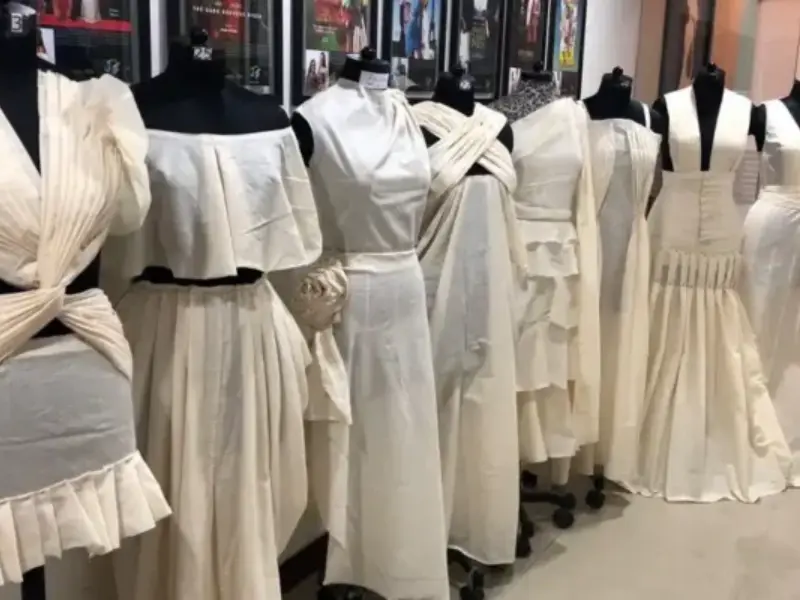
Bias and Fluid Dresses
Bias-cut dresses are one of the clearest examples of why a correct paper pattern does not guarantee a stable garment. Fabric cut near the 45-degree bias can lengthen, narrow, rotate, or drop unevenly after it is suspended on the body. The amount of change depends on fiber, weave, weight, finish, panel shape, seam construction, and even how the garment is handled during sewing. A lightweight satin may relax noticeably while a firmer satin remains more stable, even if both are sold under the same broad fabric name. Draping or early three-dimensional testing lets the team observe those changes before the pattern is locked. For sensitive bias styles, teams commonly check grain alignment, side-seam position, center-front and center-back drop, left-to-right hem balance, and whether the lining is restricting the shell. The exact resting time before hem leveling varies by fabric and construction, so it is better to evaluate the actual material than to rely on one universal number.
Asymmetry and Sculptural Details
Asymmetric fashion can look simple in a sketch but become technically demanding once several curves begin interacting. A one-shoulder bodice, twisted waist, diagonal gathered panel, sculptural hip drape, or irregular neckline may involve tension in more than one direction. Moving a fold 15 or 20 mm can change bust coverage, waist tension, neckline position, and side-seam balance at the same time. Draping lets the pattern maker see those effects immediately instead of making a paper change, recutting, sewing, and waiting for the next fitting. The key is to separate intentional asymmetry from accidental instability. A one-shoulder dress can have an uneven neckline by design while still needing stable bust, waist, and side-seam relationships underneath. Strong draping creates visual irregularity without allowing the garment to twist around the body or drift off grain unless that movement is part of the design itself.
Fitted and Shape-Sensitive Dresses
Not every fitted dress needs to be draped. A straightforward bodycon style made in a known stretch fabric is often faster to develop from an approved block. Mannequin work becomes much more useful when close fit is combined with support, exposure, asymmetry, boning, cups, plunging necklines, cut-outs, or fabrics that behave unpredictably. Corset, bustier, halter, backless, and structured occasion dresses are good examples because bust projection, neckline security, waist suppression, coverage, and smooth transition into the skirt all have to work together. A pattern can match the measurement chart and still create hollow areas, compression lines, unstable edges, or poor bust positioning. Three-dimensional review makes those issues easier to diagnose. Typical checkpoints include bust apex position, center-front length, waist level, neckline contact, underarm height, side-seam position, back balance, hip contour, and hem level. The mannequin does not replace measurements; it shows whether those measurements are producing the intended shape.
When Is Flat Pattern Development Better?
Flat pattern development is usually the better starting point when a style is built from an established fit foundation, has predictable geometry, requires close measurement control, or will be graded and repeated in production. It is especially efficient for symmetrical garments, proven commercial silhouettes, repeat programs, and styles where most of the underlying fit architecture is already approved and only selected design details are changing.

Proven Blocks and Repeat Fits
For an established fashion brand, a reliable block is one of the most valuable technical assets in the development room. Once shoulder width, bust distribution, waist position, hip relationship, torso length, and the brand’s preferred ease have been approved, there is little benefit in rebuilding those relationships from zero for every new style. A fitted midi dress may reuse the same core bodice while changing the neckline, strap width, skirt flare, or hem length. When roughly 70 to 90 percent of the underlying fit architecture remains unchanged, starting from the existing block is often more efficient than full draping. That range is a practical way to think about development, not a universal industry rule. The important caution is that blocks are not material-neutral. A woven satin, stretch mesh, and high-recovery jersey can require different ease and support even when the visual silhouette is similar, so fabric changes may still justify pattern recalibration and a new fit check.
CAD and Grading Control
Flat patterns become essential once a style needs to live inside a controlled digital workflow. CAD systems allow exact curves, seam lengths, notches, drill points, construction lines, grainlines, and grading nests to be stored with far less ambiguity than a physical drape alone. Grading is where this becomes especially important because commercial size ranges are not created by enlarging every dimension at the same rate. Bust depth, shoulder width, waist position, hip distribution, strap placement, neckline exposure, and garment length may all require different increments. A 10 mm change at the side seam is not visually equivalent to 10 mm added through center front, and widening a neckline without checking strap placement can make larger sizes less secure. Technical teams therefore review both measurements and visual proportion across the grade. Flat patterns make those relationships visible, comparable, and easier to correct before every size is cut in fabric.
Repeatability in Production
The closer a style moves toward bulk production, the more important repeatability becomes. A one-off sample can tolerate some hand adjustment because one technician may be able to pin, ease, or trim it into the intended result. A commercial order running across 6 sizes, 4 colors, and several sewing lines cannot depend on those personal corrections. Every team needs the same seam lengths, notches, grainlines, panel shapes, seam allowances, and placement marks. That is where the approved flat pattern becomes the manufacturing reference. Repeatability also matters when a successful style returns months later in a new color or material. A well-documented pattern allows the team to identify what should remain unchanged and what needs to be recalibrated for the new fabric. The real commercial strength of flat pattern development is therefore continuity: the garment no longer depends on the original pattern maker being present to explain how the shape was created.
Which Method Gives Better Fit and Fabric Control?
Neither method always gives better fit. Draping provides faster three-dimensional information about balance, fabric fall, and body interaction, while flat pattern development provides stronger measurement, symmetry, and grading control. The better choice depends on the dominant risk. If the uncertainty is drape, bias, volume, or body contour, mannequin work is valuable. If the risk is specification accuracy, grading, or repeatability, flat pattern control becomes more important.

Fabric Behavior Changes the Pattern
Fabric is not a passive carrier of a pattern. Two materials cut from exactly the same pattern can create noticeably different necklines, waist tension, hem levels, and overall silhouettes because weight, stretch, recovery, friction, thickness, and weave structure all affect the result. A soft mesh can stretch at the shoulder and lower a neckline, while a firm power mesh can hold the same pattern higher. A satin around 80 g/m2 will usually fall differently from one around 180 g/m2, although weight alone never tells the whole story. A jersey with about 15 percent width stretch also behaves very differently from one with 40 percent stretch and strong recovery. Those figures are examples rather than approval standards, but they show why technical teams need measurable material information. When fabric changes, pattern ease, support, seam construction, or even the development method may need to change with it.
| Fabric Property | Useful Measurement | Development Risk to Watch |
| Fabric weight | g/m2 | Excess sag, stiffness, or bulky folds |
| Width stretch | % extension | Too much or too little negative ease |
| Length stretch | % extension | Vertical growth and changing garment length |
| Recovery | % return after extension | Bagging at waist, hip, elbow, or neckline |
| Bias growth | mm or % after hanging | Twisting and uneven hems |
| Thickness | mm or layer comparison | Bulky seams, cups, gathers, or facings |
| Opacity | Visual or instrument check | Need for lining or double-layer construction |
Fit Problems That Appear in 3D
Some fit problems are difficult to understand from a measurement chart because they are really spatial problems. A neckline can meet its finished measurement and still gape away from the chest. A side seam can be the correct length and still rotate forward. A corset waist can match the target circumference while the bust cups sit too far apart or too low. Three-dimensional fitting helps because position, tension, hollow areas, and movement become visible. Strong technical comments then turn those observations into measurable actions. Instead of saying that a neckline looks wrong, a team might record that it stands 8 mm away from the body. A side seam might be noted as 12 mm forward at the hip, or a bust apex 10 mm below target. Once the deviation is described clearly, the team can decide whether the cause is pattern balance, fabric behavior, sewing tension, or construction and then correct the right part of the system.
Reducing Sample Revisions
Sample revisions often multiply because the team is solving the wrong problem with the wrong tool. If the main uncertainty is a waterfall neckline, three rounds of increasingly detailed flat patterns may be less efficient than draping the neckline first. If the real issue is a waist that is 25 mm too large, repeatedly pinning it on a mannequin without correcting the base pattern is equally inefficient. A useful first-sample brief identifies the main priority before cutting begins: fit accuracy, drape accuracy, bust support, neckline coverage, silhouette, fabric performance, construction feasibility, or grading readiness. This allows the first sample to answer a specific question instead of trying to perfect every element at once. Duolan’s development workflow, for example, can begin from tech packs, reference images, original samples, or mixed inputs, with fit, drape, support, coverage, and fabric behavior reviewed before the sample direction is locked. That approach does not eliminate revisions; it makes each revision more purposeful.
Do Professional Teams Use Both Methods?
Yes. Professional pattern teams often combine draping and flat pattern development in the same garment because each method solves a different problem. A complex neckline, twist, or asymmetric fold may be developed on the mannequin, then converted into a paper or CAD pattern for measurement control, grading, and repeatability. The most efficient workflow often moves from 2D to 3D, back to 2D, and then into another physical fit check.

The Hybrid Workflow
A hybrid workflow does not mean draping an entire garment and then rebuilding everything in CAD. The efficient approach is to identify the area of uncertainty. If the brand already has an approved bodice block but the new style includes a deep cowl, the block can remain intact while only the cowl section is developed in three dimensions. Once that area looks right, seam lines, grainlines, balance points, and fold references are marked and transferred into the flat pattern. The pattern maker then walks the seams, smooths curves, checks intersections, and verifies finished measurements before cutting the first complete sample. A practical sequence is straightforward: start from an approved block, drape the high-risk visual area, mark and flatten it, digitize the pieces, true the seams, make the sample, fit the garment, and correct the flat pattern. That cycle preserves creative freedom while preventing the final product from becoming dependent on one person’s handwork.
Areas Worth Draping First
The best areas to drape are the ones where a small geometric change creates a large visual result. A cowl attachment moved 15 to 25 mm can alter fold depth, bust exposure, shoulder tension, and center-front length at the same time, making three-dimensional evaluation much faster than repeated guesswork on paper. Other strong candidates include one-shoulder bodices, twisted waist details, side drapes, waterfall panels, sculptural folds, irregular ruching, bias skirts, gathered hip sections, and draped corset overlays. By contrast, facings, simple linings, straight waistbands, basic sleeves, standard back panels, and many internal support pieces are normally easier to engineer flat. Selective draping keeps the workflow focused. The goal is not to use the most artisanal method possible; it is to use three-dimensional development where it provides information that flat geometry cannot reveal efficiently enough.
Converting the Drape
A successful drape becomes commercially useful only when another technician can reproduce it without the original mannequin setup. Before the fabric comes off the form, the pattern maker should mark grainline, center lines, seam positions, waist level, bust landmarks where relevant, fold direction, balance points, and matching references. The piece is then flattened carefully and translated into paper or CAD. At this stage, it should not simply be traced and accepted. Pinning can distort edges, so connecting seams must be walked together, curves trued, corners checked at the sewing line, and symmetric areas compared. The resulting flat pattern is an engineered interpretation of the draped shape rather than a photocopy of it. Once that conversion is complete, the style can be graded, costed, stored, revised for another season, and passed between development and production teams without relying on the memory of the person who created the original drape.
How Does the Pattern Move Into Production?
A pattern is not production-ready simply because one sample looks good. Before bulk manufacturing, the approved silhouette must be converted into controlled geometry, measurements, grade rules, materials, workmanship standards, and tolerances. The production pattern should reproduce the approved garment across sizes and repeat orders without depending on hand corrections during sewing. That transition from attractive sample to repeatable product is where disciplined pattern development proves its commercial value.

From Drape to Production Pattern
When a draped piece comes off the mannequin, the technical work is only beginning. The fabric is flattened carefully so that it is not stretched further during handling, then the marked sewing lines are transferred to paper or CAD. The pattern maker checks whether seams that join each other actually have compatible lengths, whether curves flow cleanly through intersections, whether corners meet at the correct angle, and whether the grainline still reflects the intended fabric behavior. Seam allowances, notches, drill points, fold lines, internal construction references, cut quantities, and directional requirements are then added. Seam allowance is usually safest to add after the sewing line itself is finalized because measuring only from cut edges can hide mismatches. A production-ready piece should make sense to a technician who never saw the original drape. If an essential instruction lives only in someone’s memory, the pattern is not finished, no matter how good the first sample looked.
Turning Fit Comments Into Pattern Changes
Useful fit comments describe an observable problem and a measurable change. “Make the neckline better” leaves too much room for interpretation, while “reduce the center-front neckline opening by 12 mm” gives the pattern maker a target. The same principle applies to comments such as raising an underarm 10 mm, moving a bust apex 8 mm inward, shortening a strap 12 mm, or removing 15 mm total excess at the back waist. Even with measurements, the team should diagnose the cause before changing the pattern. A gaping neckline might come from excess pattern length, weak elastic tension, stretchier fabric, incorrect sewing, or poor bust shaping, and the wrong correction can simply move the problem elsewhere. Version control matters as well. Pattern Version 3 should show what changed from Version 2 so that an approved correction is not accidentally reversed during the next sample or forgotten when the style returns for a repeat order.
What Must Be Locked Before Bulk
Grading and production should begin only after the base pattern is stable enough to represent the intended fit and silhouette. Grading an unresolved base size simply multiplies the same problem across the range. Before release, the team should lock the main body relationships, fabric direction, material specification, support structure, critical seams, finished measurements, and construction logic. Production tolerances should then be set according to the garment type, fabric, measurement point, and brand standard rather than copied blindly from a generic chart. A close-fitting corset dress and a relaxed woven dress should not automatically share the same tolerance logic. The same caution applies to grading: neckline exposure, strap position, cup placement, slit height, and cut-out dimensions may need special review because their visual effect can change quickly across sizes. A disciplined pre-production review is what protects the original development intent when the garment leaves the sample room.
| Production Control | What Should Be Confirmed Before Release |
| Base pattern | Approved balance, geometry, seam relationships, grainlines |
| Finished measurements | Measurement points, target specs, brand-specific tolerances |
| Grading | Size increments and visual proportion across the range |
| Fabric | Quality, weight, stretch, recovery, shade and direction |
| Lining | Compatibility, stretch, opacity, and effect on drape |
| Trims | Zippers, elastic, boning, cups, hardware, decorative components |
| Construction | Seam types, stitch requirements, reinforcement, critical operations |
| PP reference | Approved pre-production garment or equivalent standard |
| QC points | High-risk fit, measurement, workmanship, and appearance checks |
| Packaging | Labels, folding, hangtags, barcodes, and handling requirements |
A strong pattern-development process does not end when a sample receives a visual “OK.” It ends when the design intent has been translated into a pattern, specification, material set, grading logic, and construction method that production teams can repeat with controlled variation. Draping may be the fastest way to discover a difficult shape, while flat pattern development may be the best way to engineer and preserve it. Brands developing fitted, occasion, asymmetric, bias-cut, corset, or other shape-sensitive dresses benefit most when their development partner can move comfortably between both methods instead of forcing every garment through one rigid process.
For teams reviewing a new dress project, it is useful to begin with a simple question: what is still uncertain? If the uncertainty lives in the fabric’s fall, a twist, a fold, or a body-sensitive shape, test it in three dimensions early. If the uncertainty is measurement control, grading, or repeatability, resolve it in the flat pattern. When a project needs support moving from reference image or tech pack through fit review and into a production-ready version, Duolan can evaluate the development basis and identify which parts of the style need visual draping, controlled flat pattern work, or a combination of both.
Frequently Asked Questions
Is draping better than flat pattern making for fashion dresses?
Draping is not universally better; it is better for certain kinds of uncertainty. If a dress depends on bias behavior, sculptural folds, asymmetry, complex ruching, or a neckline whose appearance is driven by gravity, mannequin work can reveal the correct shape faster. Flat pattern development is usually stronger for accurate dimensions, symmetry, grading, repeat orders, and production control. Most commercially demanding dresses benefit from choosing the method by garment area rather than declaring one technique superior for the whole style.
Which dresses usually need mannequin draping?
Bias-cut dresses, cowl-neck dresses, asymmetric styles, waterfall details, twisted bodices, side-draped skirts, sculptural occasion dresses, and some corset or bustier designs are common candidates. The shared feature is not the product name but the way the shape is created. If small changes in grain direction, fabric volume, gravity, or body position can dramatically change the appearance, three-dimensional work is often useful. A simple fitted knit dress based on a proven stretch block may need little or no draping at all.
Can a draped pattern be used directly for bulk production?
Usually not without technical conversion. A draped fabric piece still needs to be flattened, trued, checked for seam compatibility, given grainlines and balance marks, and converted into a clean paper or CAD pattern. Production information such as seam allowances, notches, drill points, cut quantities, internal construction lines, and grading rules also needs to be added. The drape is a development result; the production pattern is the controlled manufacturing version of that result. Skipping this conversion makes repeatability much harder.
Does flat pattern development work for complex dresses?
Yes, and many complex dresses rely heavily on flat pattern development. Corsets, fitted bodices, cut-outs, panels, linings, facings, and support structures often need precise two-dimensional control even when the outer silhouette has been draped. The question is whether the difficult part can be predicted reliably from geometry. A complex dress may use flat patterns for 80 percent of its structure and mannequin draping for one high-risk neckline or asymmetric panel. Complexity alone does not mean the whole garment should be draped.
How does fabric choice affect draping and pattern development?
Fabric choice can change both the development method and the final pattern. Weight, stretch, recovery, stiffness, thickness, friction, and bias stability affect how a garment falls and how much ease or support it needs. A lightweight satin and a heavy satin may require different cowl volume even when the design drawing is identical. A stretch fabric with weak recovery may also need a different bodycon pattern from one with similar stretch but stronger recovery. Whenever the fabric changes materially, fit and pattern assumptions should be reviewed rather than copied automatically.
When should a fashion brand use a hybrid draping and flat pattern workflow?
A hybrid workflow is especially useful when most of the garment can be built from a reliable block but one or two areas are visually unpredictable. A brand may keep an approved bodice, drape a new cowl or twisted waist on the mannequin, transfer that shape into CAD, and then fit the complete sample before grading. This approach avoids unnecessary draping while still giving difficult areas the three-dimensional attention they need. It is often the most practical route for fashion-driven dresses that must later be produced consistently.