Skip to content
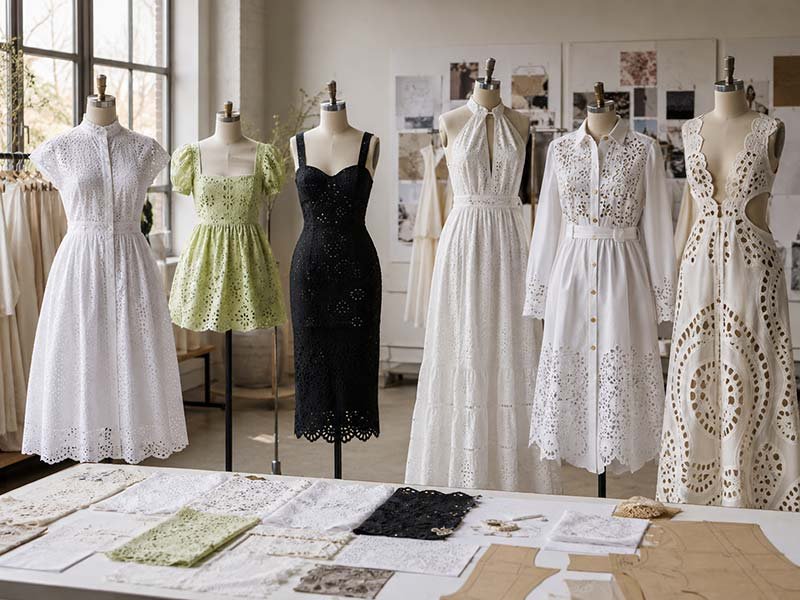
Eyelet dresses have never fully left the summer wardrobe, yet the category is entering a more demanding stage. A familiar white cotton sundress can still sell, but it now competes with countless similar products across every price level. For Spring/Summer 2027, the real opportunity is not simply to repeat eyelet as a nostalgic surface. It is to develop the material into dresses with clearer occasions, better proportions, stronger color stories and construction that works beyond a styled campaign image.
The eyelet dress trends most likely to shape 2027 are modern femininity, cleaner silhouettes, larger or engineered embroidery motifs, expanded color choices, selective transparency and closer coordination between fabric, lining and fit. White cotton styles will remain important, but growth is more likely to come from refined midis, shaped bodices, placement eyelet, colored embroidery and occasion-ready designs.
That shift sounds subtle until a development team begins working with the actual cloth. The holes that create an airy appearance can weaken a seam, dense embroidery can turn a light base into a stiff shell, and a lining chosen too late can change the fit of the whole dress. The most convincing 2027 collections will make those technical decisions invisible. The customer will only see a dress that feels fresh, fits naturally and looks effortless, even though considerable work has taken place behind the finished garment.
What Will Shape Eyelet Dresses in 2027?
Eyelet dresses in 2027 will move beyond the familiar white summer sundress. The category will keep its romantic character while adopting cleaner proportions, deliberate embroidery placement, stronger color, refined lining solutions and silhouettes suitable for resort, occasion and city dressing. The strongest products will preserve recognizable eyelet texture while improving fit, styling versatility and production reliability.
Trend Continuity
Eyelet is unlikely to disappear after one strong season because it serves several lasting needs at once. It gives a plain woven fabric visible texture, creates natural airflow, photographs clearly and fits recurring warm-weather occasions such as vacations, graduations, brunches, day parties and informal celebrations. These occasions return every year, which gives the category more stability than a novelty trim that depends on a single viral moment.
The challenge is that the most recognizable formula has become crowded. White cotton, puff sleeves, a gathered waist and a scalloped hem are now available at many price points. A similar product may remain commercially useful, but it no longer proves that a collection has understood where the category is heading. Product teams need to decide whether a style is intended to be a familiar volume driver, a fashion update, a campaign piece or a repeatable seasonal core.
A practical 2027 range can therefore contain both continuity and change. One white commercial dress may anchor the collection, while a colored fitted midi, a clean halter maxi and a placement-embroidered shirt dress offer different reasons to purchase. This approach reduces the risk of betting the entire season on an unfamiliar shape, yet it also avoids filling the line with several dresses that compete with one another because they look almost identical.
| 2027 Direction | Commercial Role | Suitable Products | Main Watchpoint |
| Refined white eyelet | Core seasonal business | Midi dresses, sundresses, shirt dresses | Avoid bridal or overly traditional styling |
| Colored eyelet | Seasonal freshness | Minis, fitted midis, day-party dresses | Control ground and thread shade consistency |
| Placement embroidery | Product differentiation | Bodices, hems, sleeves, waist panels | Maintain cutting and motif alignment |
| Graphic cutwork | Editorial and social impact | Statement dresses, coordinated sets | Manage hole stability and coverage |
| Structured eyelet | City and occasion use | Fitted dresses, corset-inspired styles | Build support through lining and seams |
| Lightweight resort eyelet | Vacation and warm-weather demand | Halter maxis, loose midis | Control transparency and garment weight |
Modern Femininity
Eyelet will continue to look feminine, but femininity does not need to mean excessive volume, bows and ruffles. A more current direction combines softness with control. The embroidery may remain floral and decorative, while the silhouette becomes straighter, the neckline sharper and the internal structure more precise. This contrast lets the material keep its emotional appeal without trapping the finished dress inside a single cottage-inspired visual language.
Cleaner shapes also allow the fabric to carry more of the design. A column midi with a shaped waist can feel fresher than a dress built from several gathered tiers. A halter neckline can create a stronger resort identity without additional trimming. A black eyelet mini can move naturally into evening and going-out dressing, particularly when the lining is tonal and the accessories are simple. The result still feels recognizably eyelet, yet it belongs to a broader wardrobe.
Restraint is important because openwork fabric already contains visual information. When a designer adds oversized sleeves, multiple ruffles, lace insertion, bows, beads and a contrast lining to the same garment, the product can become crowded and expensive before it becomes distinctive. Strong commercial development usually gives the silhouette, motif and lining separate jobs. The shape defines the customer, the embroidery provides texture and the lining controls coverage and support.
Market Relevance
Eyelet demand will not develop in exactly the same way in every market. In the United States, white minis and midis often connect with graduation, summer events, sorority activities and pre-wedding occasions. In the United Kingdom, broderie anglaise is a familiar term across romantic daywear and polished summer dresses. Australian collections often emphasize resort, vacation and day-party dressing, while European contemporary labels may prefer linen blends, natural shades and controlled volume.
These patterns are useful starting points rather than fixed rules. A brand’s own sales history, customer age, climate, return data and average retail price should carry more weight than a broad regional assumption. A low-back halter maxi may be right for a warm-weather social label but wrong for a customer who expects bra-friendly coverage. A full white dress may work strongly in a graduation edit while creating an unwanted bridal signal in a general occasion collection.
The development brief should therefore name the use case with more precision than ‘summer eyelet dress.’ A lined midi for daytime occasions, an open-back maxi for resort or a white mini for graduation gives the pattern, fabric and sample teams a clear target. This decision influences neckline depth, strap security, lining length, pocket placement, internal support, acceptable transparency and the level of trim required to support the intended price.
Eyelet Terminology
Eyelet, broderie anglaise and cutwork are often used interchangeably in commercial conversations, but they do not always describe the same construction. Traditional broderie anglaise is associated with embroidered holes finished around their edges, commonly arranged in floral or geometric patterns on cotton or linen. Modern suppliers may use ‘eyelet’ for a much wider range of machine-embroidered openwork fabrics made from cotton, viscose, polyester blends or other woven bases.
Cutwork can contain larger open areas where portions of the ground fabric are removed and secured with embroidery. Lace is structurally different because the decorative open structure may be created without a conventional woven base, while crochet uses another construction method entirely. These differences affect seam strength, drape, transparency, pressing and the type of support needed in a fitted garment. Approving material by a broad name alone leaves too much room for variation.
A useful material record should identify fiber composition, finished weight, usable width, motif repeat, hole scale, embroidery-thread composition, border construction, shrinkage, color method and recommended care. ‘White cotton eyelet’ communicates the visual category, but it does not tell the pattern maker whether the cloth will remain soft, whether a scalloped edge can be used as the hem or whether the embroidered area will distort after washing. Physical specifications make the concept repeatable.

Which Fabrics and Colors Will Lead?
Cotton eyelet will remain the main commercial choice in 2027, supported by cotton voile, lawn, poplin, linen blends and selected viscose or polyester blends. White and ivory will continue to lead, while soft blue, yellow, green, pink, black and deeper occasion colors will broaden the category. Fabric selection should follow the intended silhouette, opacity, drape, care method and embroidery stability.
Fabric Selection
The best eyelet fabric is not automatically the lightest, softest or most expensive option. It is the material that produces the intended garment shape while remaining stable through embroidery, cutting, sewing, pressing and care. Cotton voile and lawn create airy sleeves and fluid tiers, but they can become fragile when the embroidery contains large holes or heavy thread coverage. Their transparency also makes lining a design decision rather than a final correction.
Cotton poplin gives eyelet a cleaner, more structured appearance and works well for shirt dresses, A-line minis and shaped bodices. The development risk is stiffness. A base that feels pleasantly crisp before embroidery may become board-like after dense stitching, backing removal and finishing. Linen-cotton blends can produce a premium resort character, although natural slubs, creasing and dimensional change should be reviewed before the material is approved for a close-fitting silhouette.
Viscose and rayon blends can improve drape in midis and maxis, but they may shift during embroidery or stretch during cutting. Polyester-cotton blends can provide useful stability and easier care, especially in repeat programs, although hand feel and heat sensitivity must suit the brand’s position. The finished embroidered cloth, not the plain ground swatch, should determine pattern ease, seam selection and the amount of internal support.
| Fabric Type | Finished Weight | Best Uses | Lining Need | Main Risk |
| Cotton voile eyelet | 80-120 GSM | Loose minis, sleeves, tiered skirts | Usually high | Transparency and seam weakness |
| Cotton lawn eyelet | 90-135 GSM | Day dresses, soft fitted bodices | Medium to high | Distortion around larger holes |
| Cotton poplin eyelet | 120-185 GSM | Shirt dresses, A-lines, structured minis | Medium | Excess stiffness after embroidery |
| Linen-cotton eyelet | 130-210 GSM | Resort midis and maxis | Medium | Creasing and dimensional change |
| Viscose-blend eyelet | 110-175 GSM | Fluid skirts, soft occasion dresses | Medium | Stretching and shrinkage |
| Polyester-cotton eyelet | 110-180 GSM | Repeat programs and commercial dresses | Low to medium | Hand feel and heat sensitivity |
White and Natural Shades
White will remain commercially important because it gives eyelet immediate recognition. The contrast between the solid ground, embroidered edge and open hole is easy to understand in product photography, especially on mobile screens. Yet optic white, soft white, ivory, cream and natural ecru do not create the same result. The shade changes the age signal, occasion, styling direction and perceived price of the finished dress.
Optic white often looks youthful and sharp, while soft white is easier to position across daywear and occasion edits. Ivory can feel more refined but may move closer to bridal associations. Natural ecru supports craft-led or resort stories, particularly when combined with linen texture and matte trims. The lining matters just as much. White lining reduces contrast, nude lining highlights the holes and a soft color underneath can create a new visual identity without changing the outer shell.
White eyelet also reveals production problems quickly. Oil marks, loose threads, dirty machine contact points, shade differences and uneven pressing are easier to see than on mid-tone colors. Clean handling, controlled storage and protective packing become part of quality management. The intended occasion should also guide opacity. A sheer beach layer and a graduation dress may use a similar outer fabric, but they require very different coverage through the bust, hip and upper thigh.
Expanding Color
Color gives eyelet a wider commercial life. Soft blue preserves the freshness of white while reducing bridal associations. Butter yellow can bring warmth to social and vacation styles, while sage, pistachio and muted green support natural or resort positioning. Blush and pale coral suit feminine daywear. Black, chocolate, navy and deep red can shift the material toward evening, transitional dressing and a more mature customer without removing the recognizable openwork texture.
Color development becomes more complicated when the ground and embroidery thread contain different fibers. The two materials may absorb dye differently and create an unintended two-tone effect. Piece-dyed embroidered cloth can also behave differently from embroidery applied to a pre-dyed base. Dark shades reveal lint, chalk and broken thread more easily, while pale shades expose stains and shade variation. Saturated colors may need closer control of rubbing and staining against a light lining.
A controlled capsule palette is often more useful than many small colorways. Two white or natural options, two seasonal colors and one dark fashion shade provide enough variety for merchandising without creating unnecessary lab-dip approvals, minimum material commitments and scheduling complexity. The strongest colors should be chosen with the silhouette in mind. A black fitted midi may look sophisticated, while the same color on a heavily tiered prairie shape can feel visually heavy.
Lining Strategy
Lining is not simply a coverage layer. It changes color depth, motif visibility, movement, comfort and the way the outer fabric hangs. Cotton voile lining supports natural-fiber positioning and breathability but may crease or cling after care. Lightweight viscose feels smooth and fluid, although dimensional change needs attention. Polyester is stable and accessible, but a low-quality option can feel hot or generate static. Stretch lining can help a fitted shell when recovery and weight are carefully matched.
Full lining gives dependable coverage but can add weight and reduce airflow. Partial lining keeps sleeves, yokes or lower borders open, while a detachable slip provides styling flexibility at the cost of extra fit, packing and component management. The stopping point of a partial lining should relate to the body and motif. A straight edge visible through openwork at the widest part of the thigh often looks accidental rather than designed.
Shell and lining should be washed and evaluated together because different shrinkage rates can cause the lining to drop below the hem or pull the outer dress upward. In fitted bodices, the lining may carry cups, boning, stabilizing tape or zipper reinforcement, which means it also affects the final measurements. The lining decision should be made during initial development, when the pattern can still respond to its weight and structure.

Which Silhouettes Will Define 2027?
Eyelet silhouettes in 2027 will range from commercial minis and versatile midis to resort maxis and more controlled fitted shapes. Square, halter, strapless, asymmetric and shirt-style necklines will refresh the category. The most useful collections will combine familiar, easy-to-sell dresses with cleaner and more structured designs that give eyelet a stronger contemporary identity.
Length and Proportion
Mini, midi and maxi eyelet dresses each serve a different commercial purpose. Minis create immediate visual impact and work well for graduation, birthdays, vacations and social drops. Their main risk is effective coverage because a scalloped border and open embroidery can shorten the opaque length. The shell edge, lining and body movement need to be reviewed together rather than approving the garment from a standing front photograph.
Midis usually offer the broadest market reach. They can move between brunch, resort, wedding guest, daytime events and polished casual dressing, depending on the neckline and fabric. A midi also provides enough area for border motifs and engineered placement without the material consumption of a maxi. Maxis deliver stronger campaign imagery and work naturally for resort, but dense embroidery, full lining and several gathered tiers can make them heavier and more expensive than the initial sketch suggests.
Proportion matters as much as total length. A high waist can shorten the torso, oversized sleeves can overpower a mini and a narrow fitted bodice may need a fuller skirt to allow movement. The same motif can appear delicate on a maxi and visually crowded on a short dress. Development should therefore evaluate the whole silhouette, including body length, waist position, skirt volume, sleeve scale and the visual weight created by the embroidery.
| Length | Strongest Uses | Useful Shapes | Starting Lining | Main Technical Concern |
| Mini | Graduation, parties, vacation, social drops | A-line, fitted, babydoll, halter | Full body lining | Coverage and scalloped hem placement |
| Midi | Brunch, day events, wedding guest, resort | Shirt, fit-and-flare, column, corset-inspired | Full or strategic partial lining | Waist and hip balance |
| Maxi | Resort, vacation, campaign styles | Halter, tiered, open-back, column | Full skirt or short-slip concept | Weight, cost and skirt distortion |
Neckline Direction
Necklines can modernize eyelet faster than adding more surface decoration. Square necklines frame embroidery clearly and suit fitted or relaxed dresses. Scoop necks improve bra-friendly wearability, while halter necks support resort and day-party positioning. Shirt collars can move eyelet into polished daytime dressing. One-shoulder and asymmetric shapes create a useful contrast with traditional floral motifs, especially when the embroidery placement reinforces the direction of the cut.
Strapless and corset-inspired dresses have strong visual impact but require more internal engineering. Lightweight eyelet rarely provides enough support by itself. Cups, boning, elastic grip, fusible reinforcement and a stable lining may be needed, and each internal component must be concealed carefully because larger holes can reveal the structure. A front sketch alone is not enough to approve the design; the back view, underarm depth, strap position and intended undergarment all affect commercial wearability.
A bra-friendly design does not have to look conservative. Wider straps, controlled armholes and raised back coverage can increase the usable customer base while leaving the neckline fresh and open. The size range also matters. A neckline that appears stable on one fit model may gape or expose the bra at another size. Front and back drop, neckline opening, strap spacing and underbust support should be tested through movement and grading rather than treated as decorative measurements.
Fitted Shapes
Fitted eyelet dresses offer a clear alternative to loose, gathered summer shapes. The aim is not necessarily bodycon compression. A more useful direction is controlled fit through the bust, waist and hip while preserving enough ease for movement and keeping the holes from pulling out of shape. Because embroidery changes the mechanical behavior of the ground cloth, a pattern developed in plain cotton cannot be assumed to perform the same way after openwork stitching is added.
Dense thread areas may resist movement, while broad holes reduce strength. Princess seams can shape the body but divide large motifs, and darts can create bulky overlaps when they cross dense embroidery. Side zippers need stable fabric around the opening, while waist seams may require pattern matching. In many fitted styles, the lining or internal bodice should carry the support so the outer eyelet remains a decorative shell rather than bearing all of the tension.
Fit reviews should include sitting, walking, arm lifting and torso rotation. The team should inspect pulling at the bust, zipper, hip and back opening, as well as changes in hem level after movement. Size grading also requires a motif rule. A flower centered at the waist in the sample size may shift toward a side seam in larger sizes unless the placement is deliberately controlled. Fit and embroidery engineering have to develop together.
Occasion Fit
Eyelet works across many occasions because it sits between casual cotton dressing and heavily embellished formalwear. Vacation and resort styles can use open backs, tie straps, halter necks, loose skirts and partial lining, provided the garment remains comfortable after travel and repeated sitting. Graduation and sorority-related dresses often favor white minis and midis, where dependable coverage, secure straps and easy movement matter as much as the visual effect.
Wedding guest styles are usually easier to position in color, natural shades or a refined midi silhouette. Full white can create the wrong signal in many wedding contexts. Going-out collections can use black eyelet, contrast underlayers, fitted shapes and sharper cutouts to move the fabric away from daytime associations. Polished daywear needs greater coverage, bra-friendly construction and restrained trimming, which makes shirt dresses, belted midis and lined sleeves particularly useful.
The occasion should be written into the brief before sampling because it determines almost every technical choice. A beach café dress and a graduation dress may use the same outer fabric, but they should not share the same lining length, strap security, support or transparency. When the intended use is clear, the sample room can make decisions around pockets, closure, bust coverage, skirt ease and trim quality with much greater accuracy.

How Will Eyelet Details Evolve?
Eyelet details will become more graphic, more strategically placed and more closely connected to garment structure. Small floral repeats will remain commercially useful, while oversized motifs, geometric cutwork, embroidered borders and selective openwork will provide stronger differentiation. Mixed techniques can add value, but coverage, seam strength, fabric weight and production consistency must remain under control.
Graphic Motifs
Traditional small floral repeats remain easy to recognize and merchandise, but larger and more distinctive motifs can prevent the category from looking repetitive. Oversized flowers create strong product imagery on clean minis and midis. Vertical vines can lengthen the body, while geometric circles, medallions and linear cutwork move eyelet away from a purely romantic direction. Border motifs that increase in scale toward the hem can create a finished visual effect without adding separate trim.
Larger open areas require more engineering. A small embroidered hole of roughly 2-5 mm often creates less structural disruption than a cut area of 15-30 mm or more. These figures are not quality limits, but they illustrate how quickly fabric behavior can change as the missing area grows. Broad openings near the waist, hip or zipper can weaken the garment, while dense edge stitching can make the surrounding cloth stiff or puckered.
The strike-off must be large enough to answer the design question. A hand-sized swatch can confirm thread color but cannot show how a complete repeat will cross a bodice or hem. Engineered motifs should be reviewed at full scale and across more than one size. A large flower centered on the sample waist may shift during grading unless the technical file defines whether the motif remains fixed, moves with the pattern or requires a separate placement layout.
Placement Embroidery
Placement embroidery concentrates openwork where it creates the greatest visual value. A neckline, sleeve, waist panel, side insert, yoke or hem can carry the motif while the remaining garment uses a more stable fabric area. This approach can reduce embroidery consumption, control transparency and keep high-stress zones stronger. It also makes coordinated collections easier because one motif can be repeated across a dress, blouse, skirt or matching set.
Accuracy becomes more important than with all-over fabric. The embroidery file, grain line, garment pattern and cutting marker need a shared reference point. When scallops meet at center front or mirrored motifs sit on both sides of a bodice, a small cutting shift becomes visible. For highly exposed placements, development teams often begin with a tolerance around plus or minus 3-5 mm, then tighten or relax it according to motif scale, fabric movement and price level.
The technical file should define the motif origin, face and direction, mirror rules, distance from seams, placement tolerance, grading treatment and matching requirements. It should also state where interruption is acceptable. A border may be allowed to break at the side seam but not at center front. Without these rules, the approved sample can look considered while bulk units appear inconsistent even though each garment technically contains the same embroidery.
Mixed Techniques
Eyelet can be combined with scalloped edges, lace insertion, pintucks, narrow ruffles, contrast thread, appliqué, beads or sequins. The strongest combinations support the silhouette and occasion rather than competing with the base fabric. Scalloped borders are a natural extension because the embroidery can form the sleeve or hem edge. Contrast stitching can make a motif more visible, while tonal mesh behind selected openings improves coverage without removing the appearance of transparency.
Beads, pearls and sequins can move eyelet toward occasionwear, but the attachment area needs enough strength. A heavy embellishment close to a large hole can tear the ground, and dense sequins can change the drape of a lightweight skirt. Three-dimensional flowers may look attractive in a sample but flatten during packing unless their structure and packaging are considered together. Added decoration should survive handling, cleaning and normal movement rather than only the fitting session.
Every additional technique should have a clear job. It should strengthen the focal point, support the intended occasion or create a recognizable collection signature. When the reason is unclear, the detail may be adding cost and risk rather than value. Sampling time, inspection, repair and production scheduling all become more complex as processes accumulate. A disciplined combination of two compatible techniques often produces a stronger commercial dress than a surface overloaded with unrelated decoration.
Wearable Coverage
Coverage should be designed into the embroidery and pattern rather than corrected after the dress is completed. The amount of skin or lining visible through eyelet changes with lighting, movement and body position. The bust apex, bra line, side bust, waist, seat and upper thigh usually require more control than the shoulder, upper chest, sleeve or lower hem. Motif density and lining shape can change across these zones without making the design look interrupted.
A practical fitting review uses natural light, direct sunlight and flash photography, because each reveals different problems. Light and dark underwear can expose lining gaps that are not visible on the fit model’s usual base layer. The wearer should sit, walk and raise the arms. A dress that appears covered in a standing front photograph can open at the side bust, pull above the lining or reveal a bra strap during normal movement.
Commercial wearability improves when the customer can understand the undergarment solution immediately. Wider straps, controlled armholes, raised back coverage and shaped bust lining can increase confidence without making the product look conservative. Partial lining can remain part of the design, but the stopping point should relate to the motif and body proportion. A straight lining edge visible through a large open pattern often looks accidental unless it is deliberately integrated into the visual concept.

How Should Brands Develop Eyelet Dresses?
Eyelet dresses should be developed through a material-first process that confirms embroidery stability, shrinkage, lining, fit, motif placement and workmanship before bulk production. A dependable sequence includes fabric screening, full-scale strike-offs, prototype fitting, wear and care tests, pre-production approval and documented quality checkpoints. Attractive fabric alone is not enough to guarantee a production-ready dress.
Pre-Sample Testing
Testing should begin before the first complete garment is cut. Eyelet development becomes expensive when a full sample reveals problems that could have been identified on a larger strike-off. The embroidered fabric should be reviewed in its finished state, using the actual ground, thread, color, backing removal and proposed wash or finish wherever possible. A plain base swatch cannot predict the weight, stiffness, shrinkage or hole stability of the completed material.
The strike-off should contain at least one complete motif repeat and any intended border. Small swatches are useful for thread-color approval but too limited for judging a bust, waist or long skirt panel. Testing should focus on product-specific risk rather than becoming a checklist for its own sake. Dimensional change, rubbing, seam behavior, embroidery puckering, hole-edge security, pressing response, lining compatibility and wear are the areas most likely to affect the final dress.
A dimensional-change target around 3% is a common starting reference for many woven dress programs, but it is not universal. Premium specifications may be tighter, while natural fabrics or special finishes may require an agreed alternative. The important point is that the target is set before pattern finalization and applied to both shell and lining. The care method used for testing should also match the intended label rather than an unrelated laboratory cycle.
| Development Test | Useful Starting Point | Risk Reduced |
| Dimensional change after care | Often around 3% as a starting reference, subject to brand standard | Shell and lining length mismatch |
| Colorfastness to rubbing | Agree market and customer requirement before bulk | Transfer onto lining, skin or packaging |
| Embroidery distortion | No visible puckering at normal viewing distance | Wavy seams and uneven panels |
| Hole-edge security | No loose or broken edge stitching after handling | Fraying and enlargement of open areas |
| Seam behavior | No significant slippage or tearing with planned seam | Failure around fitted or stressed zones |
| Pressing response | No shine, flattening or shade change at approved temperature | Finishing damage |
| Lining compatibility | Stable hanging relationship after care | Lining drop or shell pull-up |
| Wear trial | Stable neckline, coverage and movement over extended wear | Fit complaints and preventable returns |
Fit and Pattern
The pattern should be finalized only after the team understands how the embroidered material behaves. Thread coverage can reduce stretch, add stiffness and create directional tension, while open areas remove part of the ground fabric. The effect may be limited in a loose sundress but significant in a fitted bodice, halter neck or open-back style. A pattern copied from plain cotton can produce gaping, twisting or pulling once the true eyelet cloth is used.
Pattern development needs to consider whether darts cross dense motifs, whether princess seams divide large flowers, whether the zipper is surrounded by stable material and whether the waist seam can be matched. Scalloped hems must remain level after the lining is attached, and engineered motifs need a grading rule. Many teams begin with tighter tolerances around critical bodice measurements, often approximately plus or minus 0.5 cm, while selected lengths or fuller areas may begin around plus or minus 1.0 cm.
Those figures are starting references rather than universal standards. Style complexity, fabric behavior, size range and customer specification determine the final tolerance. The fit session should include movement and should separate visual approval from functional approval. In structured dresses, the lining may carry cups, boning, fusible reinforcement and stabilizing tape. Pattern, embroidery and lining decisions need to be reviewed together, because a change in one area can alter measurements and balance elsewhere.
Production Control
Bulk risk is reduced when every visible feature of the approved sample is translated into a measurable instruction. ‘Make like sample’ is not enough for an eyelet product because motif position, scalloped edges, open zones and lining transitions can vary even when the general construction remains similar. The technical file should define fabric face, grain direction, embroidery repeat, placement references, seam locations, reinforcement, pressing limits and the appearance standard for holes and thread trimming.
Usable fabric width deserves particular attention. A cloth sold as 140 cm wide may provide less cutting area after embroidered borders, selvedge damage or one-way motifs are considered. Marker efficiency can fall when panels must be centered, left and right pieces require mirroring, scallops form the finished hem or seams need matching. Consumption should be calculated from the usable embroidered area, not from the supplier’s nominal width or an unembroidered base fabric.
The first controlled bulk output should be inspected before the entire order is released. Early units confirm measurements, motif placement, seam appearance, pressing and lining behavior. Quality checkpoints belong before cutting, after fabric or embroidery inspection, during sewing, after pressing and before packing. Common defects include broken edge stitching, damaged holes, visible backing, uneven scallops, motif misalignment, seam puckering and lining exposure. Prevention at the source is more reliable than depending on final inspection alone.
Capsule Planning
A strong eyelet capsule balances commercial familiarity with enough newness to attract attention. It should not contain several white dresses that differ only in sleeve length. Each style needs a clear role: an accessible entry product, a dependable volume style, a campaign piece, a higher-value occasion dress or a design that can be recolored and repeated. This structure helps merchandising teams build a coherent story instead of managing a group of isolated samples.
A practical range could include a white square-neck midi as the commercial anchor, a colored A-line mini for seasonal impact, a halter maxi for resort imagery, a shirt dress for polished daywear, a fitted lined midi for occasion use, a graphic placement-eyelet statement dress and a coordinating top-and-skirt set. Two or three styles can share a base fabric and embroidery family while changing placement, silhouette and color, reducing duplicated development work.
Price architecture should be planned at the same time. A statement dress may justify engineered embroidery, special lining and more difficult cutting, while a simpler mini creates an accessible entry point. If every style uses the most complex construction, the line can become hard to merchandise and slow to repeat. Before approval, each product should serve a distinct occasion, silhouette or price role and have a clear path for recoloring, replenishment or seasonal extension.
Production Readiness
A visually approved sample is not automatically ready for bulk production. Production readiness means that shell, lining, embroidery, fit, measurements, trims, labels, care and manufacturing method are defined well enough to be repeated. The final package should include approved material references, strike-offs, color confirmation, final patterns, grading rules, closed fit comments, measurement tolerances, construction details, placement diagrams, packing instructions, quality checkpoints and a pre-production sample.
Visual approval and fit approval should be recorded separately. A dress may look correct in campaign photographs while still having neckline gaping, limited sitting ease or an unstable open back. A technically comfortable sample may need refinement before it reflects the intended price and brand identity. The pre-production review should identify what is fully locked and which areas require extra monitoring during cutting, embroidery, sewing, pressing or packing.
For fashion teams developing eyelet minis, midis, maxis, occasion dresses or coordinated capsules, Duolan Apparel can support the work from material and embroidery development through pattern, sampling, fit correction and scalable production planning. The company operates from Guangdong within a dress-focused manufacturing network and is structured for established brands that need clear development communication, special-process coordination and stable translation from approved sample to repeat production. Share your tech pack, reference sample or collection brief to begin a project review and quotation.