Skip to content
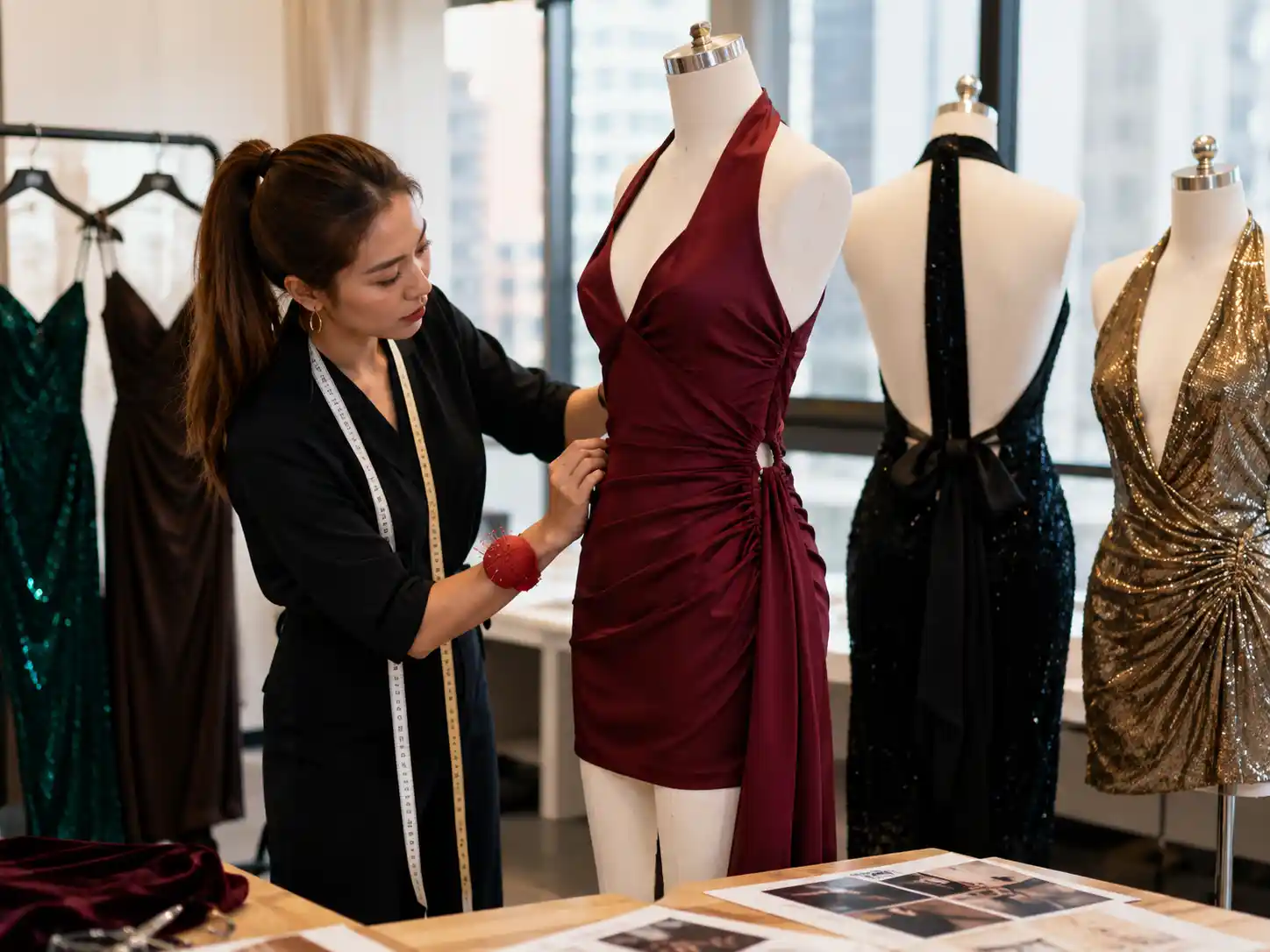
The halter dress is returning to fashion conversations, but describing it as a simple comeback misses the more important change. In earlier trend cycles, a halter neckline was often added to an otherwise familiar mini or maxi dress. For 2027, the stronger direction starts at the neckline and continues through the entire garment: shoulder framing, bust support, back exposure, waist position, fabric weight and skirt movement must behave as one connected system. Spring 2027 bridal reporting has already highlighted halter necklines, open backs and fluid draping, while Resort 2027 coverage points toward elongated waists, deep yokes and dresses that combine function with visual tension.
Halter dress development in 2027 will be shaped by sculpted necklines, open-back construction, elongated proportions, controlled draping and more deliberate internal support. Commercial success will depend less on copying runway images and more on matching each design to the right occasion, fabric behavior, size range, comfort expectation and production method.
That difference becomes obvious in the fitting room. A dress can look almost perfect on a hanger and still fail when someone walks, sits or dances: a neck strap stretches, the armhole opens, the bust shifts and the back begins to rotate. The most successful 2027 collections will not be the ones with the lowest backs or the most complicated cutouts. They will be the ones developed by teams that identify those risks before the first sample is approved. One small decision at the pattern stage can determine whether a dramatic campaign dress becomes a repeatable bestseller or an expensive return problem.
Are Halter Dresses Still Trending in 2027?
Yes. Halter dresses remain relevant for 2027, but the strongest versions will look more refined than earlier Y2K-inspired styles. Clean high necklines, crossed fronts, controlled open backs, softer draping and better internal support will matter more than extreme cutouts. Commercial performance will depend on how convincingly the neckline is adapted to real occasions, movement and broader size ranges.
What Is Driving the Revival?
The renewed interest in halter dresses is not coming from one isolated fashion reference. Several familiar ideas are meeting at the same neckline: 1990s minimalism, early-2000s party dressing, 1970s evening glamour, Grecian draping and the continuing appetite for shoulder-baring silhouettes. Together, these references make the halter recognizable without forcing every product to feel nostalgic. The neckline can appear precise and architectural in a crepe column, relaxed in a scarf-tie vacation dress or sensual in a draped jersey mini, which gives design teams room to interpret the trend through their own brand language.
The halter also solves a practical visual problem. It frames the face, shoulders and upper back without requiring dramatic sleeves, oversized collars or heavy surface decoration. A relatively restrained dress can gain a clear identity once the shoulder line is exposed and the neckline is shaped correctly. That is particularly useful in ecommerce, where a style needs to read quickly in thumbnails, campaign images and short product videos. Open backs and crossed fronts provide multiple strong views, but visual impact still has to be supported by fit, coverage and comfort once the customer stops posing and begins moving normally.
Is the Trend Moving Beyond Bridal?
Spring 2027 bridal collections provide one of the clearest early signals for the neckline direction, with halter shapes, elegant front coverage, open backs and fluid draping appearing prominently in trend reporting. The commercially useful lesson is not that every fashion label should enter specialist bridal production. Formal collections often reveal proportion and construction ideas before those ideas move into wedding guest, cocktail, graduation, prom, resort and evening categories, where fabrics, internal structures and price expectations are very different.
A high-neck lace gown can become a lined occasion midi. A dramatic satin dress can be simplified into a cleaner maxi with fewer internal layers. A low-back formal silhouette can be re-engineered into a stretch-jersey mini that keeps the visual effect while improving movement and accessibility. The transition succeeds when the original idea is edited according to the end use. A wedding guest dress must remain comfortable for several hours; a vacation dress needs lower weight and easier packing; a party mini can accept more exposure but still requires stable bust coverage and controlled hem movement.
Do Halter Dresses Have Staying Power?
The halter has more staying power than many surface-level trends because it is a construction category rather than a single motif. It can be narrow or wide, high or low, minimal or embellished, fitted or fluid. That allows the neckline to remain familiar while the fabric, length, waist position and detail direction change across seasons. A commercially durable style usually combines a recognizable neckline, a strong back view, several hours of wearable comfort, reliable grading and materials that can be reordered for additional colors or repeat production.
Shorter-lived versions often depend on one extreme feature, such as an unusually deep plunge, very thin neck ties or multiple cutouts competing for attention. These designs may generate fast engagement, but they can narrow the customer base and increase complaints involving support, coverage and neck pressure. Longer-lasting versions balance exposure with control: a high front may open deeply at the back, while a plunging front may use a wider shoulder frame, an underbust anchor and concealed mesh. The aim is not to remove drama, but to ensure that the drama survives normal movement and commercial sizing.
Which Markets Are Most Responsive?
Halter dresses are most responsive in occasion-led markets where customers actively look for a strong visual moment. Party, birthday, homecoming, graduation, wedding guest, cocktail, vacation and going-out collections all offer relevant entry points, but they do not need the same product. Trend-led ecommerce brands can react with jersey minis, open-back maxis and satin midis, while premium occasion labels may focus on cleaner construction, more controlled draping and higher-quality lining. Resort brands can favor adjustable ties, prints and lighter fabrics, while multi-channel retailers may require greater coverage and easier bra compatibility.
The buying calendar matters as much as the neckline. A pale satin maxi intended for wedding guest or graduation seasons has a different launch window from a velvet halter planned for year-end events. A bright jersey mini can perform around holiday travel and social periods, while a clean black midi may have a longer selling season. The halter should also sit within a wider assortment rather than dominate every product. A stronger collection uses it as one recognizable group alongside one-shoulder, corset, draped and sleeved options, giving customers different coverage levels without losing the overall seasonal story.
| Trend Signal | Likely 2027 Interpretation | Practical Product Response |
| Shoulder-baring silhouettes | Cleaner upper-body lines | Develop stable armholes and refined neck shapes |
| Open-back dressing | Greater emphasis on rear views | Add waist anchoring, back straps or concealed elastic |
| Soft minimalism | Less visible decoration | Use proportion, drape and fabric quality as the main value |
| Y2K influence | Narrow ties and body-skimming fits | Improve support and reduce uncontrolled exposure |
| Resort styling | Scarf ties and fluid movement | Test lighter fabrics and adjustable neck constructions |
| Elongated proportions | Drop waists and deep yokes | Rebalance bust, waist and hip positions carefully |
Which Halter Silhouettes Will Lead?
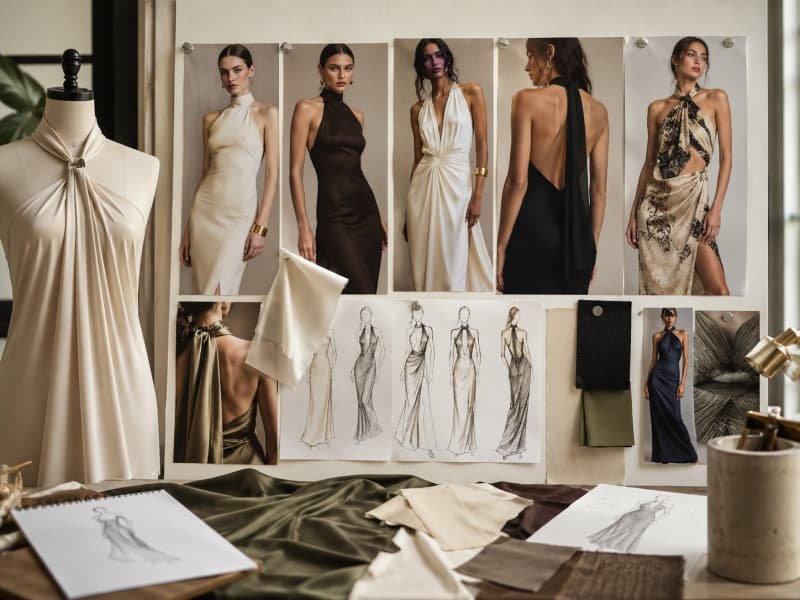
The leading 2027 halter silhouettes are likely to include crossed fronts, high-neck columns, scarf ties, gathered plunges and open-back minis or maxis. Fitted styles will remain commercially important, while softer bias-cut and draped shapes will offer a more refined alternative. Length, neckline depth and skirt volume should be chosen according to the intended occasion and fit expectation.
Which Necklines Will Matter Most?
A halter neckline should be selected as a structural system, not only as a visual detail. A crossed-front halter creates a strong diagonal line and works well in jersey, satin and crepe. It can provide more coverage than a straight plunge, but the overlap must be stabilized so the front does not spread during movement. The crossing point also needs to remain consistent across sizes, because a small vertical shift can change both bust coverage and the perceived length of the upper body.
A high-neck halter moves attention toward the shoulders and back, making it suitable for clean column dresses, lace overlays and premium occasion styles. Its main risk is backward pull around the throat when the back is too open or the skirt is too heavy. A deep-V halter creates a stronger evening look but normally needs hidden mesh, cups, an underbust seam or elastic to control the opening. Scarf-tie and gathered halters add softness and adjustability, yet they demand precise tie lengths, gathering ratios and fabric choices so the finished neckline looks intentional rather than bulky or uneven.
Are Open-Back Halters Still Growing?
Open backs remain closely connected to halter styling because removing the shoulder area naturally shifts attention to the rear of the garment. The design challenge is that an open back also removes fabric that would normally help stabilize the bodice. A full low back produces the strongest campaign image but depends heavily on a secure waist or underbust anchor. A keyhole opening is easier to control, while crossed straps can support both fit and visual identity. Horizontal back straps may look less dramatic, but they can stop side panels from drifting forward during movement.
The important question is not how low the back can go, but where the dress obtains stability after the back is removed. A shaped waist seam, internal waist stay, stable underbust elastic, side-front boning, power-mesh lining or adjustable crossed straps can all contribute. Bra compatibility should be decided early. Some styles are intentionally designed for built-in cups, while others can accommodate specialist low-back solutions. Open-back edges must also be tested for rolling, stretching and standing away from the body, particularly in satin and soft jersey where a visually clean edge may require concealed elastic or lightweight stabilization.
Which Dress Lengths Will Perform Best?
Mini, midi and maxi lengths each support a different commercial expression. Halter minis are strongest in party, birthday, homecoming and going-out categories, where compact jersey, stretch crepe, sequins and structured satin can create a close, energetic silhouette. Their main risks are hem lift, concentrated neck tension and excessive side exposure. A mini that looks balanced while standing may become significantly shorter when the wearer sits or raises an arm, so movement testing is essential before the hem and side seam are approved.
Midi lengths give the neckline a more polished character and often provide wider multi-channel potential. A fitted crepe midi can work for cocktail and dinner settings, while a draped satin or softly flared version can move into wedding guest and occasionwear. Maxi halters offer the greatest room for bias cutting, Grecian folds, scarf details and low backs, but additional skirt length increases garment weight. Drop-waist versions can feel fresh as elongated torso proportions continue, yet the lowered seam must not restrict the hip or pull the entire bodice downward.
Fitted or Fluid?
Fitted halter dresses remain commercially important because they connect naturally with partywear, body-conscious styling and social-event dressing. They are easy to recognize in product photography and can be developed across mini, midi and maxi lengths. The technical demand is higher than the simple silhouette suggests. Bust balance, waist suppression, hip shaping, stretch recovery and neckline tension all interact, and a small change to fabric recovery can affect the full dress. A fitted style that depends on compression must also be checked across sizes rather than approved only on the core fit model.
Fluid halters provide a softer alternative through bias satin, draped jersey, chiffon layers and lightweight crepe. They appeal to customers who want exposed shoulders without a highly compressed fit, but they are not automatically easier to produce. Fluid dresses are sensitive to grain direction, seam growth, fold placement and garment weight. A balanced seasonal range can include both categories: a fitted mini for high-impact party dressing, a draped midi for broader occasions and an open-back maxi for campaign storytelling. The shared neckline connects the group while the silhouettes answer different customer needs.
| Silhouette | Suitable Categories | Typical Fabric Direction | Main Development Risk |
| Fitted halter mini | Party, birthday, homecoming | 180-280 GSM stretch jersey or crepe | Hem lift and neck strain |
| Draped halter mini | Vacation, going out | Lightweight jersey or satin | Uneven gathers and side exposure |
| Column halter midi | Cocktail, dinner, occasion | Crepe, double knit, satin-back crepe | Restricted stride |
| Bias halter midi | Wedding guest, resort | 90-160 GSM satin or fluid crepe | Grain growth and twisting |
| Open-back halter maxi | Evening, resort, formal events | Satin, jersey, chiffon layers | Skirt weight pulling at neckline |
| Drop-waist halter | Fashion-led occasion | Soft woven or stable jersey | Incorrect torso and hip proportion |
| Flared halter maxi | Vacation, summer occasion | Chiffon, georgette, lightweight crepe | Lining mismatch and waist bulk |

What Fabrics and Details Will Define Halter Dresses?
Satin, jersey, crepe, mesh, chiffon, lace and compact knits will remain central to halter dress development. The right choice depends on whether the design requires fluid drape, compression, support or transparency. Ruching, hardware, scarf extensions and controlled embellishment can add commercial value, but they must not weaken the neckline or place unnecessary weight on the neck.
Which Fabrics Suit Each Silhouette?
Fabric behavior has a direct effect on neckline stability, bust support and back fit. Stretch jersey suits fitted, ruched and draped silhouettes because it follows the body and allows movement, yet the important measurements are not limited to GSM. Stretch percentage, recovery, thickness and directional behavior determine whether the neckline returns to shape after wear. A soft jersey with high extension and weak recovery may appear attractive during sampling but gradually lengthen at the neck and back edge, especially when a long skirt adds downward force.
Satin works well for fluid occasion dresses, bias cuts and crossed-front shapes. Lightweight qualities create movement but can expose seam puckering, pressing marks, body lines and lining differences. Medium-weight satin feels more substantial but increases garment load. Crepe offers a cleaner, less reflective surface and can support both stable columns and fitted stretch designs. Mesh has several distinct roles: fashion mesh creates visible transparency, power mesh supplies internal recovery and illusion mesh can secure a plunge. Chiffon, georgette and lace provide lightness or texture, but each requires planned lining, seam treatment and motif placement before costing is finalized.
Are Satin and Jersey Still Important?
Satin and jersey remain important because they communicate two different product promises. Satin signals occasion and visual polish. It reflects light effectively in campaign photography and gives crossed necklines, scarf ties and bias skirts a fluid appearance. Its weaknesses are equally visible: uneven feed, seam puckering, shade variation, snagging and poor pressing can make an otherwise well-developed dress look inexpensive. Satin therefore needs controlled sewing tension, appropriate needles, suitable seam types and pressing methods that are confirmed during sampling rather than left for the production floor to solve.
Jersey communicates movement, comfort and body definition. It allows gathers and draping to be built into the pattern with fewer rigid components, but the phrase ‘stretch jersey’ is too broad for accurate development. Two fabrics with similar weight may recover very differently after extension. One can support a close open-back dress, while another may grow around the armholes and neckline. Material approval should therefore include stretch and recovery checks, shrinkage, opacity, surface pilling risk and bulk availability. A visually similar substitute should not be accepted without refitting the key neckline and support areas.
How Will Sheer Panels Be Used?
Sheer panels are most effective when they solve a structural problem as well as a visual one. A skin-tone mesh insert can stabilize a deep plunge without significantly changing the front appearance. A mesh side panel can control exposure while preserving the cutaway shape of an armhole. Power mesh can sit inside a jersey bodice to support the bust and improve recovery. The correct result depends on transparency, weight and direction of stretch, not simply on choosing a material described as mesh.
Transparency should be checked under daylight, studio lighting and camera flash because a panel that appears invisible in one environment may become obvious in another. Fine mesh can distort under excessive tension, while heavier mesh can create ridges beneath satin or jersey. For plunging fronts, the panel should not pull horizontally across the bust or create wrinkles when the wearer moves. Multiple skin-tone options may be necessary for a wider market. Sheer design feels refined when the panel remains stable and deliberate; rolling edges, mismatched lining and random gaps quickly make the garment appear unfinished.
Which Details Add Commercial Value?
Ruching, hardware and scarf elements can make a halter dress easier to recognize, but each feature should contribute to the product rather than compete with it. Ruching adds texture and can make fitted dresses more forgiving, yet it must be controlled through gathering ratios, elastic lengths or fixed placement marks. Instructions such as ‘gather evenly’ leave too much variation between operators. A consistent finished appearance requires measurable distribution and a reference sample, particularly when the folds cross the bust, waist or side seam.
Metal rings, bars and decorative neck pieces can create a signature look, but hardware must be reviewed for weight, plating, edge smoothness, pull strength and skin contact. Scarf extensions add movement and styling flexibility, although their length should be tested while walking and sitting. Sequins, beads and crystals suit evening collections, but decoration close to the neck needs careful backing and weight control. A useful discipline is to give each design one leading feature and one supporting feature. A crossed halter with strong draping may need only a clean open back, not additional cutouts, rosettes, hardware and dense embellishment.
| Material | Typical Development Range | Key Performance Check | Suitable Direction |
| Lightweight satin | 90-130 GSM | Opacity, seam smoothness, snagging | Bias midi, scarf halter, fluid maxi |
| Medium satin | 130-190 GSM | Drape against garment weight | Occasion column, crossed-front maxi |
| Stretch jersey | 180-260 GSM | Stretch and recovery | Fitted mini, ruched midi, draped maxi |
| Compact double knit | 220-320 GSM | Compression and edge stability | Structured bodycon halter |
| Fashion mesh | 40-90 GSM | Transparency and seam slippage | Layered and illusion designs |
| Power mesh | 100-180 GSM | Recovery after repeated extension | Internal bust and back support |
| Chiffon or georgette | 50-100 GSM | Static, sheerness and layer movement | Flared maxi, resort dress |
| Woven crepe | 140-220 GSM | Wrinkle recovery and seam appearance | Cocktail midi, high-neck halter |
| Stretch lace | 120-220 GSM | Motif distortion and edge recovery | Fitted lace halter or overlay |

How Should Halter Fit and Support Be Developed?
A well-developed halter dress distributes weight through the bust, underbust, waist and back instead of placing the full load on the neck. Fit development should control strap extension, armhole gaping, bust position, side-seam movement and back stability. Built-in support, fabric-specific patterns and movement testing are essential, especially for low backs, long skirts and extended size ranges.
How Should the Neckline Carry Weight?
Neck discomfort is usually caused by poor weight distribution rather than the halter shape itself. A long skirt, heavy satin, dense sequins or several chiffon layers can create significant downward force. If the waist and underbust provide little support, that force travels directly to the neck. Wider straps can spread pressure over a larger area, but width alone is not a solution. A wide strap cut in unstable bias satin may still lengthen during wear, while a narrow strap can remain comfortable when the dress is lightweight and securely anchored elsewhere.
Development records should include finished strap width and length, grain direction, internal layers, closure method and garment weight in the approved sample size. The strap should be measured before and after a wear test to identify growth. Tied halters need additional attention because the knot must remain secure without creating a hard bulk at the back of the neck. The internal finish also matters: thick seam allowances, rough sequins or uncovered hardware can irritate a sensitive area. Security should come from the whole garment structure, not from asking the wearer to tie the neckline more tightly.
How Can Bust Support Be Built In?
Bust support should be selected according to neckline depth, back openness, fabric stretch and target size range. Molded cups can provide a clean rounded shape, but their position must match the approved bust apex. Generic cups added late in development often sit too high, too low or too far apart. Cut-and-sew cups offer more control in seamed bodices, while an underbust seam creates an anchor for crossed fronts, deep plunges and open-back dresses. Boning can stabilize side-front and side seams, but incorrect length or placement may create visible ridges and restrict movement.
Power mesh is especially useful inside stretch garments because it provides recovery without excessive bulk. It can support the bust, control side movement and stabilize a low back. Other options include underbust elastic, clear elastic along a neckline, stable lining panels, side bust slings, inner waist stays, concealed back straps and adjustable neck closures. Larger sizes normally need more than proportional grading. Wider straps, deeper cups, firmer underbust anchoring and greater side coverage may be necessary. Support should always be tested on a moving body because a standing fitting can hide problems that appear when the wearer bends, reaches or raises both arms.
What Causes Gaping or Neck Strain?
Armhole gaping often begins with incorrect bust shaping, front width or strap placement. Tightening the neck may appear to close the opening, but it usually increases pressure and distorts the bust. Neck strain can result from excessive skirt weight, unstable straps, a back opening that removes too much support or a neckline positioned too close to the throat. Back instability appears when side panels lack a reliable anchor, allowing the dress to rotate forward and the side seam to migrate away from its approved position.
Fabric substitution is another common cause. A pattern approved in compact jersey may fail in a softer quality with higher stretch and weaker recovery. Bias satin may grow after hanging, changing the neckline, side seam and hem at the same time. For fit-sensitive halters, the development team should separate design preference from functional failure. Lowering a neckline is a design choice; a neckline that opens unexpectedly when the wearer bends is a functional risk. Measurements, movement video and the approved physical sample should be reviewed together rather than relying on a single posed photograph.
How Should Patterns Change by Fabric?
A halter pattern cannot be separated from the material used to develop it. Stretch jersey patterns often contain negative ease, meaning the finished garment measures smaller than the body so the fabric can create a close fit. The correct amount depends on stretch and recovery, and it may need to change when the fabric quality changes. Bias-cut satin behaves differently because it can lengthen under its own weight. A sample should normally hang before final side seams and hem balance are approved, particularly when the skirt is long or the fabric is fluid.
Woven crepe offers more stability but less forgiveness, so bust shaping, armhole contour and zipper placement must be more precise. Mesh may require smaller seam allowances, lighter needles and reinforced edges. Lace can force the pattern team to reposition seams around motifs or scallops, while chiffon often needs layered handling and careful feed control. A material change should therefore be treated as a technical change rather than a simple sourcing substitution. Even when two fabrics look similar on a swatch card, differences in stretch, weight and grain behavior can alter the finished fit significantly.
| Fit Area | Development Check | Practical Starting Point |
| Neckline growth | Measure before and after wear testing | Limit unplanned extension to about 3-5% |
| Bust apex position | Compare with approved fit | Often controlled within approximately +/-0.5 cm |
| Armhole edge | Check standing, reaching and sitting | No uncontrolled gaping |
| Side-seam rotation | Compare before and after movement | Keep movement close to 1 cm or less |
| Underbust position | Check arm movement and sitting | Remains level without riding up |
| Open-back edge | Observe walking and bending | No rolling, flipping or sudden opening |
| Key neckline measurements | Compare with specification | Frequently controlled within +/-0.5 cm |
| Main body measurements | Follow brand tolerance chart | Commonly around +/-1 cm where appropriate |
| Hem balance | Measure after hanging | No twisting or uneven drop |
| Cup placement | Review across key sizes | No collapse, floating or visible edges |
These figures are practical development starting points rather than universal acceptance standards. Final tolerances should be set by the approved sample, fabric behavior, brand measurement chart and risk level of the style. A low-back satin maxi normally requires tighter control at the neckline and bust than a relaxed vacation dress, while a high-stretch bodycon style may need fabric-recovery limits that are more important than a single flat garment measurement.

How Can Brands Develop Sellable Halter Dresses?
Sellable halter dresses begin with a clear occasion, customer profile and fit promise. Brands should develop a balanced capsule rather than several nearly identical open-back styles. First samples must be tested for movement, coverage and support, while materials and construction methods should be selected with repeat production in mind. Strong design and production stability need to be developed together.
Which Occasions Offer the Best Potential?
Halter dresses perform best when customers can immediately understand where and why they would wear them. Party and birthday collections favor shorter lengths, close fits, shine and statement backs. Wedding guest and cocktail styles generally benefit from midi or maxi lengths, more controlled exposure and elevated materials. Vacation and resort dresses can use adjustable ties, prints, lightweight jersey and fluid skirts, where packability and movement may matter more than rigid internal construction. Graduation, homecoming and prom categories can support stronger color, structure and embellishment, but fit consistency is critical because the customer is often buying for a fixed event date.
Going-out collections can adopt lower necklines, hardware and shorter lengths, yet a commercial garment should not depend entirely on styling tape used during campaign photography. A balanced capsule might include one image-led open-back maxi, one repeatable fitted mini, one satin occasion midi, one adjustable vacation style, one higher-coverage high-neck halter and one embellished hero piece. This creates several exposure levels, price positions and reasons to buy. It also allows sales performance to reveal which expression of the trend deserves deeper color expansion or repeat production.
How Should a Halter Capsule Be Balanced?
A useful capsule should not repeat the same neckline, fabric and length with minor changes. Customers need visible reasons to choose one style over another. One dress may lead with a crossed satin front and low back, another may use a high neckline and clean column shape, while a third offers adjustable scarf ties and a flared skirt. The shared halter direction keeps the collection connected, but differences in occasion, coverage and fit prevent the products from competing with each other too directly.
Color planning should follow product role. Black, chocolate, navy and deep red are dependable for evening categories, while pale yellow, blush, soft blue and ivory can support wedding guest and resort stories. Strong pink, green, orange or metallic finishes may be more suitable for selected campaign styles. The capsule also needs both image products and repeat products. Hero styles create attention but may have narrower fit appeal or higher manufacturing costs. Repeatable styles should use materials, trims and constructions that can support additional colorways, replenishment and future seasonal updates without rebuilding the full development process.
What Should Be Tested in the First Sample?
The first sample should answer whether the design can become a reliable garment, not only whether it resembles the sketch. The wearer should walk, sit, bend, turn and raise both arms. For long dresses, the sample should hang before final length comments are issued, especially when bias fabrics or heavy skirts are involved. Review points should include neckline position, neck pressure, strap growth, bust coverage, armhole gaping, side exposure, cup placement, underbust support, side-seam balance, open-back stability, closure access, opacity, lining movement, hem lift, hardware rotation and any decoration that touches the skin.
Fit comments should distinguish design preference from functional risk. Lowering a neckline by two centimeters is a design decision, while a neckline that opens when the wearer bends is a construction problem. Photographs and video help record the fitting, but measurements should remain the controlling evidence because posing can hide instability. The first sample is also the best time to question unnecessary complexity. A feature that increases cost and sewing variation without improving appearance, fit or product differentiation may be better removed before the revised sample, rather than protected simply because it appeared in the original sketch.
How Can Design Intent Survive Production?
Design intent survives production when the approved shape is converted into clear and repeatable controls. The final pattern version should be locked, and the approved sample should remain available as a visual reference. The fabric quality, lining, elastic, cups, hardware and trims need confirmed specifications. Draping requires more than a photograph: gather length, placement points and fold direction may need measurement. Back openings should have defined dimensions, strap positions should be measured from stable reference points and scarf ties should have approved finished lengths. A visually similar material should not be substituted without checking weight, stretch, recovery and hand feel.
A size-set review is particularly valuable for halter dresses because the neckline, bust depth, armhole and back opening may not grade successfully through simple proportional increases. Reviewing a smaller, middle and larger size can expose balance problems before bulk cutting. A pre-production sample should use the intended materials, followed by first-piece or pilot approval for fit-sensitive styles. Inline inspection can then identify neckline stretching, uneven gathers, seam puckering or measurement drift early. Repeat orders depend on archived patterns, approved samples, bills of materials and fit records so later production begins from controlled information rather than memory or interpretation.
For brands that need this level of development discipline, Duolan Apparel focuses on fashion dresses, occasion dresses, party dresses, fitted dresses and collection-based womenswear, including halter, backless, satin, mesh and body-conscious constructions. The company’s documented manufacturing structure includes 16 self-owned fashion factories, more than 20 long-term satellite factories, 300 sewing lines and over 50 flexible-response lines, supported by teams covering trend research, fabric and trim development, patternmaking, samples, process engineering, production coordination and quality control. Its compliance foundation includes a completed SMETA 2-Pillar audit record and the ability to coordinate customer requirements involving widely used apparel testing and quality standards.
A productive inquiry should include design files or reference images, the intended fabric effect, size range, estimated quantity by style and color, target price position, sample deadline, bulk delivery window and any testing, labeling or packaging requirements. This information allows the development team to review neckline structure, support method, fabric suitability, likely sample risks and production route before quoting. To discuss a 2027 halter dress capsule or a specific mini, midi or maxi style, contact Duolan Apparel for a development assessment and customized production quotation.