Skip to content

The most important party dress trend for 2027 is not a single hemline, color, or decorative technique. It is the growing expectation that a dress should create an immediate emotional response while still working in real life. Customers want pieces that look memorable in photographs, feel secure through a long dinner, move easily on a dance floor, and remain useful after one event. That combination is changing the way designers approach familiar ideas such as corsetry, sheer layering, satin draping, sequins, and low-back construction.
The biggest party dress trends for 2027 are expressive color, fluid draping, elongated waists, asymmetric necklines, softer corsetry, strategic transparency, and more selective embellishment. Mini, midi, and maxi lengths will all remain relevant, but the strongest designs will connect silhouette, fabric, support, movement, and occasion instead of treating trend details as decoration added at the end.
Early 2027 direction suggests a season that is dressed-up without feeling trapped by traditional eveningwear rules. A clean black column can feel as current as a crystal-covered mini when its proportions are right. A lace dress can look modern when transparency is controlled rather than excessive. The real story begins when a beautiful sketch meets a moving body, because that is where a passing trend either becomes a product customers remember or a dress they spend the entire evening adjusting.
What Is Driving Party Dress Style in 2027?
Party dress style in 2027 is being driven by expressive femininity, stronger color, fluid movement, and more thoughtful exposure. Lace, draping, ruffles, elongated waists, and corseted shapes are returning in cleaner forms, while minimal dresses gain impact through asymmetric lines, sculpted necklines, and precise fit. The mood is sensual and celebratory, but noticeably lighter and easier to wear.
Romantic Dressing Returns
Romantic details are returning, but the strongest versions do not resemble heavily decorated occasionwear from earlier cycles. Lace may appear only through a bodice panel, around a neckline, or as an asymmetric overlay rather than covering the entire garment. Ruffles are being used to frame a slit, soften a shoulder, or create movement at the hem. Rosettes and bows can still work, but they are most convincing when they give the silhouette a clear focal point instead of competing with several other decorative ideas.
Draping is especially valuable because it changes both the visual line and the way a dress accommodates the body. A diagonal fold can lengthen the torso, side gathering can create flexibility through the waist, and a softly twisted front can add depth to a simple satin surface. These effects must be developed on a body or dress form rather than judged only from a flat sketch. Moving an anchor point by 10 to 15 millimeters can change where folds collect, particularly in lightweight satin, mesh, or stretch jersey.
The commercial lesson is editing. A dress rarely needs lace, crystals, corsetry, ruffles, and cut-outs at the same time. One dominant romantic feature usually creates a clearer product photograph, a stronger identity, and more consistent bulk production. When the decoration has a practical role – providing support, shaping the waist, directing the eye, or controlling coverage – it tends to feel more modern and less like an afterthought.
Color Gets More Emotional
Black, deep brown, navy, and softened neutrals will continue to anchor partywear because they are easy to understand and can cross several occasions. The fresher 2027 direction comes from more emotional color: vivid red, saturated pink, cobalt or pool blue, plum, yellow, and light-catching metallics. These shades are particularly effective in digital retail because they separate quickly from a crowded product grid and give campaigns an immediate seasonal identity.
Color should be planned by role rather than added randomly. Core shades support dependable volume and repeat orders. Seasonal shades refresh proven silhouettes. Image colors create campaign impact and give stylists a reason to feature the collection. A balanced launch may place roughly 40 to 50 percent of its color depth in proven dark shades, 25 to 35 percent in recognizable seasonal colors, and the remaining share in higher-risk statement shades, although actual ratios should follow the brand’s sales history and market.
Fabric finish changes how a color behaves. Tomato red in matte crepe appears controlled, while the same shade in glossy satin becomes more dramatic. Pale mesh can look substantially lighter when stretched across the body, and velvet absorbs light in a way that makes deep colors appear richer. Approvals should therefore be made in the intended material under daylight, warm indoor lighting, and flash photography rather than from a screen rendering alone.
Minimalism Gains Tension
Minimal party dresses are not disappearing; they are becoming more technically demanding. A clean mini can feel current through a longer torso, a sharply curved neckline, or a precise low back. A satin midi may rely on a twisted strap, diagonal cowl, or narrow column skirt. A black maxi can create drama through one controlled slit and a close, uninterrupted line rather than through obvious decoration.
The fewer visual elements a dress contains, the more visible every production decision becomes. Seam puckering on satin, neckline gaping, uneven hems, zipper rippling, and poorly balanced lining are difficult to hide on an undecorated surface. Fabric weight, bias growth, seam construction, pressing temperature, and lining tension become part of the design itself. A simple-looking dress often requires more disciplined sampling than a surface-heavy style because there is nowhere for mistakes to disappear.
Expressive minimalism works best when one area carries tension and the rest remains calm. A high front can balance an open back. A structured bodice can sit above a soft draped skirt. A long, clean sleeve can frame a cut-out without making the dress feel exposed everywhere. This selective contrast gives a familiar silhouette a new point of view while keeping it understandable for customers who want fashion without costume.
Runway Ideas Become Wearable
Runway collections are useful because they reveal changes in proportion, mood, and styling before those ideas become widely commercial. They are less useful when copied without considering movement, support, price, care, and customer expectations. A transparent runway dress may need engineered lining zones, a floor-sweeping train may need to become an ankle-length maxi, and a narrow bandeau may require internal elastic, grip tape, or detachable straps.
A strong commercial adaptation preserves the emotional effect that made the original look desirable. If the impact comes from transparency, the wearable version might use double-layer mesh at the bust and single-layer mesh at the waist. If the drama comes from a plunging neckline, illusion mesh or an internal bridge can improve security without changing the front view. If dense crystals create the story, concentrated placement at the neckline or hip can reduce weight while keeping the sense of occasion.
Real-party testing matters because the customer will not remain in a campaign pose. The dress has to survive sitting, walking, turning, raising the arms, using stairs, and dancing. A style that needs constant adjustment may earn attention online but can produce returns and poor reviews. The best 2027 interpretations will keep a clear fashion point of view while solving the ordinary physical problems that determine whether someone enjoys wearing the dress.
Turning Directional Ideas into Wearable Party Dresses
| Directional Idea | Common Wear Risk | Wearable Adaptation | Useful Verification |
| Extreme transparency | Coverage changes when mesh stretches or catches flash | Use zoned lining, double layers, or an integrated bodysuit | Daylight, flash, seated, and stretch-opacity checks |
| Very deep neckline | Gapping, exposure, or loss of support during movement | Add illusion mesh, a bridge, hidden fastening, or internal cups | Arm-lift, forward-bend, and dancing simulation |
| Dense crystal surface | High garment weight, skin irritation, and attachment failure | Concentrate decoration or use lighter mixed embellishment | Weight review, rub test, pull test, and seam-stress check |
| Oversized ruffles | Bulk at the hip, crushed packing, and uneven gathering | Reduce layers, soften edge finishes, or make the trim removable | Packing recovery, seated comfort, and gathering-ratio control |
| Floor-sweeping train | Restricted walking and contamination at crowded venues | Shorten to ankle length or add a discreet bustle point | Stair, stride, heel-height, and dance-floor checks |

Which Silhouettes Will Lead 2027?
Mini, midi, and maxi party dresses will all remain important in 2027. Fitted minis, extended waists, corseted midis, fluid columns, asymmetric dresses, and low-back maxis are likely to lead. The defining change will be proportion: longer bodices, carefully placed volume, controlled draping, and stronger upper-body shapes will make familiar lengths feel fresh without limiting them to one occasion.
Mini Proportions
The mini dress remains commercially important because it serves birthdays, homecoming events, club nights, holiday parties, and fashion-led social occasions. It is also effective in ecommerce because the complete silhouette can be understood quickly on a mobile screen. The newer mini is less dependent on simply becoming shorter; it feels current through waist placement, bodice length, skirt volume, and the relationship between a strong upper body and a controlled hem.
Two directions are especially useful. The first is fitted and elongated, using corset seams, a lowered waist, curved hip panels, or a narrow bodycon line. The second is deliberately playful, with bubble hems, skater shapes, compact babydoll volume, or short drop-waist skirts. Both can work within the same collection when they share a fabric, color story, or neckline language, allowing the range to feel varied without becoming visually disconnected.
A mini should never be approved while the fit model only stands still. Stretch, hip tension, lining recovery, and skirt construction can cause the back hem to rise noticeably when the wearer walks or sits. Development teams should record finished length from a fixed reference point, test movement in the intended shoes, and check whether the hem still offers suitable coverage after the garment has been worn for at least 15 minutes.
Midi Versatility
The midi remains one of the strongest commercial party-dress formats because it can cross cocktail events, dinners, wedding guest occasions, graduation celebrations, and more formal social settings. Fresh shapes include narrow columns, soft bias cuts, corseted bodices with straight skirts, asymmetric hems, and gathered jersey silhouettes. Small changes to neckline, slit height, sleeve coverage, and fabric finish can move the same basic proportion from daytime polish to evening impact.
Walking width is an overlooked development issue. A close woven midi may look elegant during a static fitting but restrict the wearer’s stride. A center-back vent, side slit, stretch component, or slightly increased hem circumference may be required. Slit height should be checked while sitting, because the opening can rise significantly as the hip bends, especially when the skirt is narrow and the fabric has little mechanical give.
Midi grading also needs more than proportional enlargement. If every measurement grows by the same amount, the waistline can drop, the slit can become relatively higher, and a corseted bodice can lose its intended support. Key style lines should be repositioned by size so that the silhouette remains balanced. Brands extending into broader size ranges benefit from fitting at more than one point rather than assuming a single base-size approval will protect the full range.
Maxi Movement
The 2027 party maxi is becoming lighter, closer to the body, and easier to style than traditional heavy eveningwear. Bias satin, draped jersey, layered mesh, narrow columns, thigh slits, and low-back halters can create strong visual drama without excessive volume. The most effective designs rely on fabric movement, clean length, and a confident back or neckline rather than on a large skirt that becomes difficult to sit in, pack, or repeat-wear.
Maxi development should include the intended heel range. A hem approved with a 100-millimeter heel may drag when worn with a 50-millimeter heel, while a length cut for flats can look unintentionally short in campaign styling. Product pages should state garment length, sample size, model height, and shoe height clearly. For international markets, offering petite or tall adjustments on selected volume styles can reduce uncertainty and improve the customer’s first impression of fit.
Bias-cut maxis require time to settle before final hemming because some fabrics lengthen after hanging. A sample may need to rest for 24 to 48 hours, depending on fabric structure and cut, before the hem is balanced. Low-back and halter versions also need weight distribution checks: a heavy skirt can pull on the neck or distort the back edge unless internal waist support, stabilized seams, or a lighter lining system is introduced.
Halter, Asymmetry, and Corsetry
Halter necks, one-shoulder lines, diagonal draping, and corseted bodices are likely to remain strong because they give the upper body an immediate identity. These shapes photograph well from several angles and allow a dress to feel directional without relying on heavy decoration. Their success, however, depends on stability. The neckline must stay in place, the bodice must balance the skirt weight, and asymmetric seams must not twist after repeated movement.
Halter dresses can create neck pressure when the skirt is heavy or when the front neckline is cut too low to distribute tension. Adjustable ties, internal waist stays, lighter skirt construction, and hidden bust support can improve comfort. One-shoulder styles need careful control of stretch and seam tension so the garment does not rotate around the body. The side seam and underarm on the unsupported side should be reviewed during walking and arm movement rather than only in a front-facing pose.
Corset dresses are becoming softer and more wearable rather than simply more rigid. Shaped seams, flexible boning, molded or cut-and-sewn cups, supportive lining, and carefully placed back closures can create the language of corsetry without making the wearer feel restricted. Cup volume, bridge width, underbust position, waist length, and back tension must be developed as one system. Adding boning channels to an ordinary bodice does not automatically create a secure or flattering corset fit.
Leading 2027 Silhouettes and Their Main Development Controls
| Silhouette | Best-Fit Occasions | Useful Fabric Direction | Critical Control Point |
| Elongated-waist mini | Birthday, homecoming, club, holiday event | Stretch woven, structured satin, ponte, stable jersey | Back hem rise, torso length, and hip tension |
| Corset midi | Cocktail, dinner, wedding guest, formal social event | Satin, crepe, mesh overlay, stable stretch woven | Cup volume, waist balance, walking width, and slit height |
| Fluid column maxi | Evening, destination event, formal celebration | Bias satin, fluid jersey, crepe, layered mesh | Bias growth, hem balance, lining movement, and heel height |
| Asymmetric dress | Campaign-led party edit, cocktail, dinner | Jersey, satin, crepe, mesh | Twisting, one-sided strap tension, and side-seam balance |
| Halter low-back dress | Summer party, destination event, evening dinner | Light satin, crepe, fluid jersey | Neck pressure, bust support, and back-edge stability |
| Soft corset mini | Birthday, party launch, modern occasionwear | Structured satin, stretch mesh, bonded or lined woven | Boning comfort, cup shape, zipper stress, and grading |

Which Colors, Fabrics, and Details Will Trend?
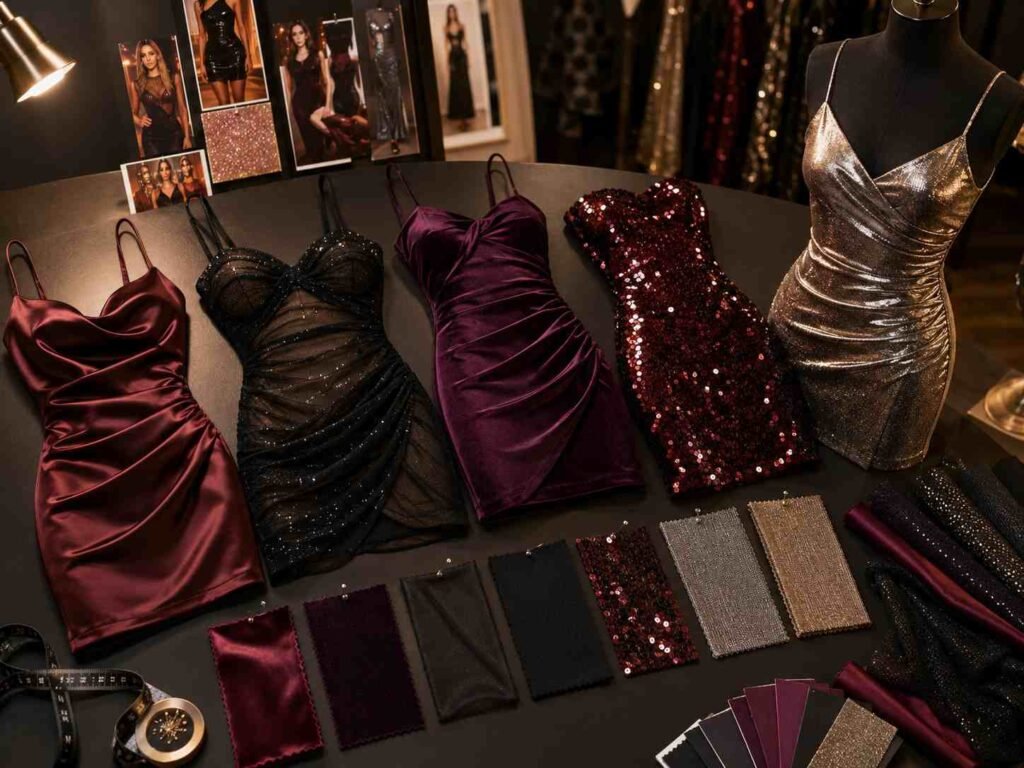
The leading 2027 party-dress materials will combine movement, light reflection, texture, and controlled transparency. Satin, velvet, stretch mesh, lace, sequins, fluid jersey, and lightweight organza will remain important, while color will move between dependable dark shades and expressive reds, pinks, blues, plums, yellows, and metallic finishes. Material performance will matter as much as visual novelty.
Color Stories
The 2027 party palette is likely to combine emotional color with reliable commercial anchors. Vivid red, saturated pink, cobalt or pool blue, plum, yellow, chocolate, and metallic silver can create campaign impact, while black, deep brown, and softened neutrals provide continuity. The point is not to abandon dependable shades. It is to place stronger colors where they can refresh silhouettes the customer already understands and give each seasonal drop a distinct visual identity.
Color should be reviewed in the intended fabric because surface and stretch change perception. A vivid red in matte crepe feels controlled, while the same color in glossy satin becomes louder and more reflective. Pale pink mesh can become noticeably lighter across the bust or hip, and deep velvet can appear almost black in one direction and richly colored in another because of its nap. Approval should include folded, stretched, draped, and photographed views rather than a small flat swatch alone.
A clear collection palette usually has three layers: core colors for proven volume, seasonal colors for freshness, and image colors for campaign attention. The strongest commercial styles may be repeated in two layers, such as black plus one emotional shade, while the most experimental silhouette receives a narrower color offer. This reduces unnecessary inventory risk without making the collection look cautious or repetitive.
Satin and Velvet
Satin and velvet remain important because they communicate occasion immediately, but their success depends on specification. Lightweight satin supports slips, cowls, and fluid maxis, yet it may reveal seam tension, underwear lines, or surface marks. Heavier satin gives structure to corsets and sculpted minis, but it can become bulky at gathered seams. The appropriate choice depends on the silhouette, lining, decoration, intended retail price, and the level of maintenance the customer will accept.
Velvet is especially useful for autumn, winter, holiday, and evening collections. Stretch velvet suits fitted dresses, while woven velvet can support more structured shapes. Nap direction must remain consistent during cutting because reversed pieces can appear to be different colors. Pile pressure, seam shine, and crushing during packing also need review. A premium-looking sample can lose much of its appeal when the surface arrives flattened or marked after transport.
Neither material should be selected from appearance alone. Satin requires seam, snag, opacity, and pressing checks. Velvet requires nap, color, seam, abrasion, and packing-recovery checks. When a collection repeats one approved base quality across several styles, it becomes easier to control color consistency and reorder. However, a fabric suitable for a fitted mini may still be wrong for a bias maxi, even when the fiber content looks similar on paper.
Mesh and Sheer Layers
Sheer dressing will continue, but the strongest commercial versions will use transparency strategically rather than uniformly. Mesh can create an illusion neckline, frame the waist, support a plunge, soften a corset, or form an outer layer over an opaque base. The design feels more intentional when transparency reveals and conceals in planned zones instead of forcing the customer to solve coverage with separate undergarments after purchase.
Opacity changes with stretch, color, lighting, and layer count. A double mesh panel that appears modest while hanging may become noticeably sheer when stretched across the hip. Pale shades reveal cups, boning channels, and seam allowances more clearly than black. Development should include daylight, studio light, flash, seated, and movement checks. The lining should also be reviewed from front, side, and back because shifting layers can make coverage appear uneven during wear.
Recovery is equally important. Low-quality stretch mesh can grow at the neckline, wrinkle at the waist, or lose tension after a few hours. Armholes and neck edges should feel soft against the skin while remaining stable enough to avoid gaping. When an illusion effect is intended, brands may need more than one mesh tone for different markets, or they may choose an intentional contrast rather than presenting one beige shade as a universal skin match.
Sequins, Lace, and Surface Detail
Sequins, beads, crystals, lace, and embroidery are becoming more selective and design-led. Tonal sequins, scattered stones, jeweled necklines, pearl placement, and concentrated embroidery can guide attention without covering every surface. This approach can reduce weight, improve comfort, and create a clearer silhouette. It also allows a decorative technique to feel connected to the dress shape rather than functioning as a generic partywear signal.
Embellishment should be reviewed for attachment strength, skin contact, and seam stress. A densely beaded sleeve can become tiring, sequins near the underarm may scratch, and stones placed directly on stretch fabric can loosen when the garment expands. The approved sample should define placement coordinates, density, thread, backing, edge finish, and acceptable variation. Photographs are not precise enough to control a complex surface across several production lines or repeat orders.
Lace, ruffles, and draping are most useful when they shape the body or create movement. Lace may need motif matching and stable edge treatment. Ruffles require a controlled gathering ratio so left and right sides remain consistent. Draping needs clearly marked anchor points and notches because small placement differences can alter the entire silhouette. The strongest details have a job: support, coverage, movement, proportion, or visual focus.
Practical Starting Specifications for Party-Dress Materials
| Material | Typical Starting Weight | Common 2027 Uses | Priority Tests |
| Lightweight satin | 90-140 gsm | Slip midis, cowls, draped maxis, scarf details | Opacity, seam puckering, snagging, bias growth, and pressing |
| Structured satin | 160-260 gsm | Corset dresses, sculpted minis, fitted bodices | Seam bulk, press marks, cracking, color consistency, and lining balance |
| Stretch mesh | 70-160 gsm | Ruched dresses, illusion panels, sleeves, layered bodies | Stretch and recovery, opacity, edge comfort, and color under tension |
| Stretch velvet | 220-320 gsm | Bodycon dresses, winter partywear, fitted midis | Nap direction, seam shine, abrasion, recovery, and packing pressure |
| Sequin fabric | 180-350 gsm | Statement minis, panels, sleeves, holiday dresses | Garment weight, attachment, skin contact, seam stress, and shedding |
| Lightweight lining | 60-110 gsm | Satin, lace, mesh, and embellished dresses | Stretch compatibility, static, opacity, shrinkage, and color match |

How Do You Choose the Right Party Dress?
The right party dress depends on the event, venue, season, body preference, and expected movement. A strong choice balances visual impact with secure fit, suitable coverage, comfortable fabric, and enough flexibility to sit, walk, eat, and dance without constant adjustment. Trend relevance matters, but context and construction determine whether the dress actually feels right once the event begins.
Occasion First
Partywear covers several different settings, and each one creates its own practical demands. A birthday dinner may call for a fitted mini or polished midi that remains comfortable while sitting. A cocktail reception may suit a column midi, corset dress, or asymmetric shape with controlled coverage. A club night favors stretch, recovery, and hem stability. A formal evening event may justify a dramatic maxi, but the wearer still needs enough walking width and secure bust support.
The useful question is not whether a style is generally fashionable. It is whether its level of exposure, shine, volume, and structure suits the place and timing. A sheer micro mini can feel appropriate at a nightlife launch and uncomfortable at a seated corporate celebration. A velvet midi can be ideal for a winter dinner but impractical at an outdoor summer event. Context helps the customer choose more confidently and helps brands write product descriptions that set realistic expectations.
Event-based merchandising can also reduce confusion. Instead of placing every dress under one broad party category, brands can build edits for cocktails, birthdays, holiday events, destination celebrations, and formal evenings. The same style may appear in more than one edit, but its description should explain the features that make it suitable: adjustable straps, stretch lining, secure cups, walking slit, breathable fabric, or a finish that photographs well under evening light.
Fit and Body Balance
There is no single silhouette that flatters every body, and customers increasingly respond better to specific construction information than to vague claims about hiding flaws. A bodycon dress follows the body closely and depends on balanced stretch and recovery. Draping creates softer transitions and can offer more flexibility at the waist. Corsetry defines the torso but requires the correct cup volume and length. A-line and skater shapes create separation between the waist and skirt, while columns emphasize a long vertical line.
Useful product information includes fabric stretch, bust support, waist position, lining, strap adjustment, and the model’s measurements. These details help a customer judge whether a dress matches her preferences without suggesting that one body type is the standard. A fit-and-flare silhouette may feel comfortable to someone who wants more hip movement, while another customer may prefer the security of a close jersey dress. Neither choice is inherently more flattering; they create different physical and visual experiences.
Brands extending a style across a broad size range should fit more than one body shape before approval. Grading dimensions alone cannot guarantee that a corset cup remains balanced, an asymmetric neckline stays stable, or a slit remains appropriately positioned. Key design lines often need movement rather than simple enlargement. This is particularly important for fitted party dresses, where a small change at the bust, waist, or hip can alter both comfort and the intended silhouette.
Season and Dress Code
Season affects appearance, comfort, and construction. Summer party dresses benefit from breathable linings, lighter internal structure, soft mesh, and fabrics that do not trap heat. Winter styles can support velvet, heavier satin, lined lace, longer sleeves, and denser embellishment. The same silhouette may need a different lining or support method when adapted for another climate, because a technically impressive dress is not successful if the wearer feels overheated or cold throughout the event.
Dress code matters just as much. Cocktail usually allows a polished mini or midi, while black-tie settings more often call for an elevated maxi or formal column. Day parties can support softer colors, prints, and lower shine. Evening venues allow deeper tones, metallics, and more dramatic exposure. The word party is broad, so customers need cues about where a dress sits between casual social dressing, cocktail, semi-formal, and formal occasionwear.
Global brands should also consider that seasons reverse between hemispheres. A December holiday collection in Australia serves a different temperature from one in the United Kingdom or northern United States. Successful international ranges may repeat a color story across different weights or offer a sleeveless and long-sleeve version of the same visual direction. This creates consistency without assuming that every market experiences the same weather or social calendar.
Comfort, Support, and Repeat Wear
Comfort and support are part of the trend because they shape how confident the wearer feels. Internal cups, flexible boning, bra-friendly backs, adjustable straps, non-slip neckline tape, stable slits, and compatible stretch lining can make a fashion-led dress easier to live in. A backless dress may need hidden waist support. A strapless style must stay secure without being painfully tight. An embellished dress needs soft finishing wherever the surface touches the skin.
A useful movement fitting includes sitting for at least 10 to 15 minutes, walking at normal and longer strides, raising both arms, turning the torso, climbing steps, and repeating the zipper operation. Flash photography should be included for pale lining, mesh, and satin because transparency or surface marking may not appear under ordinary fitting-room light. These checks are simple, but they often reveal the issues that later become customer complaints.
Repeat wear also matters. A dress that works only with one shoe height, one undergarment, or one exact styling method has a narrow life. Adjustable straps, removable scarves or rosettes, balanced embellishment, and versatile colors can help one piece move across several events. Convertible details should remain secure and easy to understand; complexity is not valuable when the wearer needs a tutorial or worries that an attachment may detach while she moves.

How Can Brands Develop 2027 Party Dresses?
Brands can develop stronger 2027 party dresses by selecting trends that fit their customer, building a balanced silhouette and color plan, testing material and fit risks early, and documenting every approval before bulk production. The goal is not to reproduce every runway idea. It is to turn a clear fashion direction into dresses that can be sampled accurately, manufactured consistently, and reordered with confidence.
Trends With Sales Potential
A trend has stronger sales potential when customers can recognize it quickly, understand where to wear it, and imagine it within their existing wardrobe. Familiar silhouettes updated with one fresh element often perform more reliably than completely unfamiliar shapes. Examples include a fitted mini with an elongated waist, a satin midi with asymmetric draping, a black column maxi with a jeweled neckline, or a soft corset dress with gathered mesh rather than rigid exposed structure.
Collections benefit from separating product roles. Core-volume styles use proven silhouettes and dependable colors. Trend-volume styles update familiar shapes with current details. Image styles lead campaigns and create visual distinction. Test styles explore more directional ideas in controlled quantities. These roles should not be confused. A dramatic sheer maxi may be valuable because it attracts editorial attention even when it is not expected to carry the same order depth as a clean black midi.
Sales potential should be judged against the brand’s own market rather than social visibility alone. A design that performs well in a warm-weather nightlife market may not translate directly to a region focused on wedding guest and dinner dressing. Search interest, product-page behavior, historical returns, color sell-through, and customer comments can help determine which trend should be expanded, simplified, or limited before a large fabric commitment is made.
Collection Balance
A partywear collection needs rhythm. When every dress is heavily embellished, none of them feels special. When every style is a minimal bodycon mini, the range may not serve enough occasions or body preferences. Balance can come from varying length, coverage, fabric, and level of decoration while repeating a few visual signals, such as a curved neckline, a shared color story, or one approved satin quality across several silhouettes.
For a 20-style capsule, a practical starting structure might include five to seven minis, three to five midis, three to four maxis, two or three visibly embellished pieces, and several softer or more covered alternatives. This is not a universal buying formula. It is a planning frame that helps teams check whether the collection contains core sellers, campaign pieces, and enough event variety before sampling resources are committed.
Shared components can improve both cohesion and execution. Several styles may use the same zipper, lining, mesh, or satin base. Related dresses can share a bodice block while changing the skirt, strap, or draped detail. This reduces unnecessary material fragmentation and allows fit learning from one sample to inform another. The collection still needs visible variety, but variety does not require every style to begin from a completely different technical foundation.
Fit and Fabric Testing
Party dresses expose technical problems quickly because the silhouettes are often close to the body, open at the back, low at the neckline, or dependent on surface quality. Priority fit risks include cup volume, underbust position, halter pressure, strapless grip, armhole gaping, waist-to-hip balance, slit height, bodycon hem rise, and asymmetric twisting. These areas should be identified before the first sample so the pattern and support strategy are developed around the risk rather than corrected after several rounds.
Fabric testing should match the actual design. Stretch recovery matters for bodycon and mesh styles. Opacity matters for pale colors, stretched panels, and flash photography. Satin needs seam-puckering, snag, and pressing reviews. Velvet needs nap and packing checks. Sequins and stones need attachment, skin-contact, and weight assessment. Bias-cut fabrics may require a settling period before final hemming. A general fabric report is less useful than a focused test plan linked to the garment’s construction.
Fit and material decisions must be reviewed together. A paper pattern approved in a firm toile may behave differently in fluid satin or stretch mesh. A lining with less give than the outer fabric can restrict movement and pull seams out of position. Changing to a substitute fabric may require more than a color approval; it can affect ease, support, seam type, needle choice, and finished measurements. The safest substitution is one tested on the intended silhouette rather than accepted from specifications alone.
From Sample to Bulk
The movement from trend idea to bulk production should be treated as a sequence of decisions rather than one long sampling task. The first prototype confirms proportion and design direction. Fit samples resolve balance, support, and measurements. A revised sample confirms comments. A pre-production sample locks materials, construction, trims, and workmanship. For sensitive corset, satin, mesh, sequin, halter, or backless styles, a first-piece or small pilot run can expose risks before the full quantity is released.
Every approval should produce a usable record. The final technical package needs confirmed measurements, graded rules, fabric and trim references, stitch and seam instructions, decoration maps, color standards, packaging details, and photographs of critical areas. Verbal comments or scattered messages are not enough when several teams or production lines are involved. Documentation protects the design intent and makes repeat orders more consistent when months have passed since the original sample was approved.
Duolan Apparel focuses on fashion dresses, occasion dresses, party dresses, and fitted silhouettes, with development support covering material sourcing, pattern and fit work, sampling, special processes, bulk manufacturing, quality checkpoints, and delivery coordination. Brands preparing a 2027 partywear program can begin with a tech pack, reference sample, mood board, fabric direction, or collection brief. A useful inquiry includes target market, intended launch date, size range, expected quantities, target price, and the details that must remain unchanged.
A Practical Development Path from Trend Idea to Bulk Production
| Stage | Main Output | Priority Checks | Decision Before Moving On |
| Trend and range planning | Silhouette map, color roles, fabric direction, target price | Customer relevance, occasion mix, material availability | Confirm which styles are core, image, and test products |
| First prototype | Initial garment translating sketch, reference, or sample | Proportion, neckline, waist position, length, overall direction | Approve direction or revise before detailed fit work |
| Fit and revised samples | Corrected pattern, support system, updated measurements | Bust balance, movement, drape, slit, hem, stretch, and grading risks | Lock fit comments and define remaining material tests |
| Pre-production sample | Final approved garment with bulk materials and trims | Workmanship, color, decoration, labels, packing, measurement tolerance | Authorize bulk only after all critical details match |
| First-piece or pilot run | Small production verification for sensitive styles | Line method, seam quality, repeatability, high-risk construction points | Release full production or correct the method first |
| Bulk and final inspection | Production records, inline checks, packing and delivery status | Consistency with approval, measurements, appearance, trims, barcodes | Approve shipment and preserve records for repeat orders |
Start Customizing Party Dresses
Party dress trends for 2027 will continue to evolve as more seasonal collections reach the market, but the most durable direction is already clear: visual impact has to work with movement, support, material behavior, and occasion. Brands that choose one strong idea per style, test the areas most likely to fail, and build a balanced range will be better positioned than teams that chase every visible trend without deciding how it should fit, feel, or scale.
For a custom 2027 party dress collection, Duolan Apparel can review your tech packs, original samples, reference images, fabric concepts, or collection mood board and help translate them into production-ready dresses. Send your target market, size range, launch schedule, expected order quantities, and preferred materials to duolan apparel, fit development, material options, and bulk production planning.