Skip to content
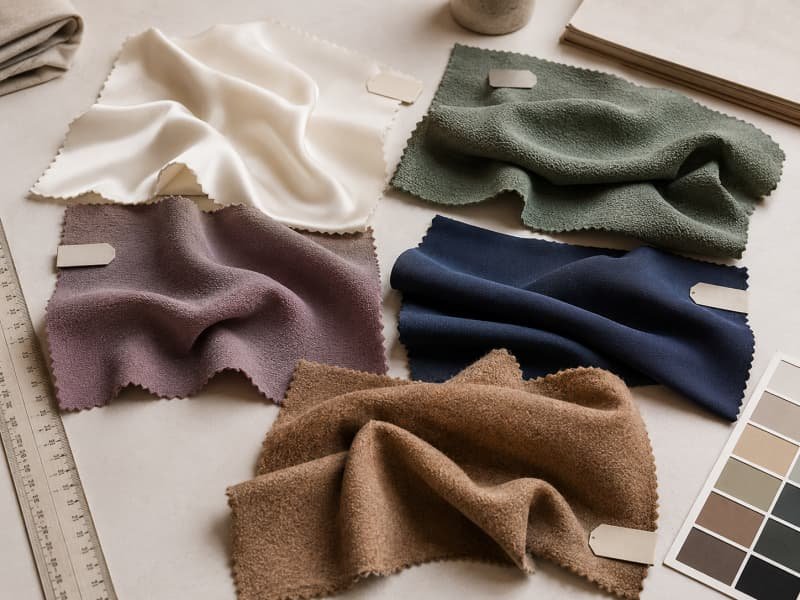
Crepe is one of those fabric names that sounds precise until a real development project begins. A designer may request “soft crepe,” a fabric mill may present twenty qualities under that name, and two finished dresses can behave as if they were made from unrelated materials. One crepe may be airy and slightly sheer, another may be compact enough to support a fitted midi, and a third may have a dry, tailored hand suited to clean occasionwear. The shared feature is texture, not a fixed fiber, weight, or construction.
Crepe fabric is a family of woven or knitted textiles with a deliberately crinkled, pebbled, grainy, or softly rippled surface. It may be made from silk, polyester, viscose, wool, cotton, acetate, or blends. Its texture usually comes from highly twisted yarns, specialized construction, controlled shrinkage, heat setting, or mechanical finishing.
That broad definition is useful, but it does not yet tell a product team whether a particular crepe will drape cleanly, stretch without bagging, remain opaque in pale colors, survive pressing, or reproduce the same silhouette in bulk production. Those questions become visible only when the fabric meets the pattern, lining, seams, internal support, care method, and the body. Many expensive sample revisions begin with a fabric that looked right on a swatch card but behaved differently in the complete garment. The following guide explains crepe from that practical point of view, so readers can recognize the main types and make better decisions before cutting the first sample.
What Is Crepe Fabric?
Crepe fabric is a broad textile family recognized by a crinkled, pebbled, grainy, or softly rippled surface. It can be woven or knitted from natural, regenerated, synthetic, or blended fibers. Its final appearance depends on yarn twist, fabric construction, finishing, weight, and stretch rather than on one fixed raw material.
Crepe Is a Fabric Family
Crepe is not a single fiber and it is not one standardized material. The name describes a surface character or fabric behavior shared by many textiles. A lightweight silk crepe may feel fluid, cool, and delicate, while a polyester stretch crepe can be dense, elastic, and suitable for a fitted dress. Wool crepe often feels dry and structured, whereas viscose crepe can feel soft, weighty, and highly drapable. All belong to the same family, but they do not respond in the same way during cutting, sewing, fitting, washing, pressing, or wear.
For sourcing and product development, the word “crepe” should therefore be treated as the beginning of a specification rather than the complete description. A usable fabric brief identifies fiber composition, woven or knitted construction, weight in grams per square meter, finished width, stretch direction, recovery, opacity, surface appearance, shrinkage, and the intended care method. Without those details, a replacement fabric may carry the same commercial name yet produce a different neckline, waist fit, skirt fall, or level of coverage.
- Fiber composition and blend ratio
- Woven or knitted construction
- Finished weight and usable width
- Stretch direction, percentage, and recovery
- Opacity in every planned color
- Shrinkage after the intended care process
- Approved surface, handfeel, and drape
Fibers Used in Crepe
Crepe can be made from natural fibers, regenerated cellulose, synthetic filaments, or blends engineered for a particular result. Silk crepe is associated with premium drape and a refined hand, but it generally requires careful handling. Viscose crepe often feels cool and fluid, although wet shrinkage and seam stress need close attention. Polyester crepe is common in commercial fashion because it is available in many weights, surfaces, stretch levels, and price points. Cotton and wool crepes serve more specific seasonal or styling needs.
The fiber name does not confirm quality by itself. A carefully developed polyester crepe may be more suitable for a repeatable dress program than a delicate natural-fiber cloth, especially when the product needs consistent color, stable bulk delivery, and straightforward care. Conversely, a low-density synthetic crepe may feel thin, noisy, overly dry, or prone to static. The best selection begins with the customer, silhouette, retail price, care label, launch calendar, and production volume, then chooses the fiber system that supports those requirements.
| Fiber Base | Typical Hand | Useful Strengths | Common Risks |
| Silk | Fine, soft, fluid | Premium drape, rich color, light feel | Higher cost, snagging, careful cleaning |
| Polyester | Soft to compact | Stable supply, durable, broad range | Static, heat sensitivity, variable breathability |
| Viscose | Cool, soft, weighty | Fluid drape, matte surface, deep color | Wet shrinkage, growth, seam stress |
| Wool | Dry, resilient, structured | Shape retention, refined tailoring | Specialist care, seasonal use |
| Cotton | Breathable, textured | Comfortable, familiar care options | Shrinkage, creasing, texture change |
Look, Hand, and Quality
Crepe usually has an irregular surface that breaks up reflected light. The texture may look like tiny grains, fine wrinkles, soft waves, raised bubbles, or a lightly sandy face. Some qualities are strongly matte, while others carry a quiet luster. Fine crepe de Chine can appear almost smooth from a distance, moss crepe has a more visible pebbled surface, and bubble crepe uses a raised texture as a design feature. Crepe-back satin adds another variation by placing a glossy face on one side and a textured face on the reverse.
Surface structure changes the way color appears. Satin produces continuous highlights that make shades look brighter and more reflective. Crepe scatters light, so the same color can look deeper, softer, or less glossy. That visual effect is useful in black, navy, red, and jewel-toned dresses, particularly when the design needs definition without strong shine. Handfeel is equally varied: a crepe can feel soft and fluid, dry and crisp, compact and springy, or grainy and slightly rough. A full-width hanging test reveals far more than rubbing a small swatch between two fingers.
Why Similar Crepes Behave Differently
Commercial fabric names are not controlled like chemical fiber names. One supplier’s moss crepe may resemble another supplier’s bubble crepe, and a fabric sold as stretch crepe may contain elastane, rely on mechanical stretch, or use a knitted structure. Even two fabrics with the same composition and weight can behave differently because yarn size, twist, density, thickness, heat setting, and finishing tension change drape, recovery, opacity, and surface character.
Color and finishing add another layer of variation. A pale shade may reveal transparency that is invisible in black. A dark crepe may show pressure shine after pressing. Printing, pleating, coating, or additional washing can change the hand and finished width. For repeat production, approval should be based on a sealed physical standard supported by measurable information, not only a fabric name or composition line. The reference should represent the expected color, surface, weight, width, stretch, recovery, drape, and care performance.
How Is Crepe Fabric Made?
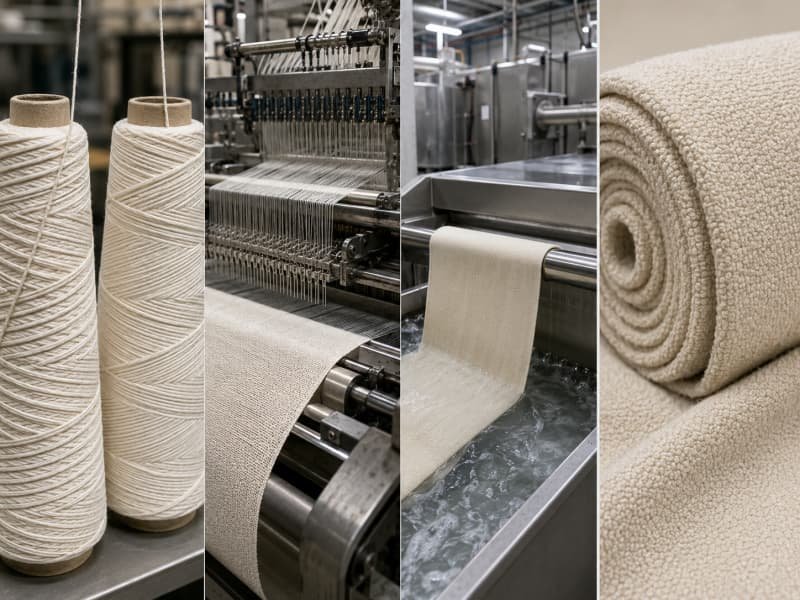
Crepe is made by creating controlled irregularity in yarns, fabric structure, or finishing. Common methods include highly twisted yarns, alternating twist directions, textured filaments, specialized weaves, knitted constructions, differential shrinkage, mechanical embossing, and heat setting. The selected route determines whether the finished fabric feels fluid, crisp, springy, elastic, dry, or strongly textured.
High-Twist Yarns
One of the traditional methods for producing crepe is to use yarns with much more twist than ordinary yarns. The extra twist stores rotational energy. When the fabric is relaxed, washed, steamed, or heat treated, the yarns try to rotate or contract, disturbing the flat surface and producing the familiar grain or crinkle. Manufacturers may alternate S-twist and Z-twist yarns, which rotate in opposite directions, to balance the cloth and create controlled texture rather than a strong twist toward one side.
The final result depends on the twist level, yarn thickness, fiber type, weave density, yarn arrangement, finishing temperature, moisture exposure, and relaxation time. More twist does not automatically mean better fabric. It may increase spring and surface character, but it can also create a drier hand, additional torque, edge curling, or dimensional change. Because these effects can become stronger after wet processing, sample approval should include the fabric after the intended wash, steam, and pressing conditions rather than only the mill’s first presentation swatch.
Woven and Knitted Crepe
Crepe can be woven or knitted, and the distinction changes almost every pattern and sewing decision. Woven crepe is made by interlacing warp and weft yarns. Traditional crepe de Chine, georgette, wool crepe, and many polyester crepes are woven. They may have very little stretch unless elastane, mechanical stretch, or a specialized weave is introduced. These qualities are often selected for bias dresses, draped silhouettes, blouses, softly tailored garments, wrap dresses, occasionwear, and fluid skirts.
Knitted crepe is built from connected loops, so it generally offers more flexibility and may stretch in two or four directions. Double-knit crepe, crepe jersey, and several bodycon qualities fall into this group. The phrase “stretch crepe” does not explain enough: one fabric may be a woven polyester-elastane quality with 15 percent crosswise stretch, while another is a knit that extends more than 40 percent in two directions. They require different pattern ease, seam types, lining behavior, reinforcement, and fitting methods.
Finishing Methods
Not every crepe effect comes from yarn twist. Synthetic filaments can be textured before weaving or knitting to create bulk, spring, and irregularity. Polyester fabrics may then be heat-set so the surface and dimensions remain stable. Mechanical processes such as embossing, tumbling, compressing, or controlled relaxation can create stronger visible texture. Other fabrics use differential shrinkage, where selected yarns contract more than surrounding yarns during wet processing and produce puckering or a bubble effect.
The important commercial question is whether the texture survives production and care. A dramatic embossed surface can look convincing in an initial sample but flatten under direct steam, fusing pressure, or repeated laundering. A heat-set synthetic crepe may be stable in washing yet sensitive to an overly hot iron. The evaluation should therefore include cutting, fusing where relevant, sewing, steaming, pressing, washing or cleaning, drying, and resting. A fabric that passes only a tabletop appearance check has not yet demonstrated garment-level stability.
| Production Method | How Texture Forms | Typical Result | Main Control Point |
| High-twist yarn | Yarn torque activates during finishing | Fine grain, spring, dry hand | Twist balance and relaxation |
| Textured filament | Synthetic yarn is crimped or bulked | Soft bulk, elasticity, depth | Heat-setting consistency |
| Special weave | Yarn arrangement interrupts a flat face | Controlled grain or reversible surfaces | Weave density |
| Knitted structure | Loops create texture and flexibility | Stretch, recovery, fuller body | Course density and stability |
| Differential shrinkage | Yarns contract at different rates | Puckering and bubble effects | Wash and heat response |
| Mechanical embossing | Pressure forms a raised surface | Strong visible texture | Texture retention |
Production Controls
Crepe performance is the result of the entire manufacturing route. Yarn choice affects torque and hand, construction controls density and movement, dyeing adds moisture and heat, and finishing determines width, surface, and dimensional stability. Small changes can create visible bulk differences. A new yarn source may alter texture, a different finishing tension can change usable width, and excessive heat can weaken stretch recovery in elastane blends. Repeat orders should not be assumed identical simply because the composition and commercial name remain unchanged.
Useful bulk controls include finished weight, usable width, roll-to-roll shade, surface texture, stretch percentage, recovery, length and width shrinkage, skew, handfeel, opacity, and pressing response. Fabric should be conditioned before measurement because rolling tension can temporarily change width and length. Stretch qualities also need time to relax before cutting. A production team that checks new dye lots against the approved standard before spreading can prevent fit, shade, and seam problems that would otherwise be discovered only after hundreds of garments have been assembled.
Which Types of Crepe Are Common?
Common crepe types include crepe de Chine, georgette, moss crepe, bubble crepe, stretch crepe, crepe-back satin, wool crepe, and heavier double-knit qualities. Each offers a different balance of texture, drape, weight, opacity, stretch, and structure. The most suitable option depends on the garment silhouette and expected wear rather than on the name alone.

Lightweight Crepes
Crepe de Chine is a fine woven crepe with a subtle grain and soft, fluid fall. Traditional qualities are made from silk, although polyester versions are common. It works well for slip dresses, blouses, draped necklines, gathered skirts, and bias-cut silhouettes. Its strengths are movement and refinement; its risks include transparency, seam puckering, needle marks, and limited structural support. A lightweight shell may need lining, interfacing, cups, boning, or a separate foundation when used in a fitted bodice.
Georgette is also lightweight, but it usually feels drier and slightly crisper. Its grain is more noticeable than chiffon, and it can hold gathers, ruffles, and layered details with greater definition. It is widely used for sleeves, overlays, tiered skirts, and occasion dresses. Fine georgette can shift during cutting, stretch along bias edges, and fray quickly. Long panels may drop after hanging, so the garment should be allowed to rest before final hemming. The lining must remain light enough to preserve movement rather than turning an airy shell into a stiff dress.
Midweight Crepes
Moss crepe is a common commercial option with a visible pebbled surface. It is often made from polyester, viscose, or blends and may feel soft and fluid or slightly dry and structured. The fabric is used for midi dresses, wrap dresses, day styles, blouses, skirts, matching sets, and relaxed trousers. It often provides more coverage than lightweight crepe while keeping a matte appearance and enough movement for versatile fashion silhouettes.
Bubble crepe has a stronger raised or puckered texture. It is frequently used for casual dresses, summer tops, skirts, and trend-led sets because the surface adds interest without a print or embellishment. Some versions are lightweight and semi-sheer; others are knitted and elastic. The key issue is texture stability. A bubble effect built into the yarn or construction may remain reliable, while a surface created mainly by finishing can flatten under heat. Sampling should include the actual pressing and care conditions planned for production.
Stretch and Structured Crepes
Stretch crepe may be woven or knitted and can gain flexibility from elastane, mechanical stretch, loop structure, or a combination of these features. It is used for fitted midis, bodycon dresses, trousers, jumpsuits, skirts, and structured fashion sets. The word “stretch” is not enough for approval. A fabric that extends 30 percent but fails to recover may bag at the seat, waist, bust, or zipper area. Stretch percentage and residual growth should be measured in both directions.
Dense double-knit crepe can provide opacity, controlled compression, and a clean surface for column dresses, fitted sleeves, and sculpted silhouettes. Heavy woven crepe offers structure with less elasticity and may suit tailored dresses, formal styles, and wide-leg trousers. More weight is not always an advantage. An overly heavy fabric can reduce movement, add heat, thicken seams, and distort a delicate neckline. The material should create the intended shape without forcing the pattern to compensate for unnecessary bulk.
| Crepe Type | Practical Weight Range | Drape | Common Uses | Main Risk |
| Crepe de Chine | 60-140 GSM | Very fluid | Slips, blouses, bias dresses | Sheerness and puckering |
| Georgette | 50-130 GSM | Airy with slight crispness | Overlays, sleeves, ruffles | Fraying and edge growth |
| Moss crepe | 130-220 GSM | Soft to moderate | Day dresses, midis, sets | Supplier variation |
| Bubble crepe | 120-220 GSM | Varies | Casual dresses, tops | Texture flattening |
| Stretch woven crepe | 180-300 GSM | Controlled | Fitted dresses, trousers | Poor recovery |
| Double-knit crepe | 220-380 GSM | Structured | Bodycon and column dresses | Heat and seam bulk |
| Crepe-back satin | 120-280 GSM | Fluid to weighty | Occasion and evening dresses | Surface marking |
| Wool crepe | 180-400 GSM | Resilient and structured | Tailored dresses and suits | Care requirements |
Reversible and Specialty Crepes
Crepe-back satin combines a smooth, reflective satin face with a matte crepe reverse. Designers may use either side as the main surface or combine both within one garment. It can create contrast at panels, ties, lapels, collars, or draped details without introducing a second fabric. Although both faces share the same dye, they can appear to be different shades because the satin side reflects more light. Cutting instructions must identify the correct face for every pattern piece.
Wool crepe is associated with tailored dresses, jackets, trousers, and cooler-season clothing. Its dry hand and natural resilience can create shape without a rigid appearance, but cost and specialist care are usually higher. Printed, pleated, jacquard, metallic, and embellished crepes introduce additional risks. Printing can change handfeel, pleating can alter stretch and shrinkage, and embellishment can load a lightweight base fabric. Each added process should be tested as part of the finished garment rather than treated as a decorative layer with no effect on performance.
What Are Crepe Fabric’s Key Properties?
Crepe is valued for surface texture, drape, visual depth, and broad design flexibility. Its breathability, stretch, opacity, shrinkage, wrinkle behavior, and durability vary widely because the name covers many fibers and constructions. These properties must be checked on the selected quality rather than assumed from the word “crepe” or from fiber composition alone.

Drape, Weight, and Opacity
Drape describes how a fabric falls under its own weight. A fluid crepe forms soft, narrow folds and follows the body, while a structured crepe forms wider folds and stands farther away. Weight influences drape, but it is only one variable. Fiber flexibility, yarn size, construction density, thickness, and finishing also matter. A 180 GSM viscose crepe may feel heavier and fall more fluidly than a 200 GSM polyester quality, while a knit of similar weight may stretch around the body instead of hanging in the same vertical lines.
Opacity changes with weight, density, color, and wearing stretch. Lightweight crepe de Chine and georgette are often sheer or semi-sheer. Dense stretch crepe may look opaque on a table but become transparent across the bust or hip. Pale shades such as white, ivory, blush, yellow, and beige usually reveal more than black or navy in the same construction. A useful review examines the fabric over contrasting backgrounds, under daylight and strong indoor lighting, with photographic flash, and at the expected wearing extension.
Stretch and Recovery
Stretch measures how far a fabric extends, while recovery measures how closely it returns to its original dimension. A simple development test marks a 10-centimeter section, extends it without excessive force, and calculates the increase. If it reaches 12 centimeters, the extension is approximately 20 percent. The test should be repeated in the width and length directions, then the fabric should be measured immediately after release and again after a rest period.
Two fabrics can both stretch 30 percent yet behave very differently in a dress. One may recover almost completely, while the other retains enough growth to create a sagging seat, enlarged neckline, rippled zipper, or loose waist after wear. Stretch behavior affects pattern ease, seam type, stitch density, lining, zipper choice, reinforcement, and hems. More elasticity is not automatically better. Excessive stretch can reduce structure, reveal undergarment lines, and create uneven compression, particularly in fitted occasion or bodycon designs.
Comfort and Dimensional Stability
Crepe may be breathable, but comfort depends more on fiber, density, thickness, lining, internal construction, and garment fit than on the crepe label. Lightweight silk, cotton, and viscose crepes may feel comfortable in warm conditions. Dense polyester stretch crepe can feel warmer, especially in close-fitting dresses. A loose silhouette also ventilates more effectively than a bodycon shape, even when both garments use the same material. Cups, boning, fusible layers, and power mesh can further change heat and moisture behavior.
Dimensional stability includes shrinkage, growth, skew, and changes in texture. Viscose and cotton crepes can show significant wet shrinkage, while synthetic crepes are generally more water-stable but may react to excessive heat. Highly twisted yarns can contribute to skew or torque after relaxation. Testing should measure both length and width after the proposed consumer care process. A predictable change can be allowed for in pattern development, but large roll-to-roll variation is much harder to control in bulk production.
Durability, Sewing, and Care
Crepe durability ranges from highly robust to delicate. Dense polyester stretch crepe can withstand frequent wear, while fine silk crepe may snag, abrade, or mark more easily. A loose woven construction may suffer seam slippage even when the yarn itself is strong. The relevant tests depend on the product: fitted party dresses may need strong recovery, seam elongation, pilling, and perspiration colorfastness, while flowing occasion styles may require snagging, seam slippage, pressing, and dry-cleaning checks.
Sewing methods must match the fabric. Fine woven crepe may shift, fray, stretch on the bias, or pucker under unbalanced tension. Stretch crepe may wave at seams or break stitches if the construction cannot extend with the fabric. Needle point, needle size, thread, stitch length, feed, seam allowance, and pressing temperature should be set through trials. Direct heat and pressure can flatten texture or create shine, so production settings should be approved and recorded before bulk sewing begins.
| Property | Useful Development Check | What It Predicts |
| Weight | GSM at several fabric points | Garment body and lot consistency |
| Stretch | Width and length extension percentage | Pattern ease and movement |
| Recovery | Residual growth after release | Bagging and shape loss |
| Shrinkage | Length and width change after care | Finished size and balance |
| Opacity | Contrast and wear-level stretch checks | Coverage and lining needs |
| Seam slippage | Stress test across woven seams | Opening at fitted areas |
| Pilling or abrasion | Relevant surface-wear test | Appearance after repeated use |
| Colorfastness | Wash, rub, water, perspiration as relevant | Transfer, staining, and shade loss |
| Pressing response | Heat, steam, and pressure trial | Shine and texture retention |
| Skew or spirality | Alignment after care and relaxation | Twisting and uneven hang |
How Do You Choose Crepe for Dresses?
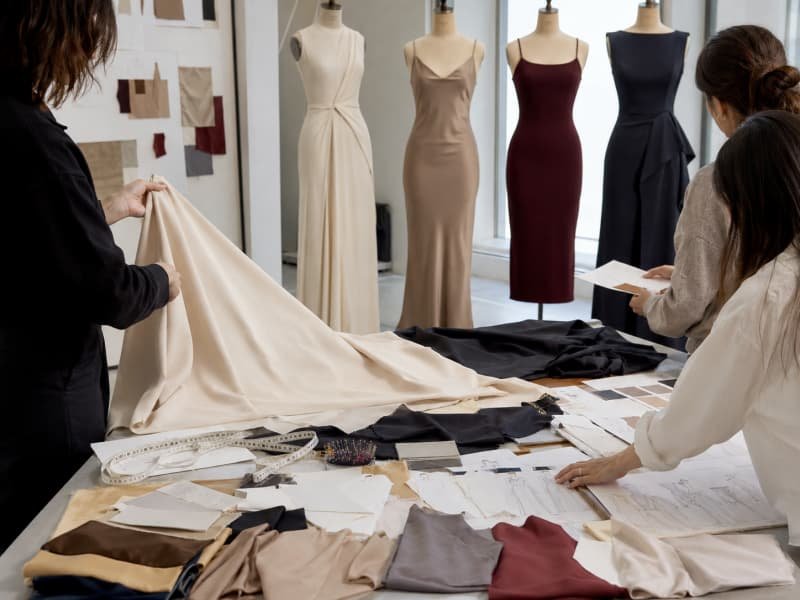
Choose crepe by matching its drape, weight, stretch, recovery, opacity, surface, and care performance to the intended dress silhouette. Lightweight fluid crepes suit gathers and flowing skirts, while denser qualities with controlled recovery suit fitted dresses. The fabric should be tested in a complete sample because a small swatch cannot reveal real fit, lining, seam, or movement problems.
Match Crepe to the Silhouette
The fabric must support the shape the designer intends to create. Lightweight crepe de Chine, georgette, and soft viscose crepe are useful for bias cuts, gathered skirts, draped necklines, flutter sleeves, tiered dresses, wrap styles, and flowing maxis. These materials move easily, but they may need lining and careful stabilization. Bias panels can lengthen after hanging, and gathered seams may grow if the fabric is not controlled during sewing.
Midweight moss crepe and balanced polyester qualities suit midi dresses, day styles, shirt dresses, soft tailoring, and occasion silhouettes that need both movement and coverage. Heavy stretch crepe and double-knit crepe are more suitable for fitted midis, bodycon dresses, columns, fit-and-flare shapes, sculpted sleeves, and structured jumpsuits. The reference image should never be copied without understanding its fabric. A bias-cut woven dress and a dense stretch-knit dress may look similar online but require entirely different paper patterns and internal construction.
Plan Lining and Internal Support
Many crepe dresses benefit from lining, although the amount and type should follow the product rather than a fixed rule. Lining can provide opacity, reduce static, improve glide, stabilize openings, conceal internal construction, and support the silhouette. Light-colored crepe often needs more coverage than dark fabric. Georgette and crepe de Chine commonly require lining through the body, while sleeves, yokes, ruffles, and overlays may remain intentionally sheer.
The lining must behave with the shell. A non-stretch lining inside a stretch dress can restrict movement and pull the outer fabric out of shape. A very elastic lining may offer too little support, while a heavy lining can destroy the movement of a fluid skirt. Partial solutions are often more effective than lining every panel. Bodice lining, skirt lining, built-in briefs, power mesh, cups, boning, localized fusible support, and self-fabric double layers can be combined according to the neckline, bust structure, coverage, and wearing situation.
Test Before Production
A good-looking sample does not prove that the fabric will remain stable across a commercial order. Fabric testing should cover weight, width, composition where required, stretch, recovery, shrinkage, shade continuity, colorfastness, opacity, pilling or abrasion, seam slippage, snagging, skew, and texture retention. The selection should be tested in every planned color because pale shades, dark shades, and printed versions can reveal different risks.
Garment testing should include finished measurements, fit on the intended size, movement, wear time, seam appearance, zipper behavior, lining compatibility, hem balance, pressing marks, transparency, and appearance after care. Bias-cut and long flowing skirts should be allowed to hang before final hemming. E-commerce and export programs should also simulate folding, polybag packing, carton pressure, unpacking, and recovery. A crepe that develops pressure shine or permanent creases in transit may need a different packing method even when its sewing performance is acceptable.
Build a Repeatable Fabric Standard
A professional sourcing decision considers more than visual similarity. The fabric has to suit the brand’s customer, retail price, care expectations, quantity, and launch timing. Before approval, the team should know whether the cloth creates the intended silhouette, remains opaque in every color, recovers after wear, works with the lining, survives pressing and care, and can be repeated across dye lots. Cost and availability matter, but a cheaper replacement can become more expensive when it creates additional sample rounds, fit corrections, or quality claims.
For repeat programs, the standard should include a sealed swatch, color reference, test results, finished-garment sample, measurement chart, construction details, and a record of approved comments. A replacement should not be accepted merely because the composition and GSM match. Yarn torque, thickness, density, stretch, recovery, surface texture, and drape can still differ enough to require a new pattern or fitting. The strongest crepe dress is not always made from the most expensive fabric; it is made from the fabric that delivers the intended appearance, movement, comfort, fit, and consistency in realistic production.
Crepe dress development becomes more predictable when fabric choice, pattern engineering, lining, internal support, sewing, pressing, testing, and bulk control are treated as one connected system. Duolan Apparel focuses on fashion dresses, occasion dresses, party dresses, fitted silhouettes, and related womenswear programs, with fabric and trim development, pattern and sample resources, and sample-to-bulk coordination for established fashion teams.
For a useful quotation and development review, send your tech pack, reference images or original sample, target silhouette, size range, preferred composition, expected weight and stretch, colors, order quantity, destination market, and launch date. The team can review fabric direction, lining, fit, construction risks, testing needs, sampling, and production feasibility before the project enters bulk production.