Skip to content
French Terry looks simple until a product team tries to specify it. One supplier may present a light cotton loopback for summer shorts, while another uses the same name for a dense polyester-rich sweatshirt fabric. Both can technically be French Terry, yet they may behave very differently after cutting, washing, printing, wearing, and bulk production. That difference matters because customers experience the finished garment, not the trade name on a swatch card.
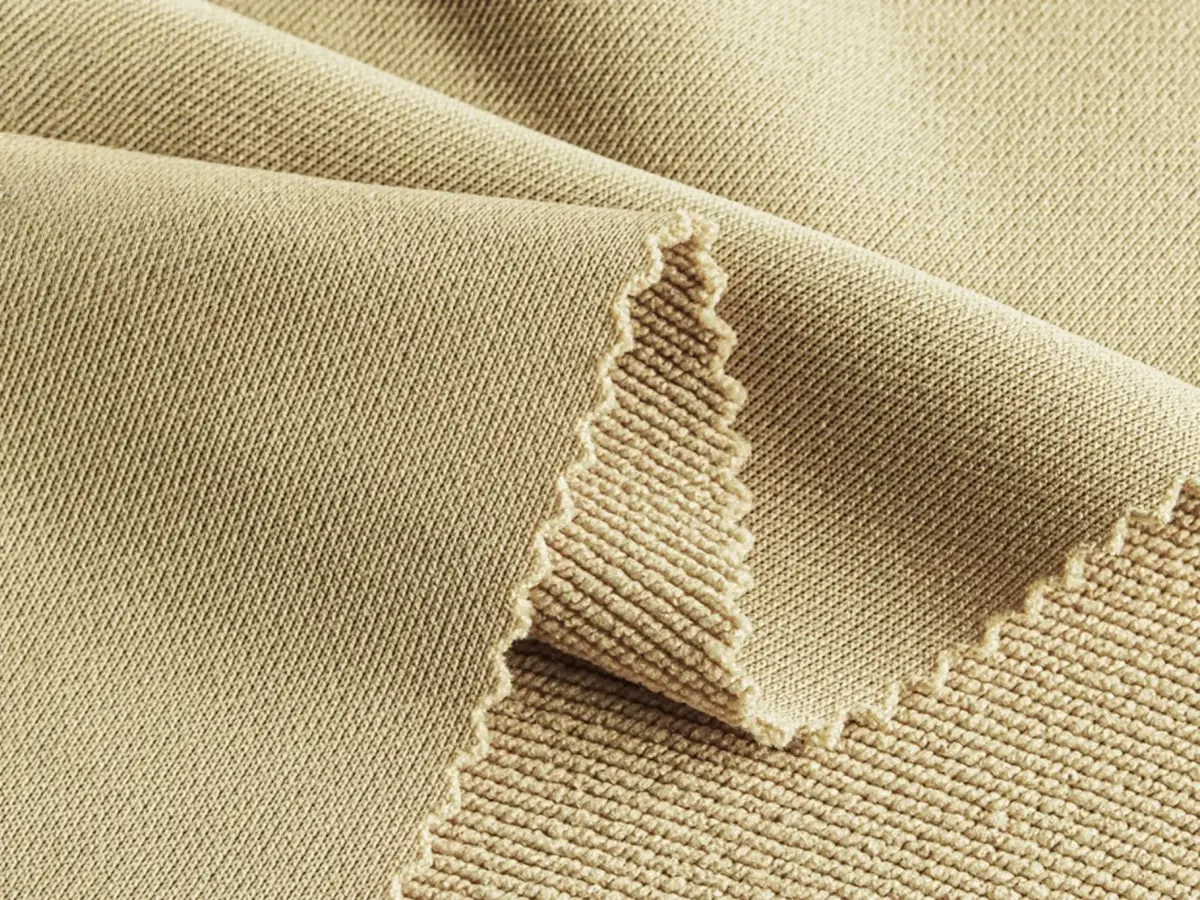
French Terry is a knitted fabric with a relatively smooth outer face and soft, uncut loops on the reverse. The loops add moisture absorption and moderate insulation without the fluffy pile of brushed fleece. It may be made from cotton, polyester, viscose, modal, elastane, or blends, and is widely used for sweatshirts, joggers, shorts, casual dresses, tops, skirts, and coordinated sets.
A fabric developer once showed a design team two nearly identical black French Terry swatches. Both felt soft and looked clean on the table. After one wash, however, one remained balanced while the other twisted, shortened, and developed a cloudy surface. The weakness was not visible in the fabric name; it was hidden in the yarn, knitting, finishing, and testing behind it. This guide explains how to see those differences before they become garment problems.
What Is French Terry?
French Terry is a weft-knitted fabric identified by a smooth or lightly textured outer face and uncut yarn loops on the reverse. It is a construction rather than a fiber name. Composition, GSM, stitch density, loop size, finishing, and elastane content determine whether the finished fabric feels light and fluid, firm and structured, soft and casual, or warm enough for transitional clothing.
Fabric Structure
French Terry is generally produced on a circular knitting machine. The ground structure creates the smoother face, while an additional yarn system forms loops or floats on the technical back. Those loops remain intact rather than being cut or brushed. This construction gives the fabric more body and absorbency than ordinary single jersey while keeping it flatter, less bulky, and usually more breathable than brushed sweatshirt fleece.
Loop size and density can vary greatly. A light quality may have short, compact loops that are barely visible from a distance, while a heavy quality may have fuller loops that add thickness and insulation. Larger loops are not automatically better. Long, open loops may snag or feel coarse, while very compact loops can make the fabric dense and warm. The correct structure depends on the silhouette, season, skin contact, target price, and intended care method.
Face and Reverse
The technical face of French Terry normally shows tidy vertical knit stitches similar to jersey. This is usually the visible side of a sweatshirt, jogger, dress, skirt, or top because it creates a clean surface for solid dyeing, printing, embroidery, and topstitching. The reverse contains small horizontal or curved loops that commonly sit against the body, adding a slightly cushioned feel and increasing the area available to absorb perspiration.
Designers sometimes expose the looped side intentionally for contrast panels, raw-edge details, pocket accents, or deconstructed styling. When both surfaces appear in one garment, color and light reflection should be reviewed under consistent lighting because the face and reverse can look like different shades. Cutting teams also need a clearly marked approved face side. Mixed panels may appear mismatched even when they were cut from the same roll, especially in black, navy, charcoal, washed colors, or fabrics treated with silicone.
Knitting and Finishing
Many commercial qualities use two-thread or three-thread constructions. A three-thread fabric can use separate yarn systems for the face, the connecting yarn, and the loop yarn, giving the mill more control over surface quality, stability, GSM, and inner texture. A finer yarn may create a cleaner outside, while a stronger or more absorbent yarn forms the interior loops. Stitch length, machine gauge, yarn count, knitting tension, and loop height all influence weight, width, stretch, recovery, and shrinkage.
After knitting, the greige fabric may be scoured, dyed, compacted, enzyme washed, heat set, bio-polished, softened, or garment washed. Each process improves some characteristics while potentially weakening others. Compacting can reduce future shrinkage but also change width and GSM. Enzyme treatment can clean the surface, yet excessive treatment may lower strength or increase fuzzing. Silicone can create immediate softness, though too much may make the fabric slippery during cutting or sewing. Approval should therefore be based on the finished production-intent fabric, not an unfinished or specially softened display swatch.
How to Identify It
A quick identification starts by opening the fabric and comparing both sides. The face should look relatively smooth, while the reverse should show uncut loops rather than a fluffy brushed pile. Run a finger across the looped side, stretch the fabric crosswise, release it, and inspect whether the surface remains balanced. The fabric should not be confused with towel-like terry cloth, which normally has more prominent absorbent loops, or with plain jersey, which lacks the additional Terry loop system.
A professional review goes further than touch. Check full-width fabric for knitting lines, barré, shade change, bowing, skew, uneven loops, and unexpected shine. Record finished GSM, usable width, composition, stretch, recovery, and wash behavior. A small folded cutting can hide instability, while a full-width panel often reveals it. Washing a test piece is particularly useful because the fabric may become rough, cloudy, twisted, narrower, shorter, or softer only after the original finishing agents have been removed.
Which French Terry Types Are Common?
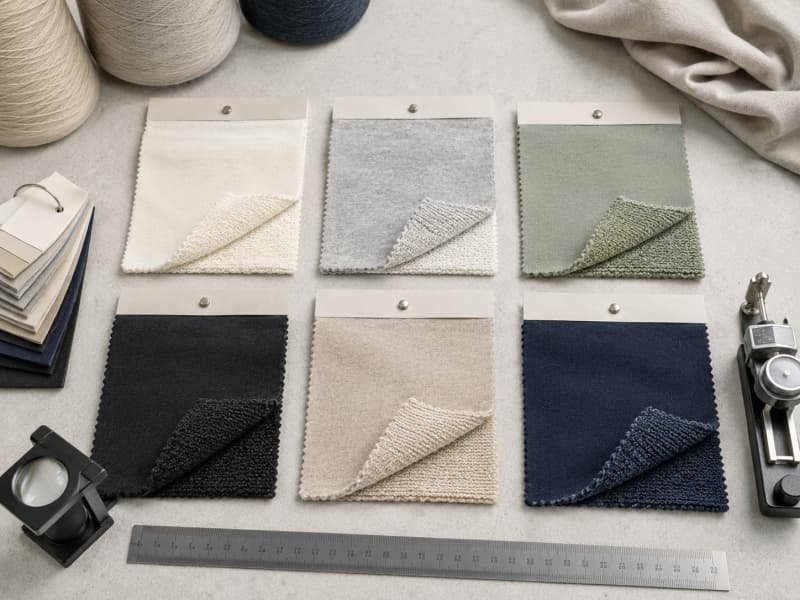
Common French Terry types are distinguished by fiber blend, finished GSM, stretch, loop construction, yarn quality, and surface finish. Cotton-rich versions provide a familiar natural hand and absorbency; polyester blends improve strength and dimensional stability; elastane supports closer fits; and viscose or modal adds softness and drape. No single formula is best for every garment, climate, care method, or price level.
Fiber Blends
French Terry is often associated with cotton, but the term does not confirm a fiber percentage. Pure cotton offers a natural touch, good absorbency, and strong consumer familiarity, yet it can be sensitive to shrinkage, twisting, long drying times, and surface wear. Cotton-polyester blends are common because polyester can improve strength, drying speed, color retention, and dimensional stability while allowing the garment to retain much of the cotton hand.
Elastane is useful when a garment needs closer fit, greater movement, or stronger recovery. Even three to five percent can noticeably change pattern reduction, neckline tension, sewing behavior, and wash performance. Viscose and modal can make the fabric softer and more fluid, creating a refined hand for dresses and elevated lounge sets, but growth and dimensional stability deserve attention. The blend should follow the product brief rather than a habit of choosing the softest swatch in the room.
| Typical composition | General character | Main advantages | Main risks to check |
| 100% cotton | Natural, absorbent, matte | Soft hand, breathability, familiar appeal | Shrinkage, twisting, slower drying |
| 80-95% cotton / 5-20% polyester | Cotton-rich with added stability | Better strength and shape retention | Pilling and blend consistency |
| 55-75% cotton / 25-45% polyester | Durable commercial quality | Easier care, quicker drying, stable color | Less natural hand and heat retention |
| Cotton with 3-8% elastane | Stretch cotton quality | Recovery and closer fit | Heat sensitivity and width variation |
| Polyester with elastane | Resilient and quick drying | Strong recovery and easy care | Static, odor retention, thermal comfort |
| Cotton-modal or cotton-viscose | Soft and fluid | Drape, smooth touch, elevated appearance | Growth, wet distortion, shrinkage |
Weight and GSM
GSM means grams per square meter and is one of the fastest ways to compare fabric weight. It is useful, but it does not describe thickness, warmth, or quality by itself. A compact 290 GSM quality may feel firmer and thinner than a loftier 260 GSM fabric with larger loops. Knit density, yarn count, loop size, fiber blend, and finishing all influence how the same nominal weight feels in a finished garment.
Many fashion programs use French Terry between about 220 and 340 GSM, covering casual dresses, tops, sets, sweatshirts, joggers, and transitional layers. Lightweight qualities can suit warm-weather items but need careful opacity and recovery checks. Heavy qualities create structure and a substantial hand, yet they raise fabric consumption, seam bulk, drying time, freight weight, and wearer fatigue. Finished GSM should be checked after dyeing, compacting, relaxation, and conditioning because production processes can move the number meaningfully.
| Finished GSM | Typical character | Common garment use | Development concerns |
| 180-220 | Lightweight and flexible | Tops, shorts, light dresses | Opacity, recovery, edge curling |
| 230-280 | Versatile medium-light weight | Casual dresses, pullovers, skirt sets | Drape and shape retention |
| 290-340 | Substantial and structured | Sweatshirts, joggers, coordinated sets | Seam bulk and drying time |
| 350-420 | Heavy and warm | Oversized hoodies, outer layers | Needle damage and garment weight |
| Above 420 | Extra-heavy or specialized | Statement sweatwear | Cost, handling, and freight weight |
Stretch and Recovery
All knitted fabrics stretch to some degree, but French Terry can range from comparatively stable to highly elastic. A non-elastane cotton quality may provide roughly ten to twenty-five percent crosswise mechanical stretch, while an elastane blend may reach thirty to sixty percent or more. These figures are practical development references, not universal standards, because test load, sample direction, relaxation time, knitting density, and finishing can change the result.
Recovery is just as important as extension. A fabric that stretches easily but does not return close to its original dimension may bag at the knees, elbows, seat, waist, or hem. Fitted dresses can lose their clean line after a short period of wear even when the first fitting looks correct. The pattern should therefore be developed with the intended bulk fabric, and fit approval should include sitting, walking, bending, and at least twenty to thirty minutes of wear where the silhouette is close to the body.
Surface Finishes
Finishing gives French Terry much of its commercial character. Enzyme washing can remove loose surface fibers and produce a cleaner face. Silicone softening can create a smooth, pleasant touch. Pigment dyeing and garment washing can add a relaxed, vintage appearance, while compacting helps control dimensional change. Peaching can lightly raise the surface without turning the reverse into fully brushed fleece. Each treatment should support the garment concept rather than disguise weak yarn or unstable knitting.
The presentation swatch and the production fabric must be compared after washing. Strong softeners can create an impressive first touch but fade after care cycles, revealing a drier or rougher base quality. Pigment-dyed garments may show seam abrasion, rubbing, and piece-to-piece variation, so an acceptable shade range should be approved before bulk. Heat setting is especially important for synthetic and elastane blends because poor temperature control can change width, recovery, shine, and hand feel.
How Does French Terry Perform?

French Terry generally offers moderate warmth, useful moisture absorption, flexible movement, and more airflow than heavily brushed fleece. Actual performance depends on composition, GSM, knit density, loop fullness, and finishing. Cotton-rich versions absorb well, synthetic blends often dry faster, and elastane improves recovery. Shrinkage, spirality, pilling, colorfastness, and appearance after laundering should be checked before bulk production.
Warmth and Breathability
French Terry usually sits between lightweight jersey and brushed fleece in warmth. The inner loops create small air spaces and add material between the skin and the environment, but they do not trap as much air as a raised fleece pile. A 190 GSM cotton quality may work as a light evening layer, while a dense 350 GSM version can feel suitable for cool autumn days, mild winters, or strongly air-conditioned indoor environments.
Breathability depends on knit density, yarn size, fiber mix, finishing, and garment fit. A cotton-rich open construction may feel airy, while a dense polyester-rich quality can retain more heat. A relaxed sweatshirt allows air to move, whereas a fitted long-sleeve dress keeps continuous fabric contact against the body. Seasonal claims should therefore consider GSM, composition, coverage, layering, and climate rather than using the fabric name as a simple promise that the garment is either a summer or winter product.
Moisture Management
The looped reverse increases surface area and helps collect perspiration, which supports comfort in casual movement, travel, light exercise, and everyday wear. This does not mean every French Terry is a technical moisture-wicking fabric. Absorbency describes how much liquid the material takes in, while wicking describes how effectively moisture spreads and moves toward the outer surface where it can evaporate. The two properties are related but not interchangeable.
Cotton-rich French Terry normally absorbs moisture well, although it may remain damp longer because cotton holds water within the fiber. Polyester absorbs less into the fiber itself and can dry faster, but useful wicking still depends on yarn engineering, construction, and durable finishing. When moisture performance is central to the product claim, compare drying time, cling when wet, odor retention, and transport after repeated laundering. A finish that works before washing may weaken after five, ten, or twenty care cycles.
Shrinkage and Shape
French Terry can shrink, twist, grow, or lose balance after washing. Cotton-rich fabrics are usually more sensitive because cotton fibers swell and the knitted structure relaxes. Uncompacted qualities can sometimes show five to ten percent or more dimensional change, while well-prepared commercial fabrics are often developed toward tighter limits. Many brand programs use roughly three to five percent as a working target, subject to the specific wash method, garment category, and customer standard.
Length and width do not always change equally. A fabric may shorten while widening, or become narrower while gaining length. Spirality can rotate side seams toward the front or back, especially on long straight garments. Soft viscose-rich qualities may pass a wash test yet grow while hanging or wearing. A reliable review should therefore include fabric washing, complete garment washing, hanging checks, fit evaluation, and comparison of main fabric, rib, lining, elastic, and trims because components can shrink at different rates.
| Performance area | Typical commercial concern | Practical evaluation |
| Dimensional change | Garment becomes shorter, wider, or narrower | Measure before and after the specified wash |
| Spirality | Side seams rotate after laundering | Compare seam position before and after wash |
| Stretch recovery | Knees, elbows, waist, or seat become loose | Extend, release, and measure recovery |
| Hanging growth | Dress or top length increases during wear | Hang or wear for a defined period |
| Appearance after wash | Fuzzing, fading, rippling, or deformation | Compare with the sealed approval sample |
| Component mismatch | Rib, lining, elastic, or trims react differently | Wash the complete garment, not fabric alone |
Pilling and Care
Pilling develops when loose fibers move to the surface, tangle through friction, and form small balls. Short fibers, low yarn twist, heavy softening, rubbing, repeated tumble drying, and some polyester blends can influence the result. Polyester fibers are strong, so pills containing polyester may remain attached and visible for longer. Many commercial programs look for pilling results around grade 3.5 to 4 or better, depending on the test method and end use, but acceptance levels vary by customer.
Care instructions should come from actual fabric and garment testing rather than a generic French Terry label. Cool or moderate washing, gentle detergent, and low-temperature drying often help preserve color, shape, elastane recovery, and surface appearance. Dark shades, pigment dyes, contrast panels, prints, embroidery, and light linings need extra color-transfer checks. Tumble drying generally produces more shrinkage and abrasion than line drying, so testing only the gentlest method may not represent how consumers will actually care for the garment.
How Is French Terry Different?

French Terry differs from fleece, terry cloth, and jersey mainly through its reverse structure and finishing. French Terry keeps uncut inner loops; fleece has a brushed, fluffy back; traditional terry cloth uses more prominent absorbent loops, often on both sides; and jersey has no additional Terry loop system. These structural differences influence warmth, weight, absorbency, drape, sewing behavior, and suitable garment categories.
French Terry vs Fleece
French Terry and fleece are both common in sweatshirts, joggers, and casual sets, but they create different wearing experiences. French Terry keeps its reverse loops intact, while sweatshirt fleece is brushed to raise fibers into a soft pile. The raised pile traps more air and usually makes fleece warmer. French Terry tends to feel flatter, less bulky, and more breathable, which makes it useful for transitional weather, indoor wear, travel, and year-round layering.
Fleece may feel immediately softer, but the pile can shed, flatten, or pill through wear and laundering. French Terry loops can snag when they are long or loose, yet the interior usually keeps a cleaner technical appearance. Production also differs: fleece can create more lint during cutting and heavy seam bulk at hoods and pockets, while French Terry may require close control of stretch, loop snagging, and needle settings. The correct choice comes from climate, garment weight, desired hand, care expectations, and retail positioning rather than a simple ranking of quality.
French Terry vs Terry Cloth
French Terry and traditional terry cloth share looped yarns, which explains the similar names, but their structure and end use are usually different. French Terry normally has a smooth knit face and smaller loops on the reverse, creating a clean exterior for apparel. Terry cloth often has more prominent loops and may show them on both sides, prioritizing absorbency for towels, bathrobes, spa products, washcloths, and beach items.
Terry cloth is generally bulkier and more prone to snagging because the loops are exposed. It may not provide the controlled stretch, smooth face, or refined drape required for a fitted garment. Suppliers sometimes use the word terry loosely, so the physical fabric should be checked for loop placement, height, density, GSM, stretch, recovery, absorbency, and surface appearance. A towel-like quality cannot normally replace apparel French Terry without changing pattern dimensions, sewing methods, garment weight, and the consumer’s wearing experience.
French Terry vs Jersey
Single jersey and French Terry share a familiar knitted face, but French Terry includes an additional loop yarn on the reverse. This usually makes it heavier, warmer, more absorbent, and more structured. Jersey follows the body easily and is widely used for T-shirts, lightweight dresses, underwear, and soft layering pieces. French Terry offers greater body and coverage for sweatshirts, joggers, shorts, coordinated sets, casual dresses, and more structured tops.
The categories can overlap at their edges. A 190 GSM French Terry may feel close to a heavy jersey, while a dense interlock can feel more substantial than some loopback fabrics. Construction must therefore be reviewed alongside GSM and composition. A jersey pattern should not be reused automatically for French Terry because thickness and recovery can alter neckline tension, sleeve width, armhole comfort, seam bulk, and finished measurements. The fabric substitution may look small on paper but create a visibly different garment on the body.
| Feature | French Terry | Brushed fleece | Terry cloth | Single jersey |
| Visible face | Smooth knit | Usually smooth knit | Often visibly looped | Fine smooth knit |
| Reverse | Uncut loops | Brushed pile | Prominent loops | Small knit reverse |
| Typical warmth | Light to moderate | Moderate to high | Variable | Light |
| Typical bulk | Medium | Medium to heavy | Medium to high | Low |
| Common use | Sweatshirts, dresses, joggers, sets | Winter hoodies and sweatpants | Towels, robes, spa items | T-shirts, tops, light dresses |
| Main risk | Shrinkage, spirality, loop snagging | Pilling, shedding, bulk | Snagging and weight | Curling, transparency, growth |
Is It Sweatshirt Fabric?
French Terry is one of the best-known sweatshirt fabrics, but sweatshirt fabric is an end-use category rather than a precise construction. Sweatshirts can also be made from brushed fleece, double knit, interlock, ponte, scuba, waffle knit, velour, or performance knits. French Terry became closely associated with sweatshirts because it combines a clean face, comfortable inner loops, moderate warmth, absorbency, flexibility, and enough structure for many casual silhouettes.
Its use extends beyond classic sweatwear. Lightweight and medium qualities can become cropped tops, zip jackets, shorts, skirts, travel sets, casual mini or midi dresses, jumpsuits, and fitted long-sleeve pieces. Not every French Terry is suitable for a hoodie, however. A fluid modal-rich 210 GSM fabric may collapse under a large hood, while a dense 380 GSM cotton-polyester quality may support an oversized silhouette but feel too heavy for a close-fitting top. The product brief should lead the choice.
How Do Brands Use French Terry?

Brands use French Terry for sweatshirts, joggers, shorts, casual dresses, tops, skirts, jumpsuits, travelwear, and coordinated sets. The strongest products match GSM, blend, stretch, recovery, drape, and wash performance to a specific silhouette. Before production, brands should confirm dimensional stability, pilling, spirality, color, loop consistency, fit, decoration compatibility, and the ability to reproduce the approved sample across bulk fabric lots.
Garment Applications
French Terry is most familiar in casual sportswear, but its commercial range is much wider. Lightweight qualities can suit tanks, short-sleeve tops, soft shorts, and warm-weather dresses when opacity and recovery are sufficient. Medium weights work well for cropped pullovers, fitted tops, long-sleeve dresses, zip jackets, skirts, and travel collections. Heavy qualities support oversized hoodies, substantial joggers, and outer-layer sets where shape and a dense hand are part of the design language.
The fabric also accepts screen printing, selected digital printing, embroidery, appliqué, garment washing, pigment dyeing, raw-edge construction, decorative topstitching, and exposed-loop panels. Each treatment changes the risk profile. Heavy embroidery can distort a light fabric, heat transfer can create shine or affect elastane, and pigment washing may highlight seam abrasion. French Terry is most successful when its casual structure supports the product idea; it should not be forced into formal occasion silhouettes that require the fluidity, luster, or transparency of satin, chiffon, mesh, or velvet.
Matching GSM to Style
Choosing GSM by product name alone often creates a garment that feels wrong. A practical hoodie weight may be too dense for a fitted dress, while a pleasant summer swatch may look weak in an oversized sweatshirt. Around 180 to 220 GSM can work for light tops and shorts; roughly 220 to 290 GSM often suits casual dresses, fitted tops, skirts, and transitional sets; and approximately 290 to 350 GSM is common for sweatshirts, joggers, and more structured coordinated pieces.
Heavy streetwear can use 350 to 420 GSM or more, but greater weight raises fabric cost, sewing difficulty, drying time, and freight. The complete garment must be considered. A double hood, kangaroo pocket, long sleeve, rib cuff, and lined body can make a reasonable fabric feel excessively heavy. Conversely, a light fabric may need interfacing, double layers, or strategic seaming to hold the intended shape. Sampling the full silhouette is more informative than approving a folded swatch by weight alone.
Fit and Pattern
French Terry fit changes with composition, GSM, stretch, recovery, and relaxation. Cotton-rich qualities may loosen during wear and contract after washing. Polyester blends can hold shape better but feel firmer. Elastane supports closer silhouettes, yet too much pattern reduction can create uncomfortable compression, pulled seams, or rolling hems. Modal and viscose blends may drape beautifully but grow in length. The pattern must therefore be developed as part of the fabric decision rather than treated as a separate technical task.
For fitted tops and dresses, review bust tension, waist balance, neckline recovery, armhole comfort, sleeve mobility, hip stretch, hem stability, and garment growth during wear. Rib trims also need separate testing because rib and main French Terry can shrink and recover differently. When a fabric is replaced after pattern approval, the team should recheck measurements and fit even when composition and GSM appear similar. Stitch density and recovery can change the body shape more than the specification sheet suggests.
Testing and Bulk Control
A dependable French Terry program combines laboratory testing, garment laundering, fit evaluation, and production trials. The fabric review should confirm composition, finished GSM, usable width, shrinkage, spirality, pilling, stretch, recovery, colorfastness, loop consistency, and appearance after washing. The complete garment should then be checked for wavy zippers, rippled hems, twisted pockets, mismatched rib shrinkage, pressing shine, needle holes, and measurement change. A fabric can pass separate tests while the assembled product still fails visually.
Bulk control begins before cutting. Production teams need a sealed fabric swatch, color standard, approved garment, measurement chart, workmanship details, care method, and testing requirements. Incoming rolls should be checked for shade, width, GSM, defects, bowing, skew, and loop irregularity, then relaxed before cutting. Shade lots should be separated so panels within one garment remain compatible. Pilot production is especially useful for fitted styles, garment-washed products, heavy hoodies, complex embroidery, and multi-material designs because it reveals problems before the full order is committed.
French Terry performs best when fabric and garment development happen together. Composition affects stretch, stretch affects the pattern, GSM affects drape and seam bulk, finishing affects shrinkage and hand feel, and laundering can change all of those characteristics again. A useful development brief therefore includes the garment category, silhouette, composition target, GSM range, stretch and recovery, color or washing direction, size standard, intended quantity, testing expectations, sample deadline, and planned launch date.
Duolan Apparel can review French Terry concepts within a wider womenswear development workflow that covers material sourcing, trim coordination, pattern adjustment, sample development, fit comments, bulk preparation, and production follow-up. This is especially useful for fashion tops, fitted knit pieces, casual dresses, skirts, jumpsuits, and coordinated sets where the fabric must support both comfort and a clear silhouette. Exact material, testing, compliance, timeline, and order requirements should be confirmed for each project before development begins.
Send a technical pack, reference images, original sample, target fabric details, quantity by style and color, and launch schedule to duolan apparel. A complete brief makes it easier to review fabric suitability, likely fit risks, sample requirements, decoration compatibility, bulk-control priorities, and the information needed for a practical quotation and development plan.