Skip to content
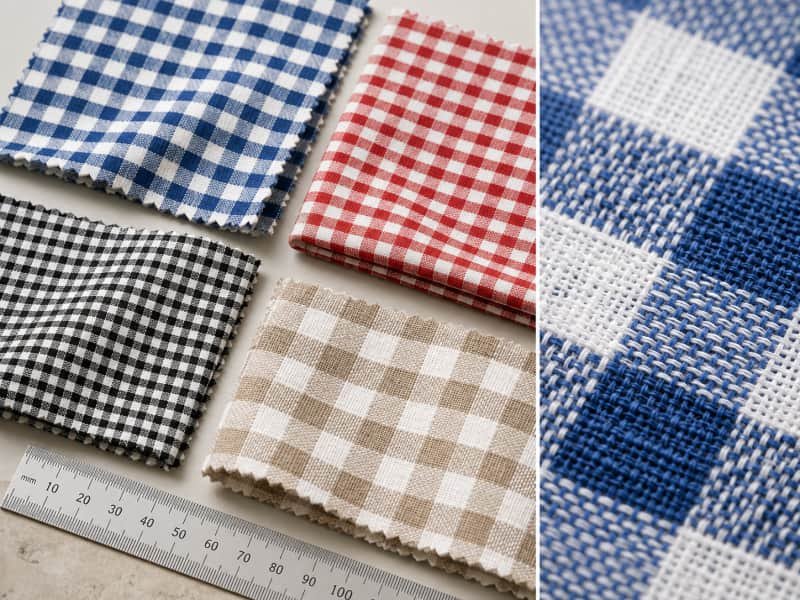
Gingham is one of those fabrics almost everyone recognizes, even when they cannot name it. The neat checks appear on summer dresses, school uniforms, blouses, children’s clothing, resort collections, table linens, and picnic blankets. Yet the familiar appearance can be misleading. Two fabrics may look nearly identical in a product photograph but behave very differently when they are cut, sewn, washed, graded, pressed, and repeated in bulk production.
Gingham is traditionally a plain-woven, yarn-dyed fabric made by crossing white yarns with yarns of another color to create balanced checks. It is commonly made from cotton or cotton blends, although polyester, viscose, linen-blend, stretch, and printed versions are also available. Its real performance depends on fiber, weight, finish, weave density, and construction rather than the check pattern alone.
A blue-and-white swatch may look perfect on a sourcing table, but the same fabric can become transparent across a fitted bodice, curve around princess seams, or lose several centimeters of length after washing. A small mismatch at the waist may then become the first detail a customer notices. Understanding gingham means looking past the squares and seeing how color, structure, scale, fit, and production decisions work together.
What Is Gingham Fabric?
Gingham is a woven fabric recognized by evenly repeated checks, traditionally created with dyed yarns rather than surface printing. Most classic versions use a plain weave with white yarns crossing yarns of one other color. Modern gingham may use cotton, polyester, viscose, linen blends, or elastane, so its appearance alone does not determine its quality, drape, comfort, or suitability for a garment.
Fabric or Pattern?
Gingham originally referred to a woven cloth, but today it can describe both the material and the familiar balanced check. That double meaning causes practical confusion. A designer may say ‘pink gingham’ while thinking only about appearance, while a fabric supplier may assume a yarn-dyed cotton construction. Both interpretations can be reasonable, but they do not always lead to the same garment.
Traditional gingham is produced by arranging colored and white yarns in repeated sequences in both the warp and weft. Where the colored yarns cross white yarns, the pattern shows the main color; where colored yarns cross each other, the intersection appears darker. This creates a three-tone optical effect from only two yarn colors, which is one of the clearest signs of authentic woven gingham.
Printed gingham can look almost identical from the face side, especially in online photographs. The reverse side may be much lighter, however, and the fabric’s behavior comes from the base cloth rather than from the check itself. A printed viscose check may drape softly, while a yarn-dyed cotton check may hold puff sleeves and gathered skirts. A production-ready brief should therefore state composition, finished weight, check size, width, stretch, opacity, finish, color standard, and whether the check must be woven or printed.
How Gingham Is Woven
Most traditional gingham uses a plain weave, in which each weft yarn passes alternately over and under each warp yarn. This basic structure creates a stable surface, clear grain lines, and an orderly grid. The checks are formed by controlling the number and spacing of white and colored yarns, not by adding a pattern after the cloth has already been woven.
A nominal 10-millimeter check is not guaranteed to remain exactly 10 millimeters after finishing. Washing, heat setting, calendaring, resin treatment, and mechanical relaxation can alter the repeat. Unequal shrinkage between warp and weft may turn a square into a slight rectangle, while bowing or skew can make horizontal lines curve across the width. These changes are easy to notice after the fabric is cut into straight garment panels.
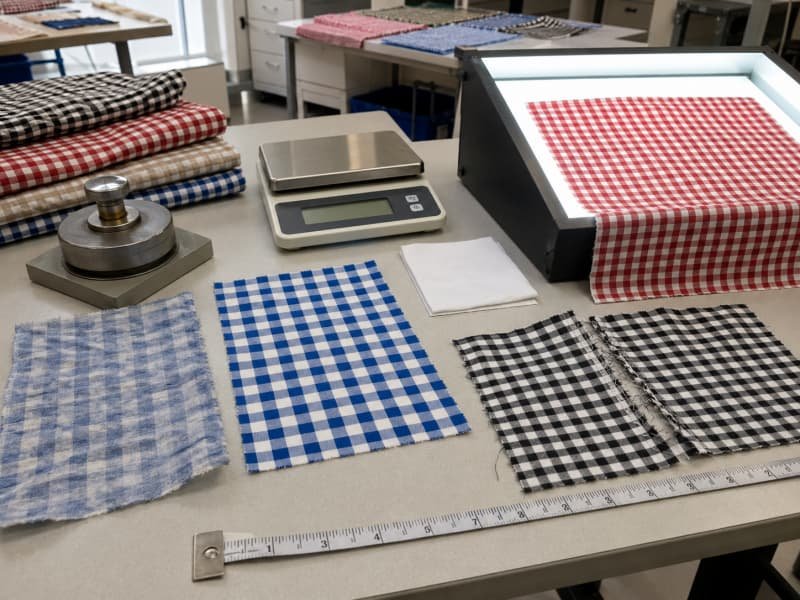
Finished fabric should be measured only after all dyeing and finishing stages are complete. Development teams commonly review horizontal and vertical repeat, finished width, weight per square meter, bow, skew, warp and weft shrinkage, color consistency, grain stability, and reverse-side appearance. These details influence marker planning, pocket placement, placket balance, seam matching, grading, and the amount of fabric needed for each garment.
Common Fiber Options
Cotton remains the fiber most closely associated with gingham because it is breathable, comfortable, easy to dye, and adaptable to different finishes. Crisp cotton can support collars, puff sleeves, gathered skirts, and bows, while washed cotton can feel softer and more relaxed. The same visual check can also be built on blended or synthetic bases when the product needs better stability, stretch, drape, or easier care.
Cotton-polyester blends are often chosen for wrinkle recovery and dimensional stability, especially in uniforms and frequently washed garments. Viscose blends create more fluid movement but may need closer control of shrinkage, seam slippage, and growth. Linen-cotton offers a dry, breathable character and natural surface variation. Stretch gingham can improve comfort in fitted styles, provided the checks remain reasonably square and the fabric returns to shape after wear.
| Construction | Typical Character | Practical Strengths | Common Risks |
| 100% cotton | Crisp to softly washed | Breathable, natural hand, easy to sew | Wrinkling, shrinkage, possible transparency |
| Cotton-polyester | Stable and practical | Better crease recovery and easier care | Less natural feel and possible heat retention |
| Cotton-elastane | Stable with controlled stretch | Comfort in fitted silhouettes | Check distortion and weak recovery if poorly engineered |
| Viscose blend | Fluid and soft | Good drape and movement | Shrinkage, seam slippage, and growth |
| Linen-cotton | Dry and textured | Breathable, premium summer character | Wrinkling, slubs, and variable surface |
| Polyester | Smooth and dimensionally stable | Durable, print-friendly, quick drying | Lower breathability and synthetic touch |
| Printed base fabric | Depends on selected base cloth | Flexible colors, scales, and hand feel | Print misregistration and pale reverse side |
The Meaning of the Check
Gingham has carried several identities over time. It has been linked with school uniforms, practical clothing, children’s wear, domestic textiles, picnic settings, rural imagery, and warm-weather fashion. Designers continue to reinterpret those associations through fitted minis, romantic blouses, corset-inspired dresses, coordinated sets, resortwear, and clean contemporary tailoring. The pattern feels familiar, but the final garment does not have to feel nostalgic.
Scale changes the message. A two-millimeter check can look almost like texture from a normal viewing distance, while a ten-millimeter check reads clearly as gingham without dominating the body. A forty-millimeter repeat becomes a graphic design element and makes every seam placement more visible. Color matters just as much: pale blue often feels fresh, red can feel energetic or retro, black and white can look sharp, and brown or olive can move the check into transitional seasons.
The most convincing use of gingham comes from aligning the pattern with the garment’s silhouette and brand mood. A loose cotton sundress, a fitted stretch mini, and a structured black-and-white midi may share the same basic grid yet communicate completely different ideas. The cloth does not dictate one aesthetic. Its final character comes from the relationship between fiber, drape, check scale, color, fit, proportion, and styling.
What Are the Properties of Gingham?
Gingham is usually stable, breathable, easy to cut, and visually structured, but its actual performance depends on fiber content, weave density, weight, and finish. Cotton versions may wrinkle and shrink, polyester blends are generally more stable, and viscose blends provide softer drape. Opacity, colorfastness, seam strength, dimensional change, and check distortion should always be tested on the selected fabric.
Breathability and Comfort
Cotton gingham is widely used for warm-weather clothing because cotton absorbs moisture and allows air to move through the fabric. Lightweight constructions can feel cool and dry in loose dresses, blouses, skirts, and children’s garments. Still, breathability comes from the fiber, yarn, density, finish, and garment design. The fact that a fabric has checks does not make it cool or comfortable by itself.
A tightly woven polyester gingham may feel warmer than a lightweight cotton version, while heavy resin finishes can reduce airflow. Lining also changes the result. A breathable shell fully lined with dense polyester may feel less comfortable than an unlined medium-weight cotton. For many summer dresses, approximately 90-140 GSM is a useful development range, but the number is only a starting point because weave compactness and finishing can make two fabrics at the same weight behave very differently.
Comfort should be evaluated as a complete garment system. Bodice layers, foam cups, fusible interlining, boning, elastic, and lining can all increase heat and stiffness. When coverage is needed, partial lining, a lightweight separate slip, or double-layer construction only in critical areas may preserve airflow better than fully lining the entire dress. Wear trials should include sitting, walking, raising the arms, and exposure to daylight, not just a brief fitting in an air-conditioned sample room.
Shrinkage and Wrinkling
Cotton gingham can shrink because fibers and yarns relax after washing. The result depends on yarn preparation, weaving tension, pre-shrinking, finishing, and the care method. As a cautious working reference, untreated or lightly stabilized cotton fabrics may show roughly 2-5% dimensional change, but the actual fabric lot must be tested. A small percentage can create a visible difference in a finished dress.
A 120-centimeter dress that loses 3% in length becomes approximately 3.6 centimeters shorter. That change can move a midi hem above the intended point, alter the relationship between bodice and skirt, and create complaints even when the garment still technically fits. Warp and weft must be measured separately because unequal shrinkage can distort the checks, twist side seams, or cause a waist seam to lose alignment after laundering.
Wrinkling is also a design and positioning decision. Pure cotton usually creases more readily than cotton-polyester, but many customers prefer its natural hand and breathable feel. Linen blends wrinkle more visibly, and that may be accepted as part of their character. Polyester blends recover faster but can feel less natural. A useful wash review checks dimensions, check shape, seam puckering, surface texture, color change, skew, pressing recovery, and hand feel after the exact care process intended for the label.
Strength and Wear
Gingham can be durable enough for everyday dresses, shirts, uniforms, and children’s wear, but the visible grid does not reveal the fabric’s strength. Yarn quality, density, fiber length, finishing, and seam construction determine how the cloth responds to pulling, rubbing, repeated washing, and body movement. A lightweight fabric may perform well in a loose sundress but fail around fitted hips or narrow seam allowances.
Loosely woven viscose gingham can suffer from seam slippage, where yarns move away from the stitch line under tension. Stretch gingham may bag at the seat, waist, or elbows when recovery is weak. Dark colored yarns can transfer onto pale linings or labels if rubbing fastness is poor. Large, open checks also make surface distortion more obvious because the eye can immediately see when the grid has lost its shape.
| Property | Useful Development Check | Why It Matters |
| Dimensional stability | Wash or dry-clean test to the intended care method | Controls finished measurements and check shape |
| Seam slippage | Test at fitted or high-stress seams | Reduces yarn separation near bust, hips, and zippers |
| Tear strength | Assess lightweight and loosely woven fabrics | Important around slits, pockets, and notches |
| Tensile strength | Evaluate pulling resistance | Relevant to fitted bodices and narrow panels |
| Colorfastness | Wash, perspiration, dry and wet rubbing | Limits transfer, fading, and color contamination |
| Recovery | Stretch and relaxation assessment | Prevents bagging and distorted checks |
| Pilling | Surface abrasion evaluation | Important for blends and frequently worn garments |
| Bow and skew | Measure grid alignment across fabric width | Prevents twisted or visibly uneven garments |
Care and Maintenance
Many cotton gingham garments can be machine washed, but the final care instruction should be based on the complete garment rather than on the shell fabric alone. Linings, fusible materials, elastics, cups, boning, embroidery, zippers, and decorative trims may respond differently to water, heat, and agitation. A safe instruction for the fabric can still damage the finished dress if the internal components were not tested together.
Cool or moderate-temperature washing is commonly suitable for stable cotton gingham. Strong bleaching should be avoided unless colorfastness has been confirmed, particularly when dark yarns are combined with white. Tumble drying may create more shrinkage and wrinkling than line drying, so a brand expecting customers to use a dryer should test that condition. Ironing temperature must follow the most heat-sensitive component, not simply the cotton shell.
Care expectations should also match the product. A casual summer dress labeled dry clean only may frustrate customers who expect simple maintenance, while a structured corset dress with internal support may justify more restrictive instructions. Repeated-cycle testing can be more revealing than a single wash because color loss, surface change, bubbling, twisting, or check distortion often becomes clearer after three or five cycles. The best label protects the garment without ignoring how people are likely to wear and clean it.
How Is Gingham Different from Other Checks?
Gingham normally features evenly sized checks formed by equal-width stripes, usually in white and one additional color. Plaid often uses several colors and varied stripe widths, buffalo check is typically larger and bolder, and checkered fabric is a broad category. Traditional gingham is yarn-dyed, while printed gingham reproduces the same appearance on the surface of another base fabric.

Gingham and Plaid
Gingham and plaid both use intersecting horizontal and vertical lines, but their visual logic is different. Gingham is usually balanced and repetitive, with equal stripe widths, regular squares, and a limited palette that often combines white with one color. Plaid tends to be more layered, using several colors, uneven stripe widths, fine accent lines, and more complex spacing within the repeat.
The distinction influences garment design. Gingham creates a clean grid that makes symmetry and seam alignment easy to judge. Plaid can feel richer, more traditional, heavier, or more directional because the eye follows bands rather than equal squares. Tartan is a historically specific form of plaid with established setts and color arrangements, although fashion retailers may use the words plaid, tartan, and check more loosely.
Naming alone is not reliable enough for production. One supplier may call a simple two-color grid plaid, while another markets the same pattern as gingham. An approved swatch, repeat measurement, digital artwork, color standard, and placement reference prevent misunderstandings. The specification should also state whether the center front must sit on a stripe or a square, whether left and right panels must mirror, and whether key seams need exact matching.
Gingham and Checkered Fabric
Checkered fabric is a broad visual family rather than one specific construction. It can include gingham, buffalo check, windowpane, graph check, shepherd’s check, checkerboard prints, houndstooth, and many other grid-based designs. Some are woven, some are printed, some use twill or jacquard structures, and some are knitted. The word check describes the appearance more than the engineering of the cloth.
A simple checkerboard often uses alternating solid blocks. Traditional woven gingham creates a more layered effect because colored warp and weft yarns overlap. The intersections appear deeper, and the edges show the texture of actual yarn crossings rather than a completely flat printed boundary. From a distance the patterns can look similar, but close inspection reveals different reverse sides, color penetration, drape, and surface character.
This difference matters when the intended product depends on authenticity or hand feel. A printed checkerboard may suit a sharp, graphic mini dress, while a yarn-dyed cotton check may better support a soft summer story. A photograph is not enough to define the fabric because camera distance can distort scale. Useful communication combines the image with the horizontal and vertical repeat in millimeters, composition, finished weight, width, and approved hand-feel sample.
| Pattern | Typical Structure | Common Color Use | Visual Character |
| Gingham | Equal crossing stripes forming balanced checks | Usually white plus one color | Clean, regular, and familiar |
| Plaid | Multiple crossing stripes with varied widths | Often three or more colors | Layered, complex, and heritage-led |
| Buffalo check | Large bold two-color blocks | Often dark plus bright color | Strong, rustic, and graphic |
| Checkerboard | Alternating solid squares | Usually two colors | Flat, high-contrast, and geometric |
| Windowpane | Thin lines forming large open squares | One line color on a plain ground | Minimal and tailored |
| Shepherd’s check | Small broken checks, often twill-based | Black-white or muted colors | Textured and classic |
| Houndstooth | Broken pointed check structure | Traditionally black and white | Sharp, directional, and formal |
Gingham and Buffalo Check
Buffalo check is closely related to gingham in appearance but is usually larger, bolder, and more strongly contrasted. Traditional examples are often red and black, although contemporary versions use cream, navy, green, brown, pink, and many other combinations. There is no universal millimeter boundary separating large gingham from buffalo check, so the measured repeat is more useful than the product name.
Large checks create stronger production challenges. A small mismatch in a five-millimeter pattern may be difficult to notice, while the same cutting error in a forty-millimeter repeat can disrupt the entire front of a dress. Larger repeats also reduce marker flexibility because pattern pieces must be placed according to the grid rather than arranged only for fabric efficiency. Symmetry between left and right pieces can raise consumption further.
For an oversized check, the product team should decide where the center front sits, whether the waist seam must align, how darts interrupt the grid, whether pockets mirror, how sleeves relate to the bodice, and how placement changes across graded sizes. Buffalo-style checks often work well for overshirts, jackets, winter dresses, and bold casual garments. Smaller gingham is generally easier to use in detailed bodices, ruffles, fitted panels, and lightweight summer silhouettes.
Printed and Yarn-Dyed Checks
Yarn-dyed gingham is created from colored yarns before weaving, so the design is integrated into the fabric structure. Printed gingham applies the check after the base cloth has been produced. The face sides can look similar, but the reverse side, color penetration, drape, lead time, cost, minimum quantity, and available fiber choices may differ considerably.
Yarn-dyed gingham often shows a usable pattern on both sides, which helps with ruffles, unlined collars, ties, turn-back cuffs, and other details that reveal the reverse during movement. Printed gingham offers wider flexibility because the base can be viscose, polyester crepe, stretch woven, jersey, or another material that would be difficult to weave as a traditional balanced check. It can also support more complex color combinations and custom scales.
Neither option is automatically superior. Printed fabric must be checked for registration, penetration, edge sharpness, skew, and colorfastness. Yarn-dyed fabric must be checked for weave consistency, bow, skew, yarn variation, and finishing distortion. A stable printed viscose may perform better in a flowing bias-cut dress than a crisp yarn-dyed cotton, while the woven cotton may be the stronger choice for a puff-sleeve sundress. The garment’s intended behavior should lead the decision.
What Is Gingham Used For?
Gingham is used for dresses, shirts, blouses, skirts, children’s clothing, uniforms, sleepwear, matching sets, accessories, table linens, curtains, quilting, and craft products. Lightweight cotton suits warm-weather garments, while softer viscose, structured blends, stretch versions, and heavier constructions allow the pattern to work across fitted, fluid, tailored, casual, and transitional-season designs.

Fashion Applications
Dresses are one of gingham’s strongest fashion applications because the check creates immediate visual identity without requiring a complex print. Crisp cotton works well for puff sleeves, gathered skirts, collars, bows, peplums, tiered shapes, and fit-and-flare dresses. Softer cotton or viscose blends suit wrap dresses, relaxed midi styles, fluid skirts, and garments that need more movement.
The pattern can also be manipulated rather than simply matched. Bias-cut panels rotate squares into diamonds. Gathers compress the checks and deepen the color visually. Pleats hide and reveal parts of the repeat, while contrasting check scales can separate a bodice from a skirt or create a directional trim. These techniques can make a familiar fabric feel original, but they need to be tested on a sample because the grid exaggerates unevenness.
Common applications include sundresses, babydoll dresses, mini and midi dresses, shirt dresses, crop tops, blouses, skirts, two-piece sets, children’s wear, casual trousers, and lightweight outer shirts. Gingham is less successful when chosen only for appearance. A stiff cloth used for a flowing design can look bulky, while an overly soft cloth may collapse in a neckline or puff sleeve that needs support. The pattern attracts attention, but the base fabric still determines whether the garment works.
Summer Dresses
Gingham is strongly associated with summer because many versions are made from cotton, linen blends, or lightweight viscose. Pale colors and open silhouettes reinforce the warm-weather feeling, but summer suitability depends on more than a fresh appearance. The fabric must provide enough airflow, coverage, stability, and wash performance for the way the dress will actually be worn.
Many lightweight summer dress fabrics fall around 90-150 GSM. Fabrics below this range can work for layered designs, but white-dominant checks may become transparent under daylight or body tension. A swatch that looks opaque on a table can show undergarments when stretched across the bust or hips. Targeted solutions include lining only the bodice, using a lightweight skirt layer, adding a separate slip, or selecting a slightly denser shell rather than automatically adding a heavy full lining.
Summer garments are often washed more frequently than occasion pieces, so shrinkage, colorfastness, seam strength, and shape retention deserve special attention. Straps, underarms, necklines, and waist seams should remain comfortable after repeated wear. A well-developed gingham summer dress should deliver four things together: visual freshness, breathable comfort, suitable coverage, and stable appearance after washing. Sacrificing any one of those can turn an attractive sample into a disappointing retail product.
Dress Silhouettes
Small checks are useful for detailed bodices and garments with many seams because minor mismatches are less obvious. Medium checks create a clear gingham identity without overpowering the silhouette. Large checks offer stronger visual impact but make every seam, dart, pocket, and panel decision easier to see. The scale should be chosen together with the garment’s fit, size range, construction, and expected photography distance.
Fitted dresses need stable stretch, good recovery, and enough density to prevent seam opening. Corset-inspired styles need structural support from lining, underlining, cups, boning, or interfacing rather than expecting the gingham shell to provide all the shape. Gathered and tiered dresses can use lighter cloth, but multiple gathered seams may become bulky. Bias-cut gingham can look elegant, although panels may grow during sewing and hanging and should be allowed to relax before hemming.
The grid changes how the eye reads the body. Horizontal bands may emphasize width across the bust or hips, while a centered vertical alignment can lengthen the torso. Poorly placed intersections can make one side appear higher or broader than the other. For an extended size range, the placement should be reviewed in more than the base size because grading changes panel width, seam position, and the relationship between the repeat and the body.
Home and Craft Uses
Gingham is also used for tablecloths, napkins, curtains, cushion covers, quilts, aprons, picnic blankets, tote bags, basket linings, gift packaging, and decorative crafts. These products need different performance priorities from clothing. A tablecloth may require stain resistance and wide fabric, a curtain needs stable hanging behavior, and a quilt depends on square grain, compatible shrinkage, and consistent color across several fabrics.
Its long domestic history explains why the pattern feels immediately familiar. Red-and-white checks may suggest picnics or kitchens, while pale blue or pink can feel nostalgic and romantic. Fashion can either embrace those associations or deliberately change them. A sharply fitted black-and-white mini can look urban and contemporary, while an oversized brown check in a structured jacket can move the pattern into autumn styling.
Familiarity can support commercial appeal, but it also makes mistakes easy to notice. Customers understand instinctively what a regular check should look like, even if they do not know textile terminology. Crooked pockets, twisting lines, poor seam matching, or transparency quickly undermine the impression of quality. Whether the end product is a dress, curtain, or quilt, gingham rewards careful cutting and exposes careless construction.
How Do You Choose Gingham for Dresses?
Choose gingham by matching fiber, finished weight, drape, structure, check size, stretch, opacity, shrinkage, and colorfastness to the intended silhouette. The development team should also define lining, check placement, seam-matching priorities, grading rules, and fabric consumption before bulk production. A color name and reference image alone are not enough for a reliable, production-ready dress specification.

Fiber and Weight
There is no single best gingham weight for every dress. A relaxed sundress, fitted mini, tailored shirt dress, and structured corset style require different combinations of drape, density, recovery, and opacity. Lightweight cotton can feel fresh and breathable, but it may be transparent or weak at stressed seams. Medium-weight cotton blends add stability, while viscose blends provide movement and stretch blends support closer fits.
Weight should be evaluated together with yarn count, weave density, finish, and hand feel. Two fabrics at 130 GSM can behave very differently: one may be crisp and compact, while the other is soft and open. A swatch that feels attractive between the fingers may become too bulky when gathered into several tiers or too weak when shaped over a fitted bust. Draping the fabric on a mannequin gives more useful information than judging it only while flat.
| Finished Weight | Typical Behavior | Suitable Dress Directions | Main Concerns |
| 70-90 GSM | Very light and often sheer | Ruffles, overlays, layered dresses | Transparency, seam strength, handling |
| 90-120 GSM | Lightweight with soft or crisp hand | Sundresses, babydoll dresses, blouses | Shrinkage, coverage, gathering control |
| 120-150 GSM | Balanced dress weight | Shirt dresses, midi dresses, puff sleeves | Check matching and wrinkling |
| 150-180 GSM | More structured and opaque | Fit-and-flare and tailored casual dresses | Bulk and reduced airflow |
| 180-230 GSM | Firm and substantial | Structured minis and transitional styles | Weight, stiffness, seam thickness |
| Above 230 GSM | Heavy for standard summer dresses | Jackets, overshirts, special concepts | Limited drape and higher consumption |
These ranges are practical starting points rather than quality grades. Before approval, compare drape, structure, stretch and recovery, opacity, skin feel, surface appearance, dimensional stability, color performance, and pressing response. The chosen fabric should support the shape without creating unnecessary layers or sewing difficulty. A clear target garment is more useful than asking a supplier for the ‘best gingham’ in the abstract.
Check Size and Proportion
Check scale changes the mood of a dress, the way the body is perceived, and the difficulty of production. Micro checks around 1-3 millimeters can appear almost solid from a distance. Small checks around 4-8 millimeters remain clearly patterned but are forgiving at seams. Medium checks around 9-20 millimeters provide the most recognizable gingham look, while larger repeats above roughly 20 millimeters become a dominant graphic feature.
Large checks demand more deliberate placement. The center front, bust points, waistline, pockets, shoulder seams, and side seams all become more visible. The grid can also change perceived proportion. Wide horizontal bands may emphasize width, while a centered vertical line can lengthen the torso. Poor placement may make the bust or waist appear uneven even when the underlying pattern pieces are symmetrical.
The base size should not be the only size reviewed. Grading changes panel widths, dart positions, and seam locations, so a balanced arrangement in a small sample size may become awkward in a larger size. This is particularly important for fitted silhouettes and oversized repeats. A sensible development process checks the check placement on the body or mannequin, then reviews at least one additional size before bulk production when the pattern scale is visually dominant.
Lining and Structure
Not every gingham dress needs lining. The decision depends on opacity, fit, fabric weight, internal construction, comfort, and the intended product level. White-dominant checks are often more transparent than they appear on a cutting table. Tension across fitted areas can open the weave slightly, and bright studio or outdoor light may reveal more than indoor fitting-room conditions.
Lining can provide coverage, stabilize openings, conceal seam allowances, reduce cling, support cups or boning, and improve the internal finish. It also adds cost, sewing operations, garment weight, and warmth. A relaxed opaque shirt dress may not need lining, while a pale sundress may benefit from a lined bodice and a lightweight skirt layer. A corset-inspired dress usually needs structural lining or underlining regardless of the shell’s opacity.
Partial solutions are often more effective than full lining. The bodice can be lined while the skirt remains unlined, selected front panels can be underlined, or a separate slip can provide coverage without adding layers to every seam. The lining must also be compatible with the shell. Different shrinkage rates can create bubbling or pulling, and stretch gingham needs a lining that moves with it. The decision should be confirmed through a full garment fitting under realistic lighting and after the proposed care test.
Check Matching and Quality
Check matching begins during pattern engineering and costing, not at the sewing machine. Repeat size affects marker efficiency, cutting method, bundling, operator handling, and fabric allowance. Critical locations often include the center front, center back, waist seam, shoulder seam, side seam, patch pockets, plackets, collars, cuffs, and visible skirt panels. The team should define where exact matching creates real visual value.
Requiring perfect alignment at every seam can increase cost without improving the garment meaningfully. A practical approach places the highest priority on center fronts, prominent waist seams, mirrored bodice panels, and visible pockets. Side seams, center backs, collars, and yokes may receive medium priority. Underarm seams, concealed areas, bias panels, and heavily gathered joins may be allowed to break the pattern when matching would add fabric and labor without a noticeable retail benefit.
Large repeats generally reduce fabric utilization because pattern pieces cannot be placed only for maximum marker efficiency. Exact left-right symmetry raises consumption further. The additional amount varies by dress design, fabric width, repeat, and placement standard, so it should be calculated from the actual marker rather than estimated with a generic percentage. Final inspection should check bow, skew, asymmetry, mismatched checks, seam puckering, color variation, transparency, pocket placement, and distortion across fitted areas.
The approved sample should lock more than the visual appearance. It should identify the fabric lot, finished repeat, placement rules, shrinkage result, workmanship standard, lining, trims, measurements, pressing method, packaging, and care instruction. Gingham makes small errors unusually visible, but when material, fit, cutting, and sewing are planned together, it can remain clean and consistent across colors, sizes, repeat orders, and larger production runs.
Gingham looks simple because its geometry is familiar, but successful garments depend on a chain of connected decisions. Yarn-dyed or printed, crisp or fluid, micro check or oversized check, lined or unlined, carefully matched or intentionally disrupted: each choice changes the fit, cost, comfort, appearance, and production method. The most reliable development process begins with the intended silhouette and customer use, then works backward to the right fabric specification and quality plan.
Duolan Apparel supports fashion dress development from fabric sourcing and pattern engineering through sampling, fit review, production preparation, quality control, and repeat manufacturing. To discuss a custom gingham dress, collection, or fabric-development project, send your tech pack, reference garment, artwork, target composition, expected quantity, size range, and delivery plan to duol anapparel for a practical project review.