Skip to content

Heavy Embellishment Support Solutions
Heavy decoration needs more than secure attachment. Duolan develops support strategies that protect silhouette, fit, movement, comfort and bulk repeatability across complex fashion dresses.
- 6 high-risk load zones reviewed: neckline, straps, bust, waist, side seam or zipper, and hem.
- 5 material behaviors checked before support decisions: stretch, recovery, drape, opacity, and structural stability.
- 3 production gates connect development to bulk: sample review, PP or first-piece confirmation, and defined QC checkpoints.
- Support decisions are reviewed against decoration density, silhouette, material behavior, and the intended size range.
Where Heavy Embellishment Usually Starts Causing Garment Failure
Neckline Drop
- Check neckline position before and after decoration.
- Review front-to-back garment balance on a mannequin or fit model.
- Confirm whether lining, tape, boning, or local backing can share the load without making the neckline rigid.
Strap Overload
- Review strap width, attachment point, seam allowance, and reinforcement.
- Check whether internal support can transfer load into the bodice or back structure.
- Test movement, dressing, and hanging behavior before bulk approval.
Asymmetric Twist
- Compare left and right decoration weight and coverage.
- Review shoulder, waist, side seam, and zipper response.
- Check whether placement or density needs a controlled adjustment.
Stretch Loss
- Measure stretch behavior before and after decoration.
- Keep support materials compatible with the required recovery.
- Review graded sizes because the same artwork density can create different tension across XS-XL.
- Compare recovery after repeated stretch so support does not create a permanent rigid zone.
Zipper And Seam Stress
- Reserve clean seam and zipper installation zones.
- Reinforce high-load joins before full decoration release.
- Inspect opening, closing, dressing, and movement after finishing.
- Recheck seam position after the garment has carried its full decorated weight for a controlled period.
Hem Growth And Drag
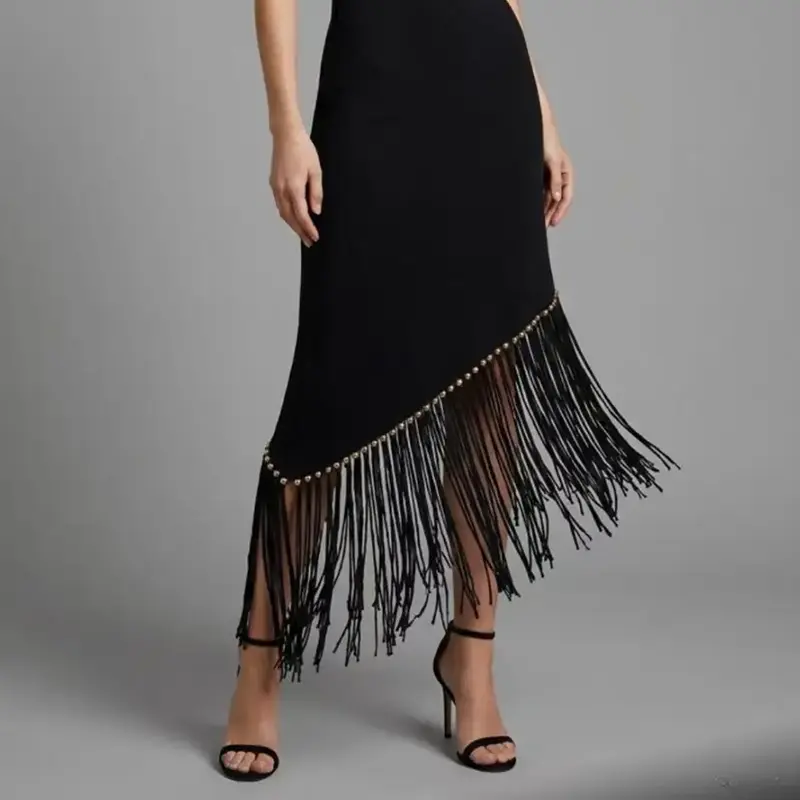
Beaded hems, fringe, metal chain, dense sequin borders, and three-dimensional trims can lengthen soft or bias-cut fabrics after hanging. A skirt may pass measurement when finished and become longer after 24 to 48 hours under its own weight. Heavy lower edges can also change swing, flare, slit behavior, and packing pressure. Hem support therefore depends on fabric behavior as much as decoration attachment.
- Hang-test weight-sensitive skirts before final length approval.
- Review hem reinforcement without destroying movement.
- Recheck finished length after decoration and before packing.
- Confirm slit opening, flare, and walking clearance after the hem has settled under full trim weight.
Engineering The Load Path Before Adding More Reinforcement
Upper-Body Loads Need A Controlled Route Into Stable Structure
The goal is not to make every area stronger. Support should be selective. A soft neckline still needs a clean edge and intended drape. A corset still needs cup placement and boning to follow the body rather than fight the decoration. A backless style may have very few stable zones, so weight has to be redirected into the side body, waist, or concealed support rather than the open back.
A useful development review marks each high-load decoration zone and each available structural route on the same garment diagram. From there, pattern and construction decisions can be tested on a sample before embellishment density is frozen. For brands working with statement dresses, the result is a garment that holds its visual effect without asking one strap, neckline, seam, or zipper to carry more load than its construction can support.
Waist, Side-Seam, And Closure Zones Often Carry More Load Than They Appear To
Support planning therefore separates decoration attachment from garment load management. Around a zipper, the team may need a clean unembellished installation zone, controlled seam allowance, stable backing, and a sequence that prevents stones or beads from forcing the zipper outward. Around the waist, internal tape, lining structure, seam reinforcement, or a structured bodice connection can help distribute lower-garment weight. On asymmetric designs, left-right balance needs to be checked after the full embellishment area is applied, not only on an undecorated toile.
The pattern team also needs to know where stiffness changes. A rigid embellished panel beside a soft panel can pull a side seam off position. A heavy decorative trim attached to a soft waist seam can stretch the seam over time. Load-path review gives sewing, pattern, embellishment, and QC teams one shared map of where stability matters most.
Hem, Fringe, And Bias Areas Need Gravity-Based Review
Lower-garment embellishment creates a different engineering problem because gravity acts continuously. Dense beading, crystal fringe, chain details, heavy sequin borders, and three-dimensional trims can pull soft woven fabric, stretch mesh, bias satin, chiffon layers, or lightweight lace downward. A sample may finish at the correct length and later grow after hanging. Fringe can also change how a slit opens, how a skirt swings, or how a fitted mini returns to shape after movement.
For weight-sensitive hems, development should include a controlled hanging period, finished-length remeasurement, and inspection of the seam or edge carrying the embellishment. Bias-cut garments deserve extra attention because diagonal grain can continue to settle under load. Stretch bases need recovery checks because a decorated hem can become heavier than the knit was designed to carry. Local reinforcement may be useful, but it cannot be so rigid that a fluid skirt loses movement or begins to flare unnaturally.
Packing is part of the same load path. A heavy decorated hem folded under the body can create pressure marks, stone imprinting, or distortion during transit. Protective folds, tissue separation, hanging alternatives, or carton planning may be needed for higher-risk programs. Garment engineering therefore continues until the finished dress can be stored, transported, and worn without the decoration changing the intended silhouette.
Six Heavy Embellishment Families Require Different Support Decisions

Pearls And Beads
Pearls, seed beads, bugle beads, metal beads, and mixed handwork can create substantial weight while leaving the base fabric locally flexible. Risk rises around necklines, cups, waist seams, straps, and hems where concentrated coverage can pull the garment out of balance. Beading plans should define density, reverse-side finish, attachment pattern, repair method, and support under the decorated zone.

Crystals And Rhinestones
Hot-fix stones, sew-on crystals, cup-chain elements, and dense rhinestone artwork can reduce stretch and create rigid islands on mesh, jersey, lace, or satin. Large stones also raise pressure and snagging risk during packing.A stable result needs compatible application temperature, controlled spacing, defined edge clearance, support under high-density zones, and attachment checks after movement or stretch.

Sequins
Sequin fabric and sewn sequin layouts introduce direction, thickness, shedding, seam bulk, and skin-contact issues. Heavy sequin density can add considerable drag to soft bases while seam allowances become difficult to stitch cleanly.
Duolan’s internal module framework treats sequin construction as a production-sensitive system rather than a surface effect.

Fringe And Chain
Beaded fringe, crystal fringe, chain trim, and swinging metal elements add dynamic load. Weight changes during movement as the trim accelerates and stops, so attachment points may experience more stress than static garment weight suggests. Fringe can also lengthen soft hems or distort slit edges.Chain details require secure connection points and enough structural support to avoid pulling soft fabric into peaks or waves.

Three-Dimensional Applique
Flowers, padded motifs, stone clusters, rosettes, sculptural bows, and layered appliques often create uneven weight and stiffness. The base fabric may need support only beneath the motif, while surrounding areas must remain soft. Large three-dimensional elements can also interfere with side seams, armholes, cups, or folding positions.
Attachment should resist rotation as well as downward pull.

Mixed Embellishment
Mixed decoration combines several risk types in one style: beads over lace, crystals on mesh, sequin embroidery beside boning, fringe below a fitted body, or metal hardware connected to a soft panel. The main challenge is interaction. A support method suitable for one decoration can create stiffness, heat, bulk, or seam conflict for another. Development should therefore review the garment as one structure rather than approve each decoration separately.
Match Base Fabric Behavior With The Right Support Strategy
Heavy embellishment changes how a base material behaves. Support selection should protect the intended drape, stretch, surface, transparency, and handfeel while preventing local sagging or distortion. The matrix below frames development decisions before a decorated sample is released.
| Base Material | Main Heavy-Embellishment Risk | Support Direction | Must Remain Intact |
|---|---|---|---|
| Stretch Mesh | Local stretch loss, sagging, stone spacing change, seam pull | Stretch-compatible backing, power mesh zones, reinforced joins | Recovery, transparency, body contour |
| Satin / Crepe Satin | Puckering, visible backing edges, drag, surface marking | Selective underlayer, controlled seam support, clean load transfer | Drape, smooth face, fluid movement |
| Jersey / Bodycon Knit | Rigid decoration zones, negative-ease disruption, recovery loss | Elastic support, compatible thread and backing, placement zoning | Stretch ratio, recovery, fit balance |
| Lace | Weak motif areas, uneven load, transparency change | Local backing aligned with motif and lining plan | Pattern visibility, softness, symmetry |
| Velvet | Surface marking, heat sensitivity, bulk, pile disturbance | Application-specific support with low-pressure handling | Pile direction, color depth, surface finish |
| Structured Woven | Concentrated stress at seams, cups, waist, closure | Bodice reinforcement, seam support, boning or stable lining as needed | Shape, clean edges, fit precision |
Build Support Inside The Dress Without Making It Rigid
Backing And Interlining Should Stabilize A Zone, Not Flatten The Garment
Backing is often the first material considered when decoration becomes heavy, yet backing can create new problems when selected only for strength. A rigid nonwoven layer may stop sagging but also kill stretch, print through satin, create a hard edge under mesh, increase heat, or make a fitted dress feel board-like. Support selection therefore starts with the base fabric and garment silhouette, then narrows the backing choice by required stretch, thickness, transparency, sewing method, and decoration process.
For stretch mesh or jersey, the support layer needs compatible extension and recovery. A non-stretch patch behind a bodycon hip or bust area can create a visible step in tension and change fit across sizes. For satin or crepe, a backing edge can show through the surface under light, especially around curved panels or bust areas. For lace, support should respect motif placement and transparency rather than covering every open area. On structured woven bodices, a firmer underlayer can be useful because the garment already relies on controlled shape.
Local zoning is often more effective than full-panel reinforcement. A crystal cluster may need stabilization only under the motif and along the seam carrying the load. A beaded neckline may need a reinforced edge plus internal connection into the bodice, not a stiff front panel. Sample review should compare face appearance, reverse-side finish, drape, temperature, skin feel, and movement before the backing specification is locked.
Lining, Power Mesh, Boning, Cups, And Elastic Form A Support Network
Heavy embellishment becomes easier to manage when internal layers share different jobs. Lining protects skin, covers thread backs, and can help distribute load, but a soft lining alone may not control a structured bodice. Power mesh can add elastic support to fitted zones without eliminating movement. Boning can stabilize vertical structure in corset or strapless styles, yet boning placement must remain aligned with cup seams, waist shaping, and the direction of the decorative load. Cups define bust volume and support but should not be treated as weight-bearing hardware for decoration placed far outside the cup area.
Internal elastic can help control upper-edge stability, back tension, or waist support. Tape can protect necklines, armholes, waist joins, and seam lines from stretching. Hidden stays or internal straps may redirect load away from delicate decorative straps. Each element should connect logically with the pattern. A support component placed in the wrong direction can create visible pulling, ridges, pressure points, or distortion even when it is technically strong.
For a one-shoulder beaded dress, the working system might combine a reinforced shoulder seam, stable side panel, internal lining connection, waist anchoring, and a graded placement adjustment. For a strapless crystal dress, support may rely more heavily on bodice structure, anti-slip measures, boning, cups, side-seam stability, and closure control.
Reinforced Seams And Closures Must Stay Compatible With Dressing And Movement
Seam reinforcement is most valuable at known stress points. Duolan’s dress-specific QC framework highlights shoulder straps, neck ties, bust support areas, side seams, zipper ends, slit tops, eyelets, lace-up points, and corset boning zones as locations where strength should be checked according to the style. A heavily embellished garment adds another layer of demand because decoration can increase weight while reducing available seam allowance or creating bulky edges.
A zipper needs enough clearance to operate freely, enough seam stability to remain straight, and enough surrounding support to resist the pull of a heavy bodice or skirt. Hook-and-eye closures need secure anchor points. Lace-up backs need eyelets and surrounding fabric strong enough for repeated tension. Slit tops need reinforcement when heavy lower-skirt decoration increases drag during walking. Shoulder seams may require more than additional stitching if the decorated panel itself continues to stretch.
Movement checks are essential. A seam can pass a static inspection and still fail during dressing, sitting, arm lifting, or repeated opening. Sample and PP review should therefore include operation, pull, movement, and visual checks selected for the garment risk. The objective is a stable dress that remains wearable, not a reinforced garment that has become difficult to put on, uncomfortable to move in, or visibly bulky around closures.

Support Strategy Changes With Every High-Risk Dress Silhouette

Corset And Bustier
- Keep high-density embellishment clear of boning and critical cup seams where needed.
- Review local backing so cup shape does not flatten or distort.
- Transfer heavy upper-bodice loads into stable side and waist structure.
- Check left-right symmetry, bust balance, zipper or lace-up function, and PP consistency.

Strapless
A strapless dress has no shoulder strap to share upper-body load. Dense decoration increases demand on the entire bodice support system, including cups, boning, side seams, anti-slip measures, waist control, back closure, and lining.
A neckline can drop even when individual stones remain secure, so visual placement and support cannot be approved separately.
- Review upper-edge position before and after full decoration.
- Confirm anti-slip, internal elastic, boning, cup, and side-seam behavior together.
- Avoid excessive reinforcement that creates a hard or thick neckline.
- Test arm movement, sitting, dressing, and extended wear before production release.

Halter
Halter silhouettes can redirect garment weight toward the neck. Heavy bodice decoration, beaded skirts, or metal trims may increase neck pressure even when the halter strap itself is structurally strong.
The objective is to distribute weight through the bodice, back, waist, and internal structure rather than allowing the halter tie or strap to become the primary suspension point.
- Review neck pressure and strap stretch during movement.
- Use stable side and back structure to share load.
- Keep decoration away from high-friction neck-contact areas when comfort is at risk.
- Check graded strap length and body balance across the size range.

One-Shoulder And Asymmetric
Asymmetric dresses are highly sensitive to unequal decoration weight. A crystal cluster on one shoulder, side beading, or diagonal fringe can rotate the bodice, shift neckline position, or pull the waist off level.
The pattern may need adjustment after the true decorated weight is present because an undecorated fitting cannot reproduce the final load.
- Map left-right decoration weight and coverage.
- Review shoulder attachment, side seam, waist, and opposite-side stability.
- Test the garment after full decoration, not only on a partial swatch.
- Adjust density or placement when support alone cannot correct visual imbalance cleanly.

Bodycon And Stretch
Bodycon styles rely on controlled negative ease and predictable stretch recovery. Dense rhinestones, beads, embroidery, or appliques can create local non-stretch zones that change pressure across bust, waist, and hip.
Support layers must stretch with the garment where movement is required, and artwork may need spacing or density adjustments by size.
- Compare stretch and recovery before and after embellishment.
- Keep backing and thread systems compatible with the base fabric.
- Review artwork scale, spacing, and placement on graded patterns.
- Fit-check the most tension-sensitive sizes rather than relying only on a middle size.

Backless And Cut-Out
Backless and cut-out dresses remove fabric from areas that would normally help carry load. Heavy decoration near the remaining straps, side body, neckline, or waist can overload a narrow connection point. Support must be planned through the stable fabric that remains while protecting open areas from visible backing, bulky seams, or unwanted coverage.
- Identify the few zones capable of carrying load without changing the design.
- Reinforce narrow joins, side panels, waist areas, or concealed internal paths as required.
- Keep support invisible around open edges and transparent sections.
- Test movement safety, edge stability, closure function, and body coverage before approval.
Preserve Fit, Movement, And Grading After Decoration Adds Weight
A decorated garment can fit differently from the same pattern before decoration. Weight, stiffness, reduced stretch, and changed friction alter how the dress sits on the body. Fit review must therefore happen with representative decoration and support already applied.
Fit Review Must Use The Decorated Construction, Not An Undecorated Proxy
Fit comments based on a clean toile are valuable for silhouette and pattern direction, but heavy embellishment introduces forces the toile cannot show. A beaded bust panel may pull the neckline lower. A dense crystal hip zone may reduce stretch and make the side seam rotate forward. A fringe hem may lengthen the skirt after hanging. A one-shoulder cluster may pull the upper body off balance. Each effect can look like a pattern problem even when the root cause is decoration weight or stiffness.
For higher-risk styles, Duolan can separate fit review into two layers: underlying pattern fit and decorated-garment behavior. The pattern team first confirms body proportions, bust-waist-hip balance, neckline position, strap length, closure alignment, and intended ease. Representative decoration and support are then added to the key zones, followed by another fit and movement review. Comments are translated into specific actions such as pattern correction, support adjustment, placement change, backing change, strap reinforcement, or density reduction.
The process helps prevent endless revision cycles where pattern and embellishment teams correct symptoms in opposite directions. It also gives brand product teams a cleaner approval basis. Instead of asking whether a garment “looks close,” the review can identify which elements are already stable and which need a defined correction before PP or bulk planning.
Movement Exposes Support Problems That Static Fittings Can Miss
Heavy embellished dresses are often designed for party, occasion, social-event, performance, or going-out settings where the wearer sits, walks, dances, raises arms, enters vehicles, and moves under warm conditions. A garment can look stable in a front-view fitting and still create neck pressure, underarm abrasion, zipper stress, waist drop, slit strain, or fringe drag during movement.
Movement review should be matched to silhouette. Halter dresses need neck-tension checks. Strapless dresses need upper-edge stability during arm movement. Bodycon dresses need stretch and recovery checks across sitting and walking. Backless and cut-out styles need security checks at narrow joins and open edges. Heavy skirts need waist and hem behavior checks. Three-dimensional decoration needs snagging and body-contact review. Review should also note whether the garment settles differently after several minutes of wear because continuous weight can reveal a problem that is invisible during the first fitting minute.
Comfort also belongs in the technical evaluation. Reverse-side bead threads, stone settings, sequin edges, exposed backing, and reinforced seam allowances can become abrasive when pressed against skin. Lining should protect without creating bulk or visible edges. Any support layer added to solve weight must be assessed for heat and flexibility, especially on fitted or open partywear.
Grading Must Protect Placement And Load Balance Across The Size Range
Heavy embellishment artwork cannot always be copied identically across every size. A fixed crystal cluster that sits correctly on a medium bust may shift toward the armhole on a larger size. Dense beadwork crossing a waist panel may occupy a different percentage of the body on XS versus XL. Stretch loss can also feel more severe where a larger size depends on greater extension from the base fabric.
Grading review should therefore consider both pattern geometry and decoration behavior. Artwork may need controlled scaling, spacing adjustment, repositioning, or boundary rules that preserve the visual concept while keeping load away from critical seams and closures. Corset styles require special care because cup, boning, panel, and embellishment relationships change as the pattern grades. One-shoulder designs need consistent visual balance even as body width and strap geometry change. Bodycon styles need decorated zones to remain compatible with target stretch and recovery.
The most reliable approach is to define decoration anchors relative to graded pattern points rather than rely on one absolute artwork position. PP review can then confirm representative sizes and critical placements before full release. A brand gains a more consistent look across the range and reduces the risk of a detail working only on the sample size.

Validate Support Feasibility Before A Full Sample Is Finished
Start With A Risk Brief, Material Trial, And Support Mock-Up
A useful heavy-embellishment development brief should identify the intended silhouette, decoration type, estimated density, main placement zones, base fabric, lining concept, size range, target wear environment, and any structural elements already required by the design. The team can then flag expected high-load areas, stretch conflicts, transparent zones, closure conflicts, and skin-contact risks before cutting a full sample.
Material trials should reproduce the real build as closely as possible. A crystal test on spare fabric is not enough if the final garment includes power mesh backing, lining, a curved cup seam, or a high-stress strap connection. The trial should help answer whether the base fabric stays flat, whether stretch changes, whether the reverse side is acceptable, whether the attachment method is stable, and whether the support layer shows through. For beading or three-dimensional decoration, a small support mock-up can also reveal how much stiffness and weight the combined layers create.
Duolan’s sampling workflow already emphasizes locking sample purpose, fabric direction, fit priority, and feasibility before development moves forward. Heavy-embellishment projects benefit from the same discipline because a clear early decision saves more time than a fast but structurally wrong first sample. A short trial can also identify whether a full sample should proceed with the original density, a revised support layer, a different attachment route, or a localized artwork change.
Move From Targeted Trial To Decision-Ready Sample In Defined Gates
After early trials, the first full sample should not be treated as a finished visual piece only. It needs to prove the interaction between embellishment, support, pattern, lining, closures, and movement. The review should separate decoration accuracy from structural performance so comments become specific: neckline needs support, shoulder weight needs redistribution, backing edge is visible, hip stretch is reduced, zipper area is too bulky, or hem length changes after hanging.
A revised sample can then incorporate the selected correction path. Higher-risk styles may benefit from a PP or production-basis sample that locks material, support layer, placement map, attachment method, seam clearance, fit points, reverse-side finish, and packing method. Duolan’s company workflow describes staged updates during sampling and a Sample Review Note at delivery so project teams can distinguish what is close to target from what still requires refinement.
The desired outcome is not more sampling. The desired outcome is a sample with enough technical definition to support a commercial decision and a clear route into production. A decision-ready sample should also give sourcing, pattern, sewing, embellishment, and QC teams the same reference so the next stage does not reopen questions already solved during development. Where a risk remains, the review should name the unresolved point and the exact confirmation needed before PP or bulk planning.
Engineer Attachment And Workmanship Around Weight, Friction, And Repair
Hand Beading Needs Controlled Stitch Paths And Protected Reverse Surfaces
Hand-applied pearls, beads, crystals, bugle beads, and mixed decorative elements can create excellent visual depth, but manual work introduces variation in thread tension, spacing, knot security, direction, and reverse-side finish. Dense coverage also increases fabric load, so attachment planning should work with the support layer rather than pull directly against an unstable base.
For high-density areas, stitch paths should avoid creating one long failure chain where a single broken thread releases multiple elements. Thread, knotting method, anchoring frequency, and local backing need to suit the decoration weight and fabric behavior. Large or top-heavy elements may require more than one secure point to resist rotation. Edges near armholes, necklines, under-bust areas, and side seams need a clean reverse surface because rough thread ends or bead backs can become uncomfortable under movement.
Production planning should also include a repair standard. Handwork naturally creates occasional missing, broken, or misaligned elements during handling. A defined method for repair, thread match, acceptable spacing, and final inspection makes the visual result more repeatable. For heavy programs, QC should inspect attachment together with garment balance because a perfectly secure bead field can still be structurally wrong if it drags the fabric out of shape.
Machine Sequin, Hot-Fix, And Sew-On Crystal Methods Need Process-Specific Controls
Machine sequin, sequin embroidery, hot-fix rhinestones, sew-on crystals, cup-chain sections, and heat-applied motifs each create a different production sequence. Heat-applied stones require compatible base materials and controlled temperature, pressure, and dwell time. Stretch fabrics need enough spacing and adhesive flexibility to preserve movement. Sew-on crystals need secure thread paths and sufficient base strength. Machine sequin areas need cutting and seam planning so excess surface bulk does not enter seams, zippers, or edge finishes.
The attachment method should be selected together with support and construction. A dense hot-fix layout on stretch mesh may need a support zone, but the support cannot eliminate required stretch. A sequin panel beside an invisible zipper may need a decoration-free installation margin. A crystal motif across a corset cup needs alignment with curved seams and boning channels. A chain or metal element needs reinforced connection points and enough clearance to move without cutting into soft fabric.
Testing should match risk. Checks may include stretch, recovery, rubbing, handling, controlled pull, opening and closing, wear movement, or specific brand protocols. The purpose is not to run every possible test on every style. The purpose is to identify the likely failure mode and validate the chosen attachment process before production volume increases.
Edge Finishing, Seam Clearance, And Skin Contact Decide Whether The Dress Feels Premium
Many heavily embellished garments fail at the boundaries rather than in the center of the decoration. Necklines, armholes, side seams, zipper edges, slit tops, cups, hems, and underarm zones combine surface decoration with cutting, sewing, turning, binding, lining, or closure installation. If the embellishment enters the seam allowance, the area may become thick, uneven, difficult to stitch, or impossible to press cleanly. If decoration ends abruptly, the edge may feel unfinished or create a visible density line.
A production-ready artwork should therefore include seam and edge rules. Some zones require stones or beads to stop before the stitch line. Others need elements removed and reapplied by hand after sewing. Raised decoration near the underarm may need a softer boundary. A heavily beaded neckline may require lining or binding that covers rough thread backs while preserving the visual edge. Sequin seams often need surface material cleared before sewing, followed by replacement or finishing after assembly.
Premium appearance depends on the reverse side as well. Lining should lie flat, attachment threads should be controlled, support edges should not show through, and internal reinforcement should not create hard ridges. The garment should look intentional from the outside and feel deliberate from the inside.

Turn The Approved Sample Into A Repeatable Bulk Standard
Lock The Inputs That Control Weight And Appearance
Before bulk release, the production basis should identify more than the decorative material name. The BOM needs the relevant bead, crystal, sequin, trim, thread, backing, lining, support material, closure, and structural components. Artwork or placement maps should define orientation, anchor points, density, boundaries, seam clearance, and any size-specific rules. Pattern references should reflect the final support construction rather than an earlier undecorated version.
The approved sample should also define what the decoration is allowed to do to the garment. Neckline position, strap length, bust balance, waist level, side-seam alignment, finished length, and closure behavior are important visual controls. Reverse-side finish, skin-contact protection, and support-edge visibility need clear acceptance criteria. If a hanging period affects length, the measurement timing should be consistent. If a crystal zone reduces stretch, the fit and recovery expectation should be recorded for the relevant sizes.
Duolan’s production-ready sample framework connects fit, fabric, trims, construction, BOM alignment, and PP or golden-sample approval so production and QC work from the same reference. Heavy embellishment adds another layer: the support specification and decoration placement must be equally explicit. Production teams should know which backing belongs to each zone, where reinforcement stops, how decoration relates to seams and closures, and which fit points cannot move after the final surface work is applied.
Confirm First-Piece Or Pilot Behavior Before Full Release
Complex decorated styles benefit from a first-piece or pilot check because material, decoration, support, and construction interact differently at production pace. The first-piece review can verify placement, density, garment balance, seam quality, attachment, lining, closure function, and critical measurements before the full quantity is released. Any issue found at that stage is smaller and easier to correct than the same issue repeated across thousands of units.
Duolan’s manufacturing workflow states that higher-risk styles can use first-piece confirmation, pilot runs, or key-process verification before the full production run. The company specifically identifies bodycon, corset and bustier, halter and backless, satin, sequin, mesh-layered, and fit-sensitive occasion or party dresses as styles where early production verification is valuable.
For heavy embellishment, pilot control should include the decoration process itself. A production line may need a defined sequence for support application, sewing, decoration, lining closure, pressing, inspection, repair, and packing. The sequence should protect stones, beads, sequins, and fabric surfaces while keeping seam quality and measurements stable. A first-piece record should capture any process adjustment made during the trial so the correction becomes part of the production instruction instead of remaining with one operator or sample maker.
Preserve The Standard Through Inline QC, Final Inspection, And Reorders
Bulk control should follow the same risks identified during development. Inline checks can confirm placement, missing pieces, seam and closure quality, garment balance, support position, and critical fit measurements while correction is still possible. Final inspection should review appearance, decoration security, inside finish, sizing, packing, labels, and shipment readiness according to the approved standard and any brand-specific requirements.
Duolan’s quality framework emphasizes bulk key-point locking, first-piece or pilot validation, in-process control, final appearance and measurement checks, packing verification, and batch consistency. The same records become valuable for repeat orders because patterns, BOM details, placement references, support specifications, issue notes, and QC checkpoints can be carried forward rather than reconstructed from memory.
A repeatable system is especially important for fashion programs with multiple embellished styles. One good sample proves development skill. Stable repeat production proves whether the technical decisions were translated into a manufacturing standard. Reorder records should preserve approved pattern versions, support materials, artwork references, known stress points, repair rules, and packing notes so later color extensions or repeat quantities begin from a controlled baseline rather than from memory. When a material or decoration component changes, the new version should be reviewed against the same load, fit, workmanship, and packing checkpoints before it replaces the approved standard.

Representative Heavy Embellishment Program From Development To Bulk
Challenge: 18 Styles Shared Visual Language But Different Load Behavior
Development: Three Approval Levels Locked Support Before Volume Increased
Bulk Control: 46,800 Pieces Needed Repeatability, Not Sample-Room Craftsmanship Alone
Bulk planning translated the approved development work into production instructions. Each style carried an approved material basis, pattern reference, placement information, support requirement, attachment method, reverse-side standard, and critical QC points. Production lines did not receive a visual sample alone. The highest-risk styles used first-piece review before full release, and inline checks focused on the failure modes identified during development. For rhinestone and bead styles, inspection covered placement, missing or loose elements, backing visibility, reverse-side finish, garment balance, and closure clearance. For structured dresses, cup, boning, waist, and zipper alignment remained part of the control standard. For stretch styles, fit and recovery mattered as much as flat measurements. For fringe, finished length and movement were rechecked after the garment had settled. Packing methods were adjusted where raised surfaces or heavy lower trims could create pressure in cartons. A program at 46,800 pieces does not become reliable because every operator works more carefully. Reliability comes from reducing interpretation. The same approved support logic must be visible in patterns, materials, workmanship notes, PP references, inline checks, final inspection, and packing. That operating discipline is the difference between a strong development sample and a collection that can be reproduced at commercial scale.

QC Heavy Embellishment At The Stress Points That Matter
Inspection should follow the known failure routes of the garment. Duolan separates decoration appearance from structural, fit, comfort, and packing checks so a style is not approved simply because the beads, crystals, or sequins look complete under static inspection.
Upper Edge Stability
Necklines, shoulder straps, halter ties, cups, and upper-back joins are checked for position, symmetry, attachment, and load response. Dense decoration can lower an edge or stretch a strap even when no visible defect appears in the embellishment itself. Review should compare finished position with the approved sample and confirm movement does not create unexpected drop or rotation.
- Neckline height and left-right balance
- Strap length and attachment stability
- Bust support and cup position
- Decoration clearance around edges and seams
- Movement response after arm lifting, sitting, and repeated dressing
Waist And Side Balance
Waist seams, side seams, darts, curved panels, and fitted body zones can move when decoration creates unequal stiffness or weight. Inspection should check whether seams remain in the intended position and whether internal support continues to lie flat. For asymmetric designs, left-right balance deserves specific attention after the garment has hung and after movement review.
- Waist level and seam alignment
- Side-seam rotation
- Support edge visibility
- Body contour against the approved fit standard
- Left-right balance after hanging under full decoration weight
Zipper And Closure Function
Invisible zippers, center-back zippers, hook-and-eye closures, lace-up backs, and metal closures need enough clearance from decoration to operate smoothly. Heavy skirts or bodices can also pull closures out of line. Dense decoration may increase local thickness, so seam allowance and hardware clearance need to remain visible in the inspection standard. QC should inspect opening, closing, seam flatness, reinforcement, and the relationship between decoration and closure hardware.
- Smooth opening and closing
- No stone or bead obstruction
- Straight zipper line without pulling
- Secure end and surrounding seam support
- No pressure ridge where decoration meets the closure zone
Decoration Security
Missing elements are only one defect category. QC also needs to review loose attachment, uneven density, misaligned artwork, color mismatch, twisted fringe, damaged stones, rough backs, or elements that rotate in wear. Inspection method can include visual comparison, handling, controlled pull, movement, or brand-specified testing based on risk.
- Placement, density, symmetry, and orientation
- Attachment condition and repair quality
- Reverse-side thread and backing finish
- Loose, sharp, cracked, or damaged elements
- No visible dragging, puckering, or local distortion around dense clusters

Stretch And Recovery
On mesh, jersey, bodycon knit, and stretch lace, decoration can reduce extension and recovery. The decorated garment should be checked against the intended fit rather than only the flat measurement. High-density zones at bust, waist, or hip are priority areas because tension differences can alter seam position and comfort. Recovery should be compared after repeated movement, not only after one manual stretch.
- Stretch behavior at decorated zones
- Recovery after movement
- No local buckling or rigid ridges
- Size-specific fit consistency
- Seam position remains stable after repeated extension and release
Comfort And Skin Contact
A garment can pass appearance inspection and still create abrasion. Underarm areas, necklines, bust edges, side seams, halter straps, and tight body zones need attention where beads, sequin edges, threads, backing, or support layers contact skin. Lining should protect the wearer without exposing raw edges or creating excessive thickness. High-friction zones should also be checked after movement because abrasion may appear only when the garment shifts against the body.
- No sharp edges at contact zones
- Lining covers rough reverse surfaces
- Reinforcement remains flexible enough for movement
- No concentrated pressure from raised trims
- Underarm, neckline, bust edge, and halter contact areas stay smooth during wear
Hem And Hanging Behavior
Heavy hems, fringe, chain, and beaded borders need measurement after representative hanging because soft fabrics may settle. QC should also check movement, slit behavior, trim alignment, and whether weight has created waves or uneven length around the skirt. Bias and stretch bases may need a defined settling period before final measurement is recorded.
- Finished length after required hanging period
- Even hem or intended asymmetry
- Fringe and chain alignment
- No drag-induced seam distortion
- Slit opening and walking clearance remain consistent with the approved sample
- Hem support does not create an unintended flare or stiff edge
Packing Protection
Raised stones, pearls, crystals, sequins, and sculptural details can be damaged after final inspection if folding and carton pressure are not controlled. Packing QC should confirm the approved fold, protective layers, separation, garment orientation, and carton loading method for high-risk styles. Packed-unit rechecks can confirm that protection still works after compression and handling.
- No direct pressure on raised decoration
- Protection against snagging and abrasion
- Stable fold without permanent creasing
- Carton loading compatible with garment weight
- Protective layers stay in place through warehouse handling
- Random packed units are rechecked after carton-close trials
Protect Raised Decoration Through Packing, Storage, And Shipment

Pressure Protection

Snag And Abrasion Control

Weight And Carton Planning
Heavy embellished garments can push carton weight higher than expected and create pressure on units at the bottom of the stack. Carton quantity, orientation, fold, and protective materials should be reviewed together. Structured bodices, fringe hems, and raised motifs may need more volume per garment than a basic dress. Shipment preparation therefore needs to consider garment weight, surface fragility, carton loading, destination handling, and whether split packing or special presentation is required for a specific retail program.
Keep Heavy Embellishment Commercially Workable Without Diluting The Design
Cost Follows Real Work Content
Heavy embellishment cost rises with material value, number of attachment points, hand time, support layers, placement precision, reverse-side finishing, repair allowance, and inspection intensity. A dense crystal bodice with graded placement and structured support is a different manufacturing task from a lightly scattered stone design.
Cost review should therefore identify which features are non-negotiable for the visual concept and which can be simplified without weakening the product.
- Protect the hero visual zones first.
- Avoid hidden complexity with little consumer-visible value.
- Review support and lining as product requirements, not optional add-ons.
Lead Time Depends On Sequence
Decoration cannot always be scheduled as one final step. Some styles require support preparation before sewing, partial decoration before assembly, seam clearing, hand replacement after closing seams, repair, final inspection, and protected packing. Sampling may also require more than one trial when weight changes fit or support. Timeline planning should therefore reflect material sourcing, craft sample, garment sample, revision, PP confirmation, bulk decoration, inspection, and shipment rather than using a basic dress calendar.
- Lock decoration materials early when supply is specialized.
- Reserve time for fit review after representative decoration is applied.
- Use first-piece or pilot checks for higher-risk construction.
Scale Requires Repeatable Instructions
A complex embellished program becomes commercially workable when design intent is translated into repeatable instructions. Placement anchors, density, seam clearance, support materials, thread, reverse finish, repair rules, grading, QC points, and packing method should be clear enough for production teams to follow without relying on one sample maker’s memory. Duolan’s project approach links development records with production planning so multi-style programs can move from approval into controlled execution.
- Build a production basis from the approved sample.
- Define repeatable checkpoints before volume increases.
- Preserve records for repeat orders and color extensions.
Manufacturing Resources Behind Complex Embellishment Dress Programs
Heavy embellishment needs coordinated sampling, pattern, sourcing, sewing, special-process, QC, and production planning resources. Duolan operates within a dress-focused manufacturing network designed for multi-style development and bulk execution rather than relying on one isolated craft workshop.
Dress-Focused Manufacturing Network
Duolan’s documented manufacturing structure includes 16 self-owned womenswear factories and more than 20 long-term satellite factories. The network is organized to keep core styles and priority projects under direct control while adding coordinated capacity for repeat orders, multi-style programs, seasonal peaks, and different process requirements. For heavy embellishment, project routing still depends on the final mix of sewing complexity, handwork, special processes, inspection intensity, and delivery timing.
Multi-Line Production Planning
The documented production base includes 300 sewing lines and more than 50 flexible or quick-response lines across the wider manufacturing system.
For complex embellishment, line allocation still depends on garment construction, handwork level, special-process routing, quantity, and delivery schedule rather than treating every line as interchangeable. A structured crystal corset, for example, requires a different routing plan from a stretch-mesh rhinestone dress or a hand-beaded fringe style.
Embellishment Development Experience
Duolan’s company records describe long-term development experience with pearl dresses, beadwork, rhinestone applications, and mixed decorative processes. The stated development logic connects silhouette, fabric compatibility, decoration density, visual effect, wear performance, and bulk feasibility instead of treating decoration as a surface-only step. Support decisions are therefore reviewed together with the garment structure rather than after the decorative technique has already been locked.
Special-Process Coordination
The manufacturing system works with long-term supporting resources for fabrics, trims, accessories, and special processes, including print, dye effects, embroidery, washing, and other decoration-related production. Special-process routing is selected according to product direction, craft requirements, and lead-time risk. Complex embellished styles can therefore be planned around the order in which support, sewing, decoration, finishing, inspection, repair, and packing need to happen.
Bulk Quality Control Discipline
Duolan’s documented quality approach emphasizes key-point locking before bulk, first-piece or pilot verification where needed, in-process control, final appearance and measurement checks, packing verification, and batch-consistency awareness. Heavy embellishment uses the same structure with added decoration-specific stress points such as attachment, load balance, reverse-side finish, closure clearance, stretch loss, and packing pressure.
Brand-System Readiness
The manufacturing system has completed SMETA and SMETA 2-Pillar audits and can coordinate brand-specific quality, social responsibility, testing, and product-standard requirements according to the project. Compliance scope is reviewed against the relevant program instead of being treated as a generic marketing claim. Technical approval for embellishment remains separate from audit status, so both product performance and supply-chain requirements can be reviewed on their own evidence.
Evidence Brand Teams Should See Before Approving Complex Decoration

Material And Craft Swatches

Pattern And Load Review
Annotated pattern or mannequin views can show neckline load, strap stress, bust support, side-seam tension, zipper clearance, waist transfer, and hem weight. The purpose is not to reveal confidential design files.
A controlled technical view proves that the development team identifies where decoration affects construction and where reinforcement or placement rules need to be defined.
It also gives pattern, sewing, and craft teams one shared reference before the full sample is assembled.

Sample Revision Evidence

PP And First-Piece Evidence

QC And Repair Records

Packing And Shipment Readiness
Packing photos and trial records should show how raised crystals, pearls, sequins, fringe, and structured areas are protected from pressure and snagging. Final packing evidence becomes especially important for heavy programs because a garment can leave final inspection correctly and still be damaged by folding, compression, or rough surface contact during transit. A carton-close trial or packed-unit recheck can verify that protective layers remain effective under real handling pressure.
How To Evaluate A Heavy Embellishment Support Supplier
A capable supplier should be able to explain where weight enters the garment, how fit changes after decoration, what support material is used, how the approved result is transferred into bulk, and what evidence proves the process. Use the framework below during supplier evaluation.
| Evaluation Area | Strong Supplier Response | Evidence To Request | Red Flag |
|---|---|---|---|
| Weight Mapping | Identifies high-load zones and load transfer paths | Annotated sample, stress map, construction note | Only discusses bead or stone attachment |
| Fabric Compatibility | Explains stretch, recovery, drape, opacity, heat, or surface risk | Decorated fabric trial, backing comparison | Uses one backing method for every fabric |
| Internal Support | Connects lining, boning, tape, mesh, seams, cups, or elastic to a defined function | Inside construction photos, support sample | “Add thicker lining” without fit review |
| Fit And Movement | Reviews decorated garment on body and during movement | Fit photos, comment summary, revision record | Approves fit only on undecorated toile |
| Size Grading | Defines artwork anchors, spacing, and load balance across sizes | Graded placement map, size review | Copies one artwork position across all sizes |
| Attachment | Chooses method by decoration, fabric, placement, and wear risk | Craft swatch, reverse-side detail, repair standard | Focuses only on front appearance |
| Bulk Transfer | Locks BOM, pattern, support, placement, PP, and first-piece standards | PP sample, workmanship note, first-piece record | Sends only one sample to production |
| QC | Inspects decoration plus seam, fit, support, closure, comfort, and packing | QC photos, defect record, inspection points | Generic “100% QC” claim without checkpoints |
| Packing | Plans pressure and snag protection for raised surfaces | Packing trial, carton method | Standard fold regardless of decoration |
| Program Scale | Matches routing and capacity to complexity, quantity, and timeline | Production plan, process routing, audit documents | Treats all embellished styles as one process |
Heavy Embellishment Support Frequently Asked Questions
We review decoration type, density, placement, base fabric, silhouette, stretch, closures, and expected load path. Reinforcement is added only where the garment needs stability. A soft dress may need local backing or seam support, while a corset-led dress may rely on a broader internal system including lining, boning, cups, tape, and reinforced joins.
Yes. Dense stones, beads, embroidery, or appliques can reduce stretch, increase stiffness, change friction, and pull the garment downward or sideways. A decorated bodycon zone can feel tighter than the same fabric without decoration. Fit should be reviewed with representative decoration and support already applied.
We review the weight at the neckline, available structural routes, edge stability, straps, bodice support, waist connection, lining, and local reinforcement. The solution depends on silhouette. Adding a thick backing everywhere may stop movement but can damage drape and comfort, so load-specific support is preferred.
Support should remain compatible with required stretch and recovery. Power mesh, stretch backing, elastic support, localized reinforcement, and placement zoning may be considered depending on the style. Non-stretch support across a high-extension bodycon zone can create a rigid patch and change fit.
Yes. Placement should follow graded pattern anchors rather than one fixed artwork position. Spacing, density, motif scale, seam clearance, and load balance may need controlled adjustment so the visual concept remains consistent while fit and stress points stay appropriate across the size range.
Inspection is selected according to the decoration and garment risk. Checks can include visual review, handling, controlled pull, movement, stretch, rubbing, opening and closing, or brand-specified tests. Attachment is reviewed together with reverse-side finish, fabric stability, seam clearance, and repair quality.
The production basis should include approved pattern, materials, decoration specification, placement map, support materials, lining, attachment method, seam clearance, graded rules, fit points, reverse-side standard, PP or production sample, QC checkpoints, and packing method. Higher-risk styles can add first-piece or pilot confirmation.
We compare left-right load, shoulder attachment, side-seam balance, waist stability, opposite-side support, and pattern behavior after full decoration. Sometimes support corrects the issue. Other designs need a controlled density or placement adjustment because structural reinforcement alone cannot fully compensate for extreme uneven weight.
Packing can use controlled folds, tissue or soft separators, individual protection, surface-facing rules, reduced carton compression, or different garment orientation. The method depends on stone height, fringe, three-dimensional details, structured bodices, garment weight, and destination handling requirements.
Send a tech pack, reference images, current sample photos, decoration artwork, base-fabric direction, size range, estimated quantity, target launch date, and any known issue such as neckline drop, strap pressure, stretch loss, twisting, zipper distortion, loose attachment, or packing damage. Partial information can still support an initial feasibility review.

Send Your Heavy Embellishment Project For Technical Review
Share the information already available for your dress program, and Duolan can review how embellishment weight may affect structure, fit, movement, attachment, grading, bulk production, QC, and packing. A useful starting package can include a tech pack, reference image, current sample photo, embellishment artwork, base-fabric direction, size range, planned quantity, target delivery window, and any known problem areas.
For a stronger first review, include:
- Decoration type, density, and main placement zones
- Base fabric, lining, and existing support construction
- Size range and priority fit size
- Target quantity by style or color
- Current concern: neckline drop, strap load, twisting, stretch loss, zipper stress, hem growth, loose attachment, skin contact, or packing damage
- Sample stage already completed, if any
Duolan will use the available information to identify the main technical risks, suggest the next development step, and clarify which points should be confirmed before sampling or bulk planning. Incomplete files are still workable when the core design direction is visible.